Reflection and Refraction of Electromagnetic Waves
Explore the concepts of reflection and refraction of electromagnetic waves at plane boundaries between homogeneous media, including considerations for wave homogeneity, ray angles, and field amplitudes, along with the application of boundary conditions and the Fresnel's Formulae for complex amplitudes.

Download Presentation

Please find below an Image/Link to download the presentation.
The content on the website is provided AS IS for your information and personal use only. It may not be sold, licensed, or shared on other websites without obtaining consent from the author. If you encounter any issues during the download, it is possible that the publisher has removed the file from their server.
You are allowed to download the files provided on this website for personal or commercial use, subject to the condition that they are used lawfully. All files are the property of their respective owners.
The content on the website is provided AS IS for your information and personal use only. It may not be sold, licensed, or shared on other websites without obtaining consent from the author.
E N D
Presentation Transcript
Reflection and Refraction of Electromagnetic Waves Section 86
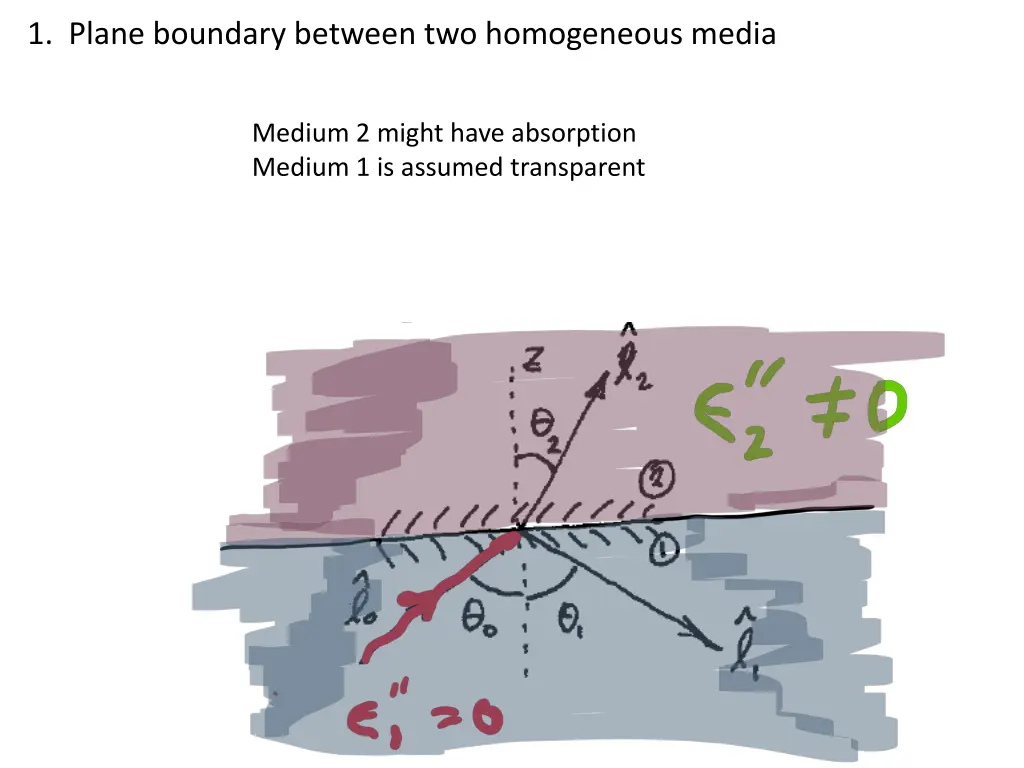
1. Plane boundary between two homogeneous media Medium 2 might have absorption Medium 1 is assumed transparent
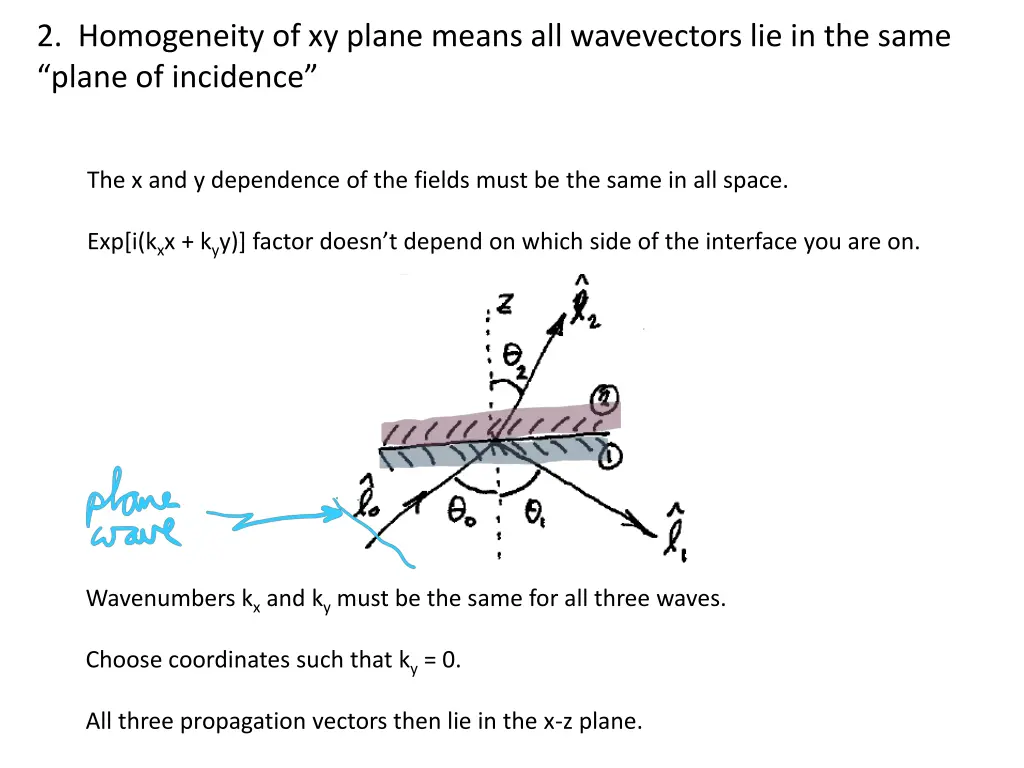
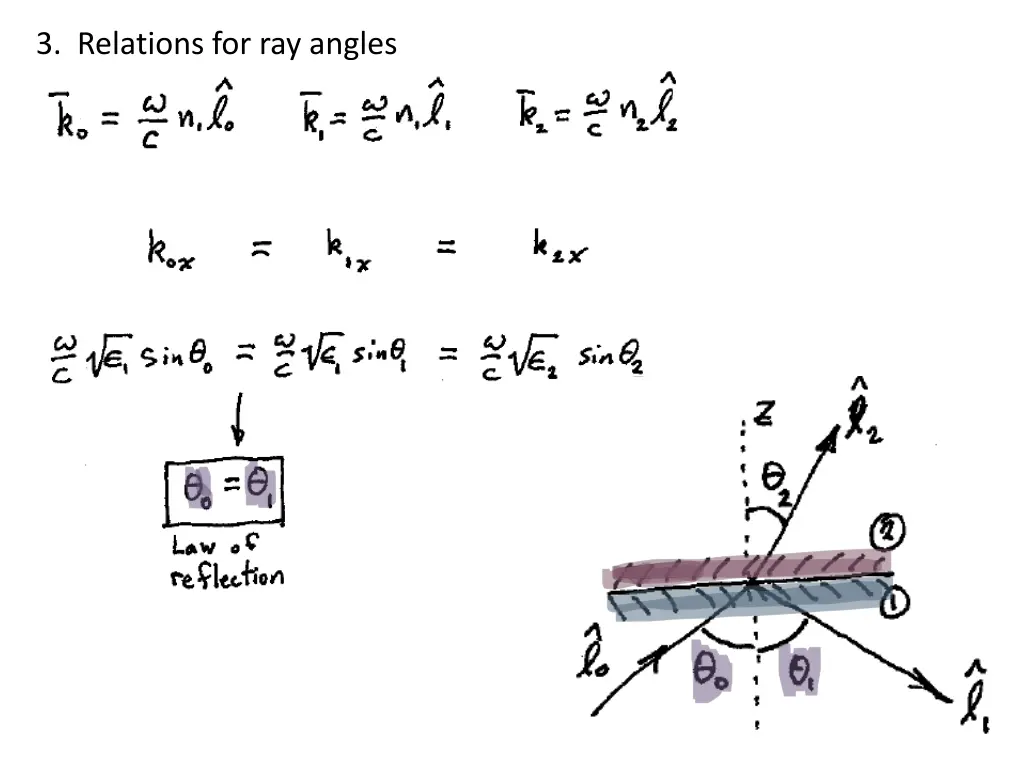
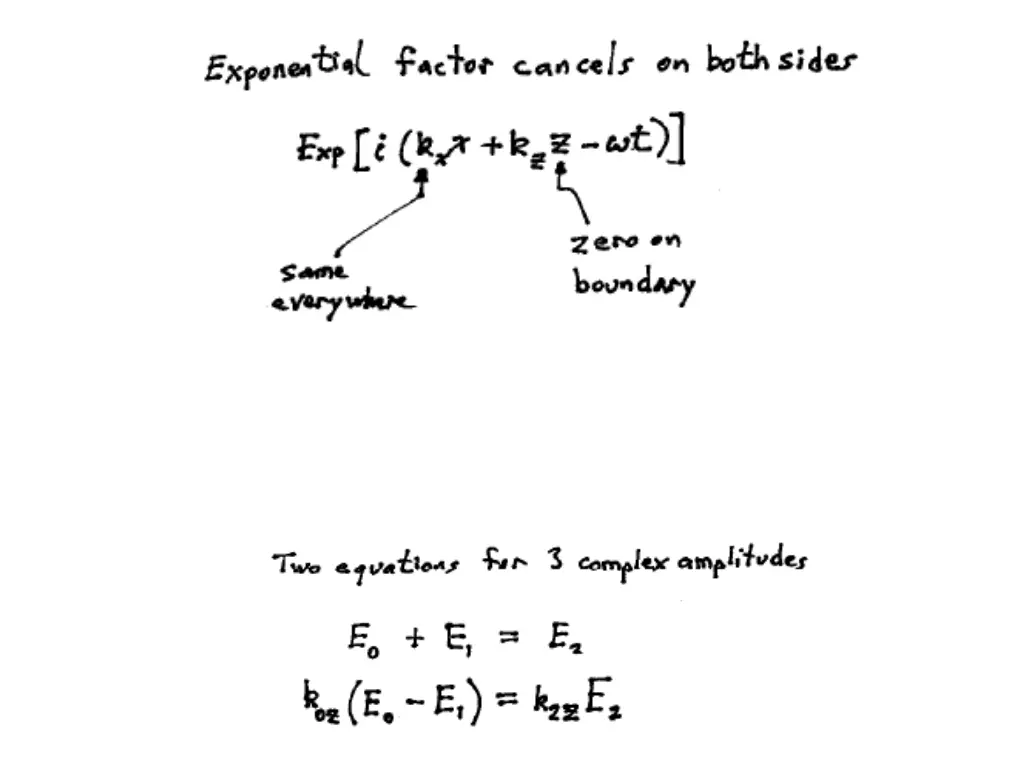
2. Homogeneity of xy plane means all wavevectors lie in the same plane of incidence The x and y dependence of the fields must be the same in all space. Exp[i(kxx + kyy)] factor doesn t depend on which side of the interface you are on. Wavenumbers kx and ky must be the same for all three waves. Choose coordinates such that ky = 0. All three propagation vectors then lie in the x-z plane.
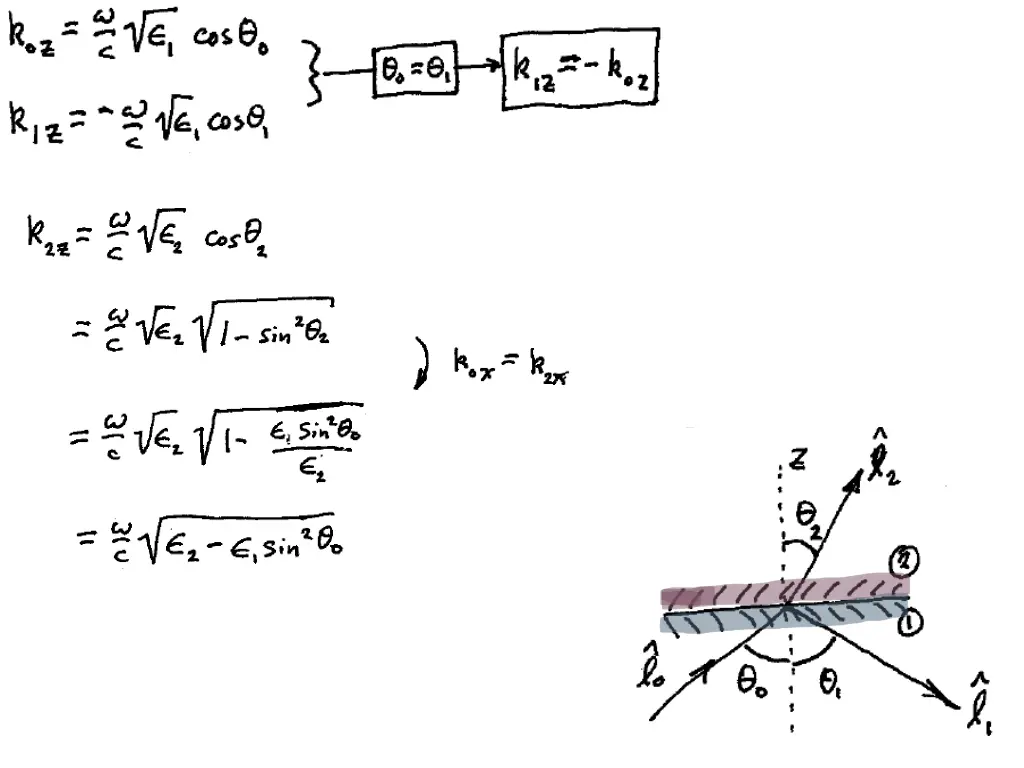
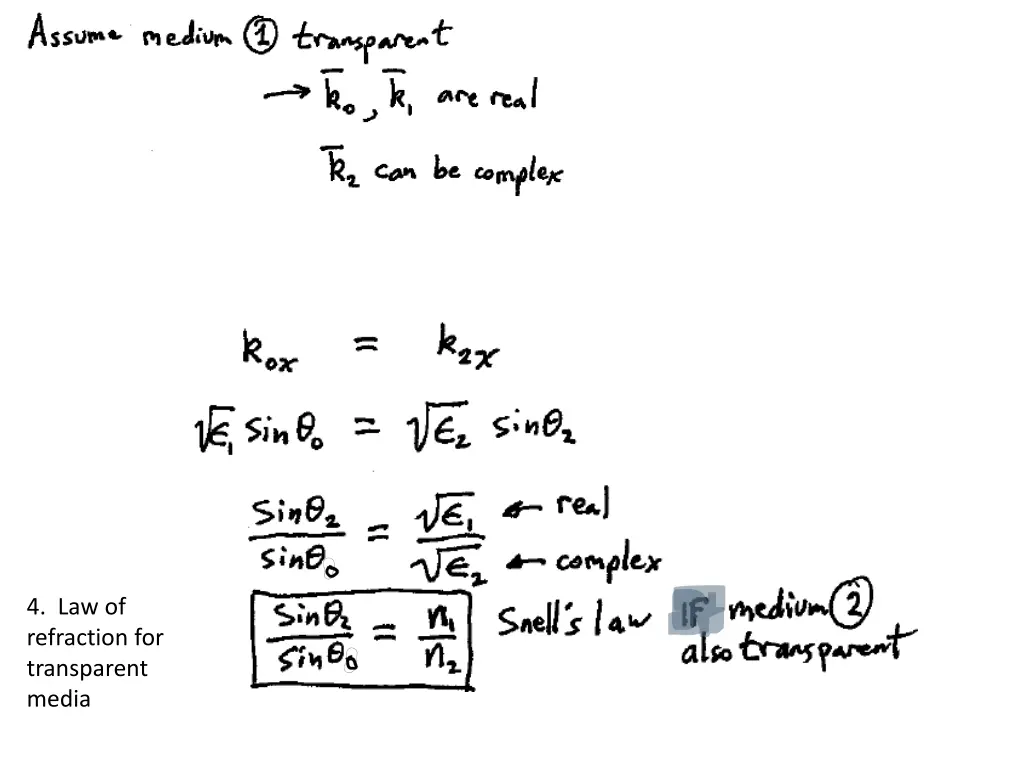
4. Law of refraction for transparent media
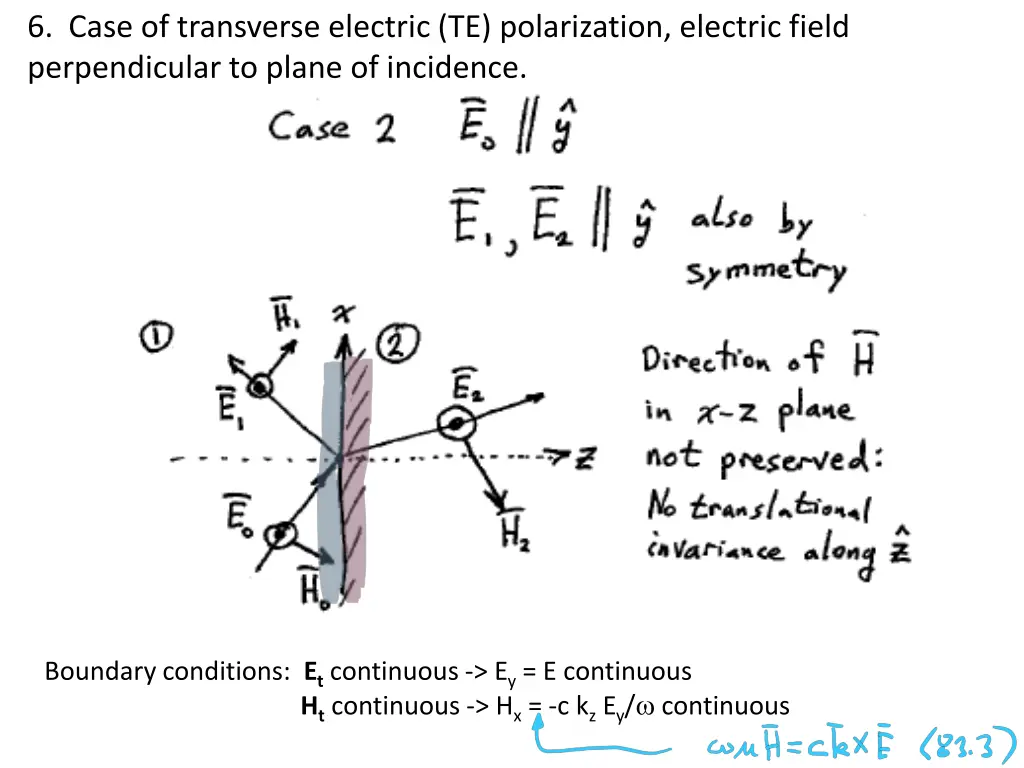
6. Case of transverse electric (TE) polarization, electric field perpendicular to plane of incidence. Boundary conditions: Et continuous -> Ey = E continuous Ht continuous -> Hx = -c kz Ey/ continuous
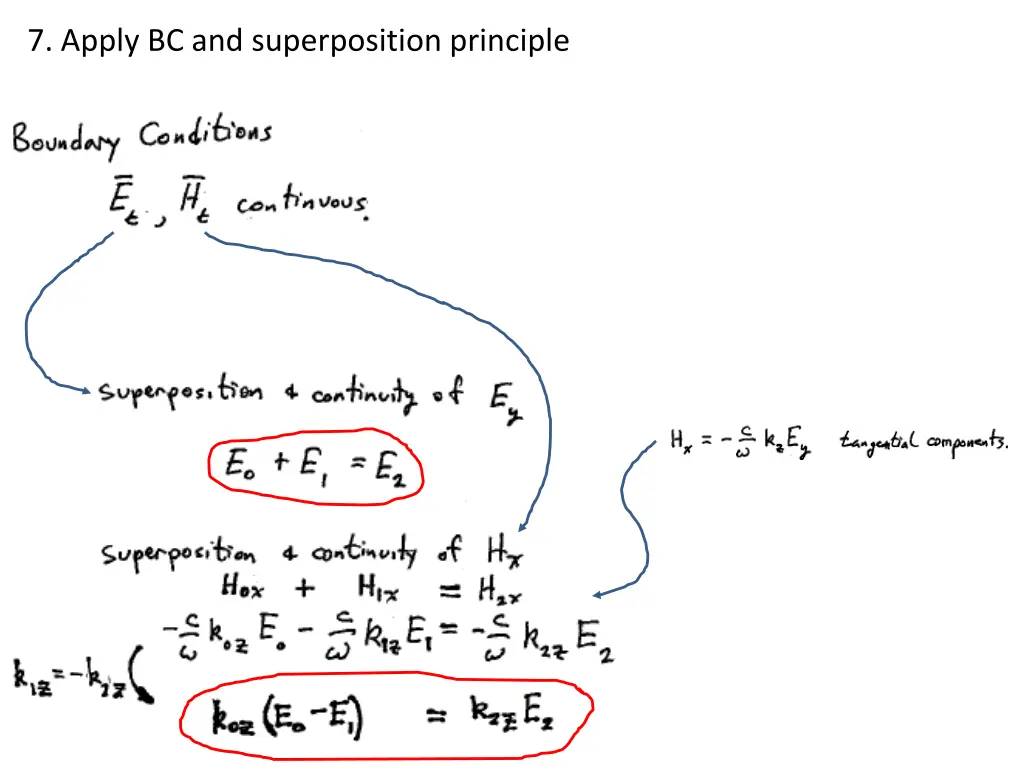
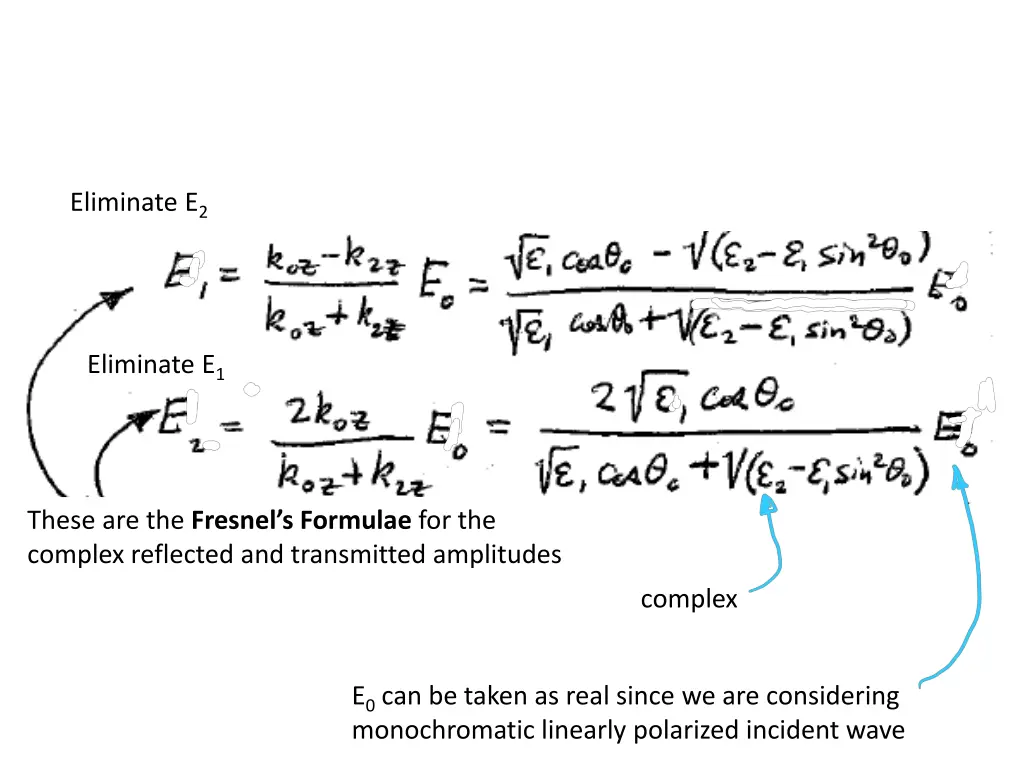
Eliminate E2 Eliminate E1 These are the Fresnel s Formulae for the complex reflected and transmitted amplitudes complex E0 can be taken as real since we are considering monochromatic linearly polarized incident wave
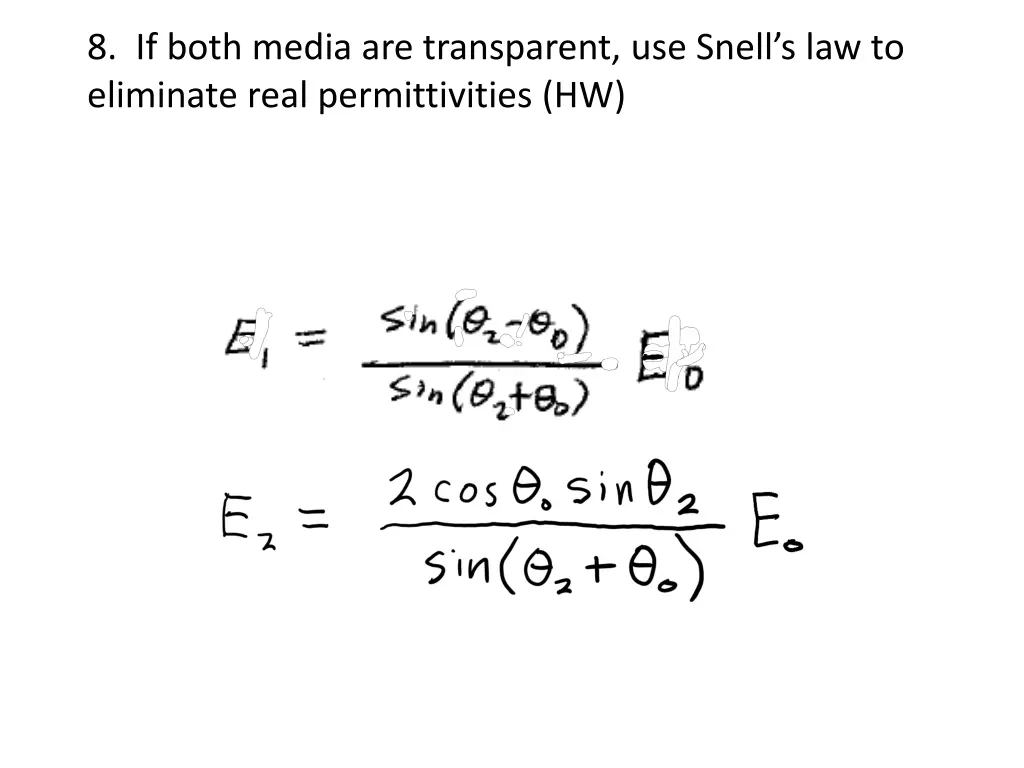
8. If both media are transparent, use Snells law to eliminate real permittivities (HW)
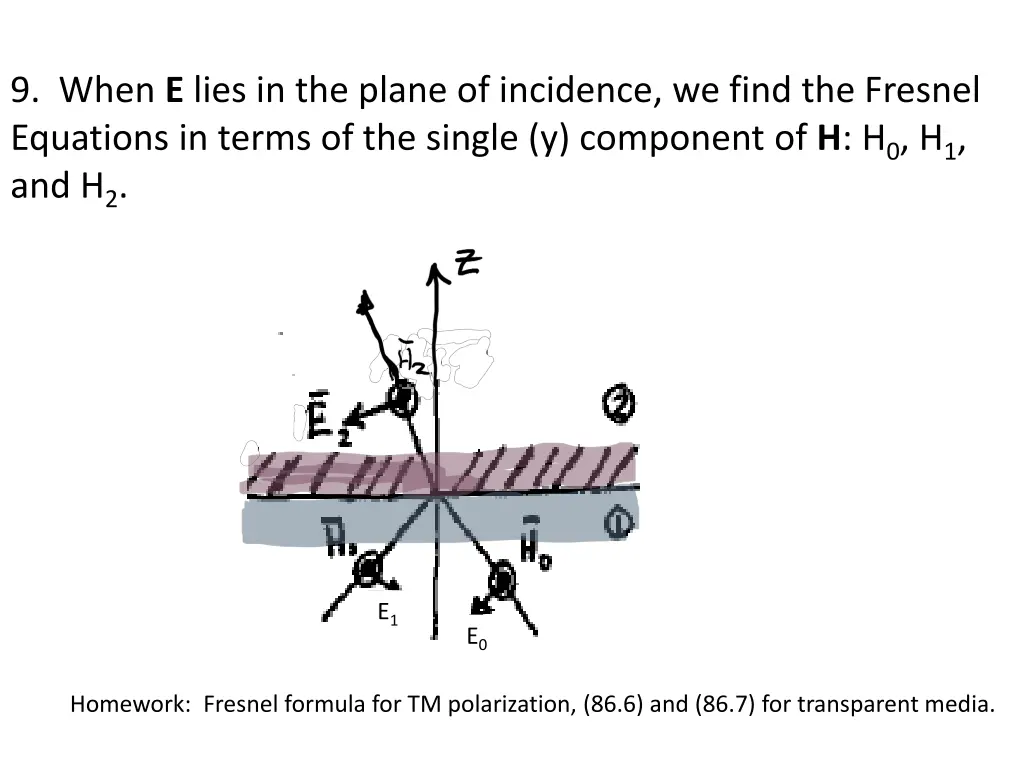
9. When E lies in the plane of incidence, we find the Fresnel Equations in terms of the single (y) component of H: H0, H1, and H2. E1 E0 Homework: Fresnel formula for TM polarization, (86.6) and (86.7) for transparent media.
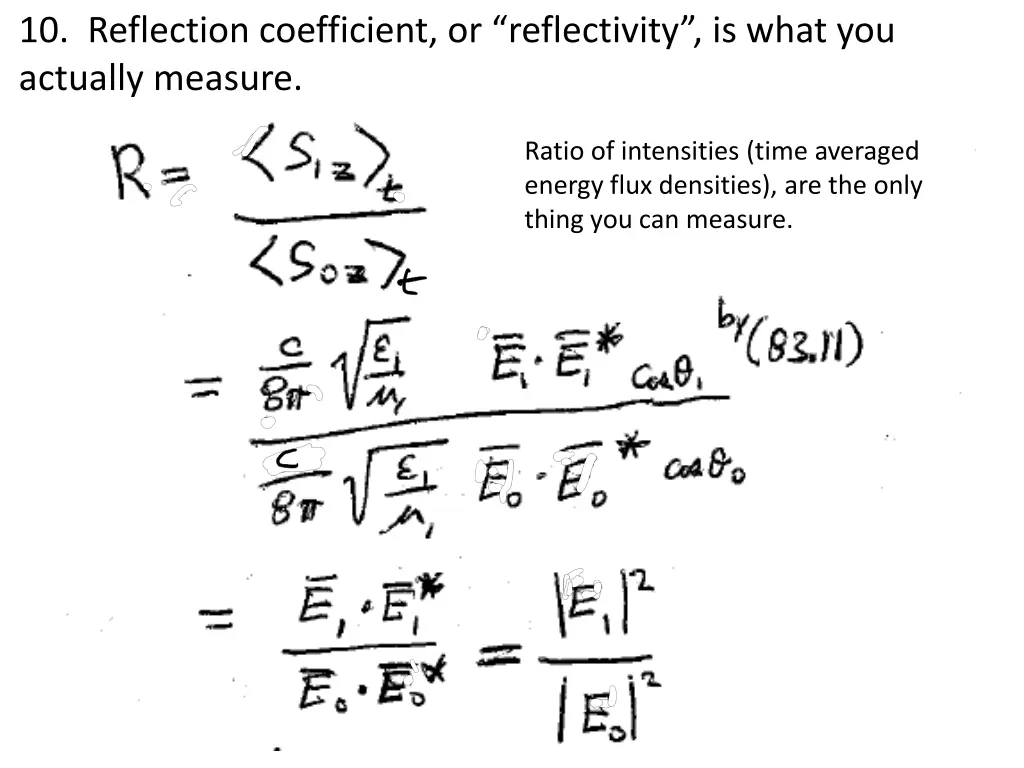
10. Reflection coefficient, or reflectivity, is what you actually measure. Ratio of intensities (time averaged energy flux densities), are the only thing you can measure.
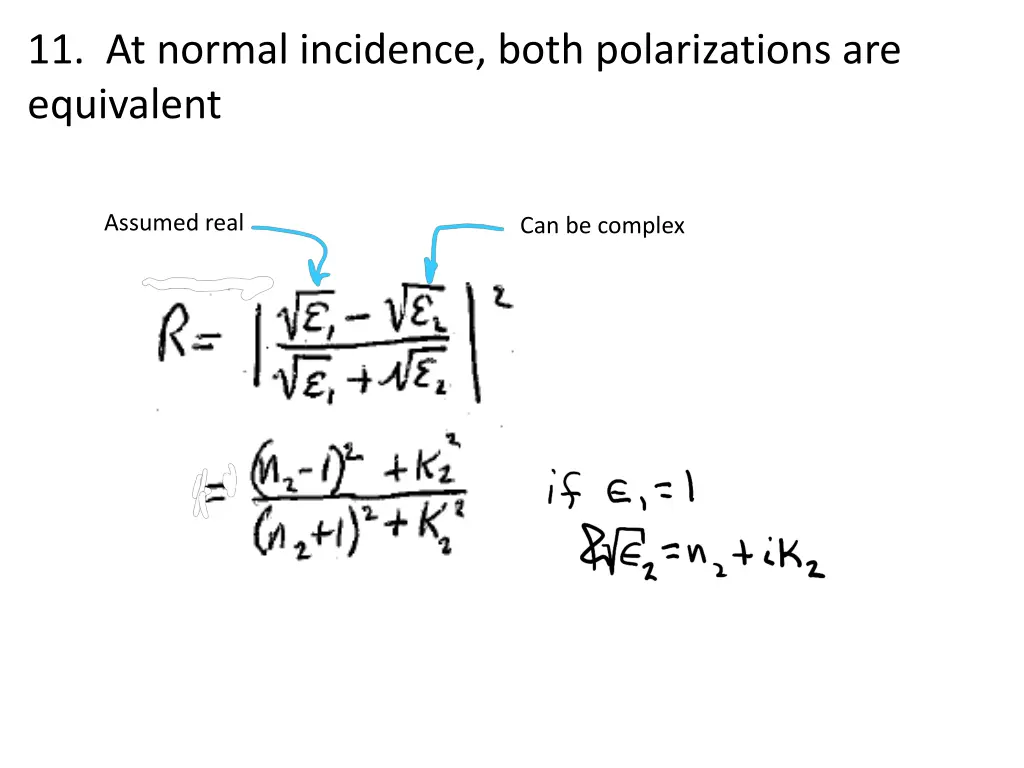
11. At normal incidence, both polarizations are equivalent Assumed real Can be complex
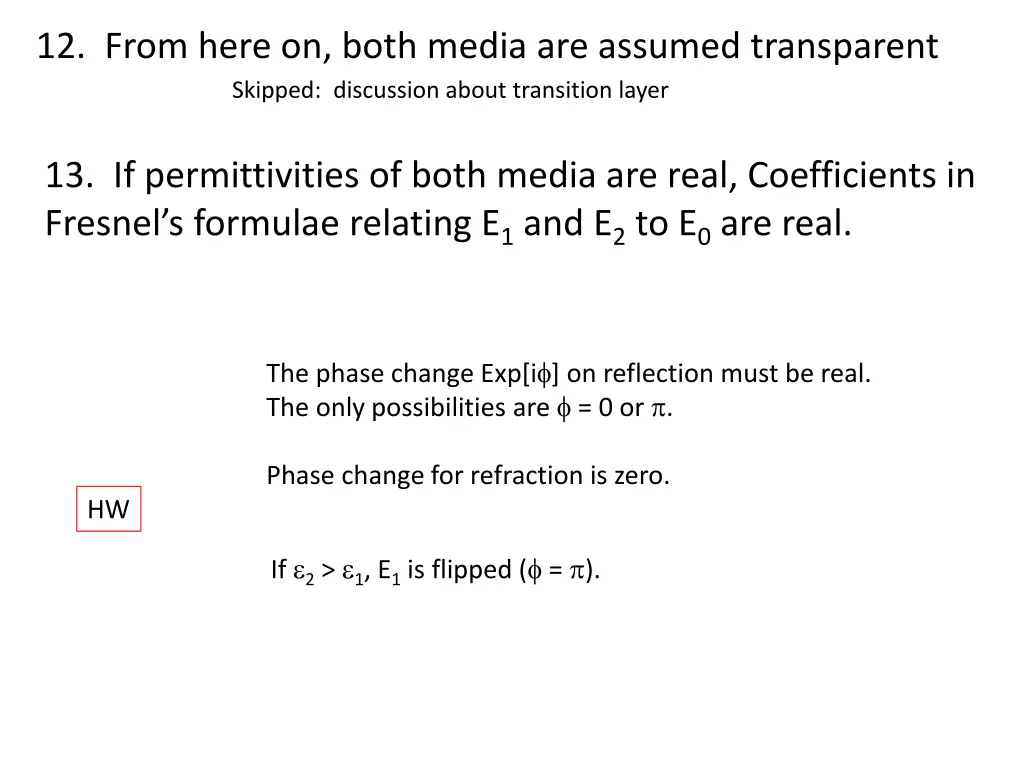
12. From here on, both media are assumed transparent Skipped: discussion about transition layer 13. If permittivities of both media are real, Coefficients in Fresnel s formulae relating E1 and E2 to E0 are real. The phase change Exp[i ] on reflection must be real. The only possibilities are = 0 or . Phase change for refraction is zero. HW If 2 > 1, E1 is flipped ( = ).
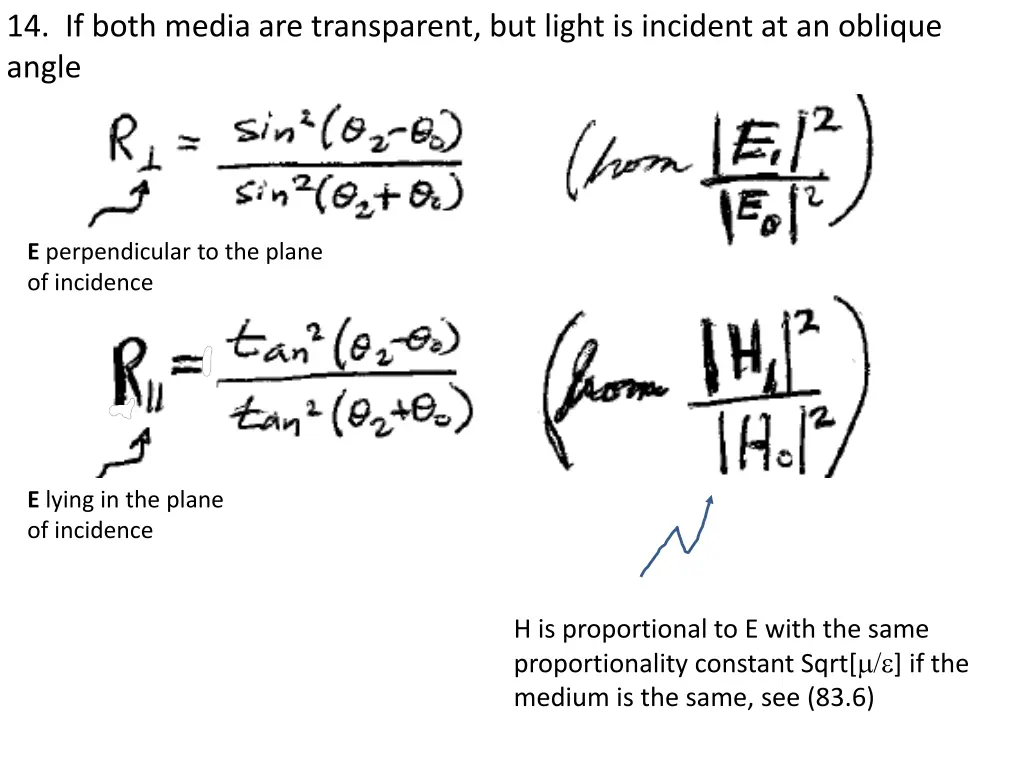
14. If both media are transparent, but light is incident at an oblique angle E perpendicular to the plane of incidence E lying in the plane of incidence H is proportional to E with the same proportionality constant Sqrt[ ] if the medium is the same, see (83.6)
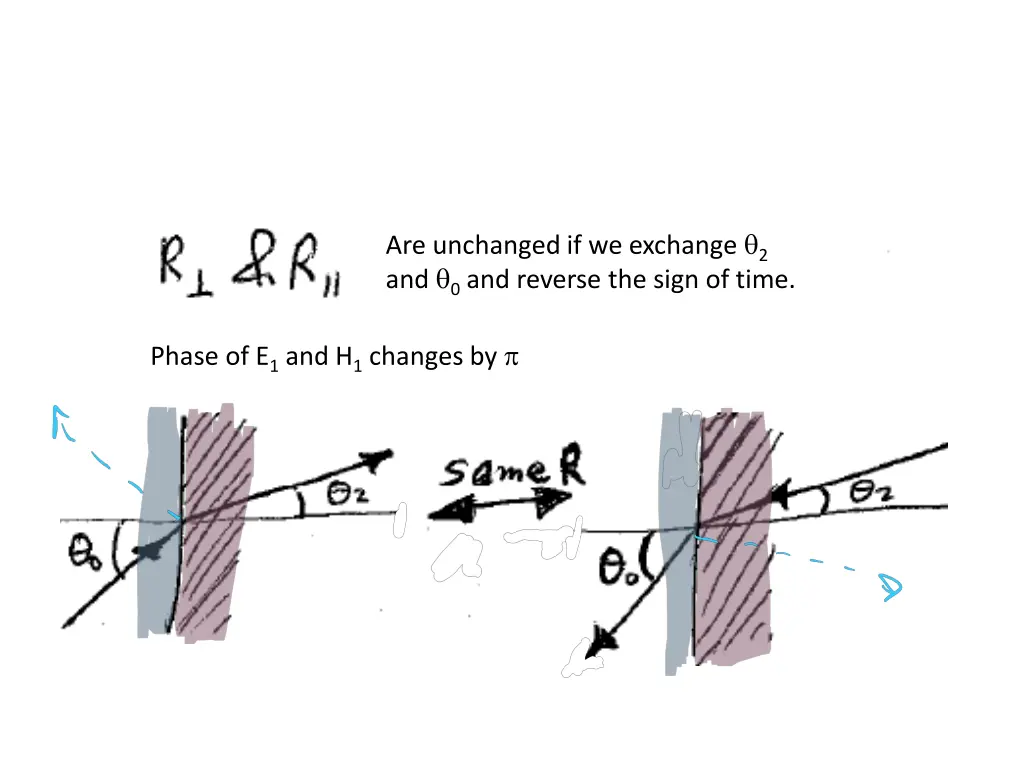
Are unchanged if we exchange 2 and 0 and reverse the sign of time. Phase of E1 and H1 changes by
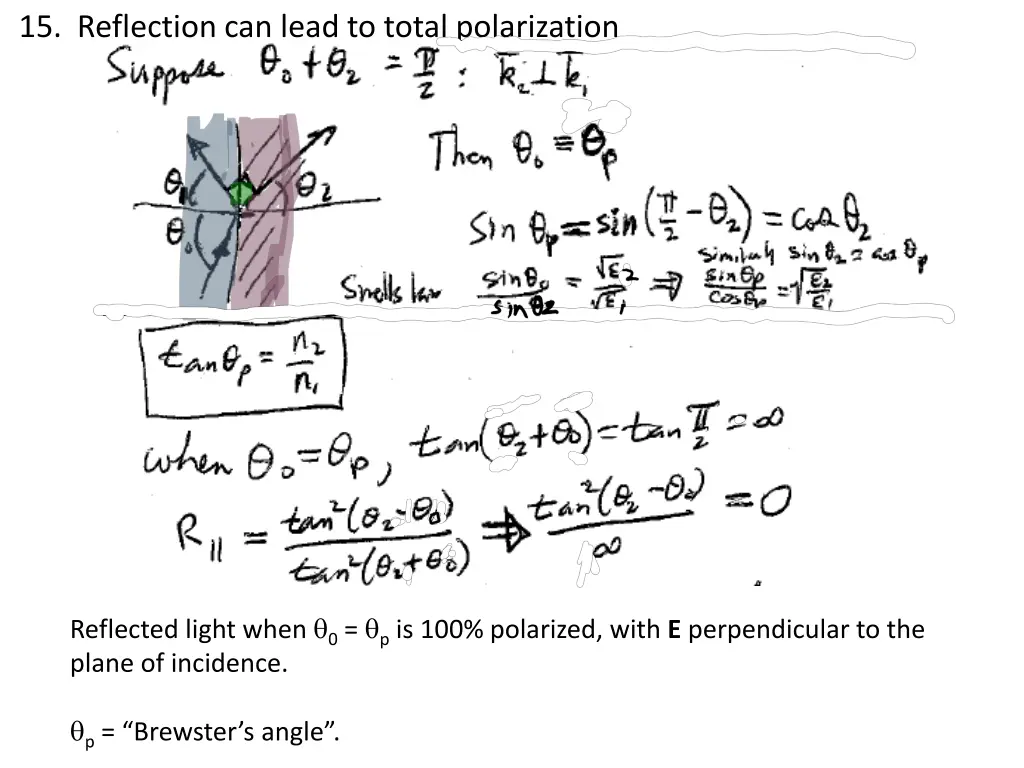
15. Reflection can lead to total polarization Reflected light when 0 = p is 100% polarized, with E perpendicular to the plane of incidence. p= Brewster s angle .
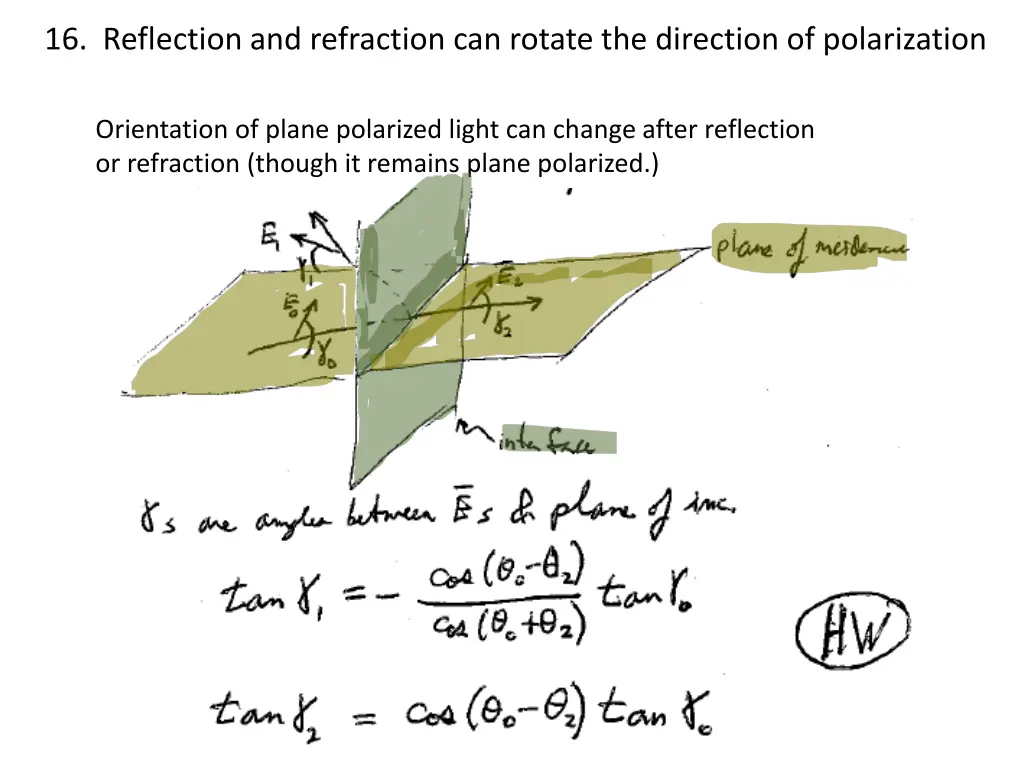
16. Reflection and refraction can rotate the direction of polarization Orientation of plane polarized light can change after reflection or refraction (though it remains plane polarized.)
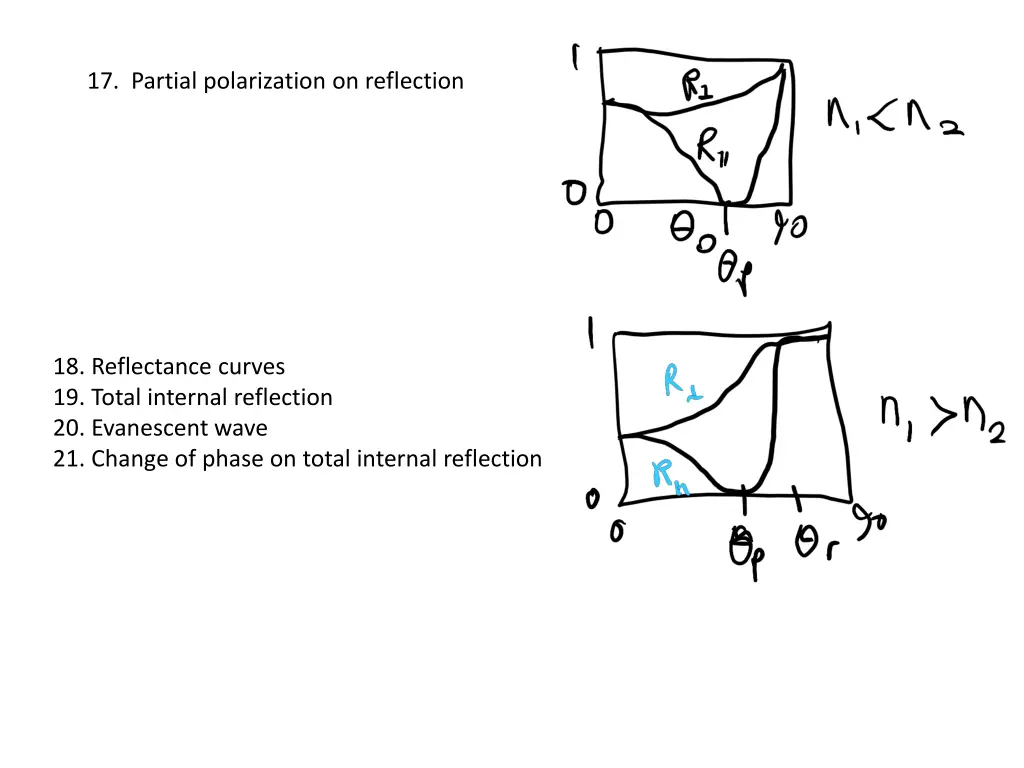
17. Partial polarization on reflection 18. Reflectance curves 19. Total internal reflection 20. Evanescent wave 21. Change of phase on total internal reflection