Explore the comprehensive process of criminalizing domestic violence in Namibia, initiated in 1996 and currently in the amendment phase of the Domestic Violence Act of 2003 by the Namibian Law Reform and Development Commission (LRDC). Understand the devastating impact of domestic violence on society and the ongoing efforts to enhance protection for victims.
Please find below an Image/Link to download the presentation.
The content on the website is provided AS IS for your information and personal use only. It may not be sold, licensed, or shared on other websites without obtaining consent from the author. If you encounter any issues during the download, it is possible that the publisher has removed the file from their server.
You are allowed to download the files provided on this website for personal or commercial use, subject to the condition that they are used lawfully. All files are the property of their respective owners.
The content on the website is provided AS IS for your information and personal use only. It may not be sold, licensed, or shared on other websites without obtaining consent from the author.
E N D
Presentation Transcript
THE NAMIBIAN LAW REFORM AND DEVELOPMENT COMMISSION ( LRDC ) REFORM OF LAW ON DOMESTIC VIOLENCE 30 JUNE 2017 BALACLAVA, MAURITIUS MS. JESSICA J. GAWACHAB, SENIOR LEGAL OFFICER, NAMIBIA LRDC
INTRODUCTION This presentation will outline the entire reform process of criminalizing domestic violence in Namibia since inception. The process started in 1996 and currently Namibia is currently in the process of amending the Domestic Violence Act of 2003 to enhance protection. Domestic Violence has been considered an offence that erodes the moral fabric of society by subjecting victims to abuse. The effects of domestic violence are so broad, not only affecting families but ripples into a dysfunctional society.
MANDATE AND SCOPE OF THE LRDC The LRDC is a statutory body established in terms of the Law Reform and Development Commission Act, 1991, (Act No. 29 of 1991), with its core mandate set out in section 6. The LRDC s main focus is to research all branches of law and to make recommendations for the reform and development of the law to the Minister of Justice. If a recommendation requires the drafting of legislation, the LRDC equally has the mandate to draft such laws, or any amendment or repeal bill to ensure the efficient and effective implementation of proposals submitted to the Minister. The LRDC thus serves an advisory body to the Minister of Justice.
ADOPTION OF THE DOMESTIC VIOLENCE STUDY The LRDC undertook a study in 1996, in partnership with the Legal Assistance Centre. The LRDC had a Women and Law Committee that established a project called Violence Against and Abuse of Women and Children Project . (Established under section 10 of LRDC Act) We received technical and financial assistance from the Legal Capacity Building Programme, implemented jointly by the Ministry of Justice and the Deutsche Gesellschaft fur Technische Zusammentarbeid (GTZ) as the implementing agency for technical co- operation of German Federal Ministry of Economic Co-operation and Development (BMZ). The study also dealt with the Namibian Police Force. A survey was conducted to establish the outcome of domestic violence cases brought to the police and the general perception of domestic violence by police officers. The ultimate aim of this survey was to emphasise the need for reform, as well as guide the reform of domestic violence legislation within Namibia.
DOMESTIC VIOLENCE(DV) Definition - Domestic Violence is defined as physical violence which occurs within a family or an intimate relationship, including sexual abuse. (1996) Domestic violence encompasses emotional, financial and psychological abuse, however for the purposes of the report only physical violence was addressed as the most prevalent form of domestic violence in Namibia. Albeit women and children being recorded as the most frequent victims, the LRDC report reflected on research that captured both sexes as victims as well as all ages. Keeping in mind the era in which this report was developed, one must understand that resources were limited. The survey was meant to provide initial information on the issue of DV.
CRIMES INCLUDED UNDER DOMESTIC VIOLENCE: Murder Assault GBH Rape Assault Indecent assault Incest Kidnapping Robbery Contravention of sections 13, 14, 15, or 16 of Combatting of Immoral Practices Act which relate to detention for purposes of unlawful intercourse, sexual offence with girl under age 16(statutory rape), sexual offence with female that suffering from mental illness and the use of certain means to stupefy or overpower females for immoral purposes.
TYPES OF DOMESTIC VIOLENT RELATIONSHIPS In order of most prevalent cases: Boyfriends were recorded at 35.7% of reported cases; Husbands were recorded at 16.5%; Ex-boyfriends were recorded at 11.3%; Brothers were recorded at 9.9%; Other relatives (including nephews, nieces and brothers-in-law etc.) were recorded at 18.3%; The highest recording of female perpetrators of domestic violence were committed by the sisters, recorded at 2.3% of all reported cases.
TOOLS USED FOR THE COMMISSION OF DOMESTIC VIOLENCE This survey assisted to provide a general understanding to the public that domestic violence did not only occur between a husband and wife. It was pertinent to exemplify that any domestic relationship warranted protection against violence or abuse and domestic violence was not restricted to romantic partnerships. Under the violent crimes the survey reflected that guns were not the most common tool used in domestic violence at a mere 1% of all reported cases. The most common weapons used were hands, feet and fists (used in 56% of incidents), knives were recorded at 9% and sticks or clubs recorded at 7%. For information purposes other weapons used included hammers, a brick, a broomstick, shoes, copper wire, teeth, matches (to burn victims between the toes) and a loaf of bread (used to hit victim over the head).
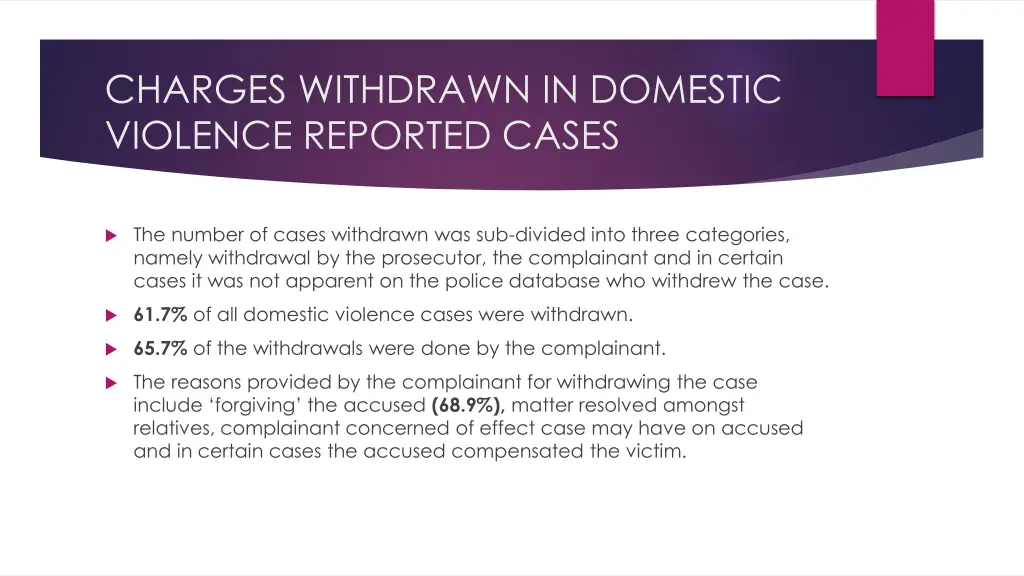
CHARGES WITHDRAWN IN DOMESTIC VIOLENCE REPORTED CASES The number of cases withdrawn was sub-divided into three categories, namely withdrawal by the prosecutor, the complainant and in certain cases it was not apparent on the police database who withdrew the case. 61.7% of all domestic violence cases were withdrawn. 65.7% of the withdrawals were done by the complainant. The reasons provided by the complainant for withdrawing the case include forgiving the accused (68.9%), matter resolved amongst relatives, complainant concerned of effect case may have on accused and in certain cases the accused compensated the victim.
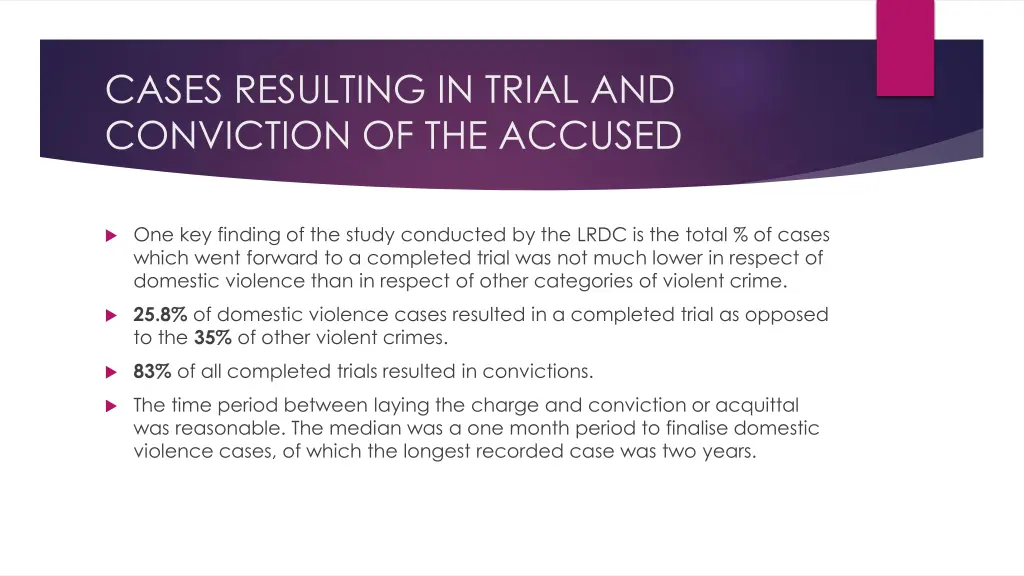
CASES RESULTING IN TRIAL AND CONVICTION OF THE ACCUSED One key finding of the study conducted by the LRDC is the total % of cases which went forward to a completed trial was not much lower in respect of domestic violence than in respect of other categories of violent crime. 25.8% of domestic violence cases resulted in a completed trial as opposed to the 35% of other violent crimes. 83% of all completed trials resulted in convictions. The time period between laying the charge and conviction or acquittal was reasonable. The median was a one month period to finalise domestic violence cases, of which the longest recorded case was two years.
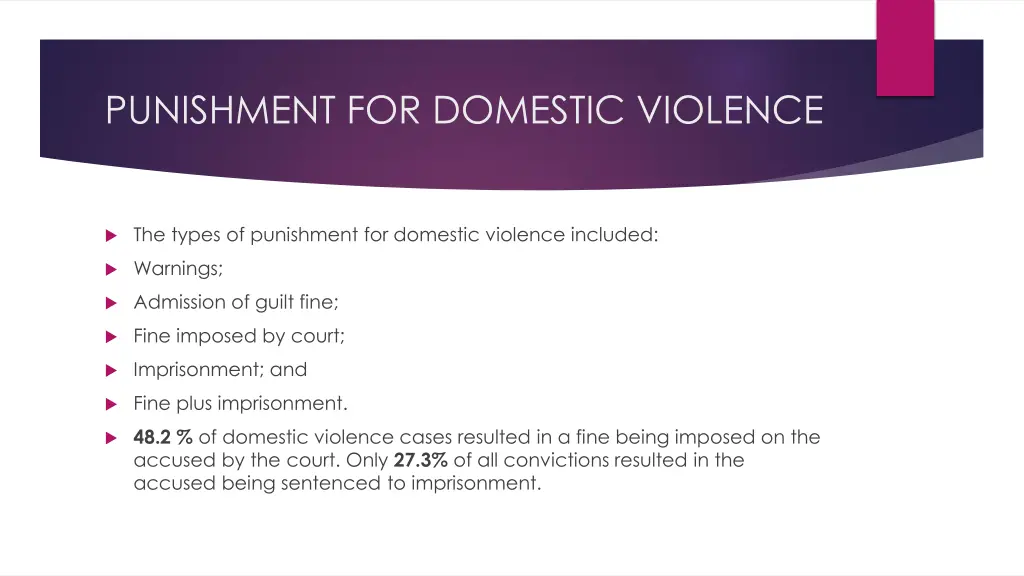
PUNISHMENT FOR DOMESTIC VIOLENCE The types of punishment for domestic violence included: Warnings; Admission of guilt fine; Fine imposed by court; Imprisonment; and Fine plus imprisonment. 48.2 % of domestic violence cases resulted in a fine being imposed on the accused by the court. Only 27.3% of all convictions resulted in the accused being sentenced to imprisonment.
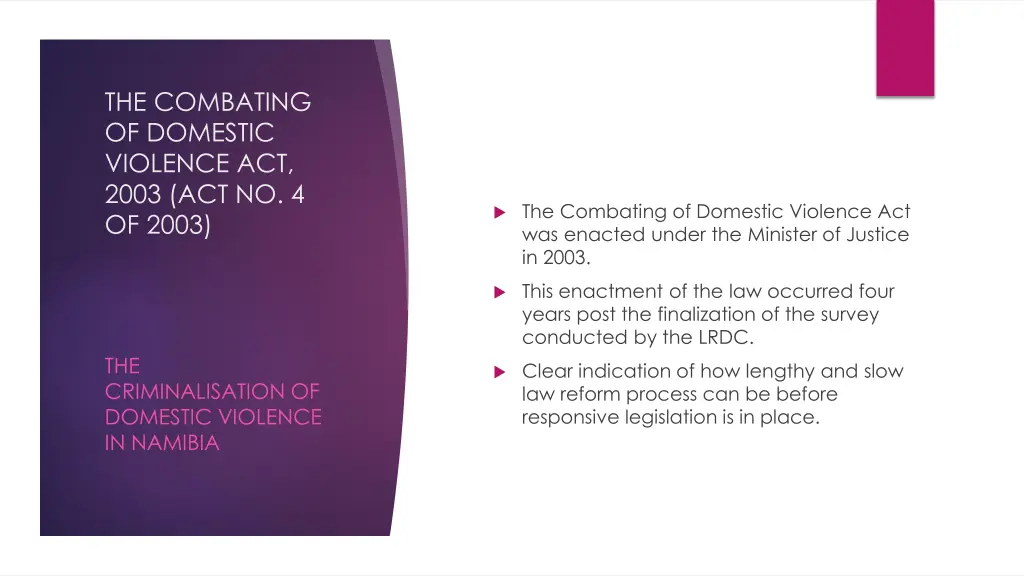
THE COMBATING OF DOMESTIC VIOLENCE ACT, 2003 (ACT NO. 4 OF 2003) The Combating of Domestic Violence Act was enacted under the Minister of Justice in 2003. This enactment of the law occurred four years post the finalization of the survey conducted by the LRDC. THE CRIMINALISATION OF DOMESTIC VIOLENCE IN NAMIBIA Clear indication of how lengthy and slow law reform process can be before responsive legislation is in place.
THE COMBATING OF DOMESTIC VIOLENCE ACT, 2003 (ACT NO. 4 OF 2003) The Act criminalized domestic violence and set out procedural aspects in dealing with domestic violence cases. The introduction of protection orders including court-ordered counselling; procedure for making an interim protection order final, investigations, protection of vulnerable witnesses, safeguards of children and domestic violence offences inter alia. Continued However, quite recently Namibia noticed an uprising of what has been erroneously termed passion killings . An increase in domestic violence cases that resulted in the death of many prompted Government to revisit the laws in place.
A legislative review of the Combating of Domestic Violence Act of 2003 The Minister of Justice in partnership with the Legal Assistance Centre undertook a review of the Act in 2016. The review was triggered by a report on whether the law was serving its intended purpose. Issues to consider included: Amendment of the definition of domestic relationship and child; Defining the term primary caretaker Effectiveness of Protection orders; Clarify the necessity to show urgency in order to obtain an interim protection order on an ex parte basis; Amend procedural matters relating to interim protection orders; Strengthen safeguards against intimidation of complainants; Introducing medical records as evidence in protection order proceedings; And inter alia to provide for the initiation of a procedure for suspending a firearm license if it appears that a person involved in the commission of a domestic violence may be unfit to possess a firearm.
Other initiatives in Namibia to curb Gender-Based Violence and Domestic Violence The Ministry of Gender Equality and Child Welfare recently commenced with the implementation of One-Stop Centre's for victims of Gender-Based Violence (GBV) Namibian government is considering review and possible amendment of other pieces of legislation i.e Criminal Procedure Act, Criminal Law, etc to provide some relief and protection.
CONCLUSION Statistically, the number of incidents of gender based violence in Namibia has subsided but reports of GBV has not reduced. However, due the number of protection order applications withdrawn based on fear of the accused one cannot be certain of the accuracy of the number of cases brought to the police. Domestic violence has been referred to as a social ill which requires broad based awareness to create behavioral change. Customary believes restrict victims from reporting domestic violence. As domestic violence trends have shown that the empowerment of women subsequently lead to an increase in gender-based violence against women. Need to redefine and eliminate stereotypes relating to the role of women in society. GBV requires urgent collective action.