Regional Integrated Strategies in Europe: The RISE Project Analysis
Explore the significance of Regional Integrated Strategies (RIS) in Europe through the RISE Project, focusing on different regions and stakeholders, with aims to develop typologies and toolkits for sustainable development. Examining methodology involving regional profiling, literature review, case studies, and toolkit development.

Uploaded on | 4 Views
Download Presentation

Please find below an Image/Link to download the presentation.
The content on the website is provided AS IS for your information and personal use only. It may not be sold, licensed, or shared on other websites without obtaining consent from the author. If you encounter any issues during the download, it is possible that the publisher has removed the file from their server.
You are allowed to download the files provided on this website for personal or commercial use, subject to the condition that they are used lawfully. All files are the property of their respective owners.
The content on the website is provided AS IS for your information and personal use only. It may not be sold, licensed, or shared on other websites without obtaining consent from the author.
E N D
Presentation Transcript
THE RISE PROJECT Regional Integrated Strategies in Europe ~ Chris Collinge, Stewart MacNeill Birmingham Business School University of Birmingham
Green Paper on Territorial Cohesion Regional Integrated Strategies (RIS) are emerging as way to focus on economic, social and territorial cohesion to secure integrated sustainable development There is no single model of RIS. Instead they consist of a combination of several core thematic and spatial topics, which vary depending on the regional contexts. RIS can be used as a valuable tool for regeneration, but there are methodological challenges in developing and implementing a RIS 2
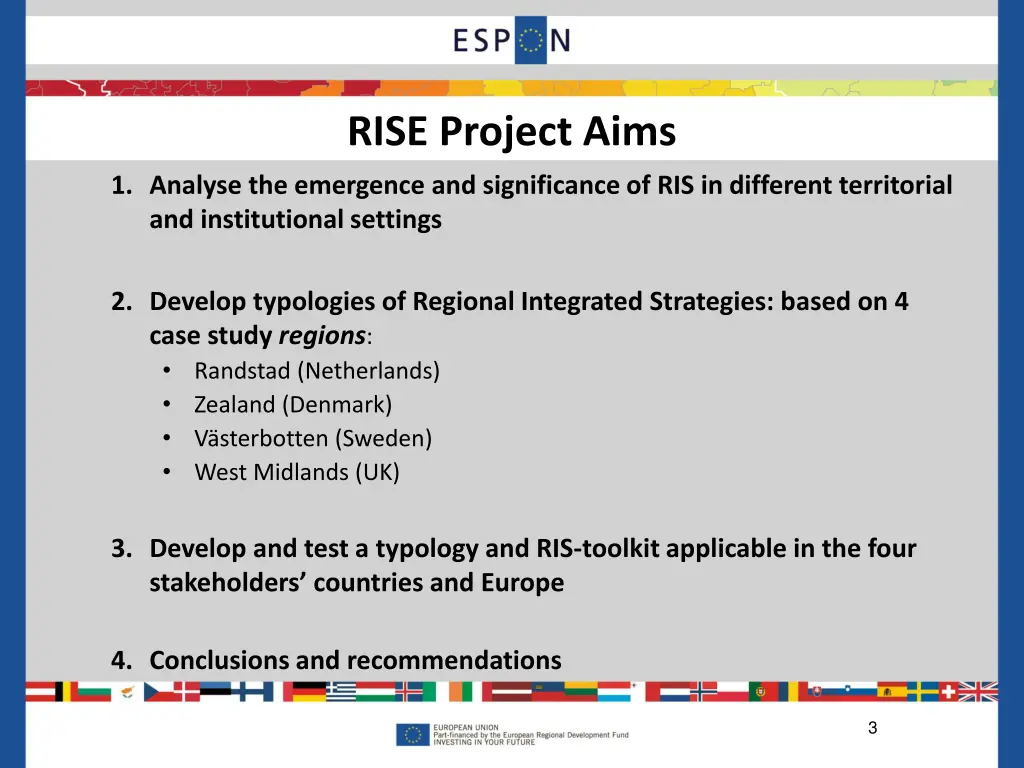
RISE Project Aims 1. Analyse the emergence and significance of RIS in different territorial and institutional settings 2. Develop typologies of Regional Integrated Strategies: based on 4 case study regions: Randstad (Netherlands) Zealand (Denmark) V sterbotten (Sweden) West Midlands (UK) 3. Develop and test a typology and RIS-toolkit applicable in the four stakeholders countries and Europe 4. Conclusions and recommendations 3
RISE: Vsterbotten (S), Randstad (NL), Zealand (DK), W. Midlands (UK) File:Sj lland in Denmark.svg 4
RISE Regional Integrated Strategies in Europe Stakeholders: Research Partners: University of Birmingham Business School Delft University of Technology Research Institute for Housing, Urban and Mobility Studies (OTB) University of Copenhagen Forest & Landscape, Denmark (FLD) University of Ume Centre for Regional Science (CERUM) Birmingham City Council (Lead Stakeholder); Regional Council of V sterbotten; Region Zealand; Randstad Region (Brussels Office) 5
Methodology 1. Regional Profiling: an analysis of economic and social data to present a statistical overview of the four regions 2. Literature Review: on policy transfer and learning; Meta-governance and new forms of governance; and Collaborative planning, legitimization and partnership. 3. Case studies: Interactive Learning approach: 1) Review of secondary sources; Interviews with practitioners and policy makers 2) Assessment of practice 3) Verification of learning with the practitioner community- focus group discussions 4. Devise Toolkit, RIS typology, Ladder of Integration 6
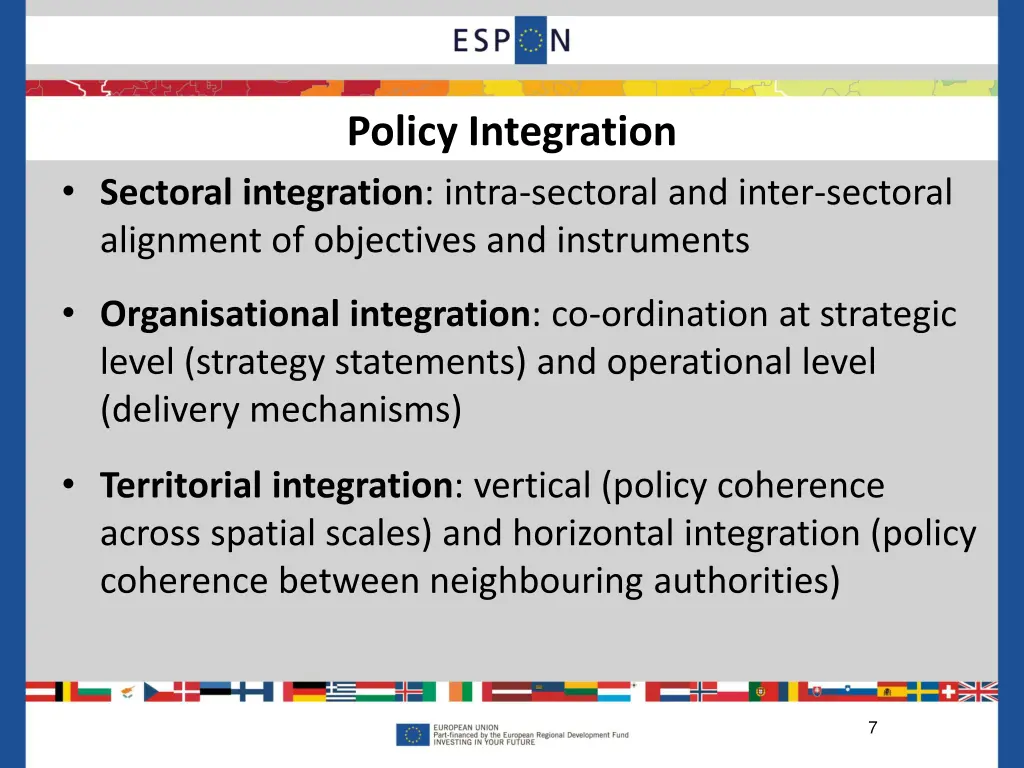
Policy Integration Sectoral integration: intra-sectoral and inter-sectoral alignment of objectives and instruments Organisational integration: co-ordination at strategic level (strategy statements) and operational level (delivery mechanisms) Territorial integration: vertical (policy coherence across spatial scales) and horizontal integration (policy coherence between neighbouring authorities) 7
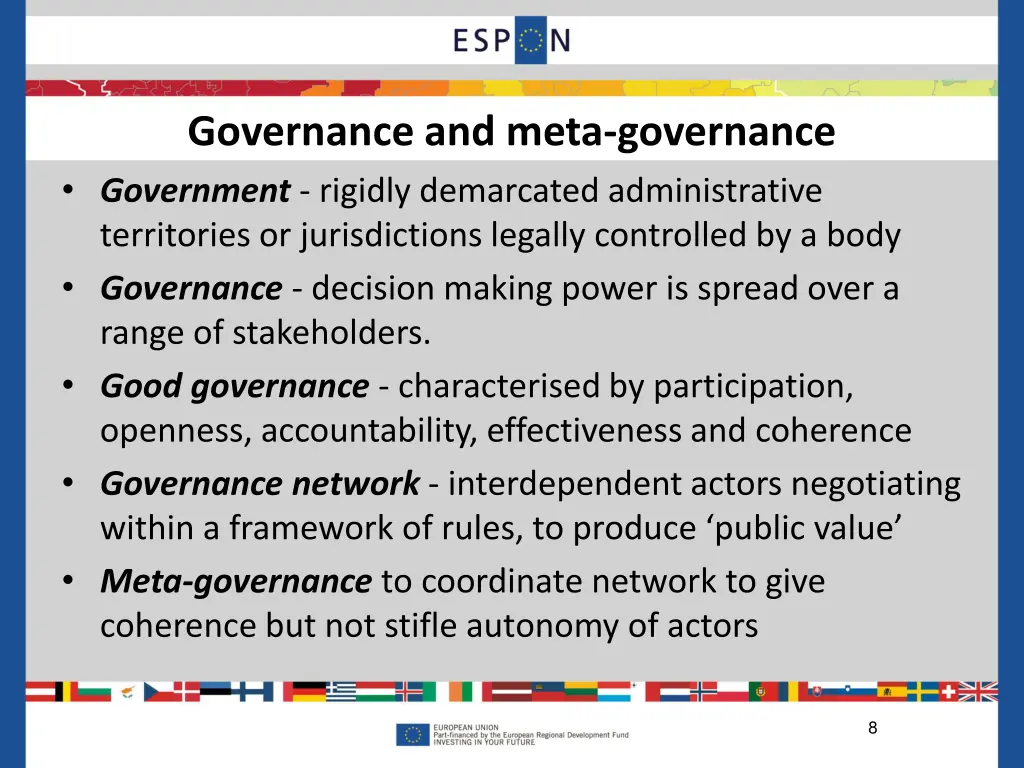
Governance and meta-governance Government - rigidly demarcated administrative territories or jurisdictions legally controlled by a body Governance - decision making power is spread over a range of stakeholders. Good governance - characterised by participation, openness, accountability, effectiveness and coherence Governance network - interdependent actors negotiating within a framework of rules, to produce public value Meta-governance to coordinate network to give coherence but not stifle autonomy of actors 8
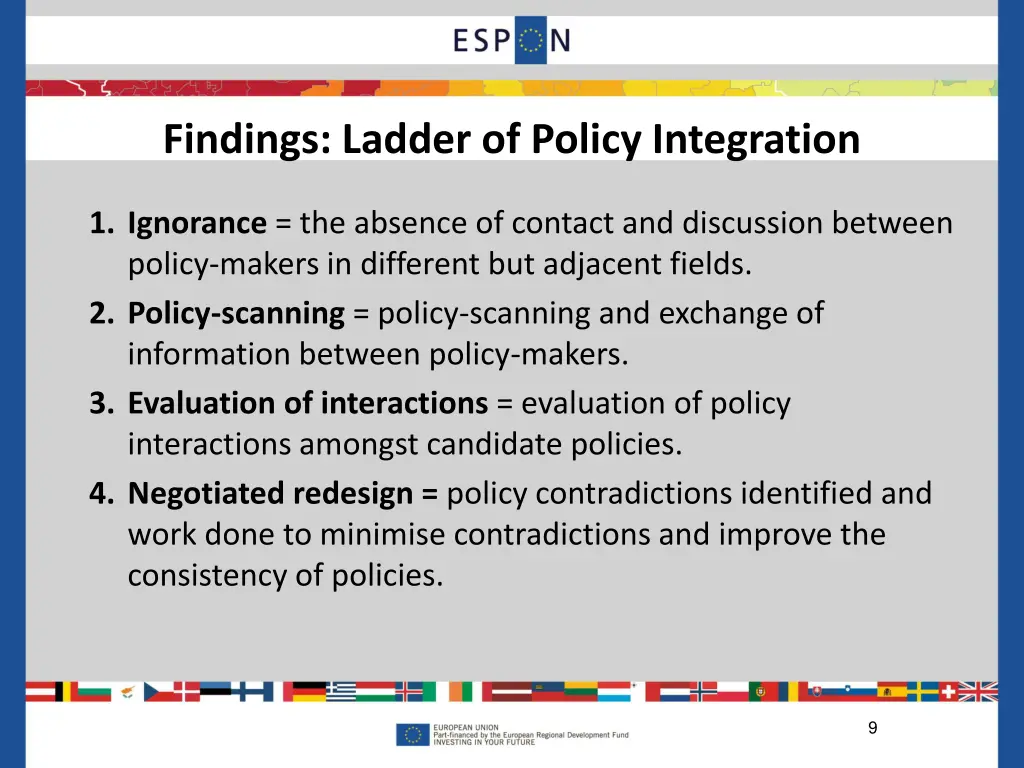
Findings: Ladder of Policy Integration 1. Ignorance = the absence of contact and discussion between policy-makers in different but adjacent fields. 2. Policy-scanning = policy-scanning and exchange of information between policy-makers. 3. Evaluation of interactions = evaluation of policy interactions amongst candidate policies. 4. Negotiated redesign = policy contradictions identified and work done to minimise contradictions and improve the consistency of policies. 9
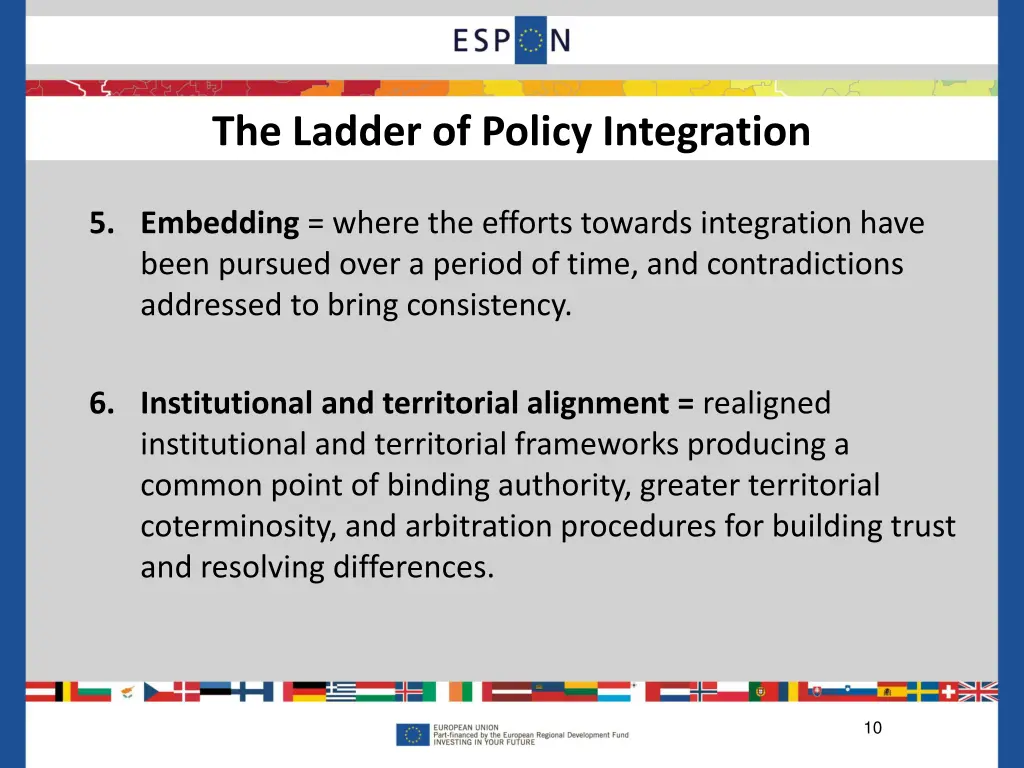
The Ladder of Policy Integration 5. Embedding = where the efforts towards integration have been pursued over a period of time, and contradictions addressed to bring consistency. 6. Institutional and territorial alignment = realigned institutional and territorial frameworks producing a common point of binding authority, greater territorial coterminosity, and arbitration procedures for building trust and resolving differences. 10
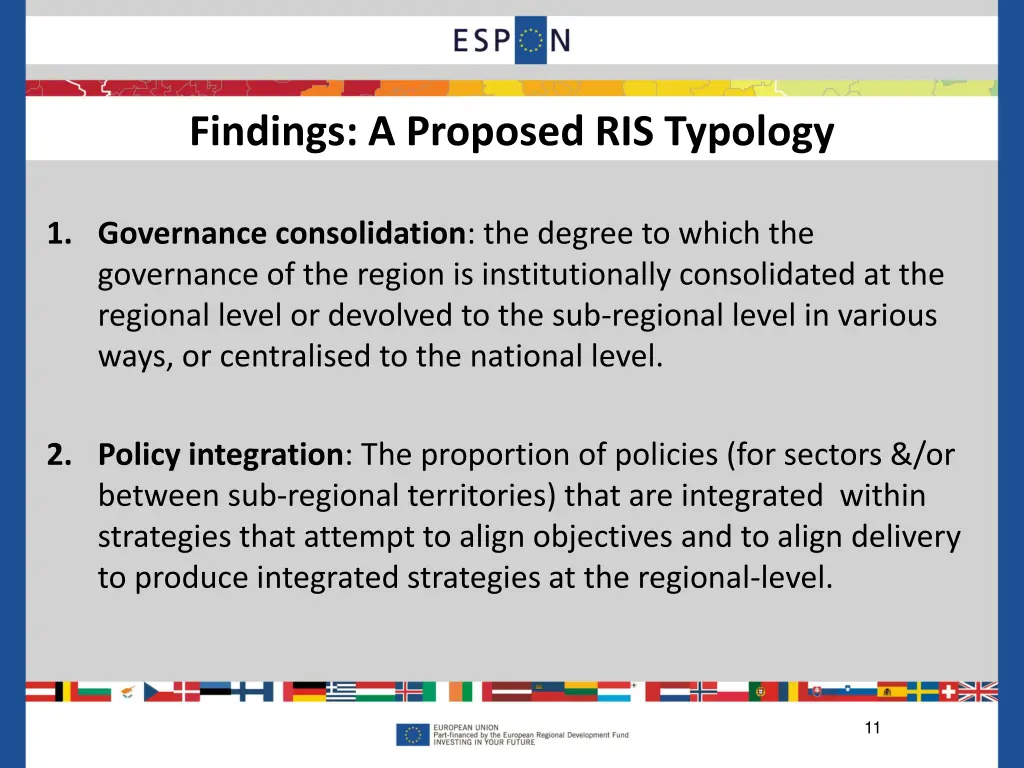
Findings: A Proposed RIS Typology 1. Governance consolidation: the degree to which the governance of the region is institutionally consolidated at the regional level or devolved to the sub-regional level in various ways, or centralised to the national level. 2. Policy integration: The proportion of policies (for sectors &/or between sub-regional territories) that are integrated within strategies that attempt to align objectives and to align delivery to produce integrated strategies at the regional-level. 11
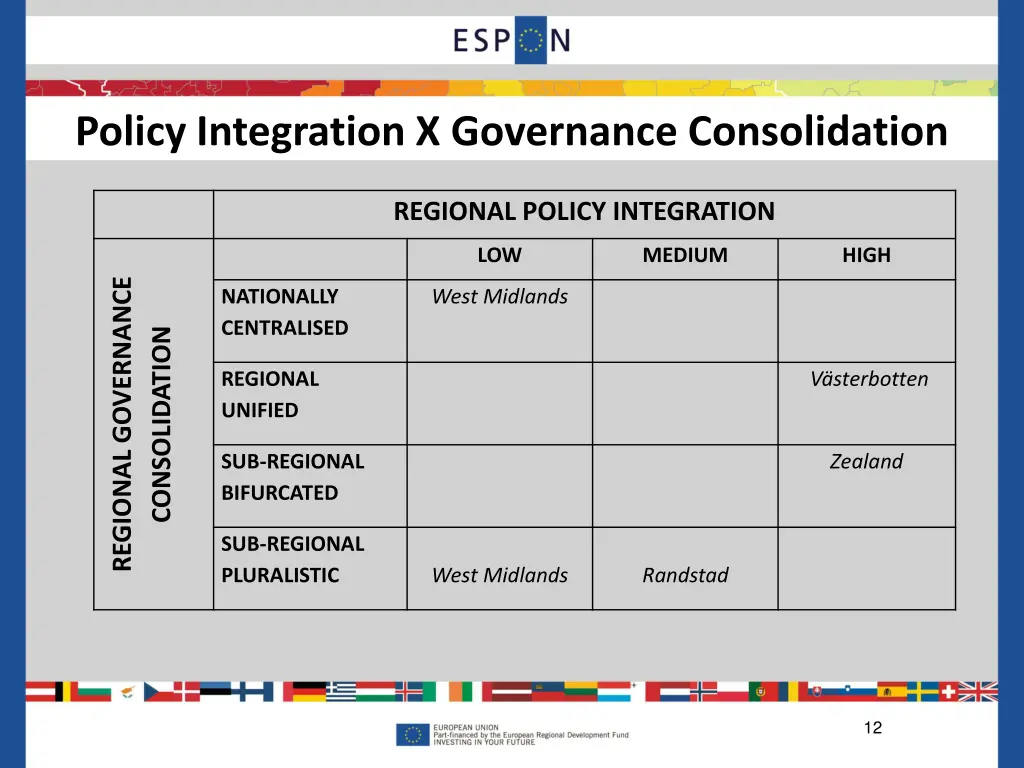
Policy Integration X Governance Consolidation REGIONAL POLICY INTEGRATION LOW MEDIUM HIGH REGIONAL GOVERNANCE NATIONALLY CENTRALISED West Midlands CONSOLIDATION REGIONAL UNIFIED V sterbotten SUB-REGIONAL BIFURCATED Zealand SUB-REGIONAL PLURALISTIC West Midlands Randstad 12
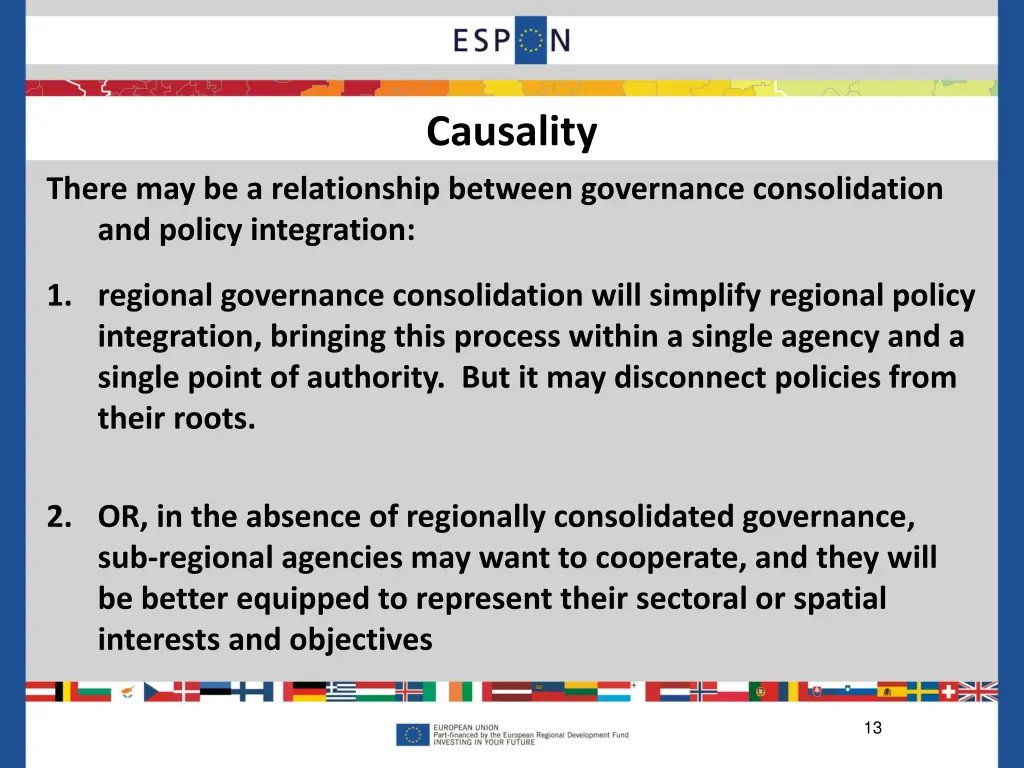
Causality There may be a relationship between governance consolidation and policy integration: 1. regional governance consolidation will simplify regional policy integration, bringing this process within a single agency and a single point of authority. But it may disconnect policies from their roots. 2. OR, in the absence of regionally consolidated governance, sub-regional agencies may want to cooperate, and they will be better equipped to represent their sectoral or spatial interests and objectives 13
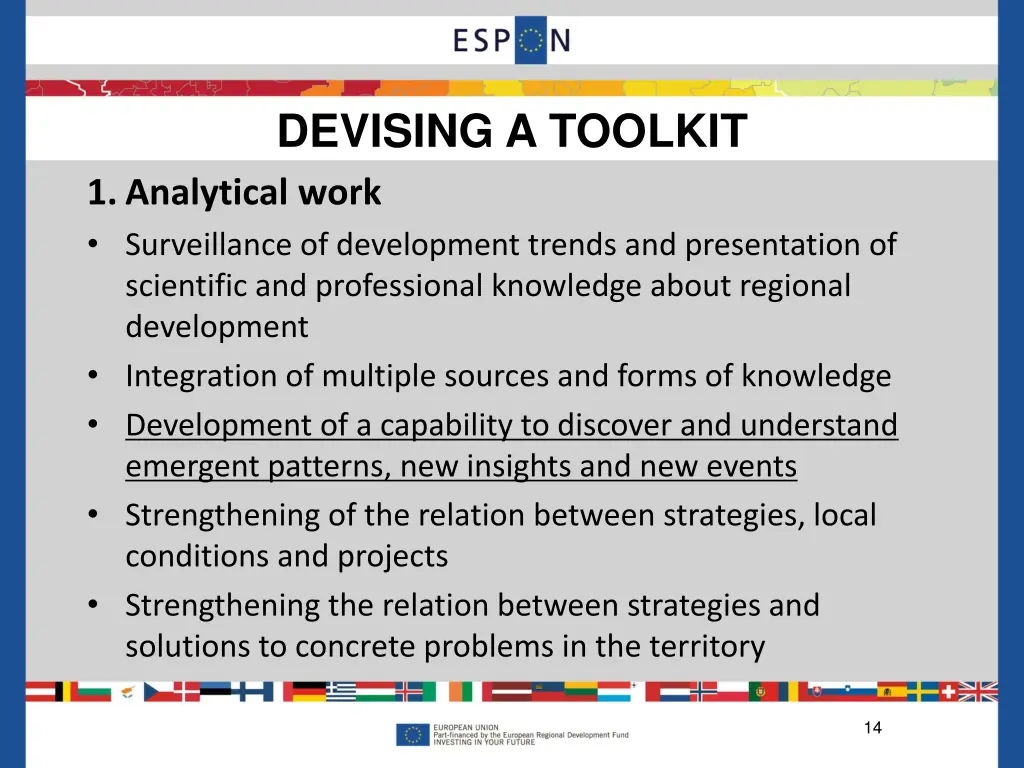
DEVISING A TOOLKIT 1.Analytical work Surveillance of development trends and presentation of scientific and professional knowledge about regional development Integration of multiple sources and forms of knowledge Development of a capability to discover and understand emergent patterns, new insights and new events Strengthening of the relation between strategies, local conditions and projects Strengthening the relation between strategies and solutions to concrete problems in the territory 14
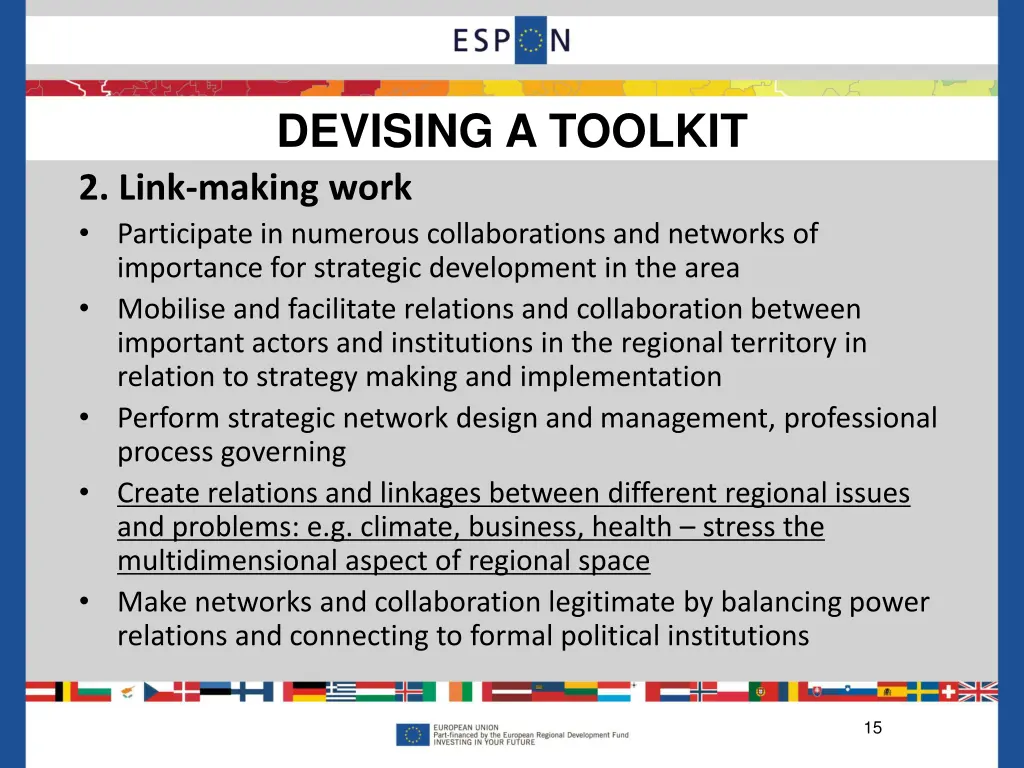
DEVISING A TOOLKIT 2. Link-making work Participate in numerous collaborations and networks of importance for strategic development in the area Mobilise and facilitate relations and collaboration between important actors and institutions in the regional territory in relation to strategy making and implementation Perform strategic network design and management, professional process governing Create relations and linkages between different regional issues and problems: e.g. climate, business, health stress the multidimensional aspect of regional space Make networks and collaboration legitimate by balancing power relations and connecting to formal political institutions 15
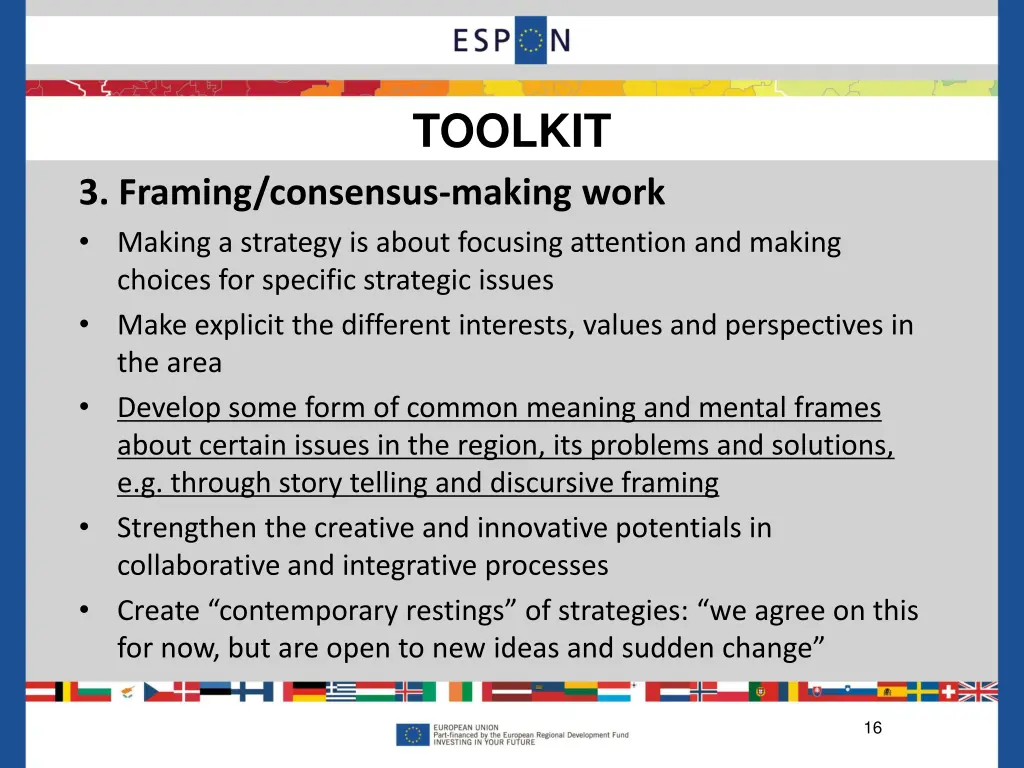
TOOLKIT 3. Framing/consensus-making work Making a strategy is about focusing attention and making choices for specific strategic issues Make explicit the different interests, values and perspectives in the area Develop some form of common meaning and mental frames about certain issues in the region, its problems and solutions, e.g. through story telling and discursive framing Strengthen the creative and innovative potentials in collaborative and integrative processes Create contemporary restings of strategies: we agree on this for now, but are open to new ideas and sudden change 16
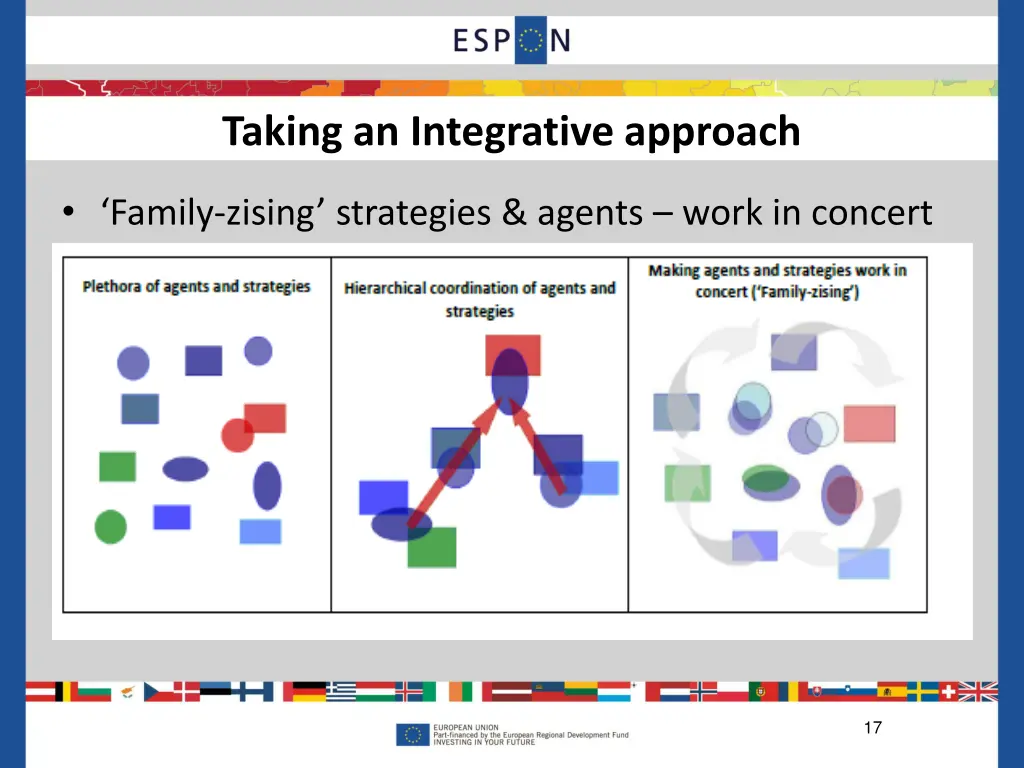
Taking an Integrative approach Family-zising strategies & agents work in concert 17
CONCLUDING REMARKS A regional integrative strategy is not a final plan but a dynamic document 18