Learn about the regulatory challenges facing the U.S. Coke Industry as discussed at the 2019 Annual Winter Meeting of the Eastern States Blast Furnace and Coke Oven Association. Explore the role of the American Coke and Coal Chemicals Institute (ACCCI) in advocating for the industry's interests and addressing key regulatory concerns.
Please find below an Image/Link to download the presentation.
The content on the website is provided AS IS for your information and personal use only. It may not be sold, licensed, or shared on other websites without obtaining consent from the author. If you encounter any issues during the download, it is possible that the publisher has removed the file from their server.
You are allowed to download the files provided on this website for personal or commercial use, subject to the condition that they are used lawfully. All files are the property of their respective owners.
The content on the website is provided AS IS for your information and personal use only. It may not be sold, licensed, or shared on other websites without obtaining consent from the author.
E N D
Presentation Transcript
Regulatory Issues Facing the U.S. Coke Industry 2019 Annual Winter Meeting of the Eastern States Blast Furnace and Coke Oven Association Thursday, 07 February 2019 Sheraton Pittsburgh Airport Hotel (Pittsburgh, PA) David C. Ailor, P.E. President American Coke and Coal Chemicals Institute 25 Massachusetts Avenue, N.W., Suite 800 Washington, D.C. 20001 USA Tel.: 703-795-3541 Fax: 866-422-7794 e-mail: dailor@accci.org
PRESENTATION OVERVIEW Overview of ACCCI/ACCCI Membership Current Status of the U.S. Coke Industry Background on the ACCCI-Managed Coke Oven Environmental Task Force (COETF) Principal Sector-Specific Regulatory Issues of Concern to the U.S. Coke Industry Principal General Industry Regulatory Issues of Concern to the Coke Industry Principal Regulatory Issues of Concern to the Coal Chemicals Industry 2 Other Important Regulatory Affairs Issues
OVERVIEW OF ACCCI The American Coke and Coal Chemicals Institute (ACCCI) was formed in 1944 by companies interested in establishing a forum to discuss and act upon issues of common concern to the metallurgical coke and coal chemicals industry. Today, ACCCI members represent over 95% of the metallurgical coke produced in the U.S. and Canada, including both merchant coke producers and integrated steel companies with coke production capacity, and 100% of companies producing coal chemicals in the U.S. and Canada. ACCCI s function is to advance the interests of the metallurgical coke and coal chemicals industry by communicating industry positions to members of Congress and Federal regulatory officials; cooperating with governmental agencies having jurisdiction over the industry; providing a forum for the exchange of information and discussion of issues; collecting statistics related to the industry; and, promoting the use of coke and its byproducts in the marketplace. 3
ACCCI MEMBERSHIP Merchant Producers of Metallurgical Coke Produce furnace/foundry coke for sale on the open market Steel Manufacturers that Produce Coke Produce furnace coke for use internally in their production of steel Coke Sales Agents Producers/processors of chemicals derived from distillation of coal and coal tar 4
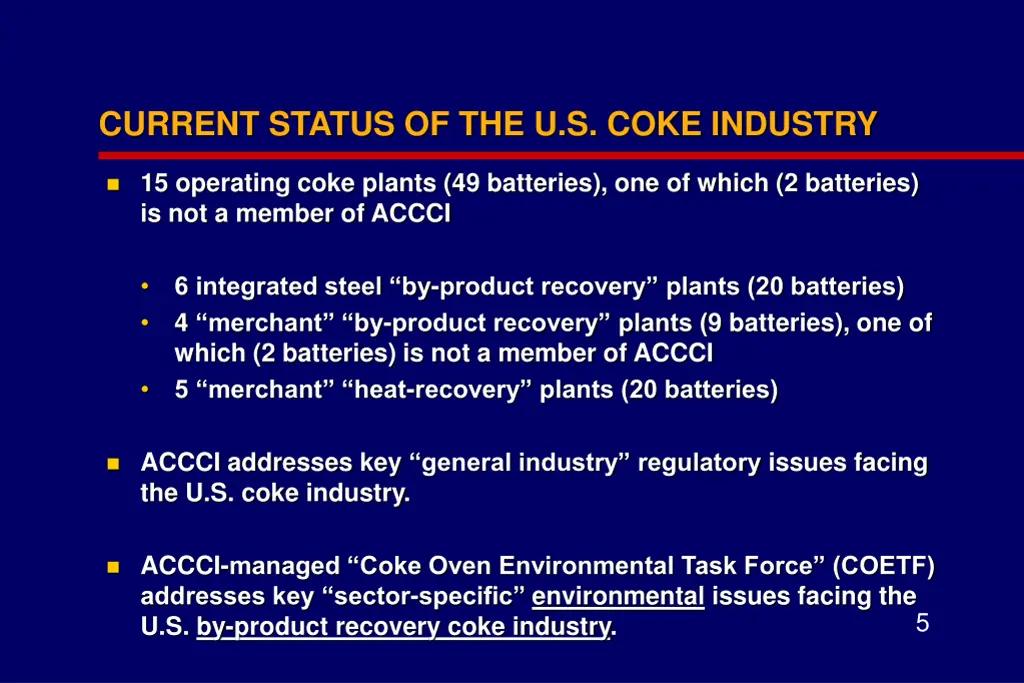
CURRENT STATUS OF THE U.S. COKE INDUSTRY 15 operating coke plants (49 batteries), one of which (2 batteries) is not a member of ACCCI 6 integrated steel by-product recovery plants (20 batteries) 4 merchant by-product recovery plants (9 batteries), one of which (2 batteries) is not a member of ACCCI 5 merchant heat-recovery plants (20 batteries) ACCCI addresses key general industry regulatory issues facing the U.S. coke industry. ACCCI-managed Coke Oven Environmental Task Force (COETF) addresses key sector-specific environmental issues facing the U.S. by-product recovery coke industry. 5
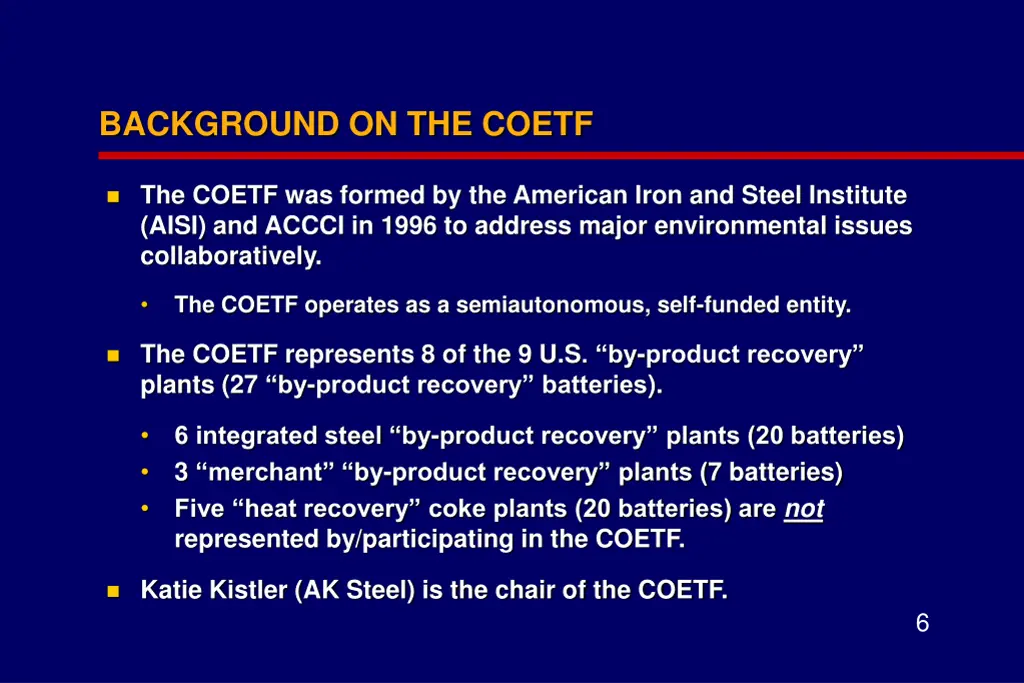
BACKGROUND ON THE COETF The COETF was formed by the American Iron and Steel Institute (AISI) and ACCCI in 1996 to address major environmental issues collaboratively. The COETF operates as a semiautonomous, self-funded entity. The COETF represents 8 of the 9 U.S. by-product recovery plants (27 by-product recovery batteries). 6 integrated steel by-product recovery plants (20 batteries) 3 merchant by-product recovery plants (7 batteries) Five heat recovery coke plants (20 batteries) are not represented by/participating in the COETF. Katie Kistler (AK Steel) is the chair of the COETF. 6
PRINCIPAL SECTOR-SPECIFIC REGULATORY ISSUES OF CONCERN TO THE U.S. COKE INDUSTRY EPA s Risk and Technology Review (RTR) of 2003 MACT Standards for Coke PQBS CAA 112(c)(6) Litigation 112(d)(6) RTR Deadline Litigation 7
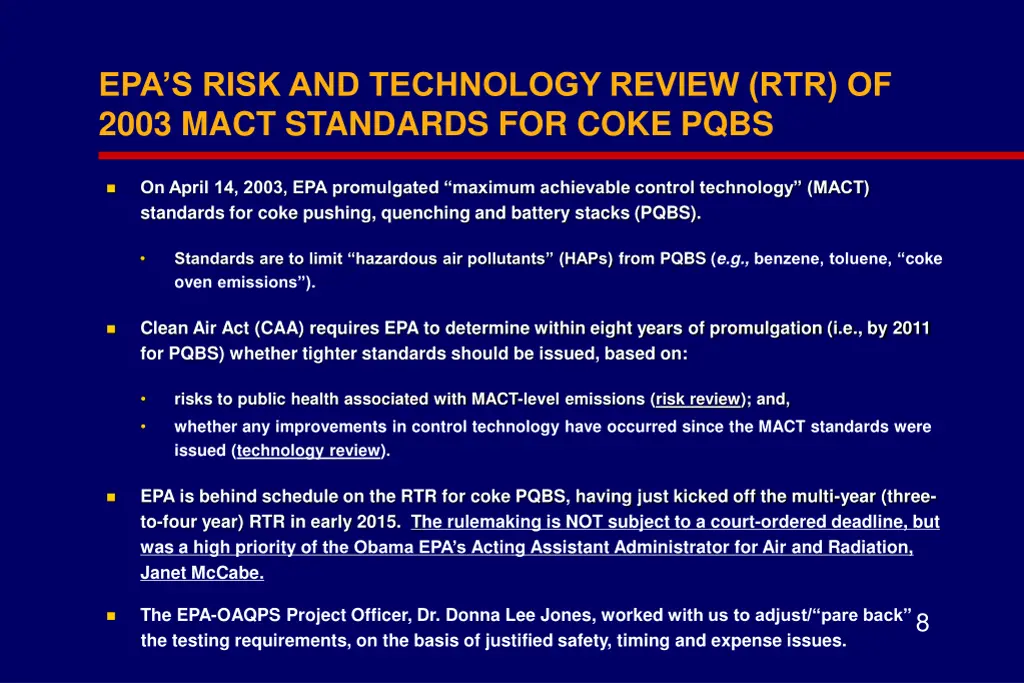
EPAS RISK AND TECHNOLOGY REVIEW (RTR) OF 2003 MACT STANDARDS FOR COKE PQBS On April 14, 2003, EPA promulgated maximum achievable control technology (MACT) standards for coke pushing, quenching and battery stacks (PQBS). Standards are to limit hazardous air pollutants (HAPs) from PQBS (e.g.,benzene, toluene, coke oven emissions ). Clean Air Act (CAA) requires EPA to determine within eight years of promulgation (i.e., by 2011 for PQBS) whether tighter standards should be issued, based on: risks to public health associated with MACT-level emissions (risk review); and, whether any improvements in control technology have occurred since the MACT standards were issued (technology review). EPA is behind schedule on the RTR for coke PQBS, having just kicked off the multi-year (three- to-four year) RTR in early 2015. The rulemaking is NOT subject to a court-ordered deadline, but was a high priority of the Obama EPA s Acting Assistant Administrator for Air and Radiation, Janet McCabe. The EPA-OAQPS Project Officer, Dr. Donna Lee Jones, worked with us to adjust/ pare back the testing requirements, on the basis of justified safety, timing and expense issues. 8
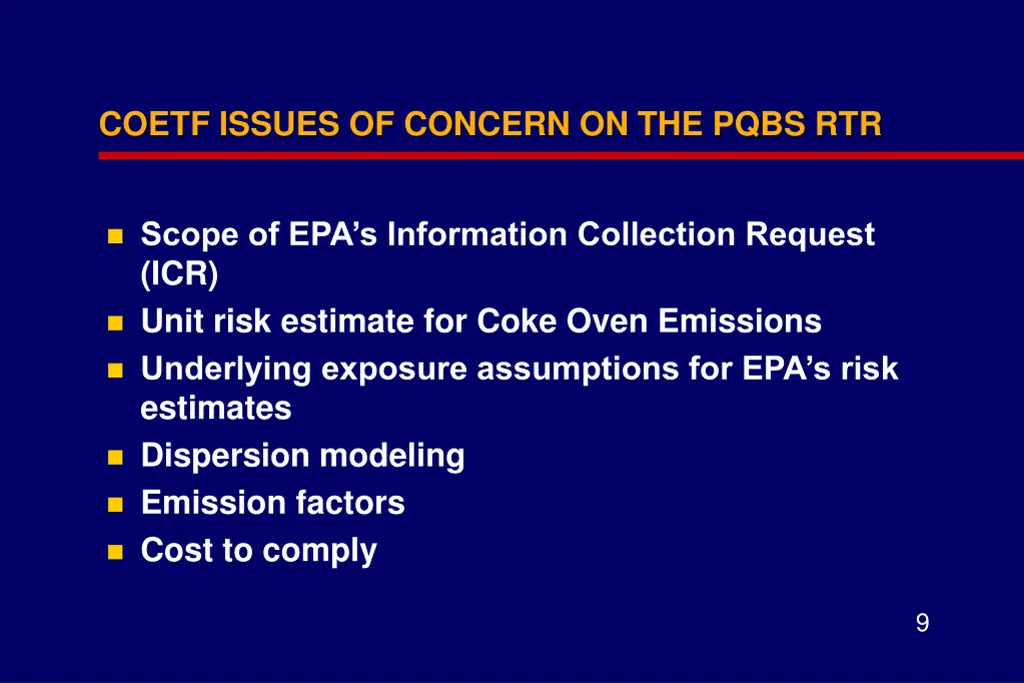
COETF ISSUES OF CONCERN ON THE PQBS RTR Scope of EPA s Information Collection Request (ICR) Unit risk estimate for Coke Oven Emissions Underlying exposure assumptions for EPA s risk estimates Dispersion modeling Emission factors Cost to comply 9
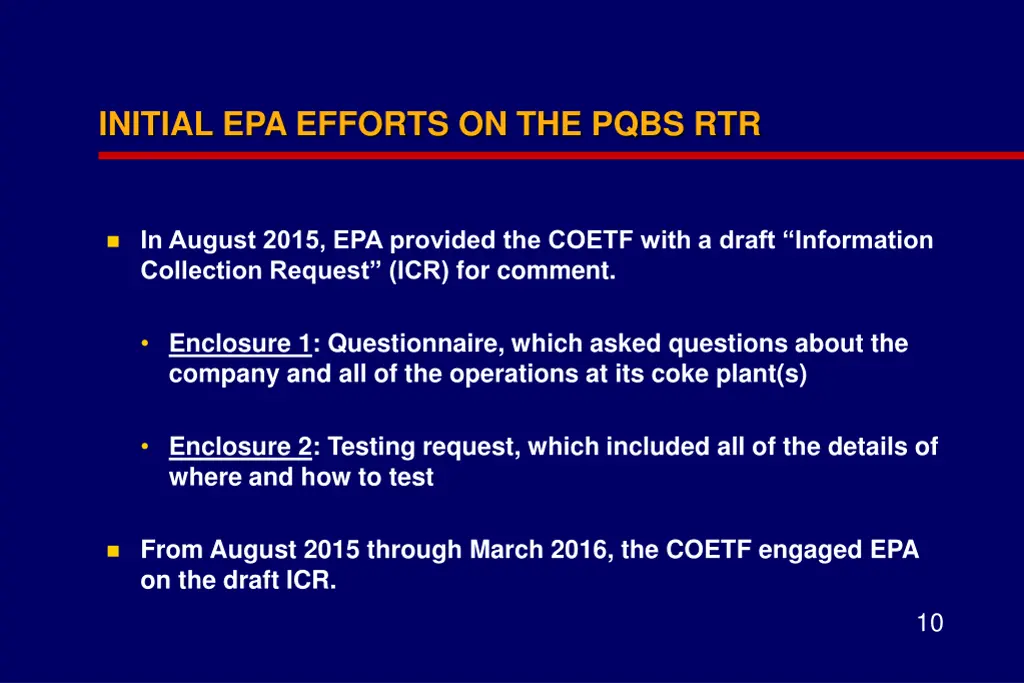
INITIAL EPA EFFORTS ON THE PQBS RTR In August 2015, EPA provided the COETF with a draft Information Collection Request (ICR) for comment. Enclosure 1: Questionnaire, which asked questions about the company and all of the operations at its coke plant(s) Enclosure 2: Testing request, which included all of the details of where and how to test From August 2015 through March 2016, the COETF engaged EPA on the draft ICR. 10
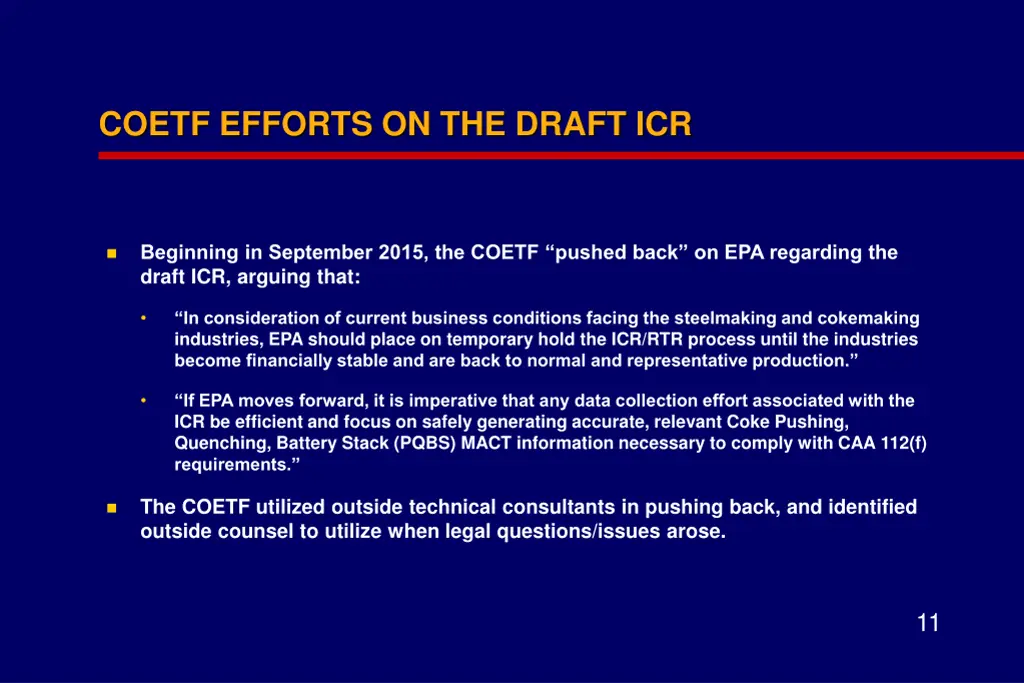
COETF EFFORTS ON THE DRAFT ICR Beginning in September 2015, the COETF pushed back on EPA regarding the draft ICR, arguing that: In consideration of current business conditions facing the steelmaking and cokemaking industries, EPA should place on temporary hold the ICR/RTR process until the industries become financially stable and are back to normal and representative production. If EPA moves forward, it is imperative that any data collection effort associated with the ICR be efficient and focus on safely generating accurate, relevant Coke Pushing, Quenching, Battery Stack (PQBS) MACT information necessary to comply with CAA 112(f) requirements. The COETF utilized outside technical consultants in pushing back, and identified outside counsel to utilize when legal questions/issues arose. 11
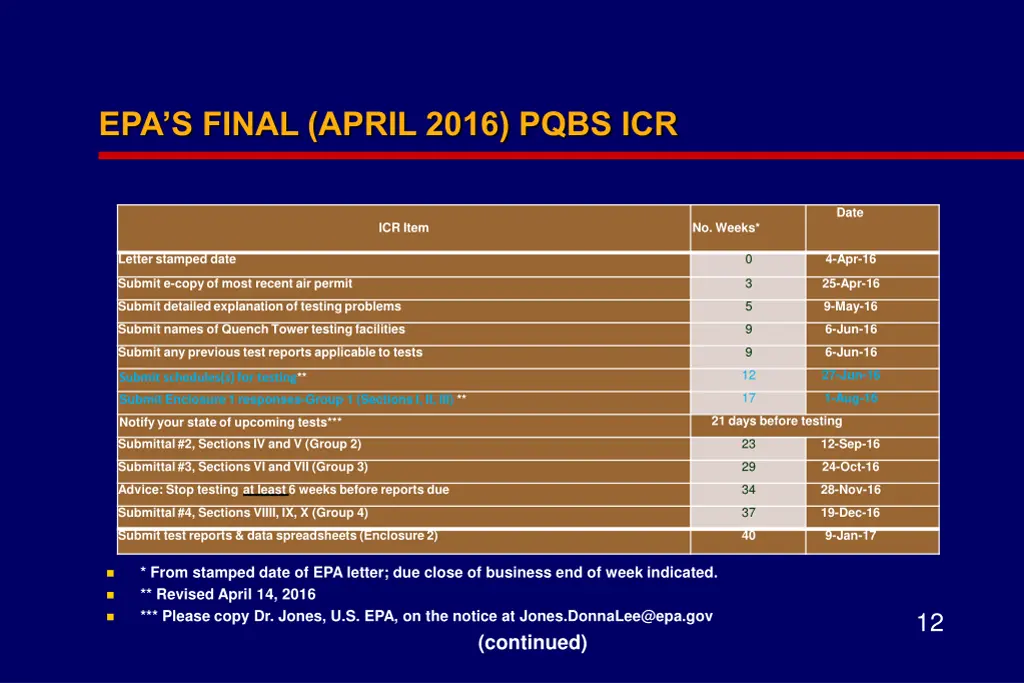
EPAS FINAL (APRIL 2016) PQBS ICR Date ICR Item No. Weeks* 0 Letter stamped date 4-Apr-16 3 Submit e-copy of most recent air permit 25-Apr-16 5 Submit detailed explanation of testing problems 9-May-16 9 Submit names of Quench Tower testing facilities 6-Jun-16 9 Submit any previous test reports applicable to tests 6-Jun-16 12 27-Jun-16 Submit schedules(s) for testing** 17 1-Aug-16 Submit Enclosure 1 responses-Group 1 (Sections I, II, III) ** 21 days before testing Notify your state of upcoming tests*** 23 Submittal #2, Sections IV and V (Group 2) 12-Sep-16 29 Submittal #3, Sections VI and VII (Group 3) 24-Oct-16 34 Advice: Stop testing at least 6 weeks before reports due 28-Nov-16 37 Submittal #4, Sections VIIII, IX, X (Group 4) 19-Dec-16 Submit test reports & data spreadsheets (Enclosure 2) 40 9-Jan-17 * From stamped date of EPA letter; due close of business end of week indicated. ** Revised April 14, 2016 *** Please copy Dr. Jones, U.S. EPA, on the notice at Jones.DonnaLee@epa.gov 12 (continued)
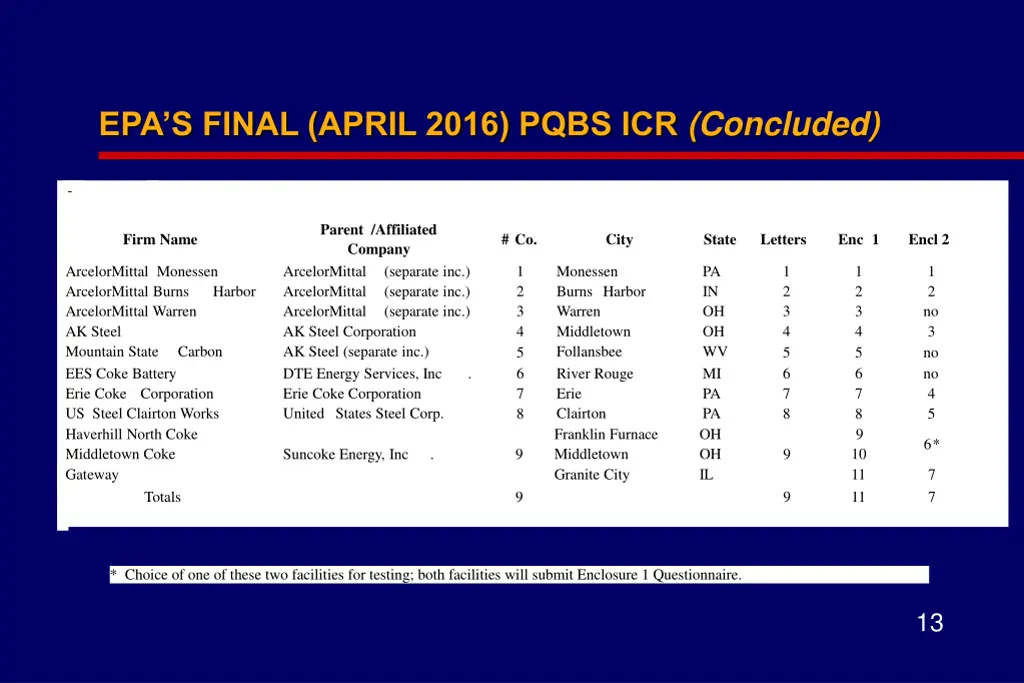
EPAS FINAL (APRIL 2016) PQBS ICR (Concluded) - Parent /Affiliated Company ArcelorMittal ArcelorMittal ArcelorMittal AK Steel Corporation AK Steel (separate inc.) DTE Energy Services, Inc Erie Coke Corporation United States Steel Corp. Firm Name # Co. City State Letters Enc 1 Encl 2 ArcelorMittal Monessen ArcelorMittal Burns ArcelorMittal Warren AK Steel Mountain State EES Coke Battery Erie Coke Corporation US Steel Clairton Works Haverhill North Coke Middletown Coke Gateway (separate inc.) (separate inc.) (separate inc.) 1 2 3 4 5 6 7 8 Monessen Burns Harbor Warren Middletown Follansbee River Rouge Erie Clairton Franklin Furnace Middletown Granite City PA IN OH OH WV MI PA PA OH OH IL 1 2 3 4 5 6 7 8 1 2 3 4 5 6 7 8 9 10 11 11 1 2 Harbor no 3 no no 4 5 Carbon . 6* Suncoke Energy, Inc . 9 9 7 7 Totals 9 9 * Choice of one of these two facilities for testing; both facilities will submit Enclosure 1 Questionnaire. 13
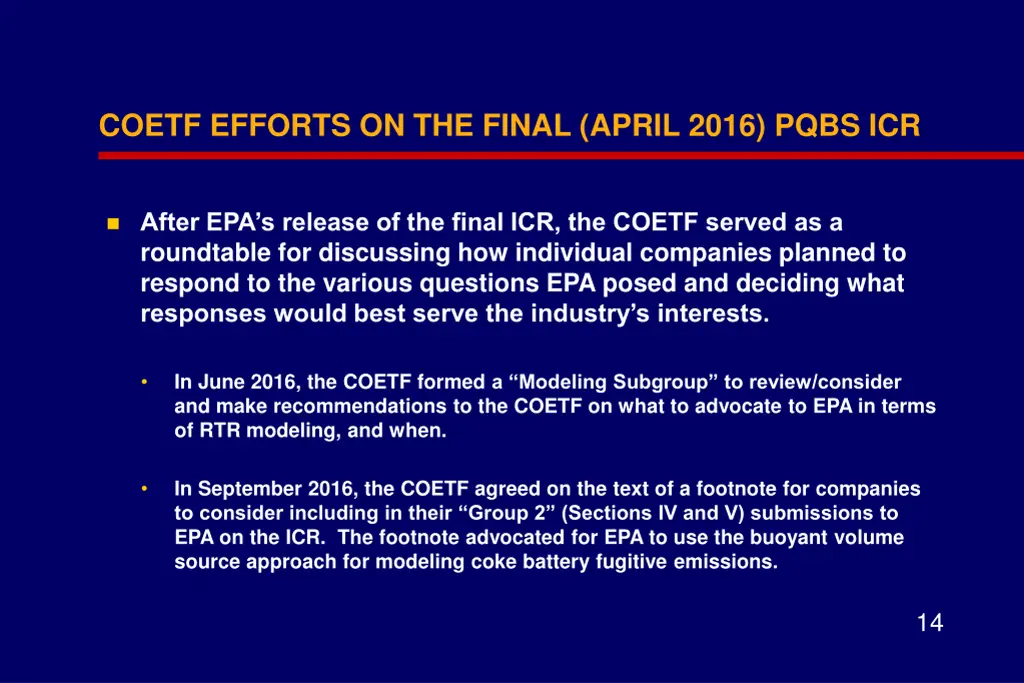
COETF EFFORTS ON THE FINAL (APRIL 2016) PQBS ICR After EPA s release of the final ICR, the COETF served as a roundtable for discussing how individual companies planned to respond to the various questions EPA posed and deciding what responses would best serve the industry s interests. In June 2016, the COETF formed a Modeling Subgroup to review/consider and make recommendations to the COETF on what to advocate to EPA in terms of RTR modeling, and when. In September 2016, the COETF agreed on the text of a footnote for companies to consider including in their Group 2 (Sections IV and V) submissions to EPA on the ICR. The footnote advocated for EPA to use the buoyant volume source approach for modeling coke battery fugitive emissions. 14
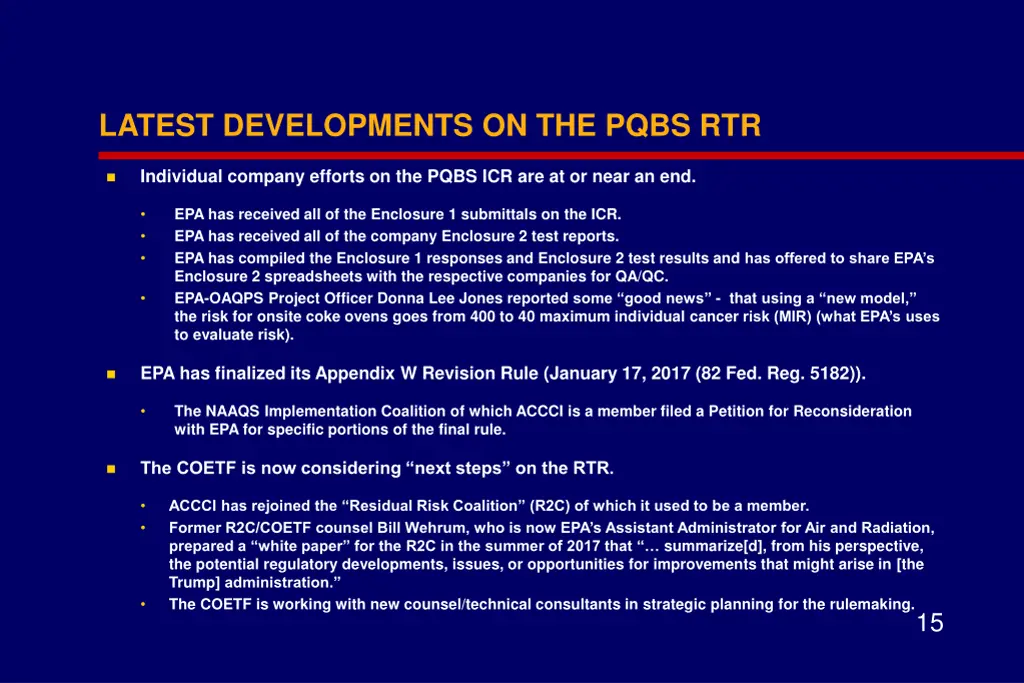
LATEST DEVELOPMENTS ON THE PQBS RTR Individual company efforts on the PQBS ICR are at or near an end. EPA has received all of the Enclosure 1 submittals on the ICR. EPA has received all of the company Enclosure 2 test reports. EPA has compiled the Enclosure 1 responses and Enclosure 2 test results and has offered to share EPA s Enclosure 2 spreadsheets with the respective companies for QA/QC. EPA-OAQPS Project Officer Donna Lee Jones reported some good news - that using a new model, the risk for onsite coke ovens goes from 400 to 40 maximum individual cancer risk (MIR) (what EPA s uses to evaluate risk). EPA has finalized its Appendix W Revision Rule (January 17, 2017 (82 Fed. Reg. 5182)). The NAAQS Implementation Coalition of which ACCCI is a member filed a Petition for Reconsideration with EPA for specific portions of the final rule. The COETF is now considering next steps on the RTR. ACCCI has rejoined the Residual Risk Coalition (R2C) of which it used to be a member. Former R2C/COETF counsel Bill Wehrum, who is now EPA s Assistant Administrator for Air and Radiation, prepared a white paper for the R2C in the summer of 2017 that summarize[d], from his perspective, the potential regulatory developments, issues, or opportunities for improvements that might arise in [the Trump] administration. The COETF is working with new counsel/technical consultants in strategic planning for the rulemaking.15
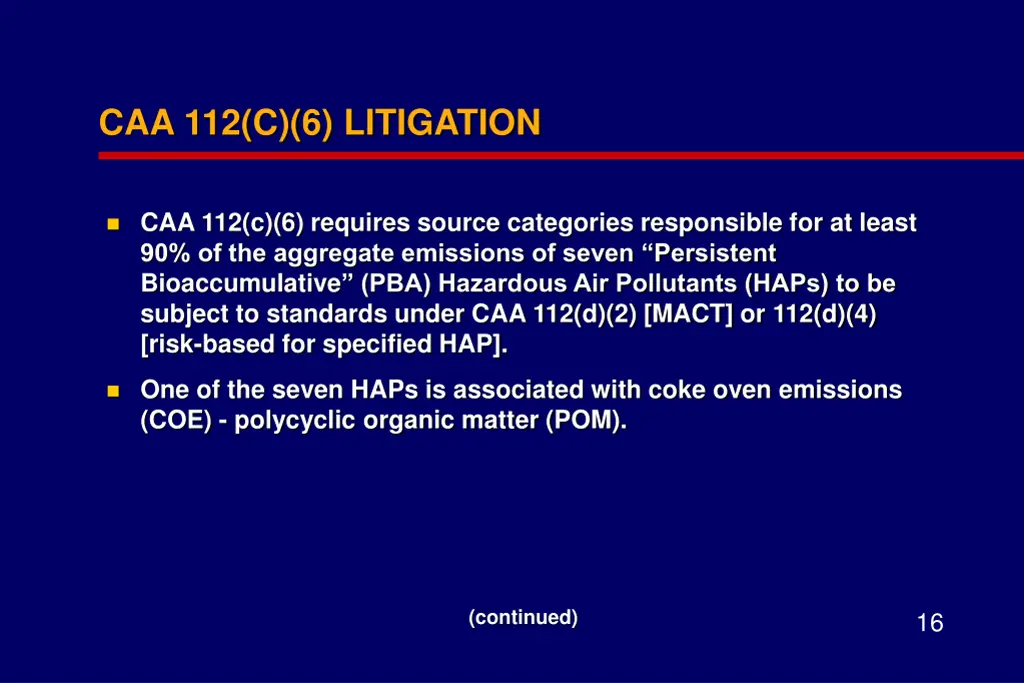
CAA 112(C)(6) LITIGATION CAA 112(c)(6) requires source categories responsible for at least 90% of the aggregate emissions of seven Persistent Bioaccumulative (PBA) Hazardous Air Pollutants (HAPs) to be subject to standards under CAA 112(d)(2) [MACT] or 112(d)(4) [risk-based for specified HAP]. One of the seven HAPs is associated with coke oven emissions (COE) - polycyclic organic matter (POM). (continued) 16
CAA 112(C)(6) LITIGATION (continued) In June 2015, EPA issued a rule stating that it had satisfied 112(c)(6) by promulgating standards for numerous specified source categories, including the NESHAPs for coke oven charging/topside/doors, by-product recovery plants, and PQBS. ENGOs filed comments on the proposed rule that EPA had not satisfied its 112(c)(6) obligations with respect to POM from coke ovens because COE is not an appropriate surrogate for POM. ENGOs argue that EPA must promulgate new MACT standards for coke ovens specifically regulating POM. (continued) 17
CAA 112(C)(6) LITIGATION (continued) In July 2015, ENGOs challenged the 112(c)(6) determination (Sierra Club v. EPA). Sierra Club challenged EPA s June 2015 determination that it had met all 112(c)(6) requirements arguing, among other things, that COE is not an appropriate surrogate for POM. Sierra Club wants EPA to promulgate new MACT standards regulating POM for coke oven charging/topside/doors, by-product recovery plants, and PQBS. In June 2016, an industry coalition comprised of seven associations (ACCCI, ACA, ACC, AF&PA, AFPM, AISI and NACWA) filed an amicus brief in support of EPA, arguing: ENGO claims are time barred; ENGO claims were raised previously and not pursued; and, EPA developed an adequate factual basis for use of surrogates. 18 (continued)
CAA 112(C)(6) LITIGATION (Concluded) On July 18, 2017, the U.S. Court of Appeals for the D.C. Circuit remanded but did not vacate the completeness determination on procedural grounds, holding that EPA failed to respond to Sierra Club s rulemaking comments regarding the reasonableness of EPA s pollutant surrogacy claims. As a result of the court s decision, EPA must respond to the comments on the pollutant surrogate issue for each of the 17 source categories challenged in the case, including subparts L and CCCCC. Implications: It is unlikely that EPA will set new MACT standards for POM. EPA has flexibility to address the surrogate issue comments in upcoming RTR rulemakings (for PQBS and several of the other source categories) or in a consolidated response to comments for all 17 source categories. POM-COE surrogacy issue may come up in the PQBS RTR rulemaking . 19
CAA 112(D)(6) RTR DEADLINE LITIGATION CAA 112(d)(6) EPA must review and revise existing NESHAPs as necessary (taking into account developments in practices, processes, and control technologies) no less often than every 8 years. April 3, 2015 ENGOs filed lawsuit in D.D.C. (CCAT v. EPA) to set court-ordered deadlines to complete RTRs for 20 source categories PQBS not included February 24, 2016 ENGOs filed a second lawsuit in D.D.C. (Blue Ridge Env. Def. Fund v. McCarthy) for 13 more source categories PQBS RTR not included (continued) 20
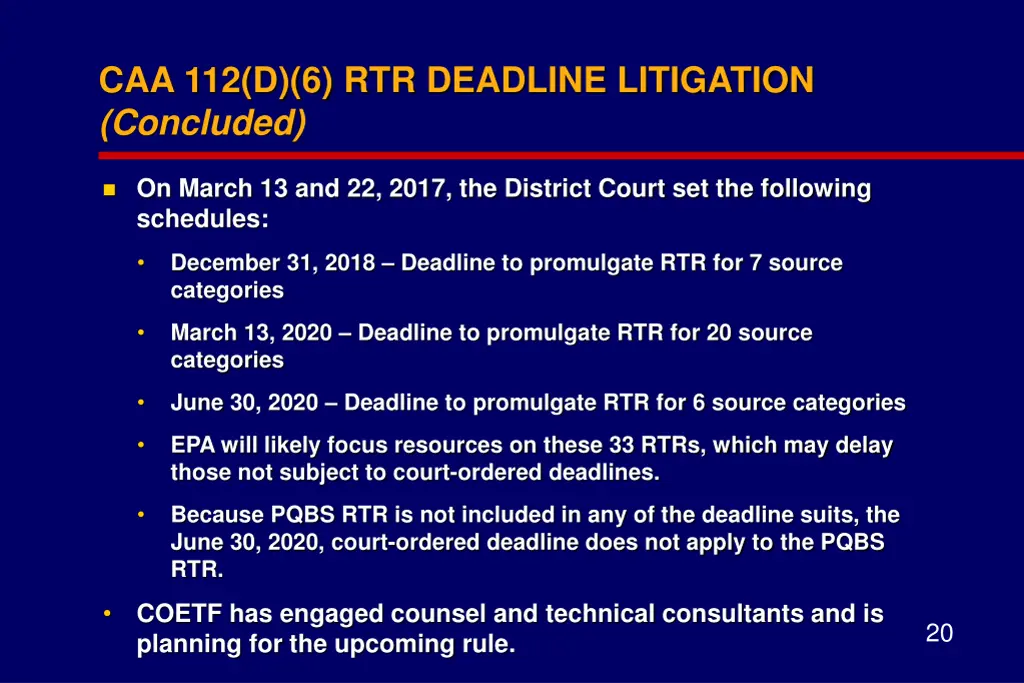
CAA 112(D)(6) RTR DEADLINE LITIGATION (Concluded) On March 13 and 22, 2017, the District Court set the following schedules: December 31, 2018 Deadline to promulgate RTR for 7 source categories March 13, 2020 Deadline to promulgate RTR for 20 source categories June 30, 2020 Deadline to promulgate RTR for 6 source categories EPA will likely focus resources on these 33 RTRs, which may delay those not subject to court-ordered deadlines. Because PQBS RTR is not included in any of the deadline suits, the June 30, 2020, court-ordered deadline does not apply to the PQBS RTR. COETF has engaged counsel and technical consultants and is planning for the upcoming rule. 20
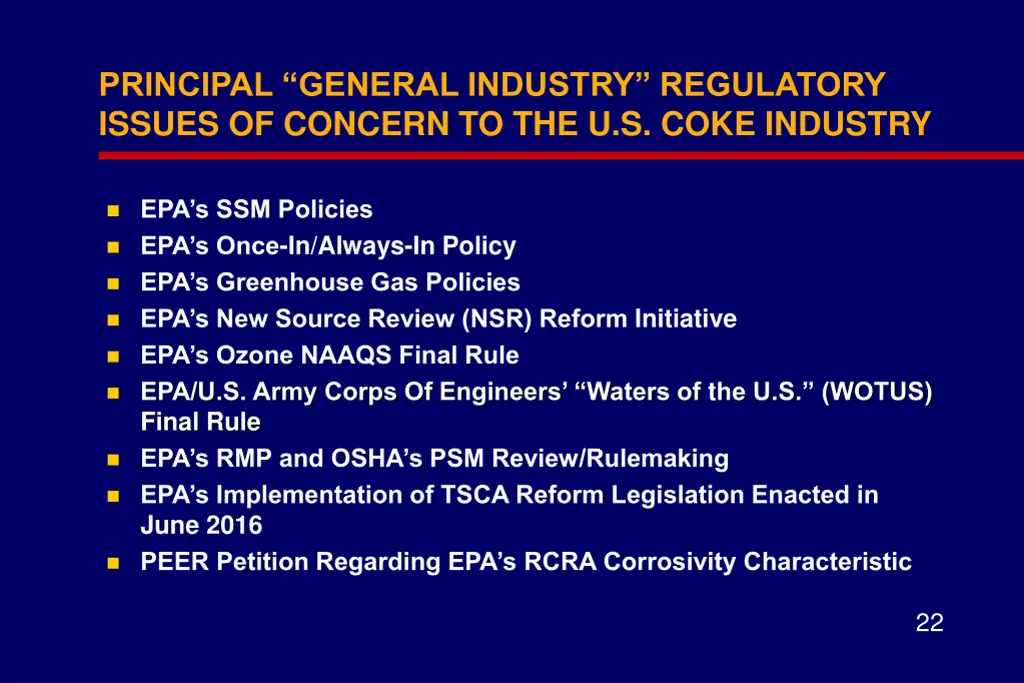
PRINCIPAL GENERAL INDUSTRY REGULATORY ISSUES OF CONCERN TO THE U.S. COKE INDUSTRY EPA s SSM Policies EPA s Once-In/Always-In Policy EPA s Greenhouse Gas Policies EPA s New Source Review (NSR) Reform Initiative EPA s Ozone NAAQS Final Rule EPA/U.S. Army Corps Of Engineers Waters of the U.S. (WOTUS) Final Rule EPA s RMP and OSHA s PSM Review/Rulemaking EPA s Implementation of TSCA Reform Legislation Enacted in June 2016 PEER Petition Regarding EPA s RCRA Corrosivity Characteristic 22
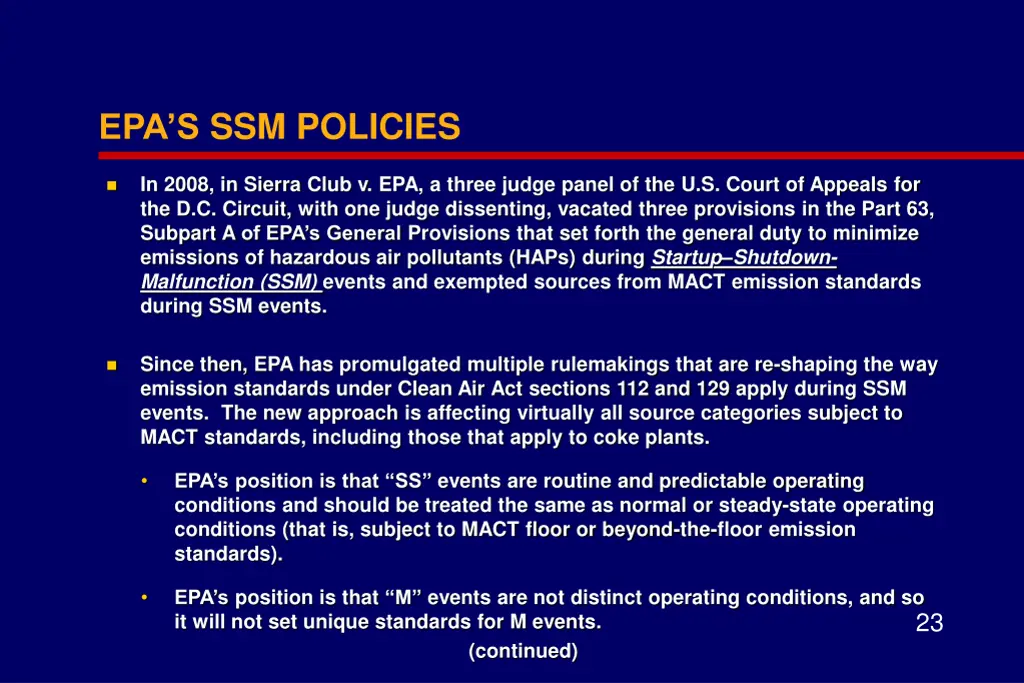
EPAS SSM POLICIES In 2008, in Sierra Club v. EPA, a three judge panel of the U.S. Court of Appeals for the D.C. Circuit, with one judge dissenting, vacated three provisions in the Part 63, Subpart A of EPA s General Provisions that set forth the general duty to minimize emissions of hazardous air pollutants (HAPs) during Startup Shutdown- Malfunction (SSM) events and exempted sources from MACT emission standards during SSM events. Since then, EPA has promulgated multiple rulemakings that are re-shaping the way emission standards under Clean Air Act sections 112 and 129 apply during SSM events. The new approach is affecting virtually all source categories subject to MACT standards, including those that apply to coke plants. EPA s position is that SS events are routine and predictable operating conditions and should be treated the same as normal or steady-state operating conditions (that is, subject to MACT floor or beyond-the-floor emission standards). EPA s position is that M events are not distinct operating conditions, and so it will not set unique standards for M events. (continued) 23
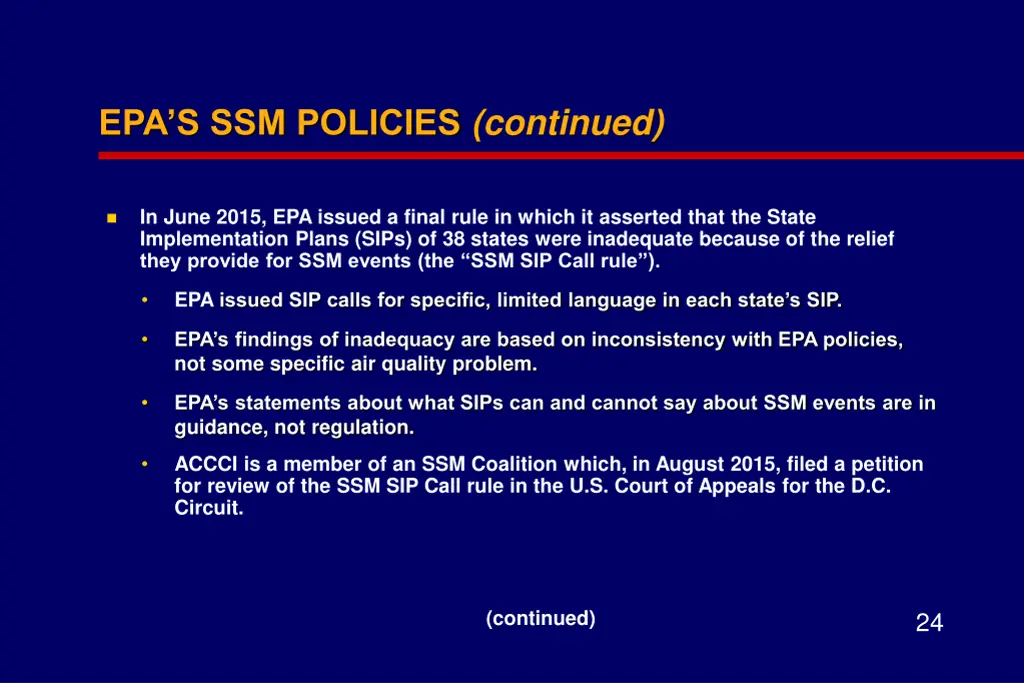
EPAS SSM POLICIES (continued) In June 2015, EPA issued a final rule in which it asserted that the State Implementation Plans (SIPs) of 38 states were inadequate because of the relief they provide for SSM events (the SSM SIP Call rule ). EPA issued SIP calls for specific, limited language in each state s SIP. EPA s findings of inadequacy are based on inconsistency with EPA policies, not some specific air quality problem. EPA s statements about what SIPs can and cannot say about SSM events are in guidance, not regulation. ACCCI is a member of an SSM Coalition which, in August 2015, filed a petition for review of the SSM SIP Call rule in the U.S. Court of Appeals for the D.C. Circuit. (continued) 24
EPAS SSM POLICIES (Concluded) State and industry petitioners in the litigation (Walter Coke v. EPA) are challenging EPA s elimination of SSM and affirmative defense provisions in 38 SIPs, arguing: that: No demonstration that SIPs are substantially inadequate to attain or maintain NAAQS; General duty and work practices provide control at all times; and, Ban on affirmative defense provisions contrary to CAA. In April 2017 (before May 2017 oral argument), the U.S. Court of Appeals for the D.C. Circuit placed the case in abeyance to allow EPA to reconsider the rule. Reconsideration is ongoing but with few developments the SSM SIP call rule technically remains in effect, but EPA HQ has directed regions not to process SIP call-related amendments. 25
EPAS ONCE-IN/ALWAYS-IN POLICY In January 2018, EPA released guidance announcing reversal of its longstanding once-in/always-in policy. Under the old policy, once a facility was subject to major source MACT, it was forever subject to those standards even if the facility s Potential to Emit (PTE) was reduced to below major source levels (10/25 tpy). New policy is based on EPA s determination that the CAA does not give authority to impose a time limitation on when a facility can become a major/area source and because the old policy created legal barriers for facilities to undertake pollution reducing changes. Under the new policy, a facility that permanently limits its PTE to below major source levels is no longer subject to major source MACT. State of California and ENGOs have filed petitions for review challenging the new guidance. Oral argument has not been scheduled, but most likely will occur in mid-2019. Open issues include whether to take advantage of the new policy, the process for implementing a major source change and legal resiliency of the new policy and potential future rulemaking. 26
EPAS GREENHOUSE GAS POLICIES On August 3, 2015, the Obama EPA took three separate but related actions to address carbon pollution from power plants: Final Clean Power Plan (CPP), President Obama s signature effort to combat carbon emissions from existing power plants; Final Carbon Pollution Standards for new, modified and reconstructed power plants; and, Proposed Federal Implementation Plan associated with the final Clean Power Plan. The Clean Power Plan, originally proposed by EPA in June 2014, is the country s first regulation of carbon emissions from the Nation s 1,500 existing power plants. the largest source of the nation s GHG pollution. Other sectors could be addressed at any time as sector-specific NSPSs are revised. (continued) 27
EPAS GREENHOUSE GAS POLICIES (continued) The associated standards could lead to the shutdown of coal plants before there is enough alternative power to replace them and, ultimately, to soaring electric bills, power blackouts and years of legal battles. If the Clean Power Plan and the other final rules survive judicial review without substantial change, they will significantly alter the way states and utilities design, plan, and operate our bulk power electric grid for decades to come. ACCCI is a member of a multi-association coalition being led by the National Association of Manufacturers (NAM, of which ACCCI is a member) and the U.S. Chamber of Commerce, which is challenging the rules. Oral argument in West Virginia v. EPA was held on September 27, 2016. In May 2017, the U.S. Court of Appeals for the D.C. Circuit placed the case in abeyance to allow EPA to reconsider under Trump Executive Order. (continued) 28
EPAS GREENHOUSE GAS POLICIES (continued) On October 16, 2017, EPA s published a CPP repeal proposed rule (82 FR 48035). EPA proposed to repeal the CPP based on a re-interpretation of CAA 111(d) that the statute does not authorize outside the fence line controls. Proposal also based the repeal on inaccuracies in the Obama Administration s calculations of costs and benefits of the CPP. New Regulatory Impact Analysis included in the proposed rule stated that repeal of the CPP would save $33 billion in 2030 due to avoided compliance costs. The comment period on the proposal closed on April 26, 2018; ACCCI was a member of a U.S. Chamber of Commerce-led coalition that commented. (continued) 29
EPAS GREENHOUSE GAS POLICIES (Concluded) On December 28, 2017, EPA published a CPP replacement advance notice of proposed rulemaking (ANPRM). EPA requested information from the public on topics related to a replacement rule for the CPP. ANPRM showed EPA s focus on federal-state cooperation in developing and implementing a rule and seeking input on BSER implemented to or at the affected EGU i.e., inside the fence line. The comment period on the proposal closed on February 26, 2018; ACCCI was a member of a U.S. Chamber of Commerce-led coalition that commented. On August 31, 2018, EPA published an Affordable Clean Energy proposal. ACCCI was a member of a U.S. Chamber of Commerce-led coalition that commented on October 31, 2018, in support of the proposal. 30
EPAS NEW SOURCE REVIEW (NSR) INITIATIVE On September 19, 2017, the Trump EPA announced a new task force to review NSR reform ideas. George W. Bush EPA s NSR reform rules have been largely overturned by courts. The goals of the Trump EPA s initiative include streamlining the NSR process, adding incentives to making investments, and providing greater certainty in outcomes. NSR reform was identified as one of the top issues in public comments to the Trump EPA s Regulatory Reform Task Force. ACCCI staff has been participating in a series of industry NSR Reform roundtables discussing what to advocate on the matter. (continued) 31
EPAS NEW SOURCE REVIEW (NSR) INITIATIVE (continued) OnMarch 13, 2018, EPA issued new guidance on emission accounting for NSR applicability: Implements project-specific emissions increase/decrease accounting to determine whether a project has a significant emissions increase; and, Implements related project emissions netting to determine whether a project has a significant net emissions increase. The U.S. Chamber of Commerce is relatively certain that opponents will file legal challenges to the memorandum and the Chamber is evaluating participation if that litigation occurs. As of April 2018, the Chamber is exploring a coalition, which ACCCI may join, geared towards providing additional legal support for the memorandum in the courts. (continued) 32
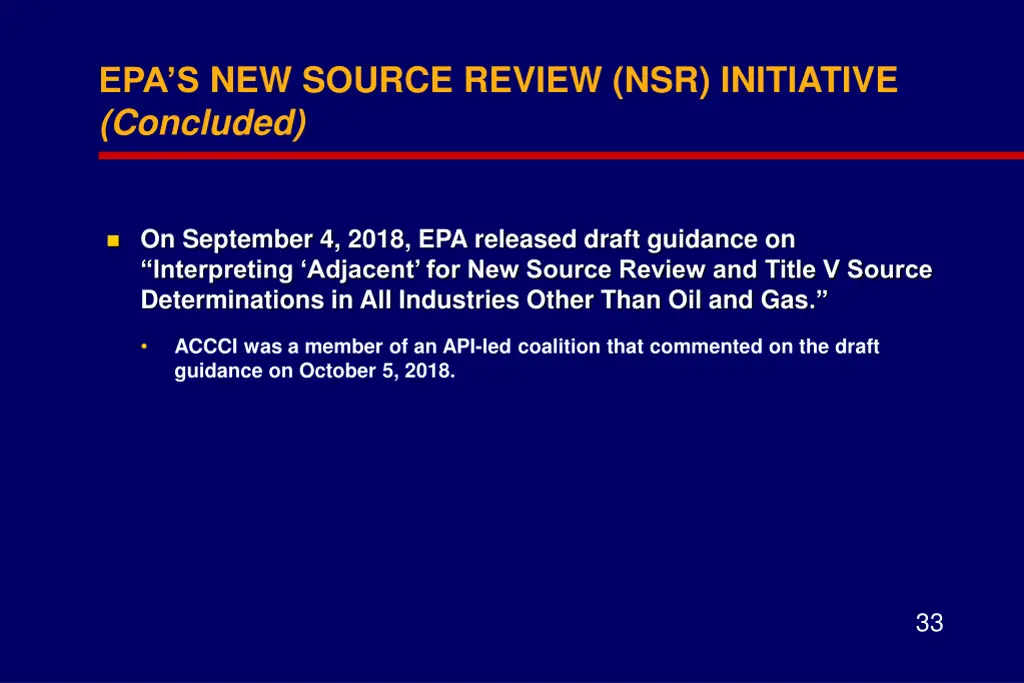
EPAS NEW SOURCE REVIEW (NSR) INITIATIVE (Concluded) On September 4, 2018, EPA released draft guidance on Interpreting Adjacent for New Source Review and Title V Source Determinations in All Industries Other Than Oil and Gas. ACCCI was a member of an API-led coalition that commented on the draft guidance on October 5, 2018. 33
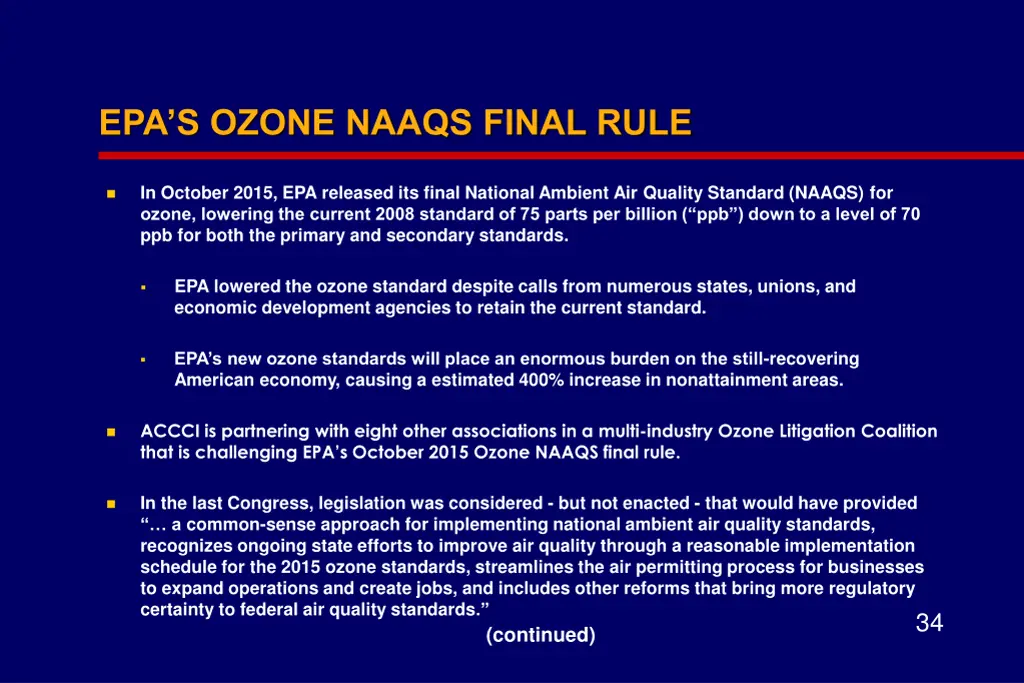
EPAS OZONE NAAQS FINAL RULE In October 2015, EPA released its final National Ambient Air Quality Standard (NAAQS) for ozone, lowering the current 2008 standard of 75 parts per billion ( ppb ) down to a level of 70 ppb for both the primary and secondary standards. EPA lowered the ozone standard despite calls from numerous states, unions, and economic development agencies to retain the current standard. EPA s new ozone standards will place an enormous burden on the still-recovering American economy, causing a estimated 400% increase in nonattainment areas. ACCCI is partnering with eight other associations in a multi-industry Ozone Litigation Coalition that is challenging EPA s October 2015 Ozone NAAQS final rule. In the last Congress, legislation was considered - but not enacted - that would have provided a common-sense approach for implementing national ambient air quality standards, recognizes ongoing state efforts to improve air quality through a reasonable implementation schedule for the 2015 ozone standards, streamlines the air permitting process for businesses to expand operations and create jobs, and includes other reforms that bring more regulatory certainty to federal air quality standards. (continued) 34
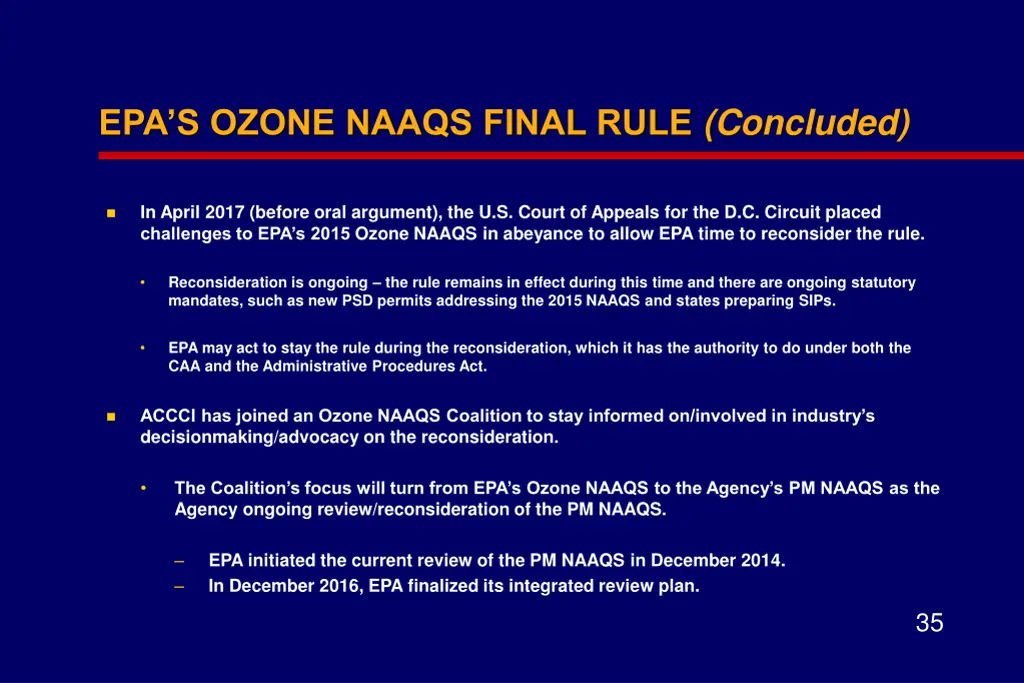
EPAS OZONE NAAQS FINAL RULE (Concluded) In April 2017 (before oral argument), the U.S. Court of Appeals for the D.C. Circuit placed challenges to EPA s 2015 Ozone NAAQS in abeyance to allow EPA time to reconsider the rule. Reconsideration is ongoing the rule remains in effect during this time and there are ongoing statutory mandates, such as new PSD permits addressing the 2015 NAAQS and states preparing SIPs. EPA may act to stay the rule during the reconsideration, which it has the authority to do under both the CAA and the Administrative Procedures Act. ACCCI has joined an Ozone NAAQS Coalition to stay informed on/involved in industry s decisionmaking/advocacy on the reconsideration. The Coalition s focus will turn from EPA s Ozone NAAQS to the Agency s PM NAAQS as the Agency ongoing review/reconsideration of the PM NAAQS. EPA initiated the current review of the PM NAAQS in December 2014. In December 2016, EPA finalized its integrated review plan. 35
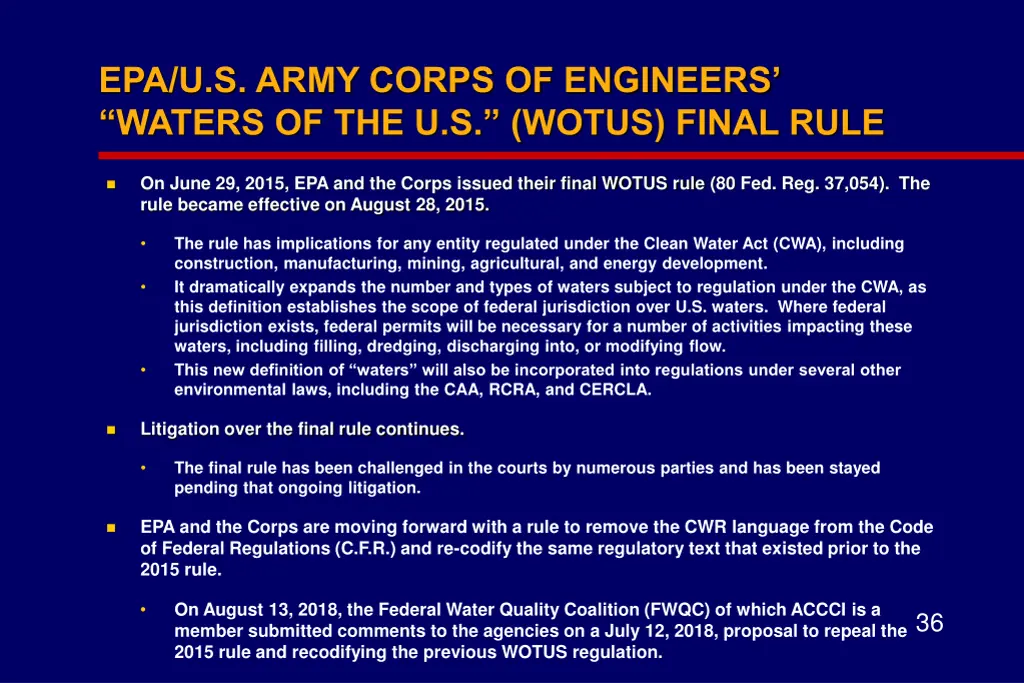
EPA/U.S. ARMY CORPS OF ENGINEERS WATERS OF THE U.S. (WOTUS) FINAL RULE On June 29, 2015, EPA and the Corps issued their final WOTUS rule (80 Fed. Reg. 37,054). The rule became effective on August 28, 2015. The rule has implications for any entity regulated under the Clean Water Act (CWA), including construction, manufacturing, mining, agricultural, and energy development. It dramatically expands the number and types of waters subject to regulation under the CWA, as this definition establishes the scope of federal jurisdiction over U.S. waters. Where federal jurisdiction exists, federal permits will be necessary for a number of activities impacting these waters, including filling, dredging, discharging into, or modifying flow. This new definition of waters will also be incorporated into regulations under several other environmental laws, including the CAA, RCRA, and CERCLA. Litigation over the final rule continues. The final rule has been challenged in the courts by numerous parties and has been stayed pending that ongoing litigation. EPA and the Corps are moving forward with a rule to remove the CWR language from the Code of Federal Regulations (C.F.R.) and re-codify the same regulatory text that existed prior to the 2015 rule. On August 13, 2018, the Federal Water Quality Coalition (FWQC) of which ACCCI is a member submitted comments to the agencies on a July 12, 2018, proposal to repeal the 2015 rule and recodifying the previous WOTUS regulation. 36
EPAS RMP AND OSHAS PSM REVIEW/RULEMAKING During the Obama Administration, EPA and OSHA, respectively, were moving forward aggressively to implement significant revisions to their Risk Management Plan (RMP) and Process Safety Management (PSM) rules that apply to facilities that use extremely hazardous substances. The agencies actions were in response to an Executive Order (EO), EO 13650, which President Obama issued on August 1, 2013, in response to an April 2013 explosion at a fertilizer facility in West, Texas, that killed 15 people and injured many others. In December 2013, OSHA announced that it was considering significant revisions to its PSM rule ("Process Safety Management and Prevention of Major Chemical Accidents ), which contains requirements for the management of hazards associated with processes using highly hazardous chemicals. On July 31, 2014, EPA announced that it was considering significant revisions to its RMP rule, which requires facilities that use extremely hazardous substances to develop an RMP. Both announcements came as a request for information (RFI). An RFI is frequently a federal agency's first public acknowledgment that it intends to pursue rulemaking. On January 13, 2017, the Obama EPA published final 112(r) RMP amendments that made major changes to the accident prevention, emergency response and public availability of chemical hazard information requirements under its RMP regulations. 37 (continued)
EPAS RMP AND OSHA PSM REVIEW/RULEMAKING (Concluded) On June 14, 2017, the Trump EPA delayed for 20 months to February 19, 2019 - the effective date of the RMP rule revisions to allow it time to conduct a reconsideration proceeding and to consider other issues that may benefit from additional comment. The Attorneys General of 11 states, labor unions and environmental and public health organizations have asked a federal judge to issue an emergency injunction blocking the delay. On March 16, 2018, a three-judge panel of the U.S. Court of Appeals for the D.C. Circuit heard oral arguments in the case. Opponents of EPA s delay urged the court to let the rule take effect. Litigation is ongoing. 38
EPAS IMPLEMENTATION OF TSCA REFORM LEGISLATION ENACTED IN JUNE 2016 During July/August 2017, EPA issued three final rules that will guide its implementation of TSCA Reform legislation enacted in June 2016 (the Frank R. Lautenberg Chemical Safety for the 21st Century Act): Inventory Reset Rule. There are currently over 85,000 chemicals on EPA s Inventory, many of these are no longer actively produced. On August 11, 2017, EPA issued the TSCA Inventory Notification (Active- Inactive) Requirements final rule (82 Fed. Reg. 37520) which requires manufacturers, including importers, to notify EPA and the public on the number of chemicals still being produced. In March 2017, ACCCI was a member of a TSCA Reform Rules Coalition that commented on EPA s proposed rule. Prioritization Rule. On July 20, 2017, EPA issued the Procedures for Prioritization of Chemicals for Risk Evaluation final rule (82 Fed. Reg. 33753) that establishes how EPA will prioritize chemicals for evaluation. EPA will use a risk-based screening process and criteria to identify whether a particular chemical is either high or low priority. A chemical designated as high-priority must undergo evaluation. Chemicals designated as low-priority are not required to undergo evaluation. ACCCI did not comment on this proposal. Risk Evaluation Rule. On July 20, 2017, EPA issued the Procedures for Chemical Risk Evaluation final rule (82 Fed. Reg. 33726) which establishes how EPA will evaluate the risk of existing chemicals. The Agency will identify steps for the risk evaluation process, including publishing the scope of the assessment. Chemical hazards and exposures will be assessed along with characterizing and determining risks. This rule also outlines how the Agency intends to seek public comment on chemical evaluations. ACCCI did not comment on this proposal. (continued) 39
EPAS IMPLEMENTATION OF TSCA REFORM LEGISLATION ENACTED IN JUNE 2016 (Concluded) During September 2017, ACCCI joined two American Chemistry Council (ACC)-led coalitions that are intervening in ENGO TSCA litigation in support of EPA and all three of the Agency s TSCA final rules. Litigation is ongoing. 40
PEER PETITION REGARDING EPAS RCRA CORROSIVITY CHARACTERISTIC The Public Employees for Environmental Responsibility (PEER) has petitioned EPA to lower the upper limit of the RCRA Corrosivity Characteristic (used to identify hazardous wastes) from pH 12.5 to pH 11.5, a 10-fold reduction; and, and to extend the standard to solid, as well as liquid materials. In June 2015, ACCCI joined a 17-association coalition focused on assisting EPA in evaluating the petition. In a September 30, 2015, letter to EPA, the coalition argued that: a rule that met the petitioners requests needlessly would subject an enormous quantity of materials, many of which currently are safely used for productive purposes, to RCRA hazardous waste requirements with no corresponding benefit in the form of improved worker, public, or environmental safety. In fact, amending the corrosivity characteristic as requested would result in classifying as hazardous millions of tons more material than could be accommodated in currently available Subtitle C landfills. (continued) 41
PEER PETITION REGARDING EPAS RCRA CORROSIVITY CHARACTERISTIC (Concluded) On April 11, 2016, EPA published in the Federal Register a tentative decision to deny the PEER petition request to amend the RCRA corrosivity characteristic. PEER asked for and received a six-month extension of the comment deadline, to December 7, 2016. On December 2, 2016, EPA denied a PEER request for a further extension. On December 7, 2016, counsel to RCRA Corrosivity Coalition via which ACCCI and other interested associations have been advocating for retention of the current standard, submitted the Coalition s final comments to EPA in support of the tentative denial of the PEER petition. On May 15, 2017, another coalition of which ACCCI is a member - the Federal Recycling and Remediation Coalition (FRRC) submitted a letter to EPA s Office of Land and Emergency Management (OLEM) setting forth Comments in Response to Executive Order 13777, Enforcing the Regulatory Reform Agenda, Seeking Input on Regulations That May Be Appropriate for Repeal, Replacement, or Modification. In one section of the comments, FRRC urged EPA to finalize its denial of the PEER petition. 42
PRINCIPAL REGULATORY ISSUES OF CONCERN TO THE COAL CHEMICALS INDUSTRY State/local legislation that would ban coal tar-based sealants Settlement Agreement Resulting from Litigation Over EPA s 2015 Multi-Sector General Permit (MSGP) 43
STATE/LOCALLEGISLATION THAT WOULD BAN USE OF COAL TAR-BASED SEALANTS Legislation that would ban use of coal tar-based sealants has been enacted or is being considered in various states/localities (e.g., NY, MI, MN, IL, ME, Chicago). Legislation is being driven by USGS scientists and handful of environmental activists and media. The Pavement Coatings Technology Council (PCTC) of which ACCCI is a member is pushing back aggressively on proposed bans, adverse publicity. 44
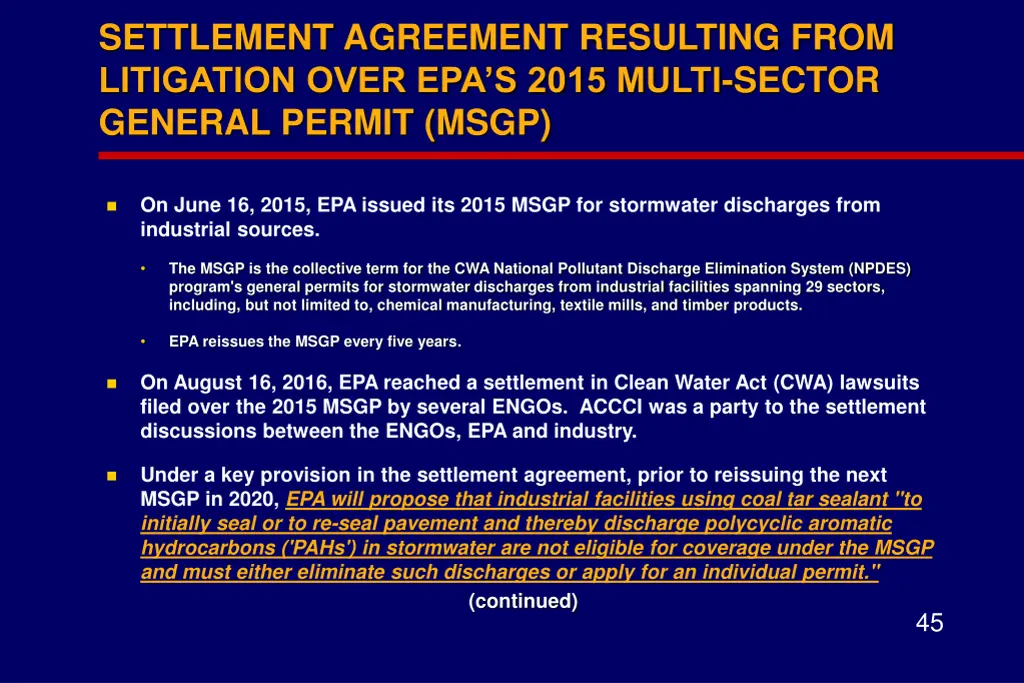
SETTLEMENT AGREEMENT RESULTING FROM LITIGATION OVER EPA S 2015 MULTI-SECTOR GENERAL PERMIT (MSGP) On June 16, 2015, EPA issued its 2015 MSGP for stormwater discharges from industrial sources. The MSGP is the collective term for the CWA National Pollutant Discharge Elimination System (NPDES) program's general permits for stormwater discharges from industrial facilities spanning 29 sectors, including, but not limited to, chemical manufacturing, textile mills, and timber products. EPA reissues the MSGP every five years. On August 16, 2016, EPA reached a settlement in Clean Water Act (CWA) lawsuits filed over the 2015 MSGP by several ENGOs. ACCCI was a party to the settlement discussions between the ENGOs, EPA and industry. Under a key provision in the settlement agreement, prior to reissuing the next MSGP in 2020, EPA will propose that industrial facilities using coal tar sealant "to initially seal or to re-seal pavement and thereby discharge polycyclic aromatic hydrocarbons ('PAHs') in stormwater are not eligible for coverage under the MSGP and must either eliminate such discharges or apply for an individual permit." (continued) 45
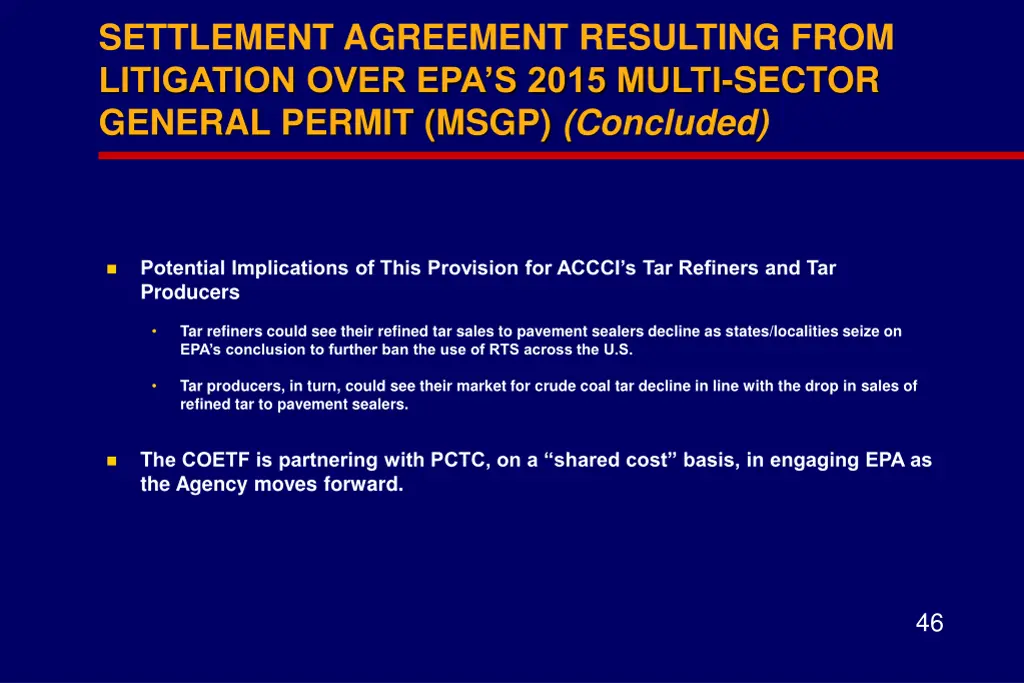
SETTLEMENT AGREEMENT RESULTING FROM LITIGATION OVER EPA S 2015 MULTI-SECTOR GENERAL PERMIT (MSGP) (Concluded) Potential Implications of This Provision for ACCCI s Tar Refiners and Tar Producers Tar refiners could see their refined tar sales to pavement sealers decline as states/localities seize on EPA s conclusion to further ban the use of RTS across the U.S. Tar producers, in turn, could see their market for crude coal tar decline in line with the drop in sales of refined tar to pavement sealers. The COETF is partnering with PCTC, on a shared cost basis, in engaging EPA as the Agency moves forward. 46
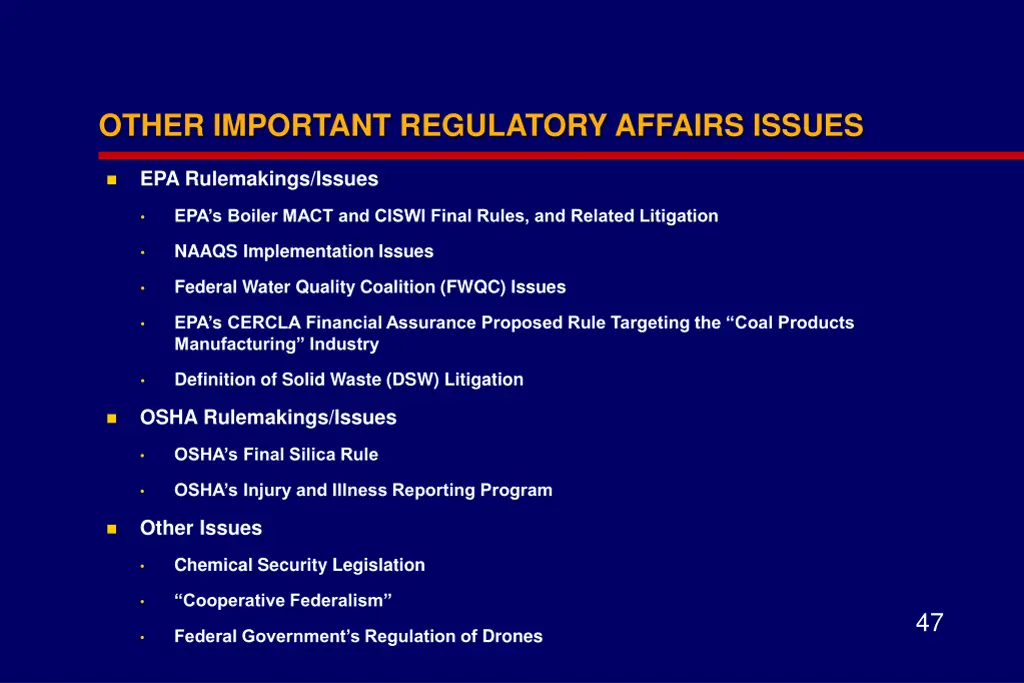
OTHER IMPORTANT REGULATORY AFFAIRS ISSUES EPA Rulemakings/Issues EPA s Boiler MACT and CISWI Final Rules, and Related Litigation NAAQS Implementation Issues Federal Water Quality Coalition (FWQC) Issues EPA s CERCLA Financial Assurance Proposed Rule Targeting the Coal Products Manufacturing Industry Definition of Solid Waste (DSW) Litigation OSHA Rulemakings/Issues OSHA s Final Silica Rule OSHA s Injury and Illness Reporting Program Other Issues Chemical Security Legislation Cooperative Federalism 47 Federal Government s Regulation of Drones
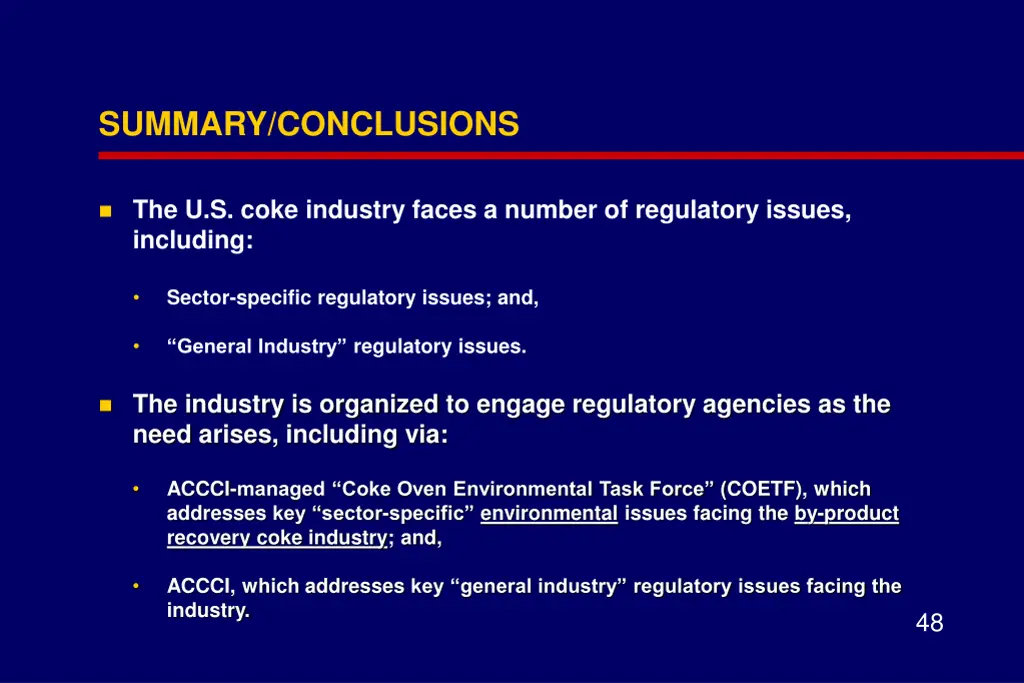
SUMMARY/CONCLUSIONS The U.S. coke industry faces a number of regulatory issues, including: Sector-specific regulatory issues; and, General Industry regulatory issues. The industry is organized to engage regulatory agencies as the need arises, including via: ACCCI-managed Coke Oven Environmental Task Force (COETF), which addresses key sector-specific environmental issues facing the by-product recovery coke industry; and, ACCCI, which addresses key general industry regulatory issues facing the industry. 48