This study delves into the critical connection between patient safety climate and adherence to standard precautions in healthcare settings. It explores the impact on healthcare workers, patients, and the prevalence and preventability of healthcare-associated infections. The research aims to enhance understanding, improve practices, and reduce risks in healthcare environments.
Please find below an Image/Link to download the presentation.
The content on the website is provided AS IS for your information and personal use only. It may not be sold, licensed, or shared on other websites without obtaining consent from the author. If you encounter any issues during the download, it is possible that the publisher has removed the file from their server.
You are allowed to download the files provided on this website for personal or commercial use, subject to the condition that they are used lawfully. All files are the property of their respective owners.
The content on the website is provided AS IS for your information and personal use only. It may not be sold, licensed, or shared on other websites without obtaining consent from the author.
E N D
Presentation Transcript
Exploring the Relationship between Exploring the Relationship between Patient Safety Climate and Adherence Patient Safety Climate and Adherence to Standard Precautions to Standard Precautions Amanda Hessels, PhD, MPH, RN, CIC, CPHQ, FAPIC Associate Research Scientist, Columbia University, School of Nursing Nurse Scientist, Hackensack-Meridian Health Hosted by Prof. Elaine Larson Columbia University School of Nursing September 14, 2017 September 14, 2017 www.webbertraining.com www.webbertraining.com
Objectives Objectives Describe the design and testing of standard precaution and safety climate tools Summarize key pilot study findings Describe expanded study plans Discuss potential use of tools 2
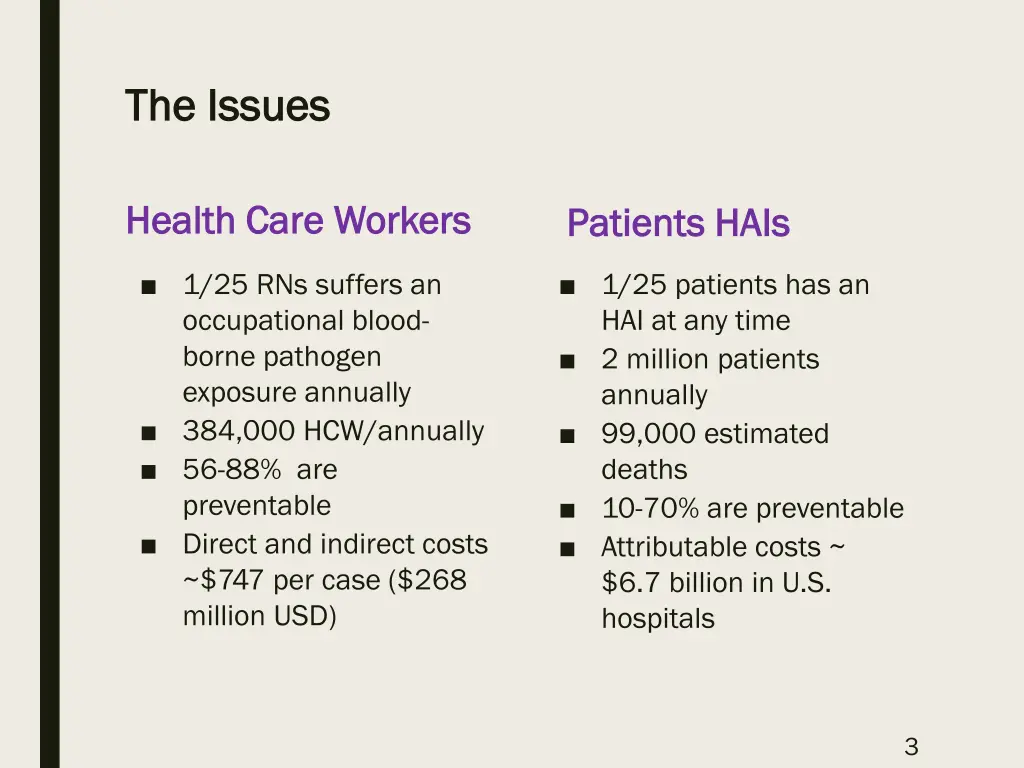
The Issues The Issues Health Care Workers Health Care Workers Patients HAIs Patients HAIs 1/25 RNs suffers an occupational blood- borne pathogen exposure annually 384,000 HCW/annually 56-88% are preventable Direct and indirect costs ~$747 per case ($268 million USD) 1/25 patients has an HAI at any time 2 million patients annually 99,000 estimated deaths 10-70% are preventable Attributable costs ~ $6.7 billion in U.S. hospitals 3
What are Standard Precautions (SP)? What are Standard Precautions (SP)? Primary strategy Primary strategy for the prevention of healthcare-associated transmission of infectious agents among patients and healthcare personnel, (Seigel et al., 2007). 4
Scope of SP Scope of SP SP apply to: SP apply to: all all patients all all healthcare settings all all the time Base of the HAI prevention pyramid 5
SP Components & Actions SP Components & Actions hand hygiene personal protective equipment (PPE) safe use and disposal of sharps decontamination of environment and equipment patient placement linen and waste management 6
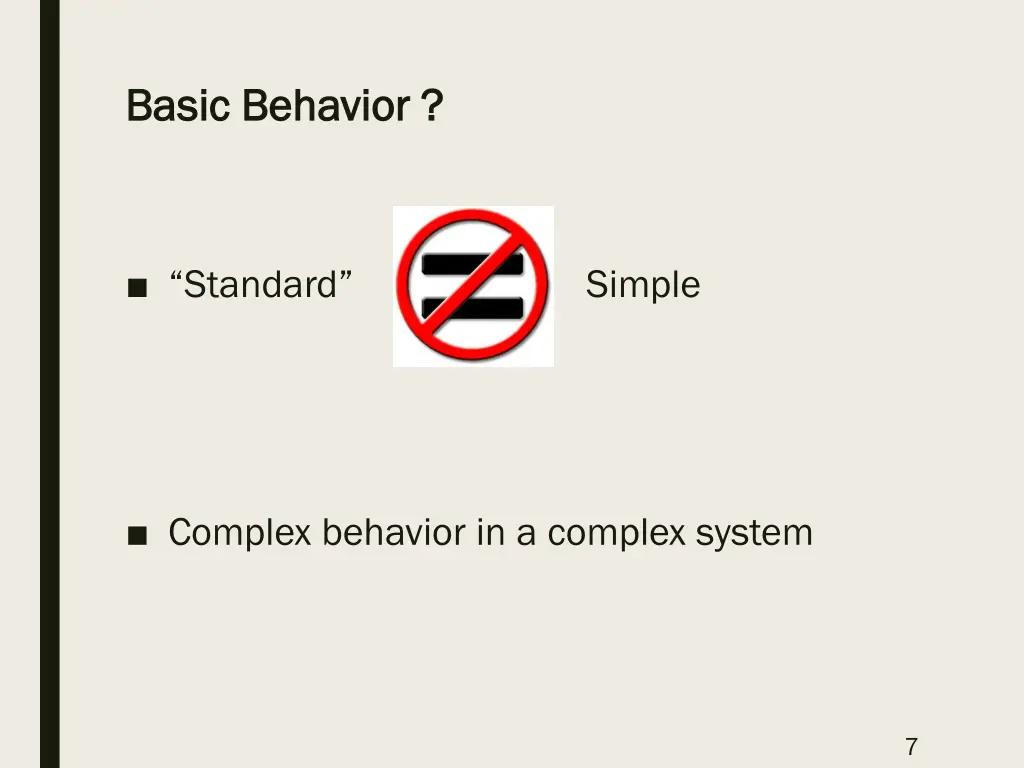
Basic Behavior ? Basic Behavior ? Standard Simple Complex behavior in a complex system 7
The Problem: Low SP Adherence The Problem: Low SP Adherence Current and important Likely to continue Affects large population: all patients and providers Possible/significant consequences: HAIs and HCW exposure/injury Incompletely described and explained Antecedents include patient safety climate (PSC) 8
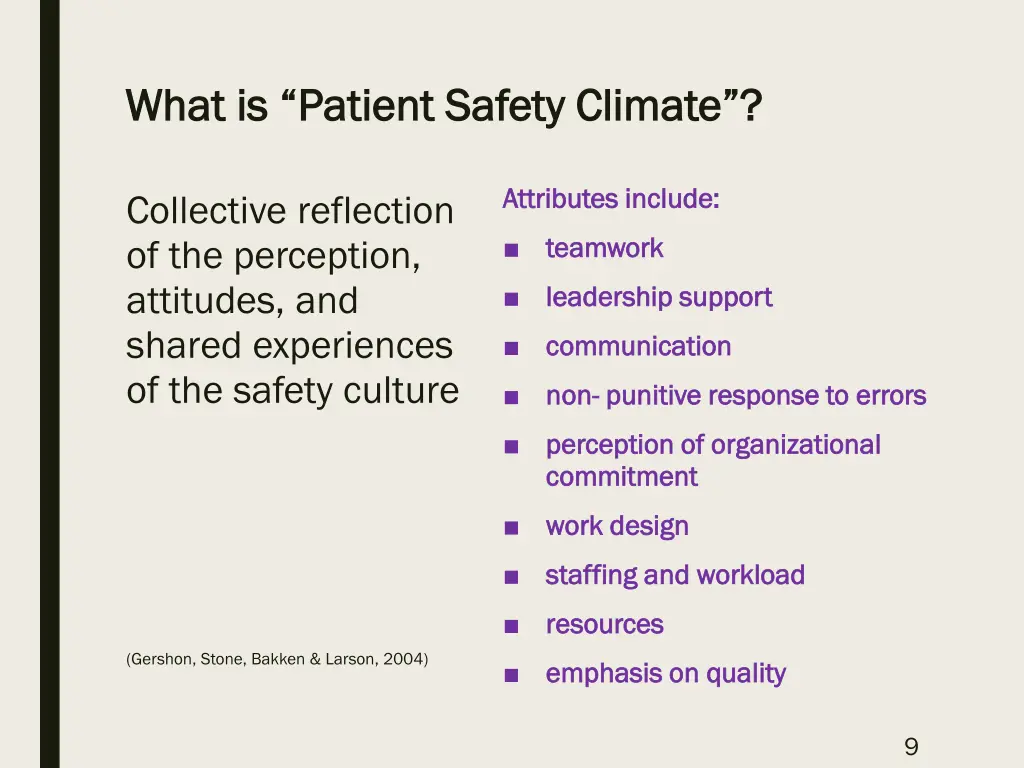
What is Patient Safety Climate? What is Patient Safety Climate ? Attributes include: Attributes include: Collective reflection of the perception, attitudes, and shared experiences of the safety culture teamwork teamwork leadership support leadership support communication communication non non- - punitive response to errors punitive response to errors perception of organizational perception of organizational commitment commitment work design work design staffing and workload staffing and workload resources resources (Gershon, Stone, Bakken & Larson, 2004) emphasis on quality emphasis on quality 9
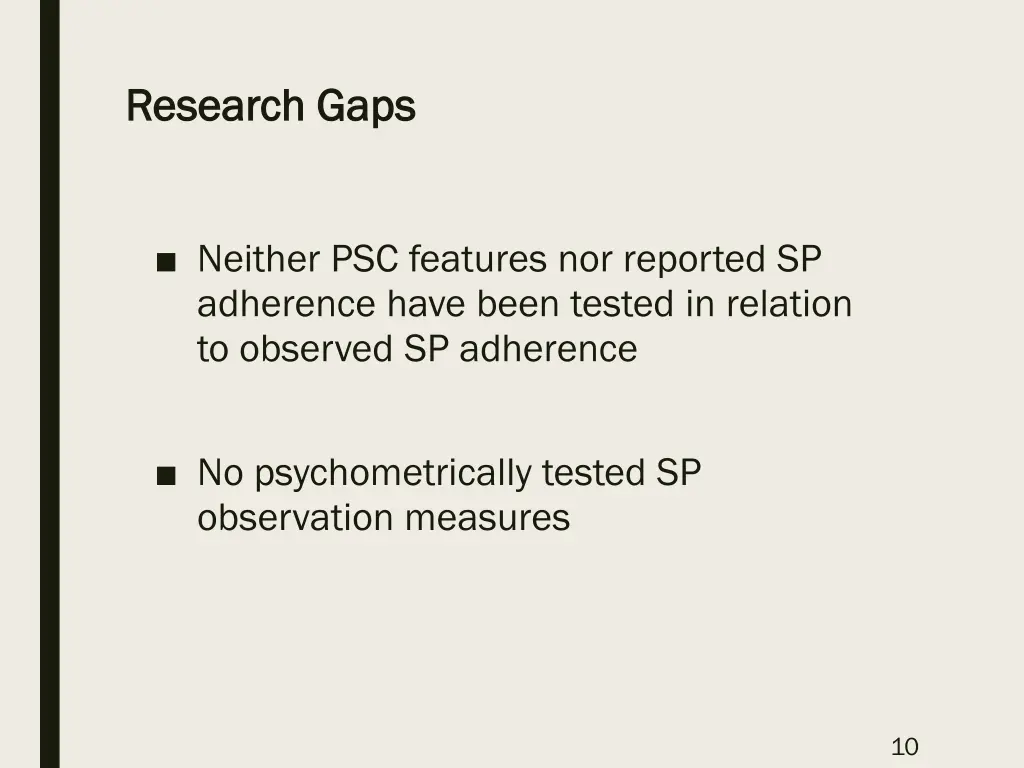
Research Gaps Research Gaps Neither PSC features nor reported SP adherence have been tested in relation to observed SP adherence No psychometrically tested SP observation measures 10
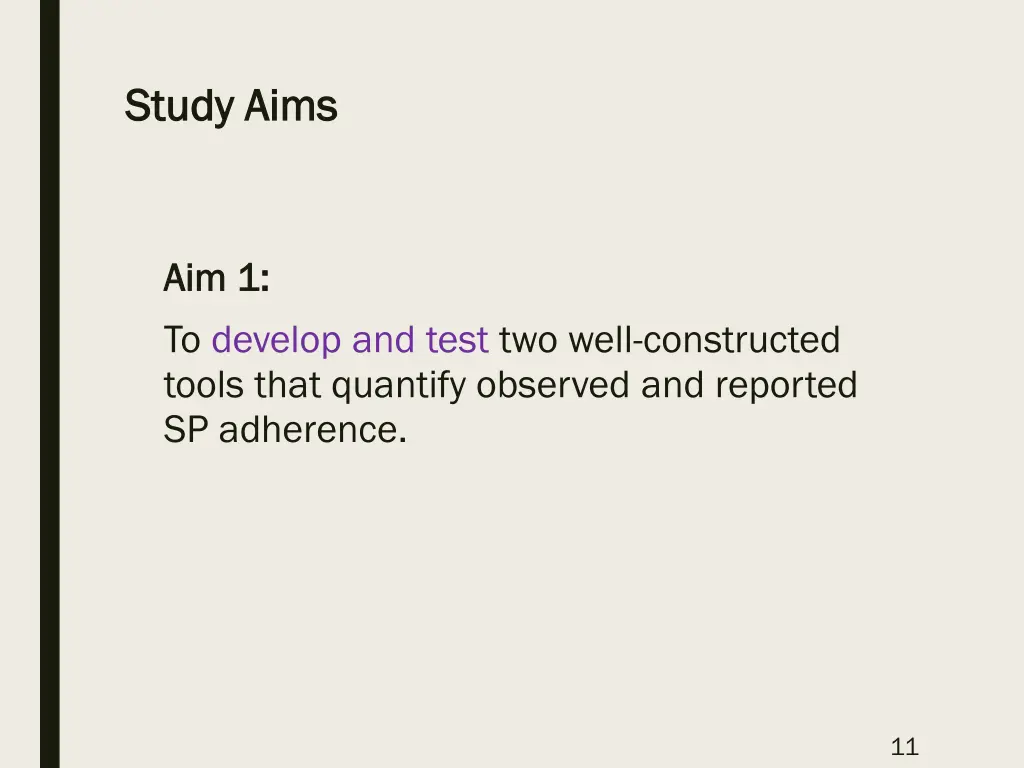
Study Aims Study Aims Aim 1: Aim 1: To develop and test two well-constructed tools that quantify observed and reported SP adherence. 11
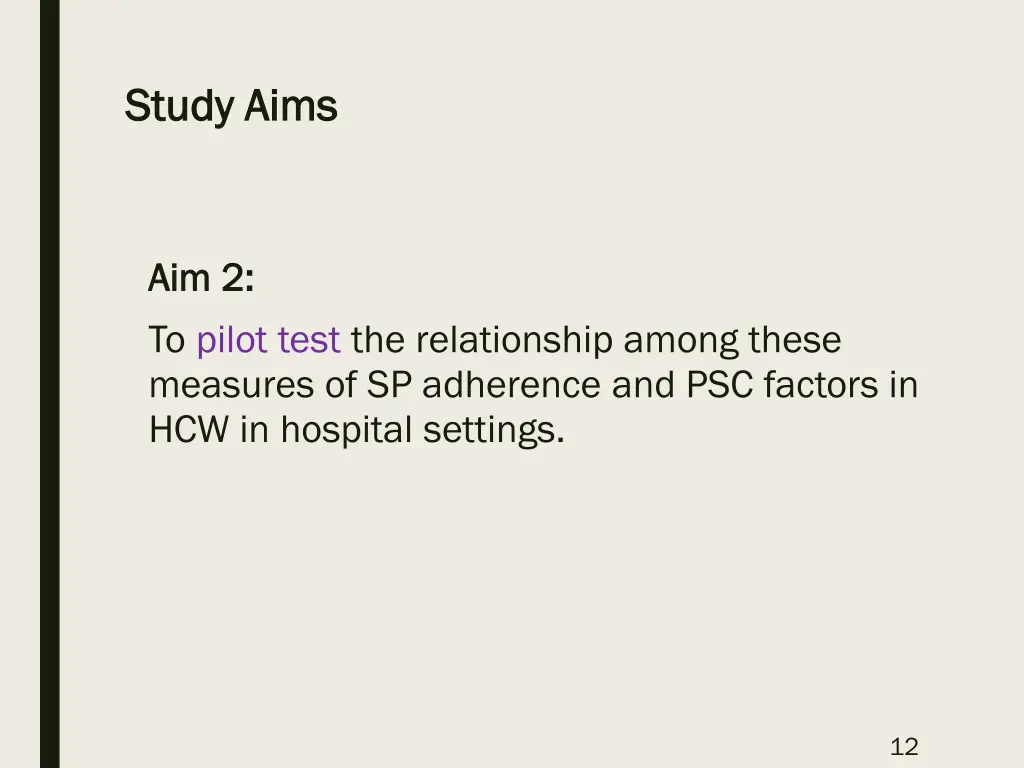
Study Aims Study Aims Aim 2: Aim 2: To pilot test the relationship among these measures of SP adherence and PSC factors in HCW in hospital settings. 12
Aim 1: Tool Development Challenges Aim 1: Tool Development Challenges What can you adapt and what must you create? How to capture complex behaviors in a simple instrument? Which SP indications/actions to observe? What features of PSC and reported SP adherence to measure? 13
Observational Tools Observational Tools Strengths Strengths direct observation the gold standard Limitations Limitations train observers awareness of being observed can influence HCW behavior time and expense 14
Survey tools Survey tools Strengths Strengths relatively inexpensive in direct cost and personnel resources information on adherence focus HCW attention to their own practices Limitations Limitations poor reliability and validity of self- report HCW s may overestimate adherence (Haas & Larson, 2007, Waltz et al., 2005; WHO, 2009) 15
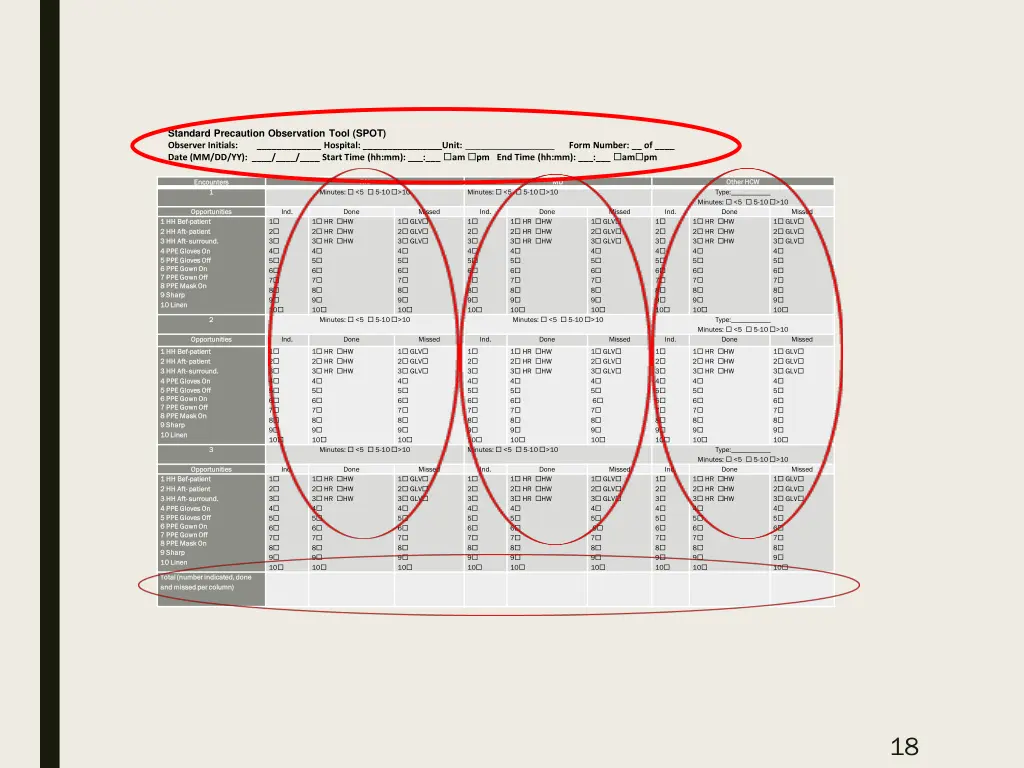
Standard Precautions Observation Tool Standard Precautions Observation Tool (SPOT) (SPOT) Designed to measure observed adherence to components of SP in hospital settings Established construct validity, items drawn from CDC Borrows from design and methods of the World Health Organization (WHO) hand hygiene observation tool 16
The SPOT The SPOT 3 sections 3 sections header: institutional and observer level information, session data, observer initials, date and time columns: provider role, encounter duration, indication and observed action footer: total number of indications and actions to calculate a percentage of adherence score 17
Standard Precaution Observation Tool (SPOT) Observer Initials: _____________ Hospital: ________________Unit: __________________ Form Number: __ of ____ Date (MM/DD/YY): ____/____/____ Start Time (hh:mm): ___:___ am pm End Time (hh:mm): ___:___ am pm RN RN MD MD Other HCW Other HCW Type:___________ Minutes: <5 5-10 >10 Done 1 HR HW 2 HR HW 3 HR HW 4 5 6 7 8 9 10 Type:___________ Minutes: <5 5-10 >10 Done Encounters Encounters 1 1 Minutes: <5 5-10 >10 Minutes: <5 5-10 >10 Opportunities Opportunities patient patient surround. Ind. Done Missed Ind. Done Missed Ind. Missed 1 HH Bef 1 HH Bef- -patient 2 HH Aft 2 HH Aft- - patient 3 HH Aft 3 HH Aft- - surround. 4 PPE Gloves On 4 PPE Gloves On 5 PPE Gloves Off 5 PPE Gloves Off 6 PPE Gown On 6 PPE Gown On 7 PPE Gown Off 7 PPE Gown Off 8 PPE Mask On 8 PPE Mask On 9 Sharp 9 Sharp 10 Linen 10 Linen 1 2 3 4 5 6 7 8 9 10 1 HR HW 2 HR HW 3 HR HW 4 5 6 7 8 9 10 Minutes: <5 5-10 >10 1 GLV 2 GLV 3 GLV 4 5 6 7 8 9 10 1 2 3 4 5 6 7 8 9 10 1 HR HW 2 HR HW 3 HR HW 4 5 6 7 8 9 10 Minutes: <5 5-10 >10 1 GLV 2 GLV 3 GLV 4 5 6 7 8 9 10 1 2 3 4 5 6 7 8 9 10 1 GLV 2 GLV 3 GLV 4 5 6 7 8 9 10 2 2 Opportunities Opportunities Ind. Done Missed Ind. Done Missed Ind. Missed 1 HH Bef 1 HH Bef- -patient patient 2 HH Aft 2 HH Aft- - patient patient 3 HH Aft 3 HH Aft- - surround. surround. 4 PPE Gloves On 4 PPE Gloves On 5 PPE Gloves Off 5 PPE Gloves Off 6 PPE Gown On 6 PPE Gown On 7 PPE Gown Off 7 PPE Gown Off 8 PPE Mask On 8 PPE Mask On 9 Sharp 9 Sharp 10 Linen 10 Linen 1 2 3 4 5 6 7 8 9 10 1 HR HW 2 HR HW 3 HR HW 4 5 6 7 8 9 10 Minutes: <5 5-10 >10 1 GLV 2 GLV 3 GLV 4 5 6 7 8 9 10 1 2 3 4 5 6 7 8 9 10 Minutes: <5 5-10 >10 1 HR HW 2 HR HW 3 HR HW 4 5 6 7 8 9 10 1 GLV 2 GLV 3 GLV 4 5 6 7 8 9 10 1 2 3 4 5 6 7 8 9 10 1 HR HW 2 HR HW 3 HR HW 4 5 6 7 8 9 10 1 GLV 2 GLV 3 GLV 4 5 6 7 8 9 10 3 3 Type:___________ Minutes: <5 5-10 >10 Done 1 HR HW 2 HR HW 3 HR HW 4 5 6 7 8 9 10 Opportunities Opportunities patient patient surround. Ind. Done Missed Ind. Done Missed Ind. Missed 1 HH Bef 1 HH Bef- -patient 2 HH Aft 2 HH Aft- - patient 3 HH Aft 3 HH Aft- - surround. 4 PPE Gloves On 4 PPE Gloves On 5 PPE Gloves Off 5 PPE Gloves Off 6 PPE Gown On 6 PPE Gown On 7 PPE Gown Off 7 PPE Gown Off 8 PPE Mask On 8 PPE Mask On 9 Sharp 9 Sharp 10 Linen 10 Linen 1 2 3 4 5 6 7 8 9 10 1 HR HW 2 HR HW 3 HR HW 4 5 6 7 8 9 10 1 GLV 2 GLV 3 GLV 4 5 6 7 8 9 10 1 2 3 4 5 6 7 8 9 10 1 HR HW 2 HR HW 3 HR HW 4 5 6 7 8 9 10 1 GLV 2 GLV 3 GLV 4 5 6 7 8 9 10 1 2 3 4 5 6 7 8 9 10 1 GLV 2 GLV 3 GLV 4 5 6 7 8 9 10 Total (number indicated, done Total (number indicated, done and missed per column) and missed per column) 18
SPOT Tool Testing SPOT Tool Testing Face validity, feasibility, usability and inter-rater reliability Incorporation of feedback into tool design simplify instructions add/eliminate items adjust number of observations 19
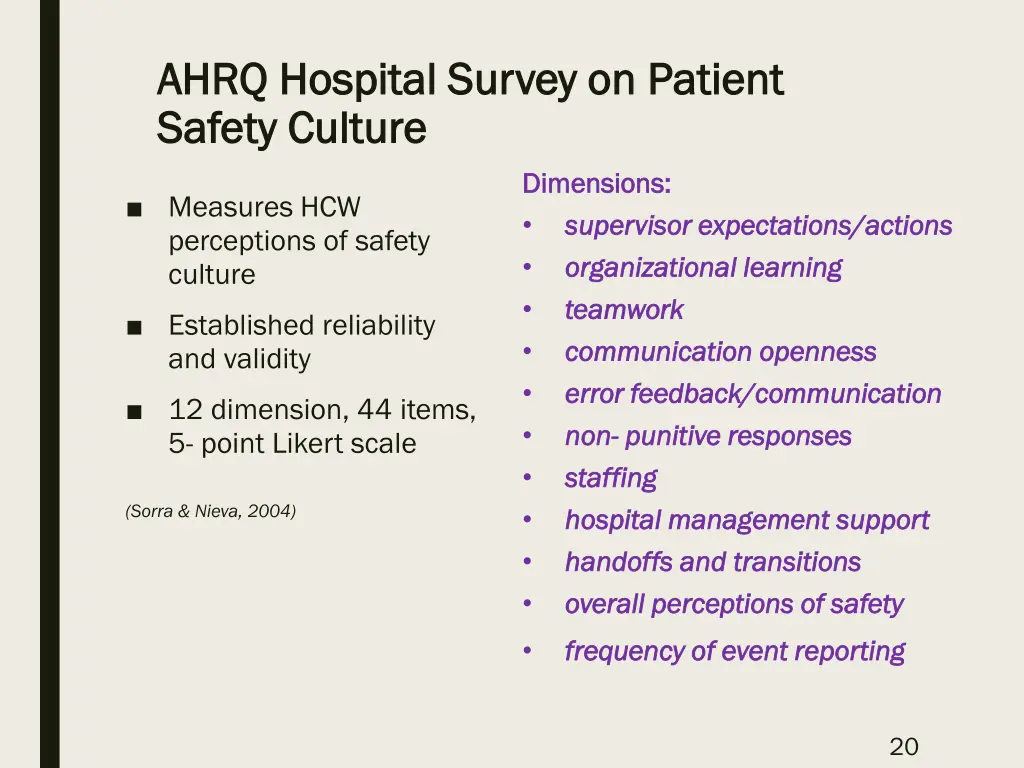
AHRQ Hospital Survey on Patient AHRQ Hospital Survey on Patient Safety Culture Safety Culture Dimensions: Dimensions: supervisor expectations/actions supervisor expectations/actions organizational learning organizational learning teamwork teamwork communication openness communication openness error feedback/communication error feedback/communication non non- - punitive responses punitive responses staffing staffing hospital management support hospital management support handoffs and transitions handoffs and transitions overall perceptions of safety overall perceptions of safety frequency of event reporting Measures HCW perceptions of safety culture Established reliability and validity 12 dimension, 44 items, 5- point Likert scale (Sorra & Nieva, 2004) frequency of event reporting 20
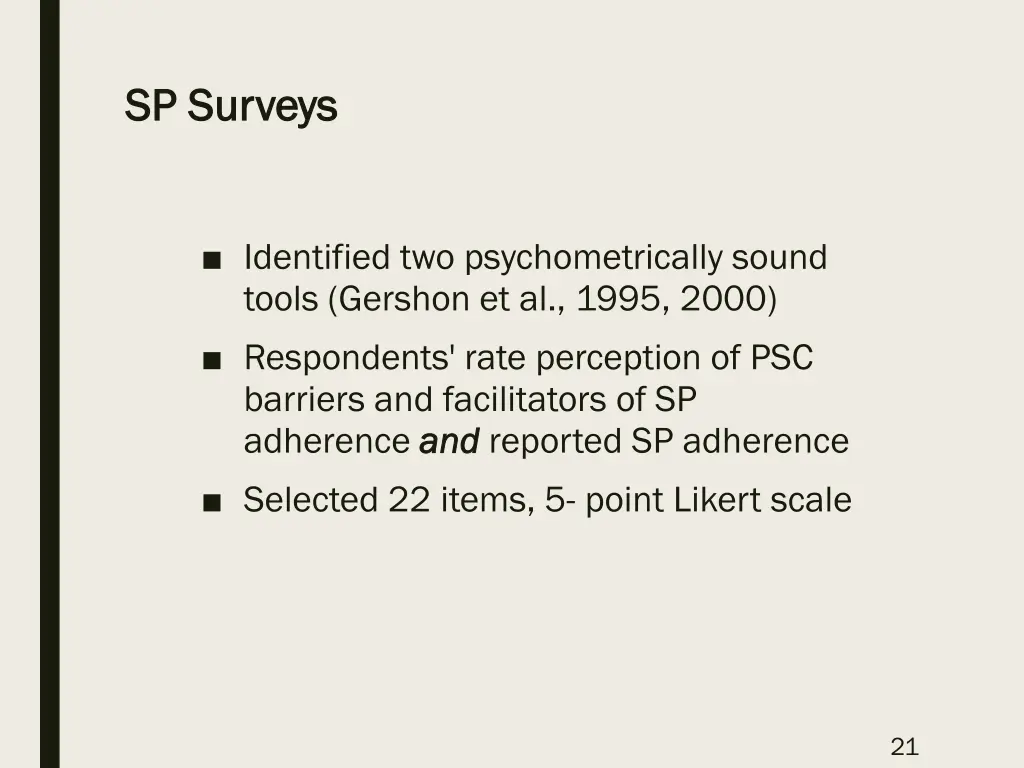
SP Surveys SP Surveys Identified two psychometrically sound tools (Gershon et al., 1995, 2000) Respondents' rate perception of PSC barriers and facilitators of SP adherence and and reported SP adherence Selected 22 items, 5- point Likert scale 21
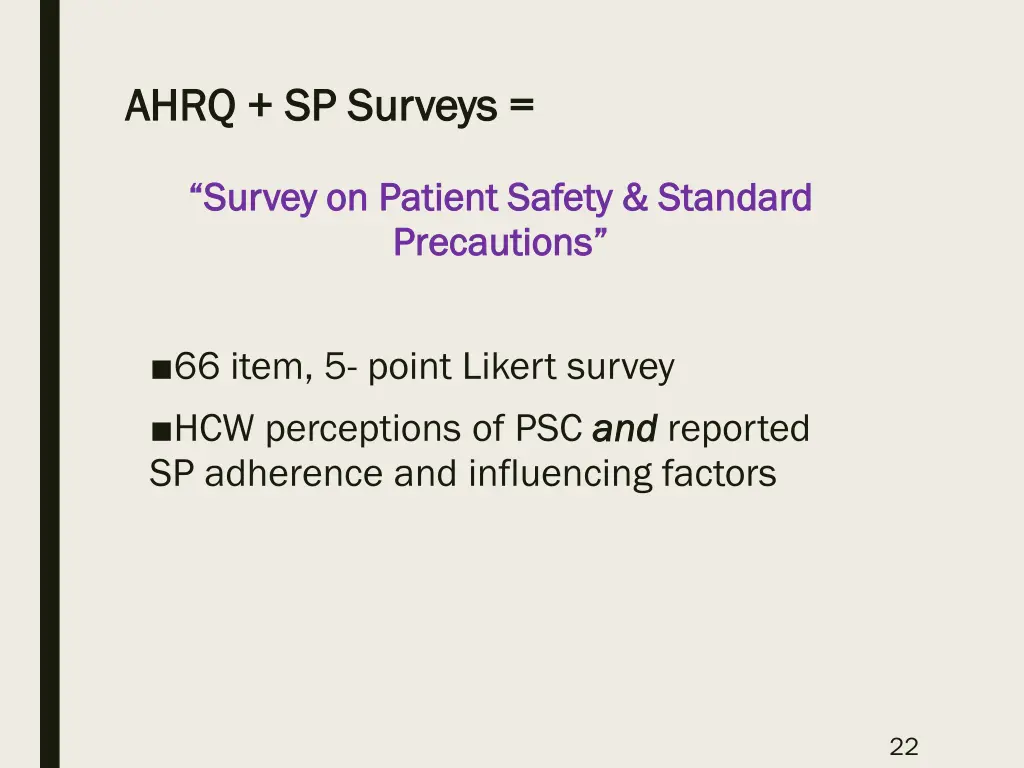
AHRQ + SP Surveys = AHRQ + SP Surveys = Survey on Patient Safety & Standard Survey on Patient Safety & Standard Precautions Precautions 66 item, 5- point Likert survey HCW perceptions of PSC and SP adherence and influencing factors and reported 22
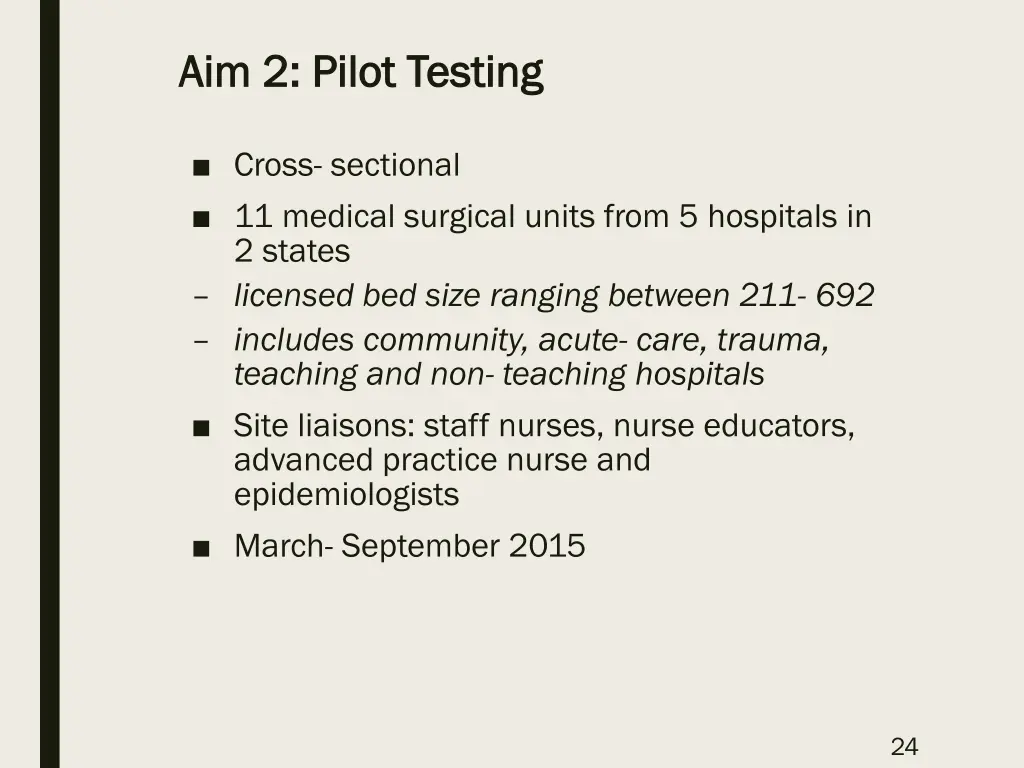
Aim 2: Pilot Testing Aim 2: Pilot Testing Cross- sectional 11 medical surgical units from 5 hospitals in 2 states licensed bed size ranging between 211- 692 includes community, acute- care, trauma, teaching and non- teaching hospitals Site liaisons: staff nurses, nurse educators, advanced practice nurse and epidemiologists March- September 2015 24
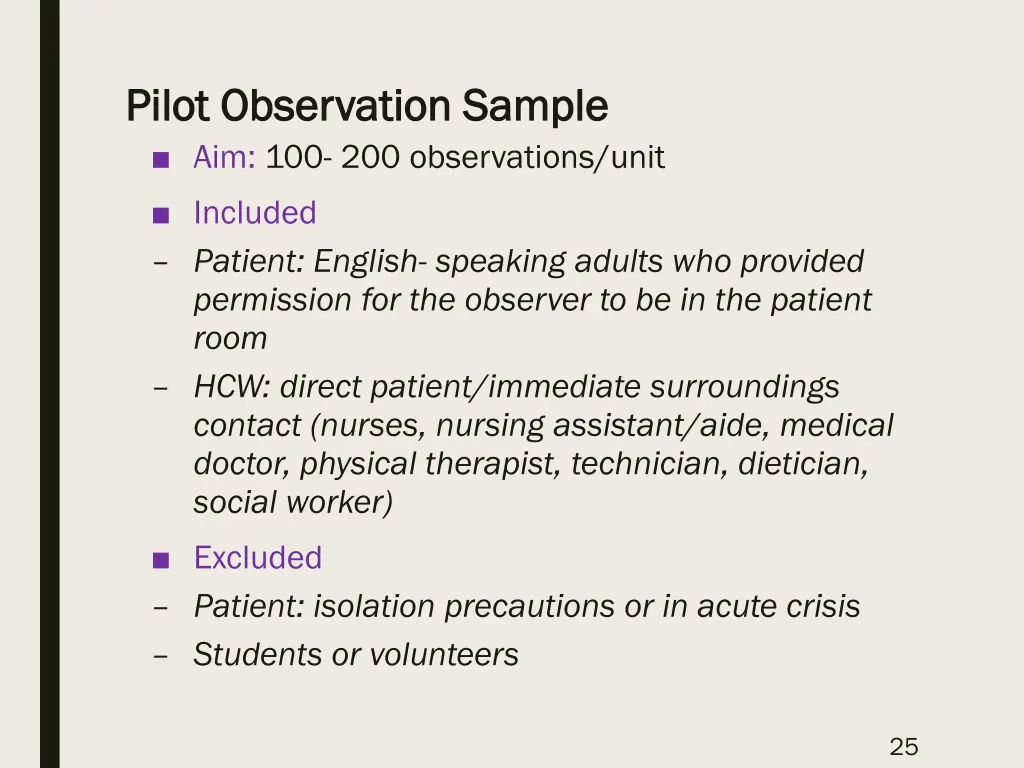
Pilot Observation Sample Pilot Observation Sample Aim: 100- 200 observations/unit Included Patient: English- speaking adults who provided permission for the observer to be in the patient room HCW: direct patient/immediate surroundings contact (nurses, nursing assistant/aide, medical doctor, physical therapist, technician, dietician, social worker) Excluded Patient: isolation precautions or in acute crisis Students or volunteers 25
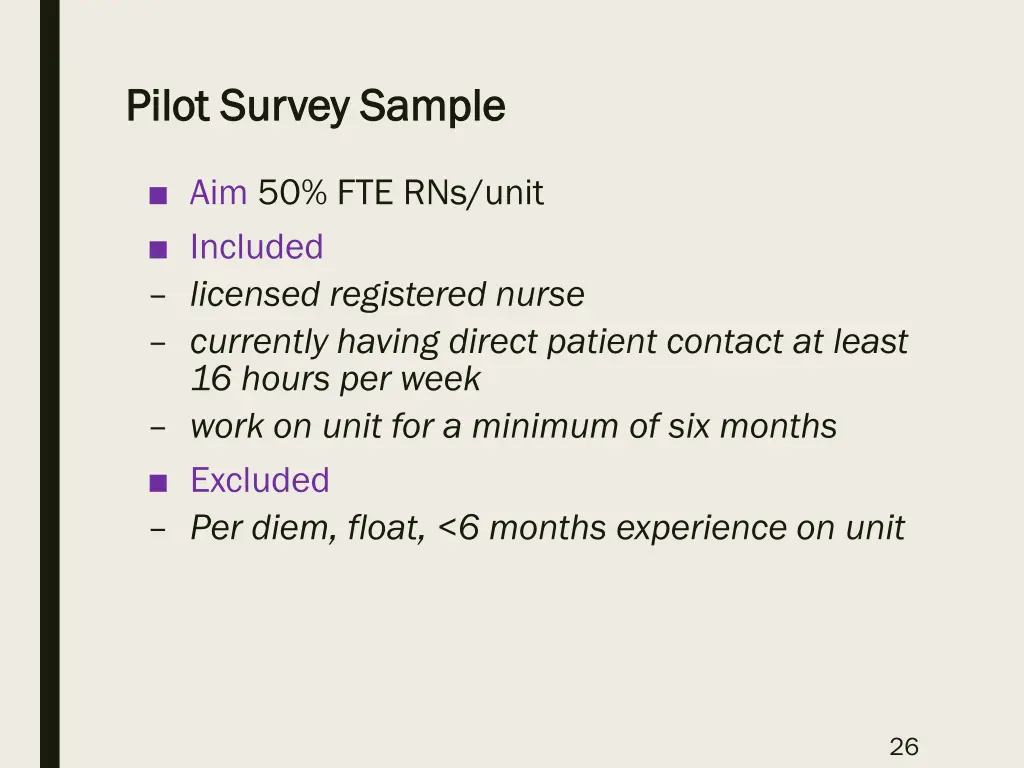
Pilot Survey Sample Pilot Survey Sample Aim 50% FTE RNs/unit Included licensed registered nurse currently having direct patient contact at least 16 hours per week work on unit for a minimum of six months Excluded Per diem, float, <6 months experience on unit 26
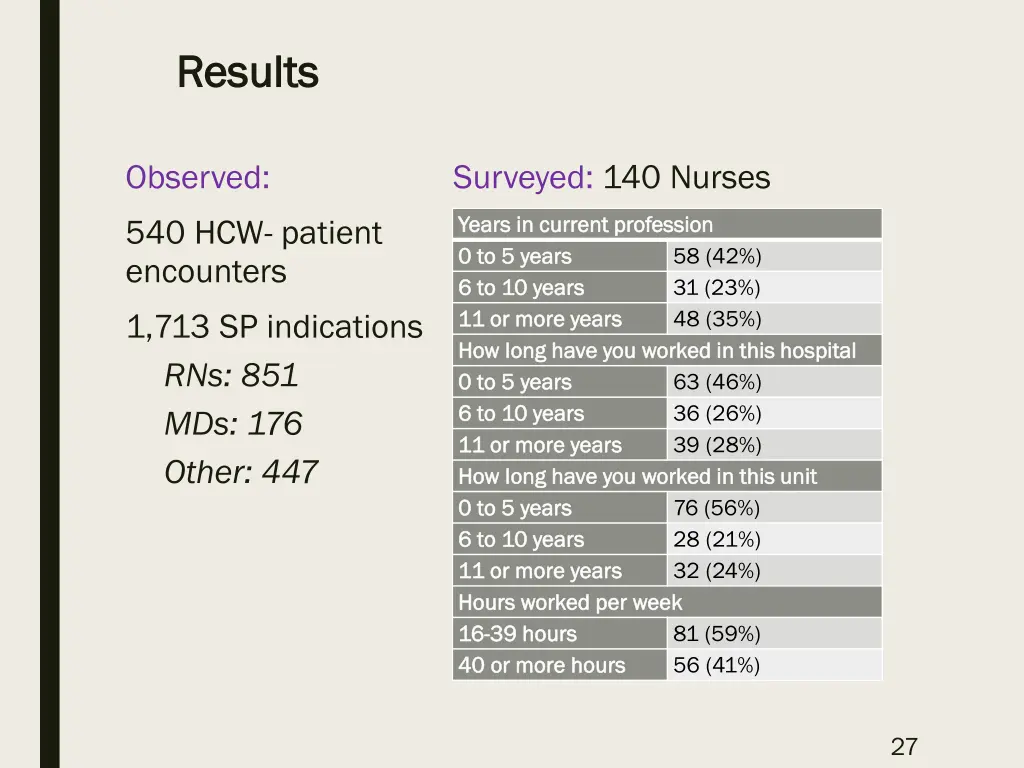
Results Results Observed: 540 HCW- patient encounters 1,713 SP indications RNs: 851 MDs: 176 Other: 447 Surveyed: 140 Nurses Years in current profession Years in current profession 0 to 5 years 0 to 5 years 6 to 10 years 6 to 10 years 11 or more years 11 or more years How long have you worked in this hospital How long have you worked in this hospital 0 to 5 years 0 to 5 years 6 to 10 years 6 to 10 years 11 or more years 11 or more years How long have you worked in this unit How long have you worked in this unit 0 to 5 years 0 to 5 years 6 to 10 years 6 to 10 years 11 or more years 11 or more years Hours worked per week Hours worked per week 16 16- -39 hours 39 hours 40 or more hours 40 or more hours 58 (42%) 31 (23%) 48 (35%) 63 (46%) 36 (26%) 39 (28%) 76 (56%) 28 (21%) 32 (24%) 27 81 (59%) 56 (41%) 27
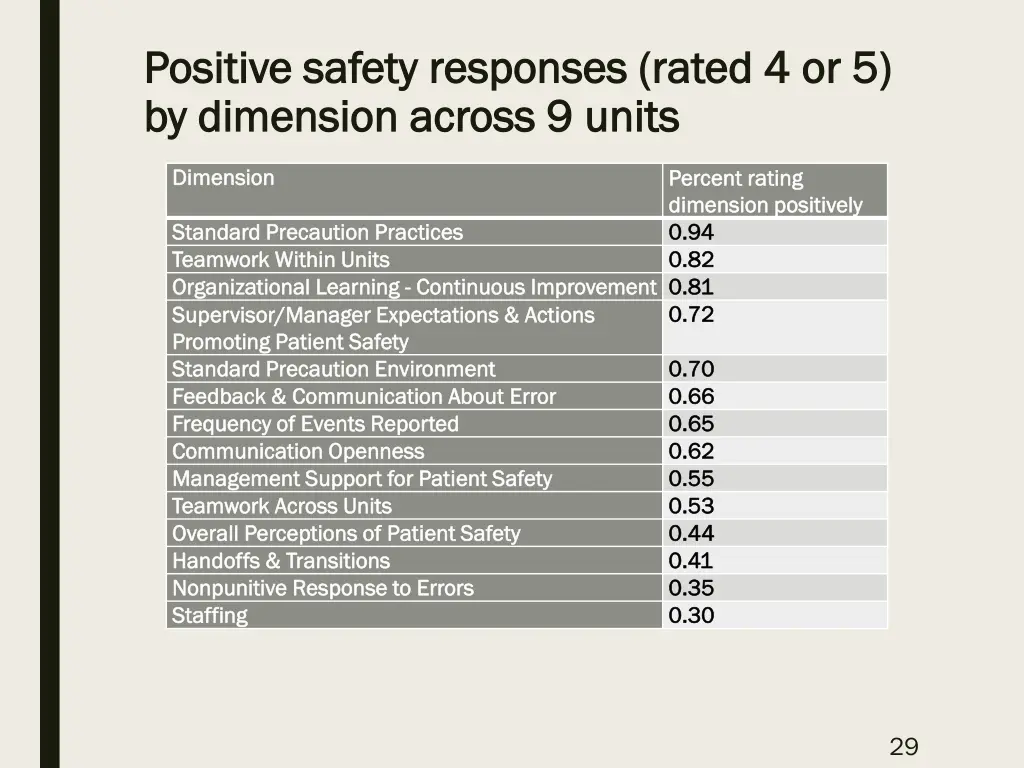
Positive safety responses (rated 4 or 5) Positive safety responses (rated 4 or 5) by dimension across 9 units by dimension across 9 units Dimension Dimension Percent rating Percent rating dimension positively dimension positively 0.94 0.94 0.82 0.82 0.81 0.72 0.72 Standard Precaution Practices Standard Precaution Practices Teamwork Within Units Teamwork Within Units Organizational Learning Organizational Learning - - Continuous Improvement Supervisor/Manager Expectations & Actions Supervisor/Manager Expectations & Actions Promoting Patient Safety Promoting Patient Safety Standard Precaution Environment Standard Precaution Environment Feedback & Communication About Error Feedback & Communication About Error Frequency of Events Reported Frequency of Events Reported Communication Openness Communication Openness Management Support for Patient Safety Management Support for Patient Safety Teamwork Across Units Teamwork Across Units Overall Perceptions of Patient Safety Overall Perceptions of Patient Safety Handoffs & Transitions Handoffs & Transitions Nonpunitive Response to Errors Nonpunitive Response to Errors Staffing Staffing Continuous Improvement 0.81 0.70 0.70 0.66 0.66 0.65 0.65 0.62 0.62 0.55 0.55 0.53 0.53 0.44 0.44 0.41 0.41 0.35 0.35 0.30 0.30 29
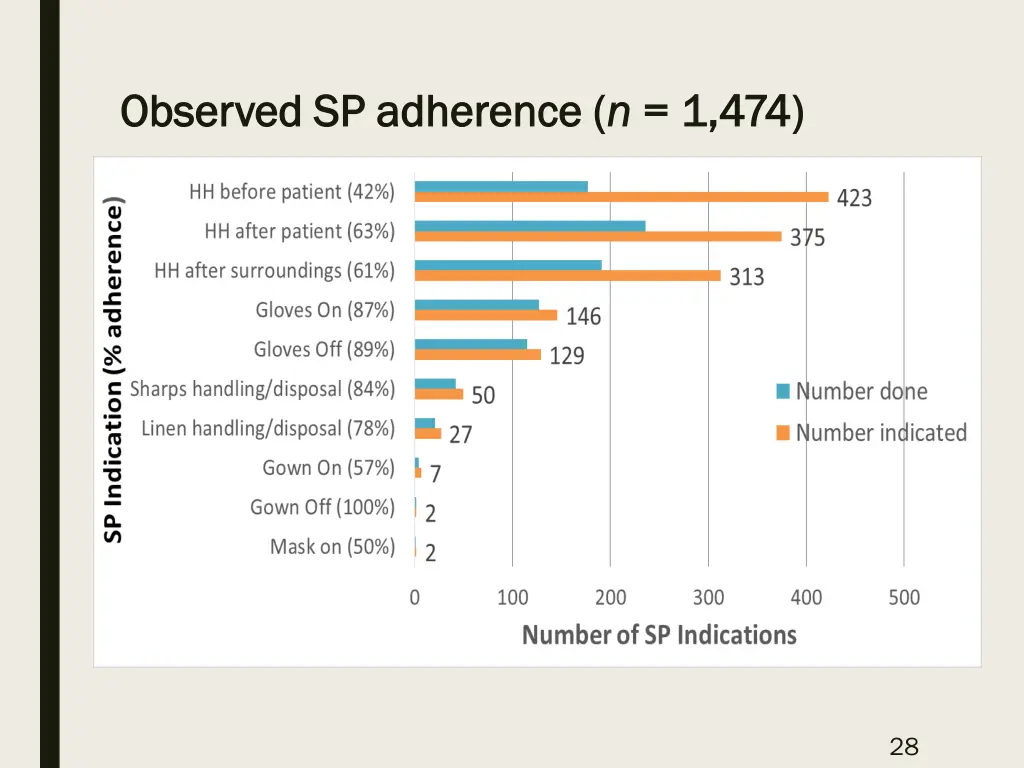
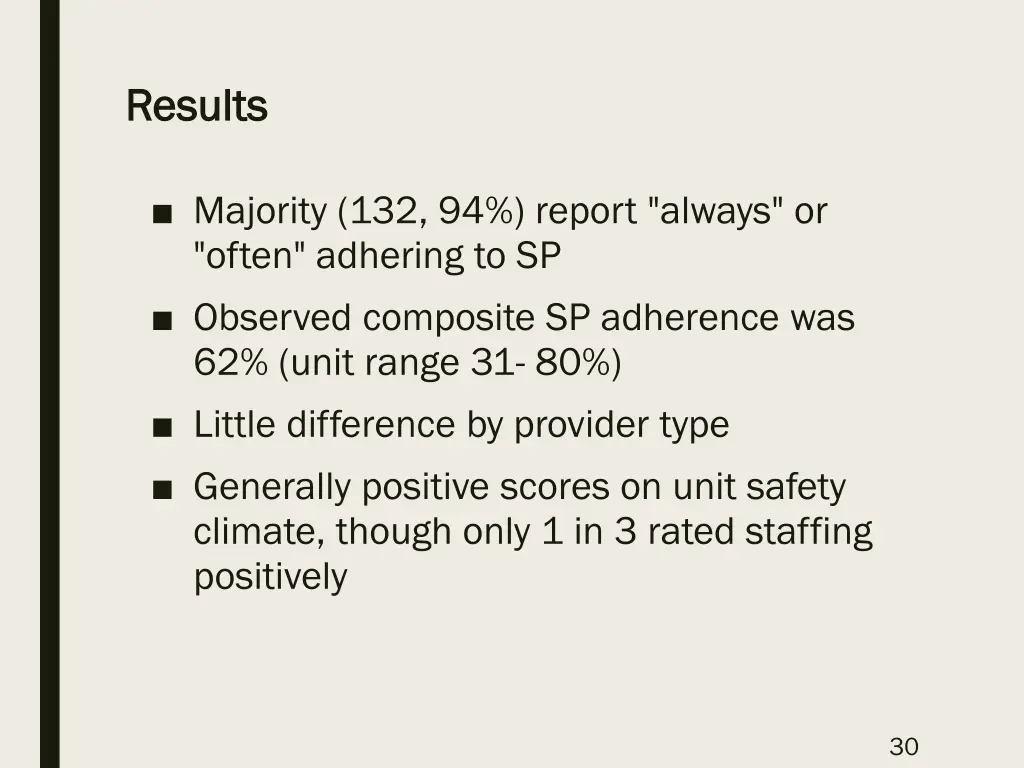
Results Results Majority (132, 94%) report "always" or "often" adhering to SP Observed composite SP adherence was 62% (unit range 31- 80%) Little difference by provider type Generally positive scores on unit safety climate, though only 1 in 3 rated staffing positively 30
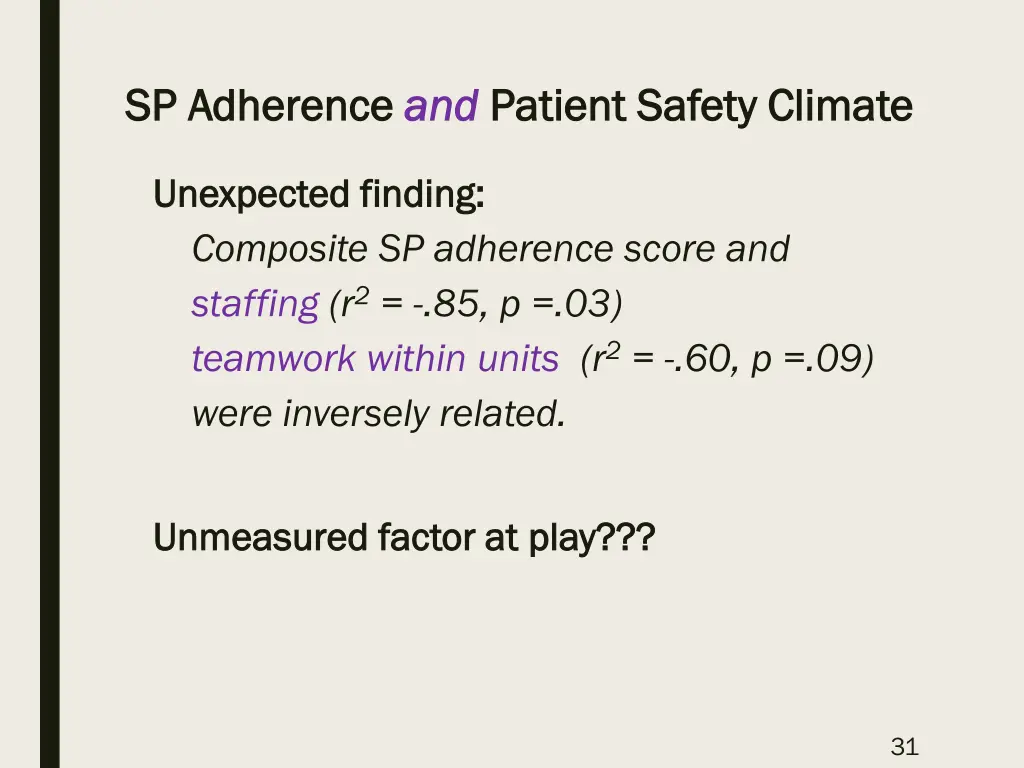
SP Adherence SP Adherence and and Patient Safety Climate Patient Safety Climate Unexpected finding: Unexpected finding: Composite SP adherence score and staffing (r2 = -.85, p =.03) teamwork within units (r2 = -.60, p =.09) were inversely related. Unmeasured factor at play??? Unmeasured factor at play??? 31
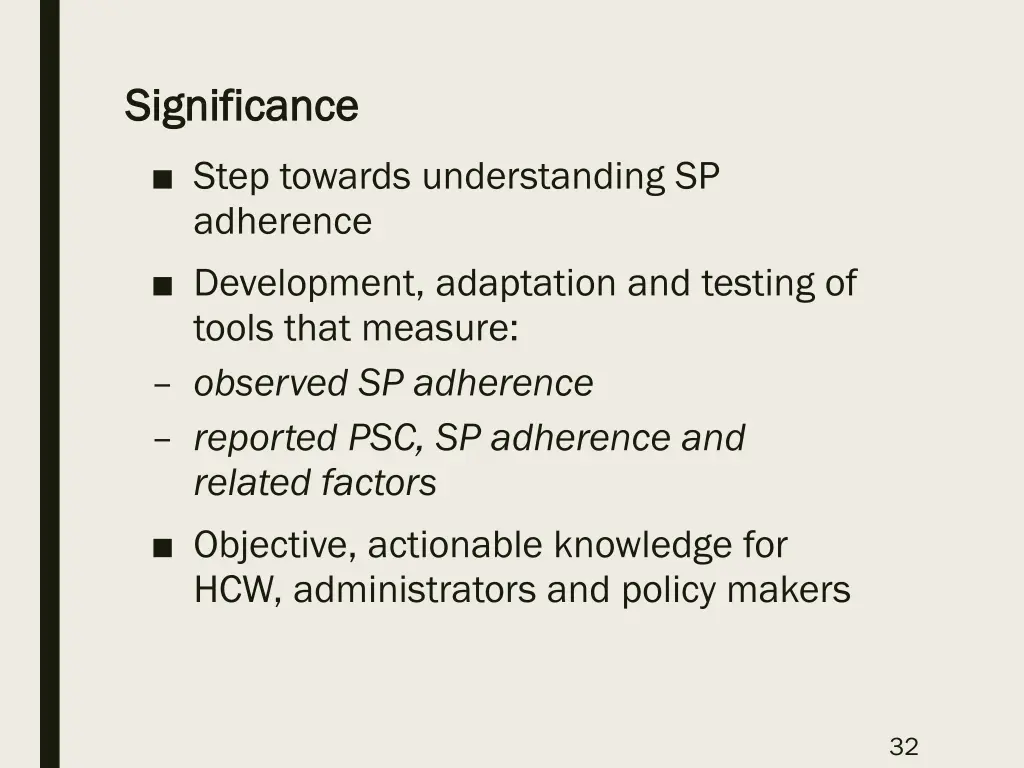
Significance Significance Step towards understanding SP adherence Development, adaptation and testing of tools that measure: observed SP adherence reported PSC, SP adherence and related factors Objective, actionable knowledge for HCW, administrators and policy makers 32
Limitations Limitations Units with lower rates of observed adherence also had fewer observations Hawthorne effect; internal or external observers Oversampling weekdays 33
Conclusions Conclusions Observed SP adherence was suboptimal. Sizeable discrepancy between reported and observed adherence exists. The relationship between safety climate, particularly staffing, and adherence to SP warrants further testing. 34
Next Steps Next Steps Evaluate use of vignettes and observational tool as an educational measure of SP knowledge Refine tools for use by IPs Develop training modules for observational tool Examine the relationship between knowledge and adherence Test relationship/efficacy among SP, HAI and HCW outcomes 35
Aims Aims Evaluate use of vignettes and observational tool as an educational measure of SP knowledge Examine the relationship between knowledge and adherence 36
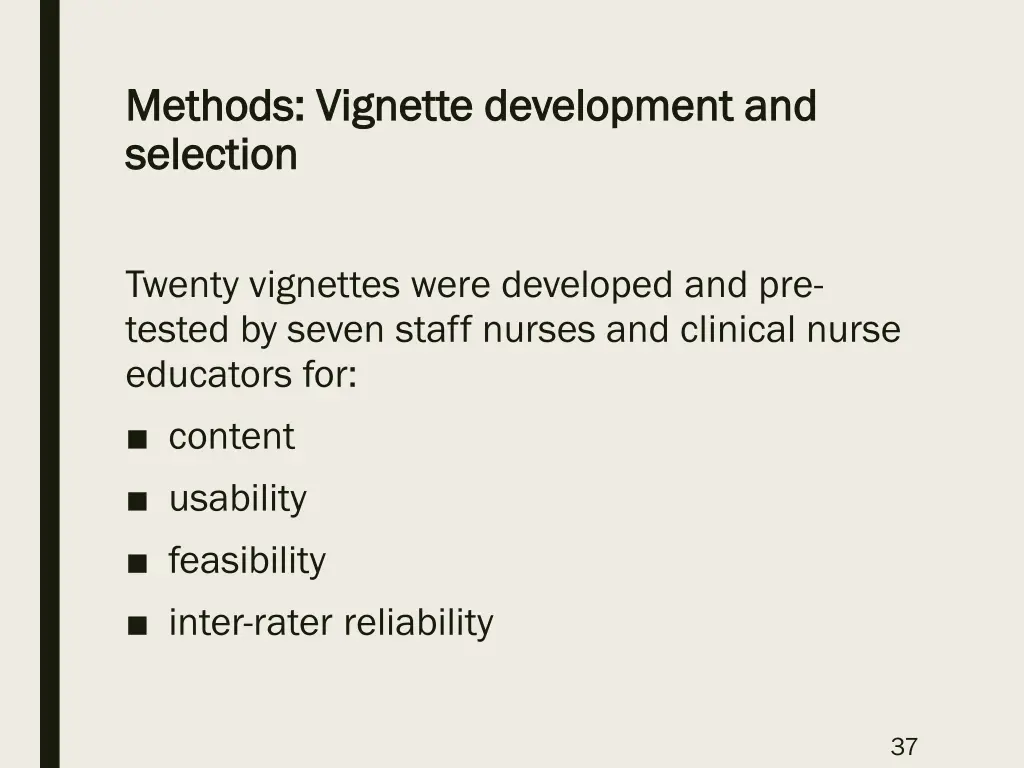
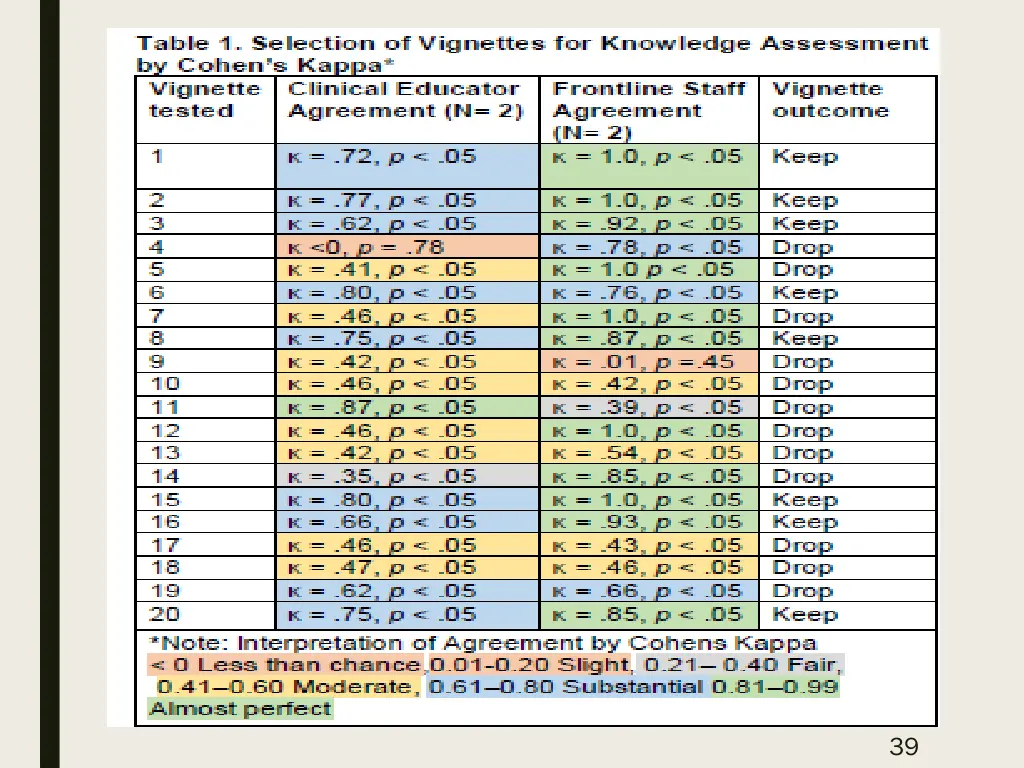
Methods: Vignette development and Methods: Vignette development and selection selection Twenty vignettes were developed and pre- tested by seven staff nurses and clinical nurse educators for: content usability feasibility inter-rater reliability 37
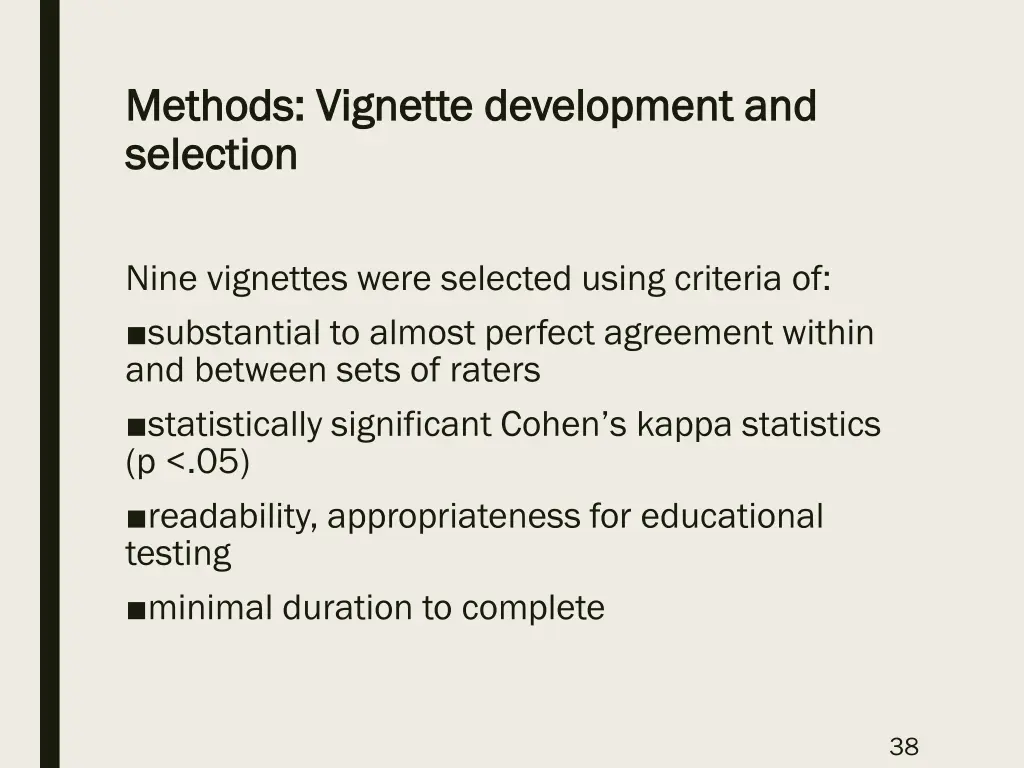
Methods: Vignette development and Methods: Vignette development and selection selection Nine vignettes were selected using criteria of: substantial to almost perfect agreement within and between sets of raters statistically significant Cohen s kappa statistics (p <.05) readability, appropriateness for educational testing minimal duration to complete 38
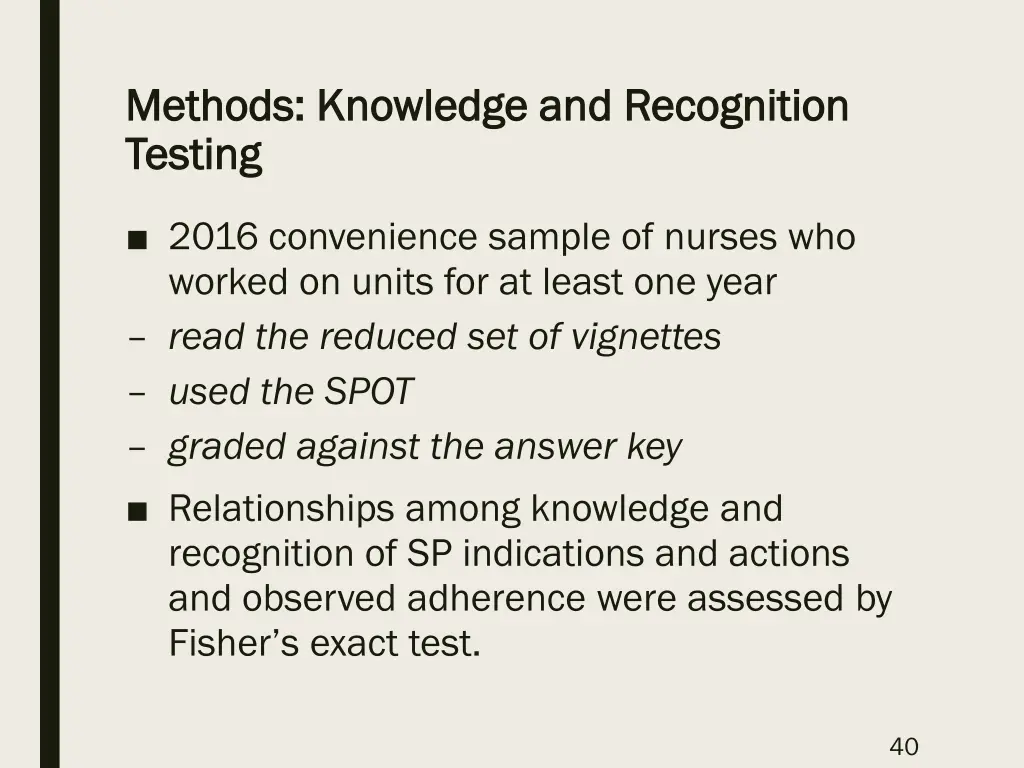
Methods: Knowledge and Recognition Methods: Knowledge and Recognition Testing Testing 2016 convenience sample of nurses who worked on units for at least one year read the reduced set of vignettes used the SPOT graded against the answer key Relationships among knowledge and recognition of SP indications and actions and observed adherence were assessed by Fisher s exact test. 40
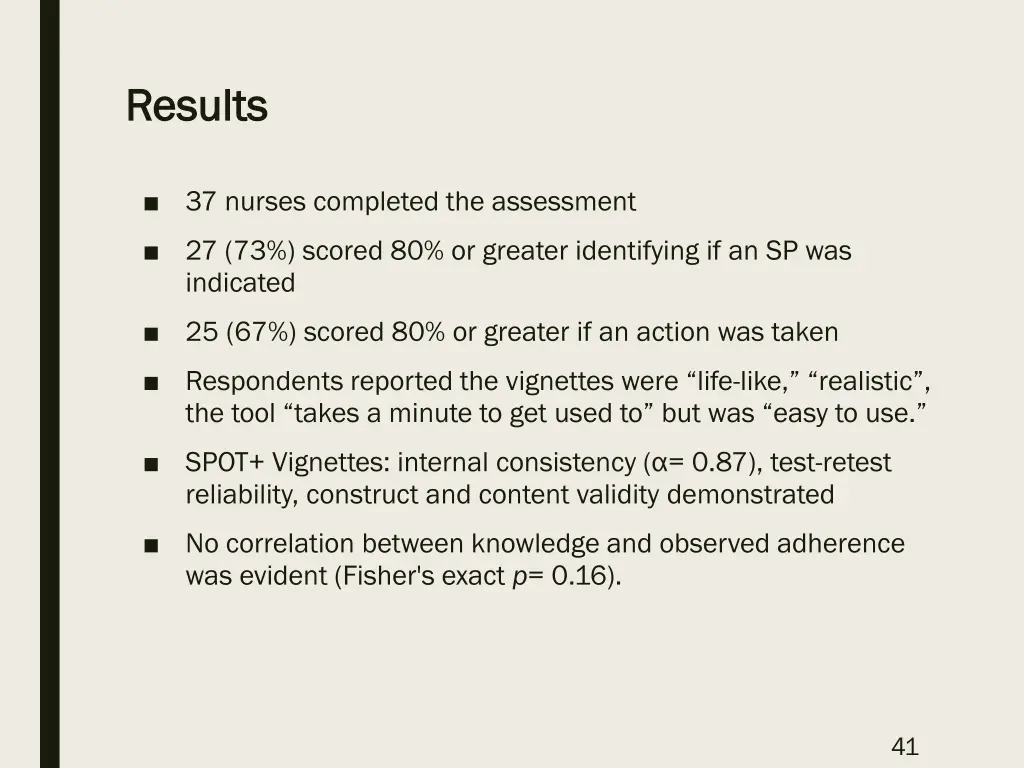
Results Results 37 nurses completed the assessment 27 (73%) scored 80% or greater identifying if an SP was indicated 25 (67%) scored 80% or greater if an action was taken Respondents reported the vignettes were life-like, realistic , the tool takes a minute to get used to but was easy to use. SPOT+ Vignettes: internal consistency ( = 0.87), test-retest reliability, construct and content validity demonstrated No correlation between knowledge and observed adherence was evident (Fisher's exact p= 0.16). 41
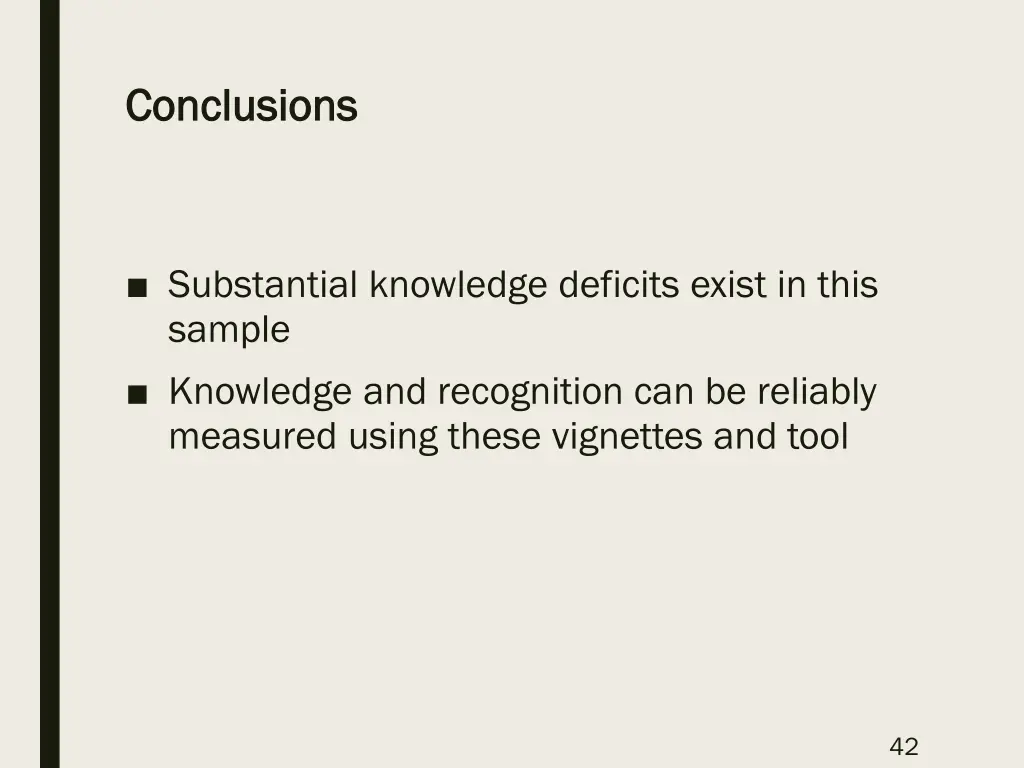
Conclusions Conclusions Substantial knowledge deficits exist in this sample Knowledge and recognition can be reliably measured using these vignettes and tool 42
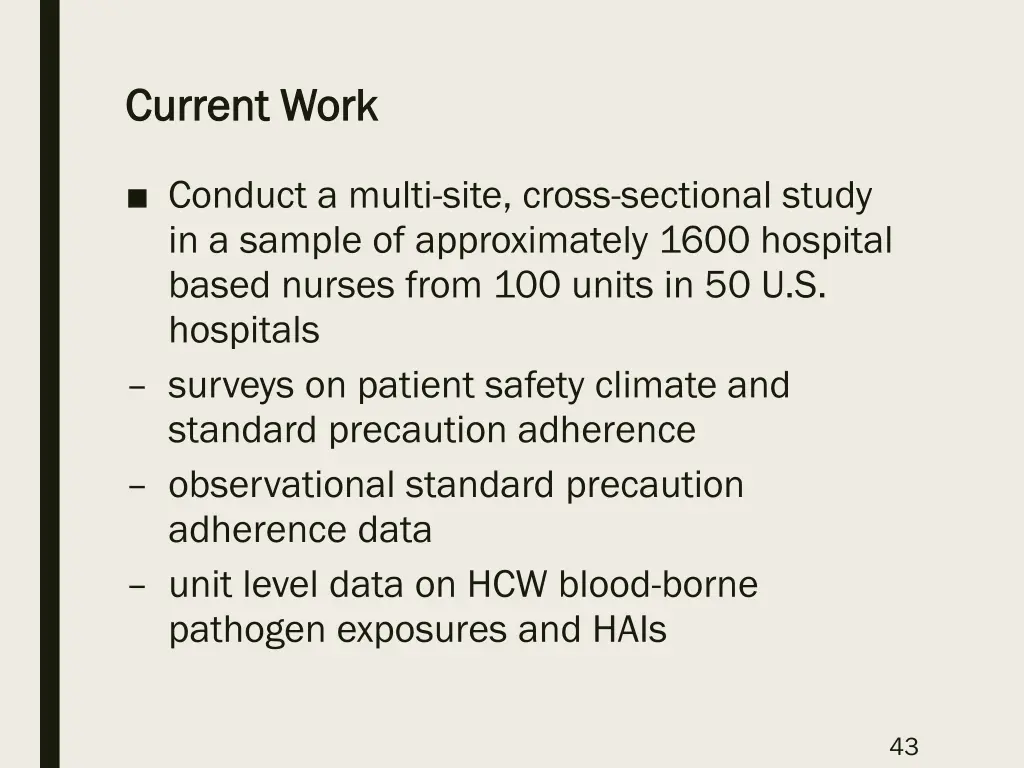
Current Work Current Work Conduct a multi-site, cross-sectional study in a sample of approximately 1600 hospital based nurses from 100 units in 50 U.S. hospitals surveys on patient safety climate and standard precaution adherence observational standard precaution adherence data unit level data on HCW blood-borne pathogen exposures and HAIs 43
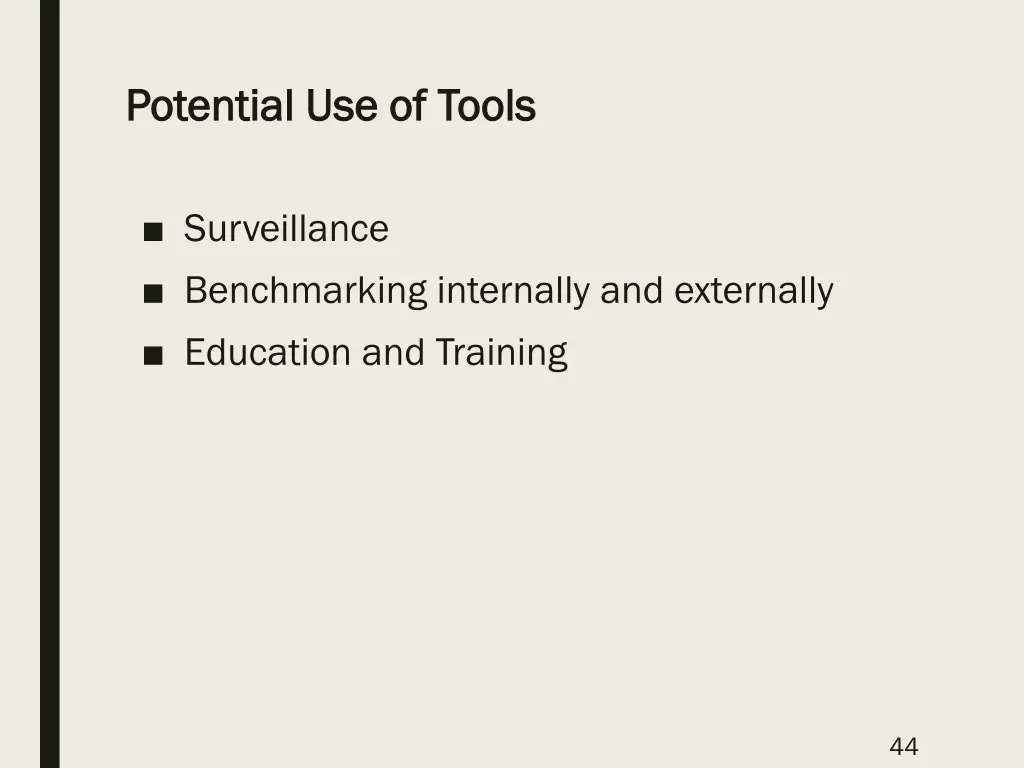
Potential Use of Tools Potential Use of Tools Surveillance Benchmarking internally and externally Education and Training 44
How can these be used in How can these be used in your your practice? practice? Consider use of survey to identify areas of opportunity to enhance safety climate Consider using the SPOT and vignettes to: assess OHP and employee knowledge identify clinical workflow and potential exposure risks target interventions based on employees ability to identify when standard precautions behaviors are indicated and actions taken 45
Acknowledgements & Disclosures Acknowledgements & Disclosures All research team members and study participants for their valuable contributions! Mentors: Dr. Elaine Larson and Dr. Robyn Gershon Funding/Disclosures: This project was funded by the APIC Heroes of Infection Prevention Research Award which is supported by a grant from BD Currently supported by DHHS/CDC/ NIOSH K01 Career Development Award 1K01OH011186-01 46
Thank you for your time and interest! Thank you for your time and interest! Questions? Questions? Amanda J. Hessels, PhD, MPH, RN, CIC, CPHQ, FAPIC Associate Research Scientist, Columbia University Nurse Scientist, Hackensack-Meridian Health ah3269@cumc.columbia.edu Amanda.hessels@hackensackmeridian.org 47
References/Resources References/Resources Chassin MR, Loeb JM. The ongoing quality improvement journey: next stop, high reliability. Health affairs (Project Hope). Apr 2011;30(4):559-568. Efstathiou G, Papastavrou E, Raftopoulos V, Merkouris A. Compliance of Cypriot nurses with standard precautions to avoid exposure to pathogens. Nursing & health sciences. Mar 2011;13(1):53-59 Gershon RR, Vlahov D, Felknor SA, et al. Compliance with universal precautions among health care workers at three regional hospitals. American journal of infection control. Aug 1995;23(4):225-236. Gershon RR, Stone PW, Bakken S, Larson E. Measurement of organizational culture and climate in healthcare. J Nur Admin 2004;34:33e40. Haas, J.P, and Larson, E.L (2007). Measurement of Compliance with hand hygiene. Journal of Hospital Infection, 66, 6-14. doi: 10.1016/j.jhin.2006.11.013 Hessels, A.J., Genovese-Schek, V., Agarwal, M., Wurmser, T. &Larson, E.L. (2016). Relationship Between Patient Safety Climate and Adherence to Standard Precautions. American Journal of Infection Control, 44 (10), 1128-1132 Henriksen K, Dayton E, Keyes MA, Carayon P, Hughes R. Understanding Adverse Events: A Human Factors Framework. In: Hughes RG, ed. Patient Safety and Quality: An Evidence-Based Handbook for Nurses. Rockville, MD: Agency for Healthcare Research and Quality; 2008. Grimmond T, Good L. EXPO-STOP: A national survey and estimate of sharps injuries and mucotaneous blood exposures among healthcare workers in US hospitals. Journal of the Association of Occupational Health Professionals in Healthcare. 2013;33(4):31- 36. RR, Karkashian CD, Grosch JW, et al. Hospital safety climate and its relationship with safe work practices and workplace exposure incidents. American journal of infection control. Jun 2000;28(3):211-221. Mannocci, A., De Carli, G., Di Bari, V., Saulle, R., Unim, B., Nicolotti, N., . . . La Torre, G. (2016). How Much do Needlestick Injuries Cost? A Systematic Review of the Economic Evaluations of Needlestick and Sharps Injuries Among Healthcare Personnel. Infection Control & Hospital Epidemiology,37(6), 635-646. doi:10.1017/ice.2016.48
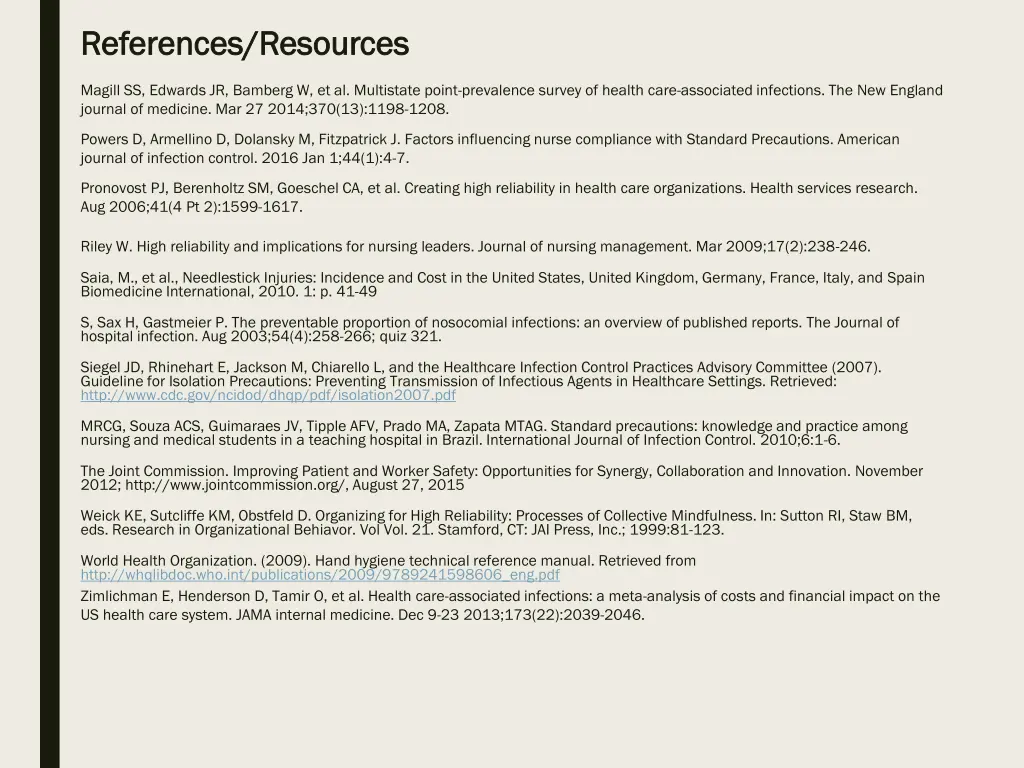
References/Resources References/Resources Magill SS, Edwards JR, Bamberg W, et al. Multistate point-prevalence survey of health care-associated infections. The New England journal of medicine. Mar 27 2014;370(13):1198-1208. Powers D, Armellino D, Dolansky M, Fitzpatrick J. Factors influencing nurse compliance with Standard Precautions. American journal of infection control. 2016 Jan 1;44(1):4-7. Pronovost PJ, Berenholtz SM, Goeschel CA, et al. Creating high reliability in health care organizations. Health services research. Aug 2006;41(4 Pt 2):1599-1617. Riley W. High reliability and implications for nursing leaders. Journal of nursing management. Mar 2009;17(2):238-246. Saia, M., et al., Needlestick Injuries: Incidence and Cost in the United States, United Kingdom, Germany, France, Italy, and Spain Biomedicine International, 2010. 1: p. 41-49 S, Sax H, Gastmeier P. The preventable proportion of nosocomial infections: an overview of published reports. The Journal of hospital infection. Aug 2003;54(4):258-266; quiz 321. Siegel JD, Rhinehart E, Jackson M, Chiarello L, and the Healthcare Infection Control Practices Advisory Committee (2007). Guideline for Isolation Precautions: Preventing Transmission of Infectious Agents in Healthcare Settings. Retrieved: http://www.cdc.gov/ncidod/dhqp/pdf/isolation2007.pdf MRCG, Souza ACS, Guimaraes JV, Tipple AFV, Prado MA, Zapata MTAG. Standard precautions: knowledge and practice among nursing and medical students in a teaching hospital in Brazil. International Journal of Infection Control. 2010;6:1-6. The Joint Commission. Improving Patient and Worker Safety: Opportunities for Synergy, Collaboration and Innovation. November 2012; http://www.jointcommission.org/, August 27, 2015 Weick KE, Sutcliffe KM, Obstfeld D. Organizing for High Reliability: Processes of Collective Mindfulness. In: Sutton RI, Staw BM, eds. Research in Organizational Behiavor. Vol Vol. 21. Stamford, CT: JAI Press, Inc.; 1999:81-123. World Health Organization. (2009). Hand hygiene technical reference manual. Retrieved from http://whqlibdoc.who.int/publications/2009/9789241598606_eng.pdf Zimlichman E, Henderson D, Tamir O, et al. Health care-associated infections: a meta-analysis of costs and financial impact on the US health care system. JAMA internal medicine. Dec 9-23 2013;173(22):2039-2046.