Remote Tutoring Exercises for Engaging and Developing Skills
Explore a variety of remote tutoring exercises designed for enhancing skills and fostering engagement among participants. Exercises range from sharing competencies to discussing elements of a good group. Participants interact through video and audio, sharing unique attributes, news updates, and insights into what makes a good group dynamic.

Download Presentation

Please find below an Image/Link to download the presentation.
The content on the website is provided AS IS for your information and personal use only. It may not be sold, licensed, or shared on other websites without obtaining consent from the author. If you encounter any issues during the download, it is possible that the publisher has removed the file from their server.
You are allowed to download the files provided on this website for personal or commercial use, subject to the condition that they are used lawfully. All files are the property of their respective owners.
The content on the website is provided AS IS for your information and personal use only. It may not be sold, licensed, or shared on other websites without obtaining consent from the author.
E N D
Presentation Transcript
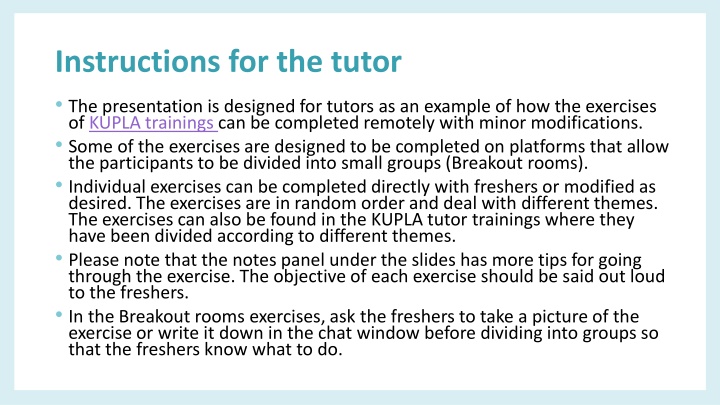
Instructions for the tutor The presentation is designed for tutors as an example of how the exercises of KUPLA trainings can be completed remotely with minor modifications. Some of the exercises are designed to be completed on platforms that allow the participants to be divided into small groups (Breakout rooms). Individual exercises can be completed directly with freshers or modified as desired. The exercises are in random order and deal with different themes. The exercises can also be found in the KUPLA tutor trainings where they have been divided according to different themes. Please note that the notes panel under the slides has more tips for going through the exercise. The objective of each exercise should be said out loud to the freshers. In the Breakout rooms exercises, ask the freshers to take a picture of the exercise or write it down in the chat window before dividing into groups so that the freshers know what to do.
MATERIAL FOR TUTORS Remote exercises for tutoring
Exercise Sharing competencies F The participants have their cameras on and also turn their microphone on when it is their turn to speak Each participant introduces themselves by saying their name and which skill/competence they want to share with the others For example, my name is Jarna and I can teach you how to knit ... I m good at explaining how to use Excel ... I like sharing food recipes with others ... I enjoy proofreading texts ... I can help you fix your bike
Exercise News round: Plusses and minuses F The participants have their cameras on and also turn their microphone on when it is their turn to speak Participants take turns telling the others one negative and one positive thing from this week or related to the start of their studies. The good thing is saved for last.
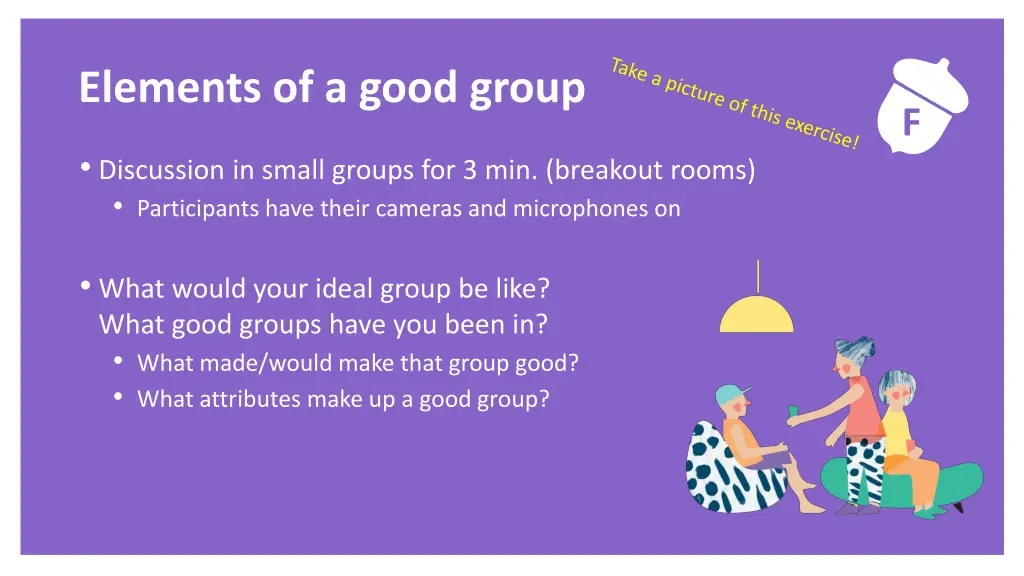
Exercise Elements of a good group F Discussion in small groups for 3 min. (breakout rooms) Participants have their cameras and microphones on What would your ideal group be like? What good groups have you been in? What made/would make that group good? What attributes make up a good group?
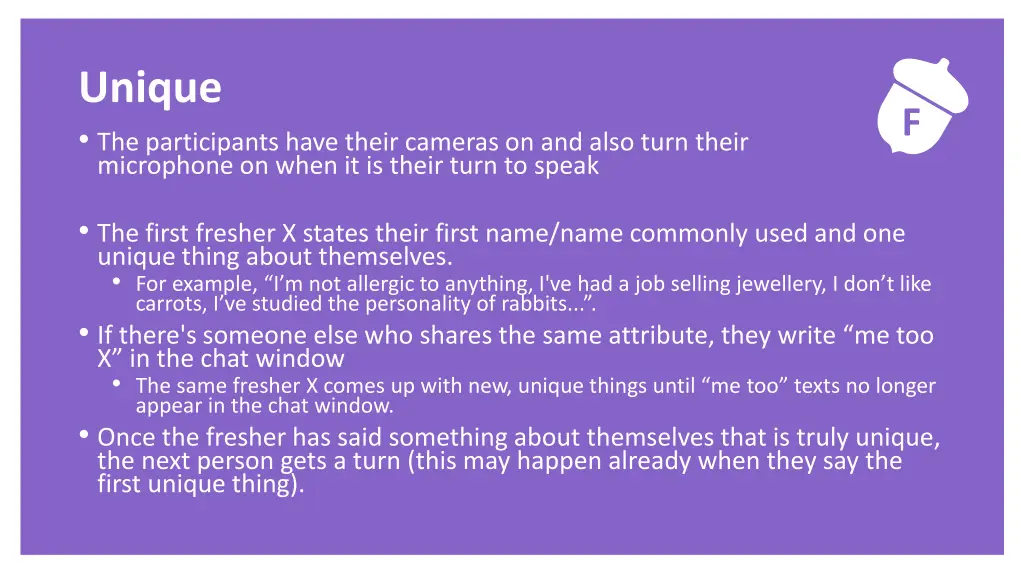
Exercise Unique The participants have their cameras on and also turn their microphone on when it is their turn to speak F The first fresher X states their first name/name commonly used and one unique thing about themselves. For example, I m not allergic to anything, I've had a job selling jewellery, I don t like carrots, I ve studied the personality of rabbits... . If there's someone else who shares the same attribute, they write me too X in the chat window The same fresher X comes up with new, unique things until me too texts no longer appear in the chat window. Once the fresher has said something about themselves that is truly unique, the next person gets a turn (this may happen already when they say the first unique thing).
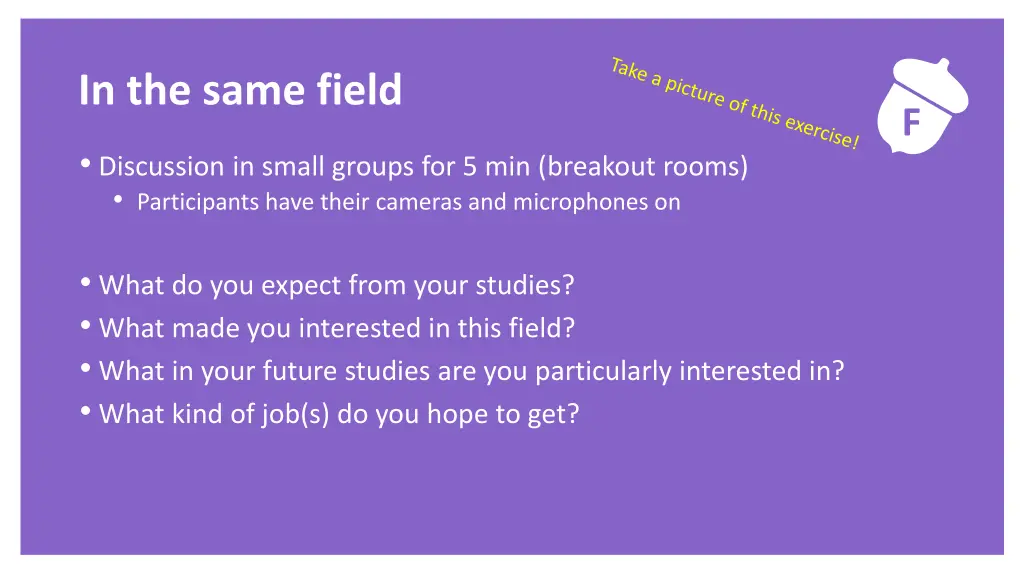
Exercise In the same field F Discussion in small groups for 5 min (breakout rooms) Participants have their cameras and microphones on What do you expect from your studies? What made you interested in this field? What in your future studies are you particularly interested in? What kind of job(s) do you hope to get?
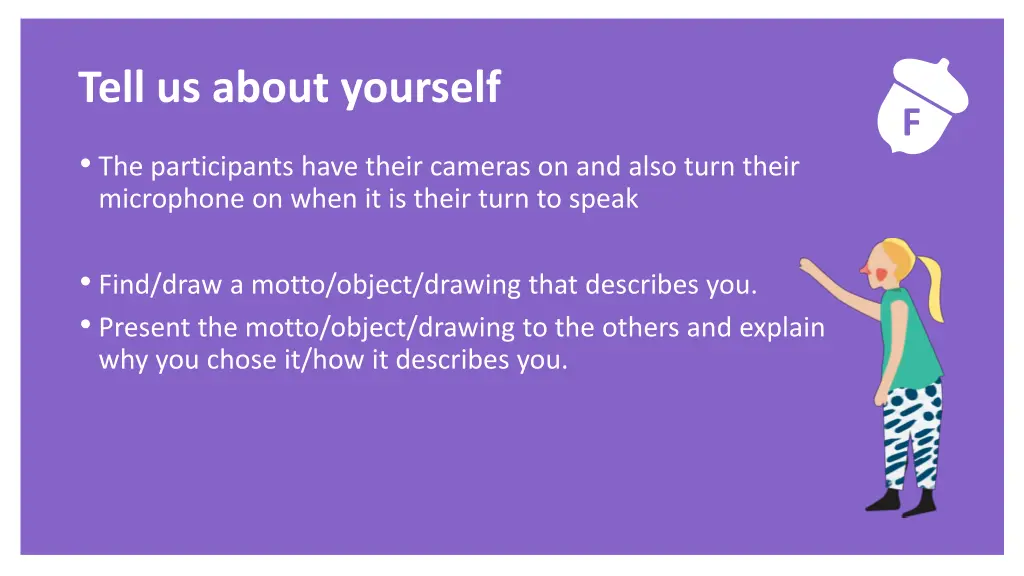
Exercise Tell us about yourself F The participants have their cameras on and also turn their microphone on when it is their turn to speak Find/draw a motto/object/drawing that describes you. Present the motto/object/drawing to the others and explain why you chose it/how it describes you.
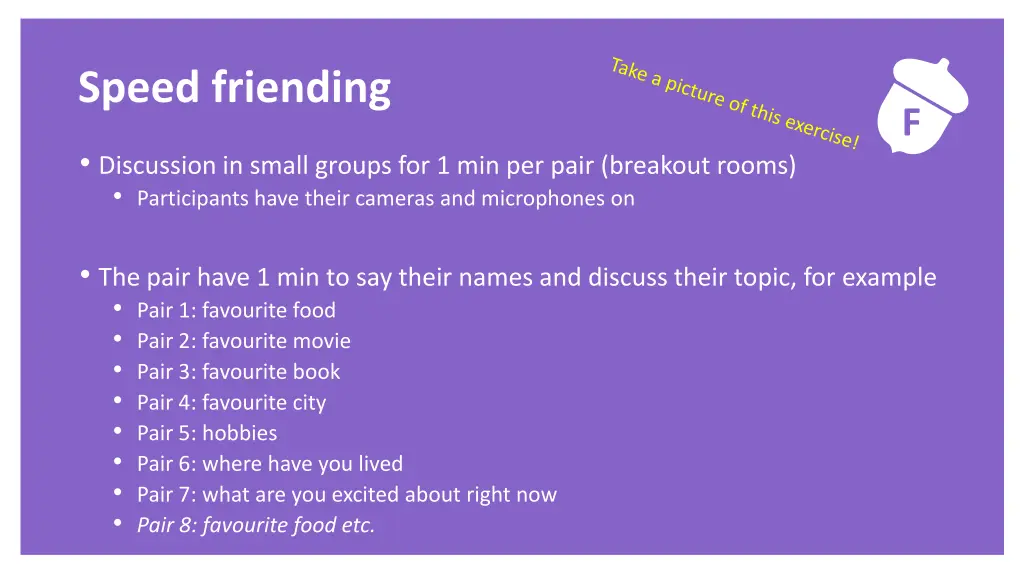
Exercise Speed friending F Discussion in small groups for 1 min per pair (breakout rooms) Participants have their cameras and microphones on The pair have 1 min to say their names and discuss their topic, for example Pair 1: favourite food Pair 2: favourite movie Pair 3: favourite book Pair 4: favourite city Pair 5: hobbies Pair 6: where have you lived Pair 7: what are you excited about right now Pair 8: favourite food etc.
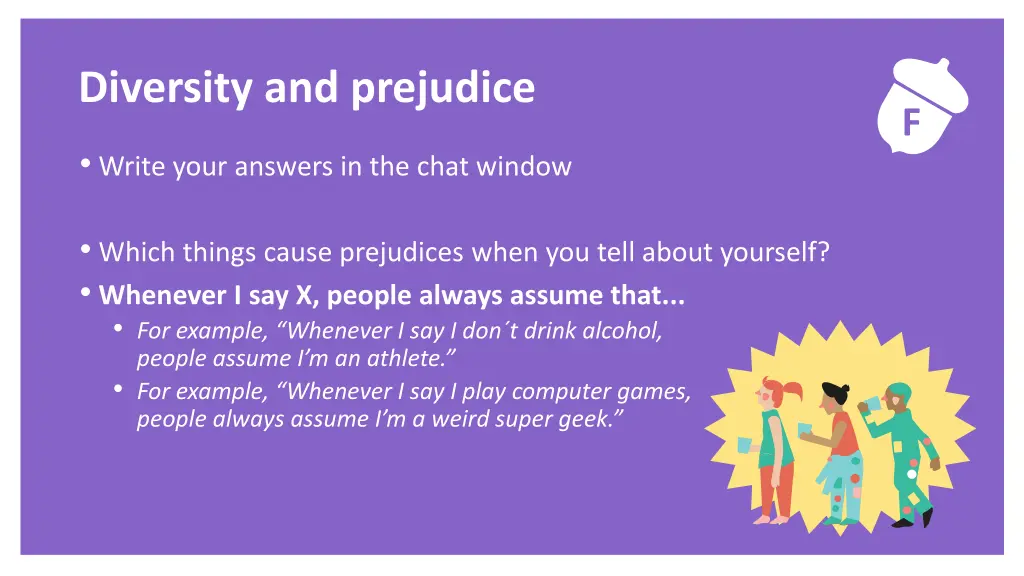
Exercise Diversity and prejudice F Write your answers in the chat window Which things cause prejudices when you tell about yourself? Whenever I say X, people always assume that... For example, Whenever I say I don t drink alcohol, people assume I m an athlete. For example, Whenever I say I play computer games, people always assume I m a weird super geek.
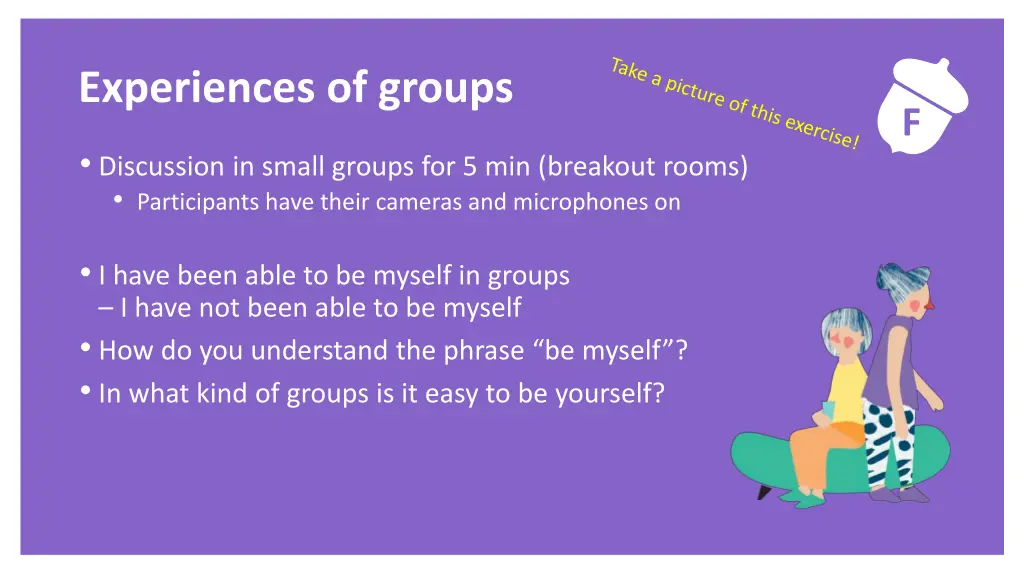
Exercise Experiences of groups F Discussion in small groups for 5 min (breakout rooms) Participants have their cameras and microphones on I have been able to be myself in groups I have not been able to be myself How do you understand the phrase be myself ? In what kind of groups is it easy to be yourself?
Exercise True or false F The participants have their cameras on and also turn their microphone on when it is their turn to speak The group members share two facts or true stories about themselves and one believable, but made-up statement. Everyone takes turns saying two truths and one lie, in whatever order they want. The others write down the name of the person and the statement they believe is a lie (A, B or C). Finally, everyone takes turns saying which of their statements was a lie and the others can check how many they guessed correctly.
KUPLA Students reforming substance use culture The presentation has been produced as part of KUPLA Students reforming substance use culture, a joint project by EHYT ry and Nyyti ry. The project was ongoing from 2018 to 2020. The partners of the project were the National Union of University Students in Finland (SYL), University of Applied Sciences Students in Finland (SAMOK), Finnish Student Sports Federation (OLL) and the Finnish Student Health Service (FSHS). This work is licensed under a Creative Commons Attribution 4.0 International license. View the license on the Creative Commons website. This presentation may be used, shared and modified freely with reference to KUPLA as the original author. The other materials of the KUPLA project can be found on the website of EHYT ry, www.ehyt.fi