Renewable Energy Sources: Solar vs. Wind - A Comparative Analysis
This study compares the efficacy of solar and wind energy in mitigating climate change, considering factors like energy return on investment, efficiency, predictability, and regional characteristics. Global trends and scholarly research are cited to support the analysis.

Download Presentation

Please find below an Image/Link to download the presentation.
The content on the website is provided AS IS for your information and personal use only. It may not be sold, licensed, or shared on other websites without obtaining consent from the author.If you encounter any issues during the download, it is possible that the publisher has removed the file from their server.
You are allowed to download the files provided on this website for personal or commercial use, subject to the condition that they are used lawfully. All files are the property of their respective owners.
The content on the website is provided AS IS for your information and personal use only. It may not be sold, licensed, or shared on other websites without obtaining consent from the author.
E N D
Presentation Transcript
ACADEMIC RESEARCH AND WRITING Omar Farouk Al Mashhour Academic Research And Writing (Bus 353) 2023-2024 Fall Week One Monday, 12thOf October 2023
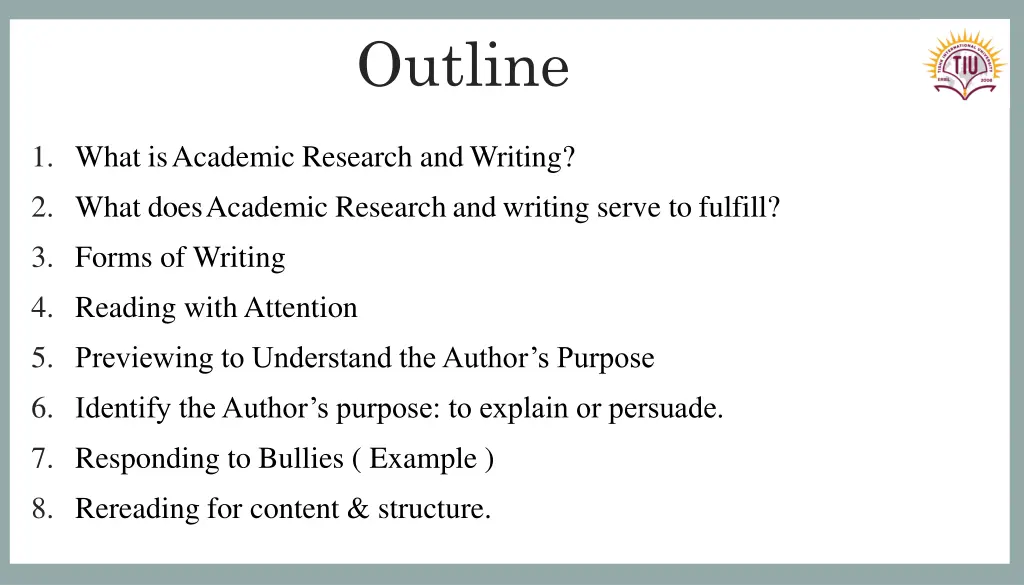
Outline 1. What isAcademic Research andWriting? 2. What doesAcademic Research andwriting serve to fulfill? 3. Forms of Writing 4. Reading with Attention 5. Previewing to Understand the Author s Purpose 6. Identify the Author s purpose: to explain or persuade. 7. Responding to Bullies ( Example ) 8. Rereading for content & structure.
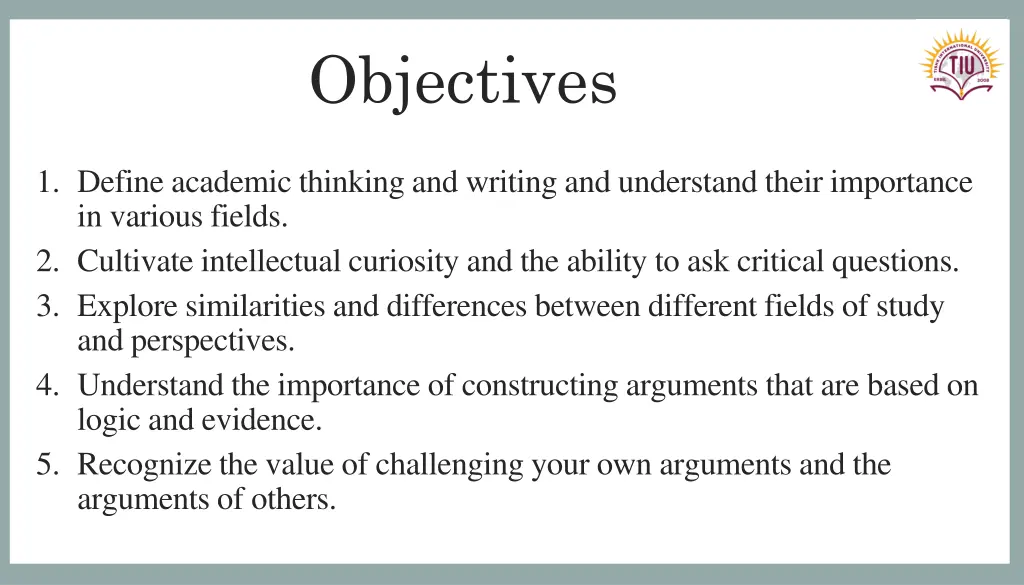
Objectives 1. Define academic thinking and writing and understand their importance in various fields. 2. Cultivate intellectual curiosity and the ability to ask critical questions. 3. Explore similarities and differences between different fields of study and perspectives. 4. Understand the importance of constructing arguments that are based on logic and evidence. 5. Recognize the value of challenging your own arguments and the arguments of others.
Identify the distinctions (differences) between these diverse (different) extracts
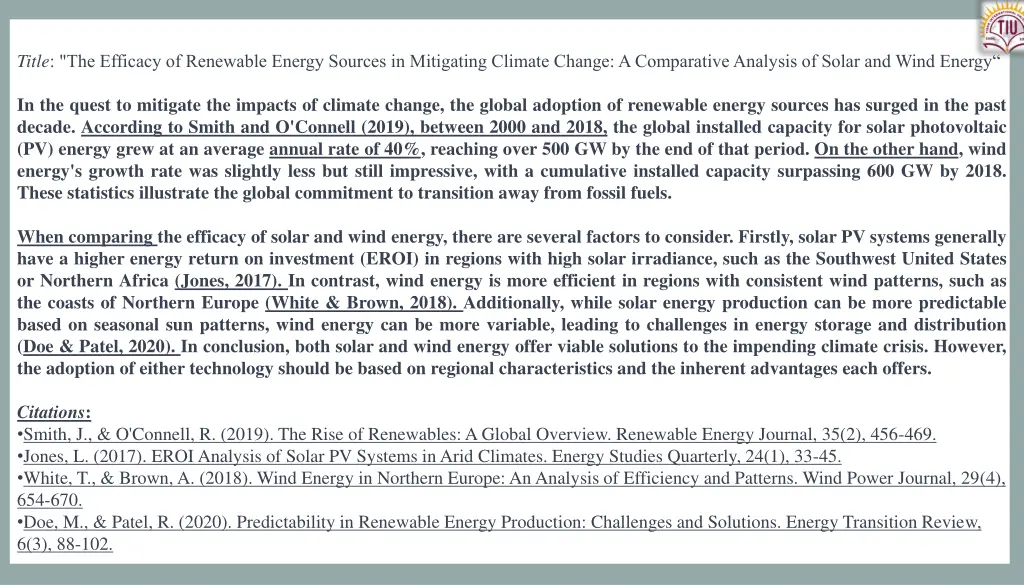
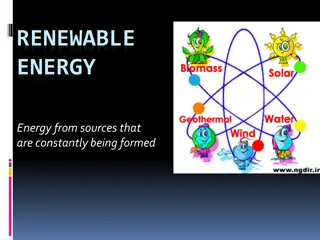
Title: "The Efficacy of Renewable Energy Sources in Mitigating Climate Change: A Comparative Analysis of Solar and Wind Energy In the quest to mitigate the impacts of climate change, the global adoption of renewable energy sources has surged in the past decade. According to Smith and O'Connell (2019), between 2000 and 2018, the global installed capacity for solar photovoltaic (PV) energy grew at an average annual rate of 40%, reaching over 500 GW by the end of that period. On the other hand, wind energy's growth rate was slightly less but still impressive, with a cumulative installed capacity surpassing 600 GW by 2018. These statistics illustrate the global commitment to transition away from fossil fuels. When comparing the efficacy of solar and wind energy, there are several factors to consider. Firstly, solar PV systems generally have a higher energy return on investment (EROI) in regions with high solar irradiance, such as the Southwest United States or Northern Africa (Jones, 2017). In contrast, wind energy is more efficient in regions with consistent wind patterns, such as the coasts of Northern Europe (White & Brown, 2018). Additionally, while solar energy production can be more predictable based on seasonal sun patterns, wind energy can be more variable, leading to challenges in energy storage and distribution (Doe & Patel, 2020). In conclusion, both solar and wind energy offer viable solutions to the impending climate crisis. However, the adoption of either technology should be based on regional characteristics and the inherent advantages each offers. Citations: Smith, J., & O'Connell, R. (2019). The Rise of Renewables: A Global Overview. Renewable Energy Journal, 35(2), 456-469. Jones, L. (2017). EROI Analysis of Solar PV Systems in Arid Climates. Energy Studies Quarterly, 24(1), 33-45. White, T., & Brown, A. (2018). Wind Energy in Northern Europe: An Analysis of Efficiency and Patterns. Wind Power Journal, 29(4), 654-670. Doe, M., & Patel, R. (2020). Predictability in Renewable Energy Production: Challenges and Solutions. Energy Transition Review, 6(3), 88-102.
Title: "Why I Love Solar Energy: A Personal Perspective "Solar energy is simply amazing! When I moved to Arizona, the sunny days seemed endless. So, I thought, why not make the most of this abundant sunshine? That's when I decided to get solar panels for my house. The results have been fantastic. Not only have my electricity bills dropped, but there's also a sense of satisfaction knowing I'm doing my bit for the planet. Some of my friends have wind turbines in their backyards, especially those who live up north where it's windier. They too love their choice. But for me, there's something special about harnessing the sun's power. It feels like a daily gift from nature."
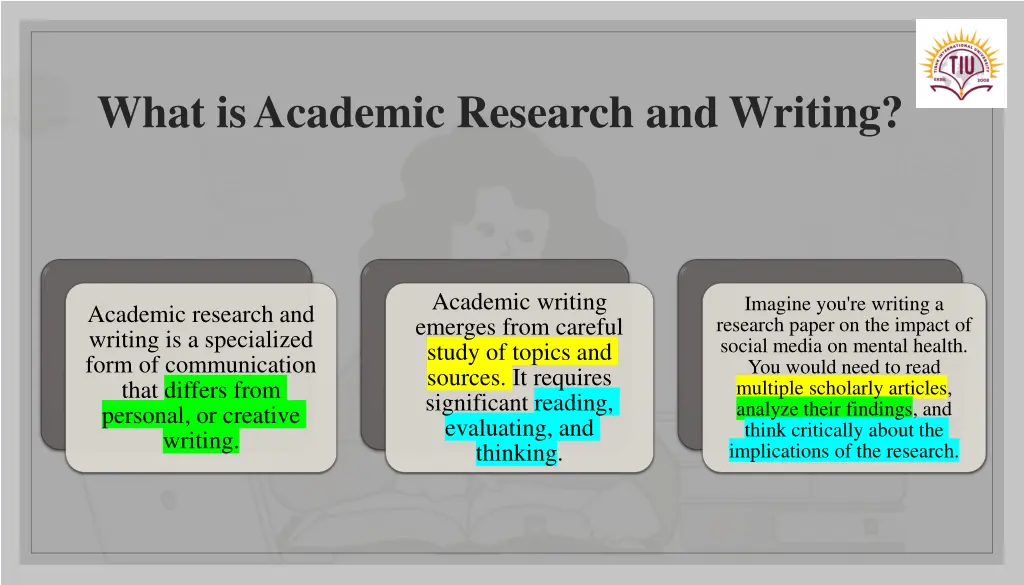
What is Academic Research and Writing? Academic writing emerges from careful study of topics and sources. It requires significant reading, evaluating, and thinking. Imagine you're writing a research paper on the impact of social media on mental health. You would need to read multiple scholarly articles, analyze their findings, and think critically about the implications of the research. Academic research and writing is a specialized form of communication that differs from personal, or creative writing.
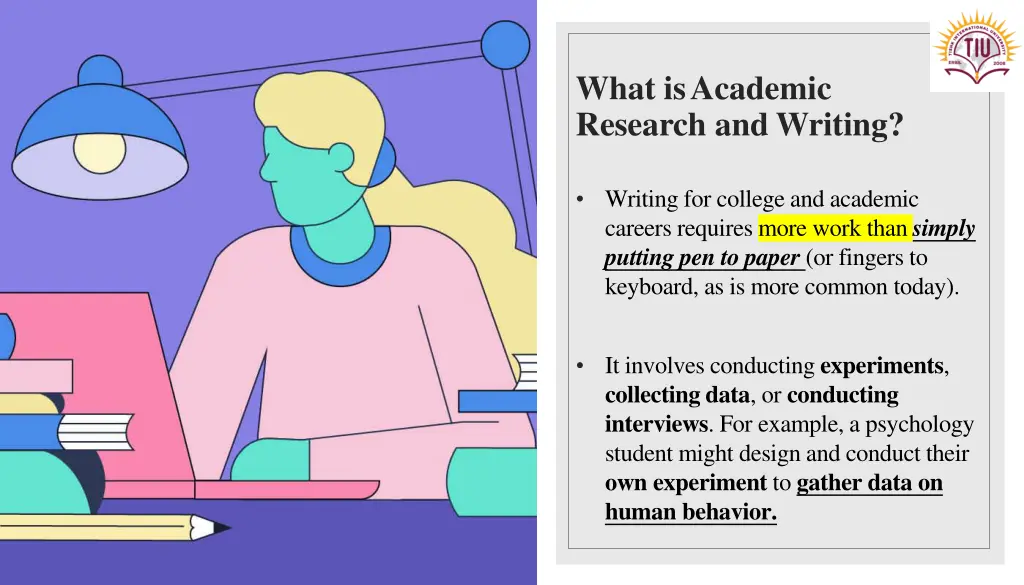
What is Academic Research and Writing? Writing for college and academic careers requires more work than simply putting pen to paper (or fingers to keyboard, as is more common today). It involves conducting experiments, collecting data, or conducting interviews. For example, a psychology student might design and conduct their own experiment to gather data on human behavior.
What does Academic Research and writing serve to fulfill? Academic research and writing serves a broader purpose beyond meeting basic writing course requirements. It plays a vital role in fostering critical thinking and curiosity across various disciplines and courses. Sociologists, artists, economists, and anthropologists, among others, employ academic research and writing to: 1. Explore similarities and differences: Academic research helps uncover similarities and differences between various concepts, phenomena, or perspectives. 2. Present logical arguments supported by evidence: It enables researchers to construct well-reasoned arguments based on empirical evidenc
Continue.. 3. Challenge existing arguments: Academic research encourages the critical evaluation of existing arguments and theories, fostering intellectual growth. 4. Introduce new ideas or perspectives: It allows researchers to communicate novel ideas or provide fresh perspectives on existing concepts or theories.
Explore similarities and differences Academic thinking often involves close study of examples. Any time you gather multiple examples of a topic and study them, you ll have an occasion to make comparisons and contrasts. For instance, if you were researching the topic of fruit, you would quickly realize that there is no single definition or form that encompasses all fruits. How would you treat the differences and the similarities you found? What conclusions would you draw? Considering the differences and similarities you find can lead to valuable insights and conclusions. In college-level work, you will frequently encounter situations where you need to observe and explain both the similarities and differences in your analysis.
Arguing With Logic & Evidence In social settings, few people want to be known for arguing all the time. However, in academic settings, the ability to argue using logic and evidence is highly valued. This includes presenting one's own work and critically reviewing the work of others. In a college setting, argumentation plays a central role in building our knowledge of the world. It involves examining evidence, drawing conclusions, and persuasively convincing others of the validity and reasonableness of our viewpoints. Developing strong argumentation skills is a fundamental aspect of the college learning experience. Let's consider an example. Imagine you are trapped in an Arctic outpost, and winter is approaching. Your urgent need is insulation to prevent freezing to death. In this situation, wouldn't three pounds of feathers (to make a down blanket) be far more valuable to you than three pounds of gold? Arguing the point challenges the conventional notion of value and prompts critical thinking.
Challenging Argument -Why arguments must be challenged In academic settings, the act of arguing is not limited to presenting your own viewpoint. It is equally important to critically examine and challenge the arguments put forth by others. By questioning the logic and evidence behind these arguments, the pursuit of knowledge is strengthened. Accepting flawed arguments as true hinders the growth of knowledge and intellectual progress. Engaging in intellectual debates requires the ability to respectfully and logically challenge arguments. By respectfully pushing back against flawed reasoning, you contribute to a richer and more robust academic environment. This skill is not only valuable in college but also in various professional and personal contexts throughout your life.
Communicating Critical Thinking Through Writing Writing can serve as a powerful tool for cultivating critical thinking skills. In your writing class, as well as in all your other classes, the primary focus will be on enhancing your critical thinking abilities. To illustrate this, let's examine an example of how any topic can be approached critically. What sets academic study apart is not the subject matter itself, but rather the thought-provoking questions researchers ask about it and the rigorous methods they employ to investigate. As a college student, you are embarking on a journey to become an investigator, equipped with the skills to think critically. You will engage in critical thinking when you nurture your intellectual curiosity, analyze similarities and differences, construct logical arguments supported by evidence, and critically evaluate the work of others. Your college diploma holds significance because it signifies the development of these vital critical thinking skills.
Forms of Writing Writing is a fundamental tool for expressing and developing your knowledge, as well as a means for learning through the process of clarifying ideas before communicating them. In college, your writing will take five typical forms: Summary: Accurately distills the main points of what you ve read or seen, in a concise and organized manner. Evaluation: Critically examines and responds to the arguments of others, weighing the evidence presented and making a reasoned judgment about its merit. Explanation: Defines and describes a topic neutrally, without interpretation or personal bias, in order to provide a clear understanding of the subject matter. Argument: Uses evidence and logical reasoning to answer debatable questions, build new knowledge, and persuade others of your viewpoint. Analysis: Studies an object, idea, or concept closely, illuminating it through examination and interpretation in order to gain deeper insights.
Reading with Attention Effective reading is a crucial skill for college-level work. It involves carefully understanding source materials such as books, scholarly articles, research reports, and more. Your academic success depends on your ability to comprehend and analyze these texts. To read with attention, you need to engage in three key tasks: Previewing: Before diving into a text, take a moment to understand the author's purpose. Forming a Preliminary Understanding:Develop an initial understanding of the text's topic and purpose to guide your reading and comprehension. Reading for Content and Structure:Read the text carefully, focusing on understanding the content and structure of the material to extract key information and identify the author's arguments or main ideas.
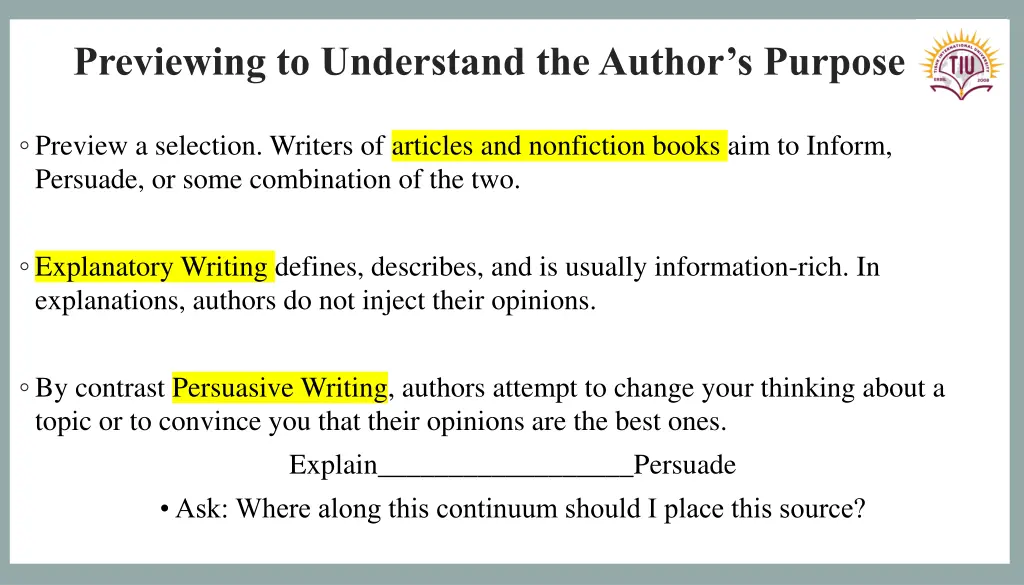
Previewing to Understand the Authors Purpose Preview a selection. Writers of articles and nonfiction books aim to Inform, Persuade, or some combination of the two. Explanatory Writing defines, describes, and is usually information-rich. In explanations, authors do not inject their opinions. By contrast Persuasive Writing, authors attempt to change your thinking about a topic or to convince you that their opinions are the best ones. Explain__________________Persuade Ask: Where along this continuum should I place this source?
Identifying the Author's Purpose: Explanation or Persuasion Before taking notes on a source, For an article: For a book: Read summaries (also called Read book jacket information, it is important to previewit to gain a holisticunderstanding. Skim the text and identify the author's purpose, whether it is to explain, persuade, or both. abstracts) if available. including the author s Read opening and closing biography. paragraphs. Read the preface. Read all major headings. Skim the table of contents. Read the first line of every Read the first and last paragraph. paragraph of every chapter.
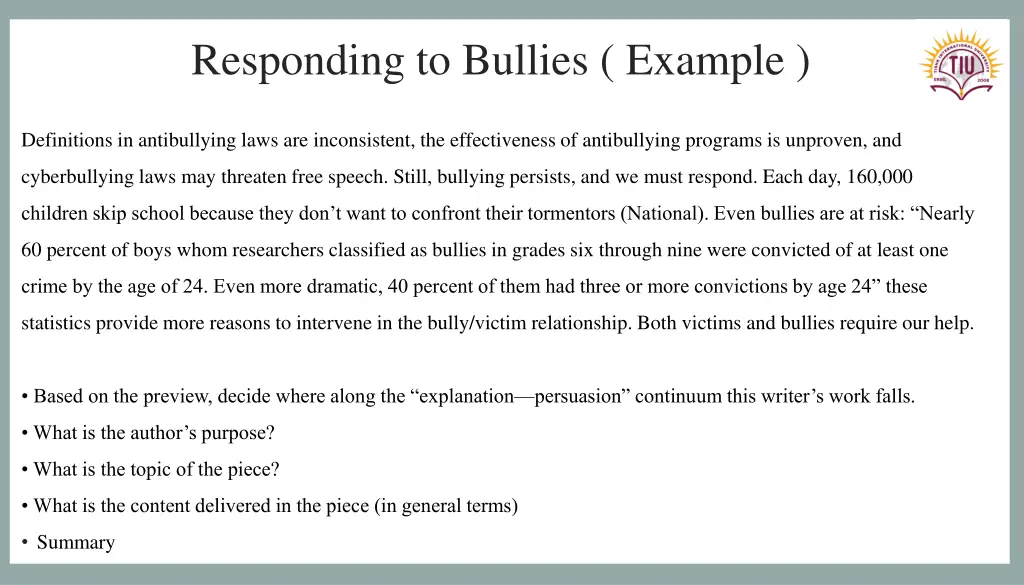
Responding to Bullies ( Example ) Definitions in antibullying laws are inconsistent, the effectiveness of antibullying programs is unproven, and cyberbullying laws may threaten free speech. Still, bullying persists, and we must respond. Each day, 160,000 children skip school because they don t want to confront their tormentors (National). Even bullies are at risk: Nearly 60 percent of boys whom researchers classified as bullies in grades six through nine were convicted of at least one crime by the age of 24. Even more dramatic, 40 percent of them had three or more convictions by age 24 these statistics provide more reasons to intervene in the bully/victim relationship. Both victims and bullies require our help. Based on the preview, decide where along the explanation persuasion continuum this writer s work falls. What is the author s purpose? What is the topic of the piece? What is the content delivered in the piece (in general terms) Summary
Responding to Bullies ( Example ) Purpose to argue to present data that changes our opinion Topic bullying Content difficulties dealing effectively with bullies Summary The problem of bullying demands an institutional response that has, up to now, been ineffective and has hurt both bullies and their victims, When you reread the paragraph in full, you find its interior sentences given to evidence that Simmons uses to change our thinking about bullies. Again, what we learn from the interior sentences does not require changes to our summary
Rereading For Content & Structure Once you ve previewed a selection, reread it carefully. Read every word, prepared to make notes: Label sections. Make margin notes to highlight a reading s main sections that is, groupings of related paragraphs. Underline or highlight the main idea and supporting ideas of each section. Is the author s purpose to inform, to persuade, or both? If the purpose is to inform, identify the topic and its parts. Identify facts, examples, definitions, processes. If the purpose is to persuade, identify the author s claim the main opinion. Identify reasons and evidence. Is the author arguing based on logic? On emotions
References Laurence Behrens, Leonard Rosen - A Sequence for Academic Writing (7th Edition) Sky Marsen - Professional Writing-Red Globe Press (2019)