Response Policy for Red Stage in Osaka Prefecture
Stay updated on the response policy during the Red Stage in Osaka Prefecture, including restrictions on travel, gatherings, and facility operations. Learn about the guidelines, closures, and strongly requested actions for residents and various sectors to combat the spread of COVID-19 effectively.

Download Presentation

Please find below an Image/Link to download the presentation.
The content on the website is provided AS IS for your information and personal use only. It may not be sold, licensed, or shared on other websites without obtaining consent from the author. If you encounter any issues during the download, it is possible that the publisher has removed the file from their server.
You are allowed to download the files provided on this website for personal or commercial use, subject to the condition that they are used lawfully. All files are the property of their respective owners.
The content on the website is provided AS IS for your information and personal use only. It may not be sold, licensed, or shared on other websites without obtaining consent from the author.
E N D
Presentation Transcript
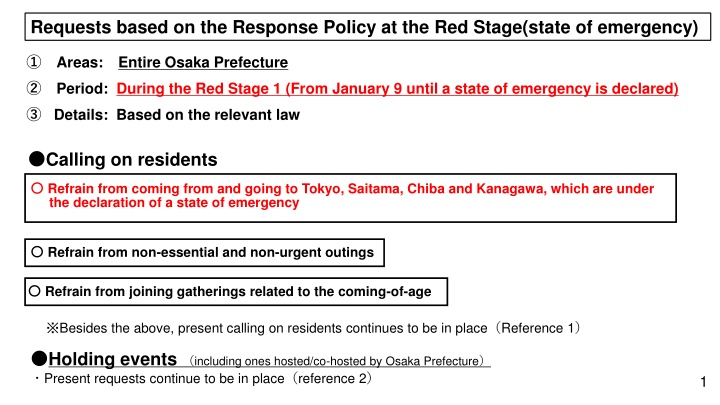
Requests based on the Response Policy at the Red Stage(state of emergency) Areas: Entire Osaka Prefecture Period: During the Red Stage 1 (From January 9 until a state of emergency is declared) Details: Based on the relevant law Calling on residents Refrain from coming from and going to Tokyo, Saitama, Chiba and Kanagawa, which are under the declaration of a state of emergency Refrain from non-essential and non-urgent outings Refrain from joining gatherings related to the coming-of-age Besides the above, present calling on residents continues to be in place Reference 1 Holding events including ones hosted/co-hosted by Osaka Prefecture Present requests continue to be in place reference 2 1
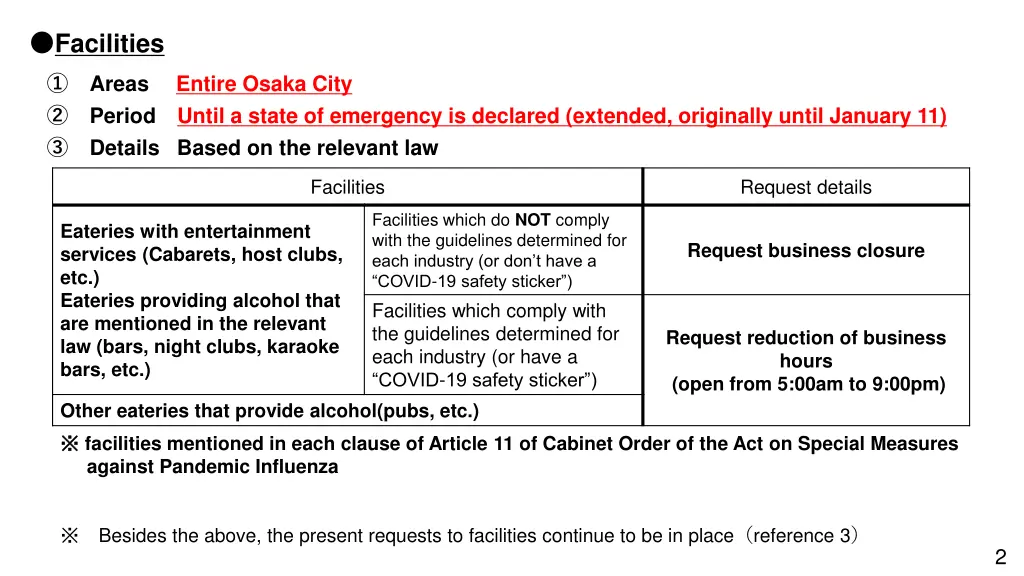
Facilities Areas Period Details Based on the relevant law Entire Osaka City Until a state of emergency is declared (extended, originally until January 11) Facilities Request details Facilities which do NOT comply with the guidelines determined for each industry (or don t have a COVID-19 safety sticker ) Facilities which comply with the guidelines determined for each industry (or have a COVID-19 safety sticker ) Eateries with entertainment services (Cabarets, host clubs, etc.) Eateries providing alcohol that are mentioned in the relevant law (bars, night clubs, karaoke bars, etc.) Request business closure Request reduction of business hours (open from 5:00am to 9:00pm) Other eateries that provide alcohol(pubs, etc.) facilities mentioned in each clause of Article 11 of Cabinet Order of the Act on Special Measures against Pandemic Influenza Besides the above, the present requests to facilities continue to be in place reference 3 2
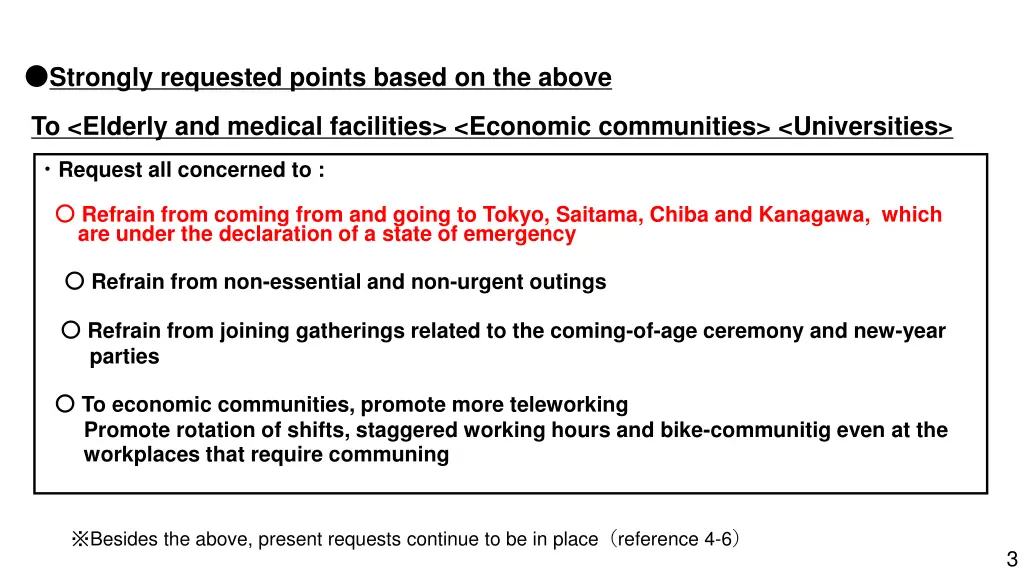
Strongly requested points based on the above To <Elderly and medical facilities> <Economic communities> <Universities> Request all concerned to : Refrain from coming from and going to Tokyo, Saitama, Chiba and Kanagawa, which are under the declaration of a state of emergency Refrain from non-essential and non-urgent outings Refrain from joining gatherings related to the coming-of-age ceremony and new-year parties To economic communities, promote more teleworking Promote rotation of shifts, staggered working hours and bike-communitig even at the workplaces that require communing Besides the above, present requests continue to be in place reference 4-6 3
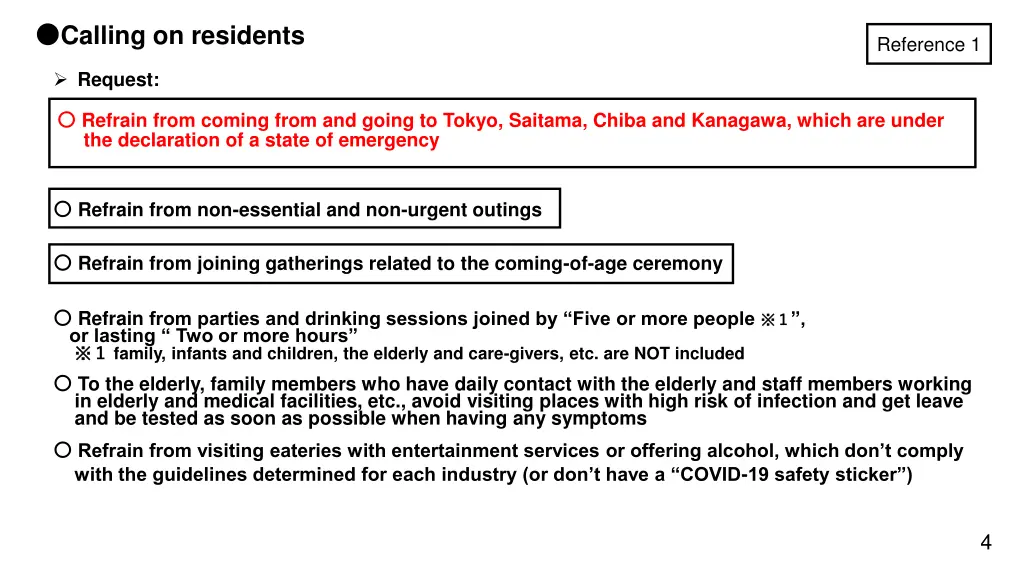
Calling on residents Reference 1 Request: Refrain from coming from and going to Tokyo, Saitama, Chiba and Kanagawa, which are under the declaration of a state of emergency Refrain from non-essential and non-urgent outings Refrain from joining gatherings related to the coming-of-age ceremony Refrain from parties and drinking sessions joined by Five or more people or lasting Two or more hours family, infants and children, the elderly and care-givers, etc. are NOT included , To the elderly, family members who have daily contact with the elderly and staff members working in elderly and medical facilities, etc., avoid visiting places with high risk of infection and get leave and be tested as soon as possible when having any symptoms Refrain from visiting eateries with entertainment services or offering alcohol, which don t comply with the guidelines determined for each industry (or don t have a COVID-19 safety sticker ) 4
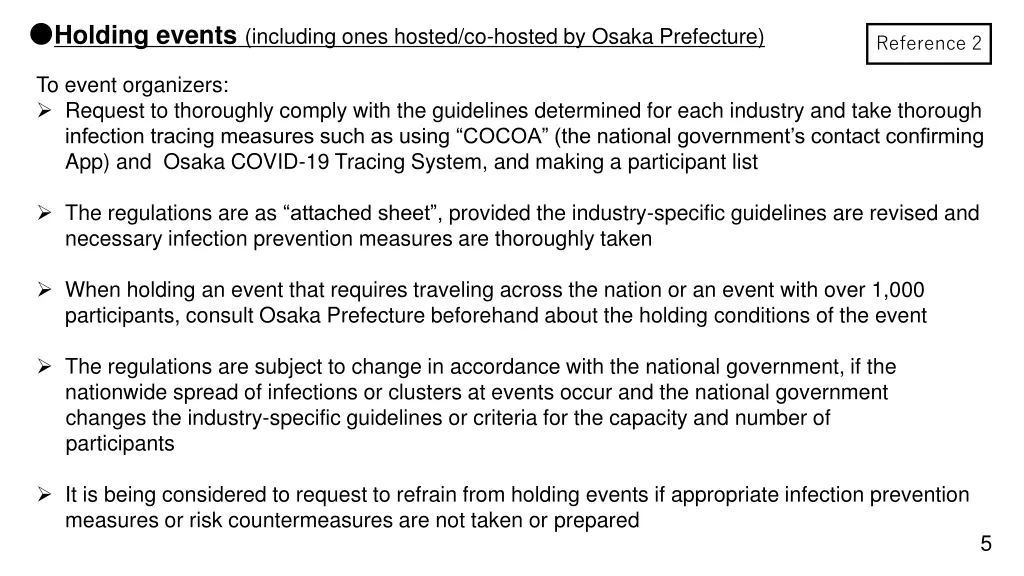
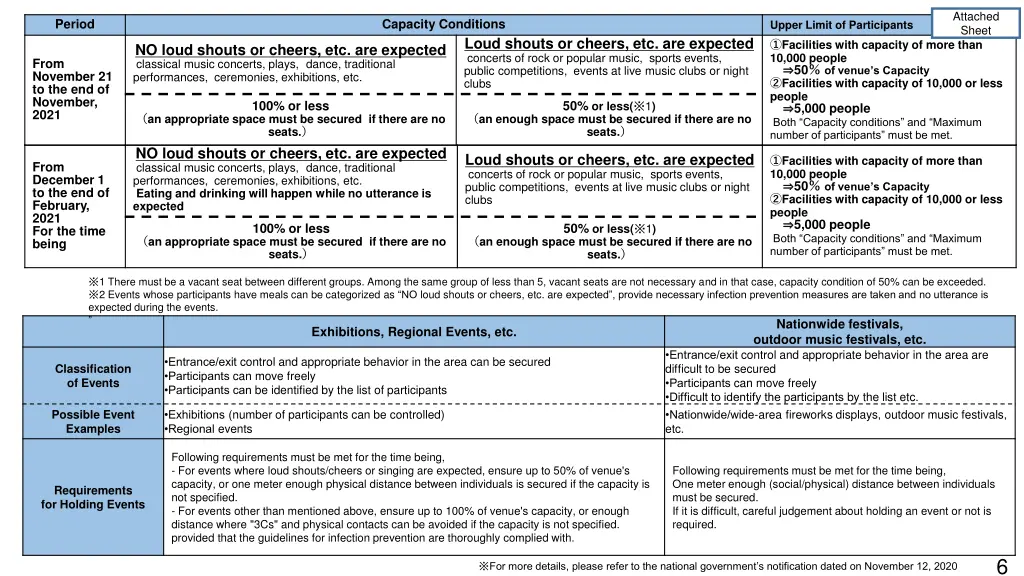
Holding events (including ones hosted/co-hosted by Osaka Prefecture) Reference 2 To event organizers: Request to thoroughly comply with the guidelines determined for each industry and take thorough infection tracing measures such as using COCOA (the national government s contact confirming App) and Osaka COVID-19 Tracing System, and making a participant list The regulations are as attached sheet , provided the industry-specific guidelines are revised and necessary infection prevention measures are thoroughly taken When holding an event that requires traveling across the nation or an event with over 1,000 participants, consult Osaka Prefecture beforehand about the holding conditions of the event The regulations are subject to change in accordance with the national government, if the nationwide spread of infections or clusters at events occur and the national government changes the industry-specific guidelines or criteria for the capacity and number of participants It is being considered to request to refrain from holding events if appropriate infection prevention measures or risk countermeasures are not taken or prepared 5
Attached Sheet Period Capacity Conditions Upper Limit of Participants Loud shouts or cheers, etc. are expected concerts of rock or popular music, sports events, public competitions, events at live music clubs or night clubs Facilities with capacity of more than 10,000 people 50 of venue s Capacity Facilities with capacity of 10,000 or less people 5,000 people Both Capacity conditions and Maximum number of participants must be met. NO loud shouts or cheers, etc. are expected classical music concerts, plays, dance, traditional performances, ceremonies, exhibitions, etc. From November 21 to the end of November, 2021 100% or less 50% or less( 1) an appropriate space must be secured if there are no seats. NO loud shouts or cheers, etc. are expected classical music concerts, plays, dance, traditional performances, ceremonies, exhibitions, etc. Eating and drinking will happen while no utterance is expected an enough space must be secured if there are no seats. Loud shouts or cheers, etc. are expected concerts of rock or popular music, sports events, public competitions, events at live music clubs or night clubs Facilities with capacity of more than 10,000 people 50 of venue s Capacity Facilities with capacity of 10,000 or less people 5,000 people Both Capacity conditions and Maximum number of participants must be met. From December 1 to the end of February, 2021 For the time being 100% or less 50% or less( 1) an appropriate space must be secured if there are no seats. an enough space must be secured if there are no seats. 1 There must be a vacant seat between different groups. Among the same group of less than 5, vacant seats are not necessary and in that case, capacity condition of 50% can be exceeded. 2 Events whose participants have meals can be categorized as NO loud shouts or cheers, etc. are expected , provide necessary infection prevention measures are taken and no utterance is expected during the events. Nationwide festivals, outdoor music festivals, etc. Exhibitions, Regional Events, etc. Entrance/exit control and appropriate behavior in the area are difficult to be secured Participants can move freely Difficult to identify the participants by the list etc. Nationwide/wide-area fireworks displays, outdoor music festivals, etc. Entrance/exit control and appropriate behavior in the area can be secured Participants can move freely Participants can be identified by the list of participants Classification of Events Exhibitions (number of participants can be controlled) Regional events Possible Event Examples Following requirements must be met for the time being, - For events where loud shouts/cheers or singing are expected, ensure up to 50% of venue's capacity, or one meter enough physical distance between individuals is secured if the capacity is not specified. - For events other than mentioned above, ensure up to 100% of venue's capacity, or enough distance where "3Cs" and physical contacts can be avoided if the capacity is not specified. provided that the guidelines for infection prevention are thoroughly complied with. Following requirements must be met for the time being, One meter enough (social/physical) distance between individuals must be secured. If it is difficult, careful judgement about holding an event or not is required. Requirements for Holding Events 6 For more details, please refer to the national government s notification dated on November 12, 2020
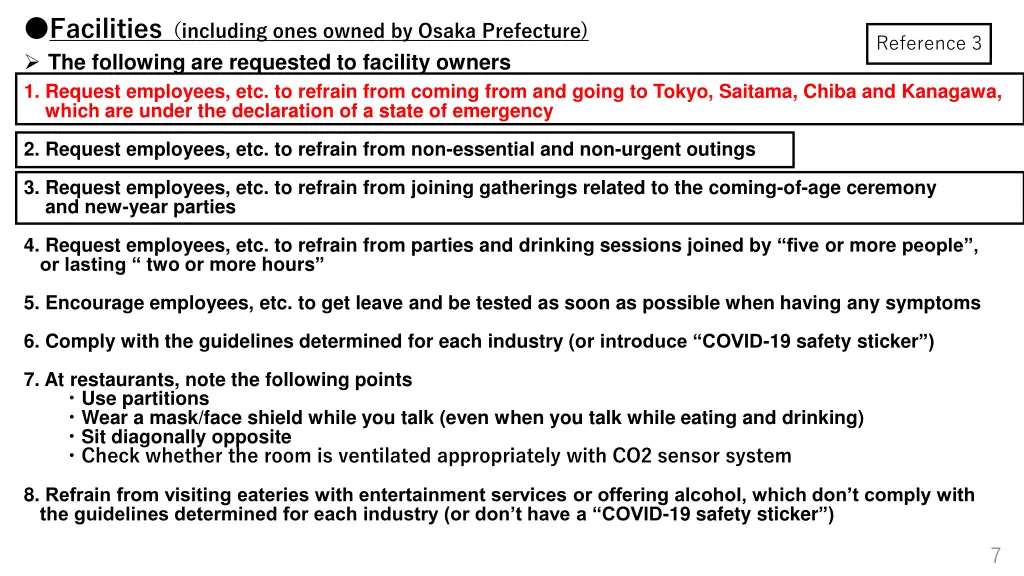
Facilitiesincluding ones owned by Osaka Prefecture) The following are requested to facility owners 1. Request employees, etc. to refrain from coming from and going to Tokyo, Saitama, Chiba and Kanagawa, which are under the declaration of a state of emergency Reference 3 2. Request employees, etc. to refrain from non-essential and non-urgent outings 3. Request employees, etc. to refrain from joining gatherings related to the coming-of-age ceremony and new-year parties 4. Request employees, etc. to refrain from parties and drinking sessions joined by five or more people , or lasting two or more hours 5. Encourage employees, etc. to get leave and be tested as soon as possible when having any symptoms 6. Comply with the guidelines determined for each industry (or introduce COVID-19 safety sticker ) 7. At restaurants, note the following points Use partitions Wear a mask/face shield while you talk (even when you talk while eating and drinking) Sit diagonally opposite Check whether the room is ventilated appropriately with CO2 sensor system 8. Refrain from visiting eateries with entertainment services or offering alcohol, which don t comply with the guidelines determined for each industry (or don t have a COVID-19 safety sticker ) 7
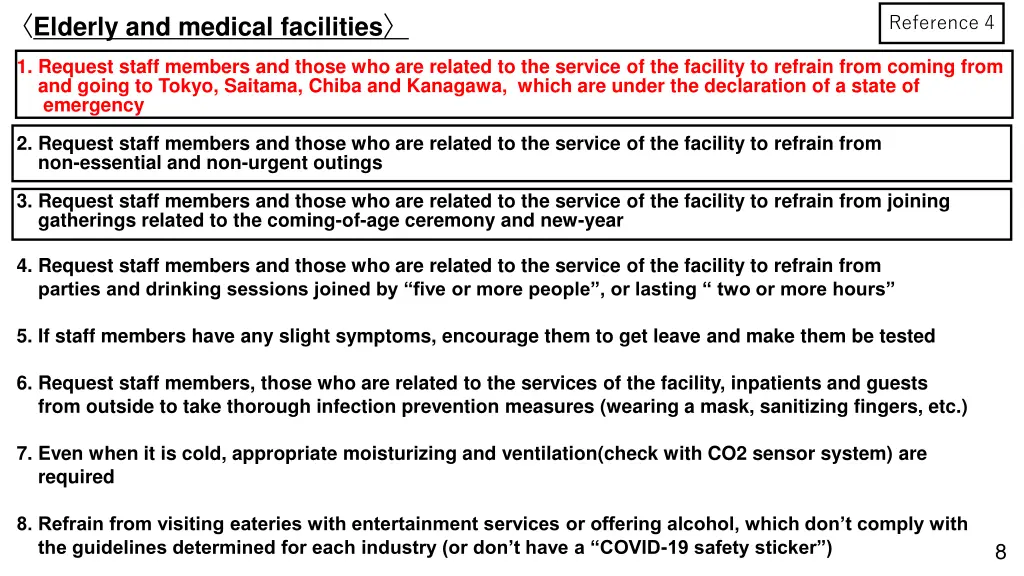
Elderly and medical facilities Reference 4 1. Request staff members and those who are related to the service of the facility to refrain from coming from and going to Tokyo, Saitama, Chiba and Kanagawa, which are under the declaration of a state of emergency 2. Request staff members and those who are related to the service of the facility to refrain from non-essential and non-urgent outings 3. Request staff members and those who are related to the service of the facility to refrain from joining gatherings related to the coming-of-age ceremony and new-year 4. Request staff members and those who are related to the service of the facility to refrain from parties and drinking sessions joined by five or more people , or lasting two or more hours 5. If staff members have any slight symptoms, encourage them to get leave and make them be tested 6. Request staff members, those who are related to the services of the facility, inpatients and guests from outside to take thorough infection prevention measures (wearing a mask, sanitizing fingers, etc.) 7. Even when it is cold, appropriate moisturizing and ventilation(check with CO2 sensor system) are required 8. Refrain from visiting eateries with entertainment services or offering alcohol, which don t comply with the guidelines determined for each industry (or don t have a COVID-19 safety sticker ) 8
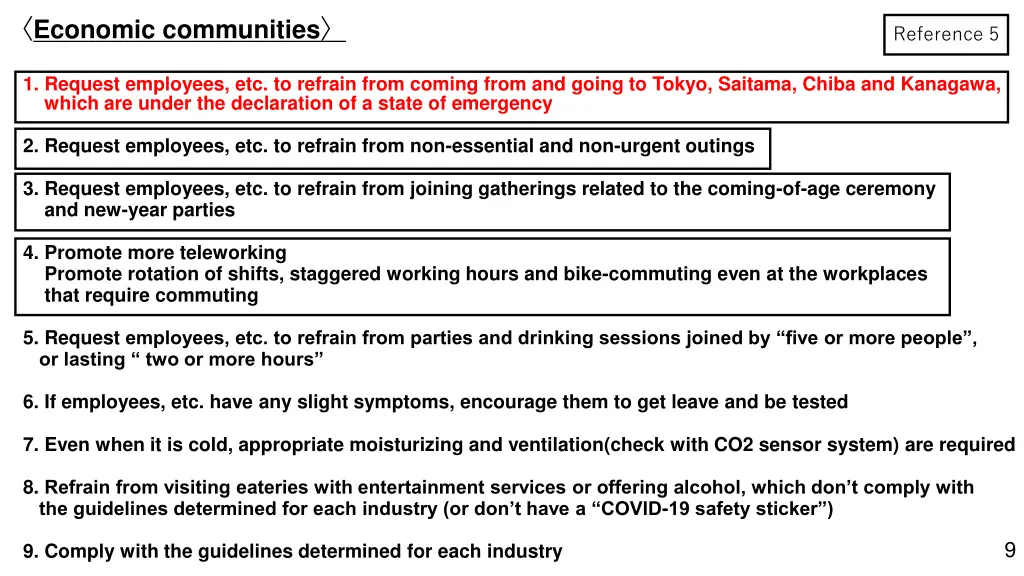
Economic communities Reference 5 1. Request employees, etc. to refrain from coming from and going to Tokyo, Saitama, Chiba and Kanagawa, which are under the declaration of a state of emergency 2. Request employees, etc. to refrain from non-essential and non-urgent outings 3. Request employees, etc. to refrain from joining gatherings related to the coming-of-age ceremony and new-year parties 4. Promote more teleworking Promote rotation of shifts, staggered working hours and bike-commuting even at the workplaces that require commuting 5. Request employees, etc. to refrain from parties and drinking sessions joined by five or more people , or lasting two or more hours 6. If employees, etc. have any slight symptoms, encourage them to get leave and be tested 7. Even when it is cold, appropriate moisturizing and ventilation(check with CO2 sensor system) are required 8. Refrain from visiting eateries with entertainment services or offering alcohol, which don t comply with the guidelines determined for each industry (or don t have a COVID-19 safety sticker ) 9 9. Comply with the guidelines determined for each industry
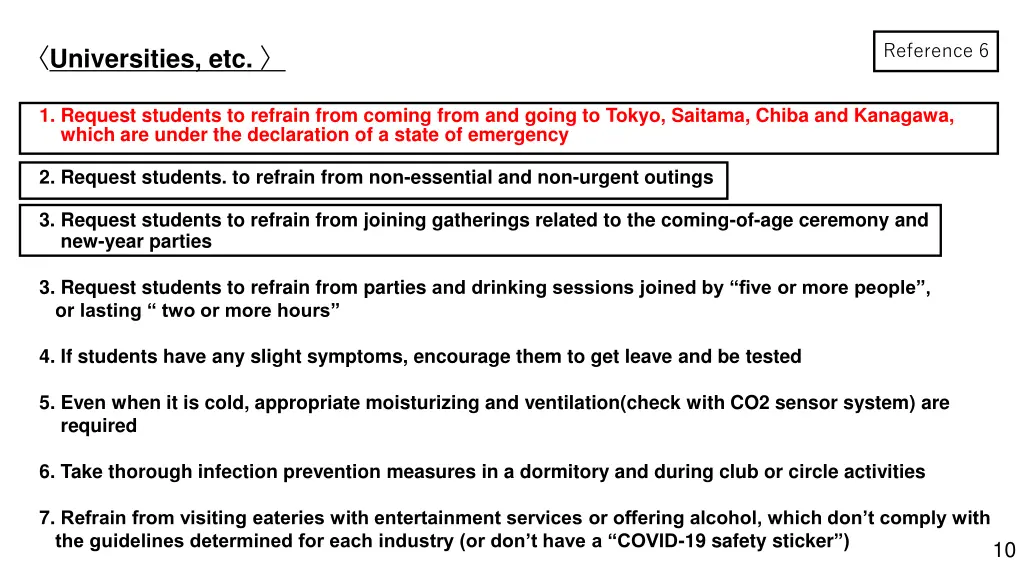
Reference 6 Universities, etc. 1. Request students to refrain from coming from and going to Tokyo, Saitama, Chiba and Kanagawa, which are under the declaration of a state of emergency 2. Request students. to refrain from non-essential and non-urgent outings 3. Request students to refrain from joining gatherings related to the coming-of-age ceremony and new-year parties 3. Request students to refrain from parties and drinking sessions joined by five or more people , or lasting two or more hours 4. If students have any slight symptoms, encourage them to get leave and be tested 5. Even when it is cold, appropriate moisturizing and ventilation(check with CO2 sensor system) are required 6. Take thorough infection prevention measures in a dormitory and during club or circle activities 7. Refrain from visiting eateries with entertainment services or offering alcohol, which don t comply with the guidelines determined for each industry (or don t have a COVID-19 safety sticker ) 10