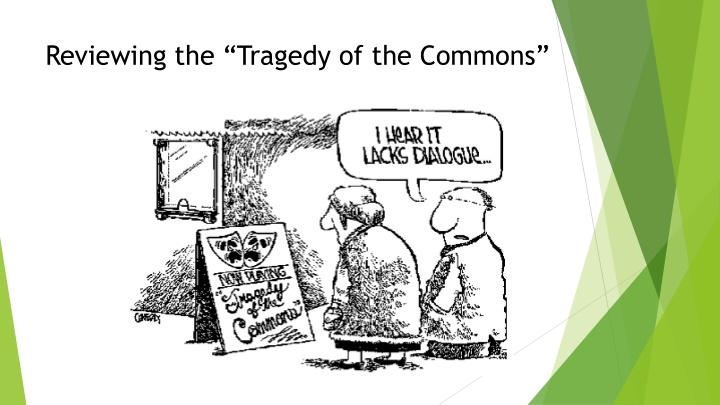
Reviewing the Tragedy of the Commons
Environmental problems caused by human activities, tragedy of the commons, interactions in environmental science, altering natural systems, and key global environmental indicators are discussed in this content about our impact on the Earth.

Download Presentation

Please find below an Image/Link to download the presentation.
The content on the website is provided AS IS for your information and personal use only. It may not be sold, licensed, or shared on other websites without obtaining consent from the author.If you encounter any issues during the download, it is possible that the publisher has removed the file from their server.
You are allowed to download the files provided on this website for personal or commercial use, subject to the condition that they are used lawfully. All files are the property of their respective owners.
The content on the website is provided AS IS for your information and personal use only. It may not be sold, licensed, or shared on other websites without obtaining consent from the author.
E N D
Presentation Transcript
Practice Questions 1. Along with population growth, which of the following is a major root of the environmental problems caused by humans? [A] our exploitation & consumption of resources [B] our renewable energy initiatives [C] our reforestation projects [D] our sustainable development practices 2. One example of the tragedy of the commons can occur when several farmers share the same pasture for feeding sheep. The root cause of this tragedy is that [A] people are bad [B] sheep reproduce too quickly [C] the market cannot support too many farmers [D] the farmers believe that if I don t use it then someone else will. [E] The cost of the sheep is lessened by bulk purchase power
Introduction to APES Studying the State of Our Earth Friday, July 31st, 2015 Textbook pages 2-11
Interactions between systems Environmental Science how nature works. how the environment effects us. how we effect the environment. how we can live more sustainably without degrading our life-support system.
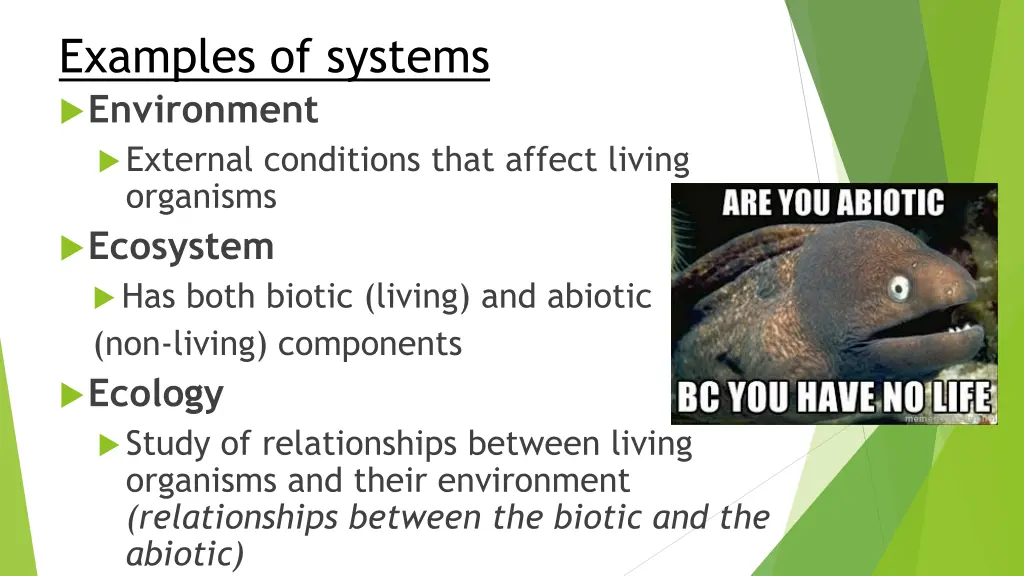
Examples of systems Environment External conditions that affect living organisms Ecosystem Has both biotic (living) and abiotic (non-living) components Ecology Study of relationships between living organisms and their environment (relationships between the biotic and the abiotic)
Humans alter natural systems more than any other species. Environmental scientists monitor natural systems for signs of stress by looking at environmental indicators.
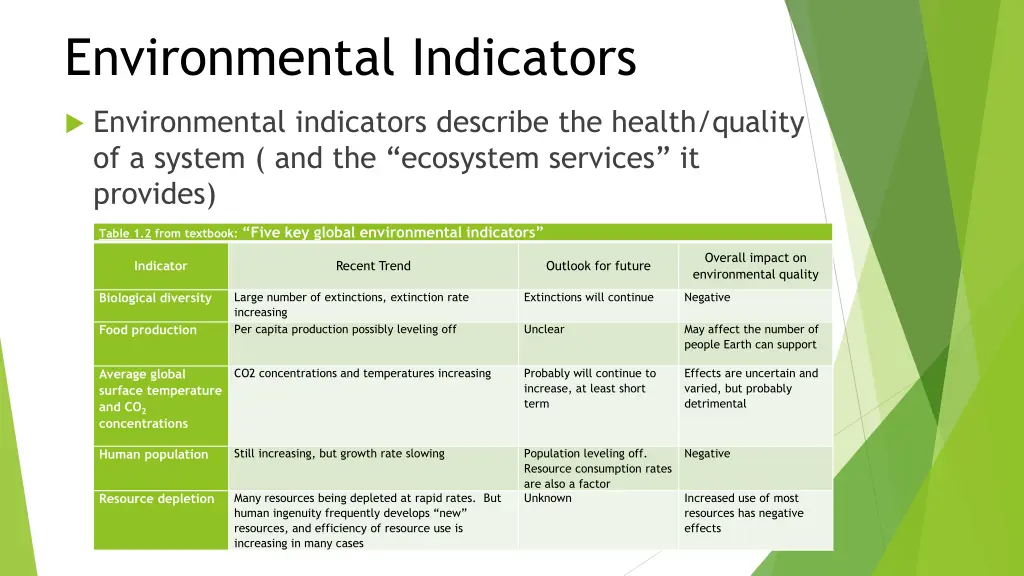
Environmental Indicators Environmental indicators describe the health/quality of a system ( and the ecosystem services it provides) Table 1.2 from textbook: Five key global environmental indicators Overall impact on environmental quality Indicator Recent Trend Outlook for future Large number of extinctions, extinction rate increasing Per capita production possibly leveling off Extinctions will continue Negative Biological diversity Unclear May affect the number of people Earth can support Food production CO2 concentrations and temperatures increasing Probably will continue to increase, at least short term Effects are uncertain and varied, but probably detrimental Average global surface temperature and CO2 concentrations Still increasing, but growth rate slowing Population leveling off. Resource consumption rates are also a factor Unknown Negative Human population Many resources being depleted at rapid rates. But human ingenuity frequently develops new resources, and efficiency of resource use is increasing in many cases Increased use of most resources has negative effects Resource depletion
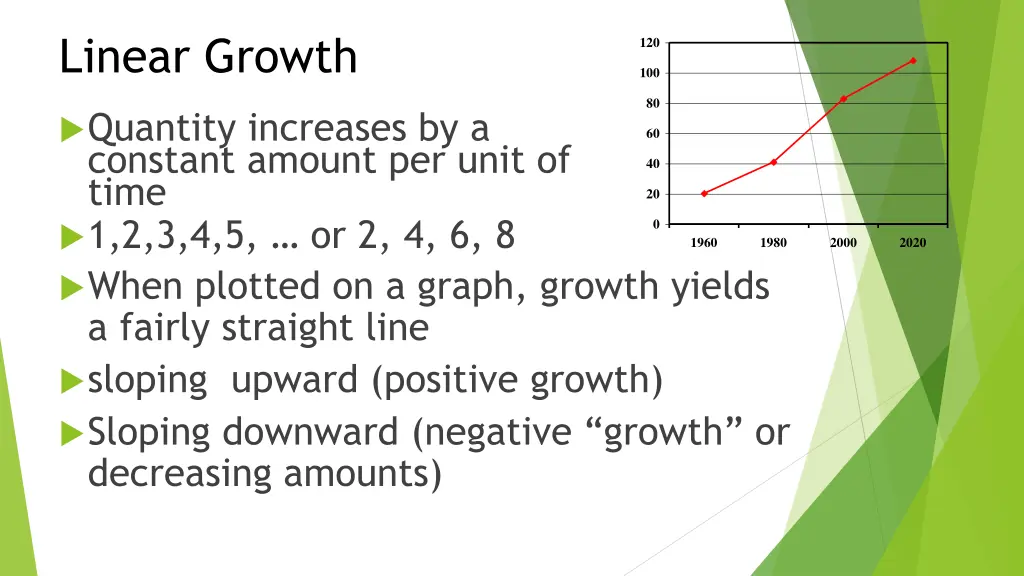
Linear Growth 120 100 80 Quantity increases by a constant amount per unit of time 1,2,3,4,5, or 2, 4, 6, 8 60 40 20 0 1960 1980 2000 2020 When plotted on a graph, growth yields a fairly straight line sloping upward (positive growth) Sloping downward (negative growth or decreasing amounts)
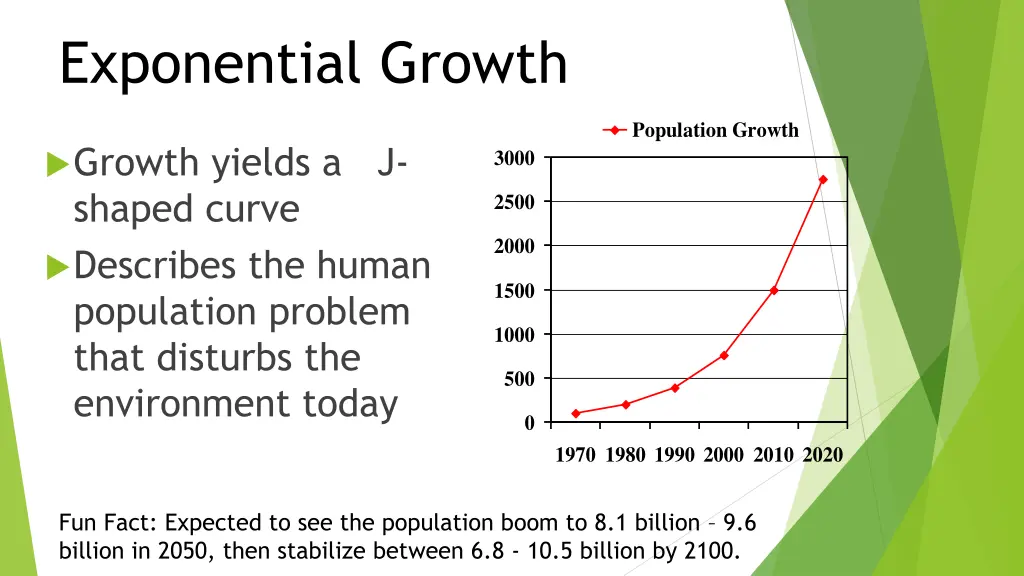
Exponential Growth Population Growth Growth yields a J- shaped curve Describes the human population problem that disturbs the environment today 3000 2500 2000 1500 1000 500 0 1970 1980 1990 2000 2010 2020 Fun Fact: Expected to see the population boom to 8.1 billion 9.6 billion in 2050, then stabilize between 6.8 - 10.5 billion by 2100.
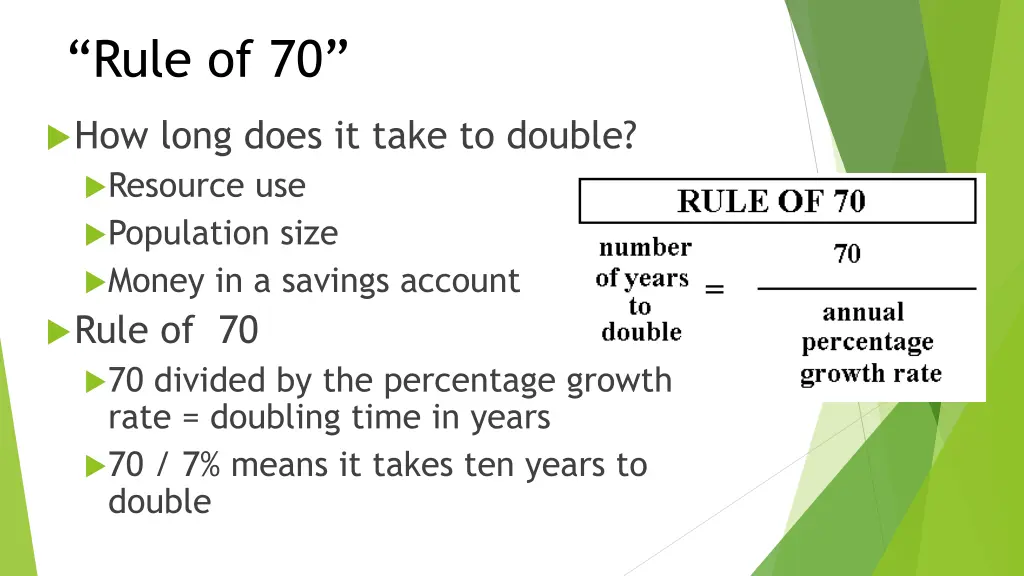
Rule of 70 How long does it take to double? Resource use Population size Money in a savings account Rule of 70 70 divided by the percentage growth rate = doubling time in years 70 / 7% means it takes ten years to double
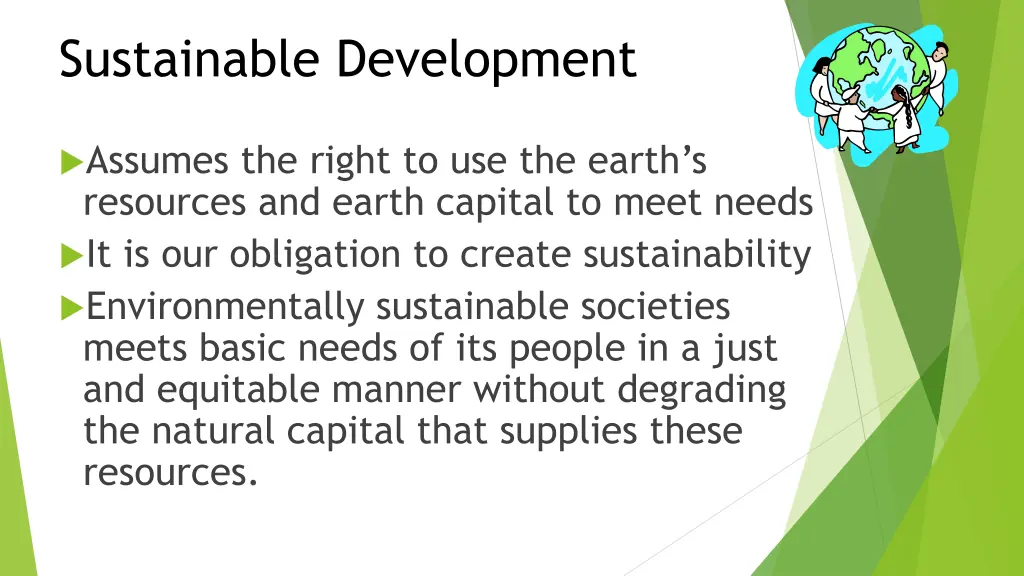
Sustainable Development Assumes the right to use the earth s resources and earth capital to meet needs It is our obligation to create sustainability Environmentally sustainable societies meets basic needs of its people in a just and equitable manner without degrading the natural capital that supplies these resources.
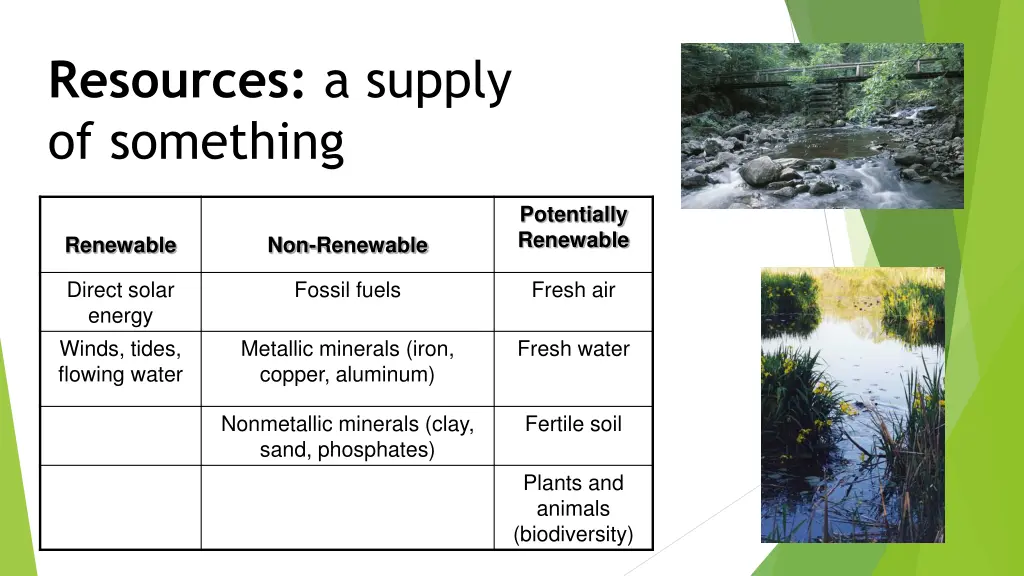
Resources: a supply of something Potentially Renewable Renewable Non-Renewable Direct solar energy Winds, tides, flowing water Fossil fuels Fresh air Metallic minerals (iron, copper, aluminum) Fresh water Nonmetallic minerals (clay, sand, phosphates) Fertile soil Plants and animals (biodiversity)
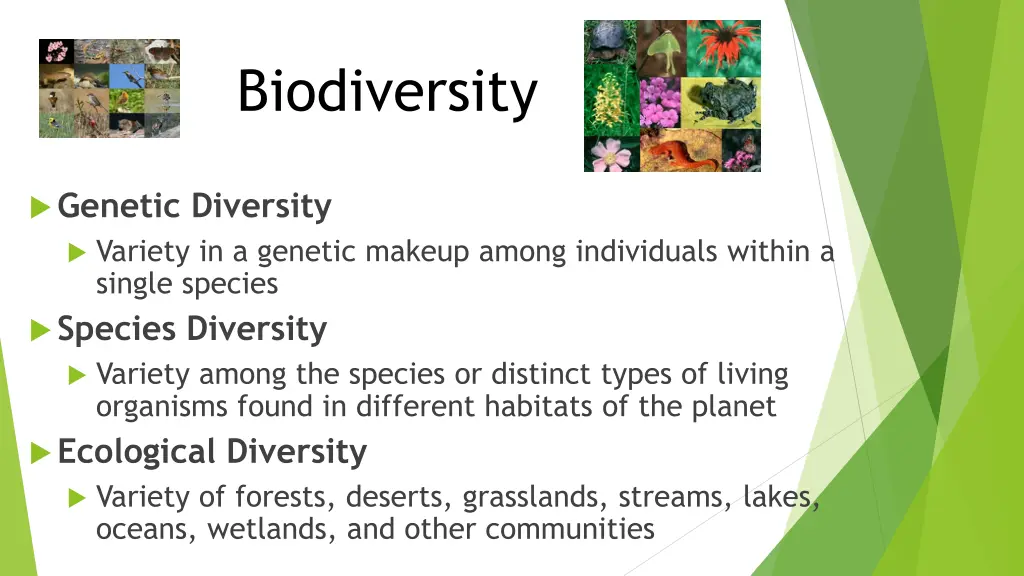
Biodiversity Genetic Diversity Variety in a genetic makeup among individuals within a single species Species Diversity Variety among the species or distinct types of living organisms found in different habitats of the planet Ecological Diversity Variety of forests, deserts, grasslands, streams, lakes, oceans, wetlands, and other communities
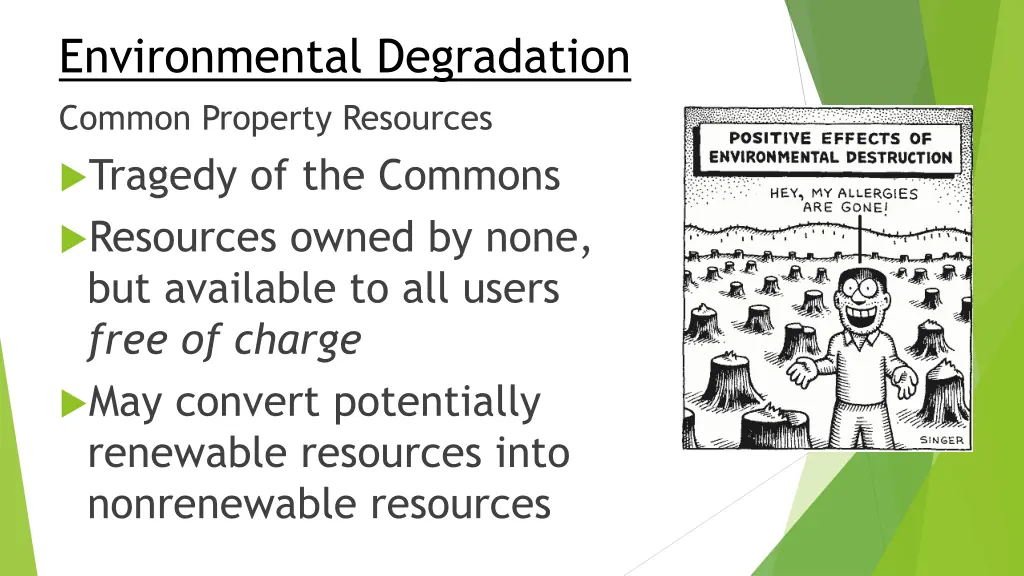
Environmental Degradation Common Property Resources Tragedy of the Commons Resources owned by none, but available to all users free of charge May convert potentially renewable resources into nonrenewable resources
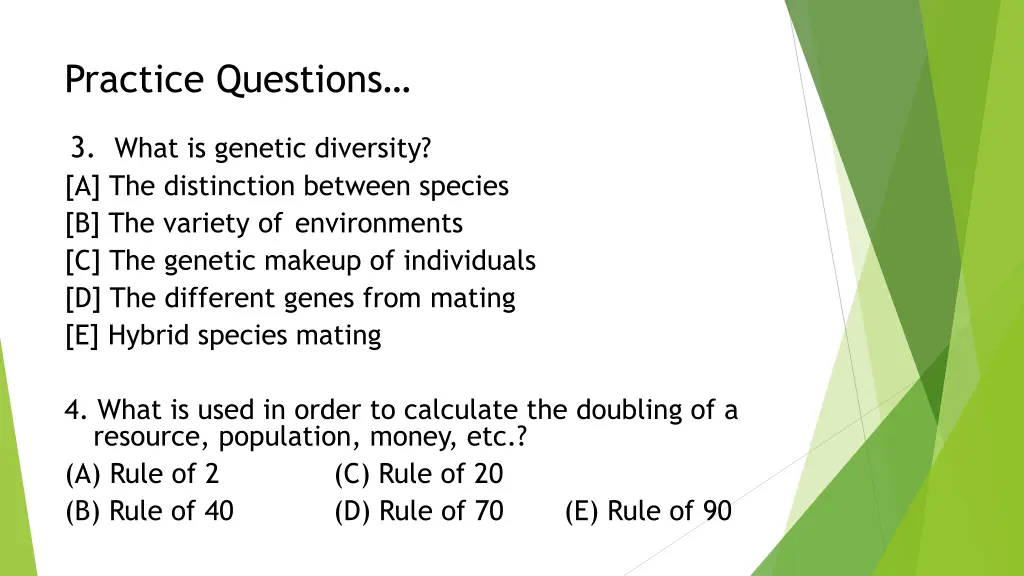
Practice Questions 3. What is genetic diversity? [A] The distinction between species [B] The variety of environments [C] The genetic makeup of individuals [D] The different genes from mating [E] Hybrid species mating 4. What is used in order to calculate the doubling of a resource, population, money, etc.? (A) Rule of 2 (C) Rule of 20 (B) Rule of 40 (D) Rule of 70 (E) Rule of 90
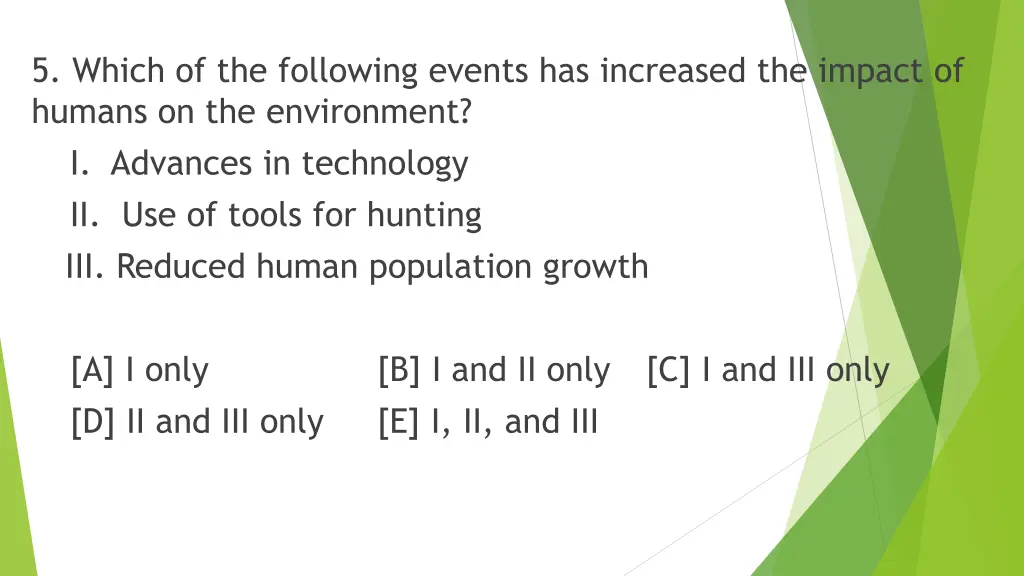
5. Which of the following events has increased the impact of humans on the environment? I. Advances in technology II. Use of tools for hunting III. Reduced human population growth [A] I only [B] I and II only [C] I and III only [D] II and III only [E] I, II, and III
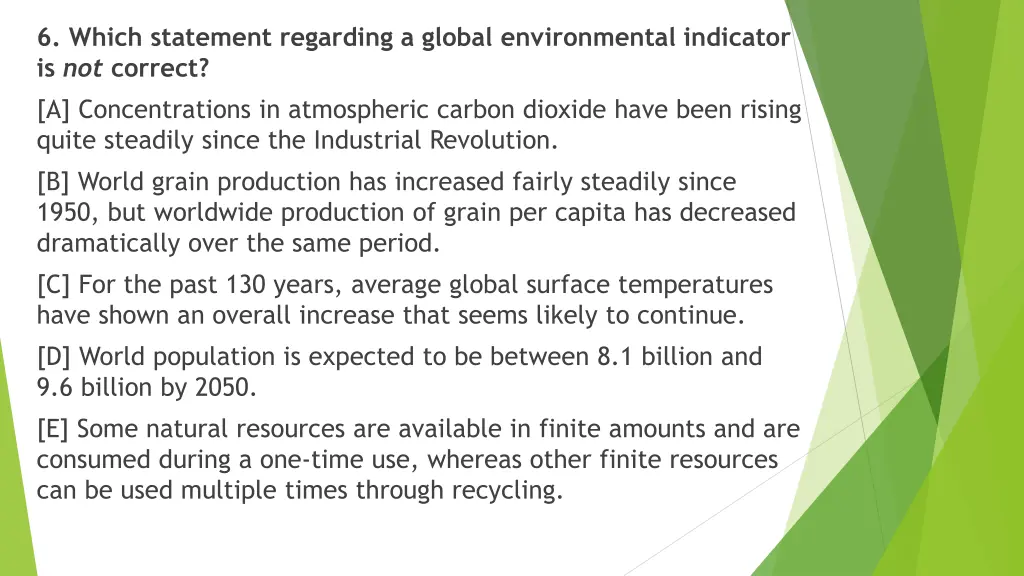
6. Which statement regarding a global environmental indicator is not correct? [A] Concentrations in atmospheric carbon dioxide have been rising quite steadily since the Industrial Revolution. [B] World grain production has increased fairly steadily since 1950, but worldwide production of grain per capita has decreased dramatically over the same period. [C] For the past 130 years, average global surface temperatures have shown an overall increase that seems likely to continue. [D] World population is expected to be between 8.1 billion and 9.6 billion by 2050. [E] Some natural resources are available in finite amounts and are consumed during a one-time use, whereas other finite resources can be used multiple times through recycling.