Revolutionary Evolution: Rise of Modern Communism in Russia
The Russian Revolution marked a significant transition from autocracy to communism, fueled by social unrest and industrialization. Czars like Alexander III and Nicholas II played crucial roles in shaping the events leading to the emergence of Social Democrats and Bolsheviks. The ideological divide between Mensheviks and Bolsheviks, led by Vladimir Lenin, ultimately paved the way for the implementation of communism in Russia.

Download Presentation

Please find below an Image/Link to download the presentation.
The content on the website is provided AS IS for your information and personal use only. It may not be sold, licensed, or shared on other websites without obtaining consent from the author. If you encounter any issues during the download, it is possible that the publisher has removed the file from their server.
You are allowed to download the files provided on this website for personal or commercial use, subject to the condition that they are used lawfully. All files are the property of their respective owners.
The content on the website is provided AS IS for your information and personal use only. It may not be sold, licensed, or shared on other websites without obtaining consent from the author.
E N D
Presentation Transcript
RUSSIAN REVOLUTION The Rise of Modern Communism
BACKGROUND rich tradition in absolutism Czars ruling with unlimited power Feudalism until 1918 Industrialization begins 1880 s Russians isolated from European culture until after Napoleonic Wars Two distinct classes- peasants and gentry Russia has been a sleeping giant but will soon be awakened
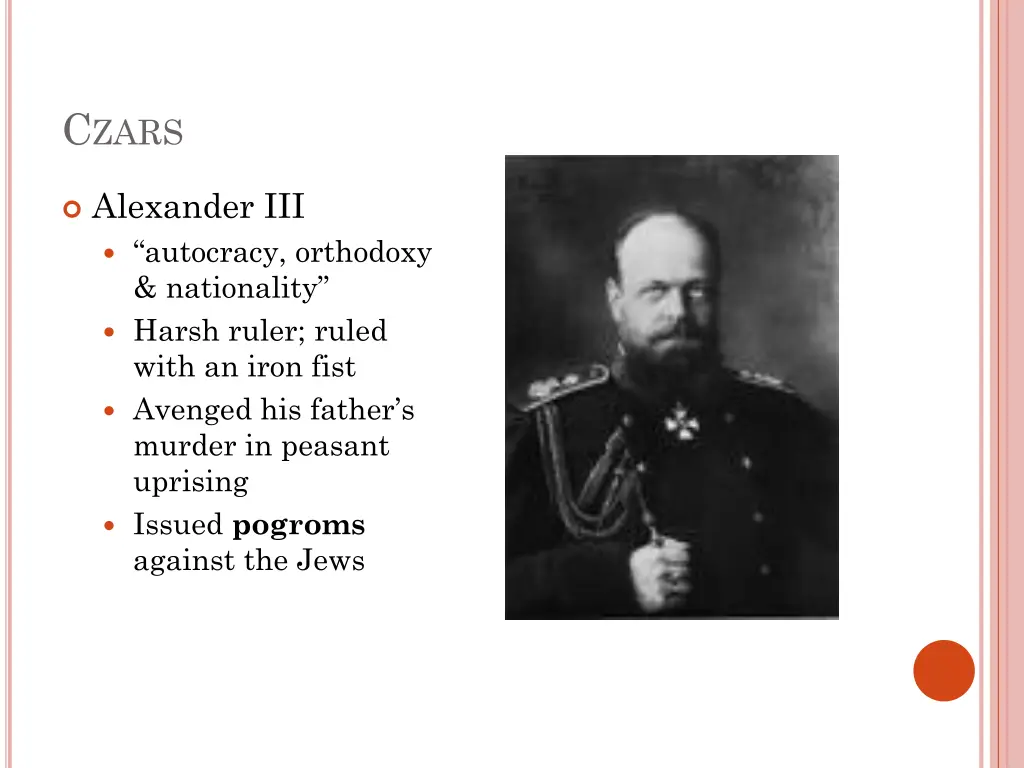
CZARS Alexander III autocracy, orthodoxy & nationality Harsh ruler; ruled with an iron fist Avenged his father s murder in peasant uprising Issued pogroms against the Jews
CZARS Nicholas II Son of Alex III & carries on his legacy Goal: Industrialize Russia; be competitive with Europe; Steel Industry Massive Industrialization raises taxes and creates harsh working conditions Social unrest and talk of revolution Fuels acceptance of communism
SOCIAL DEMOCRATS Internationalists Believed revolution would begin in Western Europe Urban proletariat was true revolutionary class Believed capitalism was necessary to develop class struggle to perpetuate a revolution Ridiculed Mirs- social communes Disproved of sporadic terrorism/assassination Split into Bolsheviks and Mensheviks Marxists Leninism
SOCIAL DEMOCRATS (RUSSIAN MARXISTS) Mensheviks Means minority Wanted to implement communism in Russia Believed in educating the population about communism Input and influence from membership Slow process to gain popular support Willing to compromise time for effectiveness Grass roots movement Bolsheviks Means majority Wanted to implement communism in Russia Believed in radical quick implementation w/out popular consent WAR COMMUNISM Dictatorship of the Proletariat Leader: Vladimir Lenin EMERGED AS DOMINANT SOCIAL REVOLUTIONARY GROUP
VLADIMIR LENIN 1870-1924 Leader of the Bolsheviks First to implement communism to any nation Leninism: Marxism reworked to fit Russian culture Father of Russian Communism
LENINISM Goal: to orchestrate the overthrow of the existing government by force and seize power on behalf of the proletariat and then implement a dictatorship of the proletariat Strongly centralized authority determining the party line and control personnel at all levels
CZAR NICHOLASS THREE MISTAKES 1. Russo-Japanese War- 1904 Meant to boost Russian morale, but Russia lost badly Anti-czar underground movements 2.Bloody Sunday-1905 Unarmed rioters killed @ Czar s Palace singing God Save the Czar 8 hour work day, minimum wage, democracy October Manifesto: Deceptive- really only to divide up the opposition Creation of the DUMA- dissolved in 10 weeks FAILURE: Conservatives afraid of Duma and Radicals skeptical of it
3. World War I Russians unclear of Russian support of Serbia Devastated the economy; millions killed Misguided leadership of Rasputin in Czar s absence
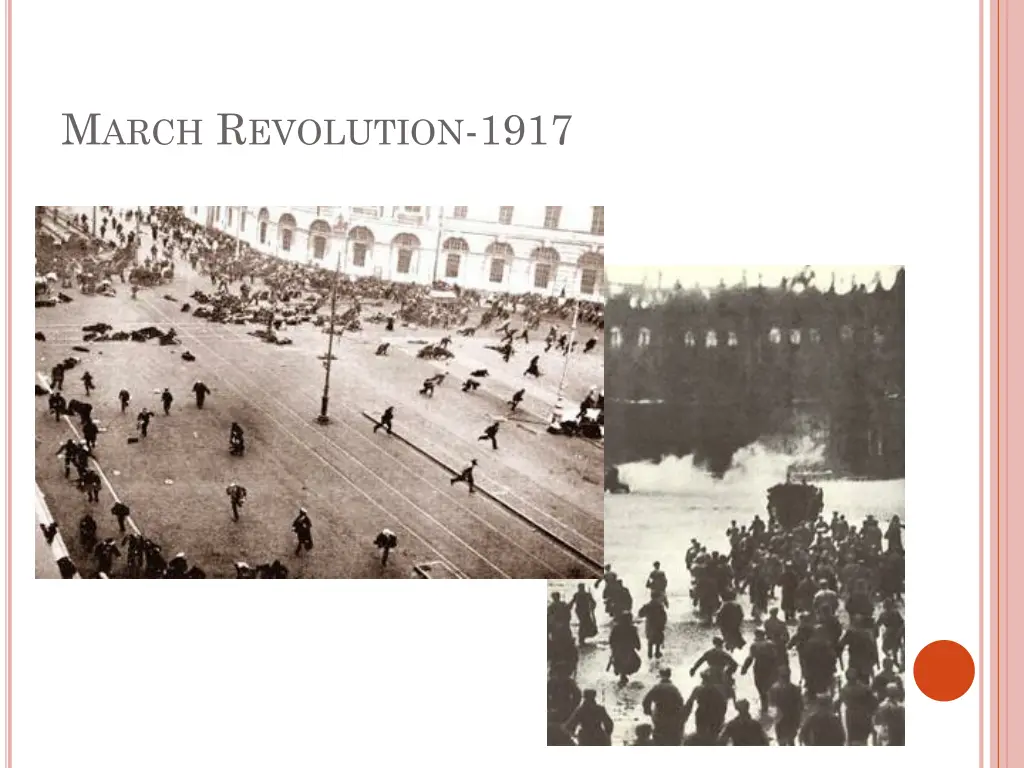
MARCH REVOLUTION-1917 Workers rioted in Petrograd; eventually gained support from soldiers Forces Czar Nicholas II to abdicate the throne Creation of Provisional Government Lead by Kerensky Leader of Petrograd Soviet Decides to continue Russia s involvement in WWI (mistake) Workers SOVIETS grow in numbers eventually more powerful that Provisional Government; this is due to the Bolsheviks
LENIN GAINS CONTROL October 24, 1917 Lenin seized power and dissolved Provisional Government NEW SOCIALIST ORDER (NSO) PEACE, LAND, BREAD Peace with Germany All farmland divided among peasants Soviet-run gov t (Dictatorship of the Proletariat) Recognition of soviet power supreme over Provisional Government Lenin s policies not widely accepted by upper class leads to civil war
RUSSIAN CIVIL WAR: 1918-1920 White Army (loyalists) Fighting to stop rise of Lenin and NSO Received $$ aid from US and other European nations Red Army (Bolsheviks) Fighting to implement Lenin s communism Under the command of Leon Trotsky Executed the Romanov Family OUTCOME: Red Army wins; Russian economy in ruins 15 million more Russians DEAD!!
EXECUTIONOF ROMANOV FAMILY During the early hours of July 17, 1918 Czar Nicholas II, his wife, children and servants were herded into the cellar of their prison house and executed Liberation by the White Army was imminent and the Reds needed to get rid of the Czar and his family
EXECUTIONOF ROMANOV FAMILY In addition to the royal family, the executed included: their doctor, cook, valet, maid and dog. 8 days after the executions, the town of Ekaterinburg was captured by the White Army.
LENIN RESTORED ORDER New Socialist Order (NSO) failed Due to Civil War and war communism Equality in economics was not working no competition Lenin implements CHEKA (secret police) to restore order and combat resisters NEW ECONOMIC POLICY (NEP) Created to fix the economic problems of NSO Brought in small amount of capitalism Successful and boosted economy
LENIN RESTORED ORDER 1922-Union of Soviet Socialist Republics Lenin creates self-governing republics in response to vast amount of nationalities Soviets govern each Republic Capital moved back to Moscow Changed party name from Bolsheviks to COMMUNIST PARTY Lenin s new policies were improving and by 1928, production was where it was before 1914. 1924: Lenin dies after series of strokes no successor named until 1928
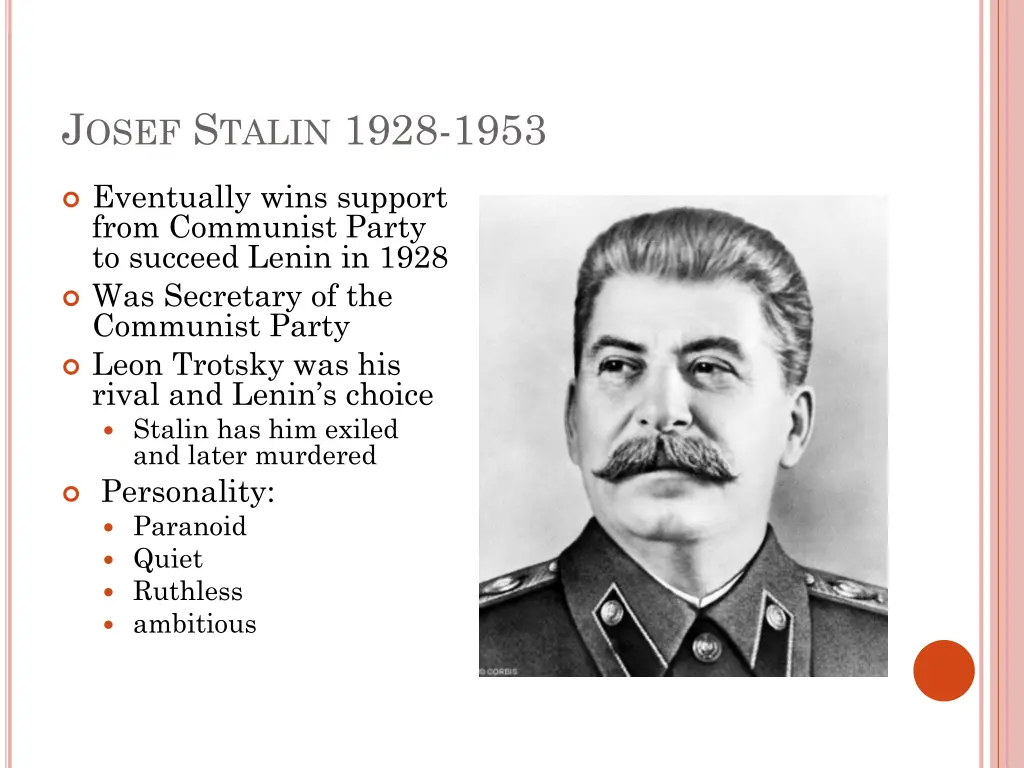
JOSEF STALIN 1928-1953 Eventually wins support from Communist Party to succeed Lenin in 1928 Was Secretary of the Communist Party Leon Trotsky was his rival and Lenin s choice Stalin has him exiled and later murdered Personality: Paranoid Quiet Ruthless ambitious
STALINS GOALS Socialism (Communism) in one country Secure and centralize Soviet economy Command Economy Industrialized Power Extreme discipline Russia was ceaselessly beaten for her backwardness because to beat her was profitable and went unpunished. ~Stalin
POLITICAL IDEOLOGY Totalitarianism: a political system in which government has total control over lives of individual citizens Stalin usurps total power to motivate and promote his goals (not Marxist) Need to create incentive to meet industrial goals and to motivate his workers Totalitarianism along with Marxism is what becomes known as STALINISM
CHARACTERISTICSOF TOTALITARIANISM Read over pages 654-57 in green text and identify examples that support Stalin s implementation of each of the following characteristics. One leader becomes symbol of government and state. 1. All opposition is suppressed. 2. Informers & secret police help ensure power of party. 3. Propaganda glorifies party s leadership. 4. Party leaders appeal to nationalism to preserve party s power. 5.
ECONOMIC POLICIES FIVE YEAR PLAN (1928-1932) Increase industry Limited production of consumer goods Increased production of military and industrial goods Increase agricultural production Collective Farming Problems?: 2nd FIVE YEAR PLAN (1933-1938) Increased production of consumer goods Specialization of workers Trained workers to become better skilled in specific areas More efficient and better quality More successful; USSR up to par with Europe 2 more 5 Year Plans continued through and after WWII
PURGES to purify; to rid of a specific group Stalin s paranoia becomes obsessive Paranoid old Bolsheviks want to seize power so Stalin holds extensive trials and executes old Bolsheviks to weed out conspirators 1936-38: THE GREAT TERROR archive data in 1934-38: the number of death sentences was 786,098; unknown # s died in prison camps Communist Party members, Red Army leaders, saboteurs 1930-53: 3,778,334 executed as counterrevolutionaries
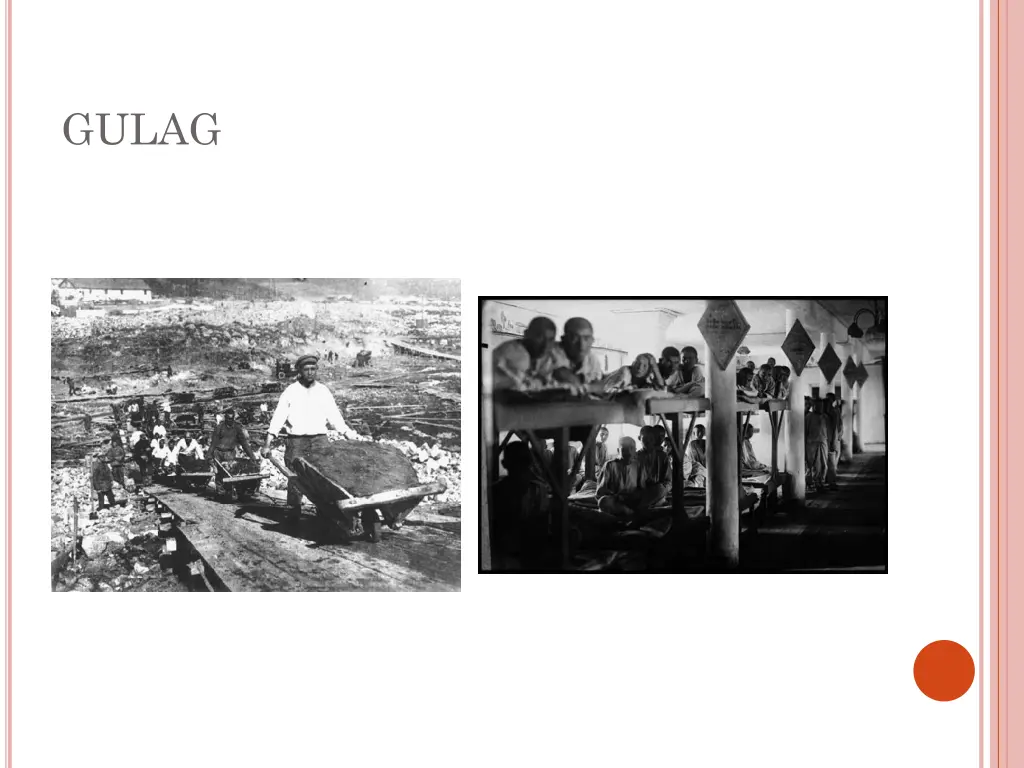
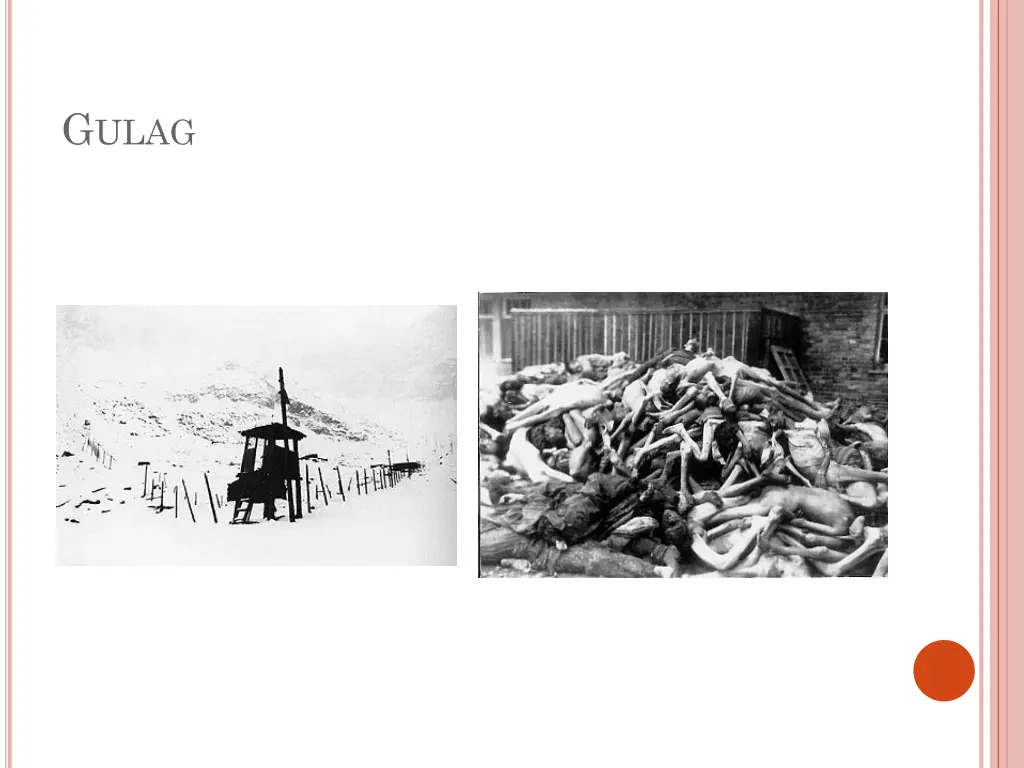
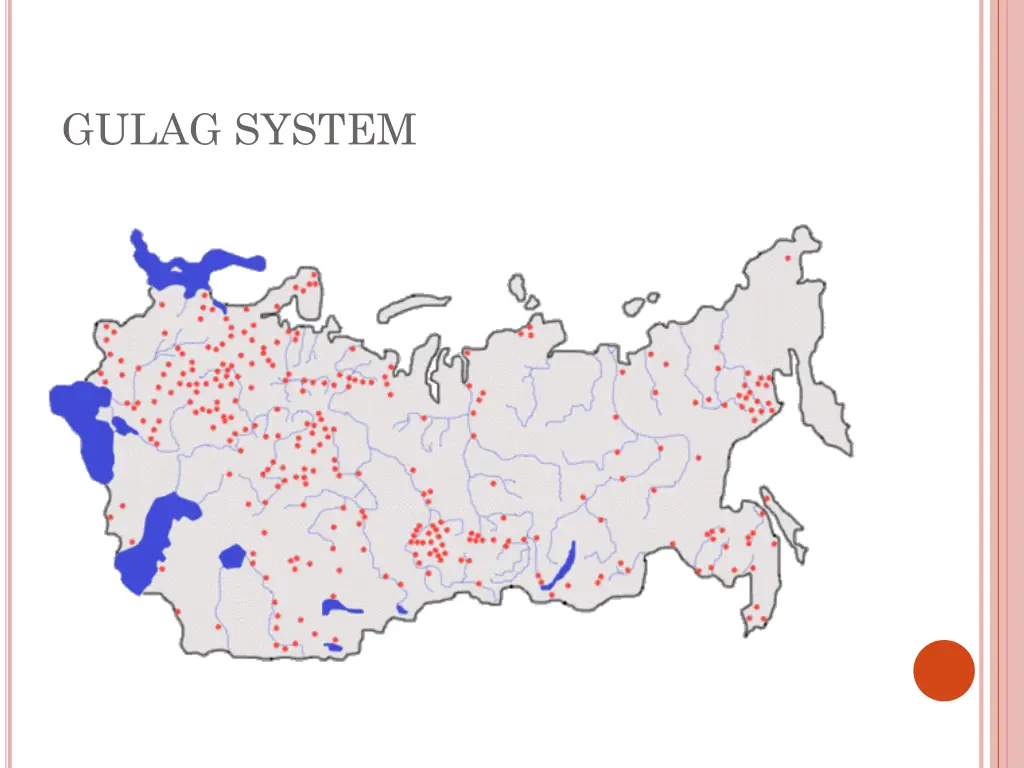
GULAG PRISON SYSTEM GULAG is the Russian acronym for The Chief Administration of Corrective Labor Camps and Colonies ( in Russian, of course) Penal labor camp system of the USSR Forced labor camps under direction of State Security 476 separate camps all over USSR Most notorious in Arctic and Sub-Arctic regions SIBERIA Estimated 20-40 million passed through camps 1928-1953 Estimated 2 million died in camps from 1934-1953 Camps existed up through 1980 s Siberian Labor Camps house up to 1 million prisoners