Discover the Rhode Island Association of School Committees' recommendations for a safe return to full, in-person learning for the 2021-2022 academic year. Explore successful prevention strategies, low COVID-19 transmission rates in schools, and an overview of adolescent vaccination efforts in Rhode Island.
Please find below an Image/Link to download the presentation.
The content on the website is provided AS IS for your information and personal use only. It may not be sold, licensed, or shared on other websites without obtaining consent from the author. If you encounter any issues during the download, it is possible that the publisher has removed the file from their server.
You are allowed to download the files provided on this website for personal or commercial use, subject to the condition that they are used lawfully. All files are the property of their respective owners.
The content on the website is provided AS IS for your information and personal use only. It may not be sold, licensed, or shared on other websites without obtaining consent from the author.
Situational Update Overview of the data and key prevention strategies for Pre K-12 for 2020-21 and data outlook for fall 2021-22.
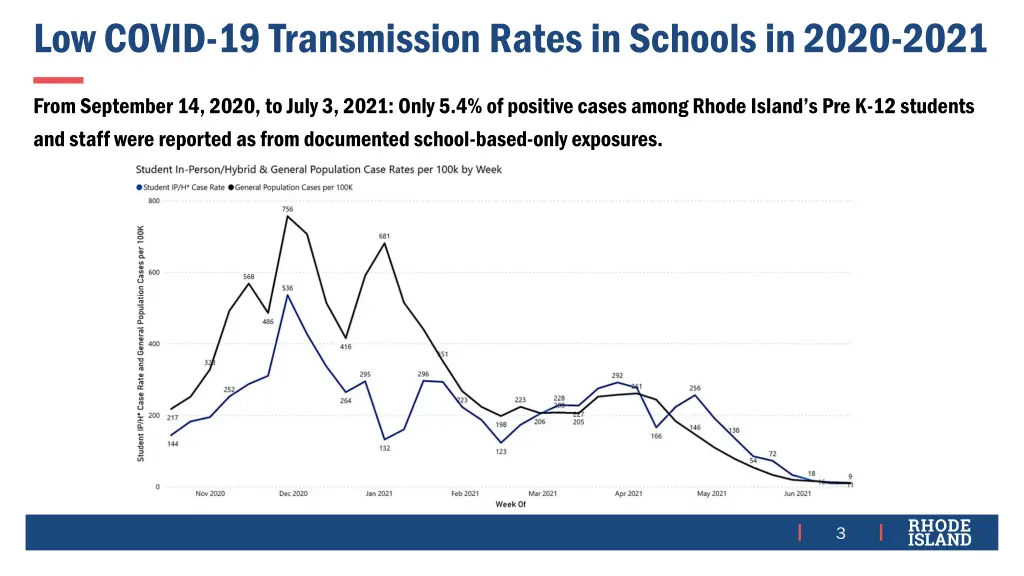
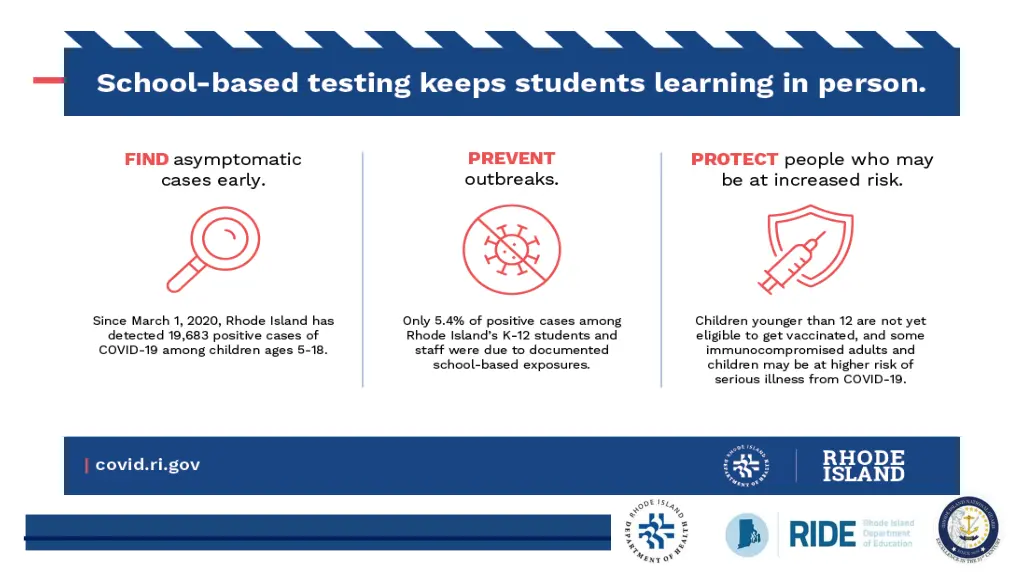
Low COVID-19 Transmission Rates in Schools in 2020-2021 From September 14, 2020, to July 3, 2021: Only 5.4% of positive cases among Rhode Island s Pre K-12 students and staff were reported as from documented school-based-only exposures. 3
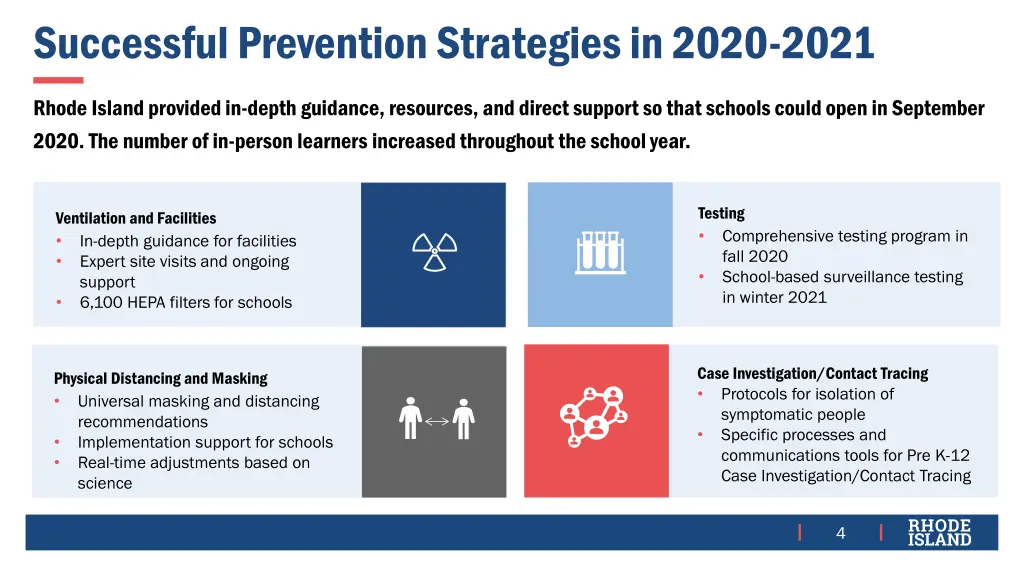
Successful Prevention Strategies in 2020-2021 Rhode Island provided in-depth guidance, resources, and direct support so that schools could open in September 2020. The number of in-person learners increased throughout the school year. Testing Ventilation and Facilities In-depth guidance for facilities Expert site visits and ongoing support 6,100 HEPA filters for schools Comprehensive testing program in fall 2020 School-based surveillance testing in winter 2021 Case Investigation/Contact Tracing Protocols for isolation of symptomatic people Specific processes and communications tools for Pre K-12 Case Investigation/Contact Tracing Physical Distancing and Masking Universal masking and distancing recommendations Implementation support for schools Real-time adjustments based on science 4
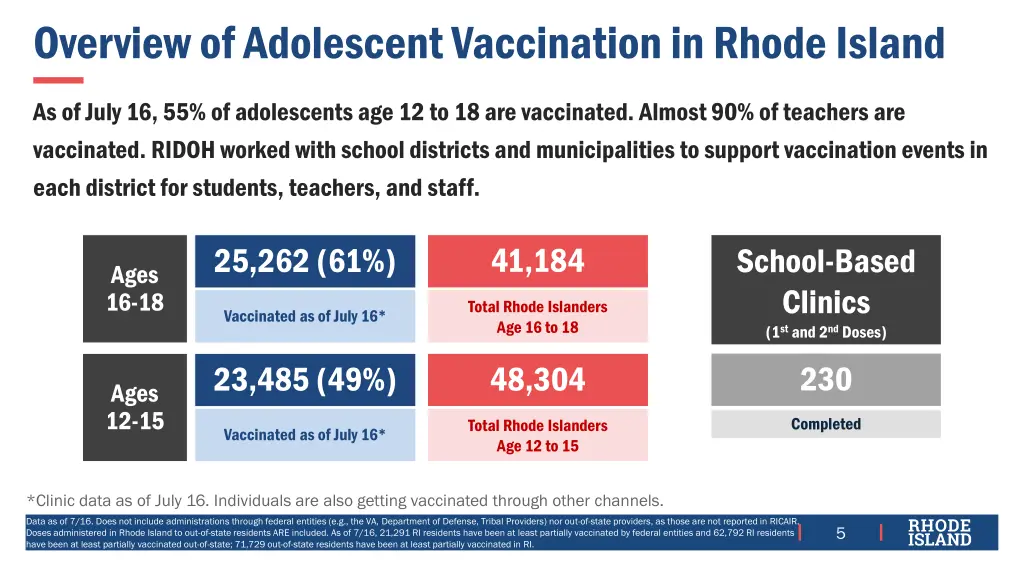
Overview of Adolescent Vaccination in Rhode Island As of July 16, 55% of adolescents age 12 to 18 are vaccinated. Almost 90% of teachers are vaccinated. RIDOH worked with school districts and municipalities to support vaccination events in each district for students, teachers, and staff. 41,184 25,262 (61%) School-Based Clinics (1st and 2nd Doses) Ages 16-18 Total Rhode Islanders Age 16 to 18 Vaccinated as of July 16* 230 48,304 23,485 (49%) Ages 12-15 Completed Total Rhode Islanders Age 12 to 15 Vaccinated as of July 16* *Clinic data as of July 16. Individuals are also getting vaccinated through other channels. Data as of 7/16. Does not include administrations through federal entities (e.g., the VA, Department of Defense, Tribal Providers) nor out-of-state providers, as those are not reported in RICAIR. Doses administered in Rhode Island to out-of-state residents ARE included. As of 7/16, 21,291 RI residents have been at least partially vaccinated by federal entities and 62,792 RI residents have been at least partially vaccinated out-of-state; 71,729 out-of-state residents have been at least partially vaccinated in RI. 5
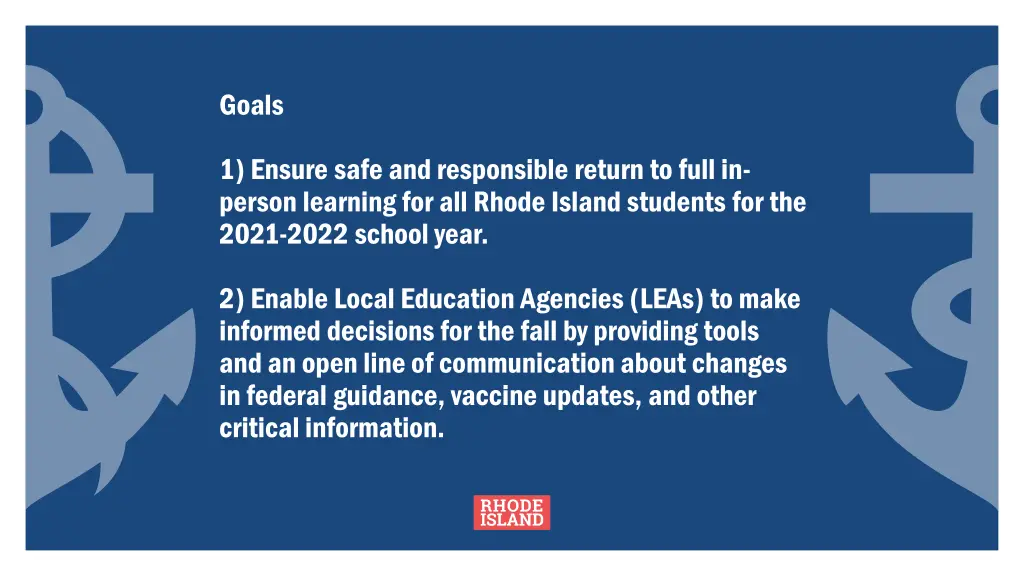
Goals 1) Ensure safe and responsible return to full in- person learning for all Rhode Island students for the 2021-2022 school year. 2) Enable Local Education Agencies (LEAs) to make informed decisions for the fall by providing tools and an open line of communication about changes in federal guidance, vaccine updates, and other critical information.
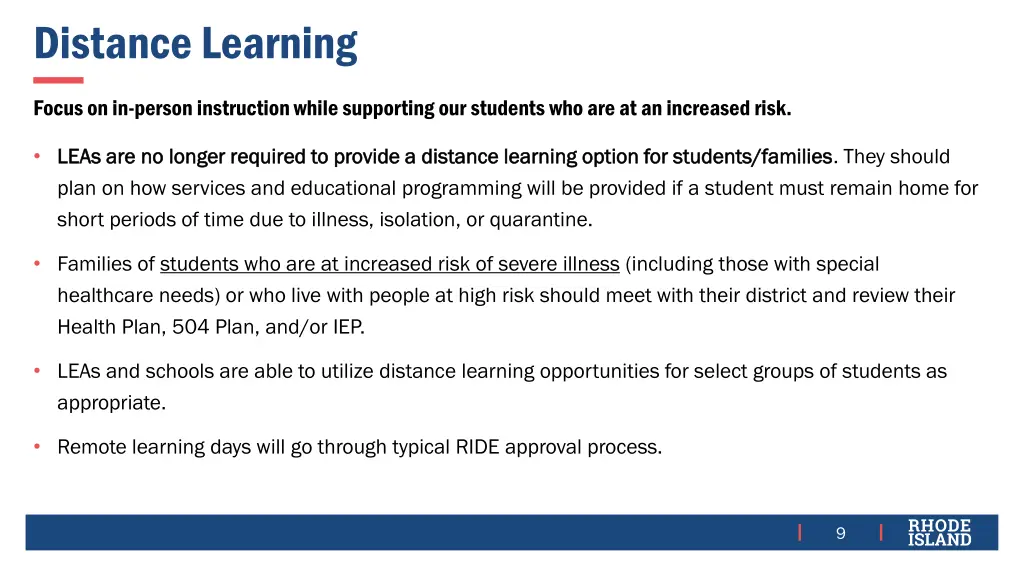
Distance Learning Focus on in-person instruction while supporting our students who are at an increased risk. LEAs are no longer required to provide a distance learning option for students/families LEAs are no longer required to provide a distance learning option for students/families. They should plan on how services and educational programming will be provided if a student must remain home for short periods of time due to illness, isolation, or quarantine. Families of students who are at increased risk of severe illness (including those with special healthcare needs) or who live with people at high risk should meet with their district and review their Health Plan, 504 Plan, and/or IEP. LEAs and schools are able to utilize distance learning opportunities for select groups of students as appropriate. Remote learning days will go through typical RIDE approval process. 9
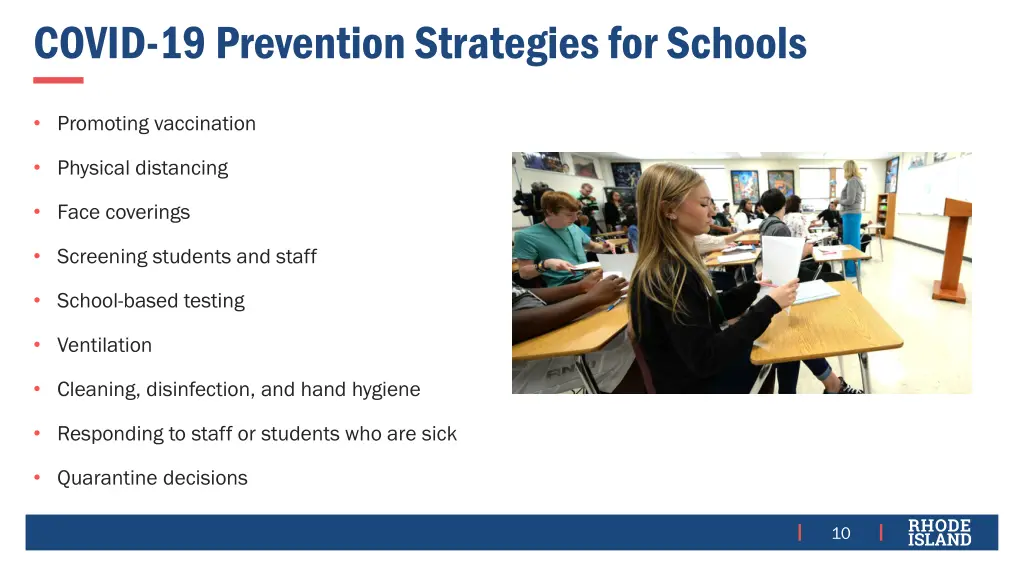
COVID-19Prevention Strategies for Schools Promoting vaccination Physical distancing Face coverings Screening students and staff School-based testing Ventilation Cleaning, disinfection, and hand hygiene Responding to staff or students who are sick Quarantine decisions 10
Promoting Vaccination Schools can promote vaccinations among teachers, staff, families, and eligible students by: Providing information about COVID-19 vaccination; Encouraging vaccine trust and confidence; and Establishing supportive policies and practices that make getting vaccinated as easy and convenient as possible. Schools can access and use RIDOH COVID-19 Vaccine Resources at COVID-19 Community Partner Toolkit. Schools can also promote vaccination with resources in CDC Guidance for COVID-19 K-12 Schools. Vaccination clinic contact: Brittan Bates at brittan.bates@health.ri.gov. 11
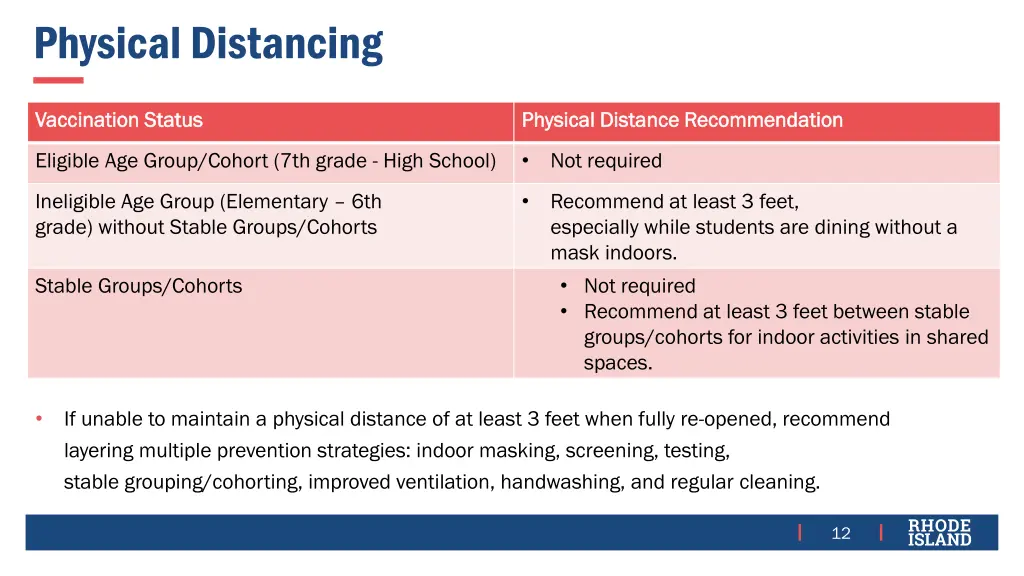
Physical Distancing Vaccination Status Vaccination Status Physical Distance Recommendation Physical Distance Recommendation Eligible Age Group/Cohort (7th grade - High School) Not required Ineligible Age Group (Elementary 6th grade) without Stable Groups/Cohorts Recommend at least 3 feet, especially while students are dining without a mask indoors. Not required Recommend at least 3 feet between stable groups/cohorts for indoor activities in shared spaces. Stable Groups/Cohorts If unable to maintain a physical distance of at least 3 feet when fully re-opened, recommend layering multiple prevention strategies: indoor masking, screening, testing, stable grouping/cohorting, improved ventilation, handwashing, and regular cleaning. 12
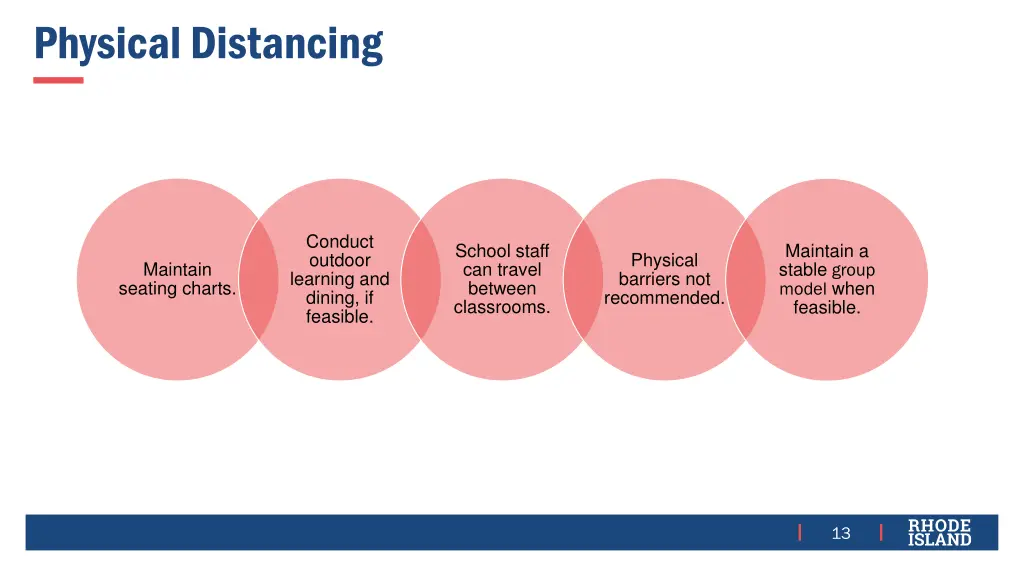
Physical Distancing Conduct outdoor learning and dining, if feasible. School staff can travel between classrooms. Maintain a stable group model when feasible. Physical barriers not recommended. Maintain seating charts. 13
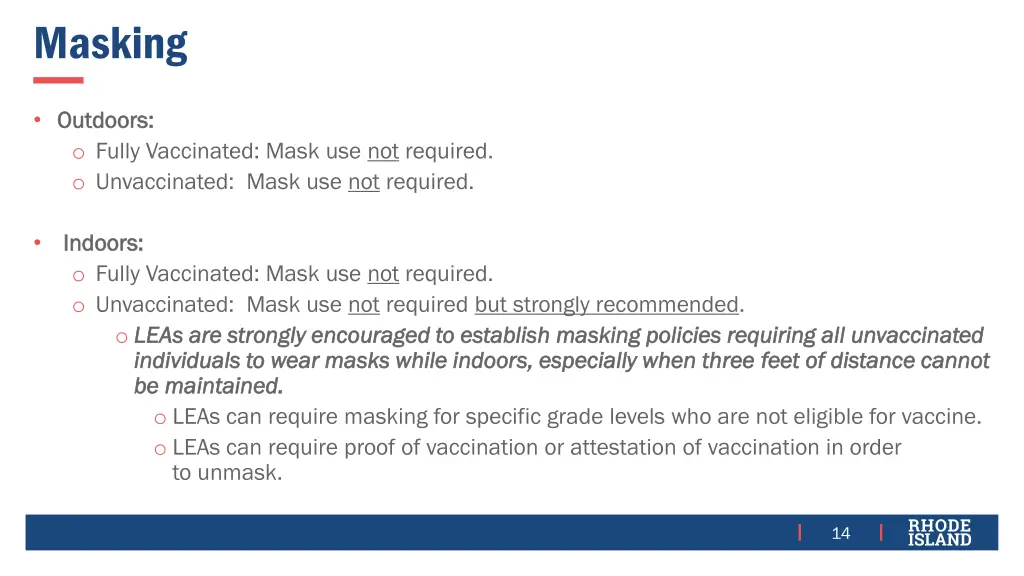
Masking Outdoors: Outdoors: o Fully Vaccinated: Mask use not required. o Unvaccinated: Mask use not required. Indoors: Indoors: o Fully Vaccinated: Mask use not required. o Unvaccinated: Mask use not required but strongly recommended. o LEAs are strongly encouraged to establish LEAs are strongly encouraged to establish masking policies requiring all individuals to wear masks while indoors, especially when three individuals to wear masks while indoors, especially when three feet of distance cannot be maintained. be maintained. o LEAs can require masking for specific grade levels who are not eligible for vaccine. o LEAs can require proof of vaccination or attestation of vaccination in order to unmask. masking policies requiring all unvaccinated feet of distance cannot unvaccinated 14
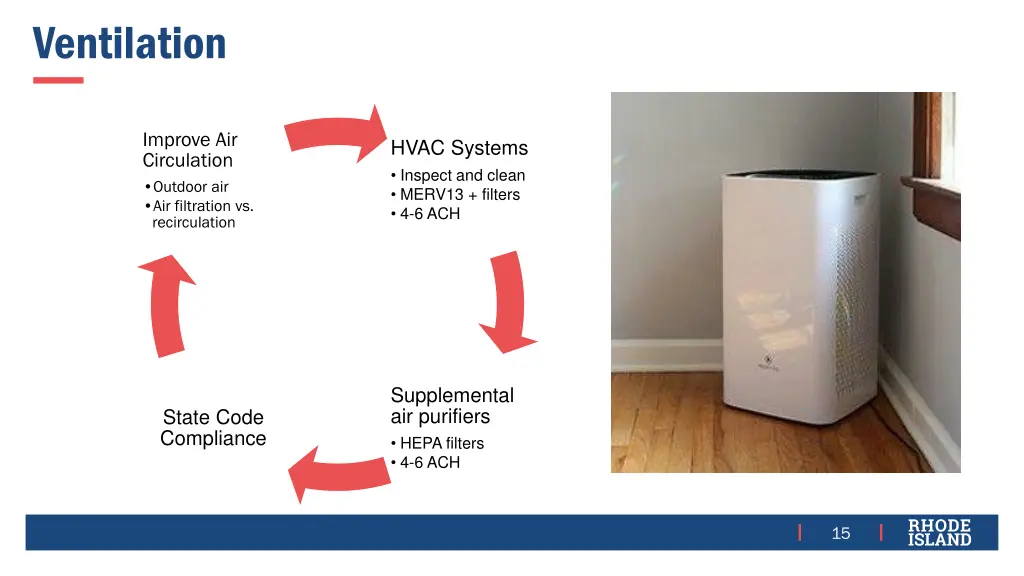
Ventilation Improve Air Circulation Outdoor air Air filtration vs. recirculation HVAC Systems Inspect and clean MERV13 + filters 4-6 ACH Supplemental air purifiers HEPA filters 4-6 ACH State Code Compliance 15
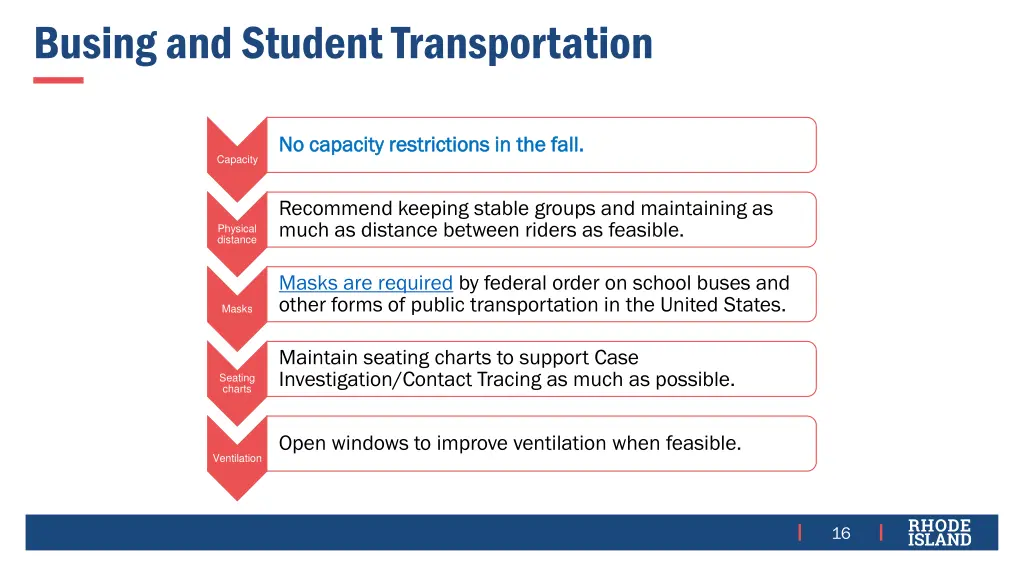
Busing and Student Transportation No capacity No capacity restrictions in the fall. restrictions in the fall. Capacity Recommend keeping stable groups and maintaining as much as distance between riders as feasible. Physical distance Masks are required Masks are required by federal order on school buses and other forms of public transportation in the United States. Masks Maintain seating charts to support Case Investigation/Contact Tracing as much as possible. Seating charts Open windows to improve ventilation when feasible. Ventilation 16
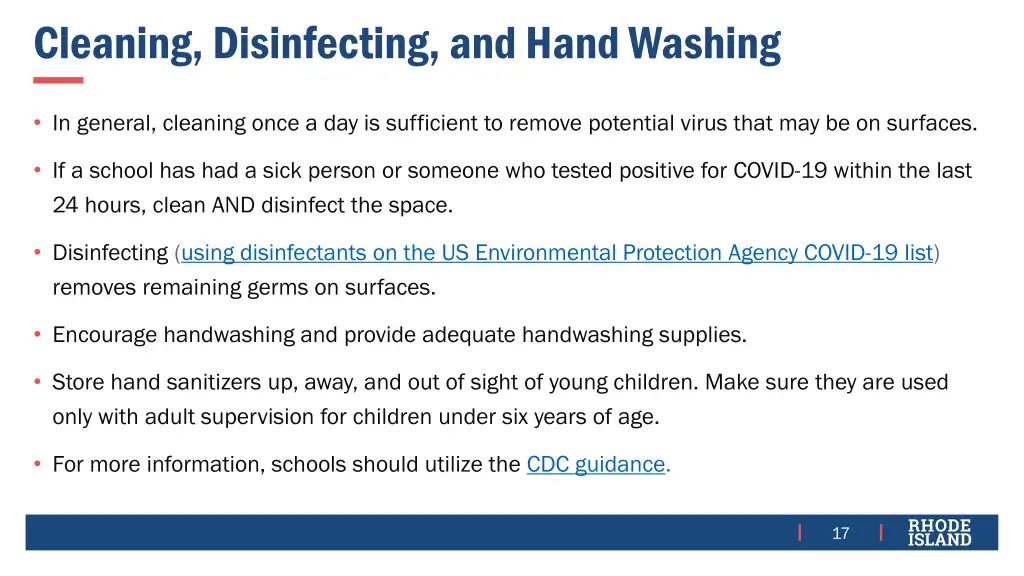
Cleaning, Disinfecting, and Hand Washing In general, cleaning once a day is sufficient to remove potential virus that may be on surfaces. If a school has had a sick person or someone who tested positive for COVID-19 within the last 24 hours, clean AND disinfect the space. Disinfecting (using disinfectants on the US Environmental Protection Agency COVID-19 list) removes remaining germs on surfaces. Encourage handwashing and provide adequate handwashing supplies. Store hand sanitizers up, away, and out of sight of young children. Make sure they are used only with adult supervision for children under six years of age. For more information, schools should utilize the CDC guidance. 17
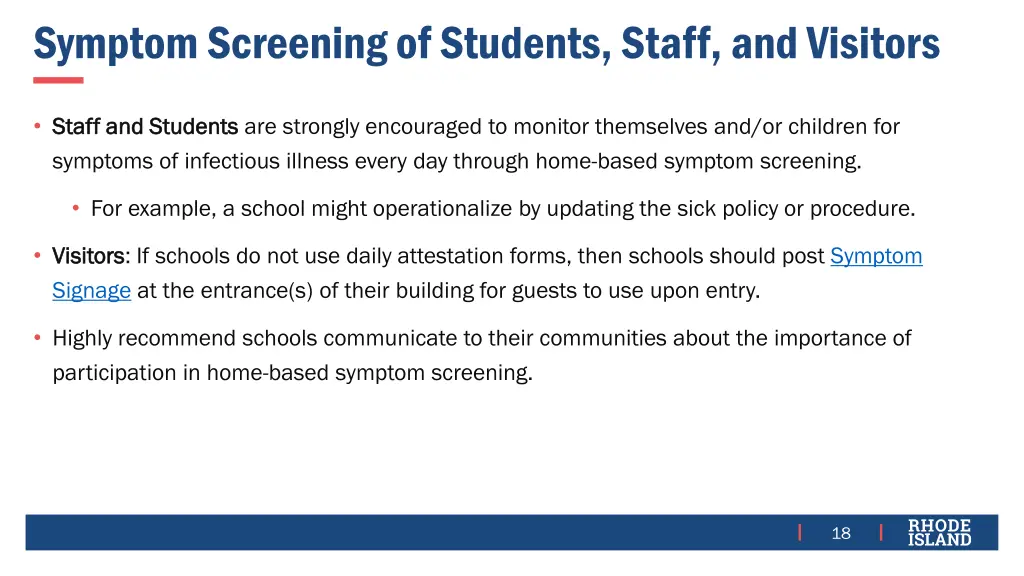
Symptom Screening of Students, Staff, and Visitors Staff and Students Staff and Students are strongly encouraged to monitor themselves and/or children for symptoms of infectious illness every day through home-based symptom screening. For example, a school might operationalize by updating the sick policy or procedure. Visitors Visitors: If schools do not use daily attestation forms, then schools should post Symptom Signage at the entrance(s) of their building for guests to use upon entry. Highly recommend schools communicate to their communities about the importance of participation in home-based symptom screening. 18
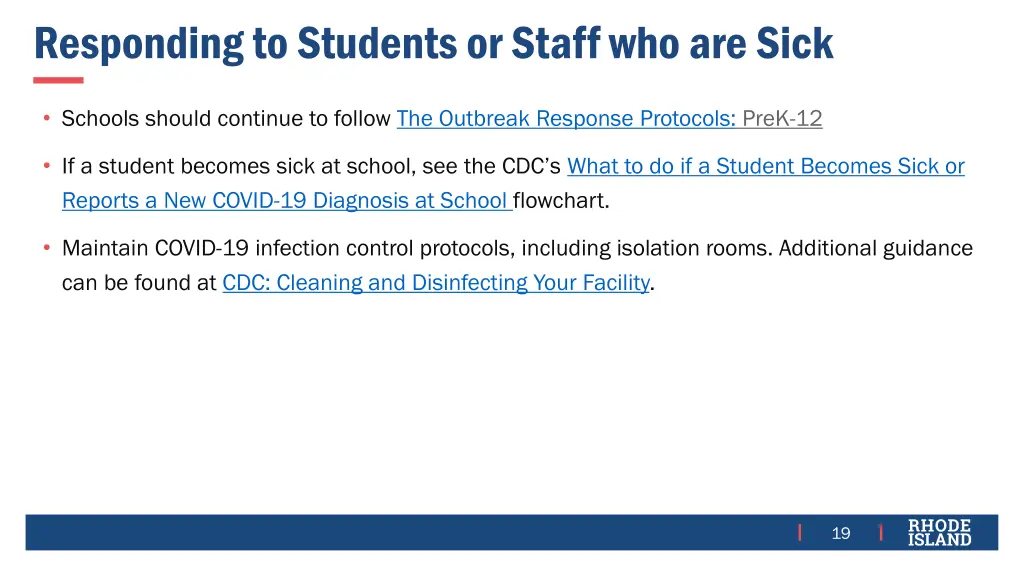
Responding to Students or Staff who are Sick Schools should continue to follow The Outbreak Response Protocols: PreK-12 If a student becomes sick at school, see the CDC s What to do if a Student Becomes Sick or Reports a New COVID-19 Diagnosis at School flowchart. Maintain COVID-19 infection control protocols, including isolation rooms. Additional guidance can be found at CDC: Cleaning and Disinfecting Your Facility. 19
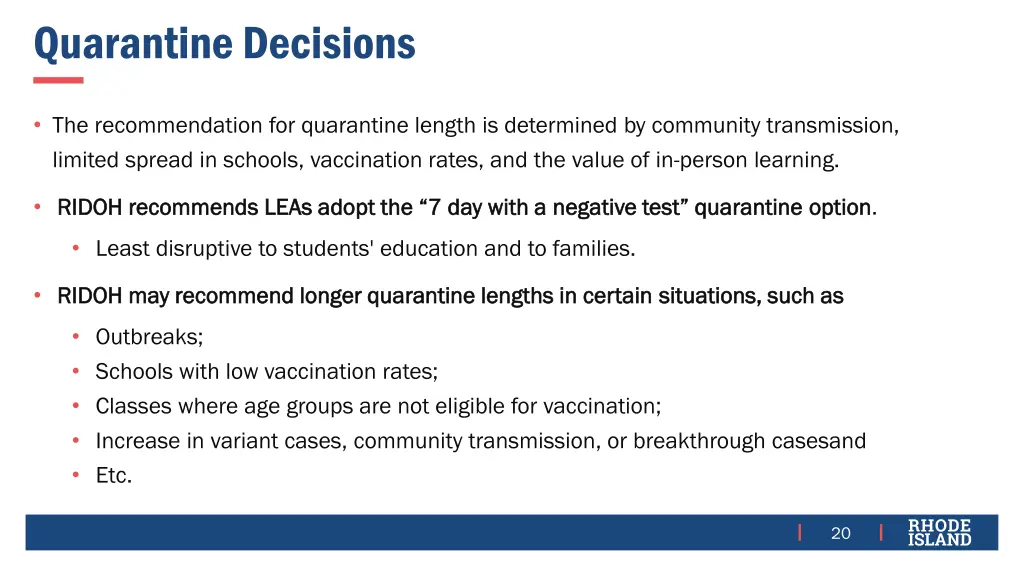
Quarantine Decisions The recommendation for quarantine length is determined by community transmission, limited spread in schools, vaccination rates, and the value of in-person learning. RIDOH recommends RIDOH recommends LEAs adopt the 7 day with a negative test quarantine LEAs adopt the 7 day with a negative test quarantine option option. Least disruptive to students' education and to families. RIDOH may recommend longer quarantine lengths in certain RIDOH may recommend longer quarantine lengths in certain situations, such as situations, such as Outbreaks; Schools with low vaccination rates; Classes where age groups are not eligible for vaccination; Increase in variant cases, community transmission, or breakthrough casesand Etc. 20
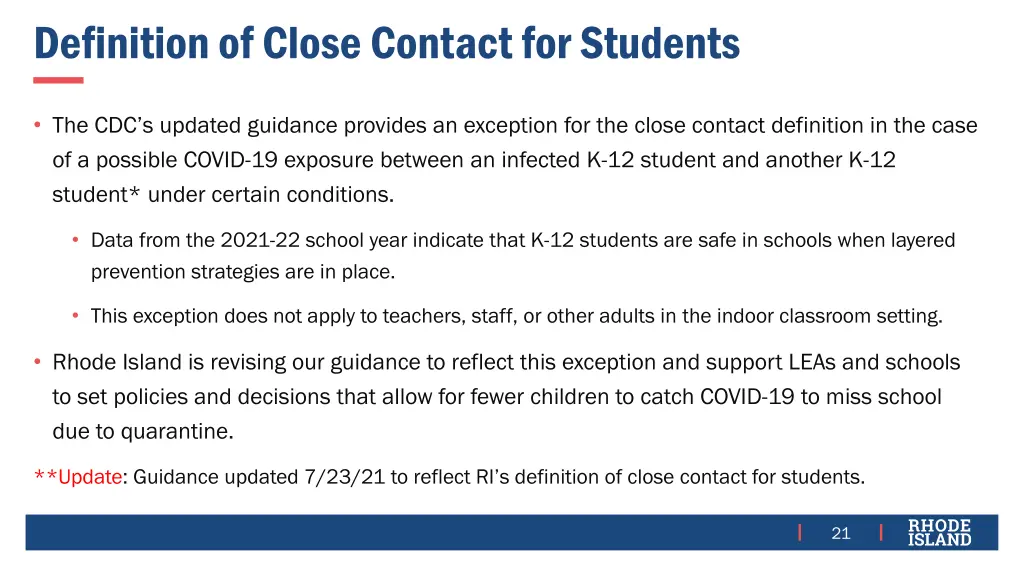
Definition of Close Contact for Students The CDC s updated guidance provides an exception for the close contact definition in the case of a possible COVID-19 exposure between an infected K-12 student and another K-12 student* under certain conditions. Data from the 2021-22 school year indicate that K-12 students are safe in schools when layered prevention strategies are in place. This exception does not apply to teachers, staff, or other adults in the indoor classroom setting. Rhode Island is revising our guidance to reflect this exception and support LEAs and schools to set policies and decisions that allow for fewer children to catch COVID-19 to miss school due to quarantine. **Update: Guidance updated 7/23/21 to reflect RI s definition of close contact for students. 21
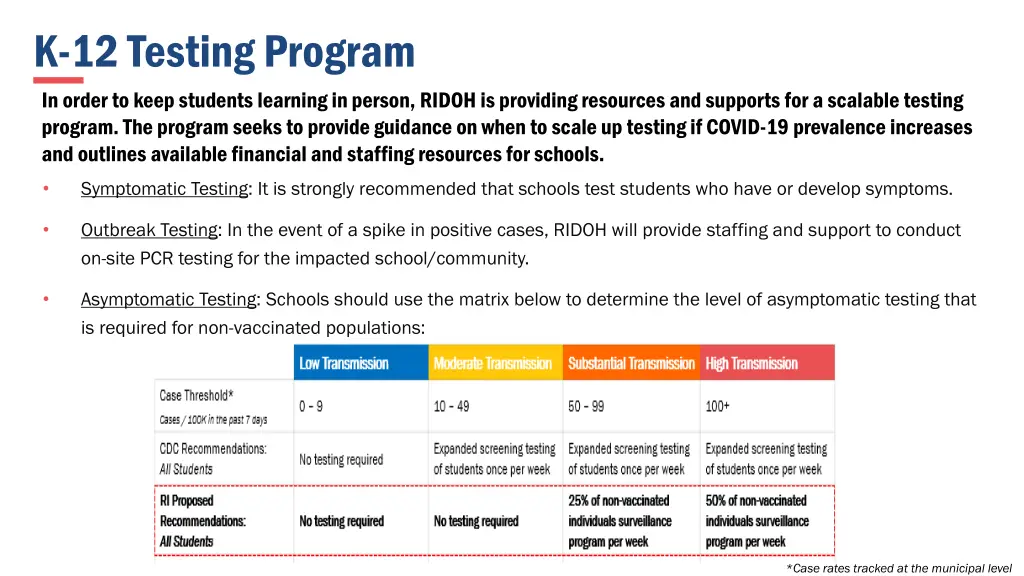
K-12 Testing Program In order to keep students learning in person, RIDOH is providing resources and supports for a scalable testing program. The program seeks to provide guidance on when to scale up testing if COVID-19 prevalence increases and outlines available financial and staffing resources for schools. Symptomatic Testing: It is strongly recommended that schools test students who have or develop symptoms. Outbreak Testing: In the event of a spike in positive cases, RIDOH will provide staffing and support to conduct on-site PCR testing for the impacted school/community. Asymptomatic Testing: Schools should use the matrix below to determine the level of asymptomatic testing that is required for non-vaccinated populations: *Case rates tracked at the municipal level
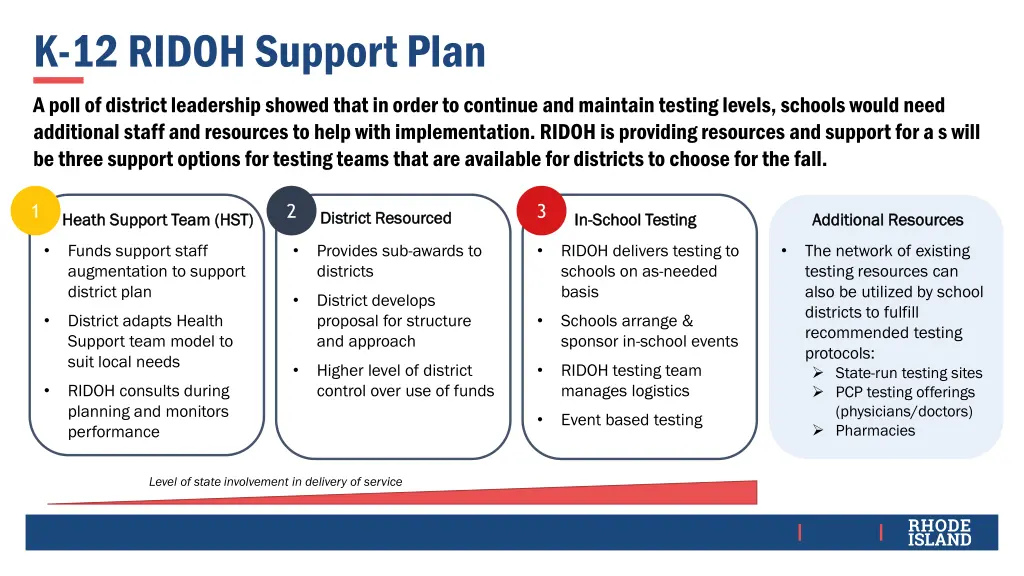
K-12 RIDOH Support Plan A poll of district leadership showed that in order to continue and maintain testing levels, schools would need additional staff and resources to help with implementation. RIDOH is providing resources and support for a s will be three support options for testing teams that are available for districts to choose for the fall. 1 2 3 District Resourced District Resourced Heath Support Team (HST) Heath Support Team (HST) In In- -School Testing School Testing Additional Resources Additional Resources Funds support staff augmentation to support district plan Provides sub-awards to districts RIDOH delivers testing to schools on as-needed basis The network of existing testing resources can also be utilized by school districts to fulfill recommended testing protocols: State-run testing sites PCP testing offerings (physicians/doctors) Pharmacies District develops proposal for structure and approach District adapts Health Support team model to suit local needs Schools arrange & sponsor in-school events Higher level of district control over use of funds RIDOH testing team manages logistics RIDOH consults during planning and monitors performance Event based testing Level of state involvement in delivery of service
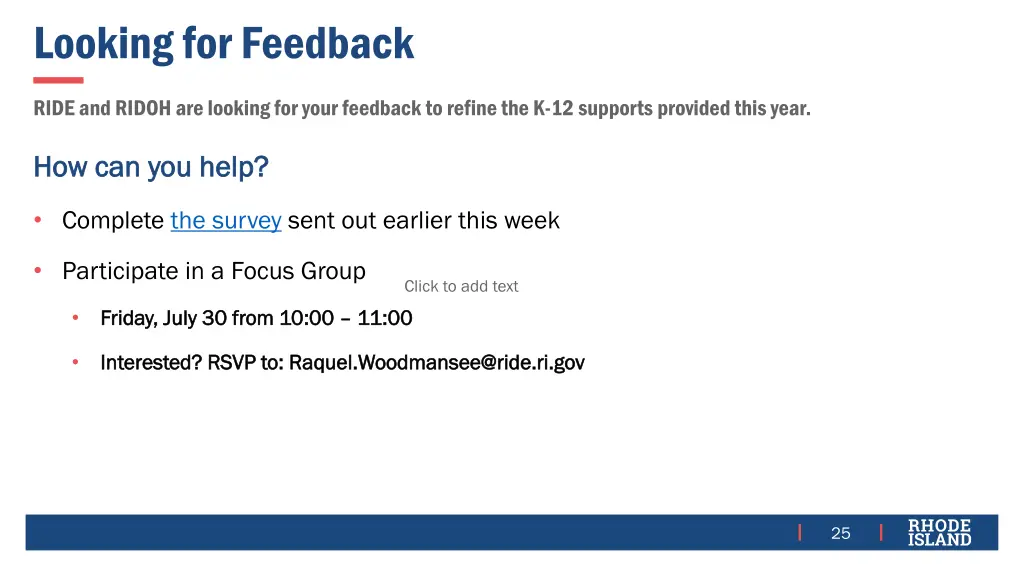
Looking for Feedback RIDE and RIDOH are looking for your feedback to refine the K-12 supports provided this year. How can you help? How can you help? Complete the survey sent out earlier this week Participate in a Focus Group Click to add text Friday, July 30 from 10:00 Friday, July 30 from 10:00 11:00 11:00 Interested? RSVP to: Interested? RSVP to: Raquel.Woodmansee@ride.ri.gov Raquel.Woodmansee@ride.ri.gov 25
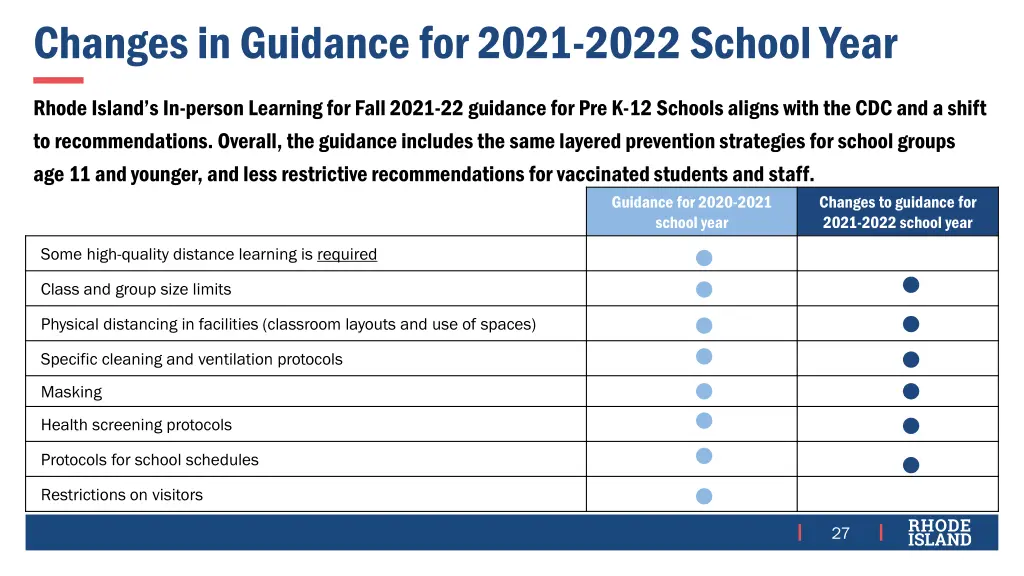
Changes in Guidance for 2021-2022 School Year Rhode Island s In-person Learning for Fall 2021-22 guidance for Pre K-12 Schools aligns with the CDC and a shift to recommendations. Overall, the guidance includes thesame layered prevention strategies for school groups age 11 and younger, and less restrictive recommendations for vaccinated students and staff. Guidance for 2020-2021 school year Changes to guidance for 2021-2022 school year Some high-quality distance learning is required Class and group size limits Physical distancing in facilities (classroom layouts and use of spaces) Specific cleaning and ventilation protocols Masking Health screening protocols Protocols for school schedules Restrictions on visitors 27
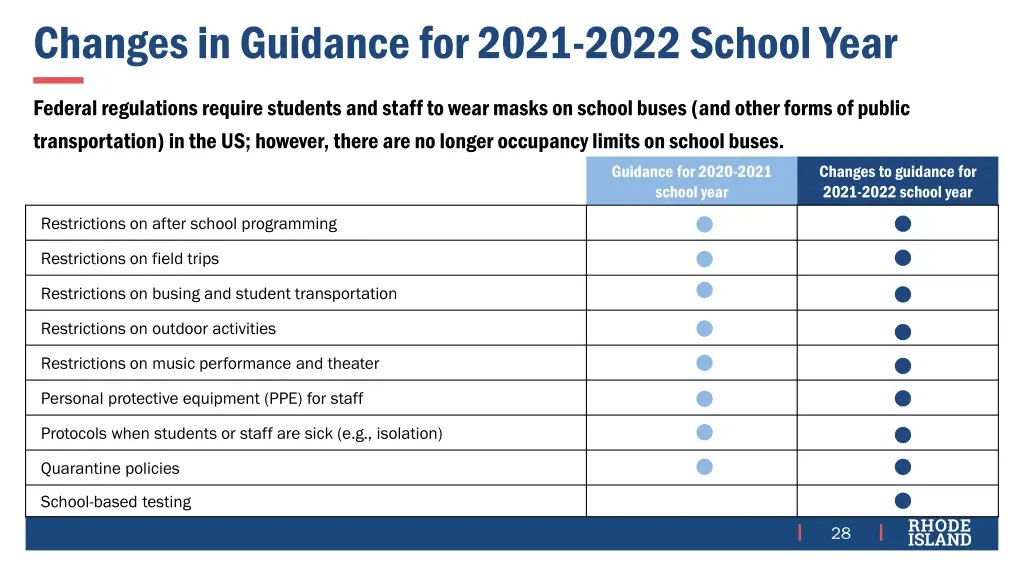
Changes in Guidance for 2021-2022 School Year Federal regulations require students and staff to wear masks on school buses (and other forms of public transportation) in the US; however, there are no longer occupancy limits on school buses. Guidance for 2020-2021 school year Changes to guidance for 2021-2022 school year Restrictions on after school programming Restrictions on field trips Restrictions on busing and student transportation Restrictions on outdoor activities Restrictions on music performance and theater Personal protective equipment (PPE) for staff Protocols when students or staff are sick (e.g., isolation) Quarantine policies School-based testing 28