Role of UK Household Characteristics in CO2 Emissions
An analysis of UK households' CO2 emissions and their association with socio-economic factors, aiming to understand the impact of environmental policies on different emission areas such as home energy, transport, and indirect emissions. The study investigates the distributional impact of these policies to identify areas for targeted intervention, particularly for low-income and disadvantaged households. Utilizing data from merged surveys, the research explores household characteristics like size, income, age, and education in relation to emissions. Regression analyses are conducted to determine which characteristics remain significant, considering income levels.

Download Presentation

Please find below an Image/Link to download the presentation.
The content on the website is provided AS IS for your information and personal use only. It may not be sold, licensed, or shared on other websites without obtaining consent from the author.If you encounter any issues during the download, it is possible that the publisher has removed the file from their server.
You are allowed to download the files provided on this website for personal or commercial use, subject to the condition that they are used lawfully. All files are the property of their respective owners.
The content on the website is provided AS IS for your information and personal use only. It may not be sold, licensed, or shared on other websites without obtaining consent from the author.
E N D
Presentation Transcript
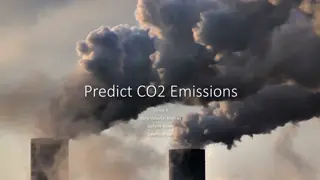
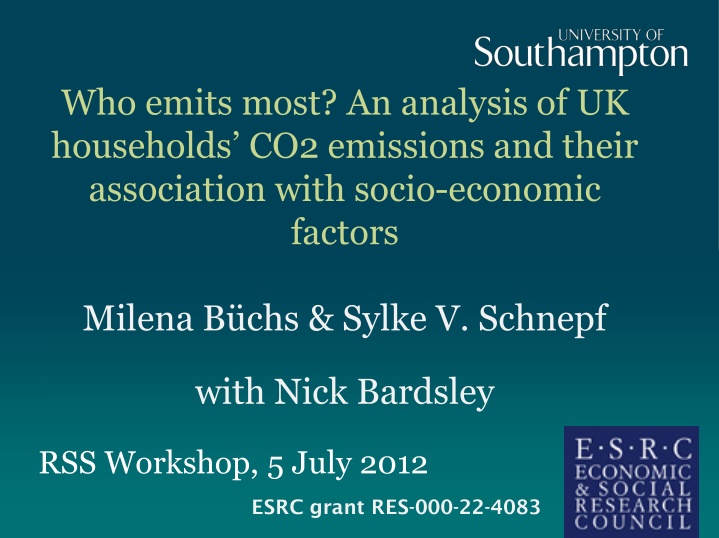
Who emits most? An analysis of UK households CO2 emissions and their association with socio-economic factors Milena B chs & Sylke V. Schnepf with Nick Bardsley RSS Workshop, 5 July 2012 ESRC grant RES-000-22-4083
Motivation Consensus on the need to implement environmental policies. Less known on the distributional impact of these policies There is an emerging literature that examines the role of socio-economic factors (SEF) for emissions but there is a lack of research comparing the association between SEF and CO2 emissions between different emission areas total hh emissions (Baiocchi 2010); hh emissions from transport (Brand et al 2008, 2010) direct hh emissions (Fahmy et al 2011) per capita CO2 emissions (DEFRA 2008) Per capita GHG emissions (Gough et al. 2011) CO2 emissions at output area level and 7 OAC groups (Druckman eta l 2008, 2009) 2
Research question Which role do household characteristics play for household CO2 emissions, separately for Home energy emissions (gas, electricity) Transport emissions (motor fuels, public transport, flights) Other indirect emissions from food and other consumption items Total emissions Which areas of emissions should be targeted such that low income / disadvantaged households are least affected? 3
Data recap Merged the Expenditure and Food Survey 2006 and 2007 with the Living Cost and Food Survey 2008 and 2009; total household sample size 24,446 Conversion for expenditure to CO2 emissions used ( mixed ) Home energy & transport emissions: Exploit as much information as possible from LCF/EFS that can be merged with external sources (i.e. external price statistics (home energy, motor fuels); estimated passenger km (public transport) to estimate units of consumption. Apply DEFRA conversion factors to estimate CO2.) Indirect emissions: use REAP to estimate CO2/ expenditure for 56 COICOP consumption categories 4
Structure talk 1 Annual average household emissions by emission area 2 Association of socio-economic factors with emissions Household size Income Age Education 3 Which characteristics still matter conditional on income? OLS regression results Quantile regression results 5
1 Annual mean hh CO2 emissions are 21.1 tonnes, with 5.1 t home energy, 5.3 t transport and 10.7 t indirect emissions % of total Gas 2.5 Electricity 2.1 Other home energy 0.5 Total Home energy % of total 12 t t 11 Indirect he and mf 10 Food 2 Catering/hotels 2.6 1.5 1.1 7 5 5.1 24 Recreation 0.8 0.7 4 3 Clothing Furniture, appliances, tools 9 Cars 4 Other indirect 25 Total Indirect Motor fuels 2.4 0.7 0.4 3.7 10.7 11 3 2 Flights Public transport Total Transport 2.0 1.0 5.3 17 51 6
The role of household size & composition Average % increase in CO2 emissions by each additional household member compared to single adult household Home energy 37 21 9 18 12 12 10 Total Co2 Indirect Transport 2nd 3rd 4th 5th + 1st 2nd 3rd 90 29 18 14 18 14 ns 97 31 18 16 24 15 ns 131 35 27 ns ns 18 -11 Adults Children Note: all figures significant at 1%. Ns denotes not significant. Results derive from OLS regressions with dependent variable type of emission. Sample size 21920 for total CO2, home energy and indirect emissions, and 18764 for transport. Model fit is 0.36 for total Co2, 0.37 for indirect emissions, 0.14 for home energy and 0.16 for transport 8
Annual hh CO2 emissions (tonnes) and income deciles 40 35 Annual hh CO2, tonnes 30 25 Total 20 indirect 15 transport 10 home energy 5 0 1 2 3 4 5 6 7 8 9 10 9 Income deciles, equivalised OECD scale
10th, 50th, 90th CO2 emissions percentiles over income deciles 70 Annual hh CO2, tonnes 60 50 90th percentile 40 30 Median 20 10th percentile 10 0 1 Income deciles, equivalised OECD scale 2 3 4 5 6 7 8 9 10 10
Percentage increase of CO2 emissions if income increases by 1% (log log OLS regression) Total CO2 Home energy Indirect Transport Income Constant 0.6 -1.1 0.7 -2.1 0.3 -0.2 0.9 -4.2 Observations 21914 R-squared 21914 0.51 21914 0.11 18761 0.28 0.50 All coefficients significant at the 1% level; households with 0 emissions in area excluded 11
Change elasticity once focus on CO2 distribution (quantile regressions) Total CO2 emissions Indirect emissions 1.3 1.1 Income Elasticity 1.2 1 1.1 0.9 0.8 1 0.7 0.9 0.6 0.8 0.5 0.7 0.4 0.6 0.6 0.2 0.4 0.9 0.1 0.5 0.7 0.8 0.3 Quantile 0.5 0.1 0.2 0.3 0.6 0.8 0.9 0.4 0.7 Quantile 12
The role of age 30 Annual household CO2, 25 20 tonnes total 15 id 10 he trans 5 0 18-29 30-39 40-49 50-59 60-69 70-79 Age group 80+ 13
Row percent of hh in low (<=25th percentile) and high (75th percentile +) CO2 emission groups by hh characteristic Low total CO2 High total CO2l Low home energy High home energy Low High transport transport Low income 52.6 6.9 39.1 16.7 50.6 7.2 High income 4.1 51.8 15.1 35.7 6.7 48.6 Age<35 22.5 20.8 32.9 16.0 21.2 24.2 Age35-64 17.1 33.5 20.9 30.9 17.2 32.1 Age>65 43.6 10.3 27.6 19.5 44.4 10.8 High education 9.2 42.6 19.0 32.5 9.1 40.4 Low education 35.4 14.3 30.7 19.1 35.0 16.4 Rural 19.2 32.5 22.4 32.0 19.9 29.8 Urban 26.8 22.5 25.6 22.3 26.5 23.6 Workless hh 45.5 12.4 39.5 19.8 44.5 12.5 Female head 34.4 16.9 28.9 20.8 34.6 17.4 Male head 19.1 30.1 22.5 27.6 19.0 29.8 Ethnic 27.3 21.1 27.3 25.9 22.8 23.8 14 Note: The table provides row percentages. I.e. 0 values for home energy and transport are included.
3 Log CO2 emissions and socio-economic factors; OLS VARIABLES Ln CO2 LN home Ln indirect emissions 0.408 0.008 -0.009 -0.093 0.053 0.065 0.087 0.019 -0.135 0.037 -0.267 0.089 -0.926 21908 0.624 Ln transport energy 0.122 0.014 -0.009 0.052 0.052 0.014 -0.008 0.052 0.012 0.033 -0.044 0.166 -0.309 21908 0.251 Lnincome Age age2_100 Agetop Female hh Education 1215 Education 16 Workless hh Ethnicity Rural hh No vehicle # bedroom Constant Observations R-squared 0.367 0.011 -0.011 -0.052 0.045 0.051 0.063 0.023 -0.057 0.050 -0.270 0.106 -0.081 21908 0.614 0.529 0.020 -0.023 -0.158 -0.033 0.090 0.109 -0.091 0.066 0.088 -0.822 0.053 -2.657 18963 0.355 15 Bold printed coefficients significant at 1 % level, results conditional on household composition
Tax burden expressed as proportion of disposable equivalised hh income assuming 100/ tonne CO2 tax 0.16 Proportion income for tax 0.18 total indirect 0.14 transport 0.12 0.1 home energy 0.08 0.06 0.04 0.02 0 1 2 3 4 5 6 7 8 9 10 Decile of Equivalised Household Income (modified OECD scale) 16
Conclusions Our research examines the role of socio-economic factors for different areas of emissions something that has not yet been directly compared using the same dataset Household size impacts differently in areas of transport, energy and indirect emissions. While a second adult living in a household doubles indirect emissions he/she only increases home energy CO2 emissions by 30% Surprisingly, high education still significant positive influence even after controlling for income for indirect and transport Taxes on home energy are likely to affect disadvantaged households most (including older and workless households) Whilst taxes on transport are still regressive overall, they are less regressive than all other forms of taxes. But will hit households in rural areas (even conditional on their income) 17