Role Play in Mathematics Learning
the significance of role play in teaching mathematics to primary school children. Uncover how role playing can enhance mathematical understanding, encourage active participation, and create a supportive learning environment. Discover effective communication strategies and methods to foster a positive mathematical community of practice."

Uploaded on Feb 17, 2025 | 2 Views
Download Presentation

Please find below an Image/Link to download the presentation.
The content on the website is provided AS IS for your information and personal use only. It may not be sold, licensed, or shared on other websites without obtaining consent from the author.If you encounter any issues during the download, it is possible that the publisher has removed the file from their server.
You are allowed to download the files provided on this website for personal or commercial use, subject to the condition that they are used lawfully. All files are the property of their respective owners.
The content on the website is provided AS IS for your information and personal use only. It may not be sold, licensed, or shared on other websites without obtaining consent from the author.
E N D
Presentation Transcript
Session One: Extending the teaching repertoire, developing role play for talk Dr. Helen Williams The relevance of role play to the learning of mathematics in the primary classroom.
There is a danger that mathematics is seen by children as something in which they learn about other people s ideas, particularly yours, and it has nothing to do with them. (Straker, A. 1993: 10)
How to produce children who have difficulties with mathematics: Create anxiety and lack of confidence (Ashcraft 1998, Maloney et al 2013) Emphasise counting and not number sense Put 4 and 5 year olds in ability groups where they will stay (Boaler 2009)
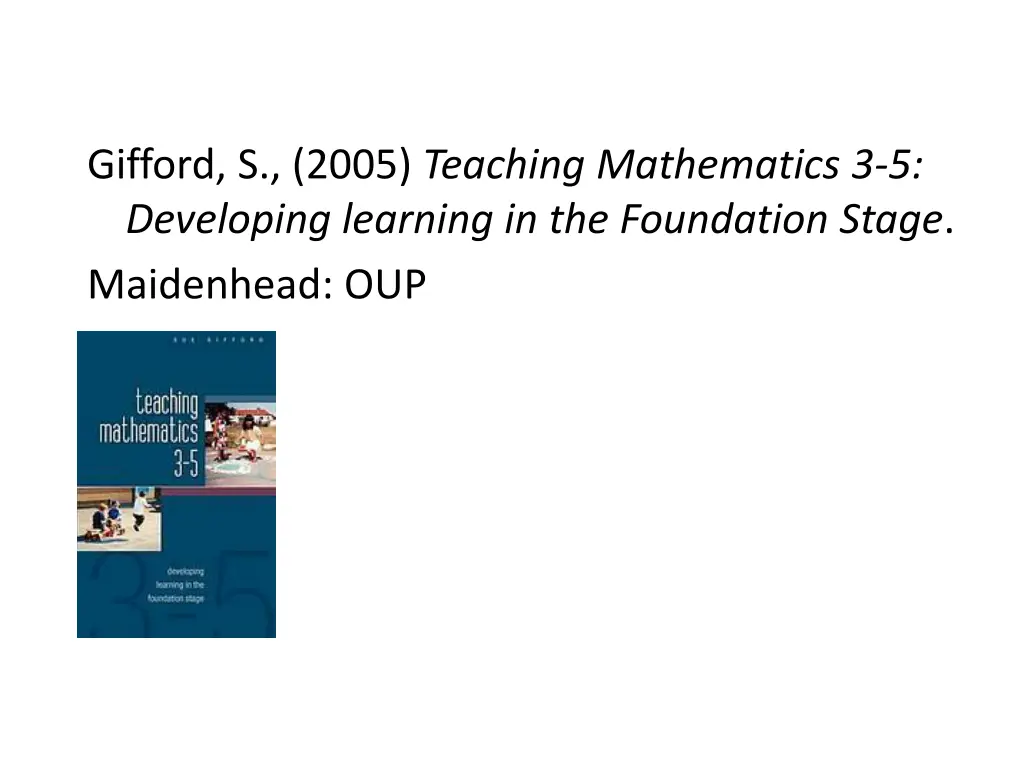
Gifford, S., (2005) Teaching Mathematics 3-5: Developing learning in the Foundation Stage. Maidenhead: OUP
Operating as members of a mathematical community of practice. (Jean Lave and Etienne Wenger, 1991) In a mathematical learning community ... participants share experiences use shared language to talk about these work together to construct meaning of a mathematical idea make reference to outside experiences of mathematics
... play where, for periods, the participants are walking in another s shoes. Helen Williams 2006: 15 ... the shared pretend play between children in which they temporarily act out the part of someone else using pretend actions and utterances. Harris, cited by Rogers and Evans 2007: 165
The particular elements of talk that support learning have been identified as talk that shares knowledge, challenges ideas, evaluates evidence and considers options in a reasoned, equitable fashion. (Wheeldon 2006, Howe and Mercer 2007)
Exploratory talk has been defined as talk in which: all relevant information is shared; all members of the group are invited to contribute to the discussion; opinions and ideas are respected and considered; everyone is asked to make their reasons clear; challenges and alternatives are made explicit and are negotiated; the group seeks to reach agreement before taking a decision or acting. (Mercer and Sams 2006: 512)
Sustained shared thinking Adult-child interaction with some degree of sustained, shared thinking is of particular value in improving a young child s cognitive achievement. Sustained shared thinking is said to occur when adult-child conversation attempts to reach some mutual understanding and the level of thinking of the child is lifted . (Siraj-Blatchford et al 2002).
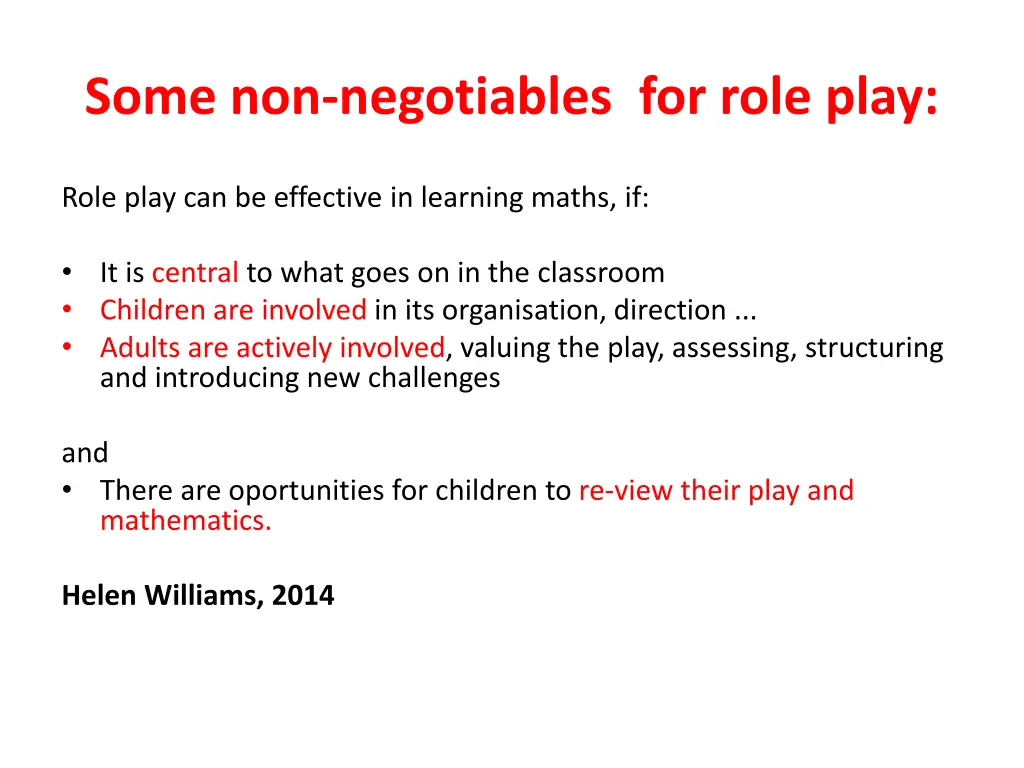
Some non-negotiables for role play: Role play can be effective in learning maths, if: It is central to what goes on in the classroom Children are involved in its organisation, direction ... Adults are actively involved, valuing the play, assessing, structuring and introducing new challenges and There are oportunities for children to re-view their play and mathematics. Helen Williams, 2014
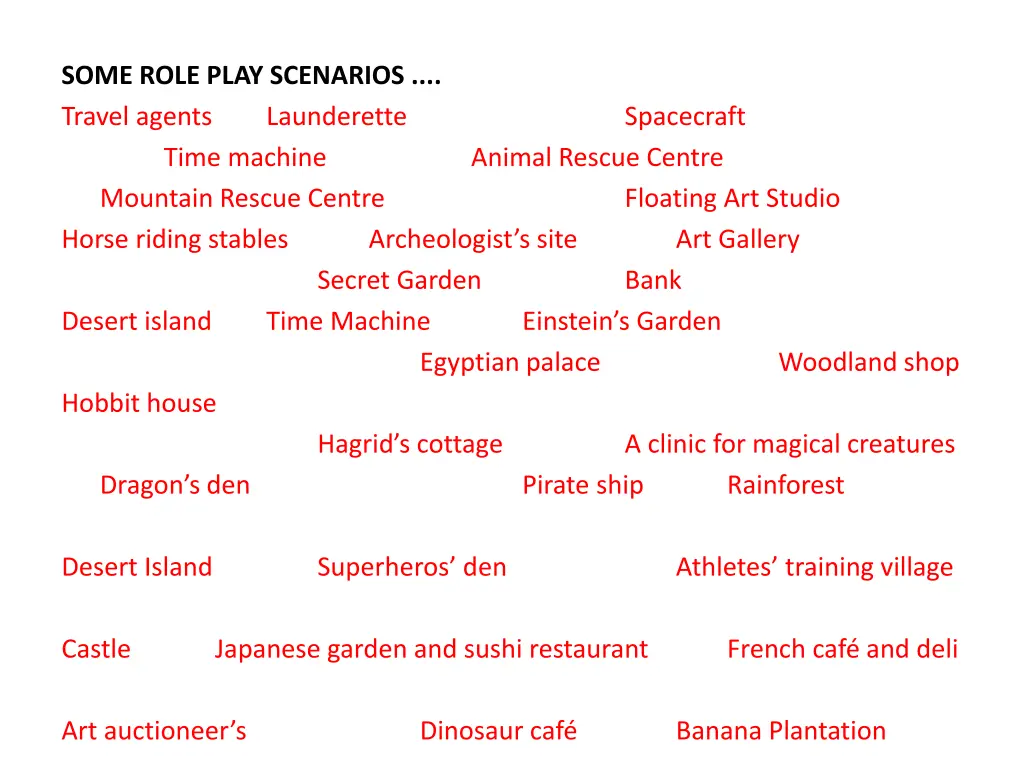
SOME ROLE PLAY SCENARIOS .... Travel agents Time machine Mountain Rescue Centre Horse riding stables Launderette Spacecraft Animal Rescue Centre Floating Art Studio Art Gallery Bank Einstein s Garden Egyptian palace Archeologist s site Secret Garden Time Machine Desert island Woodland shop Hobbit house Hagrid s cottage A clinic for magical creatures Pirate ship Rainforest Dragon s den Desert Island Superheros den Athletes training village Castle Japanese garden and sushi restaurant French caf and deli Art auctioneer s Dinosaur caf Banana Plantation
Session Two Reflective talk for maths learning
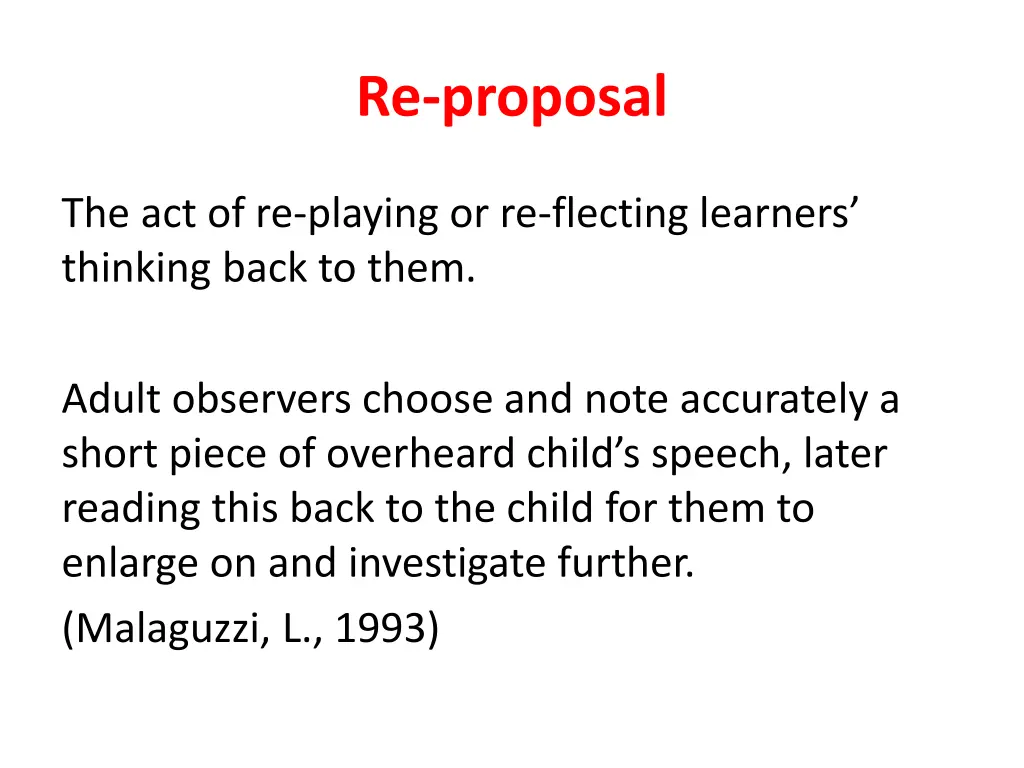
Re-proposal The act of re playing or re-flecting learners thinking back to them. Adult observers choose and note accurately a short piece of overheard child s speech, later reading this back to the child for them to enlarge on and investigate further. (Malaguzzi, L., 1993)
Reflection John Dewey (2004): We do not learn from experience. We learn from reflecting on experience.
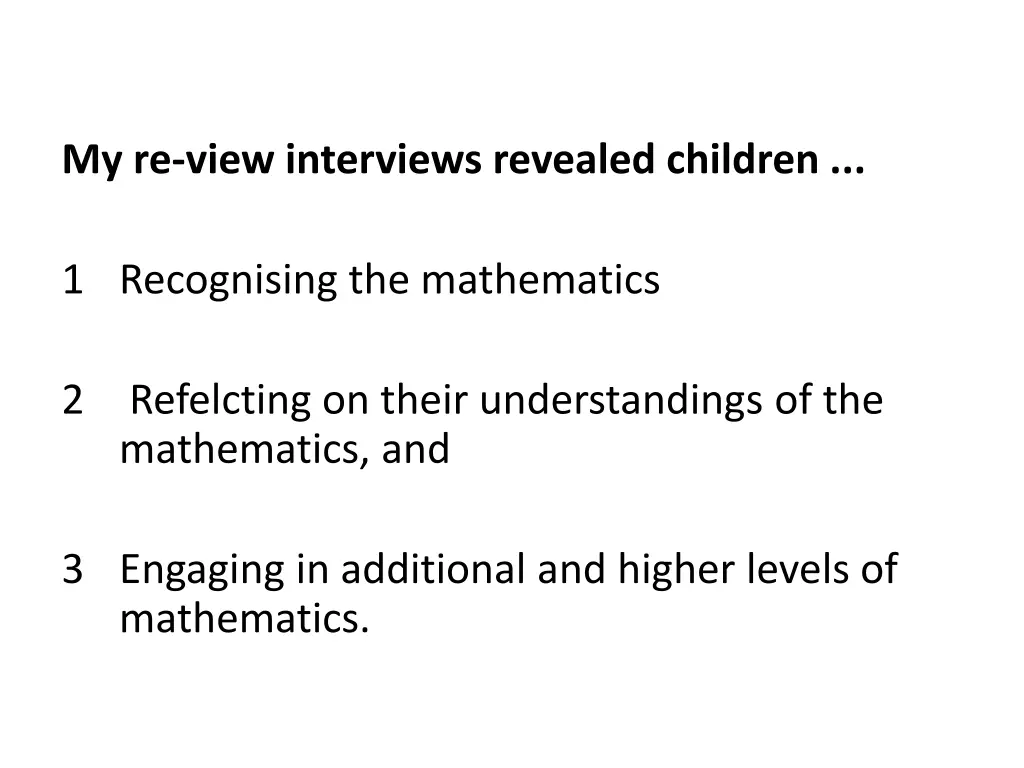
My re-view interviews revealed children ... 1 Recognising the mathematics 2 Refelcting on their understandings of the mathematics, and 3 Engaging in additional and higher levels of mathematics.
The power within a classroom continues to rest with the adults, but teachers silence, authentic questioning and requests for children s views, plus them allowing space for their children to sort things out for themselves makes the relationship more equal. (Williams, H. 2014)
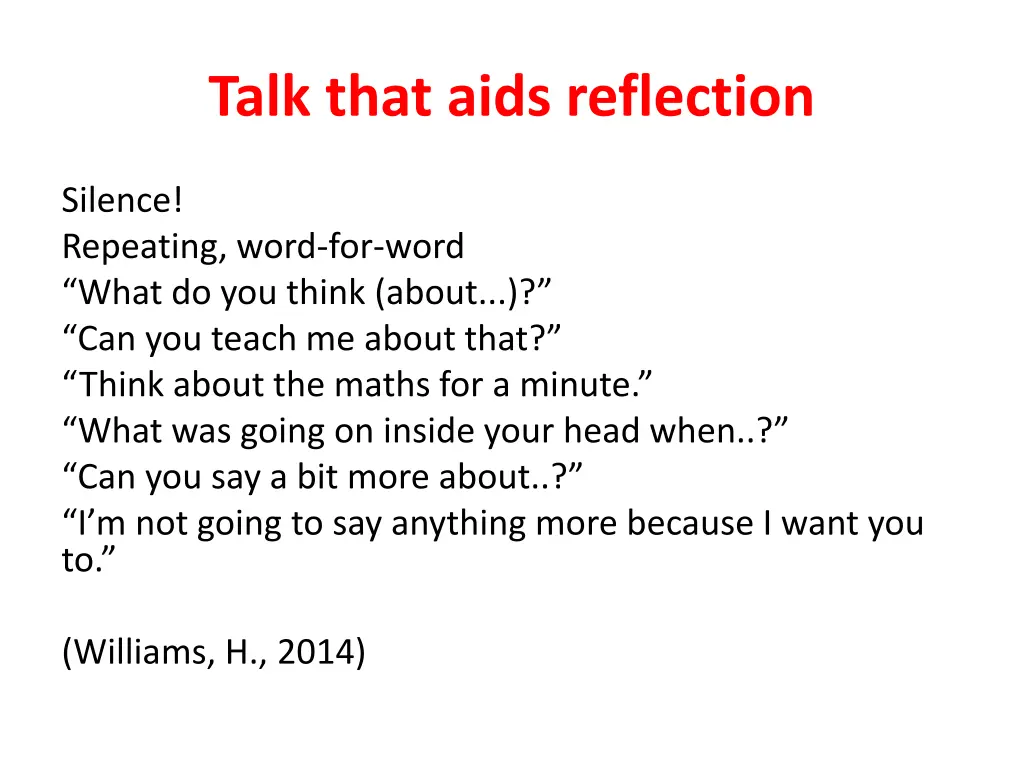
Talk that aids reflection Silence! Repeating, word-for-word What do you think (about...)? Can you teach me about that? Think about the maths for a minute. What was going on inside your head when..? Can you say a bit more about..? I m not going to say anything more because I want you to. (Williams, H., 2014)
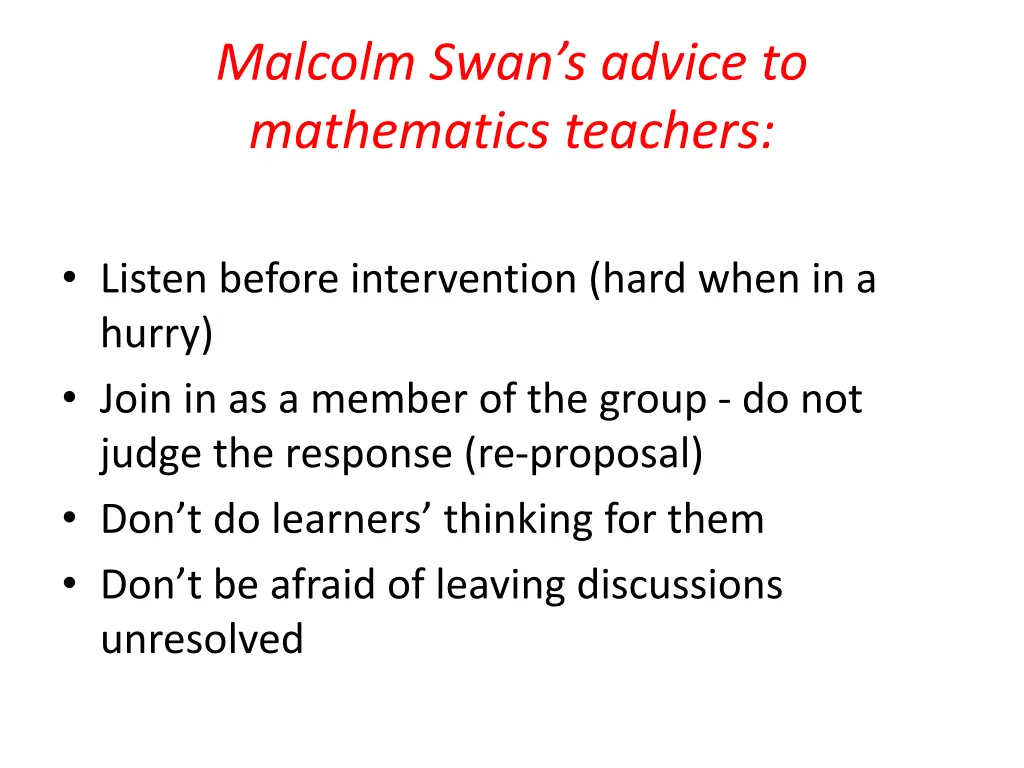
Malcolm Swans advice to mathematics teachers: Listen before intervention (hard when in a hurry) Join in as a member of the group - do not judge the response (re-proposal) Don t do learners thinking for them Don t be afraid of leaving discussions unresolved
Dr. Helen J. Williams @helenjwc Email: info@helenjw.co.uk
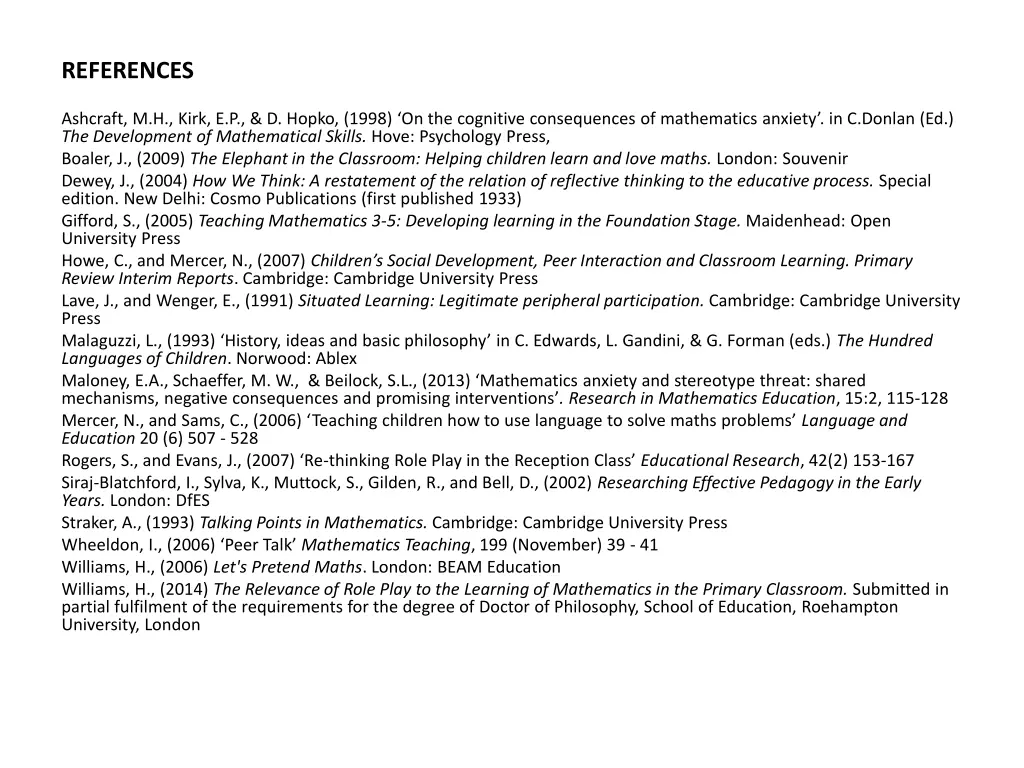
REFERENCES Ashcraft, M.H., Kirk, E.P., & D. Hopko, (1998) On the cognitive consequences of mathematics anxiety . in C.Donlan (Ed.) The Development of Mathematical Skills. Hove: Psychology Press, Boaler, J., (2009) The Elephant in the Classroom: Helping children learn and love maths. London: Souvenir Dewey, J., (2004) How We Think: A restatement of the relation of reflective thinking to the educative process. Special edition. New Delhi: Cosmo Publications (first published 1933) Gifford, S., (2005) Teaching Mathematics 3-5: Developing learning in the Foundation Stage. Maidenhead: Open University Press Howe, C., and Mercer, N., (2007) Children s Social Development, Peer Interaction and Classroom Learning. Primary Review Interim Reports. Cambridge: Cambridge University Press Lave, J., and Wenger, E., (1991) Situated Learning: Legitimate peripheral participation. Cambridge: Cambridge University Press Malaguzzi, L., (1993) History, ideas and basic philosophy in C. Edwards, L. Gandini, & G. Forman (eds.) The Hundred Languages of Children. Norwood: Ablex Maloney, E.A., Schaeffer, M. W., & Beilock, S.L., (2013) Mathematics anxiety and stereotype threat: shared mechanisms, negative consequences and promising interventions . Research in Mathematics Education, 15:2, 115-128 Mercer, N., and Sams, C., (2006) Teaching children how to use language to solve maths problems Language and Education 20 (6) 507 - 528 Rogers, S., and Evans, J., (2007) Re-thinking Role Play in the Reception Class Educational Research, 42(2) 153-167 Siraj-Blatchford, I., Sylva, K., Muttock, S., Gilden, R., and Bell, D., (2002) Researching Effective Pedagogy in the Early Years. London: DfES Straker, A., (1993) Talking Points in Mathematics. Cambridge: Cambridge University Press Wheeldon, I., (2006) Peer Talk Mathematics Teaching, 199 (November) 39 - 41 Williams, H., (2006) Let's Pretend Maths. London: BEAM Education Williams, H., (2014) The Relevance of Role Play to the Learning of Mathematics in the Primary Classroom. Submitted in partial fulfilment of the requirements for the degree of Doctor of Philosophy, School of Education, Roehampton University, London