Explore the representation of bodies in Roman verse satire, focusing on Persius and Stoic influences. From the use of literary forms like the scazon to the fusion of Stoicism and satire, delve into the complexities of vulnerability, humor, and critical discourse in ancient Roman poetry.
Please find below an Image/Link to download the presentation.
The content on the website is provided AS IS for your information and personal use only. It may not be sold, licensed, or shared on other websites without obtaining consent from the author. If you encounter any issues during the download, it is possible that the publisher has removed the file from their server.
You are allowed to download the files provided on this website for personal or commercial use, subject to the condition that they are used lawfully. All files are the property of their respective owners.
The content on the website is provided AS IS for your information and personal use only. It may not be sold, licensed, or shared on other websites without obtaining consent from the author.
E N D
Presentation Transcript
The Vulnerable Body Stuffed bellies and bad taste: Persius and the poem made flesh
Vulnerability in writing/reading Does it take one to know one? Are satirists/comedians who undermine themselves especially powerful and appealing?
Vulnerable literary forms: the scazon Scazons/choliambics (= limping iambic- Gk cholos = lame ) This is the metre Persius uses in his prologue . It was invented by Hipponax, and droops or drags its foot at the end of the line. The final foot is always a spondee, i.e. two long syllables. E.g. Catullus 8, which begins miser Catulle, desinas ineptire
It all boils down to. decoctius = something more boiled down Persius Satire 1.125 Concentrate? Potion? Medicine? Strong-tasting and pungent? A new (Stoic) take on the aesthetic of brevitas, or brevity?
Persius is hard to read. He wants it that way . callida iunctura (Horace Ars Poetica 47-8) becomes iunctura acris (Persius 5.14)
Radically different or respectful heir? Horace Sat.2.1.1-2: There is a whole class of people who think I m too harsh in satire, and that I am stretching the genre past its legal limit .
The Stoic satirist Heir to Horace and also a Stoic: one of the grounding paradoxes of Persius text? Is Stoic satire itself a contradiction in terms?
But Stoicism + satire also a natural pair? Satire a traditional vehicle for sharp moral exhortation. Established relationship between verse satire and diatribe. Aesthetically, Stoic thinking is compatible with the critical, aggressive tone of satire. Roman Stoic thought, like Roman satire, is polemical, wants to jolt people out of assumptions and beliefs, attacks the status quo. Satiric sermo, with its embrace of dialogue, can allude to Platonic dialogue and to the model of didactic exchange that lies at the heart of Stoic praxis. Cf. Seneca and Lucilius in the Letters. Satire can operate as a kind of Stoic therapy? Roman Stoicism is primarily focused on ethics, rather than physics and logic, while satire in Rome has the function of grappling with corruption and especially with the corrupt, bodily passions greed, lust, anger, bitterness which Stoic training seeks to understand and control. Satire and Stoic thinking/praxis share metaphors: the Stoic teacher is a doctor treating patients with medicine , and healing moral and emotional weaknesses as illnesses or wounds /Satire is the most corporeal of
Persius bellies Prologue, 9-11: Who taught the magpie to copy human speech? It was the belly, that master of the arts, that purveyor of genius, such an artist at miming voices that are denied him.
Satire 3.96-103 You re looking pale, my friend! It s nothing. Well see to it, whatever it is. Your skin s turning yellow. It s not as pale as yours: don t try to imitate my guardian. It s him I ve just buried, not you. Carry on then, I ll say nothing. Stuffed from his feasting he goes white-bellied to bathe, but as he drinks, his throat emitting long noxious belches, a sudden tremor makes the warm glass slip from his hand, his bared teeth chatter, and the greasy food slides from his slack mouth. Then it s the bugle, the
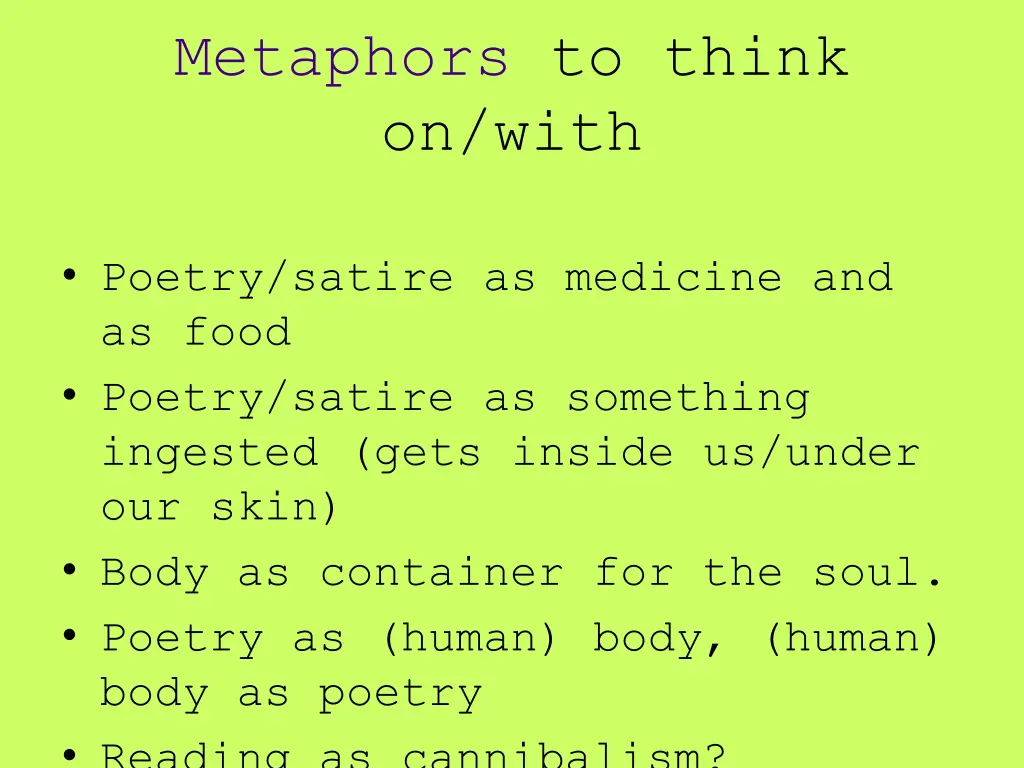
Metaphors to think on/with Poetry/satire as medicine and as food Poetry/satire as something ingested (gets inside us/under our skin) Body as container for the soul. Poetry as (human) body, (human) body as poetry Reading as cannibalism?
The prologue That s not how I suddenly become a poet, By wetting my lips in the Hippocrene, Or dreaming on the twin peaks of Parnassus. I leave the Muses, and Pirene s pale Spring, to those with busts to which A crown of ivy clings; a semi-pagan bring my song to the bards holy rites. What teaches the parrot to squawk: Hello! And urges the magpie to try human speech? It s that master of arts, and dispenser of skills, Hunger, expert at trying out sounds nature denies. For if there s the gleam of a hope of crafty gain, You ll hear crow-poets and magpie-poetesses Singing in praise of Pegaseian nectar.