Roosevelt and the New Deal: Challenges and Progress
This content discusses the challenges faced by Roosevelt during the New Deal era, including criticism from both left and right, opposition from leaders like Huey Long and Francis Townsend, and the Supreme Court's role. It also explores the launch of the Second New Deal, rise of industrial unions, and the efforts to organize workers in industries. Overall, it provides insights into the political dynamics and societal changes of that time.

Download Presentation

Please find below an Image/Link to download the presentation.
The content on the website is provided AS IS for your information and personal use only. It may not be sold, licensed, or shared on other websites without obtaining consent from the author.If you encounter any issues during the download, it is possible that the publisher has removed the file from their server.
You are allowed to download the files provided on this website for personal or commercial use, subject to the condition that they are used lawfully. All files are the property of their respective owners.
The content on the website is provided AS IS for your information and personal use only. It may not be sold, licensed, or shared on other websites without obtaining consent from the author.
E N D
Presentation Transcript
Trumpet Behavioral Health Maximizing the Potential of the Clients We Serve
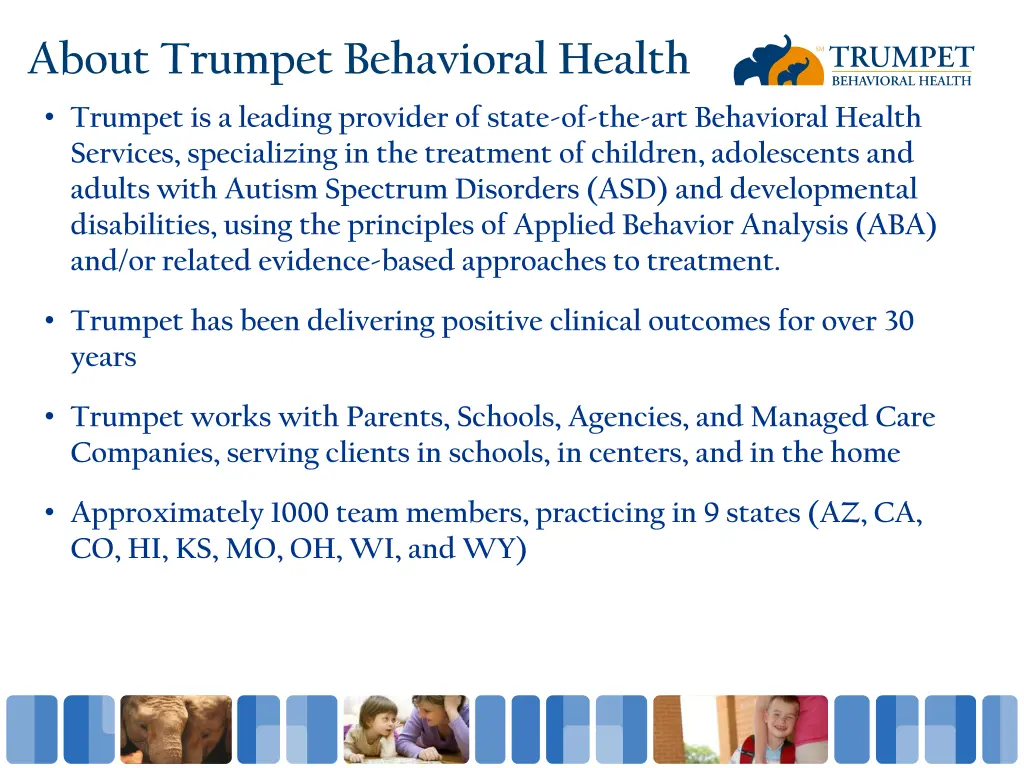
About Trumpet Behavioral Health Trumpet is a leading provider of state-of-the-art Behavioral Health Services, specializing in the treatment of children, adolescents and adults with Autism Spectrum Disorders (ASD) and developmental disabilities, using the principles of Applied Behavior Analysis (ABA) and/or related evidence-based approaches to treatment. Trumpet has been delivering positive clinical outcomes for over 30 years Trumpet works with Parents, Schools, Agencies, and Managed Care Companies, serving clients in schools, in centers, and in the home Approximately 1000 team members, practicing in 9 states (AZ, CA, CO, HI, KS, MO, OH, WI, and WY)
Our Team The national presence allows TBH s team of clinicians to collaborate on cases, best practices and standardize outcomes, treatment goals and overall client success. Consultants consist of BCBAs, PHD s, MFT s and Masters in related degrees TBH skills trainers work 1:1 with each client and have degrees in psychology, education and behavioral health related fields. All TBH clinical team members receive 40 or more hrs of continuing education yearly. We also provide training and case management systems to care providers, parents and educators through our technology division and the AutismPro product.
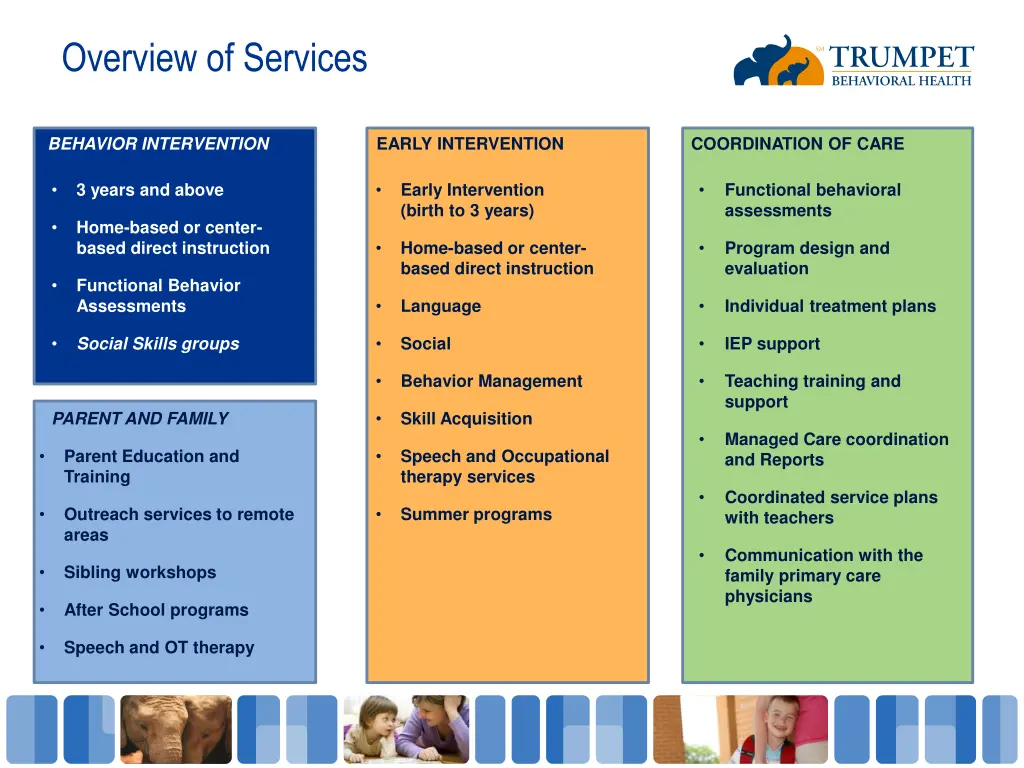
Overview of Services BEHAVIOR INTERVENTION EARLY INTERVENTION COORDINATION OF CARE 3 years and above Early Intervention (birth to 3 years) Functional behavioral assessments Home-based or center- based direct instruction Home-based or center- based direct instruction Program design and evaluation Functional Behavior Assessments Language Individual treatment plans Social Skills groups Social IEP support Behavior Management Teaching training and support PARENT AND FAMILY Skill Acquisition Managed Care coordination and Reports Parent Education and Training Speech and Occupational therapy services Coordinated service plans with teachers Outreach services to remote areas Summer programs Communication with the family primary care physicians Sibling workshops After School programs Speech and OT therapy
HOW DOES THE MANDATE EFFECT MY FAMILY?
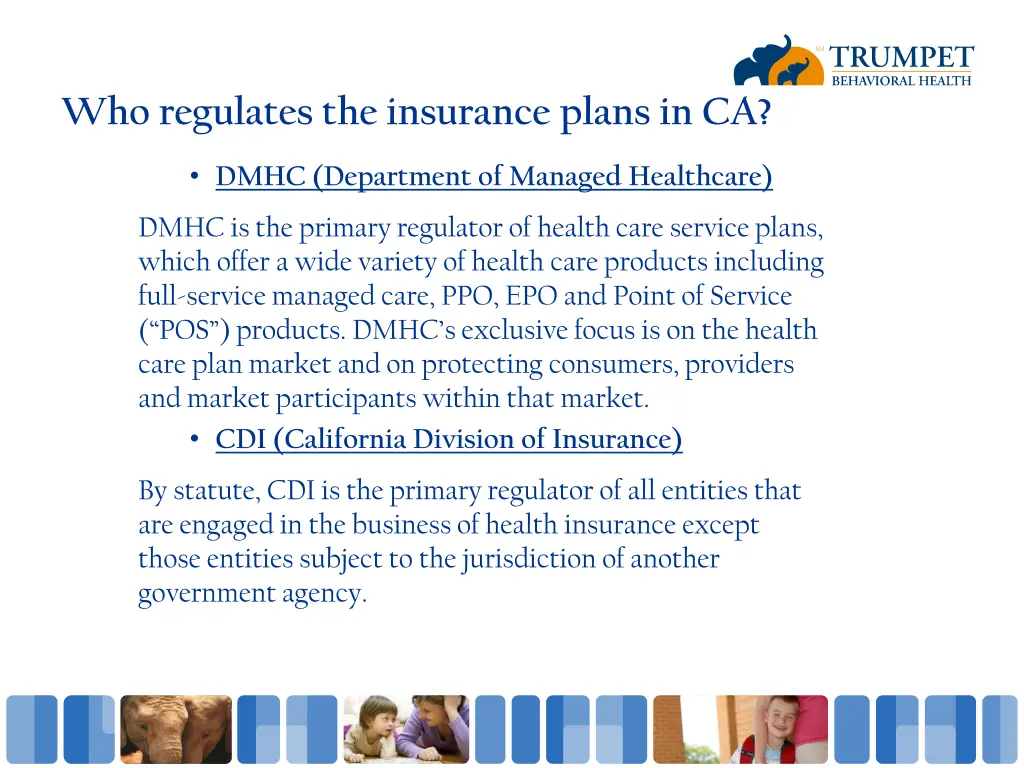
Who regulates the insurance plans in CA? DMHC (Department of Managed Healthcare) DMHC is the primary regulator of health care service plans, which offer a wide variety of health care products including full-service managed care, PPO, EPO and Point of Service ( POS ) products. DMHC s exclusive focus is on the health care plan market and on protecting consumers, providers and market participants within that market. CDI (California Division of Insurance) By statute, CDI is the primary regulator of all entities that are engaged in the business of health insurance except those entities subject to the jurisdiction of another government agency.
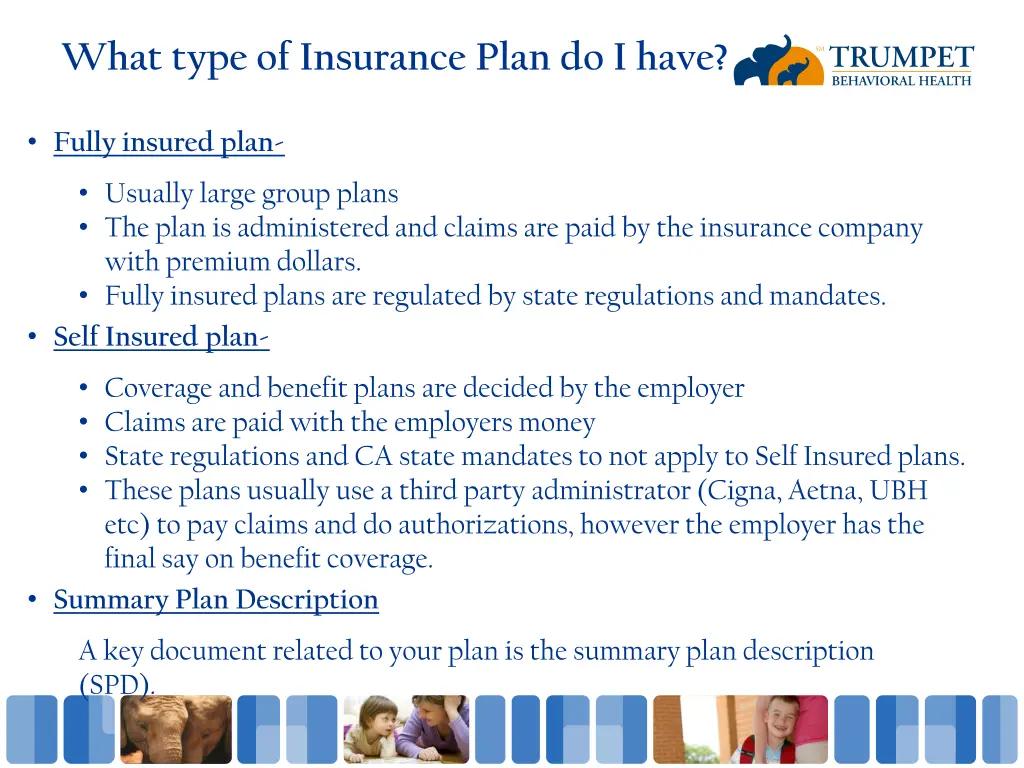
What type of Insurance Plan do I have? Fully insured plan- Usually large group plans The plan is administered and claims are paid by the insurance company with premium dollars. Fully insured plans are regulated by state regulations and mandates. Self Insured plan- Coverage and benefit plans are decided by the employer Claims are paid with the employers money State regulations and CA state mandates to not apply to Self Insured plans. These plans usually use a third party administrator (Cigna, Aetna, UBH etc) to pay claims and do authorizations, however the employer has the final say on benefit coverage. Summary Plan Description A key document related to your plan is the summary plan description (SPD).
Important things to know before starting services Assessment Who can do the assessment? How long can the assessment be? When is re-assessment required? What codes do I bill the assessment under? Supervision Who can provide it? Can it be billed on the same day as direct ABA services ? How many hours are approved? Does it have to be in the presence of the client?
Required Documents Assessment and treatment plan from a qualified autism provider including medically necessary treatment goals. Diagnosing Report from a licensed provider. Some health plans will only accept a diagnosing report less then three years old. A prescription/referral from your pediatrician stating the diagnosis and the number of hours recommended for ABA.
California Mandate (SB 946) The Mandate effective July 1, 2012 Requires every health plan contract that provides hospital, medical, or surgical coverage and health insurance policy to also provide coverage for Behavioral Health Therapy for PDD/ASD Behavioral treatment includes ABA and other evidence based programs. Requires the coverage to be provided in the same manner and to be subject to the same requirements as provided in California's mental health parity law. There are no limits or caps on the number hours of ABA allowed, dollar amount , age of child, etc. in the mandate- it is all determined individually by MEDICAL NECESSITY. Excludes MediCal (but Calpers and Healthy Families now have ABA benefit) - copay s may be covered by the regional centers- please check with your regional center for their policy.
California Mandate SB946 Who are approved providers under the Mandate? In order to be covered, the behavioral health treatment must be prescribed by a licensed physician, or developed by a licensed psychologist. The treatment plan must have measurable goals and be prescribed by a qualified autism service provider, e.g. a Board Certified Behavior Analyst (BCBA) or other licensed service provider. Behavioral health treatments must be provided by a qualified autism service provider, a qualified autism service professional such as an Associate Behavior Analyst, or a qualified autism service paraprofessional. Qualified autism service professional and paraprofessionals must be supervised and employed by a qualified autism service provider. When will the Mandate end? If the Federal government does not establish Autism behavioral health treatment as a "essential health benefit", this bill will automatically expire on 7/1/14. They are expecting Autism services to be covered through the essential health benefits at that time. Will insurance companies be able to deny ABA services if my child is not making sufficient progress? Like any other type of therapy, insurance may review treatment goals and objectives to determine if services are no longer appropriate. Per the Mandate a treatment plan must be reviewed by the healthplan every 6 months.
How do I transition from receiving state funded services to insurance covered services? Regional centers are considered the funding source of last resort; families need to take the initiative ASAP in researching their current health insurance benefits to ensure a smooth continuation of treatment services. Find out if ABA services are covered by your plan. If you have coverage-start the treatment authorization process with your insurance. While all insurance companies have different processes in place, an autism diagnosis is a prerequisite to getting started. It is best to choose an in-network provider who will assist you completing this process: Obtaining an authorization for an assessment Completion of a behavioral assessment Completion of required Treatment plan and goals Obtaining an authorization to start services If ABA is not a covered benefit under your plan, a denial letter will be initiated by the insurance company. At that point, the family may use this denial letter for the purposes of obtaining or maintaining Regional Center funded services. It is also recommended that all families with children, teens, and adults on the autism spectrum contact the plan administrator of their employer to request that ABA services be added to the plan if you have a self funded plan that does not cover ABA.
WILL I HAVE A CO-PAY FOR ABA SERVICES? It is important for families to contact their insurance companies directly to better understand the specific benefits of their health plan and their financial responsibilities. Families may expect to pay a co-payment for each visit, similar to what you would pay when visiting a family physician, or receiving physical therapy. If your child is receiving multiple ABA sessions in a given week, a co-payment may be expected for each visit. Typically, a co-payment is a set fee per day, as determined by the provisions of a given benefits plan but make sure to verify with your plan how copays are applied Most regional centers in California will offer support with co-payments. Therefore, it is very important that families contact their regional center to find out what their policy will be regarding funding assistance for co-payments. Please note that there may be other financial responsibilities for families to pay, such as deductibles, co-insurance and out-of-pocket maximum.
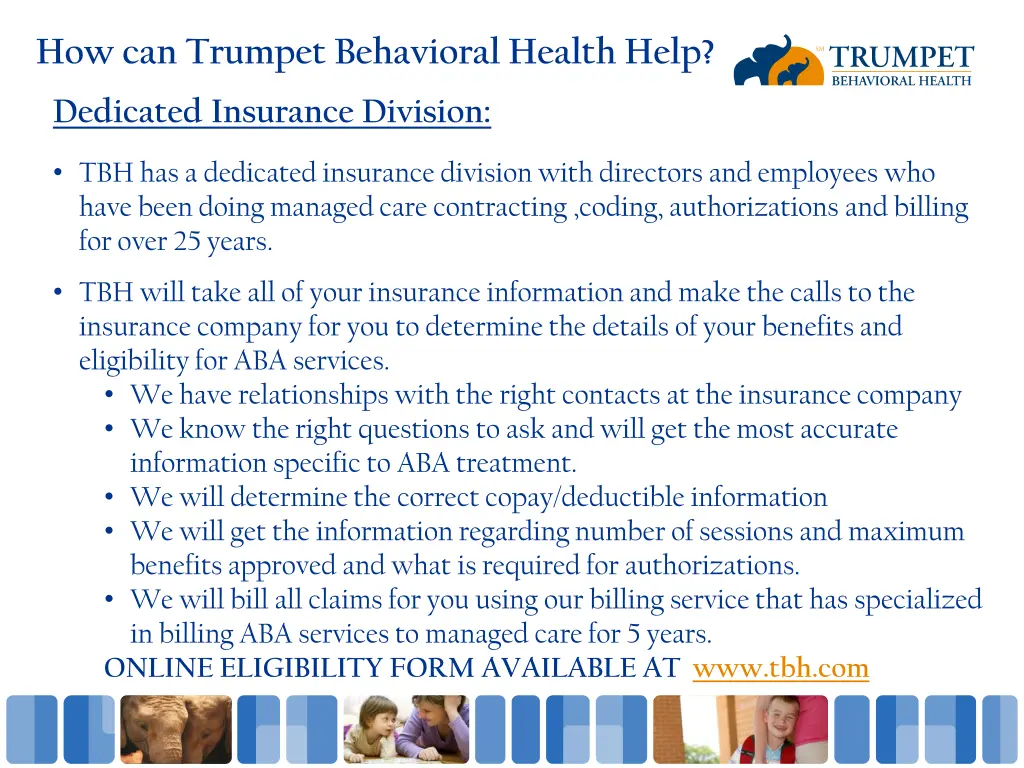
How can Trumpet Behavioral Health Help? Dedicated Insurance Division: TBH has a dedicated insurance division with directors and employees who have been doing managed care contracting ,coding, authorizations and billing for over 25 years. TBH will take all of your insurance information and make the calls to the insurance company for you to determine the details of your benefits and eligibility for ABA services. We have relationships with the right contacts at the insurance company We know the right questions to ask and will get the most accurate information specific to ABA treatment. We will determine the correct copay/deductible information We will get the information regarding number of sessions and maximum benefits approved and what is required for authorizations. We will bill all claims for you using our billing service that has specialized in billing ABA services to managed care for 5 years. ONLINE ELIGIBILITY FORM AVAILABLE AT www.tbh.com
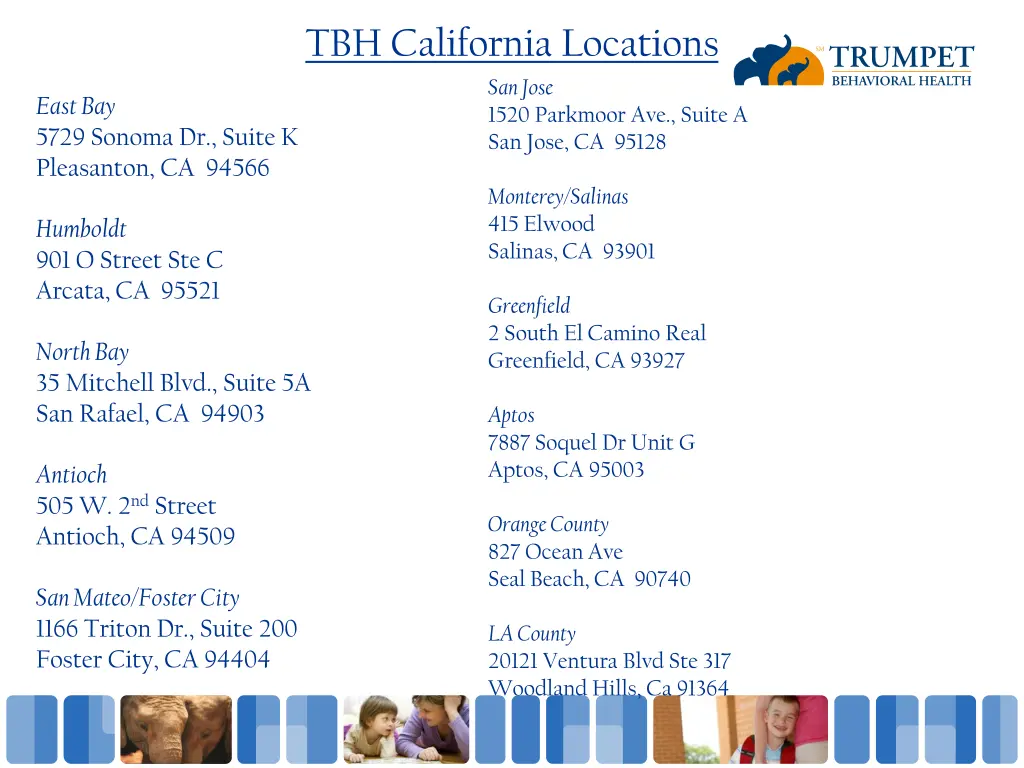
TBH California Locations San Jose 1520 Parkmoor Ave., Suite A San Jose, CA 95128 East Bay 5729 Sonoma Dr., Suite K Pleasanton, CA 94566 Monterey/Salinas 415 Elwood Salinas, CA 93901 Humboldt 901 O Street Ste C Arcata, CA 95521 Greenfield 2 South El Camino Real Greenfield, CA 93927 North Bay 35 Mitchell Blvd., Suite 5A San Rafael, CA 94903 Aptos 7887 Soquel Dr Unit G Aptos, CA 95003 Antioch 505 W. 2nd Street Antioch, CA 94509 Orange County 827 Ocean Ave Seal Beach, CA 90740 San Mateo/Foster City 1166 Triton Dr., Suite 200 Foster City, CA 94404 LA County 20121 Ventura Blvd Ste 317 Woodland Hills, Ca 91364