Rooting Evaluation Independence in Multilateral Development Organizations
The evolution of the Independent Office of Evaluation of IFAD, principles of independence, and IFAD's evaluation policy framework are discussed, emphasizing accountability, learning, and promoting pro-poor initiatives in rural poverty alleviation.

Download Presentation

Please find below an Image/Link to download the presentation.
The content on the website is provided AS IS for your information and personal use only. It may not be sold, licensed, or shared on other websites without obtaining consent from the author.If you encounter any issues during the download, it is possible that the publisher has removed the file from their server.
You are allowed to download the files provided on this website for personal or commercial use, subject to the condition that they are used lawfully. All files are the property of their respective owners.
The content on the website is provided AS IS for your information and personal use only. It may not be sold, licensed, or shared on other websites without obtaining consent from the author.
E N D
Presentation Transcript
Rooting evaluation independence in the context of multilateral development organizations Oscar A. Garcia Director, Independent Office of Evaluation of IFAD Fabrizio Felloni Lead Evaluation Officer, Independent Office of Evaluation of IFAD UNEG webinar - 19 April 2016
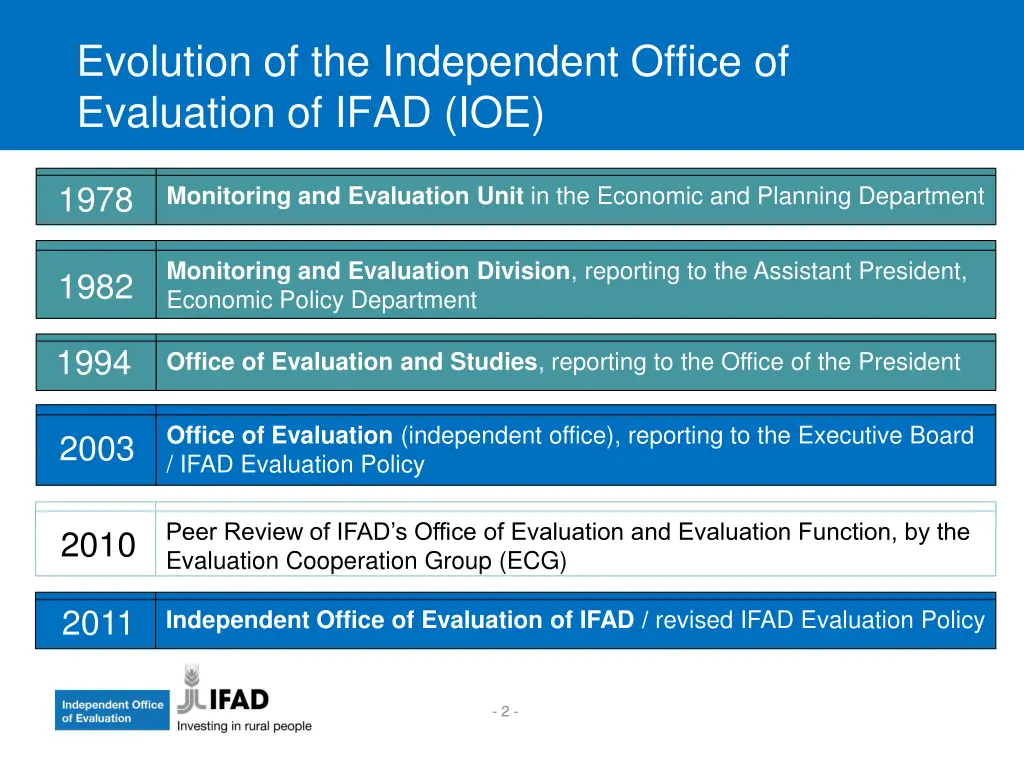
Evolution of the Independent Office of Evaluation of IFAD (IOE) 1978 Monitoring and Evaluation Unit in the Economic and Planning Department Monitoring and Evaluation Division, reporting to the Assistant President, Economic Policy Department 1982 1994 Office of Evaluation and Studies, reporting to the Office of the President Office of Evaluation (independent office), reporting to the Executive Board / IFAD Evaluation Policy 2003 Peer Review of IFAD s Office of Evaluation and Evaluation Function, by the Evaluation Cooperation Group (ECG) 2010 2011 Independent Office of Evaluation of IFAD / revised IFAD Evaluation Policy - 2 -
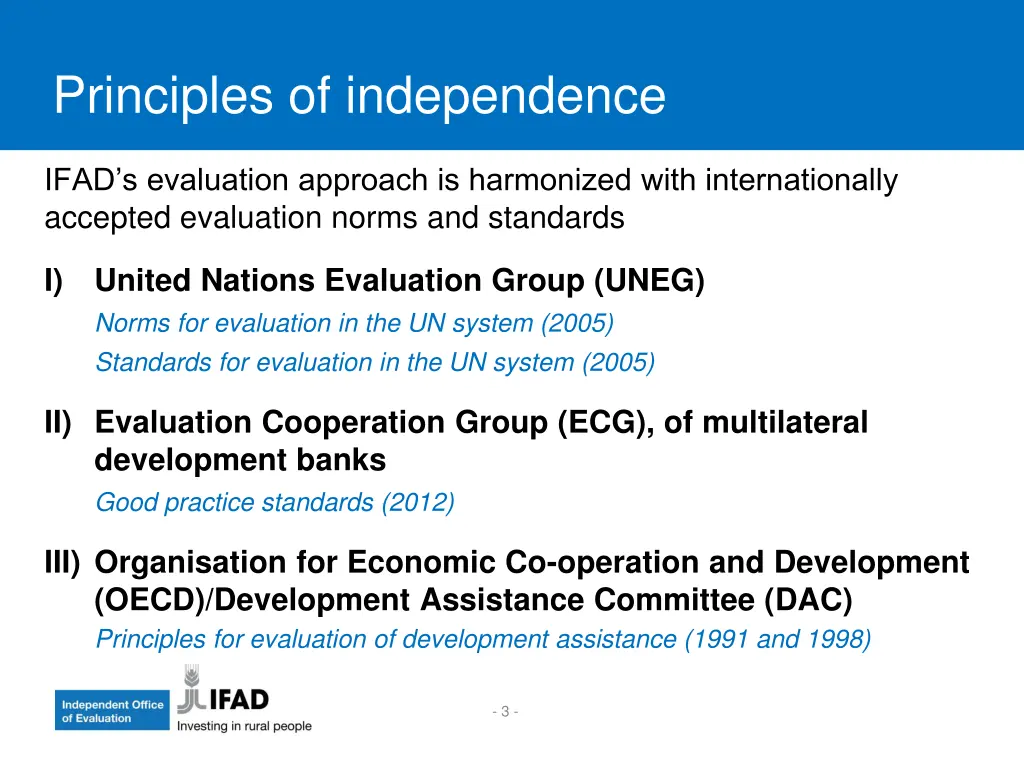
Principles of independence IFAD s evaluation approach is harmonized with internationally accepted evaluation norms and standards I) United Nations Evaluation Group (UNEG) Norms for evaluation in the UN system (2005) Standards for evaluation in the UN system (2005) II) Evaluation Cooperation Group (ECG), of multilateral development banks Good practice standards (2012) III) Organisation for Economic Co-operation and Development (OECD)/Development Assistance Committee (DAC) Principles for evaluation of development assistance (1991 and 1998) - 3 -
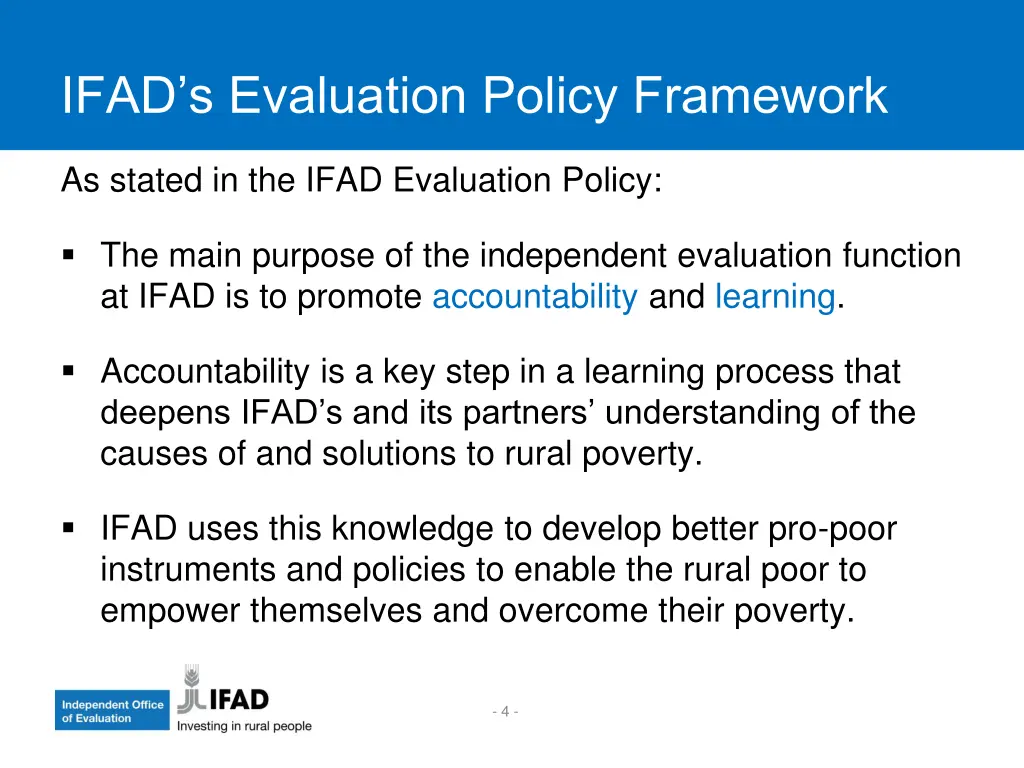
IFADs Evaluation Policy Framework As stated in the IFAD Evaluation Policy: The main purpose of the independent evaluation function at IFAD is to promote accountability and learning. Accountability is a key step in a learning process that deepens IFAD s and its partners understanding of the causes of and solutions to rural poverty. IFAD uses this knowledge to develop better pro-poor instruments and policies to enable the rural poor to empower themselves and overcome their poverty. - 4 -
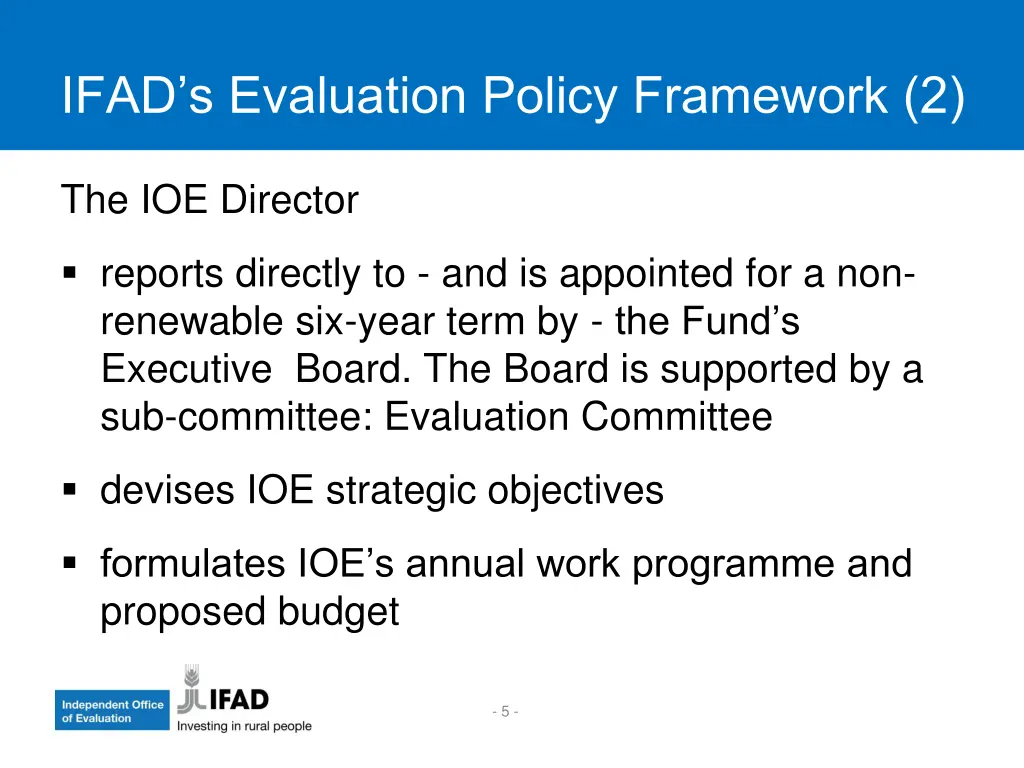
IFADs Evaluation Policy Framework (2) The IOE Director reports directly to - and is appointed for a non- renewable six-year term by - the Fund s Executive Board. The Board is supported by a sub-committee: Evaluation Committee devises IOE strategic objectives formulates IOE s annual work programme and proposed budget - 5 -
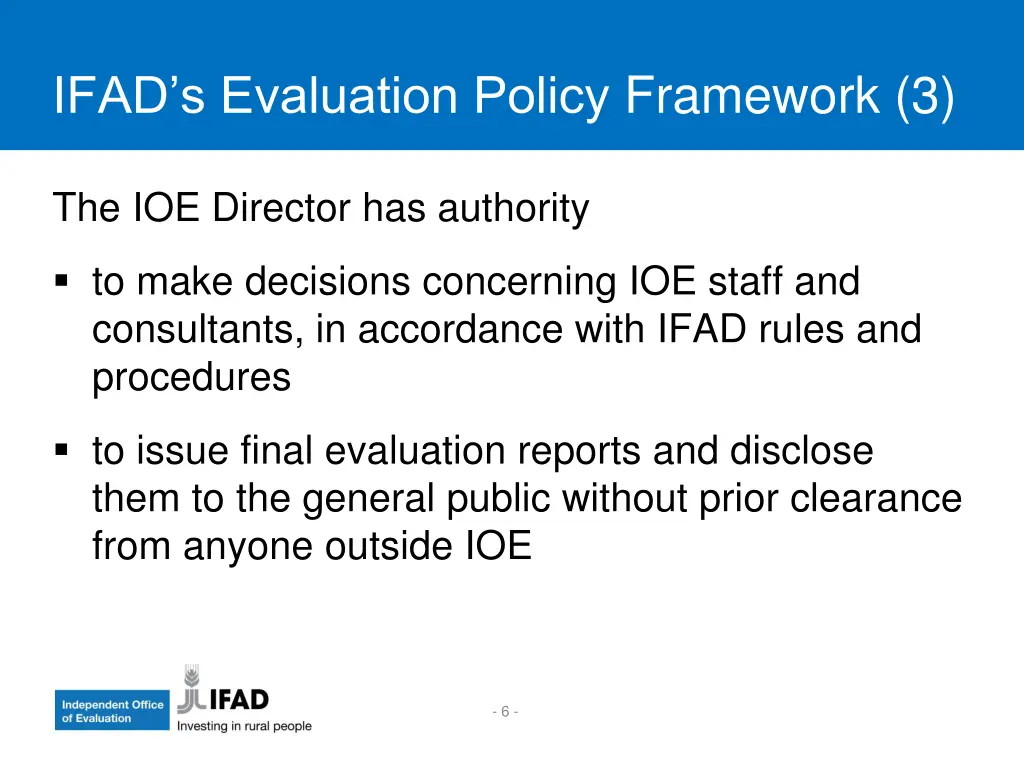
IFADs Evaluation Policy Framework (3) The IOE Director has authority to make decisions concerning IOE staff and consultants, in accordance with IFAD rules and procedures to issue final evaluation reports and disclose them to the general public without prior clearance from anyone outside IOE - 6 -
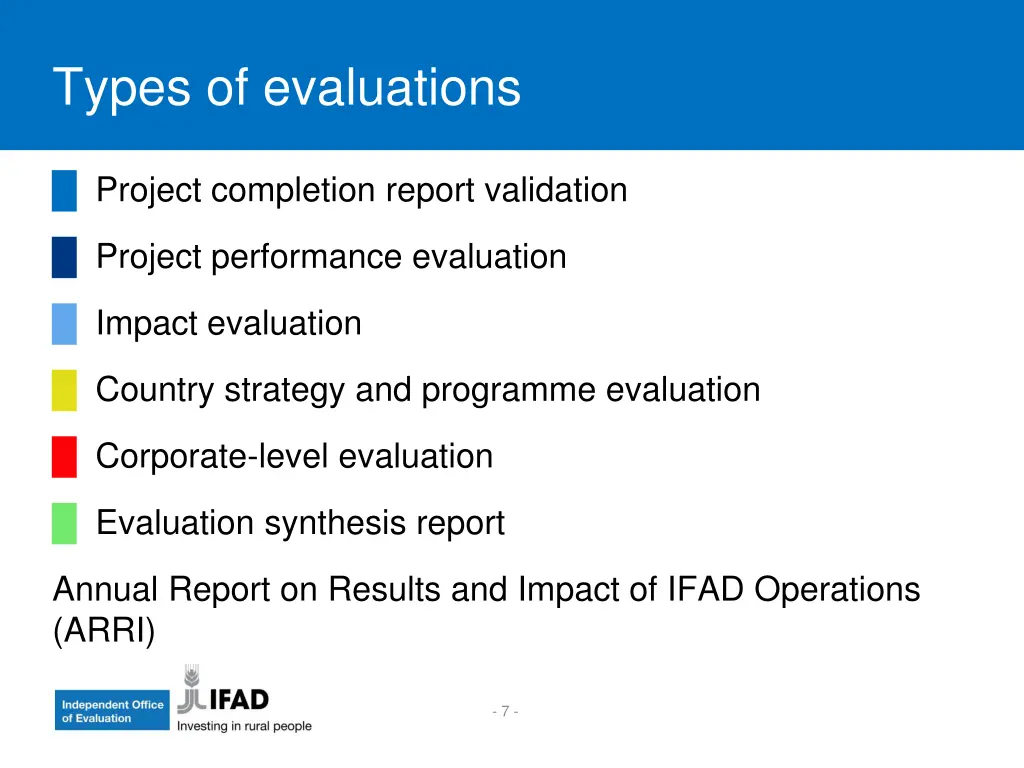
Types of evaluations Project completion report validation Project performance evaluation Impact evaluation Country strategy and programme evaluation Corporate-level evaluation Evaluation synthesis report Annual Report on Results and Impact of IFAD Operations (ARRI) - 7 -
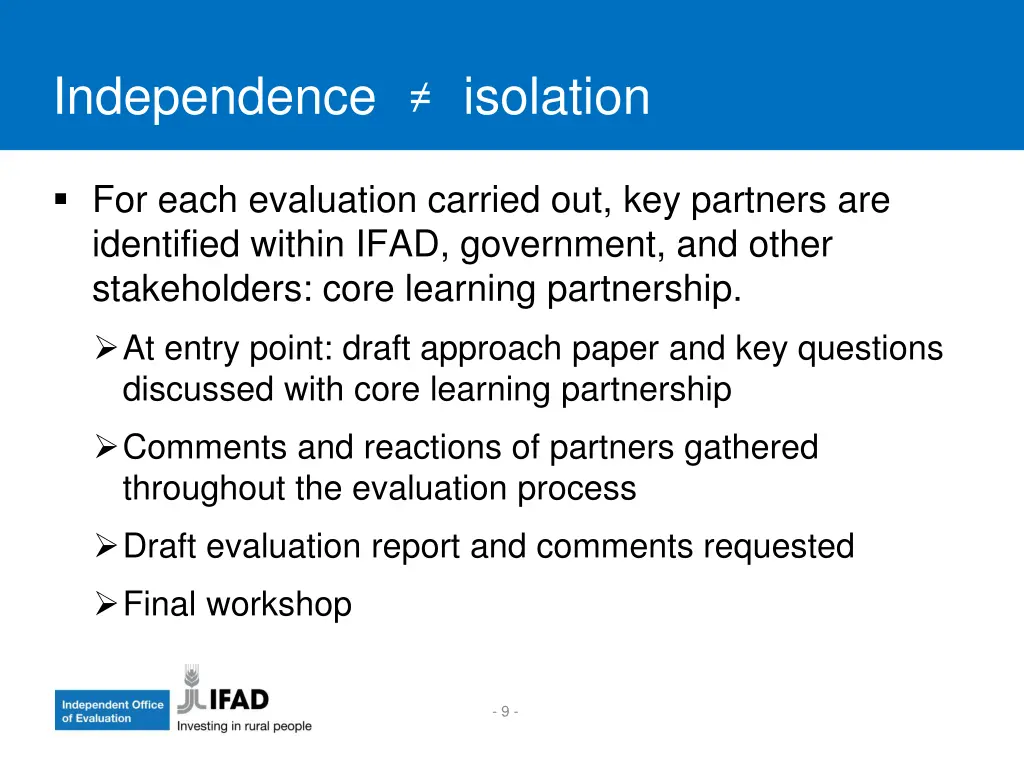
Independence isolation For each evaluation carried out, key partners are identified within IFAD, government, and other stakeholders: core learning partnership. At entry point: draft approach paper and key questions discussed with core learning partnership Comments and reactions of partners gathered throughout the evaluation process Draft evaluation report and comments requested Final workshop - 9 -
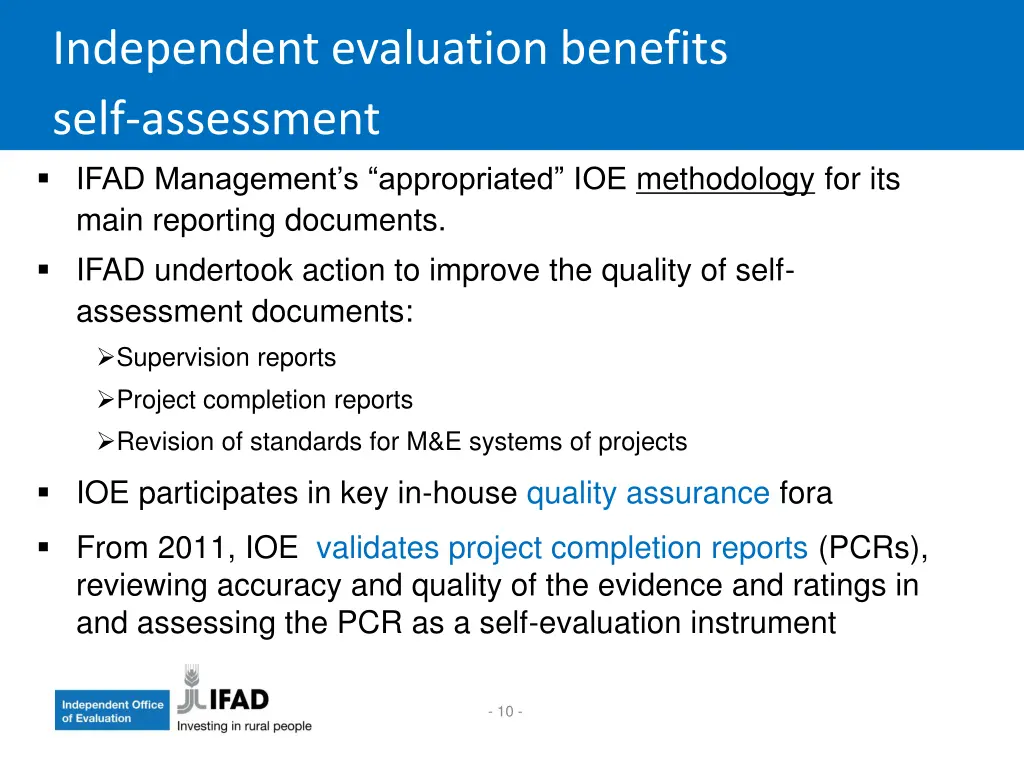
Independent evaluation benefits self-assessment IFAD Management s appropriated IOE methodology for its main reporting documents. IFAD undertook action to improve the quality of self- assessment documents: Supervision reports Project completion reports Revision of standards for M&E systems of projects IOE participates in key in-house quality assurance fora From 2011, IOE validates project completion reports (PCRs), reviewing accuracy and quality of the evidence and ratings in and assessing the PCR as a self-evaluation instrument - 10 -
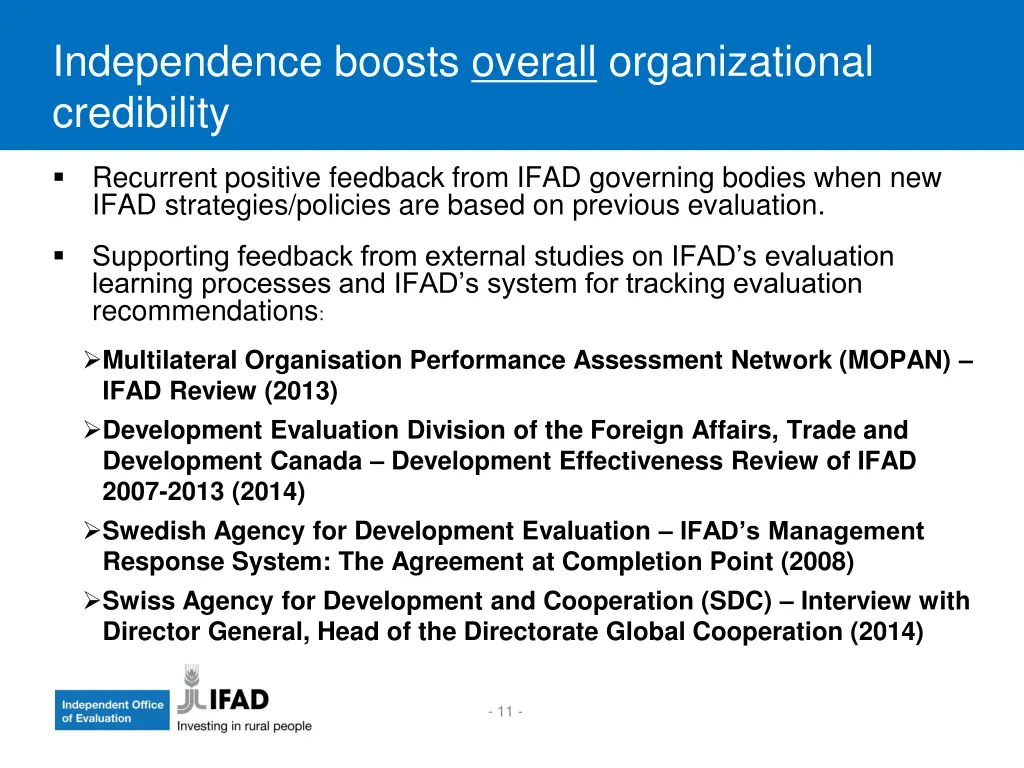
Independence boosts overall organizational credibility Recurrent positive feedback from IFAD governing bodies when new IFAD strategies/policies are based on previous evaluation. Supporting feedback from external studies on IFAD s evaluation learning processes and IFAD s system for tracking evaluation recommendations: Multilateral Organisation Performance Assessment Network (MOPAN) IFAD Review (2013) Development Evaluation Division of the Foreign Affairs, Trade and Development Canada Development Effectiveness Review of IFAD 2007-2013 (2014) Swedish Agency for Development Evaluation IFAD s Management Response System: The Agreement at Completion Point (2008) Swiss Agency for Development and Cooperation (SDC) Interview with Director General, Head of the Directorate Global Cooperation (2014) - 11 -
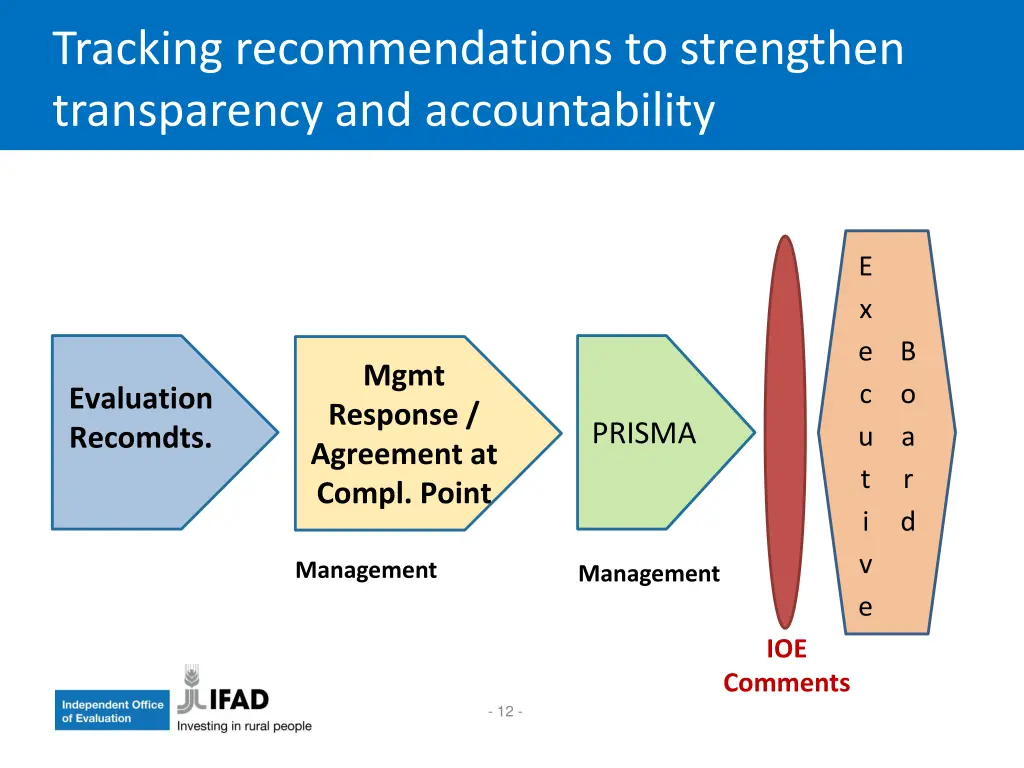
Tracking recommendations to strengthen transparency and accountability E x e c u t i v e B o a r d Mgmt Response / Agreement at Compl. Point Evaluation Recomdts. PRISMA Management Management IOE Comments - 12 -
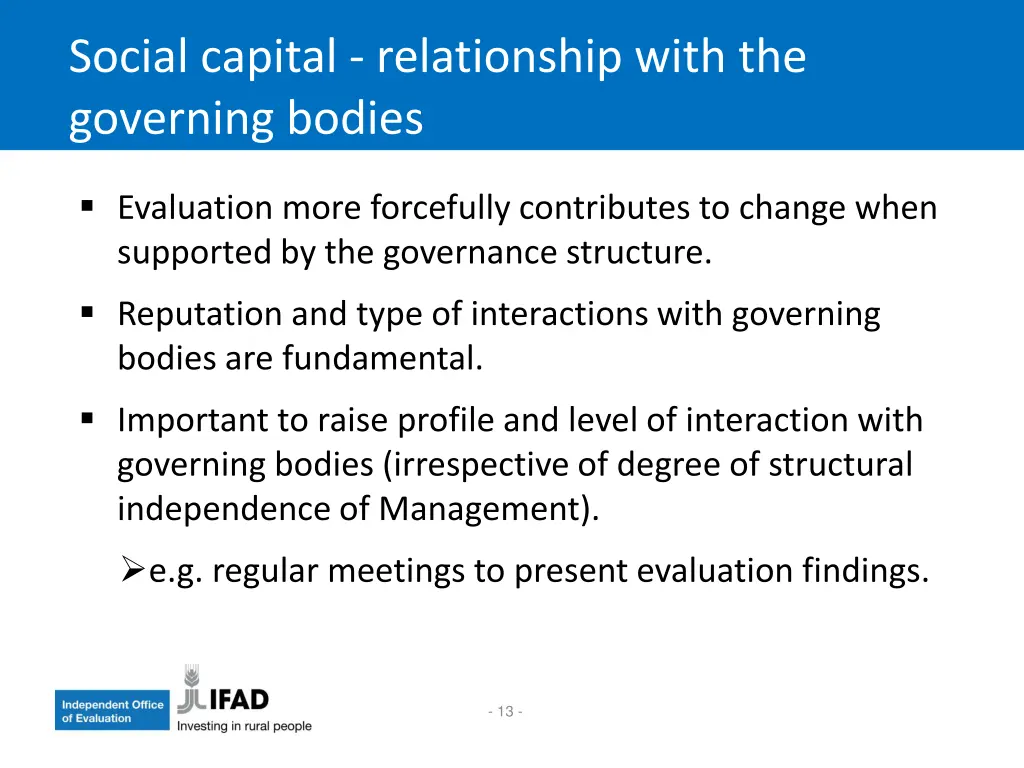
Social capital - relationship with the governing bodies Evaluation more forcefully contributes to change when supported by the governance structure. Reputation and type of interactions with governing bodies are fundamental. Important to raise profile and level of interaction with governing bodies (irrespective of degree of structural independence of Management). e.g. regular meetings to present evaluation findings. - 13 -