RUGE
RUGE is an open-source framework designed to generate and run integration/system tests efficiently. It addresses the limitations of manually crafted testing by guiding random test generation with rules, aiming for useful test cases. By focusing on functional and load testing, RUGE generates realistic events, particularly beneficial for financial systems handling large streams of events from numerous actors over time.

Download Presentation

Please find below an Image/Link to download the presentation.
The content on the website is provided AS IS for your information and personal use only. It may not be sold, licensed, or shared on other websites without obtaining consent from the author.If you encounter any issues during the download, it is possible that the publisher has removed the file from their server.
You are allowed to download the files provided on this website for personal or commercial use, subject to the condition that they are used lawfully. All files are the property of their respective owners.
The content on the website is provided AS IS for your information and personal use only. It may not be sold, licensed, or shared on other websites without obtaining consent from the author.
E N D
Presentation Transcript
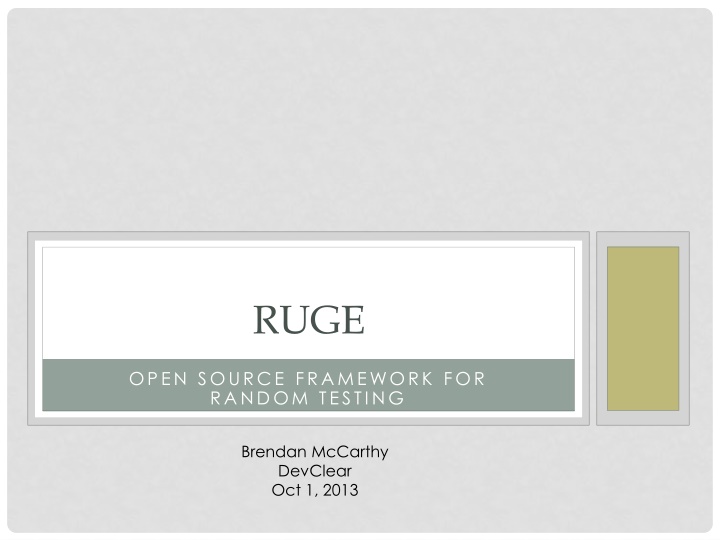
RUGE OPEN SOURCE FRAMEWORK FOR RANDOM TESTING Brendan McCarthy DevClear Oct 1, 2013
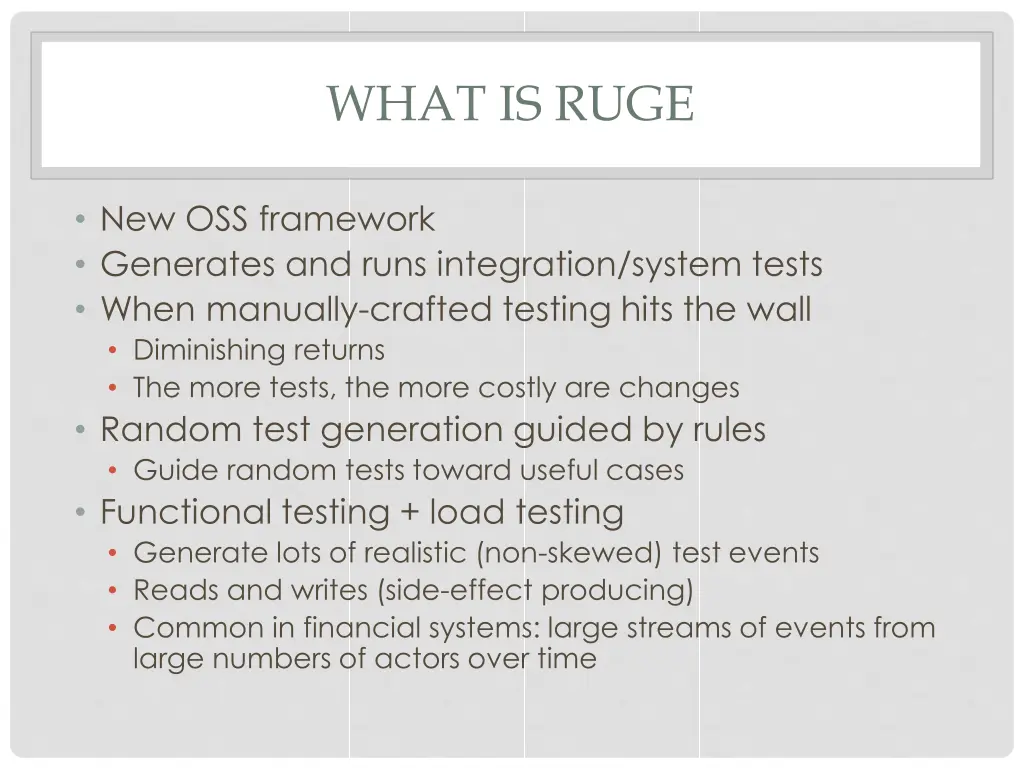
WHAT IS RUGE New OSS framework Generates and runs integration/system tests When manually-crafted testing hits the wall Diminishing returns The more tests, the more costly are changes Random test generation guided by rules Guide random tests toward useful cases Functional testing + load testing Generate lots of realistic (non-skewed) test events Reads and writes (side-effect producing) Common in financial systems: large streams of events from large numbers of actors over time
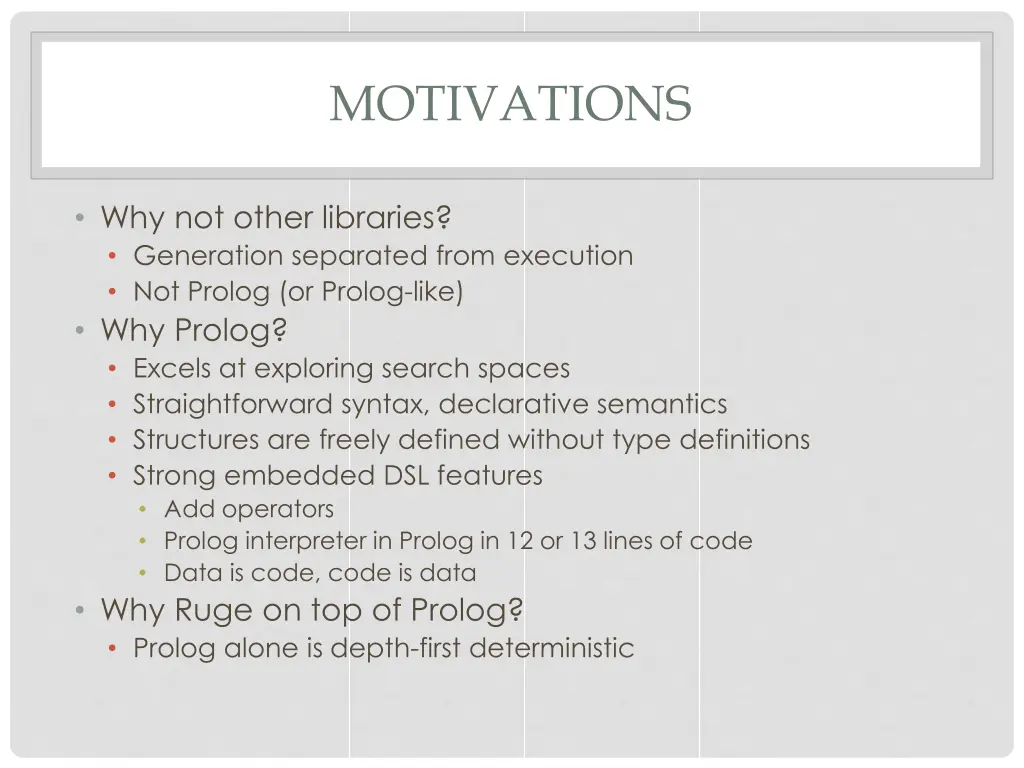
MOTIVATIONS Why not other libraries? Generation separated from execution Not Prolog (or Prolog-like) Why Prolog? Excels at exploring search spaces Straightforward syntax, declarative semantics Structures are freely defined without type definitions Strong embedded DSL features Add operators Prolog interpreter in Prolog in 12 or 13 lines of code Data is code, code is data Why Ruge on top of Prolog? Prolog alone is depth-first deterministic
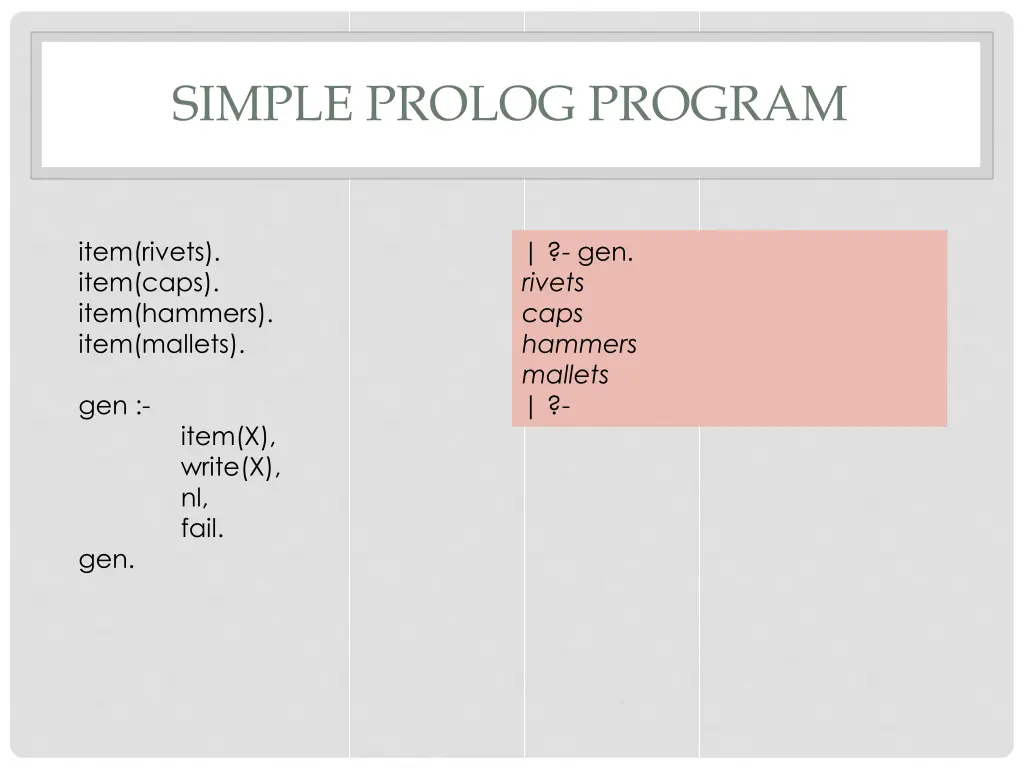
SIMPLE PROLOG PROGRAM item(rivets). item(caps). item(hammers). item(mallets). | ?- gen. rivets caps hammers mallets | ?- gen :- gen. item(X), write(X), nl, fail.
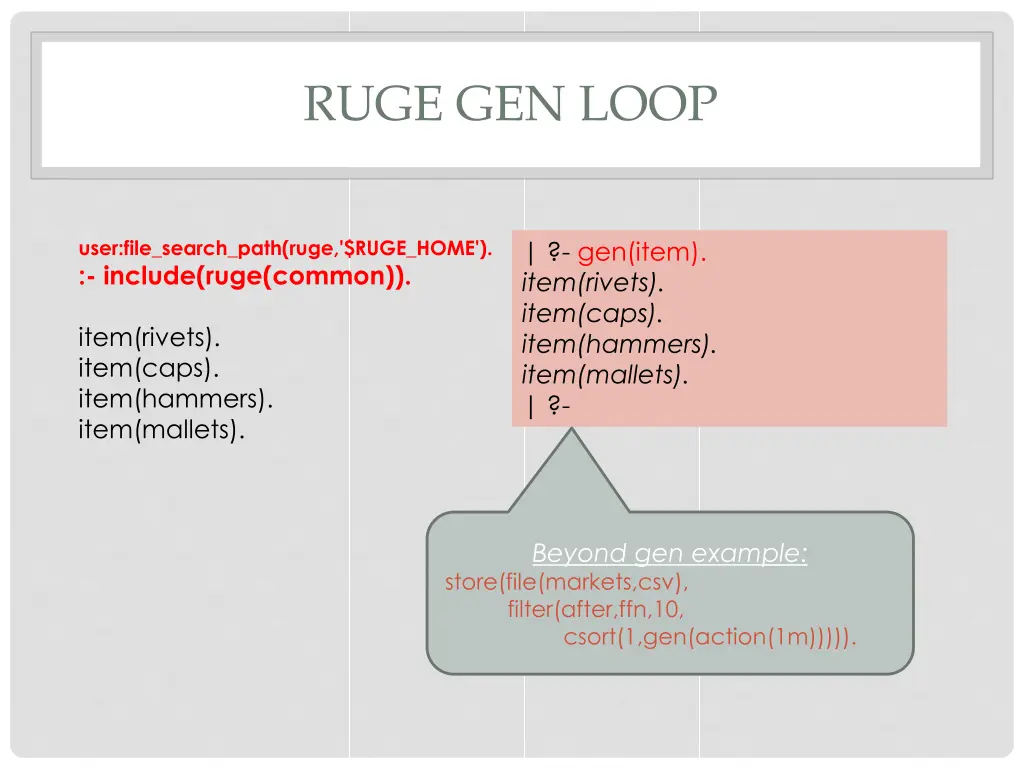
RUGE GEN LOOP | ?- gen(item). item(rivets). item(caps). item(hammers). item(mallets). | ?- user:file_search_path(ruge,'$RUGE_HOME'). :- include(ruge(common)). item(rivets). item(caps). item(hammers). item(mallets). Beyond gen example: store(file(markets,csv), filter(after,ffn,10, csort(1,gen(action(1m))))).
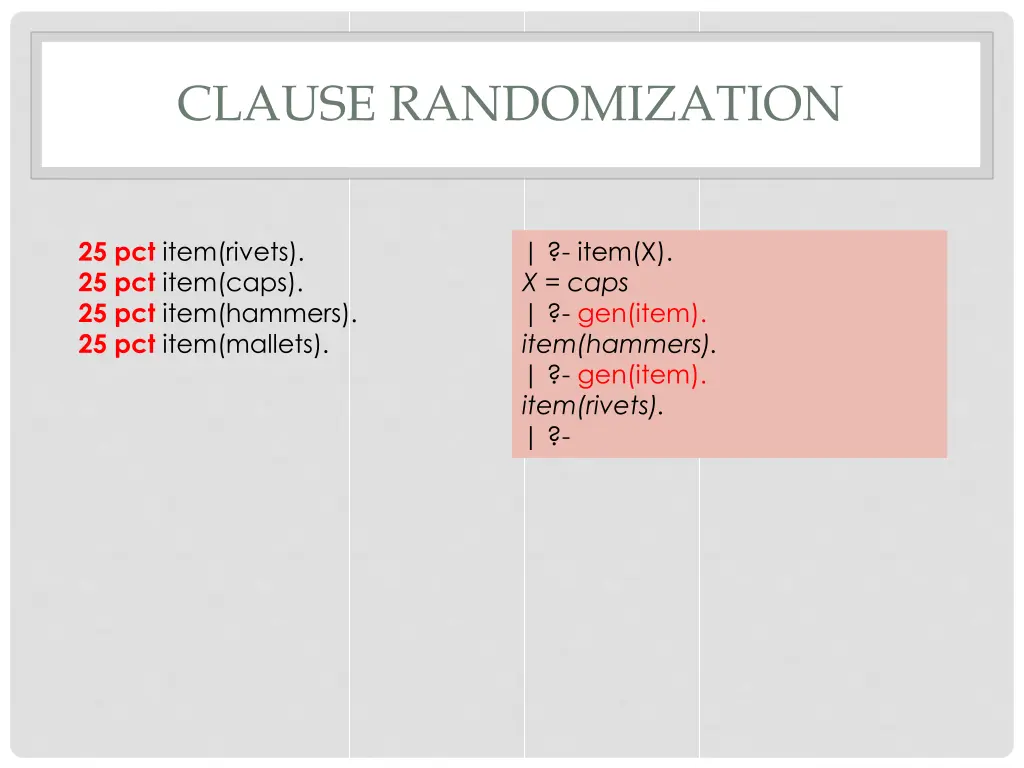
CLAUSE RANDOMIZATION 25 pct item(rivets). 25 pct item(caps). 25 pct item(hammers). 25 pct item(mallets). | ?- item(X). X = caps | ?- gen(item). item(hammers). | ?- gen(item). item(rivets). | ?-
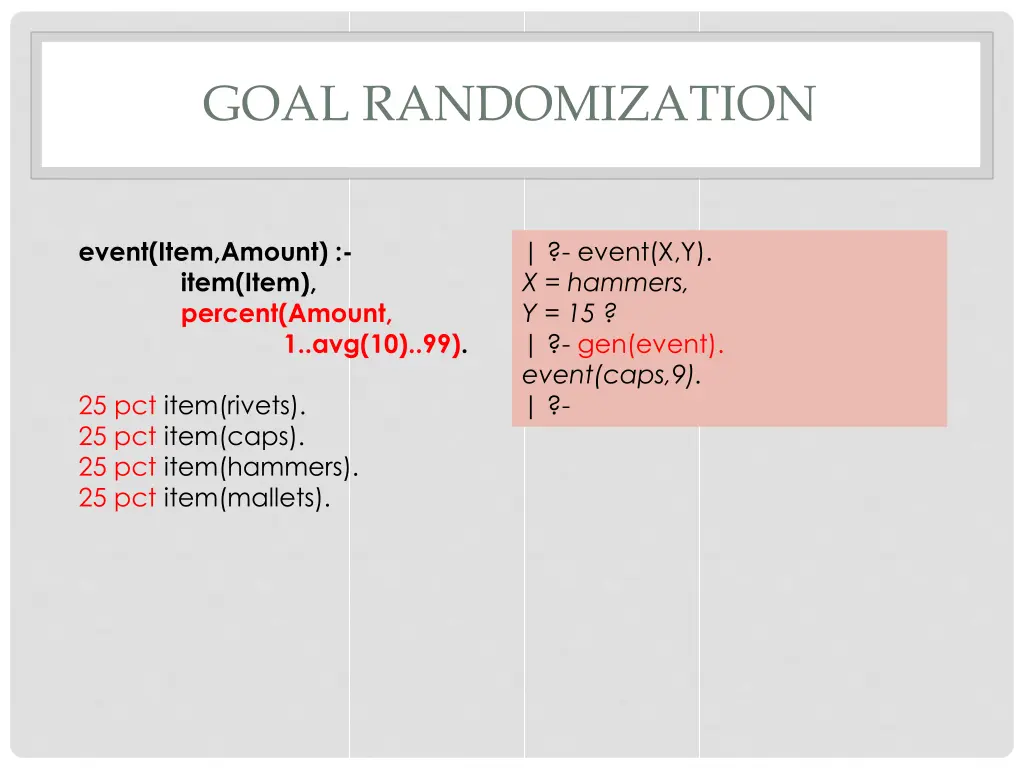
GOAL RANDOMIZATION event(Item,Amount) :- item(Item), percent(Amount, | ?- event(X,Y). X = hammers, Y = 15 ? | ?- gen(event). event(caps,9). | ?- 1..avg(10)..99). 25 pct item(rivets). 25 pct item(caps). 25 pct item(hammers). 25 pct item(mallets).
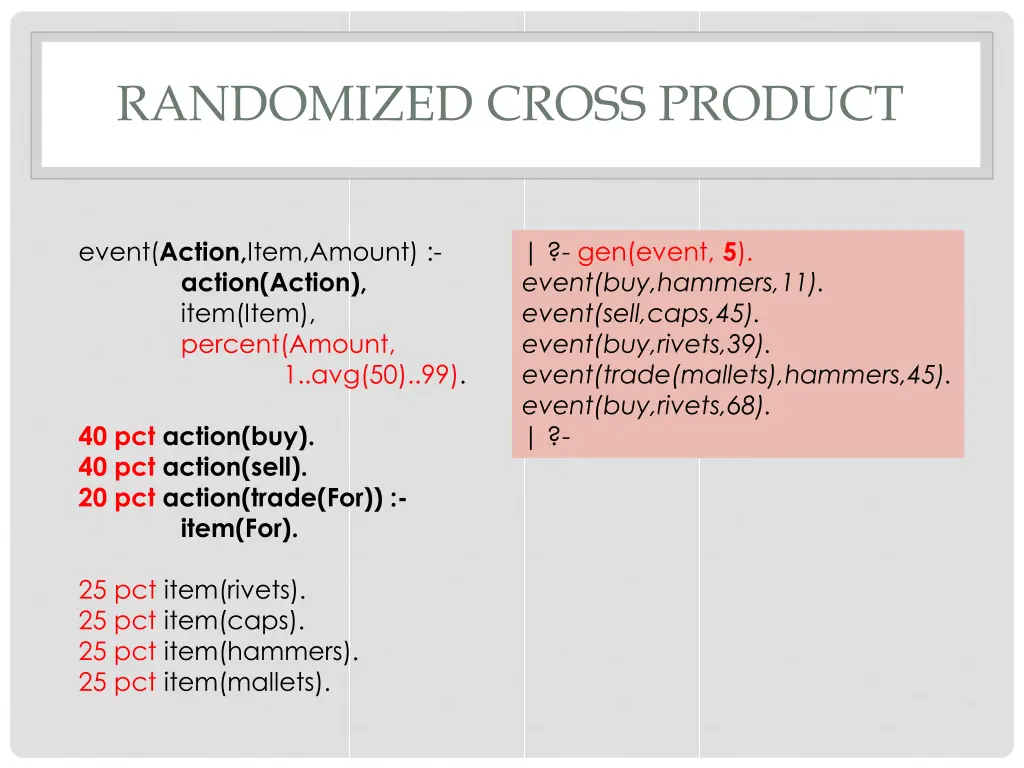
RANDOMIZED CROSS PRODUCT event(Action,Item,Amount) :- action(Action), item(Item), percent(Amount, | ?- gen(event, 5). event(buy,hammers,11). event(sell,caps,45). event(buy,rivets,39). event(trade(mallets),hammers,45). event(buy,rivets,68). | ?- 1..avg(50)..99). 40 pct action(buy). 40 pct action(sell). 20 pct action(trade(For)) :- item(For). 25 pct item(rivets). 25 pct item(caps). 25 pct item(hammers). 25 pct item(mallets).
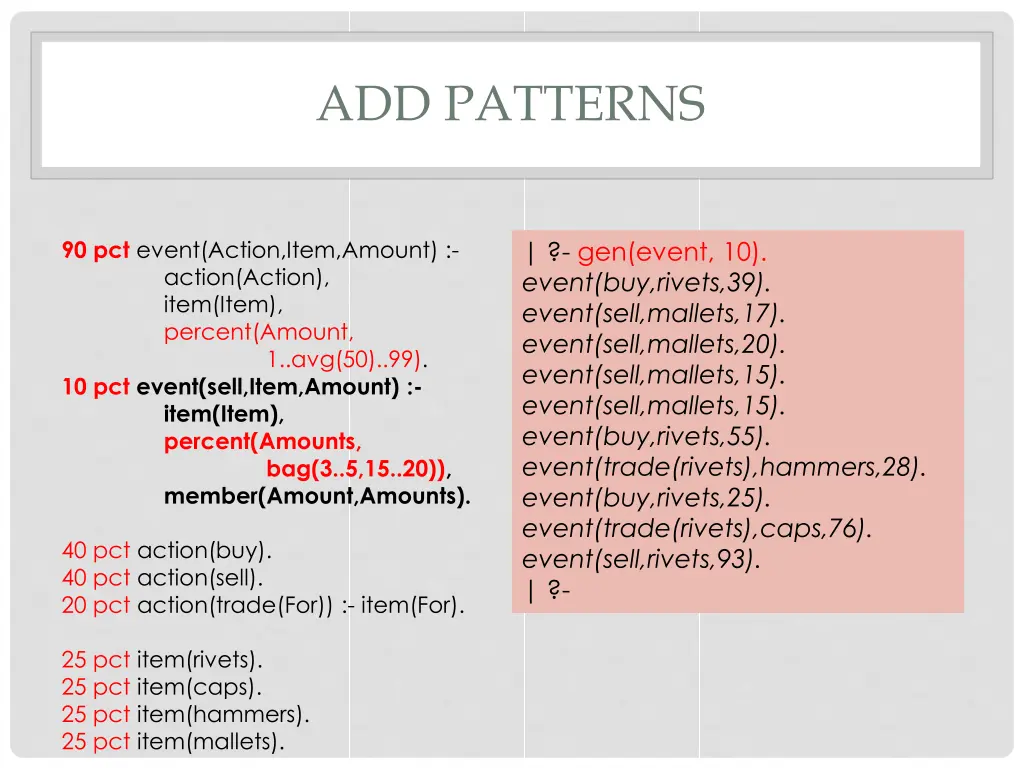
ADD PATTERNS | ?- gen(event, 10). event(buy,rivets,39). event(sell,mallets,17). event(sell,mallets,20). event(sell,mallets,15). event(sell,mallets,15). event(buy,rivets,55). event(trade(rivets),hammers,28). event(buy,rivets,25). event(trade(rivets),caps,76). event(sell,rivets,93). | ?- 90 pct event(Action,Item,Amount) :- action(Action), item(Item), percent(Amount, 1..avg(50)..99). 10 pct event(sell,Item,Amount) :- item(Item), percent(Amounts, bag(3..5,15..20)), member(Amount,Amounts). 40 pct action(buy). 40 pct action(sell). 20 pct action(trade(For)) :- item(For). 25 pct item(rivets). 25 pct item(caps). 25 pct item(hammers). 25 pct item(mallets).
SUMMARY Rule-guided random test generation Test execution Functional Load/stress Legacy comparison Find more https://bitbucket.org/bmccarthy/ruge brendan.mccarthy@devclear.com