Safety Classification in Nuclear Power Plants: Functions and Significance
Explore the purpose and process of safety classification in nuclear power plants, focusing on identifying safety functions and their significance. Learn about general safety requirements for plant design and the fundamental concepts of safety classification of structures, systems, and components.

Download Presentation

Please find below an Image/Link to download the presentation.
The content on the website is provided AS IS for your information and personal use only. It may not be sold, licensed, or shared on other websites without obtaining consent from the author. If you encounter any issues during the download, it is possible that the publisher has removed the file from their server.
You are allowed to download the files provided on this website for personal or commercial use, subject to the condition that they are used lawfully. All files are the property of their respective owners.
The content on the website is provided AS IS for your information and personal use only. It may not be sold, licensed, or shared on other websites without obtaining consent from the author.
E N D
Presentation Transcript
Basic Professional Training Course on Nuclear Safety Ghana Nuclear Regulatory Authority Accra, Ghana 15-26 January 19-30 March 2018 Safety Classification of Structures, Systems and Components Jay Hopkins IAEA J.Hopkins@iaea.org
Lerning objectives After completing this chapter, the trainee will be able to: i. Define the purpose of safety classification. ii. Define process for carrying out safety classification. iii. List and categorize safety functions iv. Define design provisions and its classification Safety Classification of Systems, Structures and Components 15-26 January - 19-30 March 2018 2
Contents Safety classification Process of safety classification Safety functions Classification of safety functions Design provisions Classification of design provisions Summary Key Points IAEA safety standards Safety Classification of Systems, Structures and Components 15-26 January - 19-30 March 2018 3
Basic Professional Training Course on Nuclear Safety Ghana Nuclear Regulatory Authority Accra, Ghana 15-26 January 19-30 March 2018 Purpose of Safety Classification
Purpose of Safety Classification The purpose of safety classification in a nuclear power plant is to identify and categorize the safety functions and to identify and classify the related SSC items on the basis of their safety significance. safety classification of structures, systems and components (SSCs) based upon fundamental safety functions. Establish relationships between safety class and requirements for design commensurate to their safety significance. and manufacturing Safety Classification of Systems, Structures and Components 15-26 January - 19-30 March 2018 5
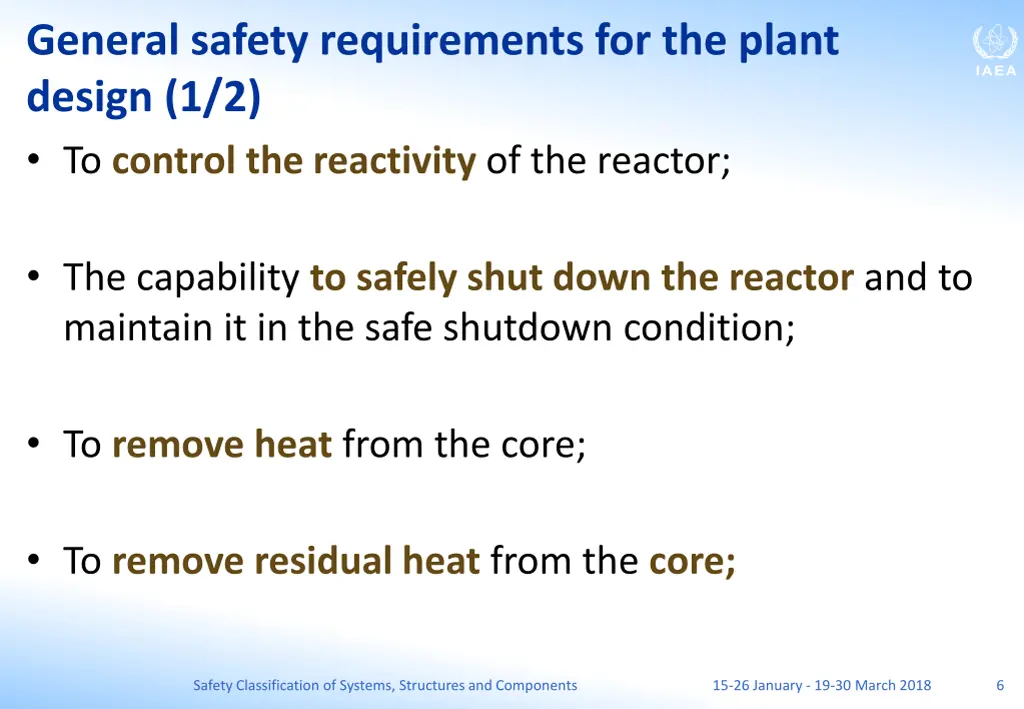
General safety requirements for the plant design (1/2) To control the reactivity of the reactor; The capability to safely shut down the reactor and to maintain it in the safe shutdown condition; To remove heat from the core; To remove residual heat from the core; Safety Classification of Systems, Structures and Components 15-26 January - 19-30 March 2018 6
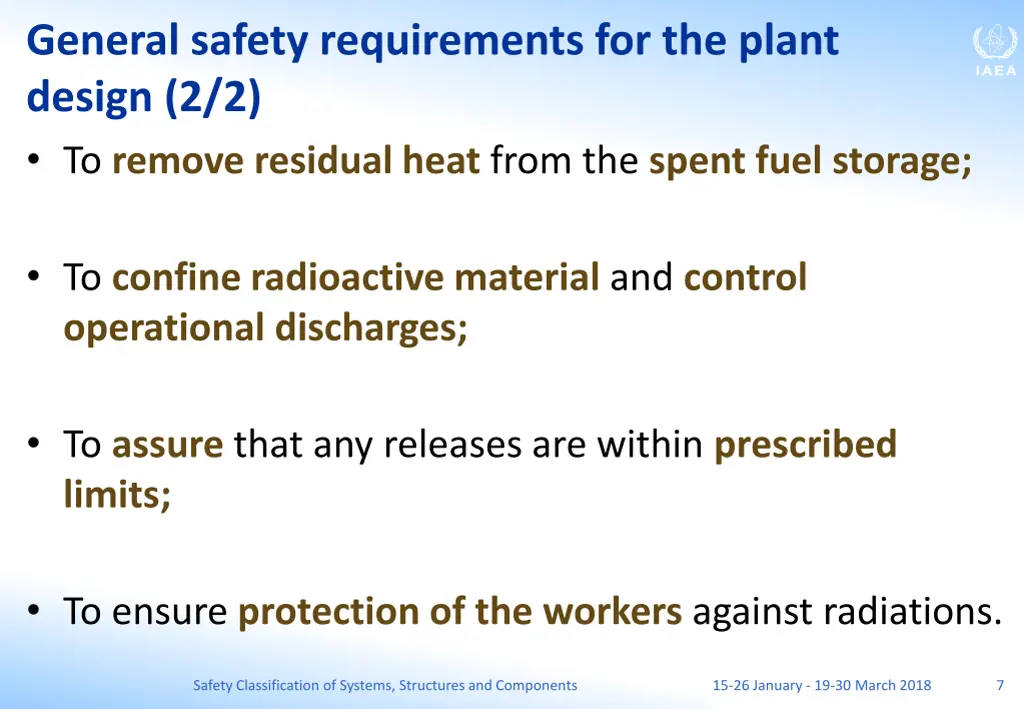
General safety requirements for the plant design (2/2) To remove residual heat from the spent fuel storage; To confine radioactive material and control operational discharges; To assure that any releases are within prescribed limits; To ensure protection of the workers against radiations. Safety Classification of Systems, Structures and Components 15-26 January - 19-30 March 2018 7
Basic Professional Training Course on Nuclear Safety Ghana Nuclear Regulatory Authority Accra, Ghana 15-26 January 19-30 March 2018 Process of Safety Classification
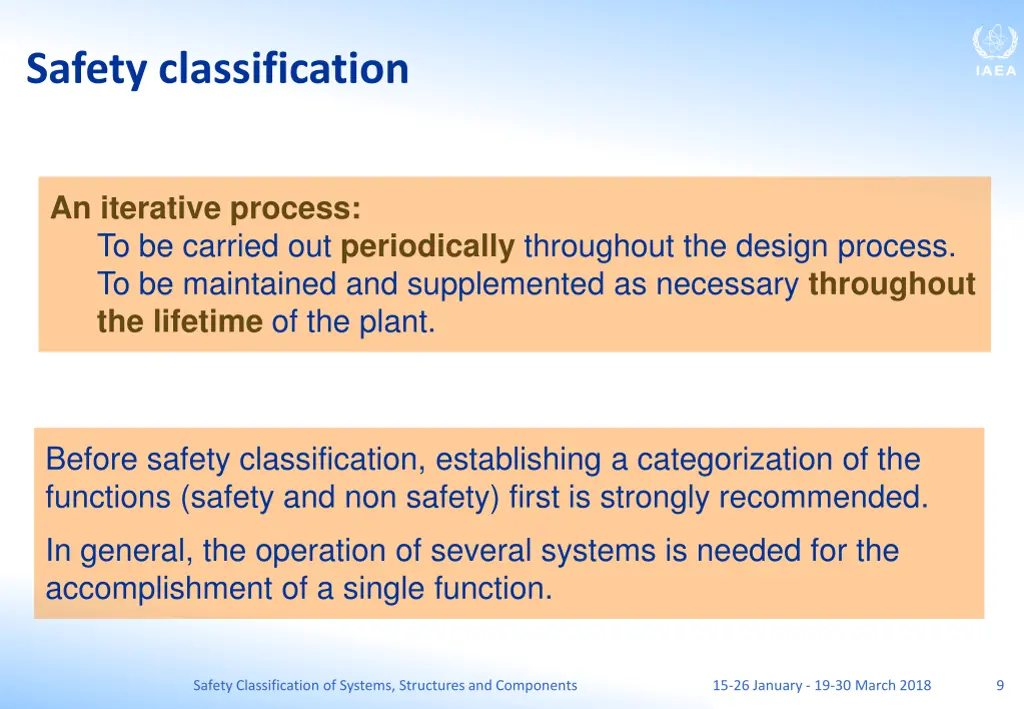
Safety classification An iterative process: To be carried out periodically throughout the design process. To be maintained and supplemented as necessary throughout the lifetime of the plant. Before safety classification, establishing a categorization of the functions (safety and non safety) first is strongly recommended. In general, the operation of several systems is needed for the accomplishment of a single function. Safety Classification of Systems, Structures and Components 15-26 January - 19-30 March 2018 9
Pre-requisites to Safety classification (1/2) Prior starting the safety classification process, following inputs are necessary: Radiological releases limits established by the Regulatory Body for operational conditions and for the different accident conditions; Plant system description; Plant states definition and categorization; Postulated Initiating Events (PIE) considered in the design with their estimated frequency of occurrence. Safety Classification of Systems, Structures and Components 15-26 January - 19-30 March 2018 10
Pre-requisites to Safety classification (2/2) Accident analysis; Application of the Defence in depth concept (which systems belong to the different levels of defence); PSA level 1 is not a strict pre-requisite for the safety Classification but needed for verification of its correctness. Safety Classification of Systems, Structures and Components 15-26 January - 19-30 March 2018 11
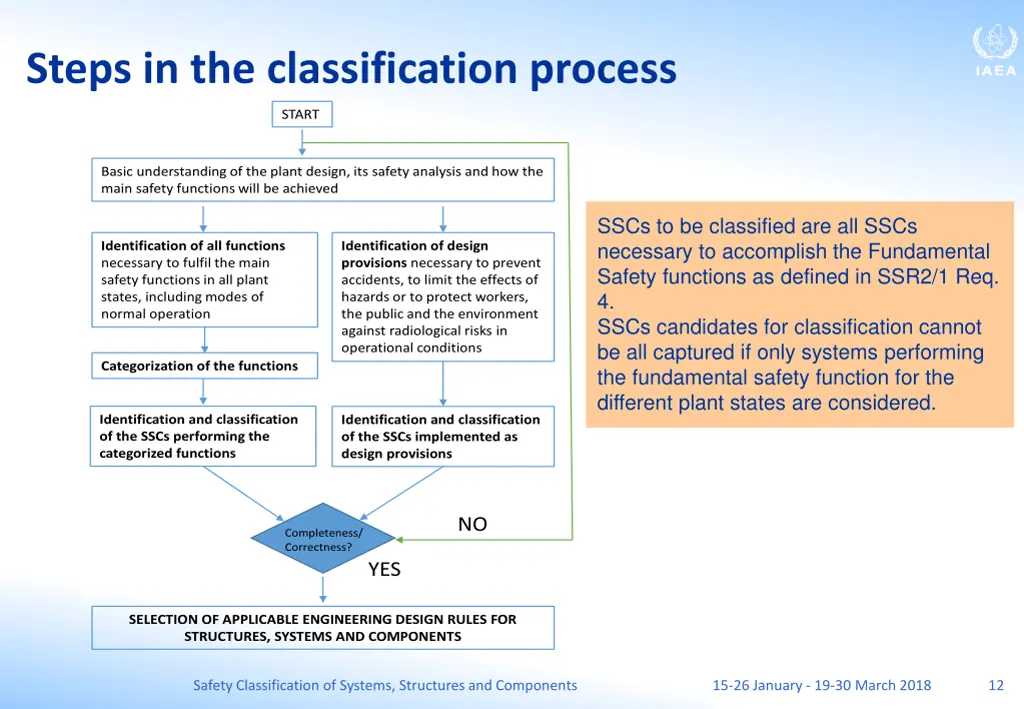
Steps in the classification process START Basic understanding of the plant design, its safety analysis and how the main safety functions will be achieved SSCs to be classified are all SSCs necessary to accomplish the Fundamental Safety functions as defined in SSR2/1 Req. 4. SSCs candidates for classification cannot be all captured if only systems performing the fundamental safety function for the different plant states are considered. Identification of all functions necessary to fulfil the main safety functions in all plant states, including modes of normal operation Identification of design provisions necessary to prevent accidents, to limit the effects of hazards or to protect workers, the public and the environment against radiological risks in operational conditions Categorization of the functions Identification and classification of the SSCs performing the categorized functions Identification and classification of the SSCs implemented as design provisions NO Completeness/ Correctness? YES SELECTION OF APPLICABLE ENGINEERING DESIGN RULES FOR STRUCTURES, SYSTEMS AND COMPONENTS Safety Classification of Systems, Structures and Components 15-26 January - 19-30 March 2018 12
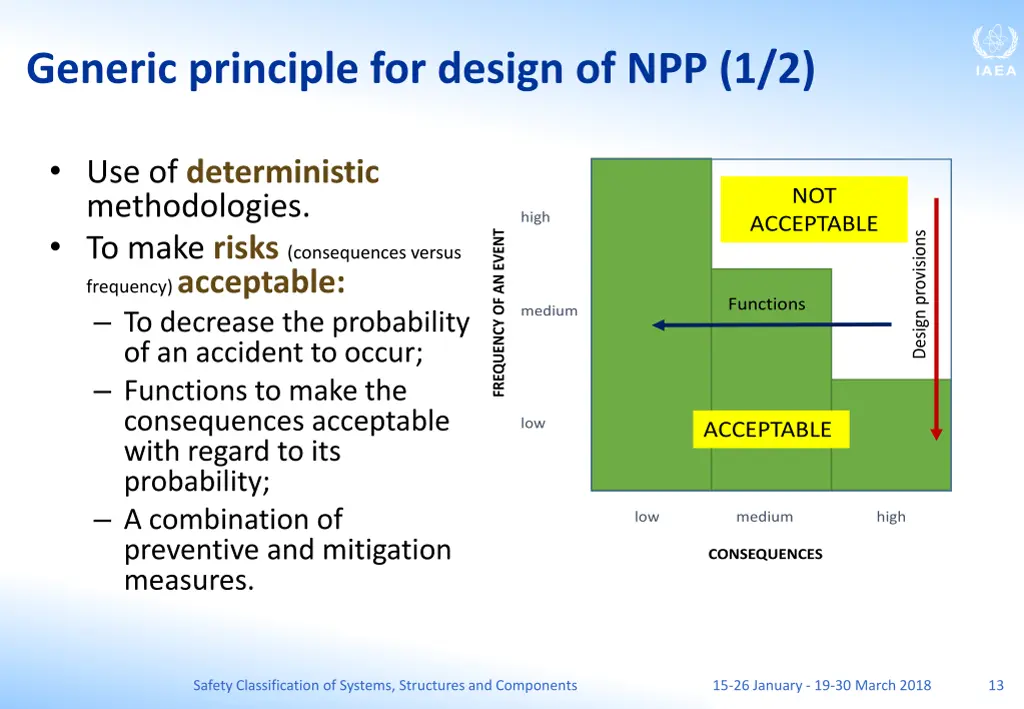
Generic principle for design of NPP (1/2) Use of deterministic methodologies. To make risks (consequences versus frequency) acceptable: To decrease the probability of an accident to occur; Functions to make the consequences acceptable with regard to its probability; A combination of preventive and mitigation measures. NOT high ACCEPTABLE FREQUENCY OF AN EVENT Design provisions Functions medium low ACCEPTABLE low medium high CONSEQUENCES Safety Classification of Systems, Structures and Components 15-26 January - 19-30 March 2018 13
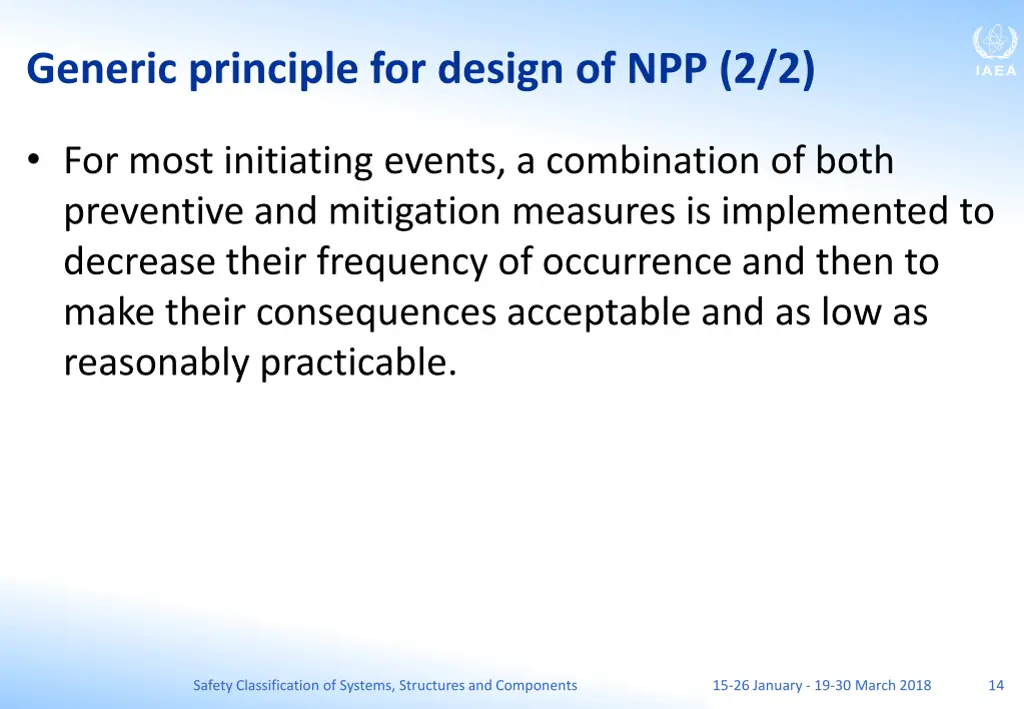
Generic principle for design of NPP (2/2) For most initiating events, a combination of both preventive and mitigation measures is implemented to decrease their frequency of occurrence and then to make their consequences acceptable and as low as reasonably practicable. Safety Classification of Systems, Structures and Components 15-26 January - 19-30 March 2018 14
Basic Professional Training Course on Nuclear Safety Ghana Nuclear Regulatory Authority Accra, Ghana 15-26 January 19-30 March 2018 Identification of Safety Functions
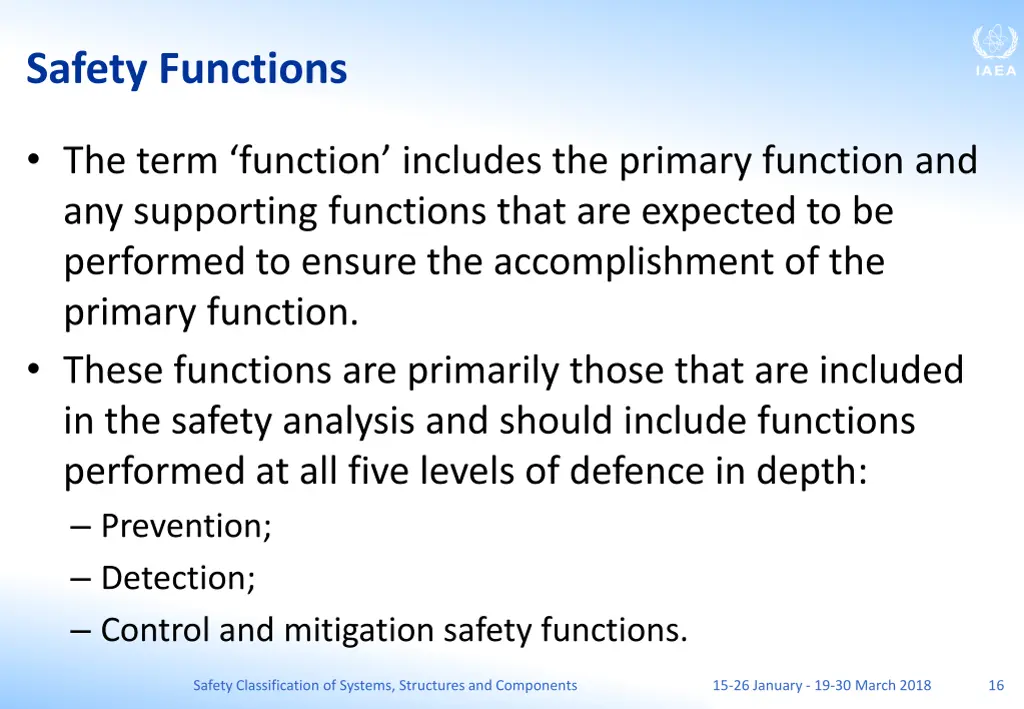
Safety Functions The term function includes the primary function and any supporting functions that are expected to be performed to ensure the accomplishment of the primary function. These functions are primarily those that are included in the safety analysis and should include functions performed at all five levels of defence in depth: Prevention; Detection; Control and mitigation safety functions. Safety Classification of Systems, Structures and Components 15-26 January - 19-30 March 2018 16
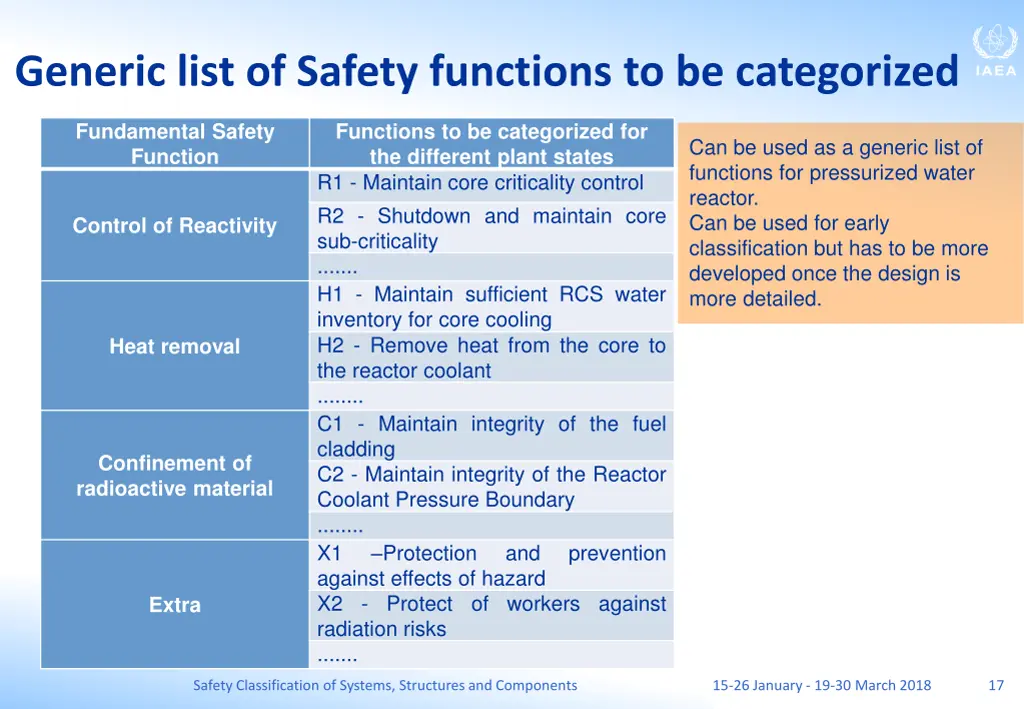
Generic list of Safety functions to be categorized Fundamental Safety Function Functions to be categorized for the different plant states R1 - Maintain core criticality control R2 - Shutdown and maintain core sub-criticality ....... H1 - Maintain sufficient RCS water inventory for core cooling H2 - Remove heat from the core to the reactor coolant ........ C1 - Maintain integrity of the fuel cladding C2 - Maintain integrity of the Reactor Coolant Pressure Boundary ........ X1 Protection against effects of hazard X2 - Protect of workers against radiation risks ....... Can be used as a generic list of functions for pressurized water reactor. Can be used for early classification but has to be more developed once the design is more detailed. Control of Reactivity Heat removal Confinement of radioactive material and prevention Extra Safety Classification of Systems, Structures and Components 15-26 January - 19-30 March 2018 17
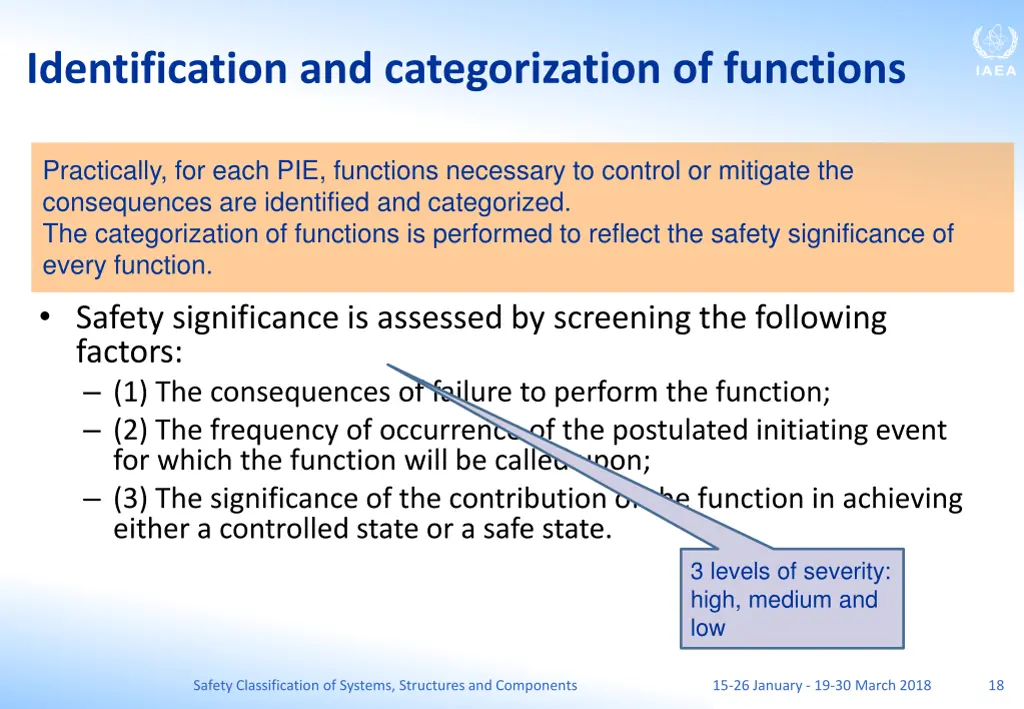
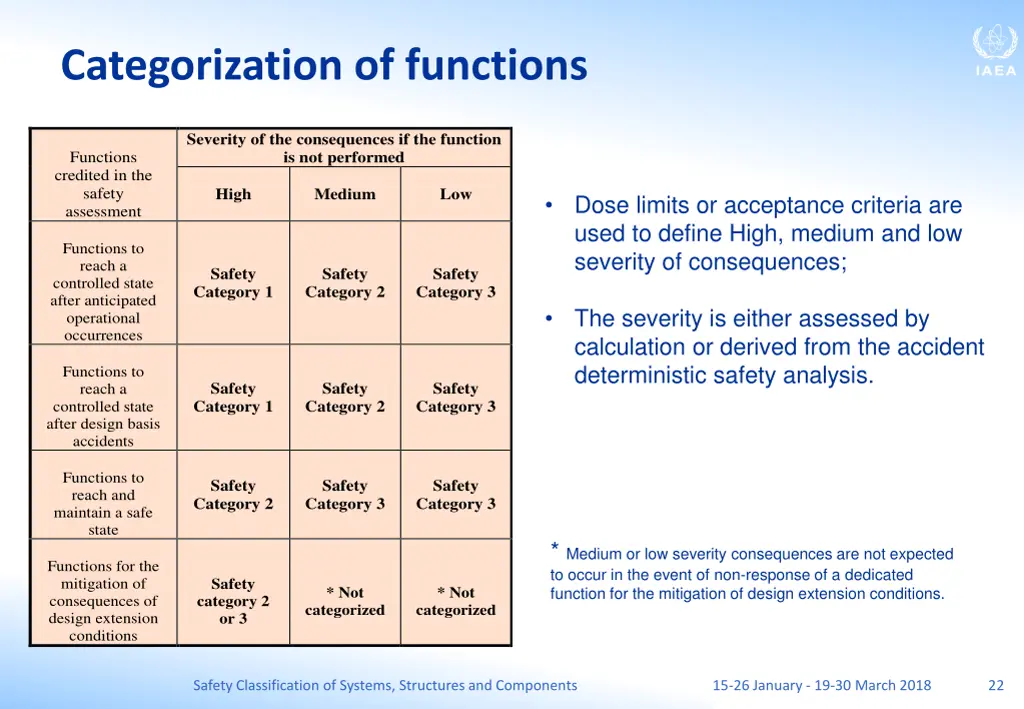
Identification and categorization of functions Practically, for each PIE, functions necessary to control or mitigate the consequences are identified and categorized. The categorization of functions is performed to reflect the safety significance of every function. Safety significance is assessed by screening the following factors: (1) The consequences of failure to perform the function; (2) The frequency of occurrence of the postulated initiating event for which the function will be called upon; (3) The significance of the contribution of the function in achieving either a controlled state or a safe state. 3 levels of severity: high, medium and low Safety Classification of Systems, Structures and Components 15-26 January - 19-30 March 2018 18
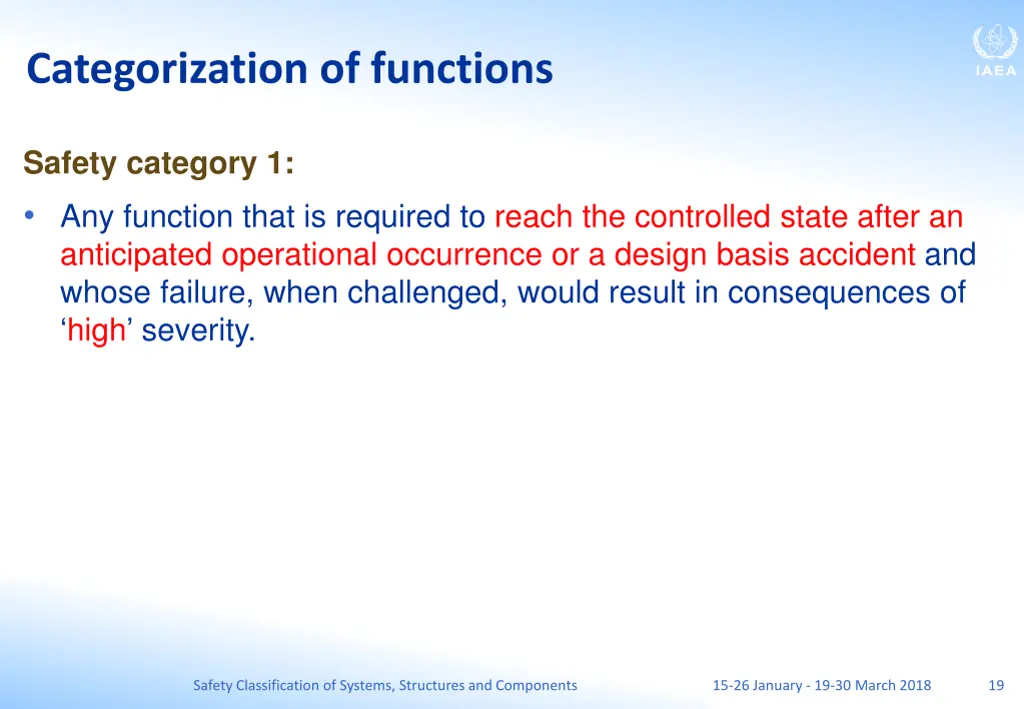
Categorization of functions Safety category 1: Any function that is required to reach the controlled state after an anticipated operational occurrence or a design basis accident and whose failure, when challenged, would result in consequences of high severity. Safety Classification of Systems, Structures and Components 15-26 January - 19-30 March 2018 19
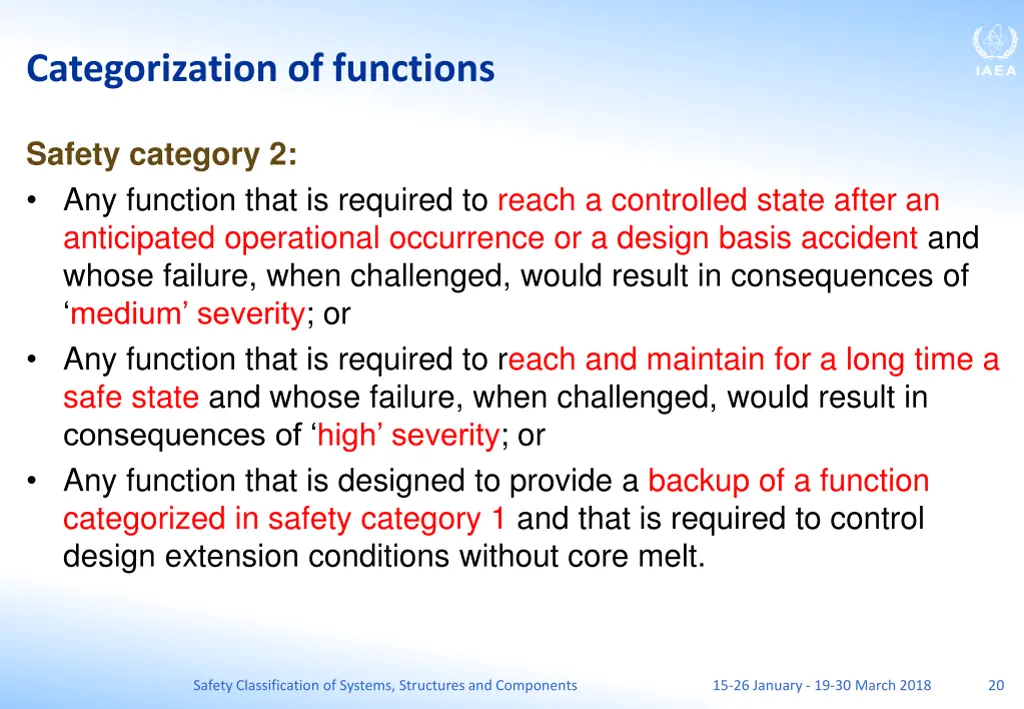
Categorization of functions Safety category 2: Any function that is required to reach a controlled state after an anticipated operational occurrence or a design basis accident and whose failure, when challenged, would result in consequences of medium severity; or Any function that is required to reach and maintain for a long time a safe state and whose failure, when challenged, would result in consequences of high severity; or Any function that is designed to provide a backup of a function categorized in safety category 1 and that is required to control design extension conditions without core melt. Safety Classification of Systems, Structures and Components 15-26 January - 19-30 March 2018 20
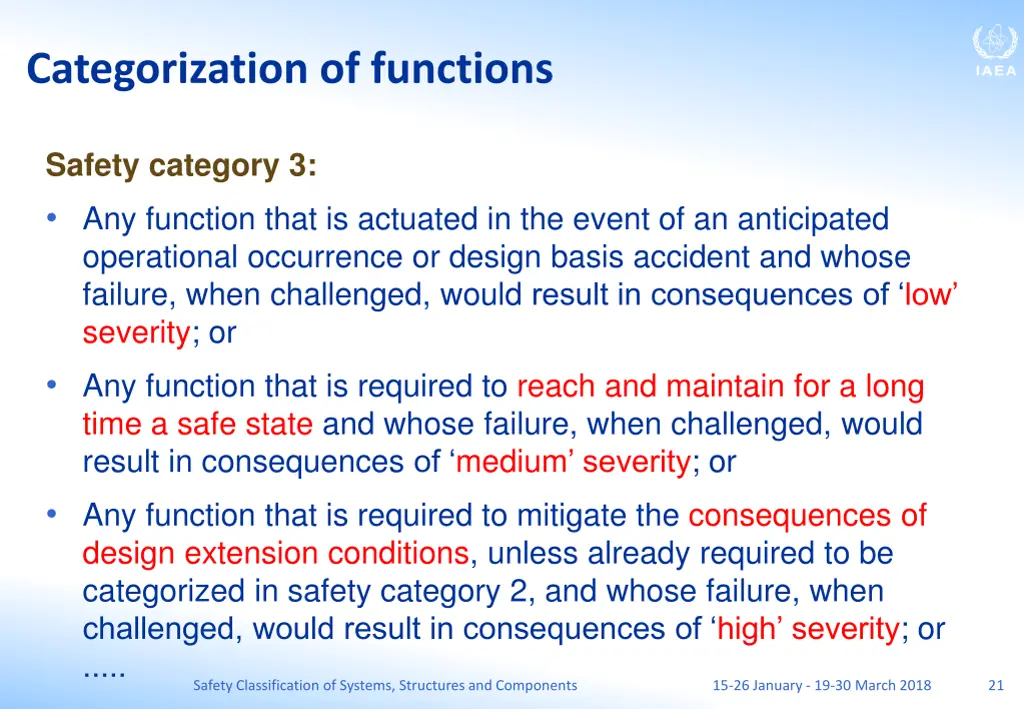
Categorization of functions Safety category 3: Any function that is actuated in the event of an anticipated operational occurrence or design basis accident and whose failure, when challenged, would result in consequences of low severity; or Any function that is required to reach and maintain for a long time a safe state and whose failure, when challenged, would result in consequences of medium severity; or Any function that is required to mitigate the consequences of design extension conditions, unless already required to be categorized in safety category 2, and whose failure, when challenged, would result in consequences of high severity; or ..... Safety Classification of Systems, Structures and Components 15-26 January - 19-30 March 2018 21
Categorization of functions Severity of the consequences if the function is not performed Functions credited in the safety assessment Functions to reach a controlled state after anticipated operational occurrences Functions to reach a controlled state after design basis accidents Functions to reach and maintain a safe state Functions for the mitigation of consequences of design extension conditions High Medium Low Dose limits or acceptance criteria are used to define High, medium and low severity of consequences; Safety Category 1 Safety Category 2 Safety Category 3 The severity is either assessed by calculation or derived from the accident deterministic safety analysis. Safety Category 1 Safety Category 2 Safety Category 3 Safety Category 2 Safety Category 3 Safety Category 3 * Medium or low severity consequences are not expected to occur in the event of non-response of a dedicated function for the mitigation of design extension conditions. Safety category 2 or 3 * Not * Not categorized categorized Safety Classification of Systems, Structures and Components 15-26 January - 19-30 March 2018 22
Basic Professional Training Course on Nuclear Safety Ghana Nuclear Regulatory Authority Accra, Ghana 15-26 January 19-30 March 2018 Design Provisions
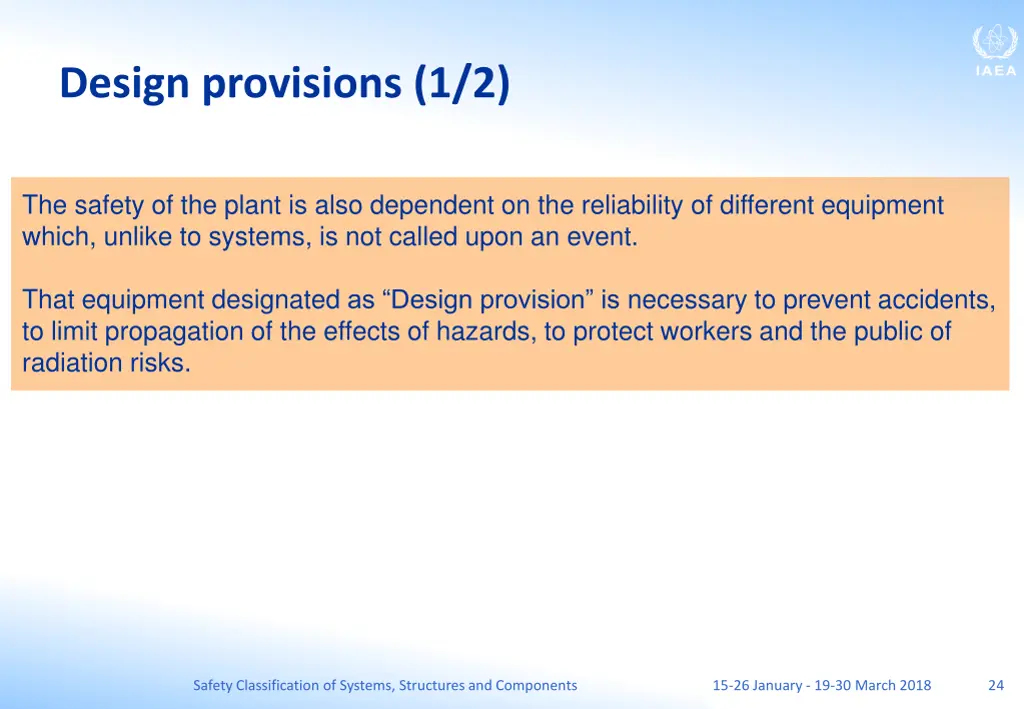
Design provisions (1/2) The safety of the plant is also dependent on the reliability of different equipment which, unlike to systems, is not called upon an event. That equipment designated as Design provision is necessary to prevent accidents, to limit propagation of the effects of hazards, to protect workers and the public of radiation risks. Safety Classification of Systems, Structures and Components 15-26 January - 19-30 March 2018 24
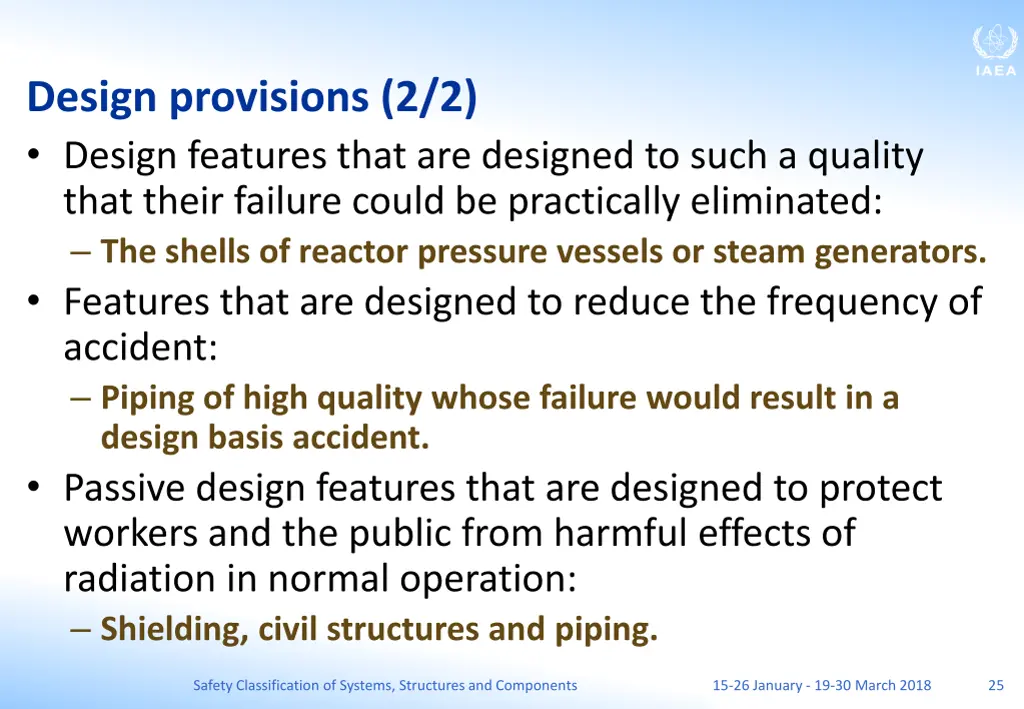
Design provisions (2/2) Design features that are designed to such a quality that their failure could be practically eliminated: The shells of reactor pressure vessels or steam generators. Features that are designed to reduce the frequency of accident: Piping of high quality whose failure would result in a design basis accident. Passive design features that are designed to protect workers and the public from harmful effects of radiation in normal operation: Shielding, civil structures and piping. Safety Classification of Systems, Structures and Components 15-26 January - 19-30 March 2018 25
Classification of the design provisions SSC implemented as a design provision can be classified directly by assessing the level of severity of its failure. Safety class 1 Any SSC whose failure would lead to consequences of high severity; Safety class 2 Any SSC whose failure would lead to consequences of medium severity; Safety class 3 Any SSC whose failure would lead to consequences of low severity. Safety Classification of Systems, Structures and Components 15-26 January - 19-30 March 2018 26
Summary The purpose of safety classification in a nuclear power plant is to; Identify and categorize the safety functions (prevention, detection, control and mitigation) and; identify and classify the related SSC items (safety class-1, safety class-2 and safety class-3) on the basis of their safety significance. Safety significance is assessed by screening the following factors: (1) The consequences of failure to perform the function; (2) The frequency of occurrence of the postulated initiating event for which the function will be called upon; (3) The significance of the contribution of the function in achieving either a controlled state or a safe state. Safety Classification of Systems, Structures and Components 15-26 January - 19-30 March 2018 27
Key points The purpose of safety classification in a nuclear power plant is to identify and categorize the safety functions and to identify and classify the related SSC items on the basis of their safety significance. Safety classification is an iterative process that should be carried out periodically throughout the design process and maintained throughout the lifetime of the plant. Safety Classification of Systems, Structures and Components 15-26 January - 19-30 March 2018 28
References Specific Safety requirements SSR-2/1; Safety of Nuclear Power Plants Design Safety Guide SSG-30; Safety Classification of Structures, Systems and Components in Nuclear Power Plants General safety requirements GSR Part 4; Safety for Facilities and Activities Specific safety guide SSG-2; Deterministic Safety Analysis for Nuclear Power Plants Safety Classification of Systems, Structures and Components 15-26 January - 19-30 March 2018 29
Basic Professional Training Course on Nuclear Safety Ghana Nuclear Regulatory Authority Accra, Ghana 15-26 January 19-30 March 2018 Thank you!