Safety Investigation Insights and Best Practices
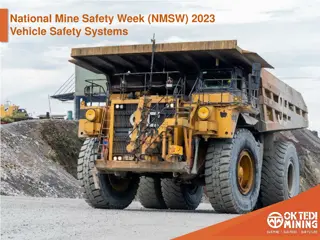
This collection explores various aspects of incident investigations, accident prevention strategies, and safety theories. From understanding the importance of investigating incidents to the roles different individuals play in ensuring workplace safety, each image delves into crucial elements of maintaining a safe work environment.

Download Presentation

Please find below an Image/Link to download the presentation.
The content on the website is provided AS IS for your information and personal use only. It may not be sold, licensed, or shared on other websites without obtaining consent from the author. If you encounter any issues during the download, it is possible that the publisher has removed the file from their server.
You are allowed to download the files provided on this website for personal or commercial use, subject to the condition that they are used lawfully. All files are the property of their respective owners.
The content on the website is provided AS IS for your information and personal use only. It may not be sold, licensed, or shared on other websites without obtaining consent from the author.
E N D
Presentation Transcript
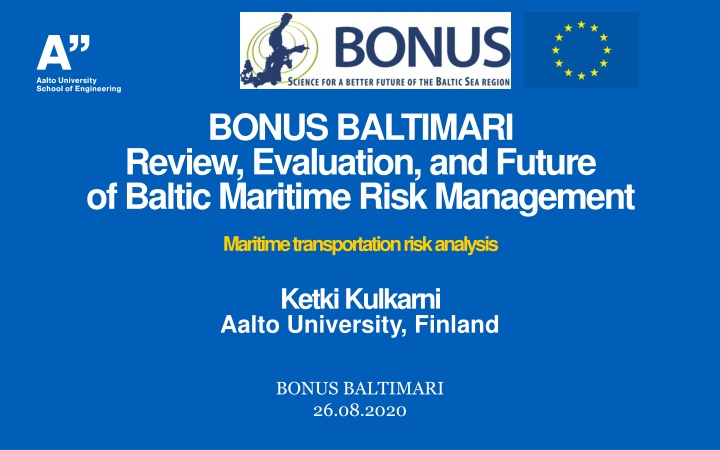
BONUS BALTIMARI Review, Evaluation, and Future of Baltic Maritime Risk Management Maritime transportation risk analysis Ketki Kulkarni Aalto University, Finland BONUS BALTIMARI 26.08.2020
Outline Prevention-oriented risk management Analysis of scientific literature Past: historic trends Present: current state-of-the-art Future: where are we headed 16.3.2025 2
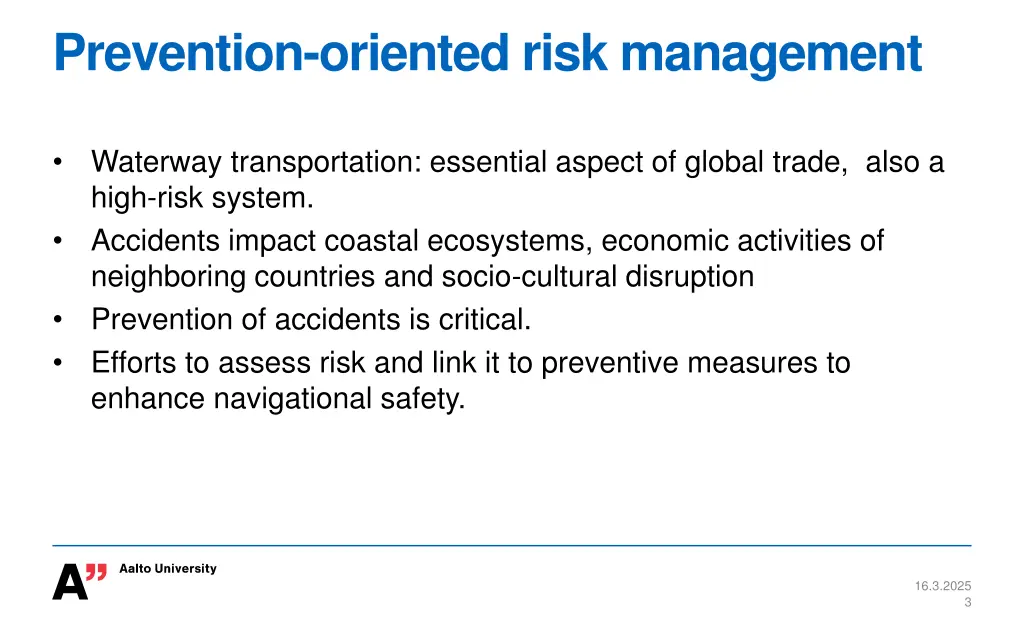
Prevention-oriented risk management Waterway transportation: essential aspect of global trade, also a high-risk system. Accidents impact coastal ecosystems, economic activities of neighboring countries and socio-cultural disruption Prevention of accidents is critical. Efforts to assess risk and link it to preventive measures to enhance navigational safety. 16.3.2025 3
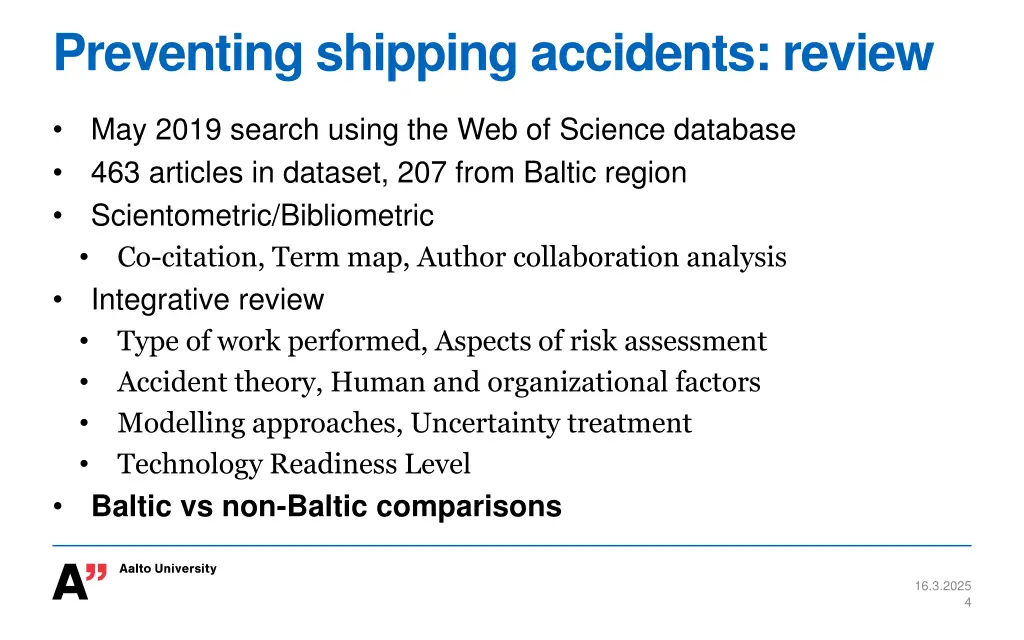
Preventing shipping accidents: review May 2019 search using the Web of Science database 463 articles in dataset, 207 from Baltic region Scientometric/Bibliometric Co-citation, Term map, Author collaboration analysis Integrative review Type of work performed, Aspects of risk assessment Accident theory, Human and organizational factors Modelling approaches, Uncertainty treatment Technology Readiness Level Baltic vs non-Baltic comparisons 16.3.2025 4
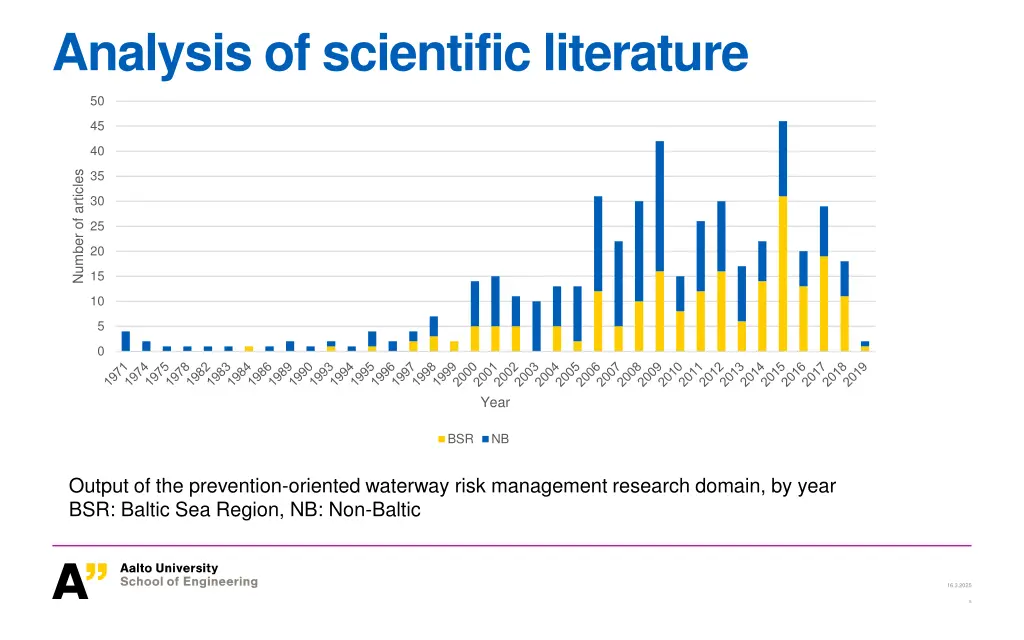
Analysis of scientific literature 50 45 40 35 Number of articles 30 25 20 15 10 5 0 Year BSR NB Output of the prevention-oriented waterway risk management research domain, by year BSR: Baltic Sea Region, NB: Non-Baltic 16.3.2025 5
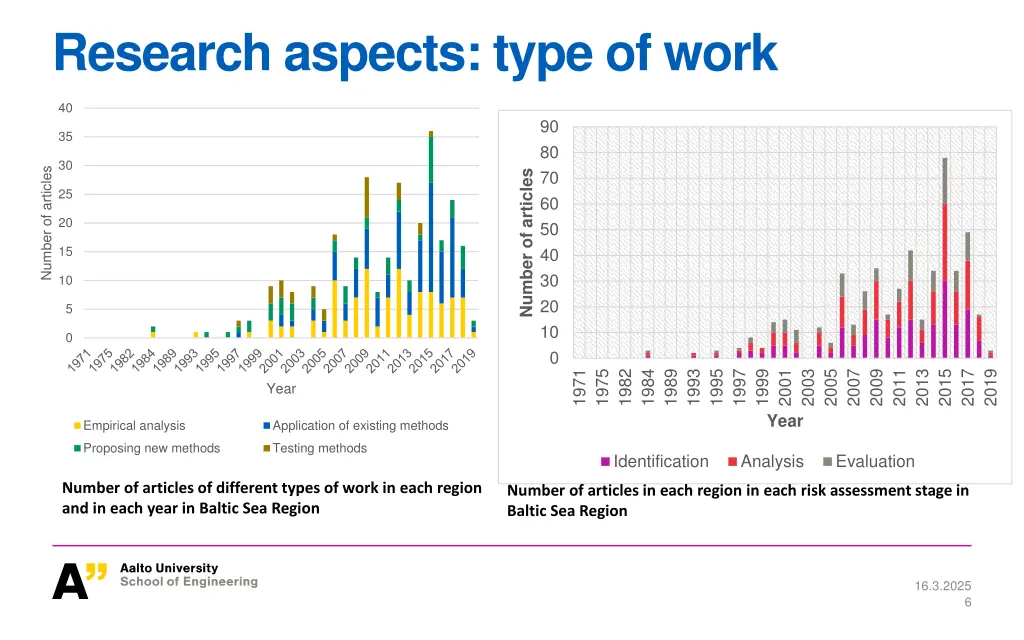
Research aspects: type of work 40 90 35 80 30 Number of articles 70 Number of articles 25 60 20 50 15 40 30 10 20 5 10 0 0 1984 1999 2009 2019 1971 1975 1982 1989 1993 1995 1997 2001 Year 2003 2005 2007 2011 2013 2015 2017 Year Empirical analysis Application of existing methods Proposing new methods Testing methods Identification Analysis Evaluation Number of articles of different types of work in each region and in each year in Baltic Sea Region Number of articles in each region in each risk assessment stage in Baltic Sea Region 16.3.2025 6
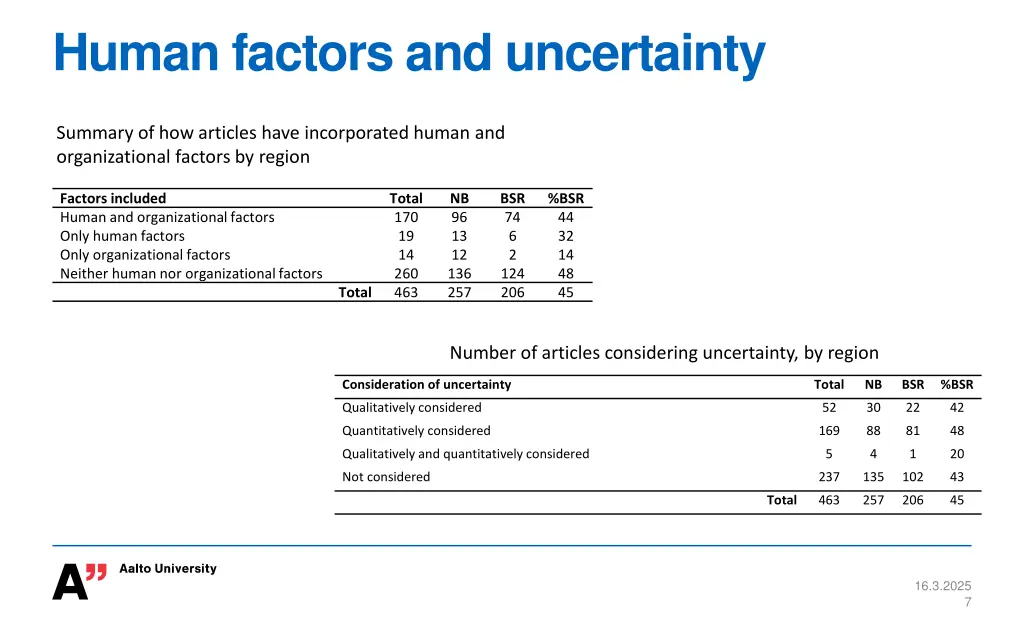
Human factors and uncertainty Summary of how articles have incorporated human and organizational factors by region Factors included Human and organizational factors Only human factors Only organizational factors Neither human nor organizational factors Total 170 19 14 260 463 NB 96 13 12 136 257 BSR 74 6 2 124 206 %BSR 44 32 14 48 45 Total Number of articles considering uncertainty, by region Consideration of uncertainty Total NB BSR %BSR Qualitatively considered 52 30 22 42 Quantitatively considered 169 88 81 48 Qualitatively and quantitatively considered 5 4 1 20 Not considered 237 135 102 43 Total 463 257 206 45 16.3.2025 7
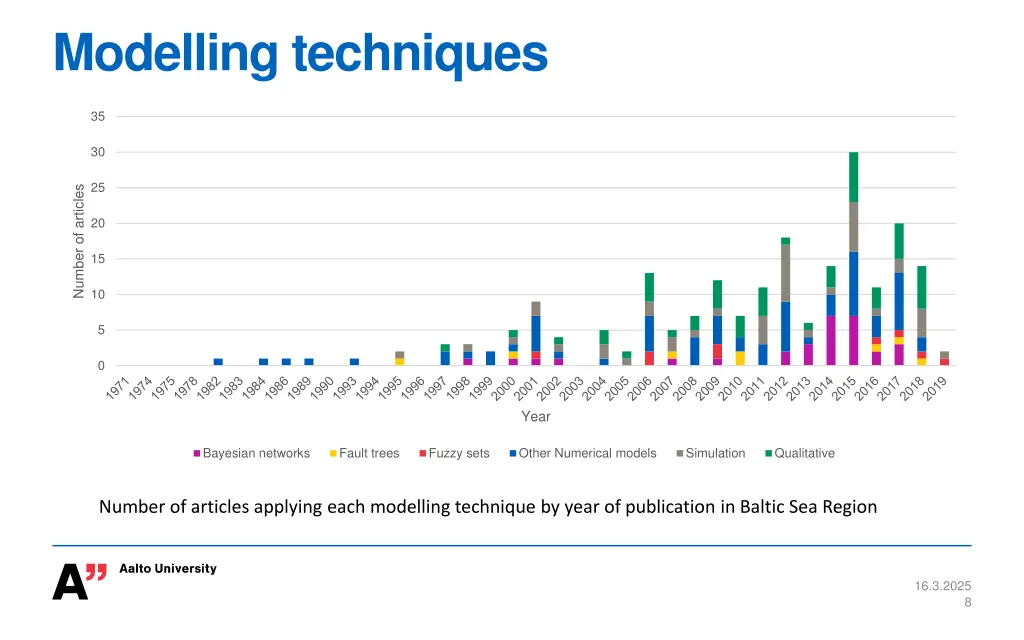
Modelling techniques 35 30 25 Number of articles 20 15 10 5 0 Year Bayesian networks Fault trees Fuzzy sets Other Numerical models Simulation Qualitative Number of articles applying each modelling technique by year of publication in Baltic Sea Region 16.3.2025 8
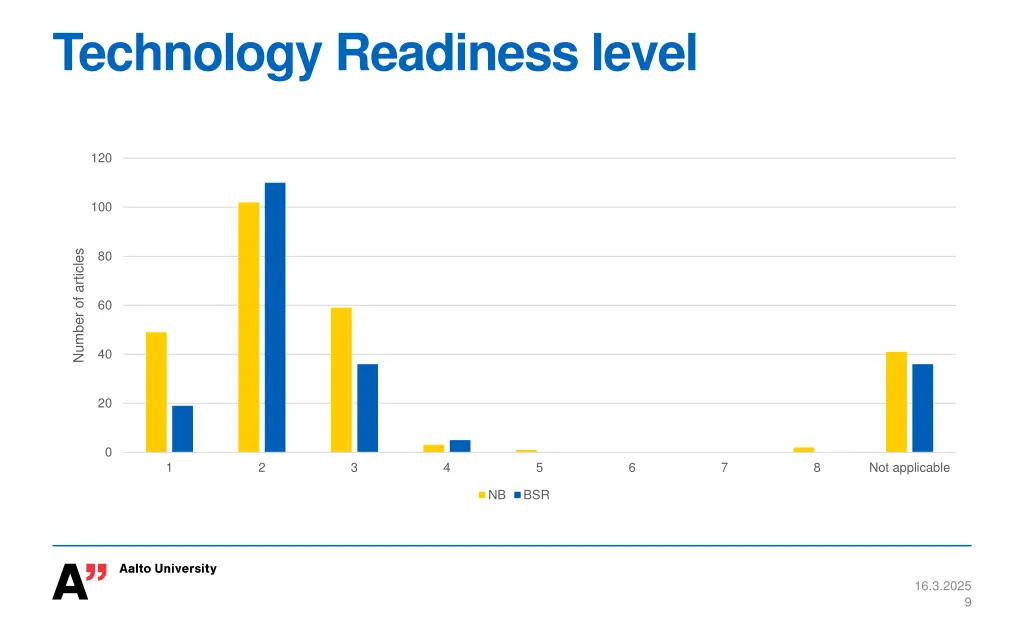
Technology Readiness level 120 100 Number of articles 80 60 40 20 0 1 2 3 4 5 6 7 8 Not applicable NB BSR 16.3.2025 9
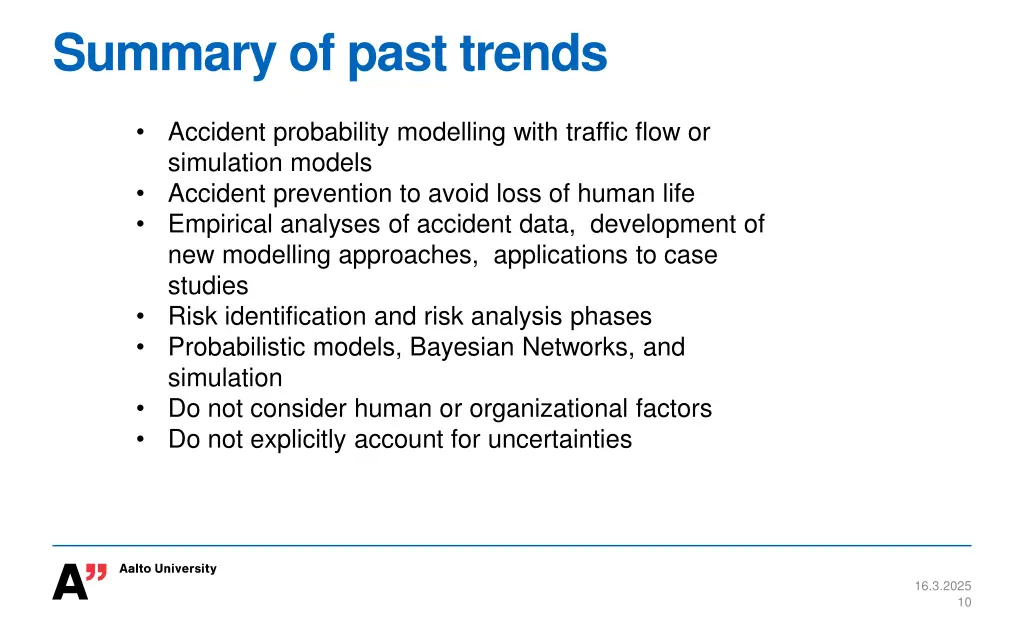
Summary of past trends Accident probability modelling with traffic flow or simulation models Accident prevention to avoid loss of human life Empirical analyses of accident data, development of new modelling approaches, applications to case studies Risk identification and risk analysis phases Probabilistic models, Bayesian Networks, and simulation Do not consider human or organizational factors Do not explicitly account for uncertainties 16.3.2025 10
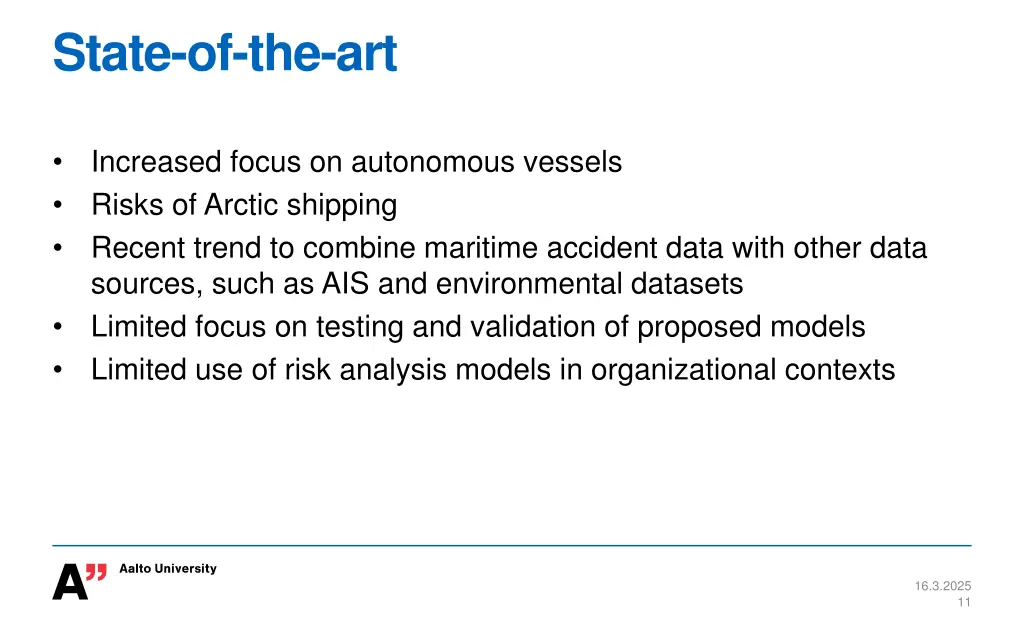
State-of-the-art Increased focus on autonomous vessels Risks of Arctic shipping Recent trend to combine maritime accident data with other data sources, such as AIS and environmental datasets Limited focus on testing and validation of proposed models Limited use of risk analysis models in organizational contexts 16.3.2025 11
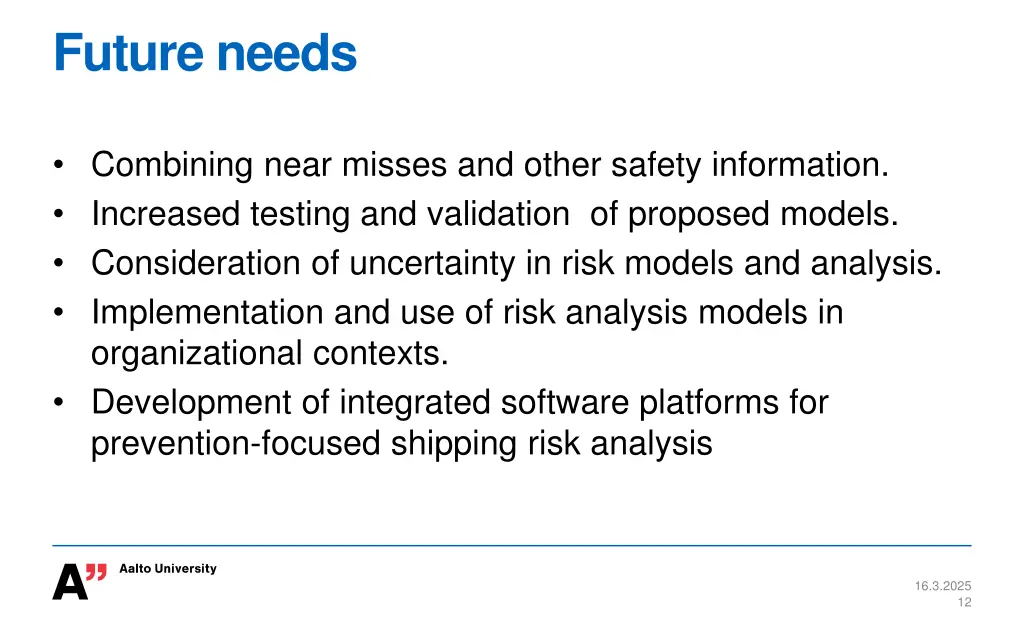
Future needs Combining near misses and other safety information. Increased testing and validation of proposed models. Consideration of uncertainty in risk models and analysis. Implementation and use of risk analysis models in organizational contexts. Development of integrated software platforms for prevention-focused shipping risk analysis 16.3.2025 12
Thank you! Ketki.Kulkarni@aalto.fi https://www.aalto.fi/en/department-of-mechanical- engineering/bonus-baltimari 16.3.2025 13