Scheduling
Explore the intricacies of scheduling policies in computing systems, including definitions such as response time, throughput, and predictability. Learn about different scheduling algorithms like FIFO, round-robin, and multilevel feedback, and how they impact system performance. Delve into scenarios where system popularity challenges the existing infrastructure and discover strategies to manage workload efficiently to maintain optimal performance.

Download Presentation

Please find below an Image/Link to download the presentation.
The content on the website is provided AS IS for your information and personal use only. It may not be sold, licensed, or shared on other websites without obtaining consent from the author.If you encounter any issues during the download, it is possible that the publisher has removed the file from their server.
You are allowed to download the files provided on this website for personal or commercial use, subject to the condition that they are used lawfully. All files are the property of their respective owners.
The content on the website is provided AS IS for your information and personal use only. It may not be sold, licensed, or shared on other websites without obtaining consent from the author.
E N D
Presentation Transcript
Main Points Scheduling policy: what to do next, when there are multiple threads ready to run Or multiple packets to send, or web requests to serve, or Definitions response time, throughput, predictability Uniprocessor policies FIFO, round robin, optimal multilevel feedback as approximation of optimal Multiprocessor policies Affinity scheduling, gang scheduling Queueing theory Can you predict/improve a system s response time?
Example You manage a web site, that suddenly becomes wildly popular. Do you? Buy more hardware? Implement a different scheduling policy? Turn away some users? Which ones? How much worse will performance get if the web site becomes even more popular?
Definitions Task/Job User request: e.g., mouse click, web request, shell command, Latency/response time How long does a task take to complete? Throughput How many tasks can be done per unit of time? Overhead How much extra work is done by the scheduler? Fairness How equal is the performance received by different users? Predictability How consistent is the performance over time?
More Definitions Workload Set of tasks for system to perform Preemptive scheduler If we can take resources away from a running task Work-conserving Resource is used whenever there is a task to run For non-preemptive schedulers, work-conserving is not always better Scheduling algorithm takes a workload as input decides which tasks to do first Performance metric (throughput, latency) as output Only preemptive, work-conserving schedulers to be considered
First In First Out (FIFO) Schedule tasks in the order they arrive Continue running them until they complete or give up the processor Example: memcached Facebook cache of friend lists, On what workloads is FIFO particularly bad?
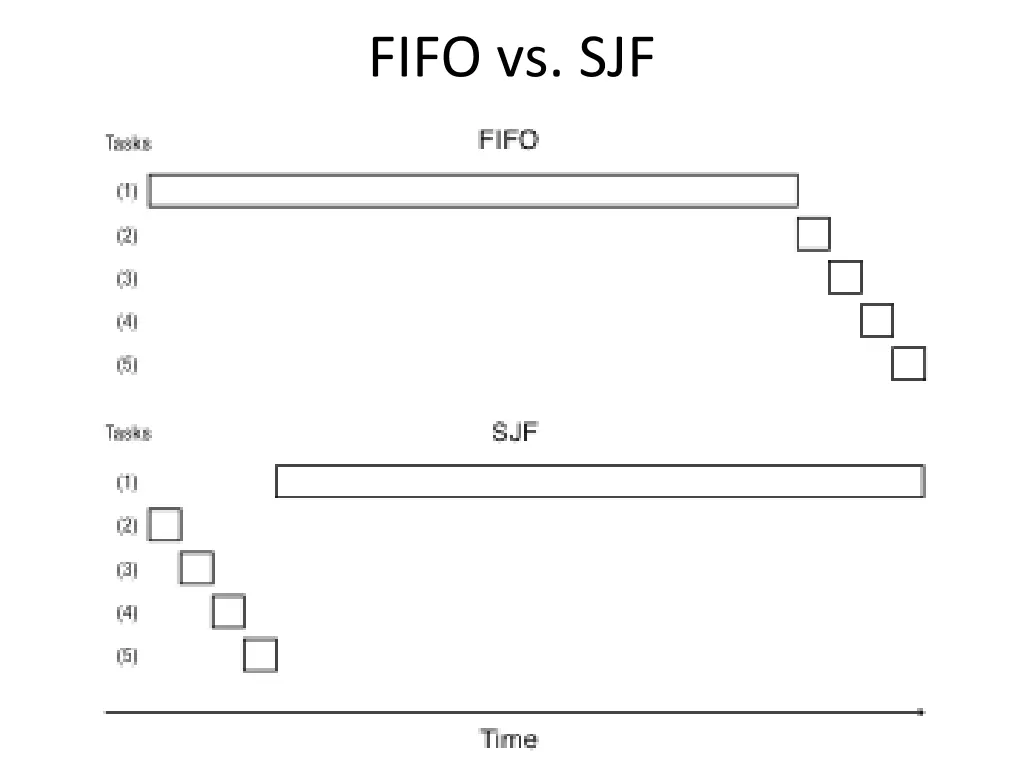
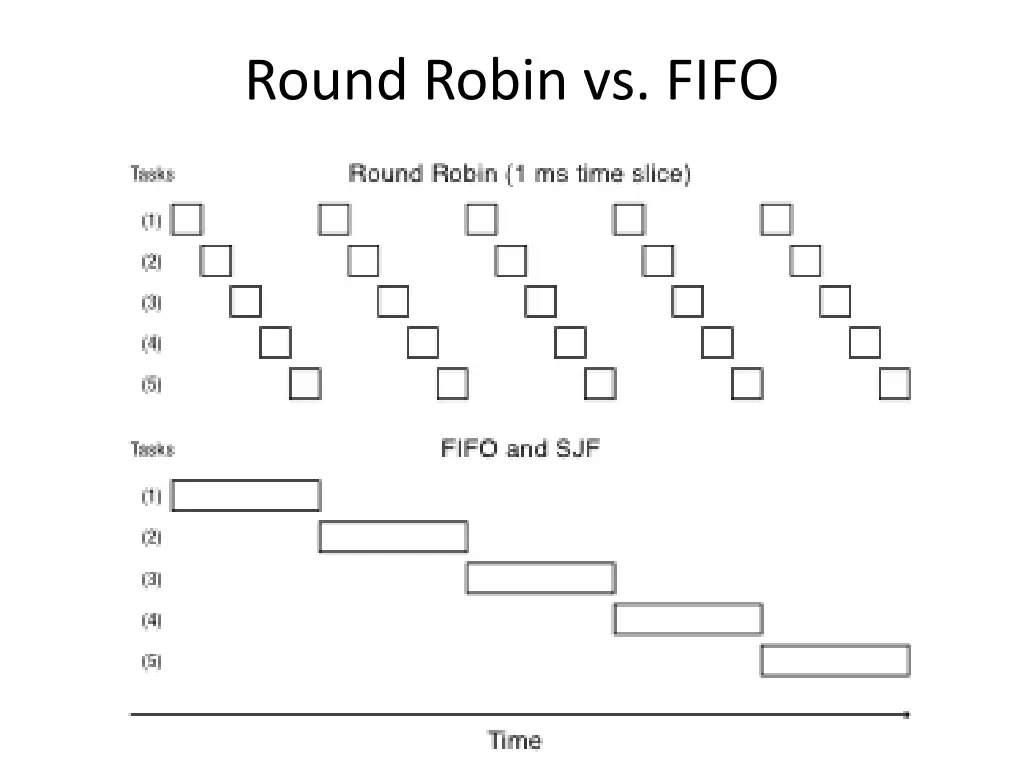
Shortest Job First (SJF) Always do the task that has the shortest remaining amount of work to do Often called Shortest Remaining Time First (SRTF) Suppose we have five tasks arrive one right after each other, but the first one is much longer than the others Which completes first in FIFO? Next? Which completes first in SJF? Next?
Question Claim: SJF is optimal for average response time Why? Does SJF have any downsides?
Question Is FIFO ever optimal? Pessimal?
Starvation and Sample Bias Suppose you want to compare two scheduling algorithms Create some infinite sequence of arriving tasks Start measuring Stop at some point Compute average response time as the average for completed tasks between start and stop Is this valid or invalid?
Sample Bias Solutions Measure for long enough that # of completed tasks >> # of uncompleted tasks For both systems! Start and stop system in idle periods Idle period: no work to do If algorithms are work-conserving, both will complete the same tasks
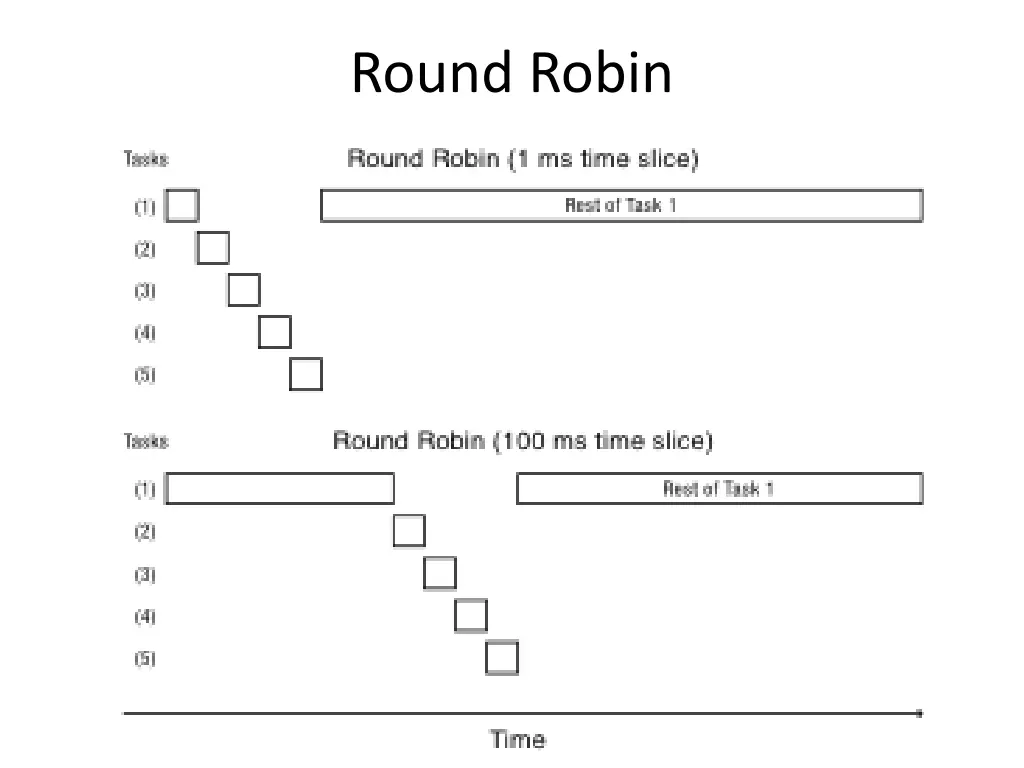
Round Robin Each task gets resource for a fixed period of time (time quantum) If task doesn t complete, it goes back in line Need to pick a time quantum What if time quantum is too long? Infinite? What if time quantum is too short? One instruction?
Round Robin vs. FIFO Assuming zero-cost time slice, is Round Robin always better than FIFO?
Round Robin = Fairness? Is Round Robin always fair? What is fair? FIFO? Equal share of the CPU? What if some tasks don t need their full share? Minimize worst case divergence? Time task would take if no one else was running Time task takes under scheduling algorithm
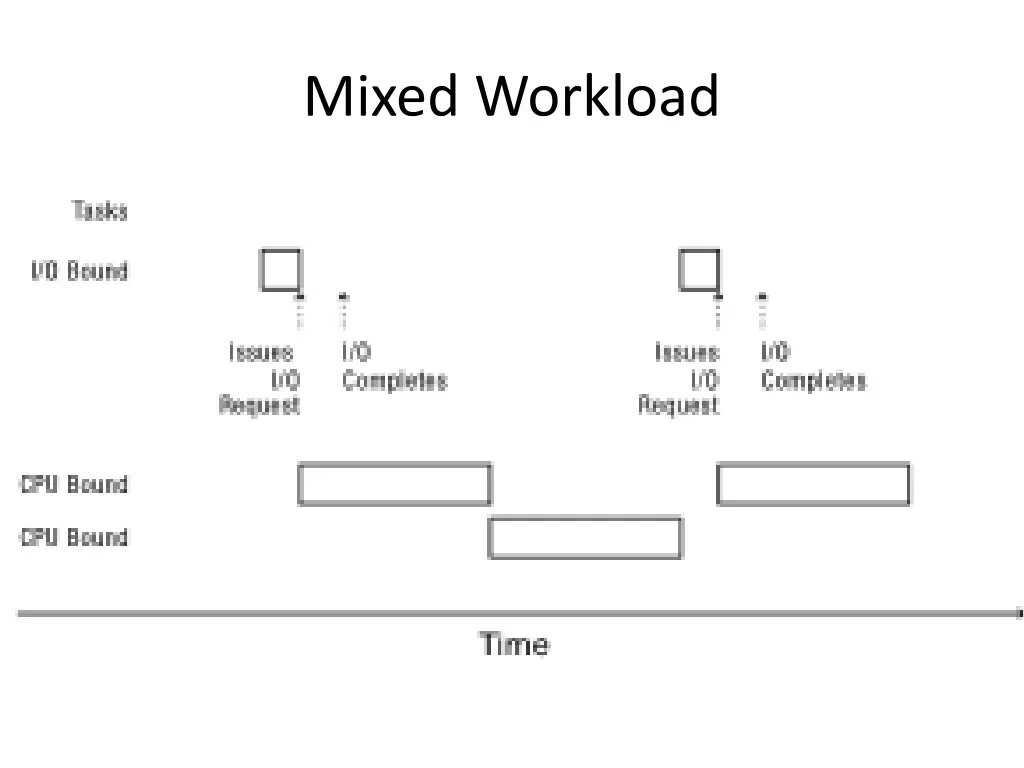
Max-Min Fairness How do we balance a mixture of repeating tasks: Some I/O bound, need only a little CPU Some compute bound, can use as much CPU as they are assigned One approach: maximize the minimum allocation given to a task If any task needs less than an equal share, schedule the smallest of these first Split the remaining time using max-min If all remaining tasks need at least equal share, split evenly
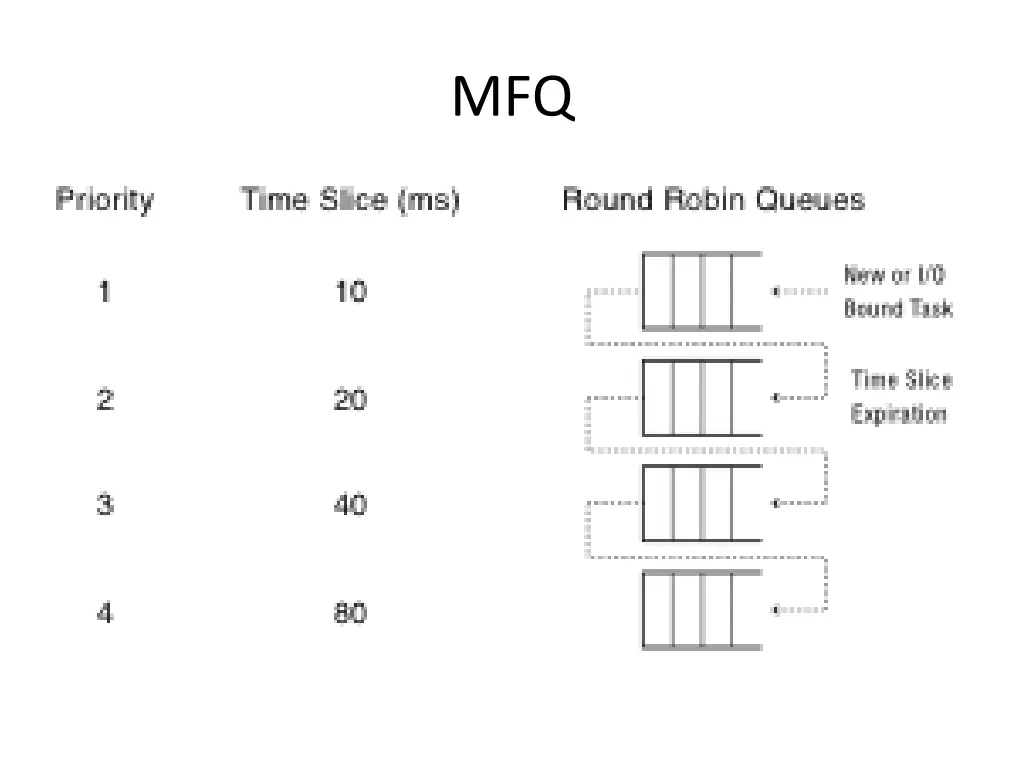
Multi-level Feedback Queue (MFQ) Goals: Responsiveness Low overhead Starvation freedom Some tasks are high/low priority Fairness (among equal priority tasks) Not perfect at any of them! Used in Linux (and probably Windows, MacOS)
MFQ Set of Round Robin queues Each queue has a separate priority High priority queues have short time slices Low priority queues have long time slices Scheduler picks first thread in highest priority queue Tasks start in highest priority queue If time slice expires, task drops one level
Uniprocessor Summary (1) FIFO is simple and minimizes overhead. If tasks are variable in size, then FIFO can have very poor average response time. If tasks are equal in size, FIFO is optimal in terms of average response time. Considering only the processor, SJF is optimal in terms of average response time. SJF is pessimal in terms of variance in response time.
Uniprocessor Summary (2) If tasks are variable in size, Round Robin approximates SJF. If tasks are equal in size, Round Robin will have very poor average response time. Tasks that intermix processor and I/O benefit from SJF and can do poorly under Round Robin.
Uniprocessor Summary (3) Max-Min fairness can improve response time for I/O-bound tasks. Round Robin and Max-Min fairness both avoid starvation. By manipulating the assignment of tasks to priority queues, an MFQ scheduler can achieve a balance between responsiveness, low overhead, and fairness.
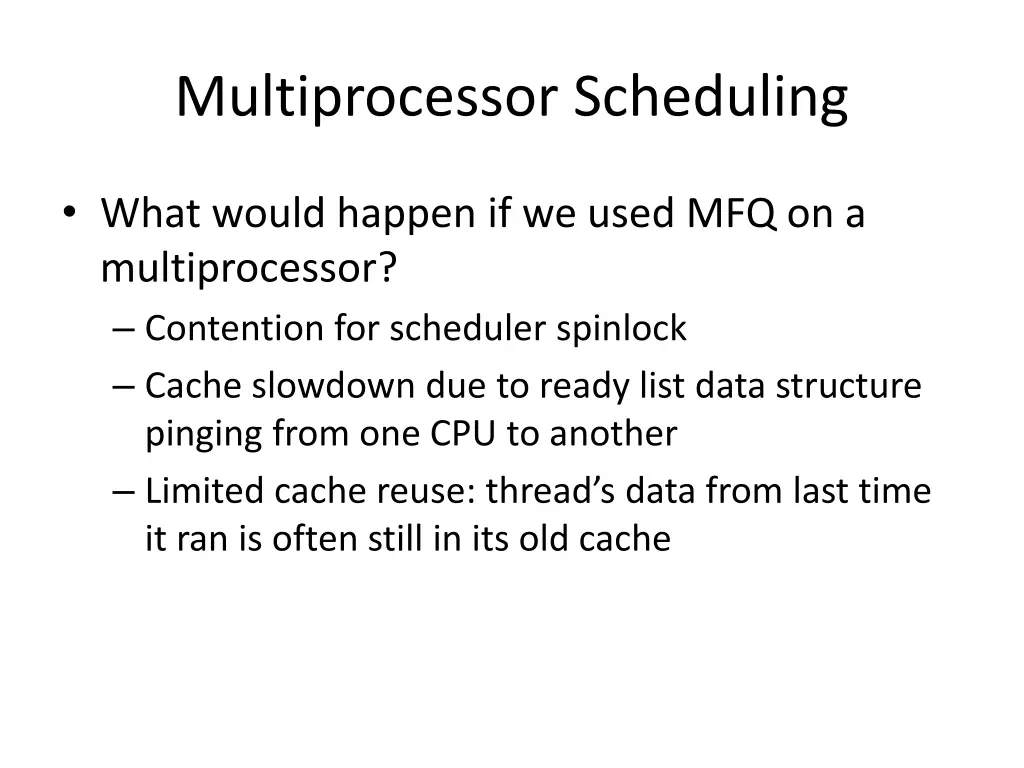
Multiprocessor Scheduling What would happen if we used MFQ on a multiprocessor? Contention for scheduler spinlock Cache slowdown due to ready list data structure pinging from one CPU to another Limited cache reuse: thread s data from last time it ran is often still in its old cache
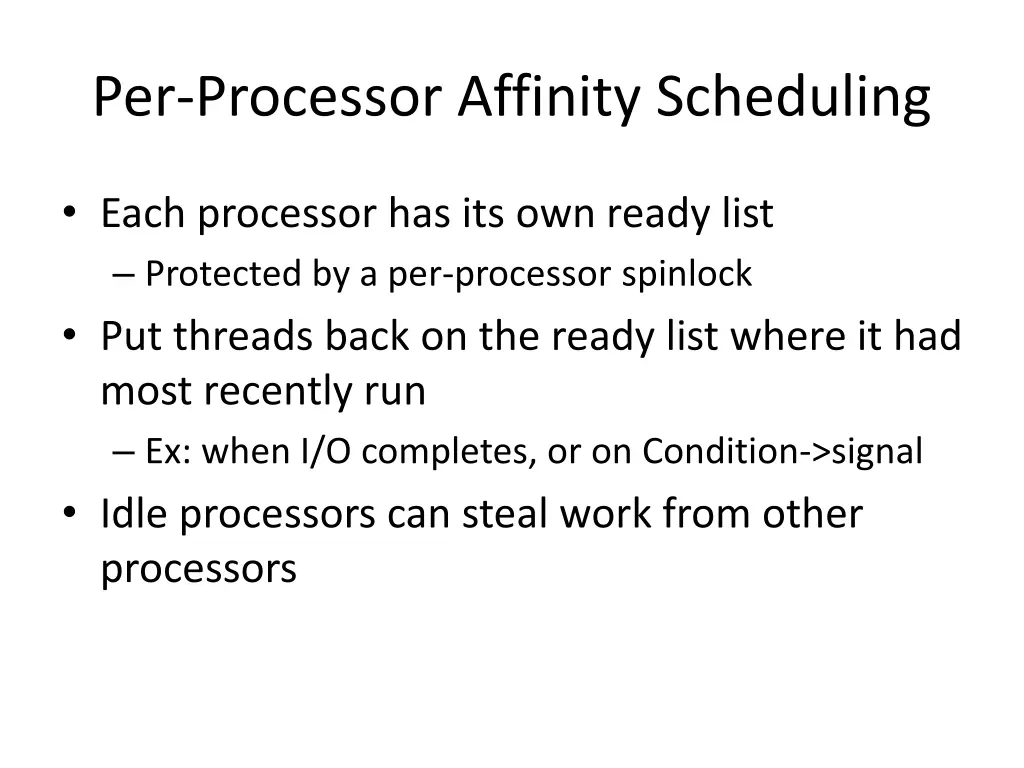
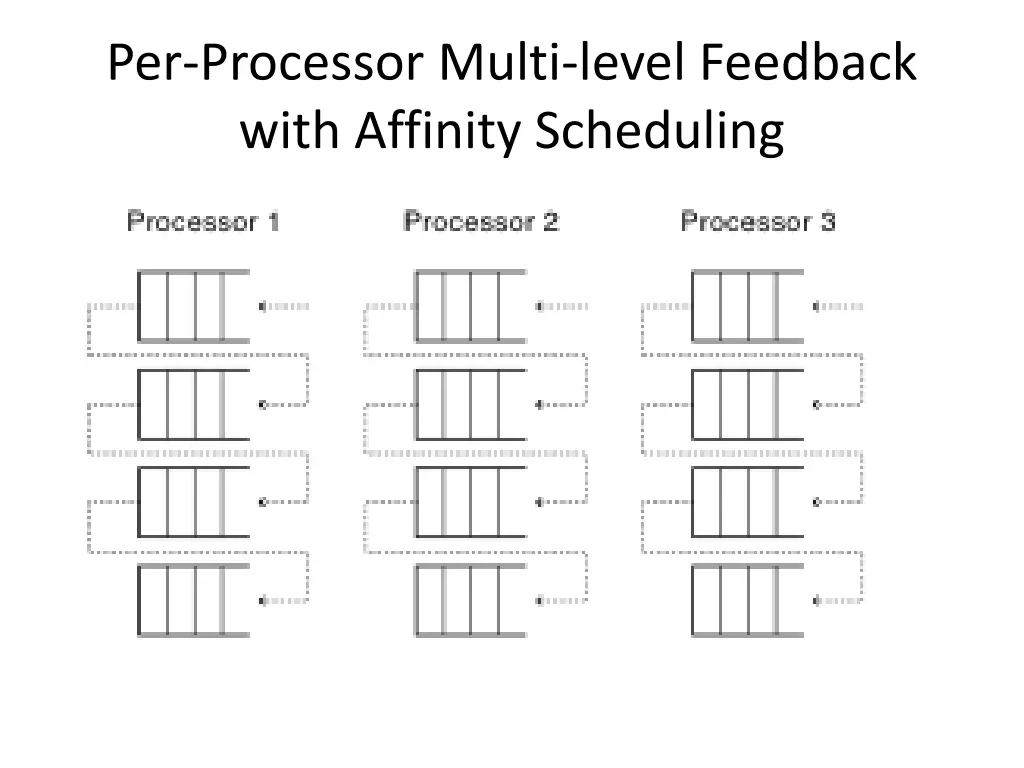
Per-Processor Affinity Scheduling Each processor has its own ready list Protected by a per-processor spinlock Put threads back on the ready list where it had most recently run Ex: when I/O completes, or on Condition->signal Idle processors can steal work from other processors
Per-Processor Multi-level Feedback with Affinity Scheduling
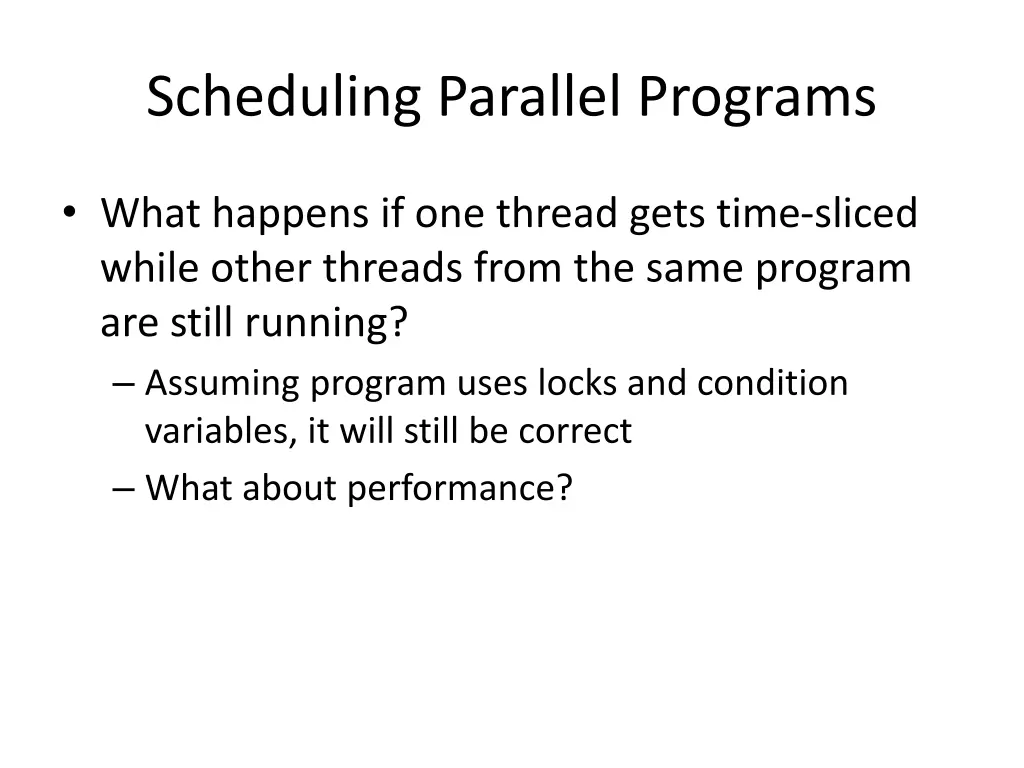
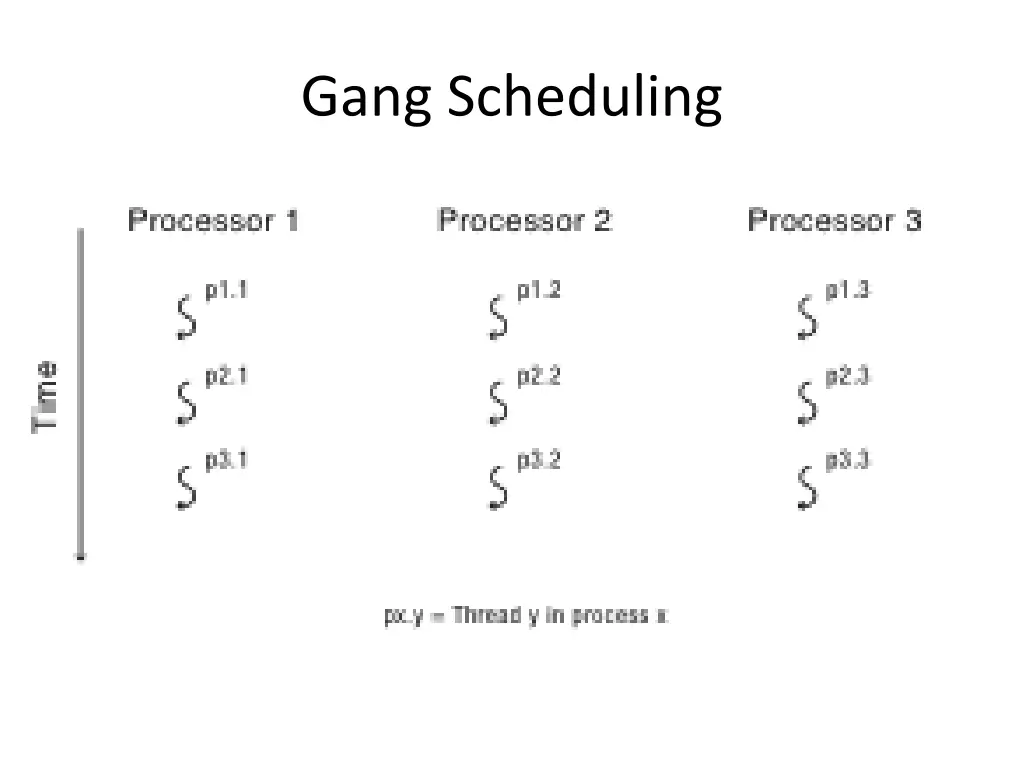
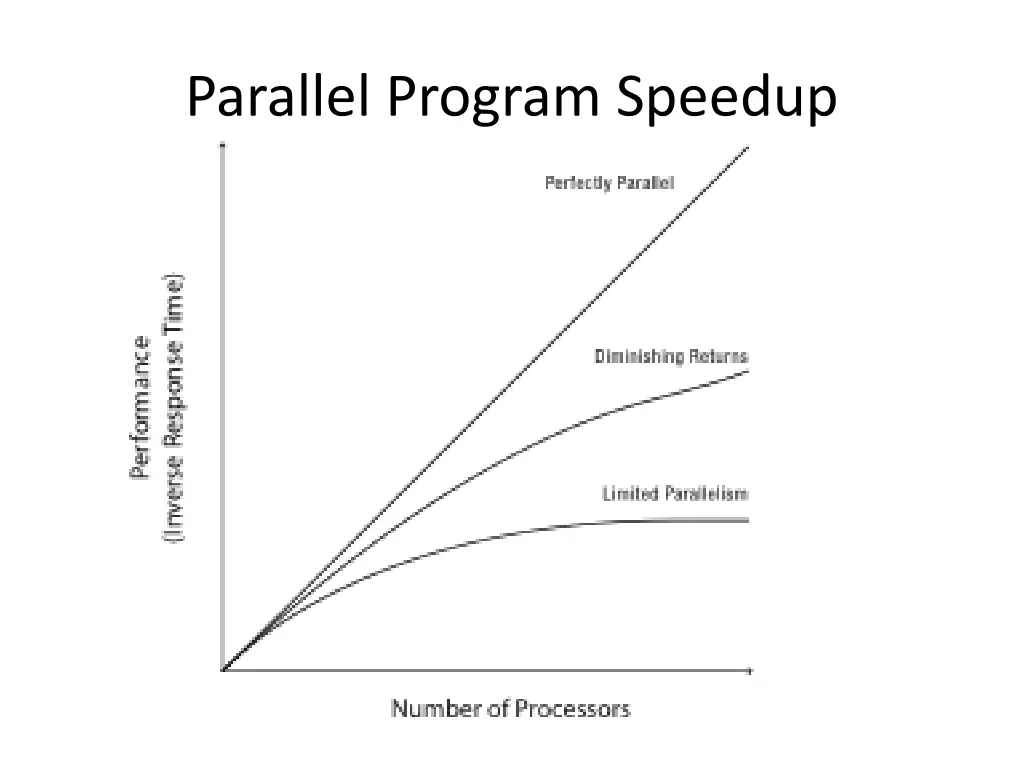
Scheduling Parallel Programs What happens if one thread gets time-sliced while other threads from the same program are still running? Assuming program uses locks and condition variables, it will still be correct What about performance?
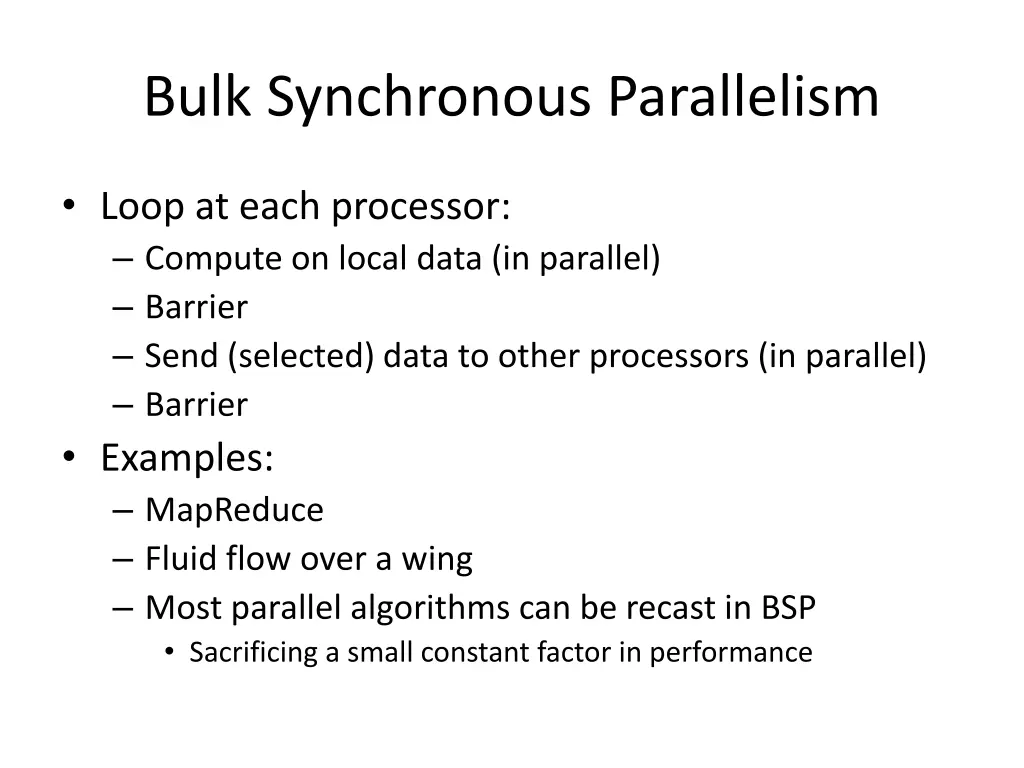
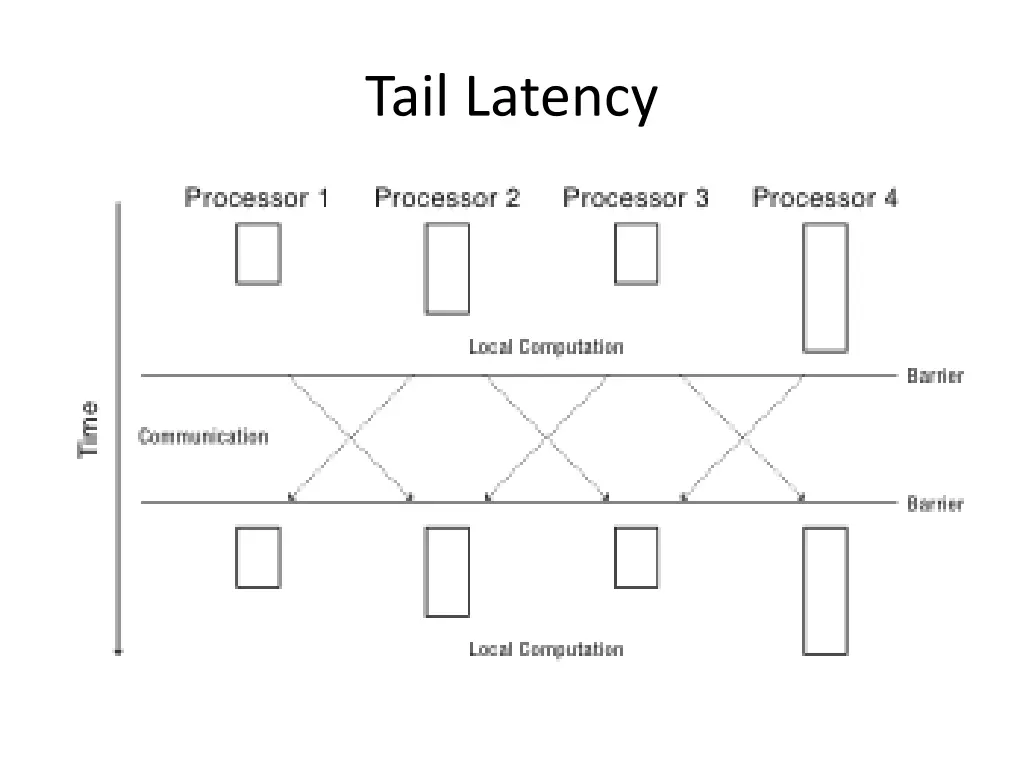
Bulk Synchronous Parallelism Loop at each processor: Compute on local data (in parallel) Barrier Send (selected) data to other processors (in parallel) Barrier Examples: MapReduce Fluid flow over a wing Most parallel algorithms can be recast in BSP Sacrificing a small constant factor in performance
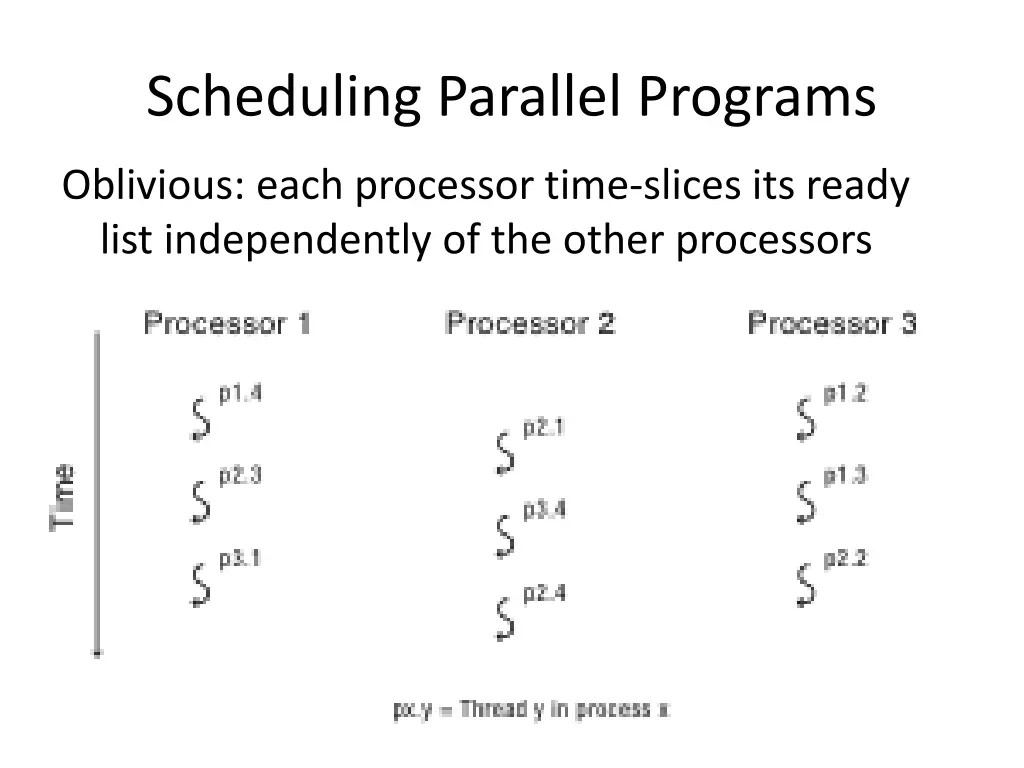
Scheduling Parallel Programs Oblivious: each processor time-slices its ready list independently of the other processors
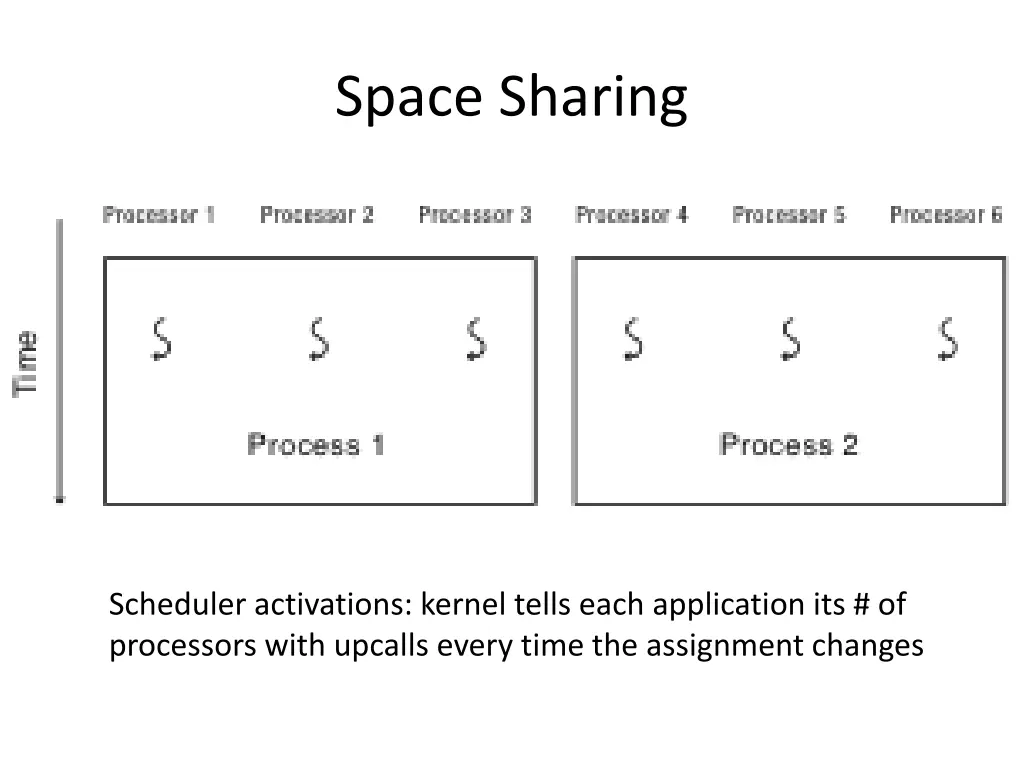
Space Sharing Scheduler activations: kernel tells each application its # of processors with upcalls every time the assignment changes
Queueing Theory Can we predict what will happen to user performance: If a service becomes more popular? If we buy more hardware? If we change the implementation to provide more features?
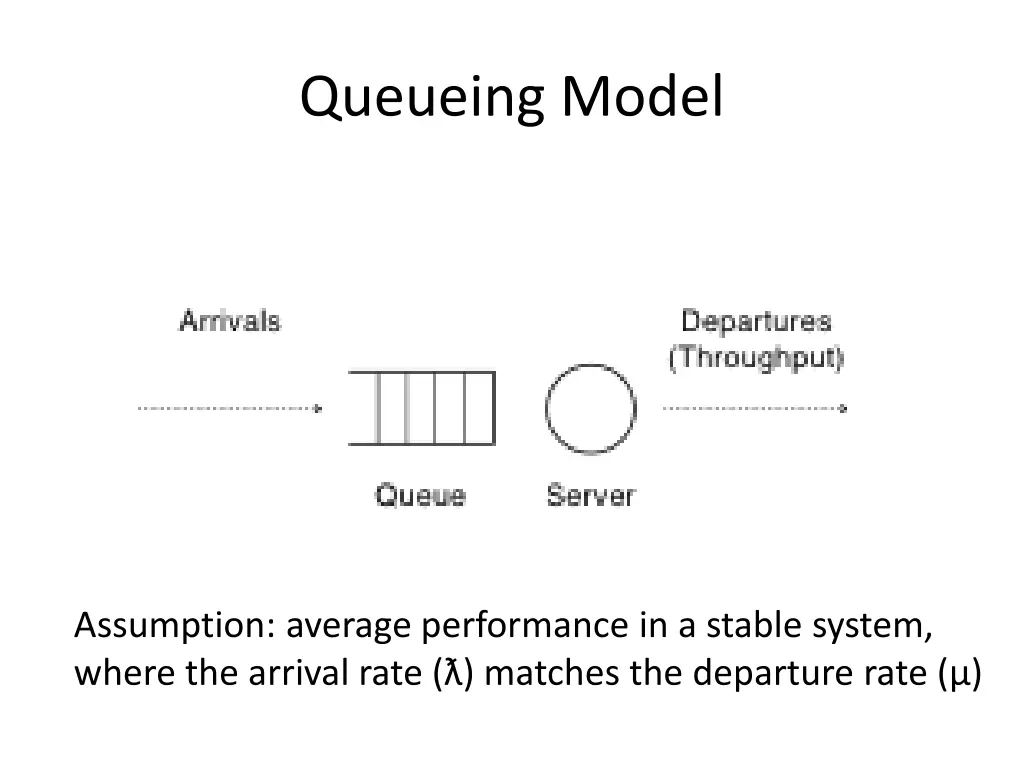
Queueing Model Assumption: average performance in a stable system, where the arrival rate ( ) matches the departure rate ( )
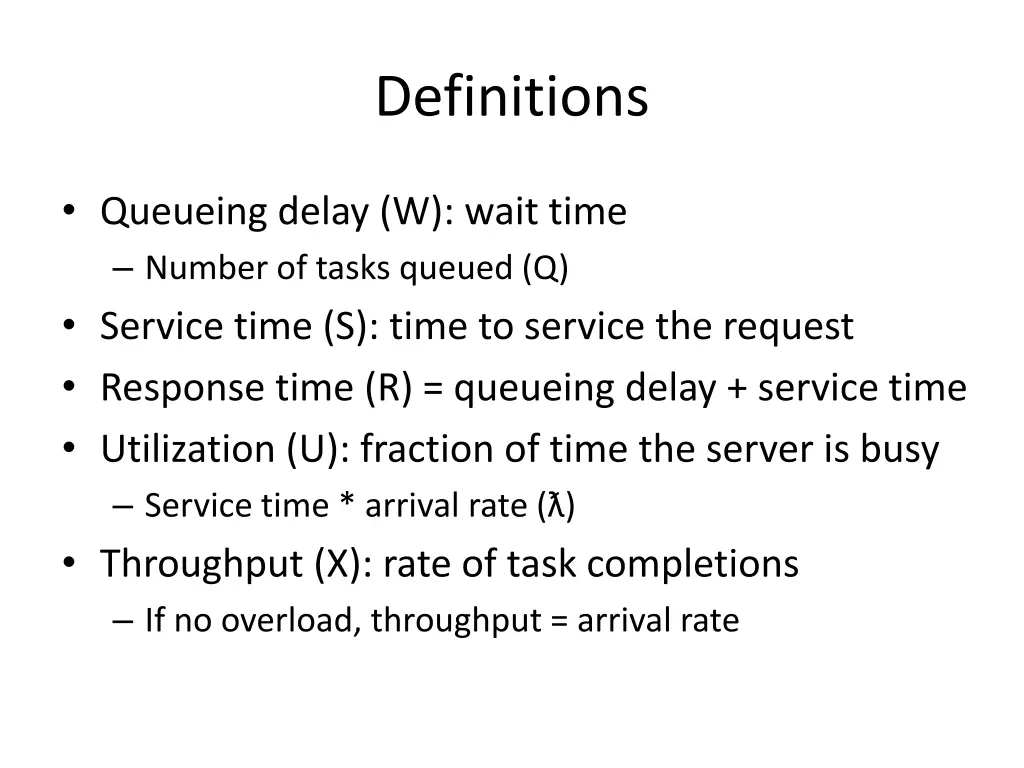
Definitions Queueing delay (W): wait time Number of tasks queued (Q) Service time (S): time to service the request Response time (R) = queueing delay + service time Utilization (U): fraction of time the server is busy Service time * arrival rate ( ) Throughput (X): rate of task completions If no overload, throughput = arrival rate
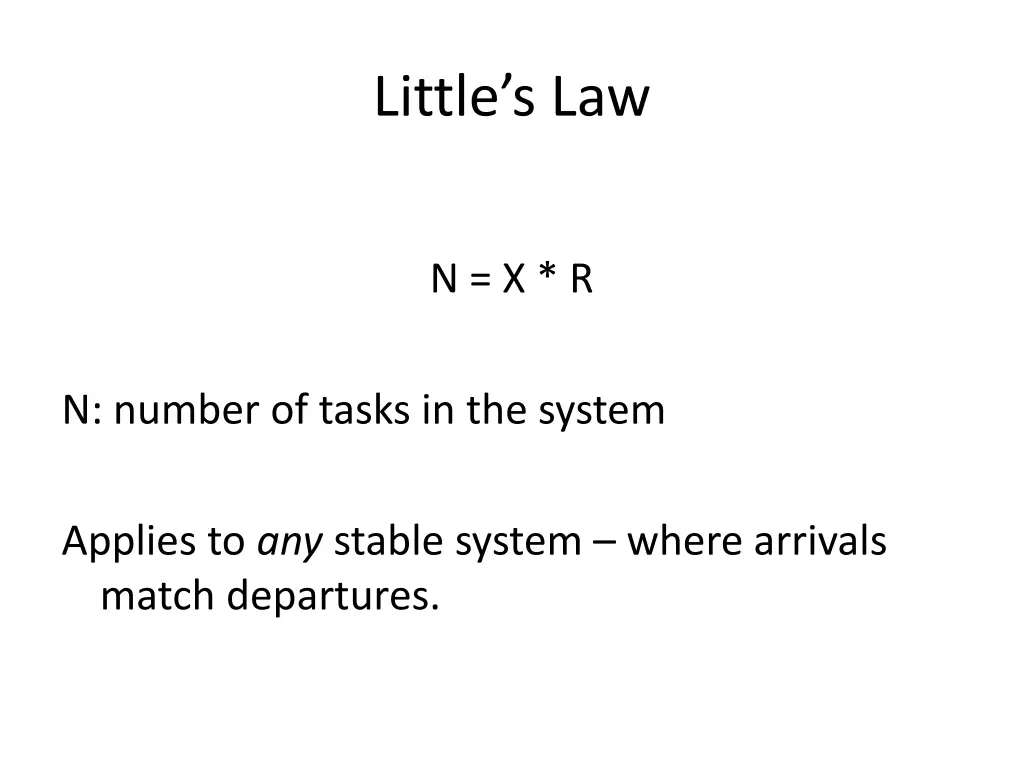
Littles Law N = X * R N: number of tasks in the system Applies to any stable system where arrivals match departures.
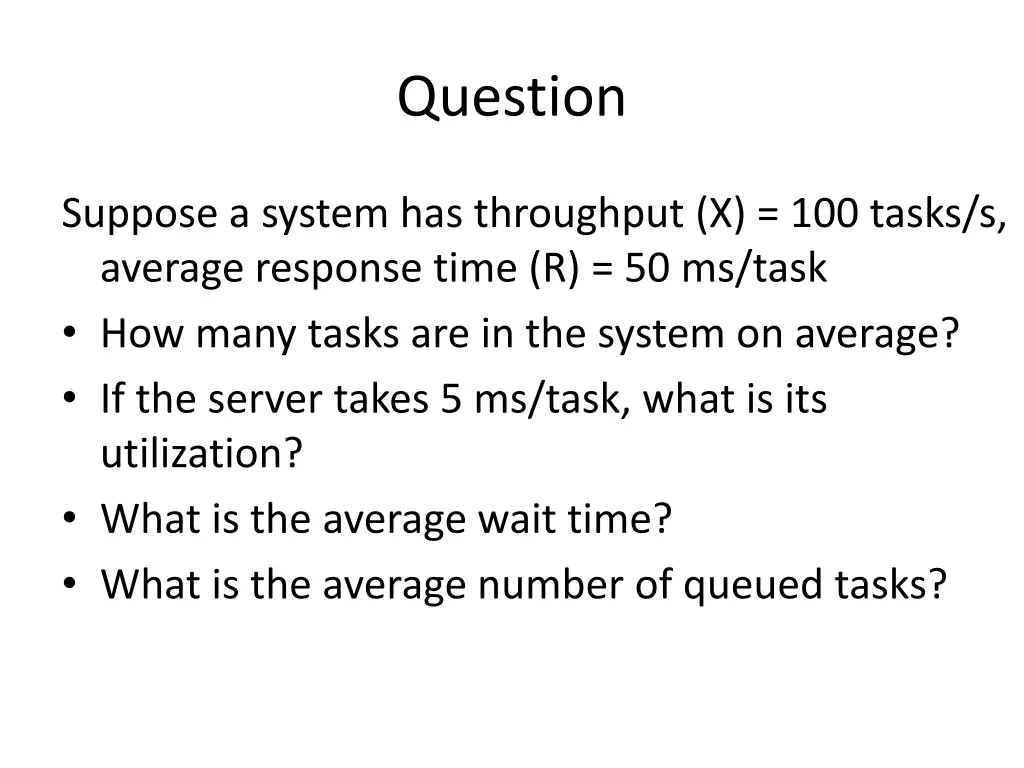
Question Suppose a system has throughput (X) = 100 tasks/s, average response time (R) = 50 ms/task How many tasks are in the system on average? If the server takes 5 ms/task, what is its utilization? What is the average wait time? What is the average number of queued tasks?
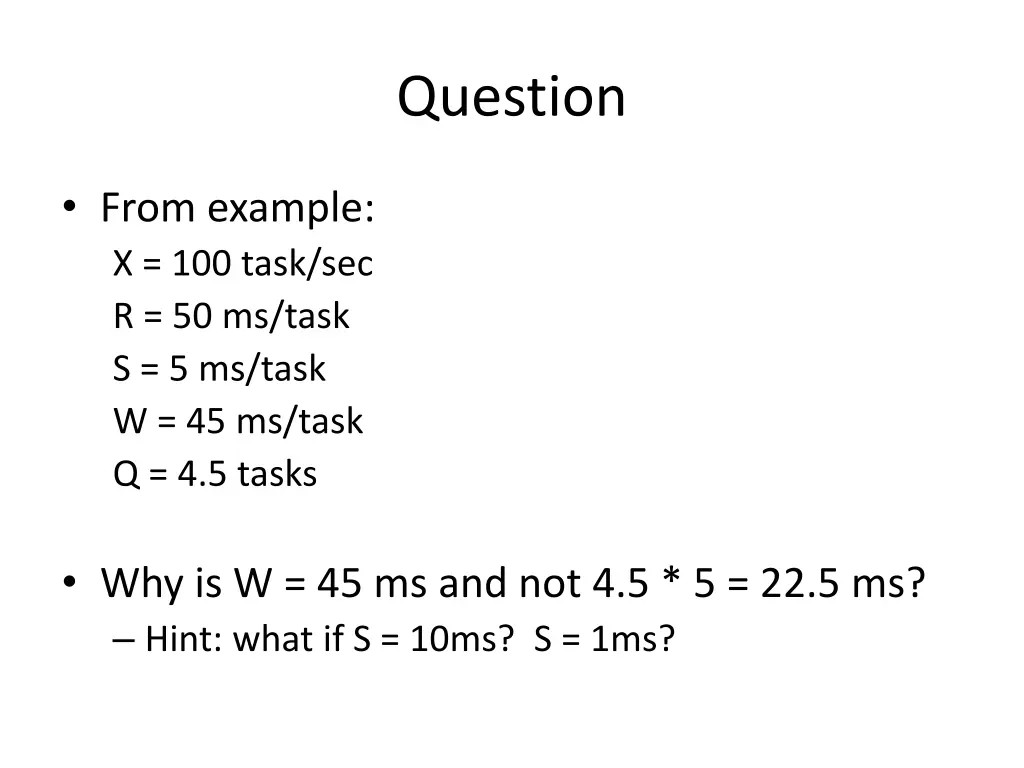
Question From example: X = 100 task/sec R = 50 ms/task S = 5 ms/task W = 45 ms/task Q = 4.5 tasks Why is W = 45 ms and not 4.5 * 5 = 22.5 ms? Hint: what if S = 10ms? S = 1ms?
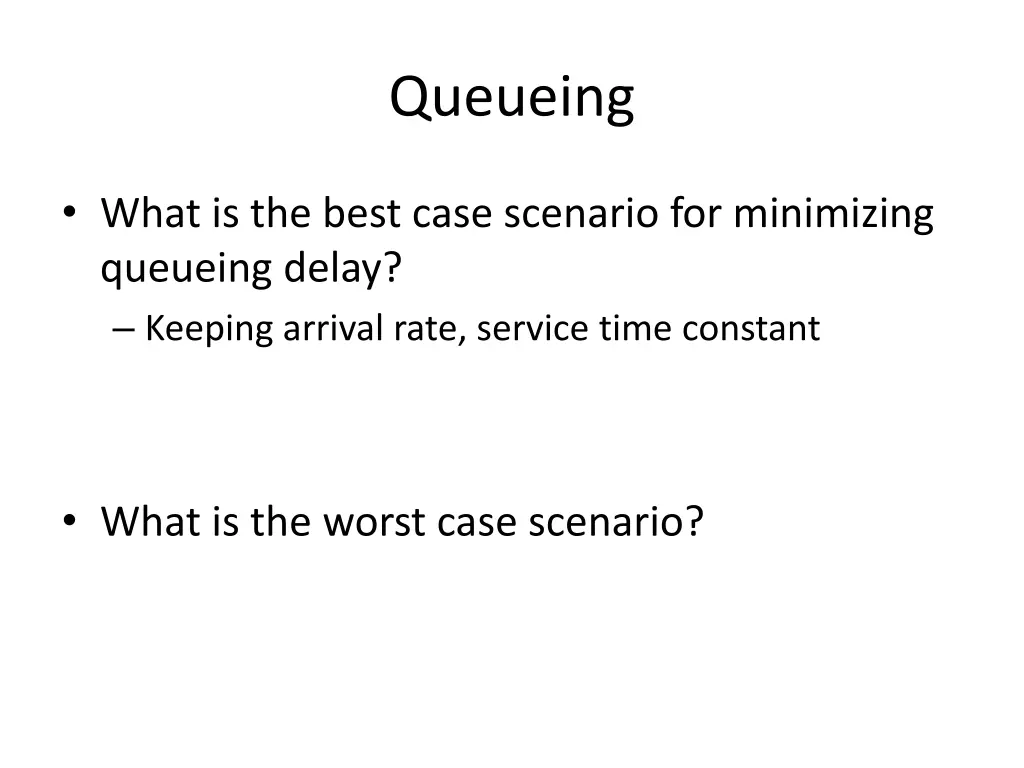
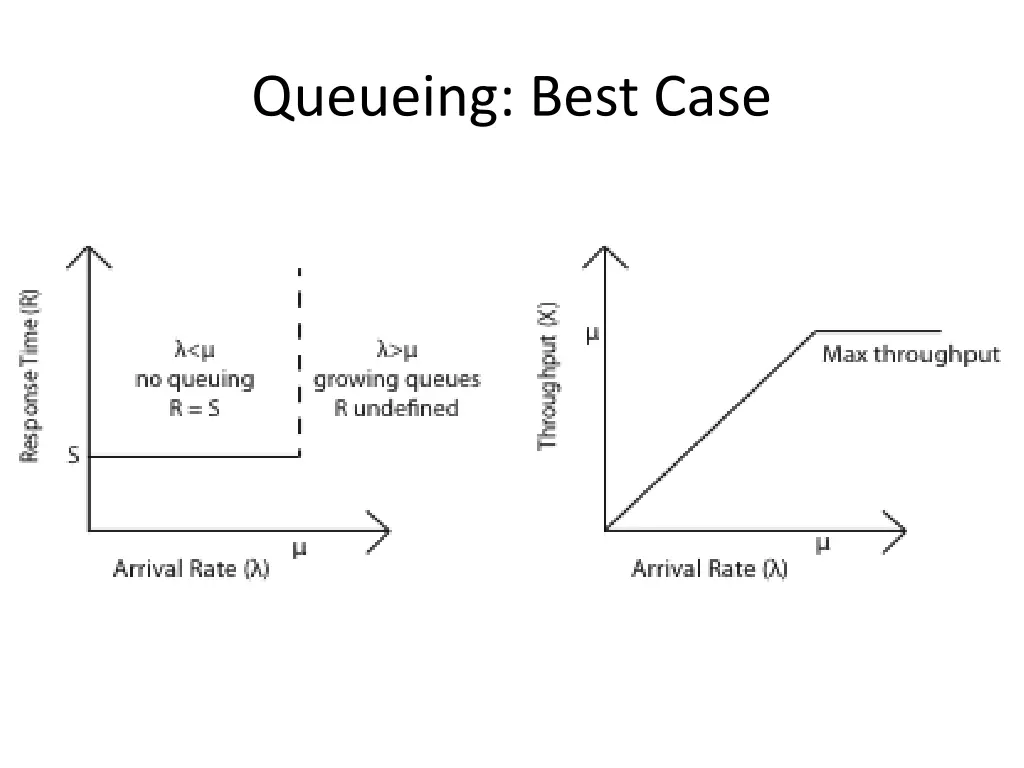
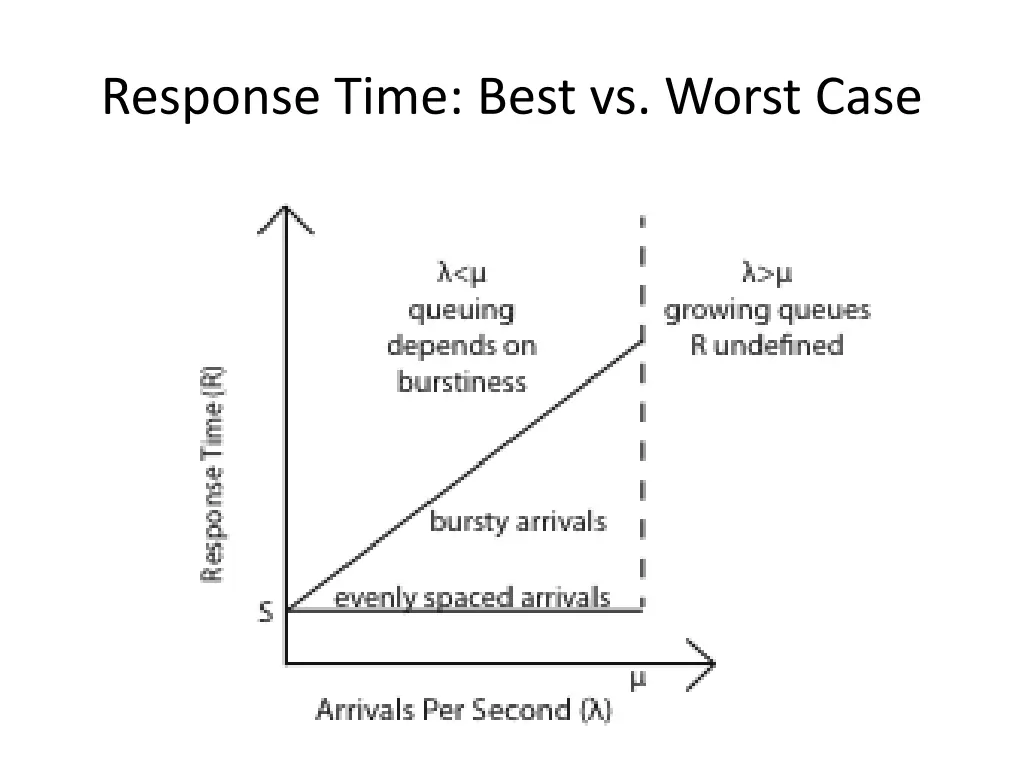
Queueing What is the best case scenario for minimizing queueing delay? Keeping arrival rate, service time constant What is the worst case scenario?
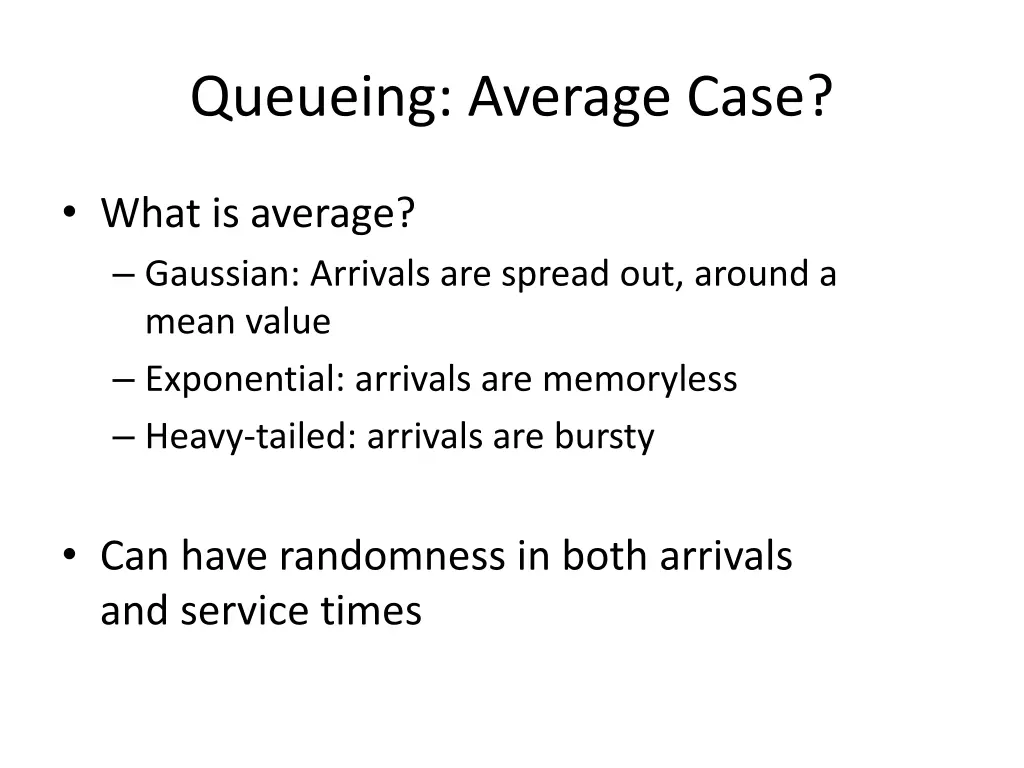
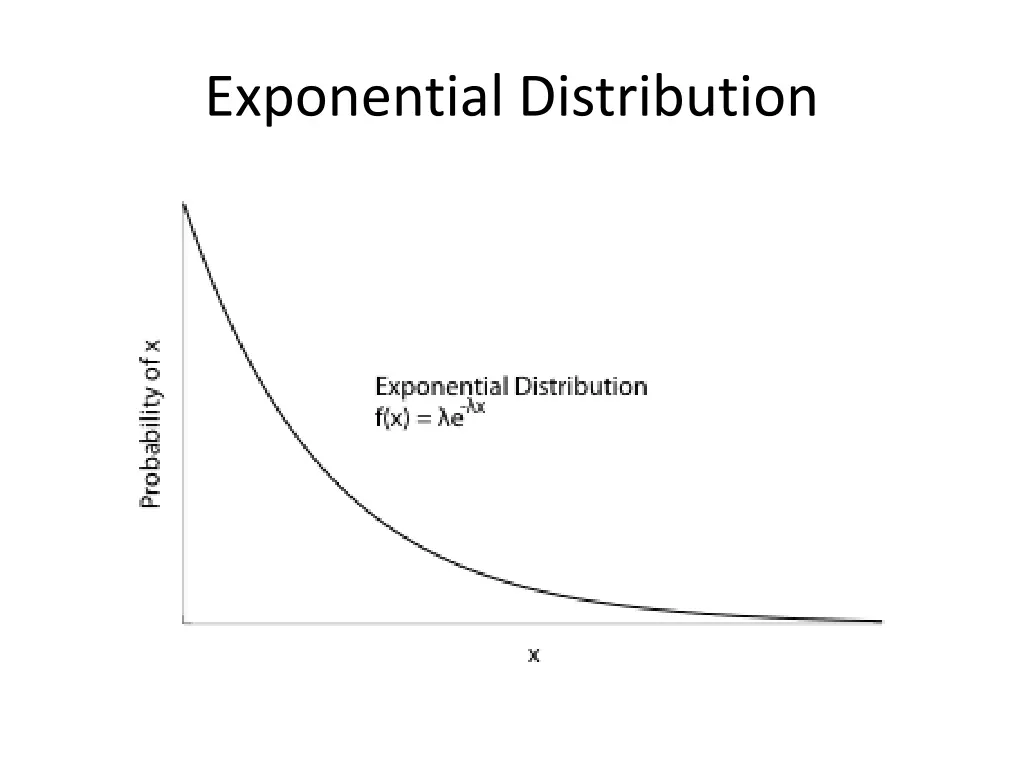
Queueing: Average Case? What is average? Gaussian: Arrivals are spread out, around a mean value Exponential: arrivals are memoryless Heavy-tailed: arrivals are bursty Can have randomness in both arrivals and service times
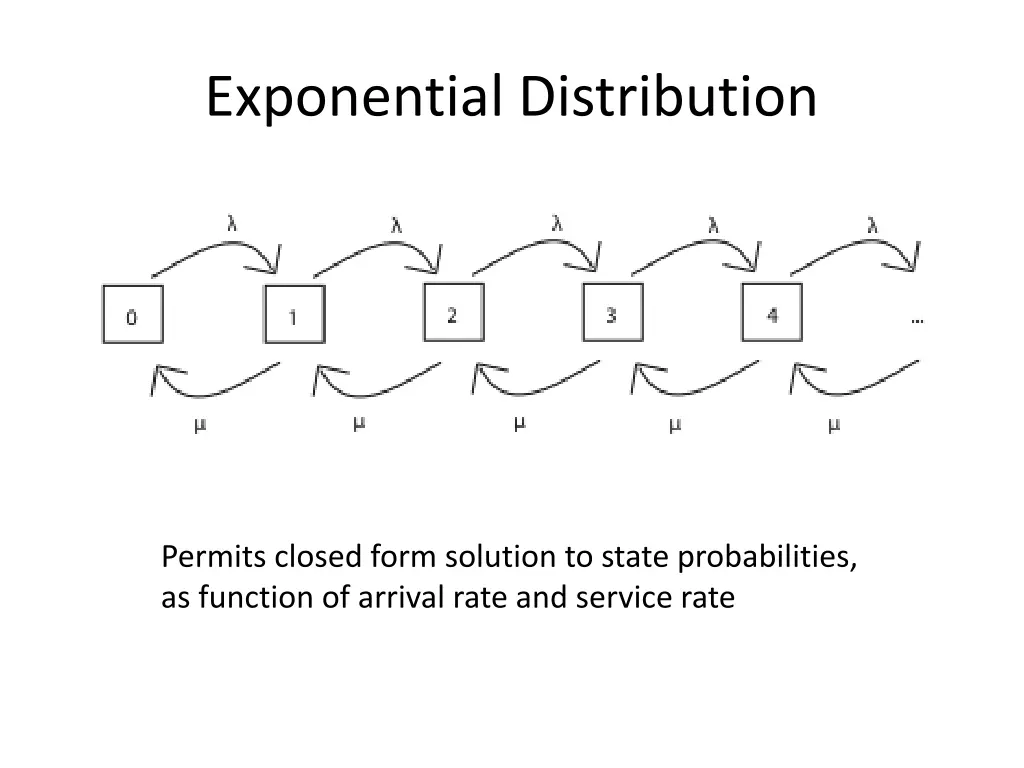
Exponential Distribution Permits closed form solution to state probabilities, as function of arrival rate and service rate
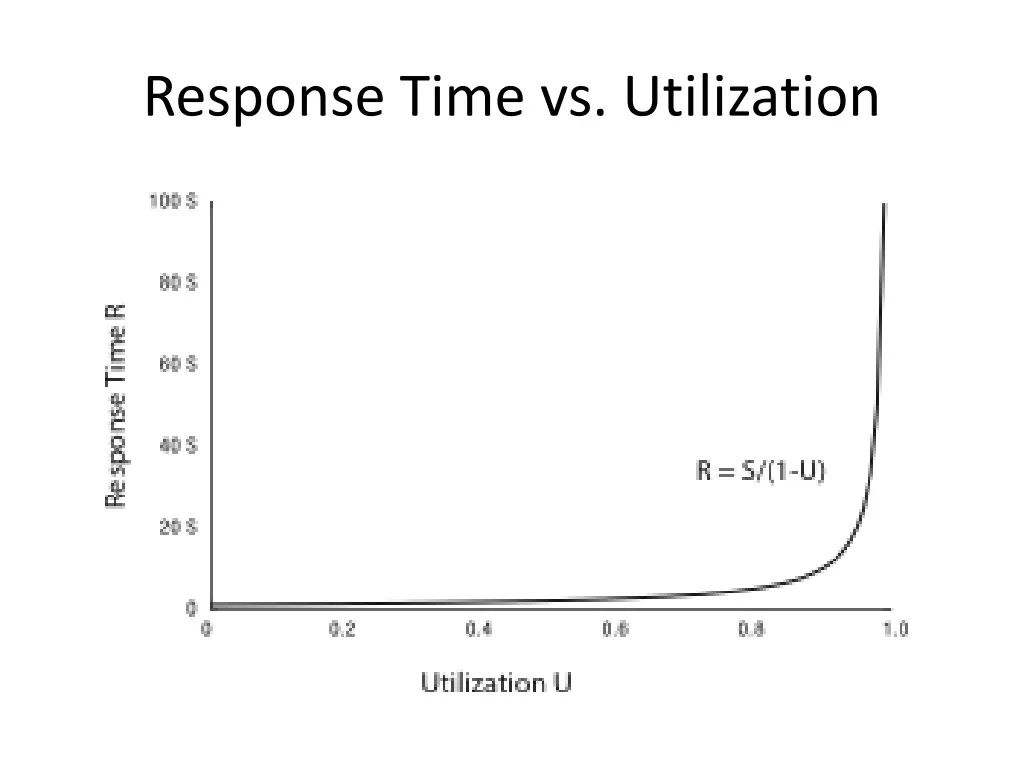
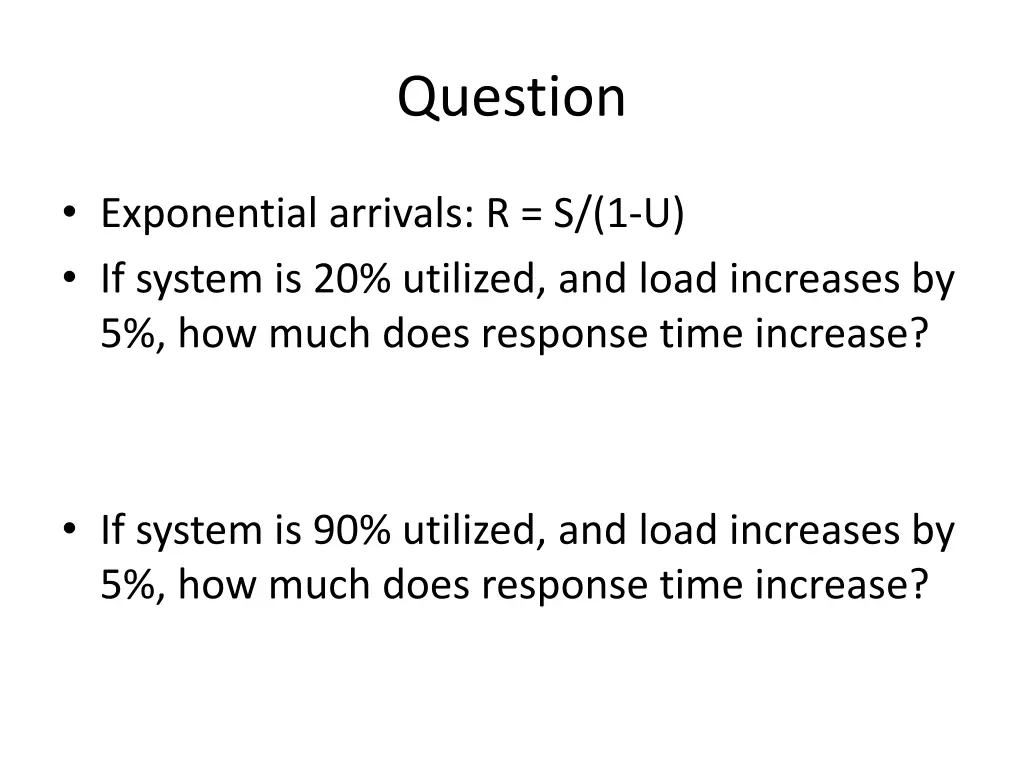
Question Exponential arrivals: R = S/(1-U) If system is 20% utilized, and load increases by 5%, how much does response time increase? If system is 90% utilized, and load increases by 5%, how much does response time increase?
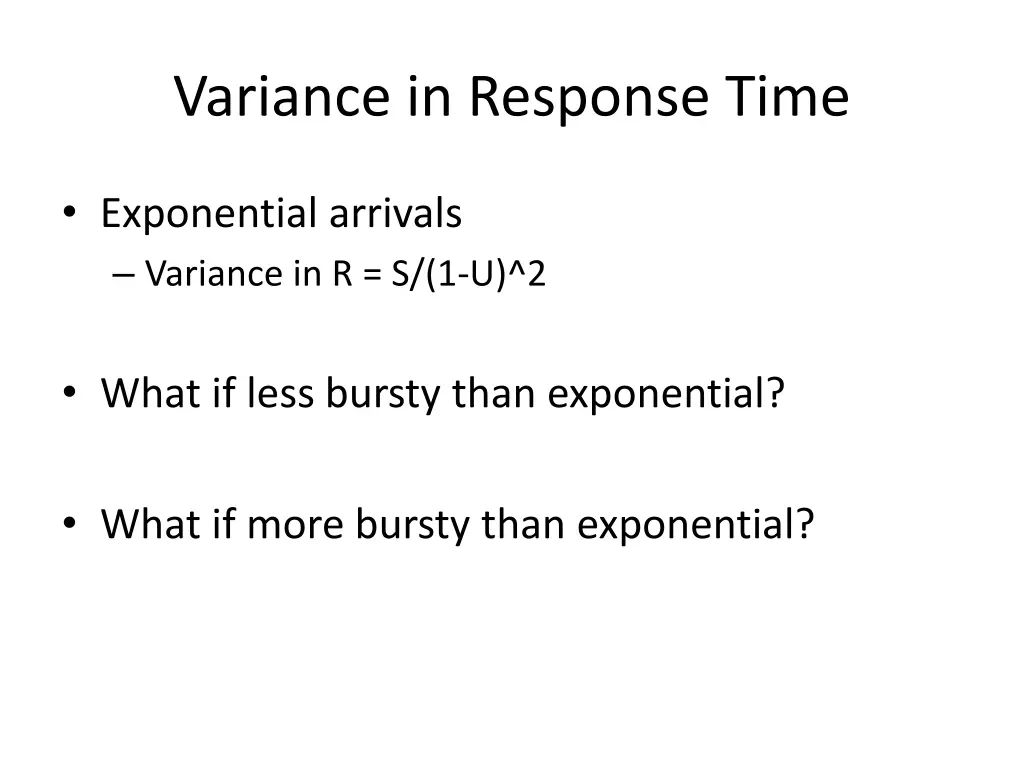
Variance in Response Time Exponential arrivals Variance in R = S/(1-U)^2 What if less bursty than exponential? What if more bursty than exponential?