School-Community Partnerships Supporting Homeless Children, Youth, and Families
Explore the importance of building school-community partnerships to support children, youth, and families experiencing homelessness. Learn about key topics, strategies, and partnership considerations in collaboration with various systems. Discover the role of education in these partnerships and the fundamental needs across systems for safe housing, connections, education, and wellbeing.

Download Presentation

Please find below an Image/Link to download the presentation.
The content on the website is provided AS IS for your information and personal use only. It may not be sold, licensed, or shared on other websites without obtaining consent from the author. If you encounter any issues during the download, it is possible that the publisher has removed the file from their server.
You are allowed to download the files provided on this website for personal or commercial use, subject to the condition that they are used lawfully. All files are the property of their respective owners.
The content on the website is provided AS IS for your information and personal use only. It may not be sold, licensed, or shared on other websites without obtaining consent from the author.
E N D
Presentation Transcript
Building School-Community Partnerships in Support of Children, Youth, and Families Experiencing Homelessness <<add presenter contact information here>>
About This slide deck Was developed by the California Homeless Education Technical Assistance Center (HETAC) Is part of the HETAC s School-Community Partnerships: A Toolkit for Working Together to Serve Children, Youth, and Families Experiencing Homelessness Covers key school-community partnership topics, including statutory requirements for collaboration, partnership considerations and strategies, and a 5-step partnership starter pack Learn more about the HETAC by visiting hetac.org
Pause, Reflect, Discuss Why is it important for schools and other systems (housing, homeless response, workforce development, public benefits, etc.) to partner in support of children, youth, and families experiencing homelessness?
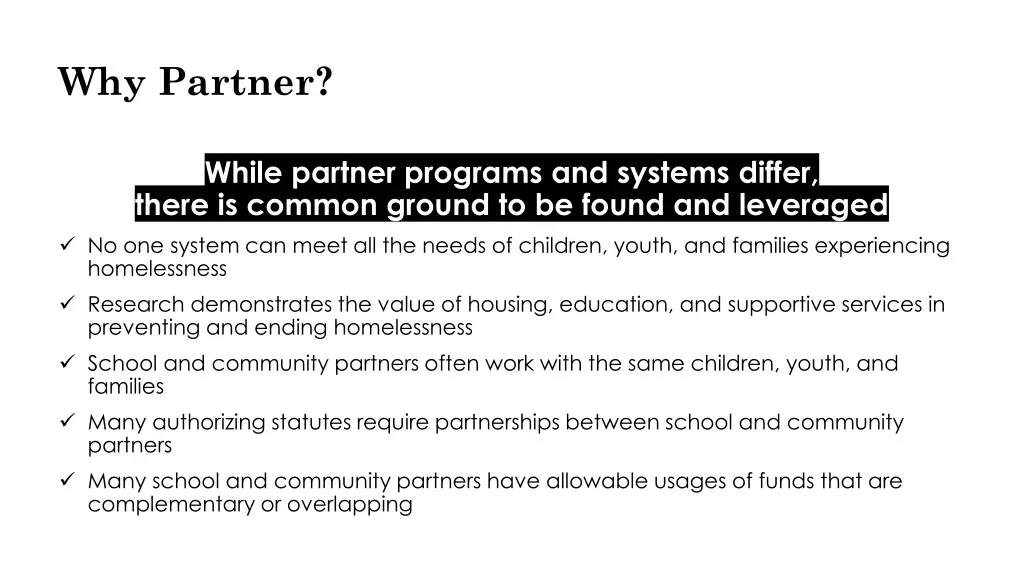
Why Partner? While partner programs and systems differ, there is common ground to be found and leveraged No one system can meet all the needs of children, youth, and families experiencing homelessness Research demonstrates the value of housing, education, and supportive services in preventing and ending homelessness School and community partners often work with the same children, youth, and families Many authorizing statutes require partnerships between school and community partners Many school and community partners have allowable usages of funds that are complementary or overlapping
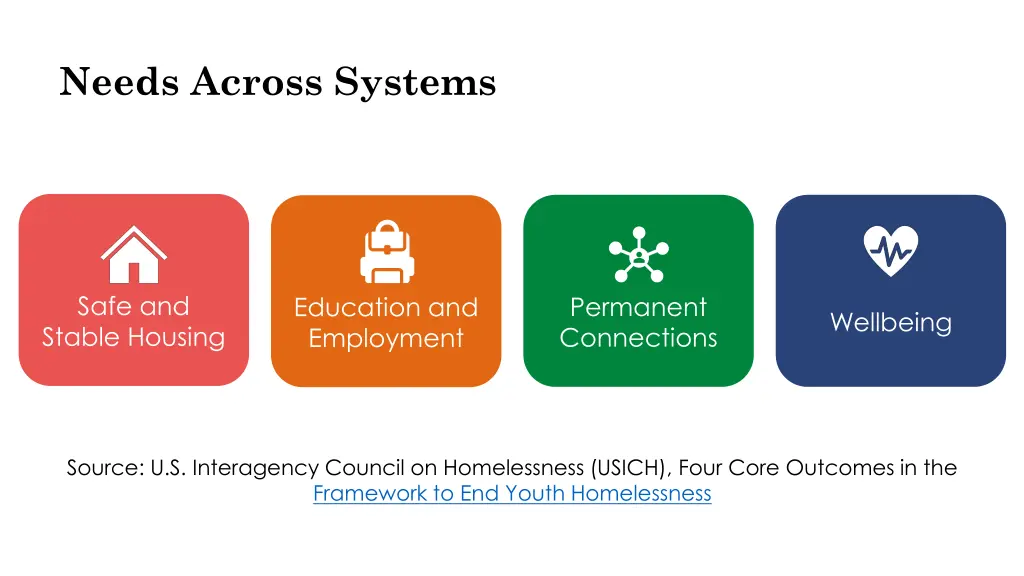
Needs Across Systems Safe and Stable Housing Permanent Connections Education and Employment Wellbeing Source: U.S. Interagency Council on Homelessness (USICH), Four Core Outcomes in the Framework to End Youth Homelessness
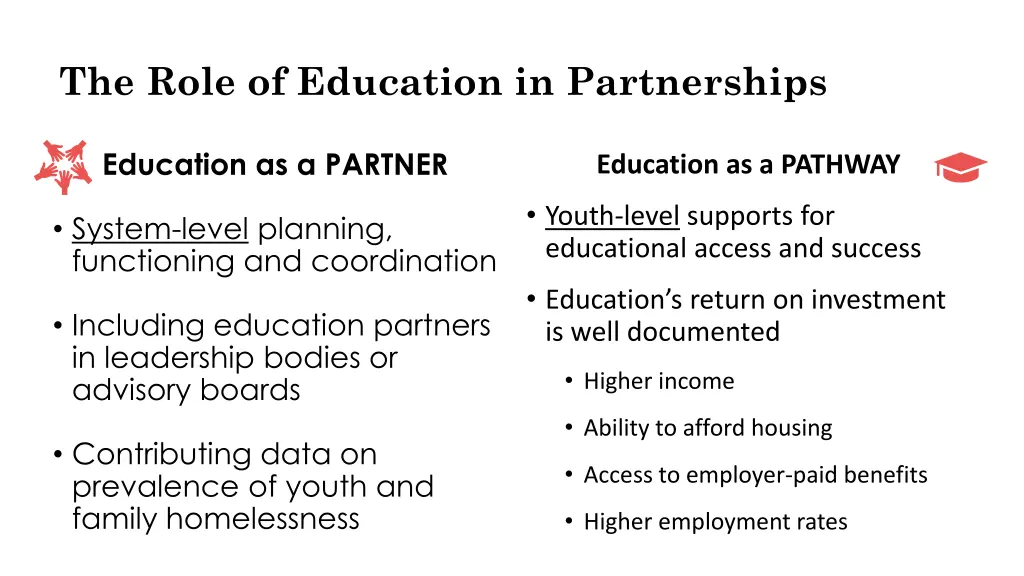
The Role of Education in Partnerships Education as a PARTNER Education as a PATHWAY Youth-level supports for educational access and success System-level planning, functioning and coordination Education s return on investment is well documented Including education partners in leadership bodies or advisory boards Higher income Ability to afford housing Contributing data on prevalence of youth and family homelessness Access to employer-paid benefits Higher employment rates
Statutory Requirements McKinney-Vento Act requirements for collaboration include State Coordinators for Homeless Education and local educational agencies (LEAs) must coordinate with a variety of partners (homeless service providers, child welfare, early childhood, mental health, and others) to improve the provision of comprehensive education and related services to McKinney-Vento students and families Local liaisons must provide McKinney-Vento students and families with referrals to health care, dental, mental health and substance abuse, housing, and other appropriate services
Statutory Requirements Partner statutory requirements for collaboration include Early childhood program homeless provisions (federal Head Start and child care) Homeless response system education assurances in the Homeless Emergency Assistance and Rapid Transition to Housing (HEARTH) Act Runaway and Homeless Youth Act (RHYA) collaboration requirements Workforce Innovation and Opportunity Act (WIOA) collaboration requirements
Partnership Considerations and Strategies
Leveraging Community Partners Remember to tap into the full range of school and community supports to meet the needs of children, youth, and families experiencing homelessness Housing (e.g., rental assistance, public housing authorities) Higher education Connectivity (e-rate for schools and libraries, affordable connectivity program for households) Homeless response (Continuums of Care) Food (child nutrition programs, SNAP) Early care and education (e.g., child care, Head Start) Other community partners (non-profits, service providers, philanthropy, faith community, etc.) K-12 education
What Makes a Strong Partnership? Strong school-community partnerships are Mutually beneficial, with all partners receiving a return on their investment of engagement in partnership work Systematic, implemented via reliable, consistent, organized practices that are communicated across all levels of partner organizations Stable, remaining strong even as partner leadership and staff change over time Effective and responsive, addressing the ongoing and emerging needs of partners and the students and families they serve
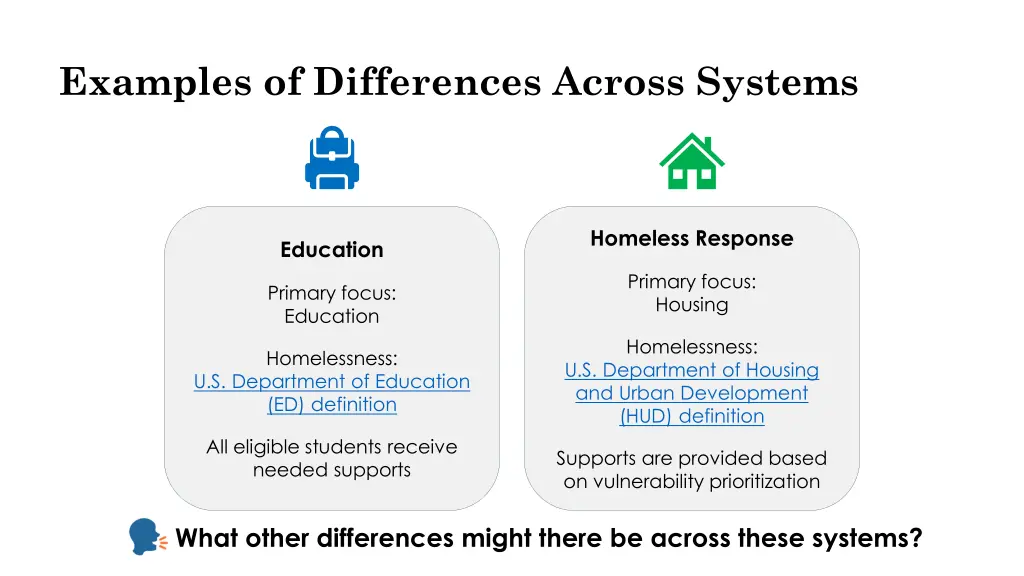
Navigating Differences Partnerships often bring together partners who approach homelessness work differently, including using a different definition of homelessness and focusing on a particular area of need (housing, education, etc.) While these systems culture differences may create challenges, they can be navigated successfully with intentionality and good will
Examples of Differences Across Systems Homeless Response Education Primary focus: Housing Primary focus: Education Homelessness: U.S. Department of Housing and Urban Development (HUD) definition Homelessness: U.S. Department of Education (ED) definition All eligible students receive needed supports Supports are provided based on vulnerability prioritization What other differences might there be across these systems?
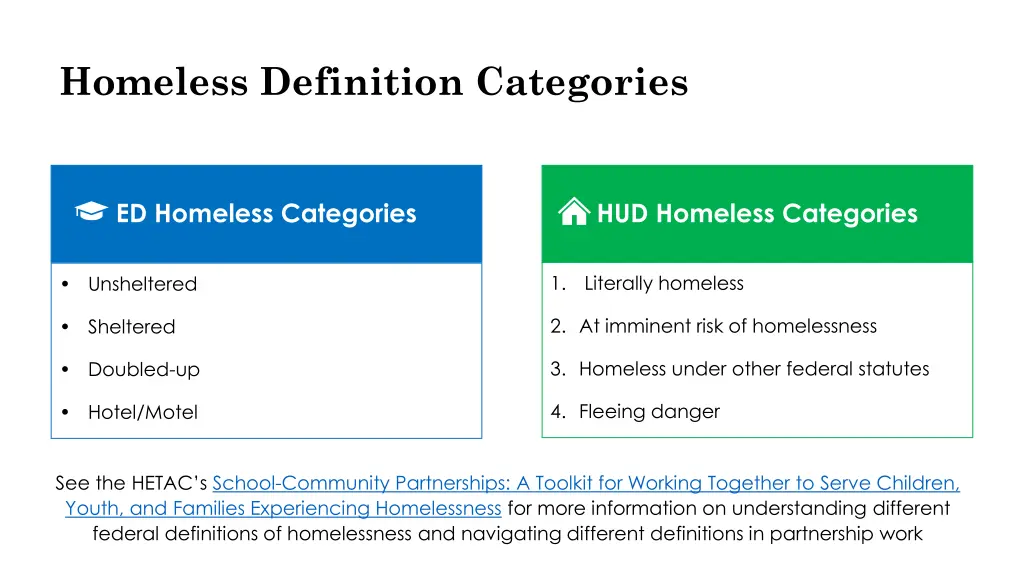
Homeless Definition Categories ED Homeless Categories HUD Homeless Categories 1. Literally homeless Unsheltered 2. At imminent risk of homelessness Sheltered 3. Homeless under other federal statutes Doubled-up 4. Fleeing danger Hotel/Motel See the HETAC s School-Community Partnerships: A Toolkit for Working Together to Serve Children, Youth, and Families Experiencing Homelessness for more information on understanding different federal definitions of homelessness and navigating different definitions in partnership work
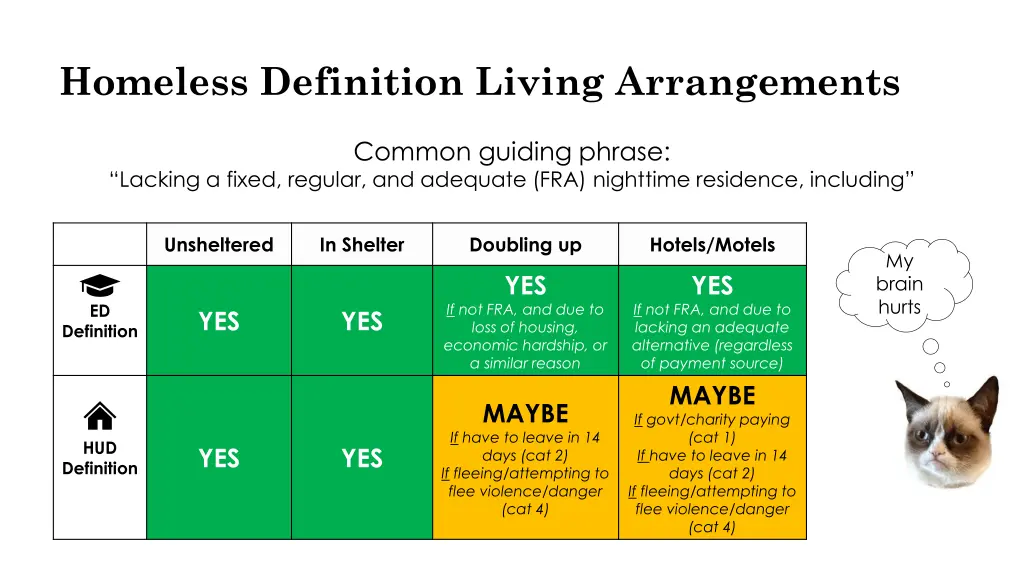
Homeless Definition Living Arrangements Common guiding phrase: Lacking a fixed, regular, and adequate (FRA) nighttime residence, including Unsheltered In Shelter Doubling up Hotels/Motels My brain hurts YES YES If not FRA, and due to loss of housing, economic hardship, or a similar reason If not FRA, and due to lacking an adequate alternative (regardless of payment source) MAYBE If govt/charity paying (cat 1) If have to leave in 14 days (cat 2) If fleeing/attempting to flee violence/danger (cat 4) ED YES YES Definition MAYBE If have to leave in 14 days (cat 2) If fleeing/attempting to flee violence/danger (cat 4) HUD YES YES Definition
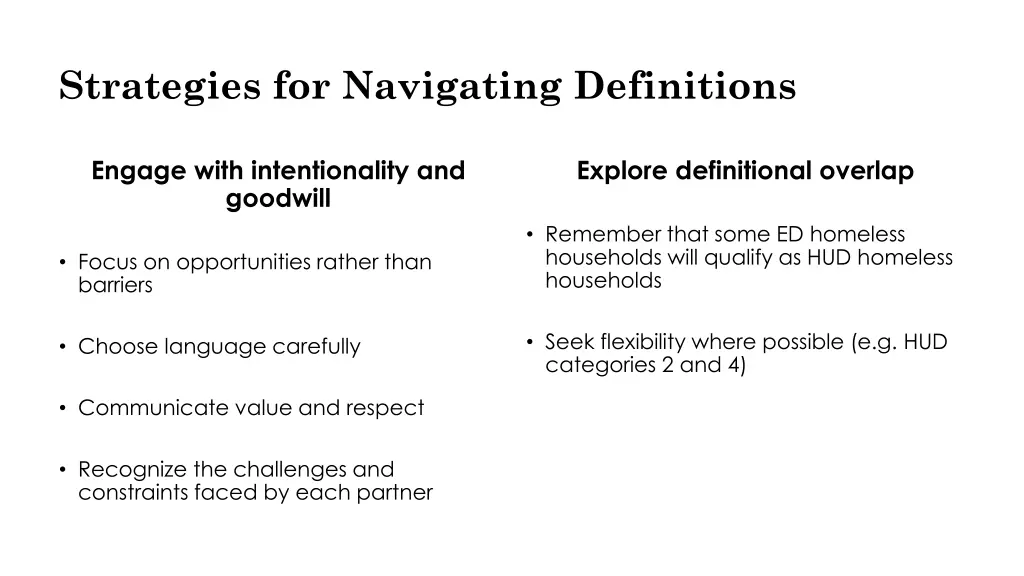
Strategies for Navigating Definitions Engage with intentionality and goodwill Explore definitional overlap Remember that some ED homeless households will qualify as HUD homeless households Focus on opportunities rather than barriers Seek flexibility where possible (e.g. HUD categories 2 and 4) Choose language carefully Communicate value and respect Recognize the challenges and constraints faced by each partner
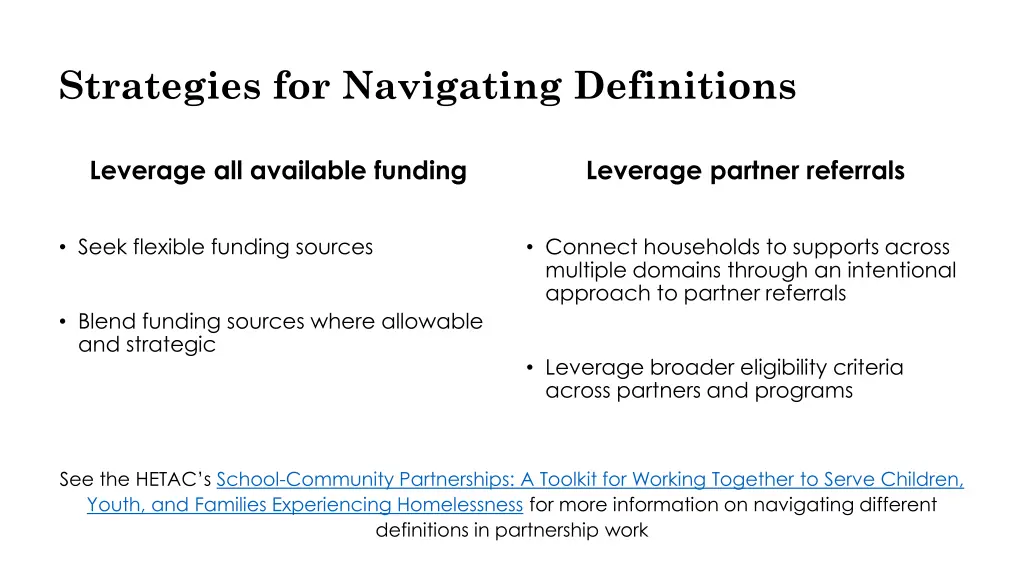
Strategies for Navigating Definitions Leverage all available funding Leverage partner referrals Seek flexible funding sources Connect households to supports across multiple domains through an intentional approach to partner referrals Blend funding sources where allowable and strategic Leverage broader eligibility criteria across partners and programs See the HETAC s School-Community Partnerships: A Toolkit for Working Together to Serve Children, Youth, and Families Experiencing Homelessness for more information on navigating different definitions in partnership work
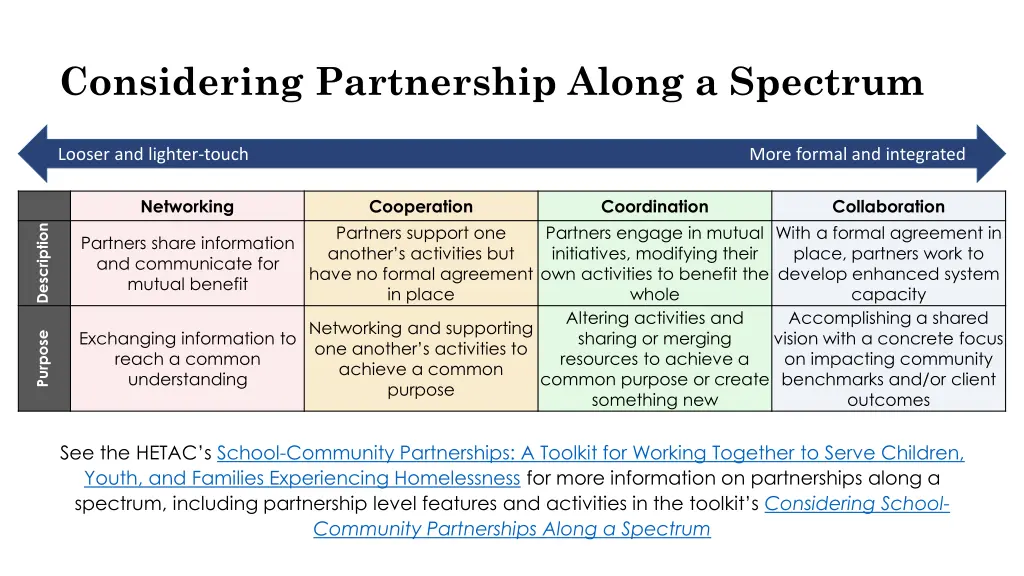
Considering Partnership Along a Spectrum Looser and lighter-touch More formal and integrated Networking Cooperation Partners support one another s activities but have no formal agreement in place Coordination Collaboration Partners engage in mutual initiatives, modifying their own activities to benefit the whole Altering activities and sharing or merging resources to achieve a common purpose or create something new With a formal agreement in place, partners work to develop enhanced system capacity Accomplishing a shared vision with a concrete focus on impacting community benchmarks and/or client outcomes Description Partners share information and communicate for mutual benefit Networking and supporting one another s activities to achieve a common purpose Exchanging information to reach a common understanding Purpose See the HETAC s School-Community Partnerships: A Toolkit for Working Together to Serve Children, Youth, and Families Experiencing Homelessness for more information on partnerships along a spectrum, including partnership level features and activities in the toolkit s Considering School- Community Partnerships Along a Spectrum
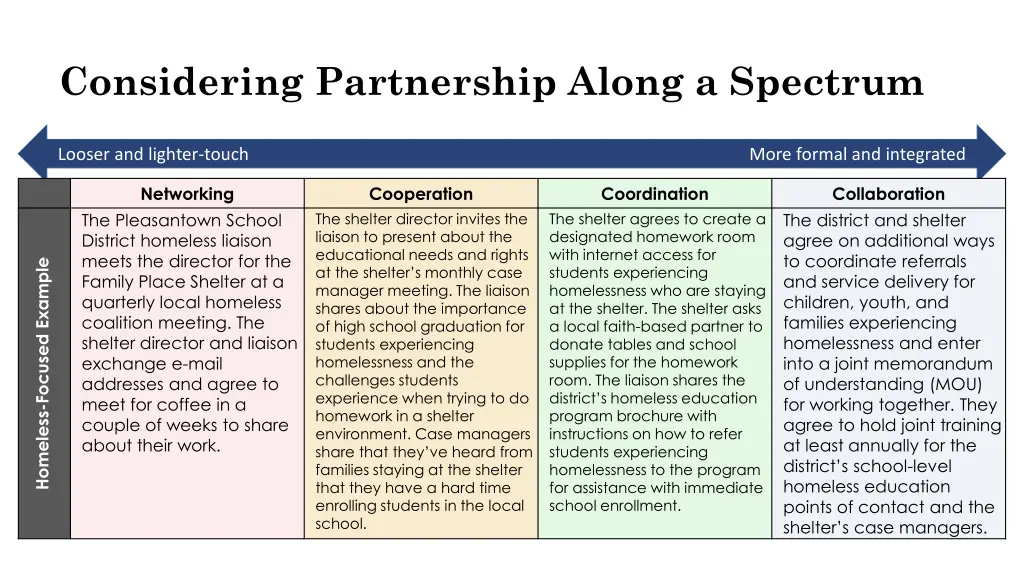
Considering Partnership Along a Spectrum Looser and lighter-touch More formal and integrated Networking Cooperation Coordination The shelter agrees to create a designated homework room with internet access for students experiencing homelessness who are staying at the shelter. The shelter asks a local faith-based partner to donate tables and school supplies for the homework room. The liaison shares the district s homeless education program brochure with instructions on how to refer students experiencing homelessness to the program for assistance with immediate school enrollment. Collaboration The district and shelter agree on additional ways to coordinate referrals and service delivery for children, youth, and families experiencing homelessness and enter into a joint memorandum of understanding (MOU) for working together. They agree to hold joint training at least annually for the district s school-level homeless education points of contact and the shelter s case managers. The Pleasantown School District homeless liaison meets the director for the Family Place Shelter at a quarterly local homeless coalition meeting. The shelter director and liaison exchange e-mail addresses and agree to meet for coffee in a couple of weeks to share about their work. The shelter director invites the liaison to present about the educational needs and rights at the shelter s monthly case manager meeting. The liaison shares about the importance of high school graduation for students experiencing homelessness and the challenges students experience when trying to do homework in a shelter environment. Case managers share that they ve heard from families staying at the shelter that they have a hard time enrolling students in the local school. Homeless-Focused Example
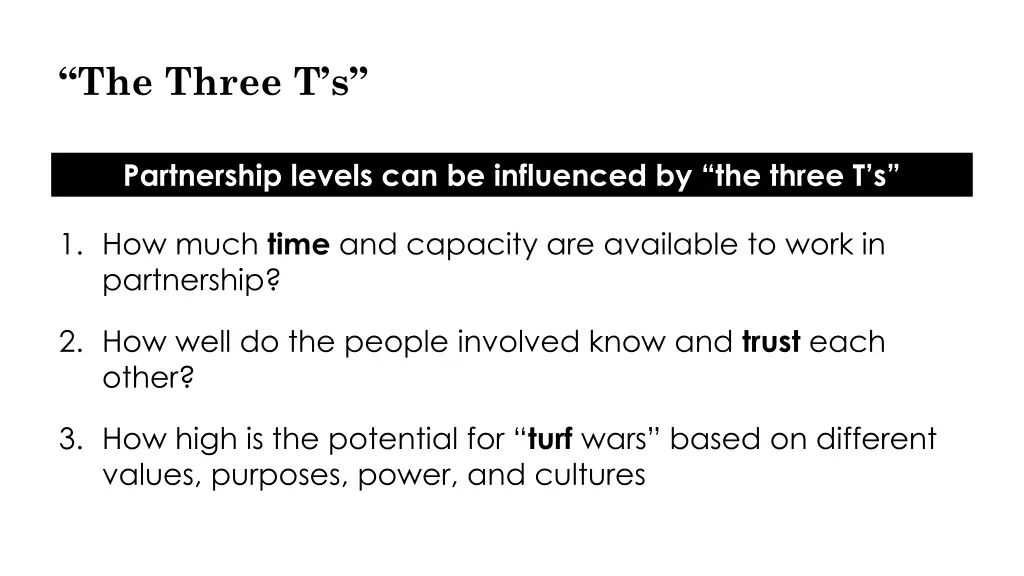
The Three Ts Partnership levels can be influenced by the three T s 1. How much time and capacity are available to work in partnership? 2. How well do the people involved know and trust each other? 3. How high is the potential for turfwars based on different values, purposes, power, and cultures
Pause, Reflect, Discuss 1.Who are some of your key partners? 2.How are the partnerships going? What is going well? What are the challenges?
The Partnership Starter Pack 1. Reach out and connect 2. Listen to your partners and focus on areas of mutual benefit 3. Target touchpoints for early momentum and build from there 4. Be savvy and strategic in messaging and engagements 5. Continue to engage and invest
The Partnership Starter Pack STEP 1 Reach out and connect Reach out and contact your partners across the aisle Share about your work and ask your partners to share about theirs
The Partnership Starter Pack STEP 2 Listen to your partners and focus on efforts with mutual benefit Seek to build a partnership where each partner receives a return on their investment of time and resources Move from abstract discussion to concrete action steps
The Partnership Starter Pack STEP 3 Target touchpoints that can build early momentum Focus first on low-hanging fruit Over time, take on more complex issues that may yield more impactful results
The Partnership Starter Pack STEP 4 Be savvy and strategic in messaging and engagements Consider how your partner might view an issue and message accordingly Design engagements with your partner s interests and needs in mind
The Partnership Starter Pack STEP 5 Continue to engage and invest Establish ongoing communication with your partners across the aisle Discuss emerging issues and consider additional needed action
Applying an Equity Lens An intentional focus on equity is critical in human services work Addressing inequities for marginalized populations in partner systems is important for creating communities that are safe and healthy for everyone Marginalized populations include People of color People identifying as LGBTQIA+ People with disabilities Other populations unique to each community
Applying an Equity Lens A focus on equity should be woven throughout school-community partnership work Equity considerations in partnership work may include Representation: How is our partnership ensuring diverse representation in our leadership bodies? Data: What does data across partner systems tell us about which populations most need services, which populations have access to services, and how different populations fare when receiving services? Planning and implementation: How are we collectively ensuring a focus on equity throughout partnership planning, implementation, and evaluation?
Engaging People with Lived Expertise Engaging authentically with children, youth, and families experiencing homelessness in school-community partnership planning and implementation Centers the voice of people most impacted by homelessness in addressing it Elevates the perspectives of people who have lived homelessness as a credible and authoritative source of information and recommendations Helps correct power imbalances that occur when people who have not experienced homelessness are the main decision makers for how it is addressed
Engaging People with Lived Expertise Considerations for engaging lived expertise in school-community partnership may include Representation: How is our partner network ensuring representation of children, youth, and families who have been involved with or served by system partners? Elevation: How are system partners elevating the voice of people with lived expertise in partnership work, including in planning and decision-making? Others? (pause, reflect, discuss) For more information, visit the California HETAC s Engaging People with Lived Experience webpage
Meeting Planning Plan school-community partner meetings in ways that make good use of partners time and keep partners coming back Given that partner systems operate differently, consider tailoring individual meetings to the unique touchpoints of each partner system If inviting multiple partner systems to a single gathering, consider sharing information of common interest with all partners and splitting into groups to for partner-specific conversations
Possible Areas of Partnership Focus Areas of focus for school-community partner work may include Staying informed about new legislation, opportunities, funding streams, etc. Needs-sensing (particularly in early conversations) Identifying children, youth, and families Engaging people with lived experience Referring children, youth, and families to services across programs and partners Addressing inequities across systems Maintaining a connected and active partner network Delivering coordinated and comprehensive services
Pause, Reflect, Discuss What is one key takeaway from this presentation? What is one next step you can take to develop stronger school-community partnerships in your area?
For More Information For more information, access the HETAC s School-Community Partnerships: A Toolkit for Working Together to Serve Children, Youth, and Families Experiencing Homelessness, including Understanding and navigating different federal definitions of homelessness Collecting and organizing partner information using a partner inventory (template provided) Planning partner meetings (template provided) Drafting partner memoranda of understanding (MOUs; example provided)
Building School-Community Partnerships in Support of Children, Youth, and Families Experiencing Homelessness <<add presenter contact information here>>















![USA Swimming and [Insert LSC Here] Starter Clinic Overview](/thumb/162824/usa-swimming-and-insert-lsc-here-starter-clinic-overview.jpg)