Science of Measurement: Qualitative vs Quantitative, Precision, Accuracy, Significant Figures
The science of measurement involves qualitative and quantitative approaches, focusing on precision, accuracy, and significant figures. Learn about the types of measurement, scientific notation, accepted vs experimental values, percent error, and significant figures rules.

Download Presentation

Please find below an Image/Link to download the presentation.
The content on the website is provided AS IS for your information and personal use only. It may not be sold, licensed, or shared on other websites without obtaining consent from the author.If you encounter any issues during the download, it is possible that the publisher has removed the file from their server.
You are allowed to download the files provided on this website for personal or commercial use, subject to the condition that they are used lawfully. All files are the property of their respective owners.
The content on the website is provided AS IS for your information and personal use only. It may not be sold, licensed, or shared on other websites without obtaining consent from the author.
E N D
Presentation Transcript
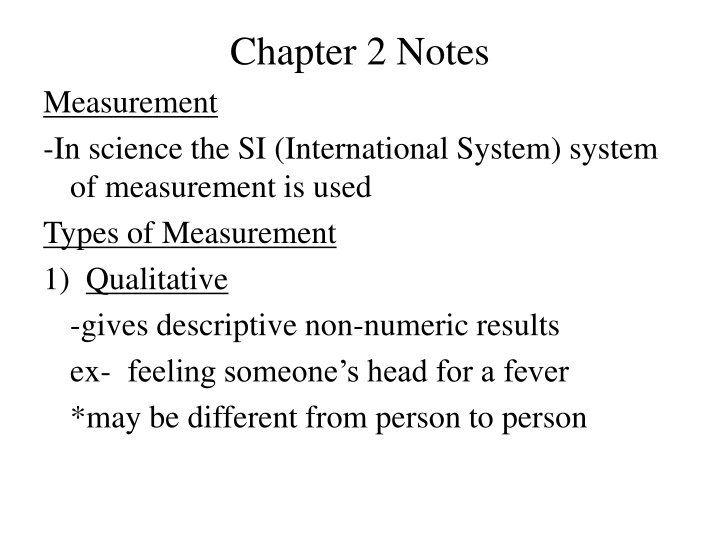
Chapter 2 Notes Measurement -In science the SI (International System) system of measurement is used Types of Measurement 1) Qualitative -gives descriptive non-numeric results ex- feeling someone s head for a fever *may be different from person to person
2) Quantitative -gives definite numeric results ex- using thermometer to check for fever
Scientific Notation ex 7.82 x 10³ -always a coefficient (in ex: 7.82) multiplied by 10 raised to a power (in ex: 103) *coefficient must be a number 1 < 10 *the exponent shows how many times the coefficient is multiplied or divided by 10 -used to write small or large numbers
precision- how close a series of measurements are to one another accuracy- the closeness of measurements to the true value of what is being observed *Can be precise, but not accurate or vice versa -page 49 figure 3.1 -to evaluate the accuracy you must compare with the actual value
accepted value- correct value based on reliable references ex- boiling point of water = 100 C or 212 F experimental value- the value measured in the lab ex- measured bp of water = 99.1 C Error = experimental value accepted value ex- error = 99.1 C - 100 C = 0.90 C
percent error = error X 100 accepted value X 100 ex- 0.90 C 100 C =0.90%
Significant Figures -all the digits that can be known precisely in a measurement plus a last estimated digit Atlantic Rule -if a decimal point is absent, start counting from the first non-zero digit from the Atlantic Ocean side inland (right left) Pacific Rule -if a decimal point is present, start counting from the first non-zero digit from the Pacific Ocean side inland (left right) **All # s significant when counting
Examples 1100m (2) 0.00130ML (3) 2003g (4) 3000 cars (4) 456 (3) 17.80 (4)
10400L 308g 0.00240m 0.40500L 230L 0.04020g 5600mg 200 pens
Rounding Sig Figs Round each number to 2 sig figs: 15698 16000 1304 1300 560 560 34.29 34 487.20 490 62.17 62
Multiplying/Dividing Sig Figs -the answer must have the same number of sig figs as the factor with the fewest sig figs Ex- (40)(56)(340) 761600 800000 (1 sig fig) Ex- 2.0035 3.20 0.626094 0.626 (3 sig figs)
Adding/Subtracting Sig Figs -the result must have the same number of decimal places as the quantity with the fewest decimal places Ex- 2.345 + 0.07 + 2.9975 5.4125 5.41 (2 decimal places) Ex- 5.9 0.221 5.679 5.7 (1 decimal place)
Metric System -universal system of measurement used by scientists globally (SI) -based on scales/multiples of 10 -uses prefixes to convert numbers Length- size, distance -basic unit is the meter (m) 1 meter = 39.37 inches -Find your height in meters!!!
Mass- the amount of matter in an object -basic unit is the gram (g) 1 kg = 2.2 lbs -Find your weight in kilograms!! weight- measure of the pull of gravity on a given mass -mass is always the same, but weight can change -weight on the moon is 1/6 your weight on the Earth -Find your weight on the moon!!
Volume- the amount of space an object occupies -basic unit is the Liter (L) 1 L = 1.06 quarts **1 milliliter = 1 cm3HOW?? (length)(width)(height/thickness) = volume (cm)(cm)(cm) = cm3(cc) = mL
Temperature- how hot or cold something is -basic unit is Celsius ( C) Conversions: F = 1.8( C) + 32 C = ( F 32) 1.8 Kelvin = K = C + 273 C = K - 273 1) 15 C = ? F 1.8(15) + 32 27 + 32 = 59 F
2) 37F = ?C (37-32)/1.8 2.78 C 3) above to Kelvin 2.78 C + 273 = 275.78K Try These! 37 C = ? F 72 F = ? C and K