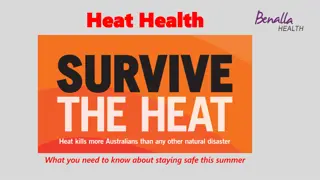
SCORCH aims to reduce the impact of cross-border heatwaves on vulnerable urban populations through enhanced risk communication strategies. Coordinated by the University Hospital Heidelberg, the project involves partners from Belgium, Netherlands, Israel, and Georgia. With a budget of €953,616, SCORCH focuses on developing effective heat risk communication, drawing from existing EU plans and guidelines to strengthen cross-border collaboration and improve public health responses during extreme heat events.
Please find below an Image/Link to download the presentation.
The content on the website is provided AS IS for your information and personal use only. It may not be sold, licensed, or shared on other websites without obtaining consent from the author. If you encounter any issues during the download, it is possible that the publisher has removed the file from their server.
You are allowed to download the files provided on this website for personal or commercial use, subject to the condition that they are used lawfully. All files are the property of their respective owners.
The content on the website is provided AS IS for your information and personal use only. It may not be sold, licensed, or shared on other websites without obtaining consent from the author.
E N D
Presentation Transcript
SCORCH Supportive Risk Awareness and Communication to Reduce Impact of Cross-Border Heatwaves evaplan at the University Hospital Heidelberg Dr. Ahmad Zia Shams Prof. Dr. Michael Marx UCLouvain Dr. Joris van Loenhout Prof. Dr. Debarati Guha-Sapir
SCORCH Call: Prevention in Civil Protection and Marine Pollution Eligible Costs: 953,616.10 EU Contribution: 715,212.09 Duration: 24 Months (starting from 1stFebruary 2019) Overall objective: to reduce the impact of heat waves on vulnerable, urban populations through improved risk communication strategies, based on existing EU plans and guidelines.
Consortium evaplan at the University Hospital Heidelberg, Germany (Coordinator) Universit catholique de Louvain, Belgium INCHES, Netherlands Tel Aviv University, Israel Educational Research Center for Environment and Health, Georgia *Sub-contracting is planned with a public health agency in Tunisia
Rationale Heatwaves have a large public health impact Cross-border phenomenon Risk groups: small children and elderly Cities are especially affected due to Urban Heat Island effect Expected increase in frequency and intensity because of climate change Human impact can be reduced by appropriate risk communication Several countries have developed National Heatwave Plans Learn from previous experiences
Expected Output Main Output Heat risk communication strategies, adapted to country needs Primary target countries: Tunisia, Israel, Georgia Other outputs Improved understanding of risky and protective behaviours Review of heatwave plans and guidelines Strengthened cross-border collaboration on heat impact prevention
Important Timelines M6 Compilation of heatwave plans and literature review M12 Critical analysis of heatwave plans and population surveys M18 Targeted risk communication campaigns - Israel, Georgia, Tunisia M21 Stakeholder workshops - Israel, Georgia, Tunisia Project meetings: M2 (Heidelberg), M11 (Israel) and M20 (Georgia)