Explore the statistical analysis of the damage index for single-degree-of-freedom systems subjected to white noise base input. The study considers time domain analysis, rainflow cycle counting, and relative damage calculation using fatigue exponents. Results indicate an approximate lognormal distribution of the damage index, aiding in predicting tolerance limits. A numerical study with one million runs and varying fatigue exponents sheds light on the relative damage index variation.
Please find below an Image/Link to download the presentation.
The content on the website is provided AS IS for your information and personal use only. It may not be sold, licensed, or shared on other websites without obtaining consent from the author. If you encounter any issues during the download, it is possible that the publisher has removed the file from their server.
You are allowed to download the files provided on this website for personal or commercial use, subject to the condition that they are used lawfully. All files are the property of their respective owners.
The content on the website is provided AS IS for your information and personal use only. It may not be sold, licensed, or shared on other websites without obtaining consent from the author.
E N D
Presentation Transcript
Vibrationdata SDOF Response to White Noise Base Input Rainflow Statistical Study Revision A By Tom Irvine May 17, 2021 1
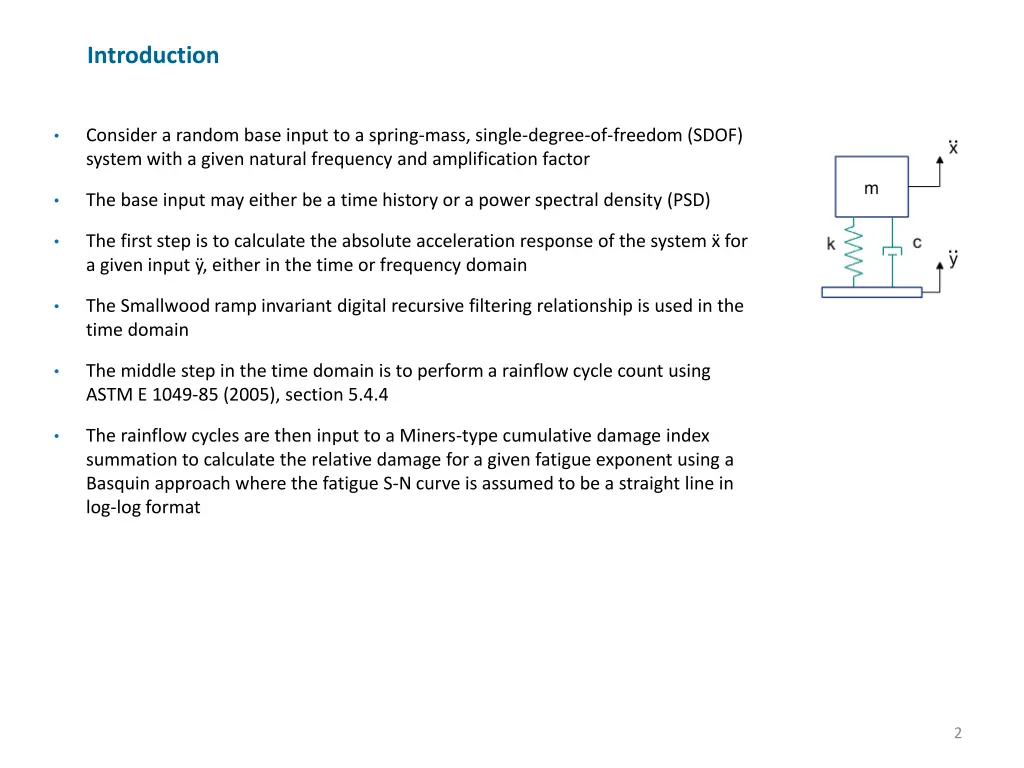
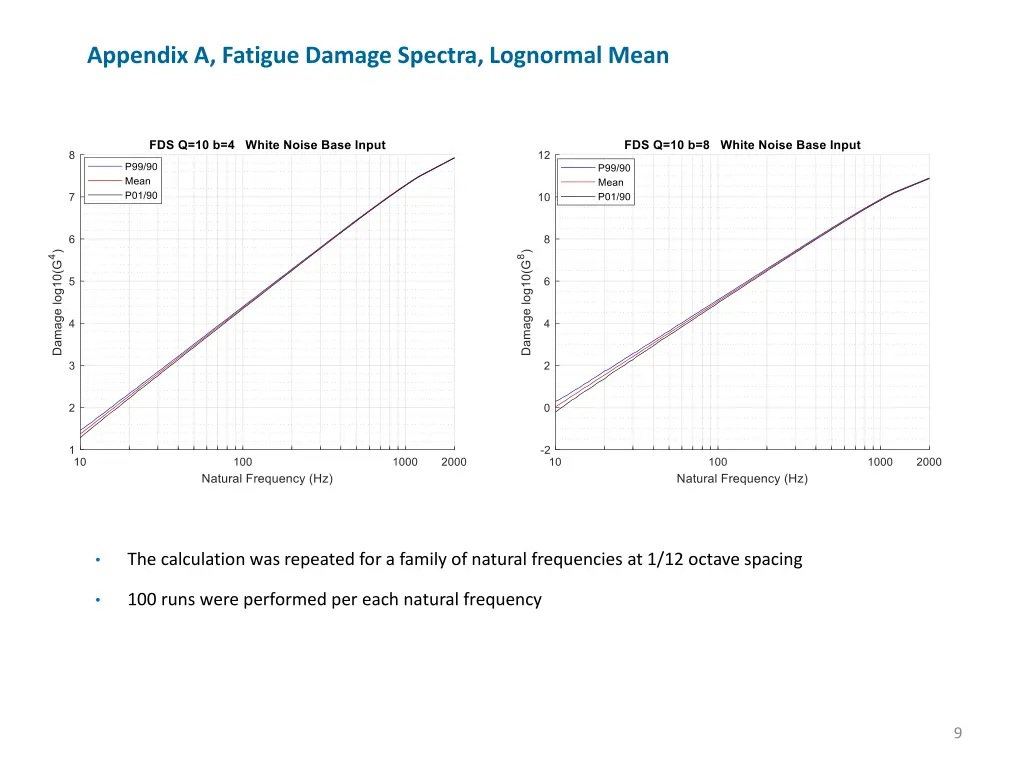
Introduction Consider a random base input to a spring-mass, single-degree-of-freedom (SDOF) system with a given natural frequency and amplification factor The base input may either be a time history or a power spectral density (PSD) The first step is to calculate the absolute acceleration response of the system for a given input , either in the time or frequency domain The Smallwood ramp invariant digital recursive filtering relationship is used in the time domain The middle step in the time domain is to perform a rainflow cycle count using ASTM E 1049-85 (2005), section 5.4.4 The rainflow cycles are then input to a Miners-type cumulative damage index summation to calculate the relative damage for a given fatigue exponent using a Basquin approach where the fatigue S-N curve is assumed to be a straight line in log-log format 2
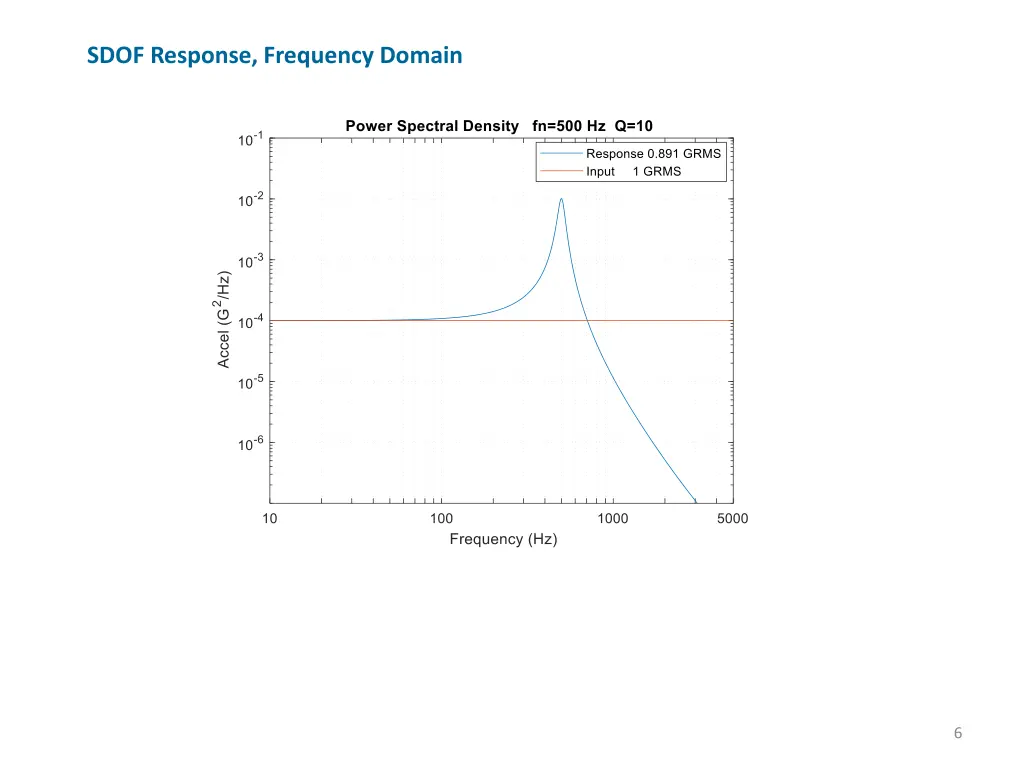
Introduction (cont) For the frequency domain analysis, the textbook power transmissibility function is used for the response calculation The semi-empirical Dirlik method can be used for the equivalent rainflow cycle counting and relative damage summation in the frequency domain, which will be considered in the follow-on analysis The Dirlik equation is based on the weighted sum of the exponential, and two Rayleigh distributions 3
Objective The purpose of this analysis is to consider the statistical variation of the damage index for the time domain analysis using a white noise base input The resulting damage index is shown to have an approximate lognormal distribution This information can be used to predict normal tolerance limits for the relative damage index Future research will be performed to derive an estimated standard deviation for the relative damage via a simple formula instead of using a vast number of time domain trials 4
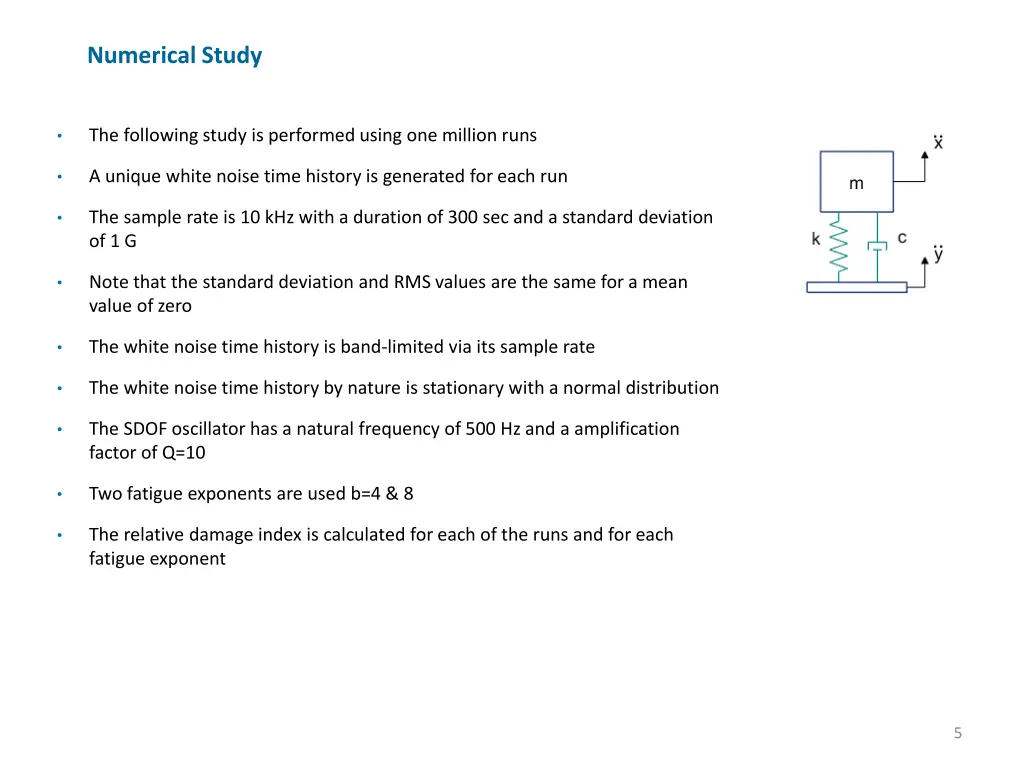
Numerical Study The following study is performed using one million runs A unique white noise time history is generated for each run The sample rate is 10 kHz with a duration of 300 sec and a standard deviation of 1 G Note that the standard deviation and RMS values are the same for a mean value of zero The white noise time history is band-limited via its sample rate The white noise time history by nature is stationary with a normal distribution The SDOF oscillator has a natural frequency of 500 Hz and a amplification factor of Q=10 Two fatigue exponents are used b=4 & 8 The relative damage index is calculated for each of the runs and for each fatigue exponent 5
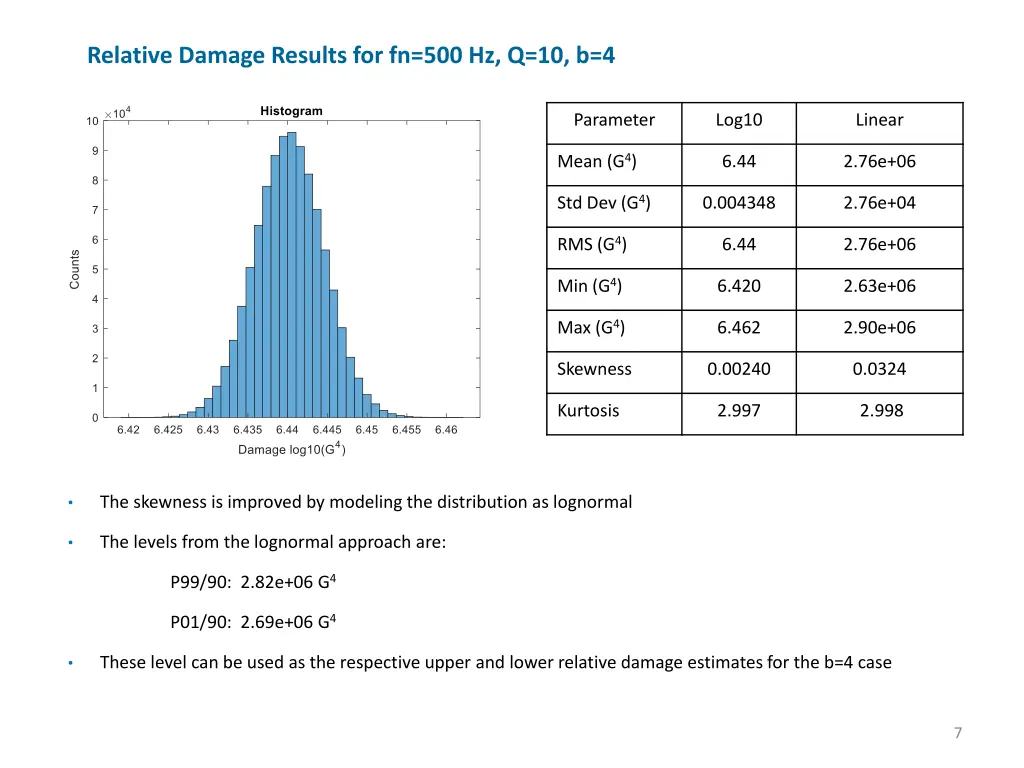
Relative Damage Results for fn=500 Hz, Q=10, b=4 Parameter Log10 Linear Mean (G4) 6.44 2.76e+06 Std Dev (G4) 0.004348 2.76e+04 RMS (G4) 6.44 2.76e+06 Min (G4) 6.420 2.63e+06 Max (G4) 6.462 2.90e+06 Skewness 0.00240 0.0324 Kurtosis 2.997 2.998 The skewness is improved by modeling the distribution as lognormal The levels from the lognormal approach are: P99/90: 2.82e+06 G4 P01/90: 2.69e+06 G4 These level can be used as the respective upper and lower relative damage estimates for the b=4 case 7
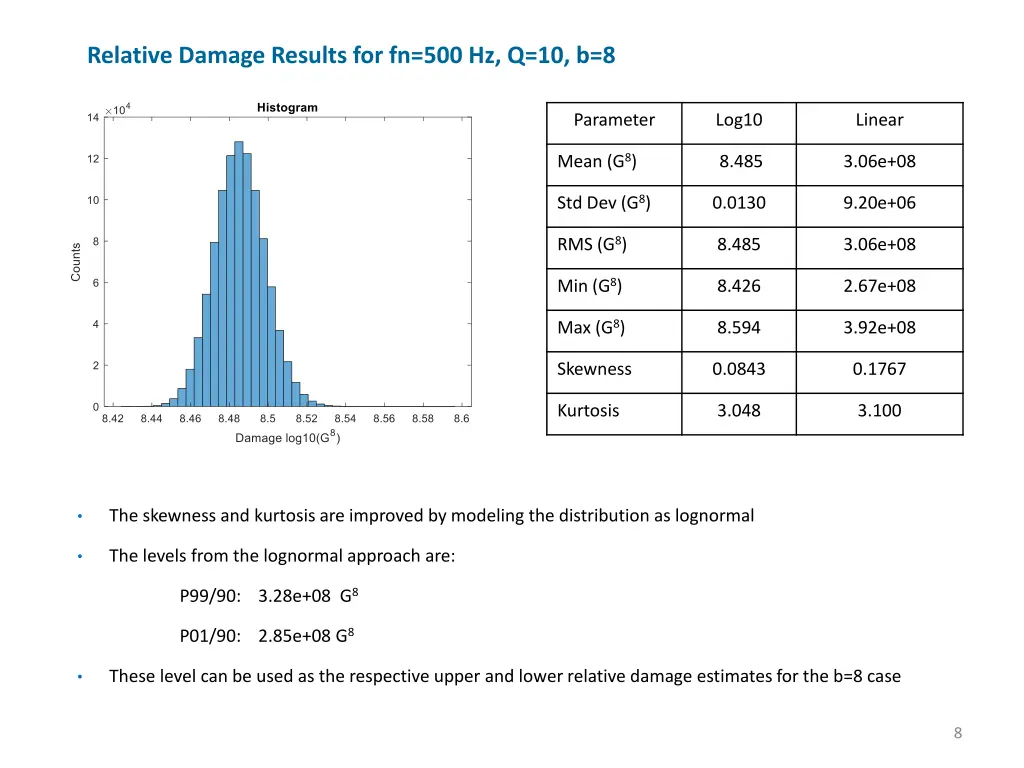
Relative Damage Results for fn=500 Hz, Q=10, b=8 Parameter Log10 Linear Mean (G8) 8.485 3.06e+08 Std Dev (G8) 0.0130 9.20e+06 RMS (G8) 8.485 3.06e+08 Min (G8) 8.426 2.67e+08 Max (G8) 8.594 3.92e+08 Skewness 0.0843 0.1767 Kurtosis 3.048 3.100 The skewness and kurtosis are improved by modeling the distribution as lognormal The levels from the lognormal approach are: P99/90: 3.28e+08 G8 P01/90: 2.85e+08 G8 These level can be used as the respective upper and lower relative damage estimates for the b=8 case 8