Explore how GDPR obligations can be expressed and evaluated using compliance queries over provenance of consent and data lifecycles through a semantic web ontology. Research includes representing provenance, SPARQL queries, and constraints for GDPR evaluation.
Please find below an Image/Link to download the presentation.
The content on the website is provided AS IS for your information and personal use only. It may not be sold, licensed, or shared on other websites without obtaining consent from the author. If you encounter any issues during the download, it is possible that the publisher has removed the file from their server.
You are allowed to download the files provided on this website for personal or commercial use, subject to the condition that they are used lawfully. All files are the property of their respective owners.
The content on the website is provided AS IS for your information and personal use only. It may not be sold, licensed, or shared on other websites without obtaining consent from the author.
E N D
Presentation Transcript
A Semantic Web Ontology for expressing GDPR compliance over consent & data lifecycles Harshvardhan J. Pandit Supervised by: Dave Lewis Co-Supervised by: Declan O Sullivan Theme E ADAPT Centre Trinity College Dublin The ADAPT Centre is funded under the SFI Research Centres Programme (Grant 13/RC/2106) and is co-funded under the European Regional Development Fund.
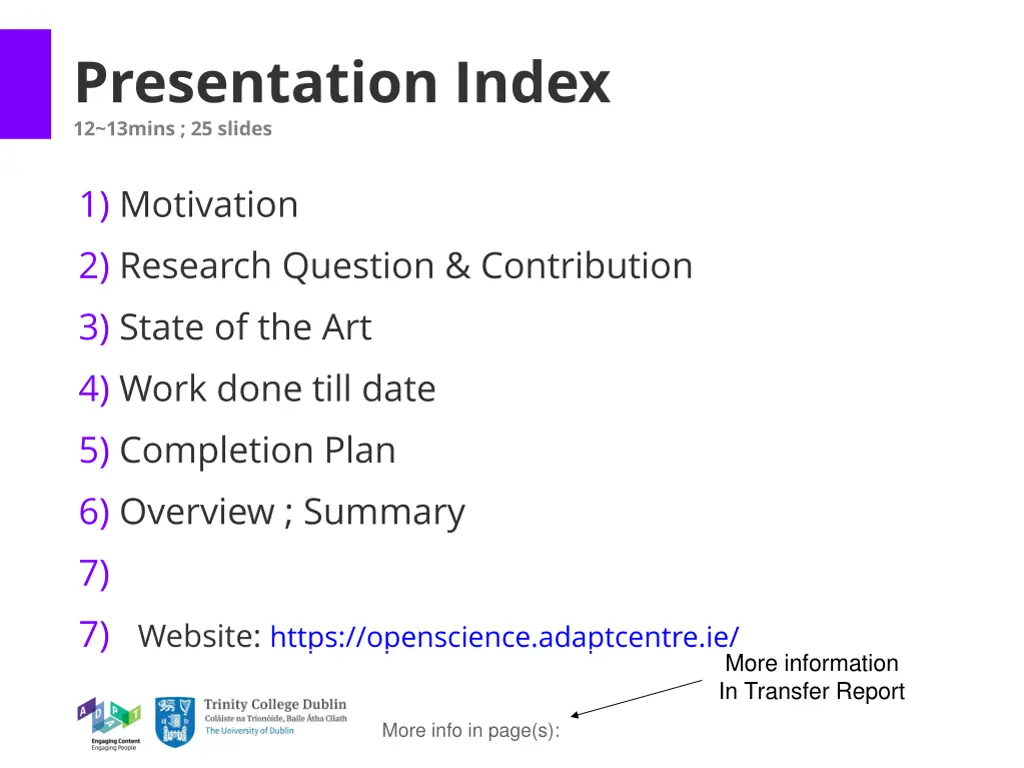
Presentation Index 12~13mins ; 25 slides 1) Motivation 2) Research Question & Contribution 3) State of the Art 4) Work done till date 5) Completion Plan 6) Overview ; Summary 7) 7) Website: https://openscience.adaptcentre.ie/ More information In Transfer Report More info in page(s):
GDPR General Data Protection Regulation Needs valid given consent Fines 4% of global turnover Record of processing activity Data Protection Officer to monitor compliance Demonstrate compliance Past Plan & Maintain compliance Future More info in page(s): 3
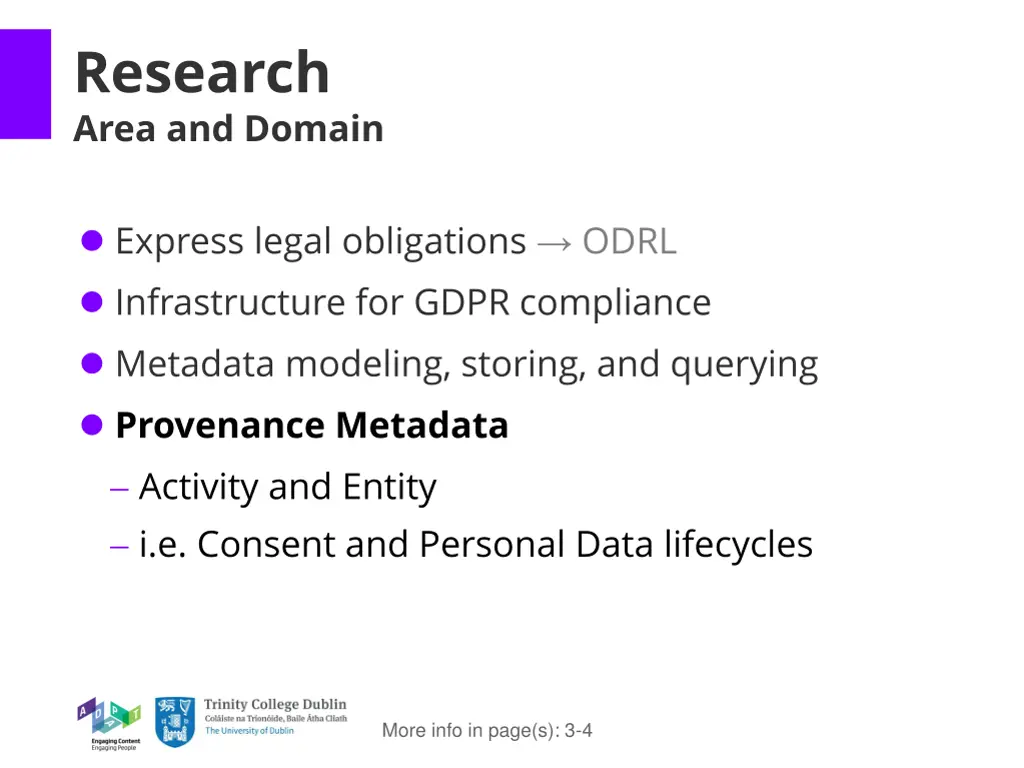
Research Area and Domain Express legal obligations ODRL Infrastructure for GDPR compliance Metadata modeling, storing, and querying Provenance Metadata Activity and Entity i.e. Consent and Personal Data lifecycles More info in page(s): 3-4
Research Question To what extent can GDPR obligations be expressed and evaluated using compliance queries over provenance of consent & data lifecycles expressed using semantic web ontologies? More info in page(s): 4
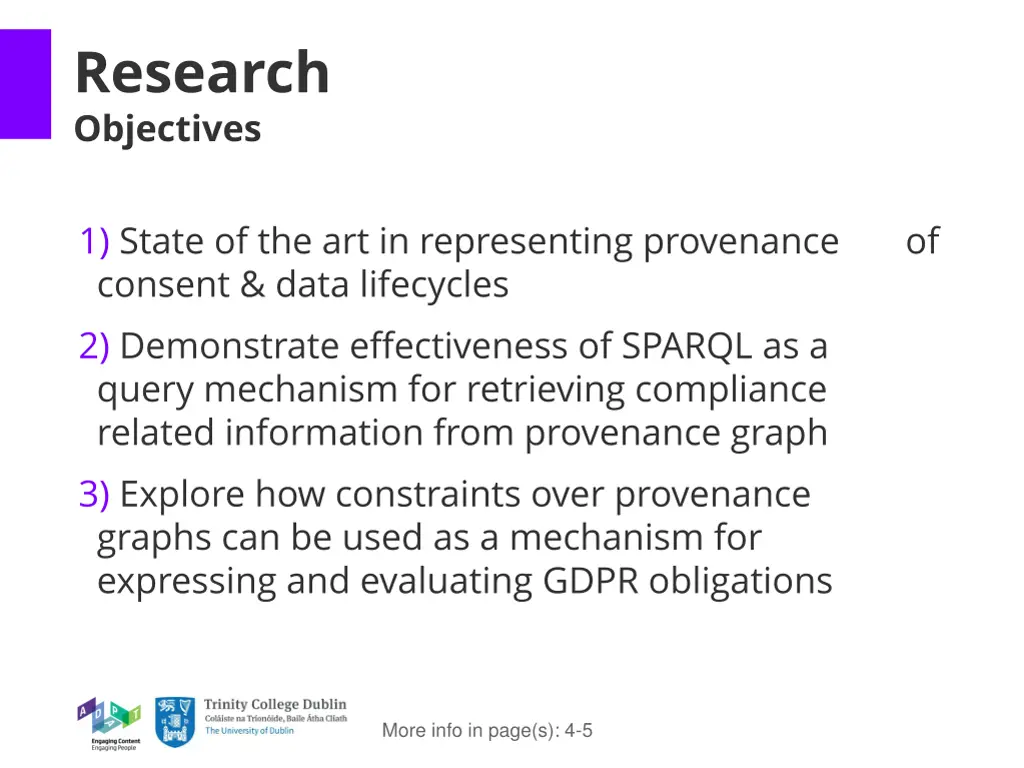
Research Objectives 1) State of the art in representing provenance of consent & data lifecycles 2) Demonstrate effectiveness of SPARQL as a query mechanism for retrieving compliance related information from provenance graph 3) Explore how constraints over provenance graphs can be used as a mechanism for expressing and evaluating GDPR obligations More info in page(s): 4-5
Research Contribution 1)Major Contribution 2)Creation of an ontology to express GDPR compliance based on obligations evaluated over provenance graphs of consent and data lifecycles 3)Minor Contributions 4)- Ontology to express provenance 5)- Constraints to express compliance obligations 6)- GDPR as a resource More info in page(s): 5
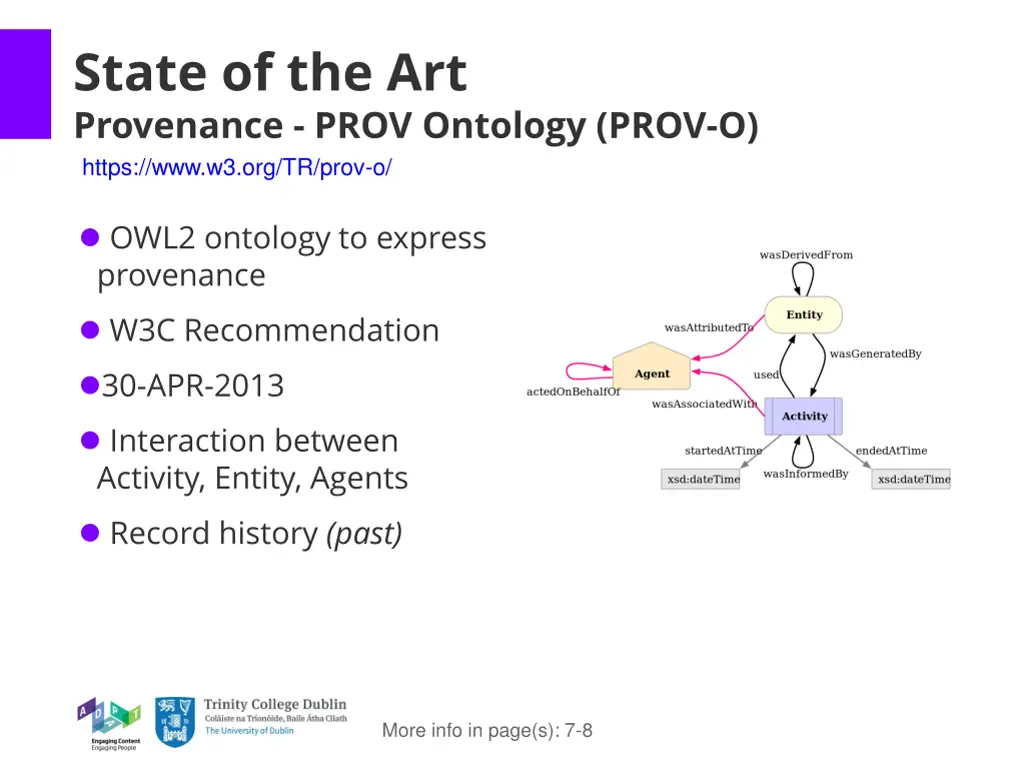
State of the Art Provenance - PROV Ontology (PROV-O) https://www.w3.org/TR/prov-o/ OWL2 ontology to express provenance W3C Recommendation 30-APR-2013 Interaction between Activity, Entity, Agents Record history (past) More info in page(s): 7-8
State of the Art Provenance - P-Plan http://vocab.linkeddata.es/p- plan/ Extension of PROV-O Represent plan that guided execution Model execution that is yet to happen (future) Common template Individual instantiations using PROV-O More info in page(s): 7-8
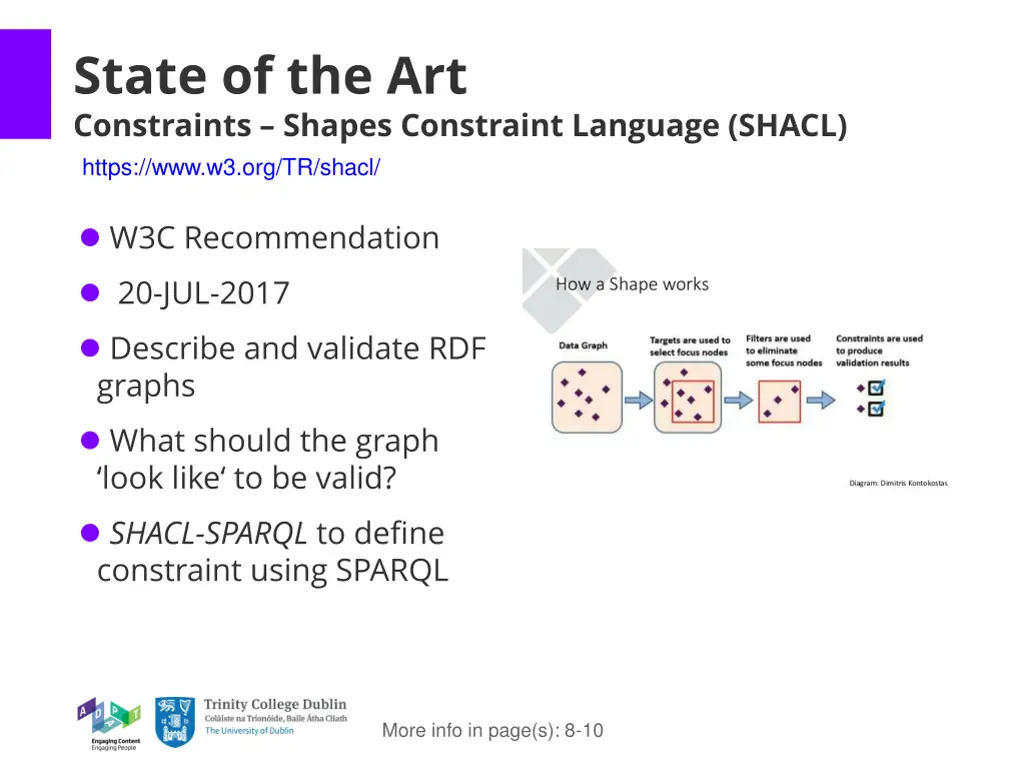
State of the Art Constraints Shapes Constraint Language (SHACL) https://www.w3.org/TR/shacl/ W3C Recommendation 20-JUL-2017 Describe and validate RDF graphs What should the graph look like to be valid? SHACL-SPARQL to define constraint using SPARQL More info in page(s): 8-10
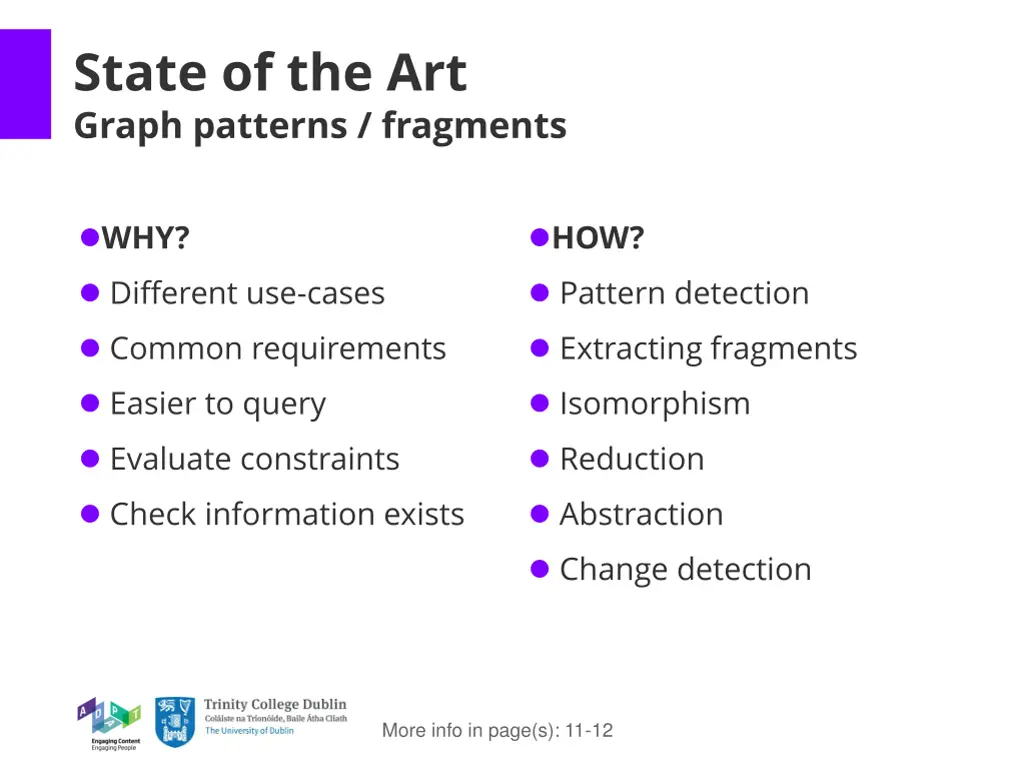
State of the Art Graph patterns / fragments WHY? Different use-cases Common requirements Easier to query Evaluate constraints Check information exists HOW? Pattern detection Extracting fragments Isomorphism Reduction Abstraction Change detection More info in page(s): 11-12
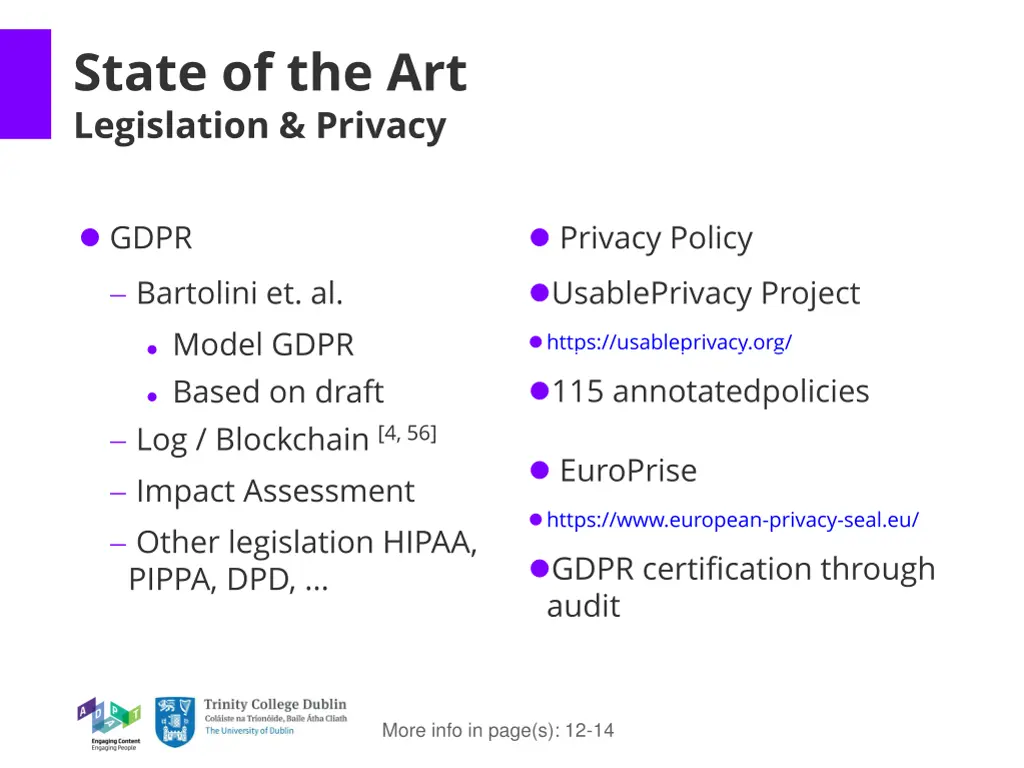
State of the Art Legislation & Privacy GDPR Bartolini et. al. Privacy Policy UsablePrivacy Project Model GDPR Based on draft Log / Blockchain [4, 56] Impact Assessment Other legislation HIPAA, PIPPA, DPD, ... https://usableprivacy.org/ 115 annotatedpolicies EuroPrise https://www.european-privacy-seal.eu/ GDPR certification through audit More info in page(s): 12-14
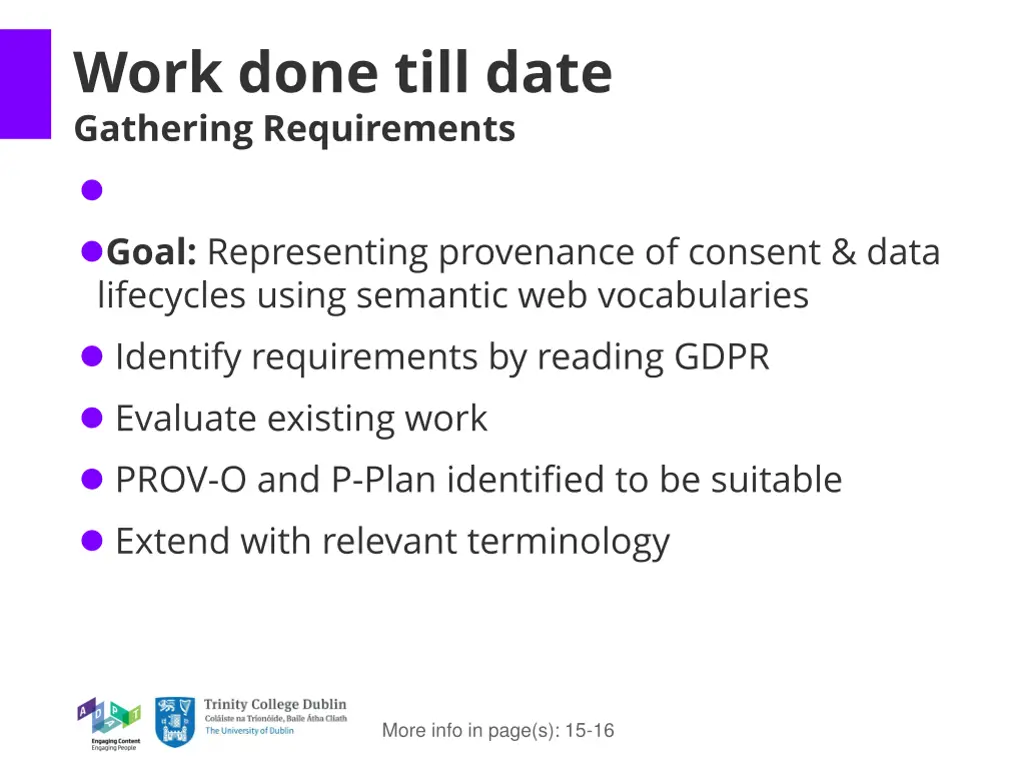
Work done till date Gathering Requirements Goal: Representing provenance of consent & data lifecycles using semantic web vocabularies Identify requirements by reading GDPR Evaluate existing work PROV-O and P-Plan identified to be suitable Extend with relevant terminology More info in page(s): 15-16
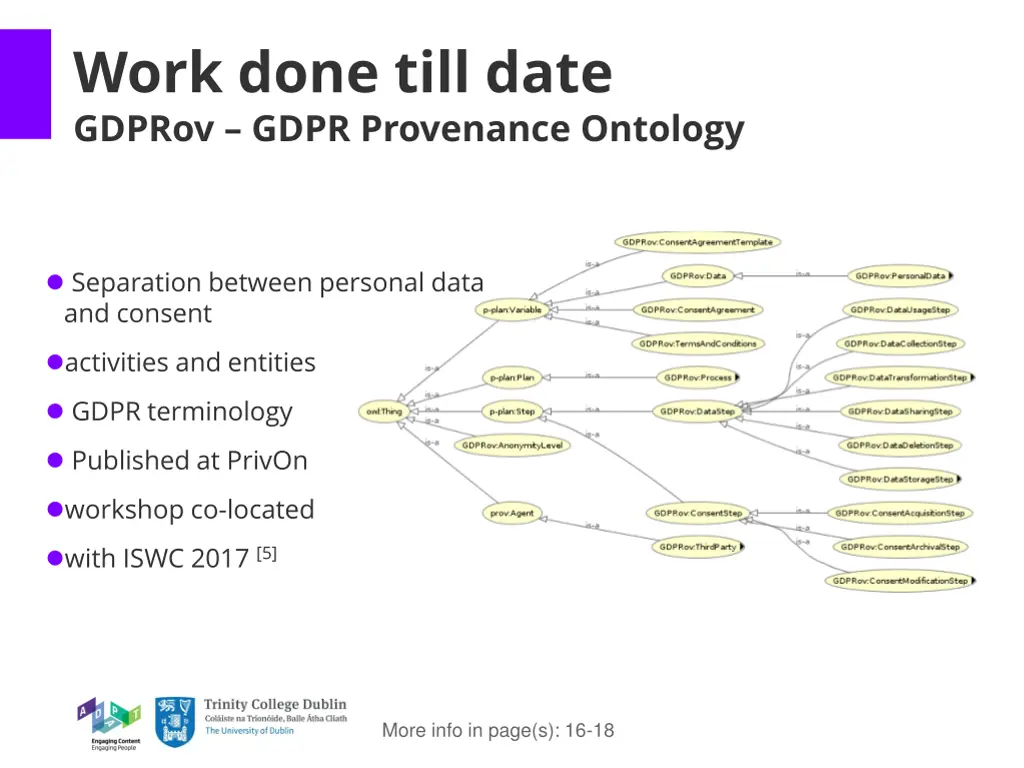
Work done till date GDPRov GDPR Provenance Ontology Separation between personal data and consent activities and entities GDPR terminology Published at PrivOn workshop co-located with ISWC 2017 [5] More info in page(s): 16-18
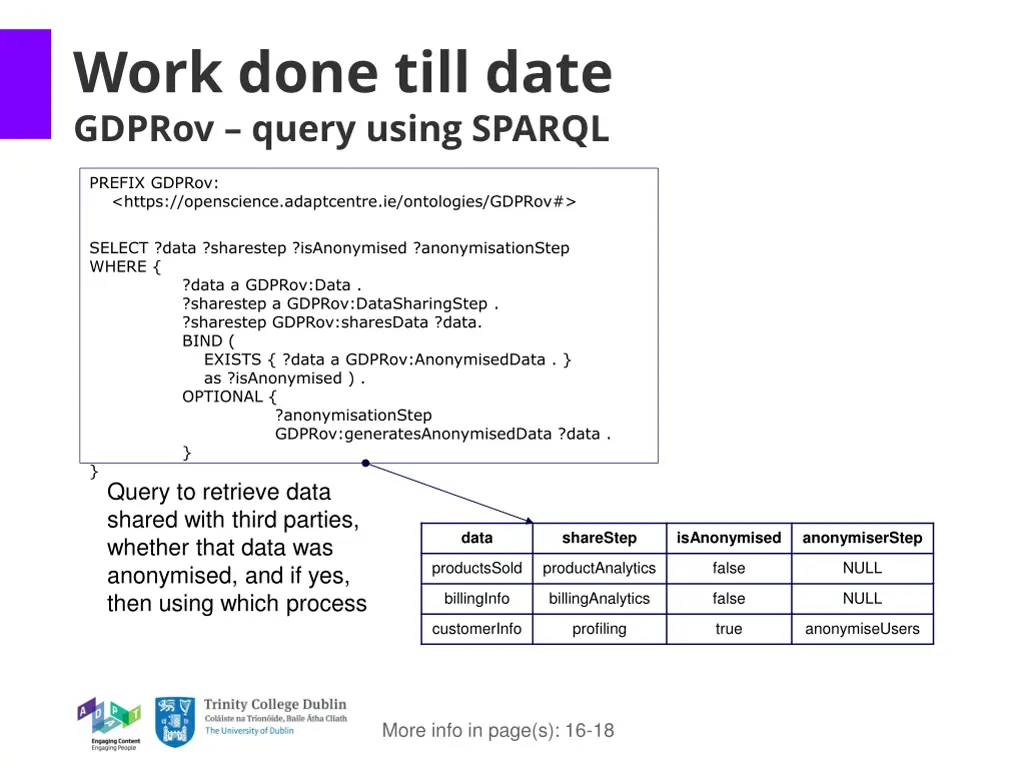
Work done till date GDPRov query using SPARQL PREFIX GDPRov: <https://openscience.adaptcentre.ie/ontologies/GDPRov#> SELECT ?data ?sharestep ?isAnonymised ?anonymisationStep WHERE { ?data a GDPRov:Data . ?sharestep a GDPRov:DataSharingStep . ?sharestep GDPRov:sharesData ?data. BIND ( EXISTS { ?data a GDPRov:AnonymisedData . } as ?isAnonymised ) . OPTIONAL { ?anonymisationStep GDPRov:generatesAnonymisedData ?data . } } Query to retrieve data shared with third parties, whether that data was anonymised, and if yes, then using which process data shareStep isAnonymised anonymiserStep productsSold productAnalytics false NULL billingInfo billingAnalytics false NULL customerInfo profiling true anonymiseUsers More info in page(s): 16-18
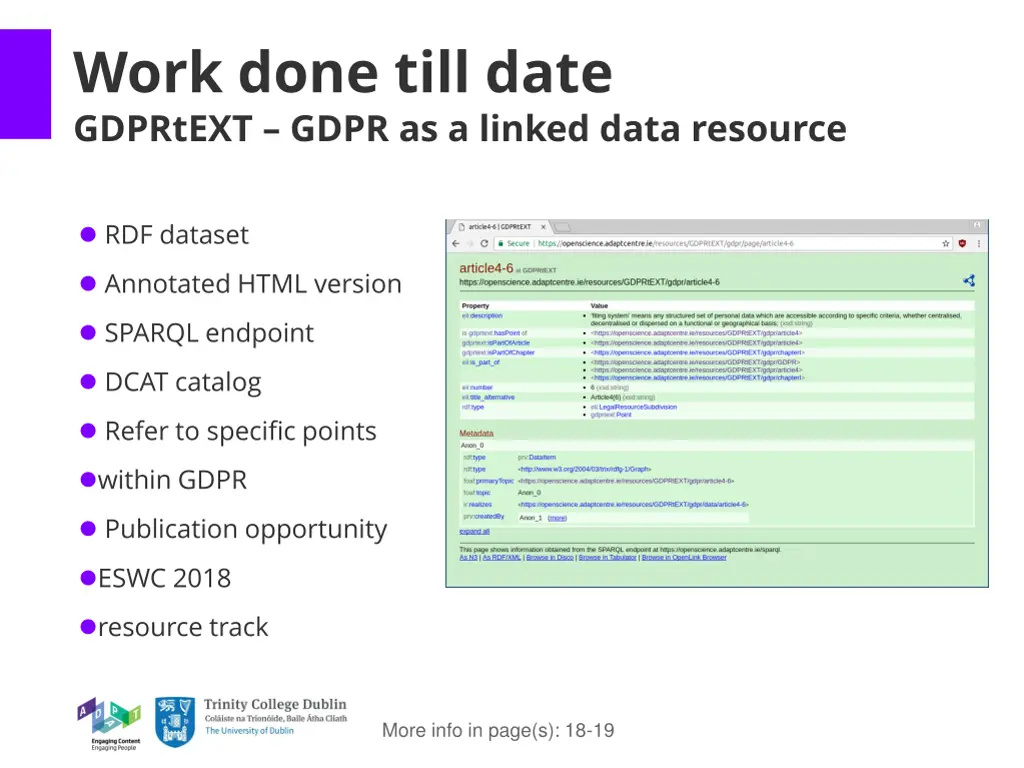
Work done till date GDPRtEXT GDPR as a linked data resource RDF dataset Annotated HTML version SPARQL endpoint DCAT catalog Refer to specific points within GDPR Publication opportunity ESWC 2018 resource track More info in page(s): 18-19
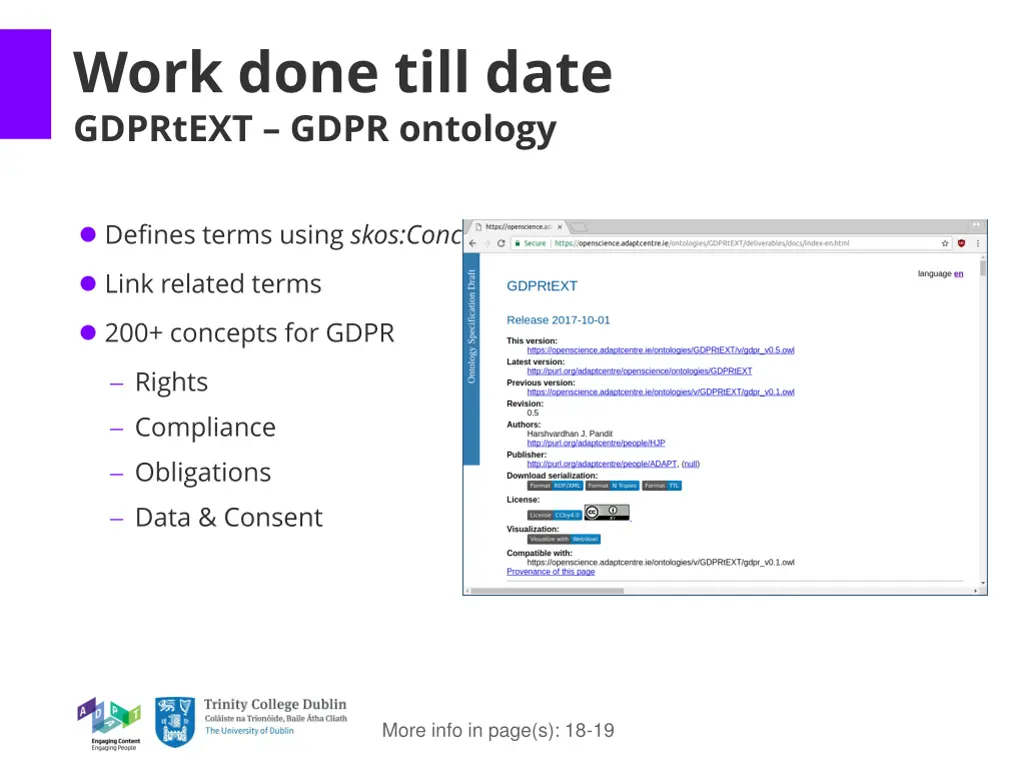
Work done till date GDPRtEXT GDPR ontology Defines terms using skos:Concept Link related terms 200+ concepts for GDPR Rights Compliance Obligations Data & Consent More info in page(s): 18-19
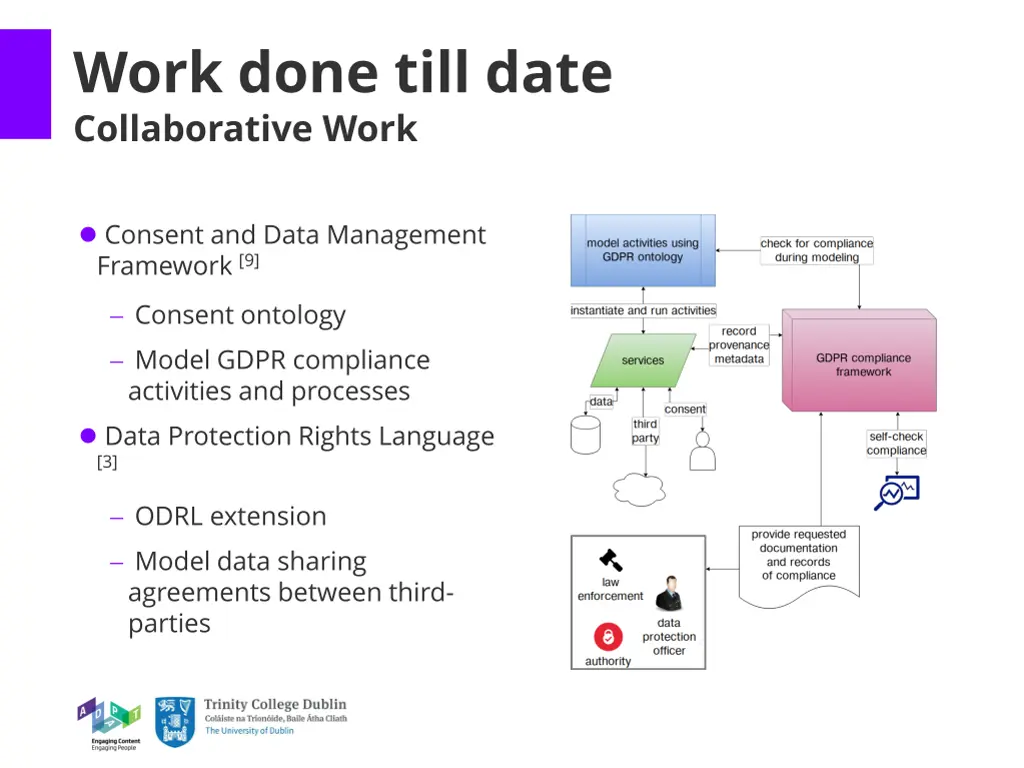
Work done till date Collaborative Work Consent and Data Management Framework [9] Consent ontology Model GDPR compliance activities and processes Data Protection Rights Language [3] ODRL extension Model data sharing agreements between third- parties
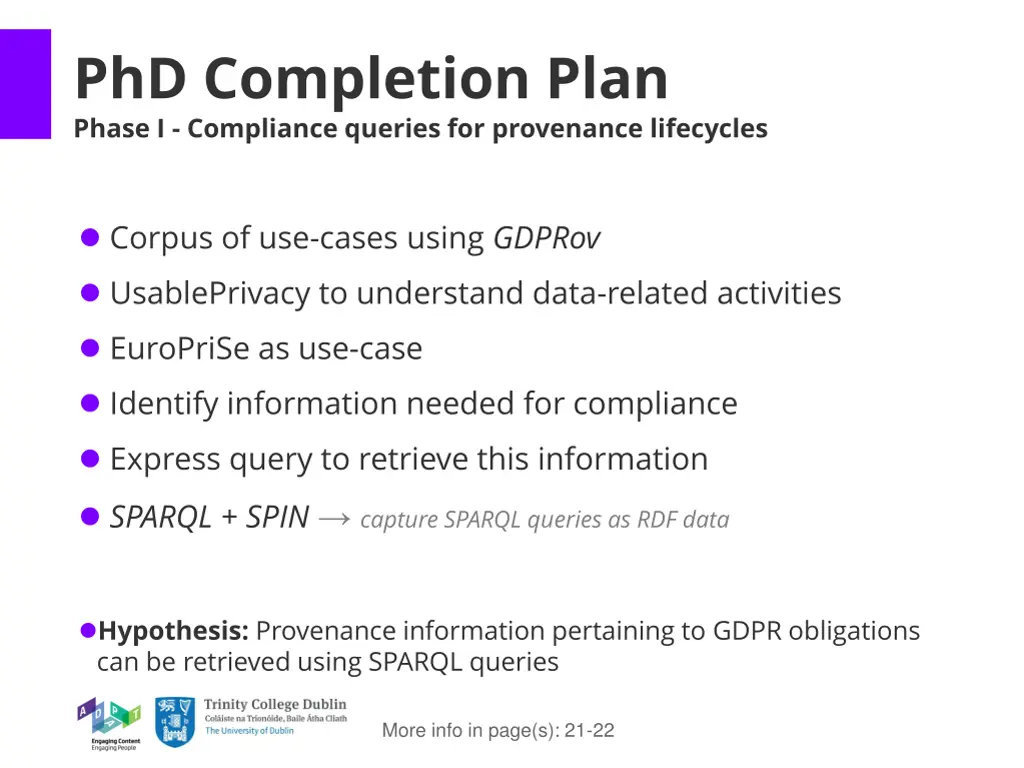
PhD Completion Plan Phase I - Compliance queries for provenance lifecycles Corpus of use-cases using GDPRov UsablePrivacy to understand data-related activities EuroPriSe as use-case Identify information needed for compliance Express query to retrieve this information SPARQL + SPIN capture SPARQL queries as RDF data Hypothesis: Provenance information pertaining to GDPR obligations can be retrieved using SPARQL queries More info in page(s): 21-22
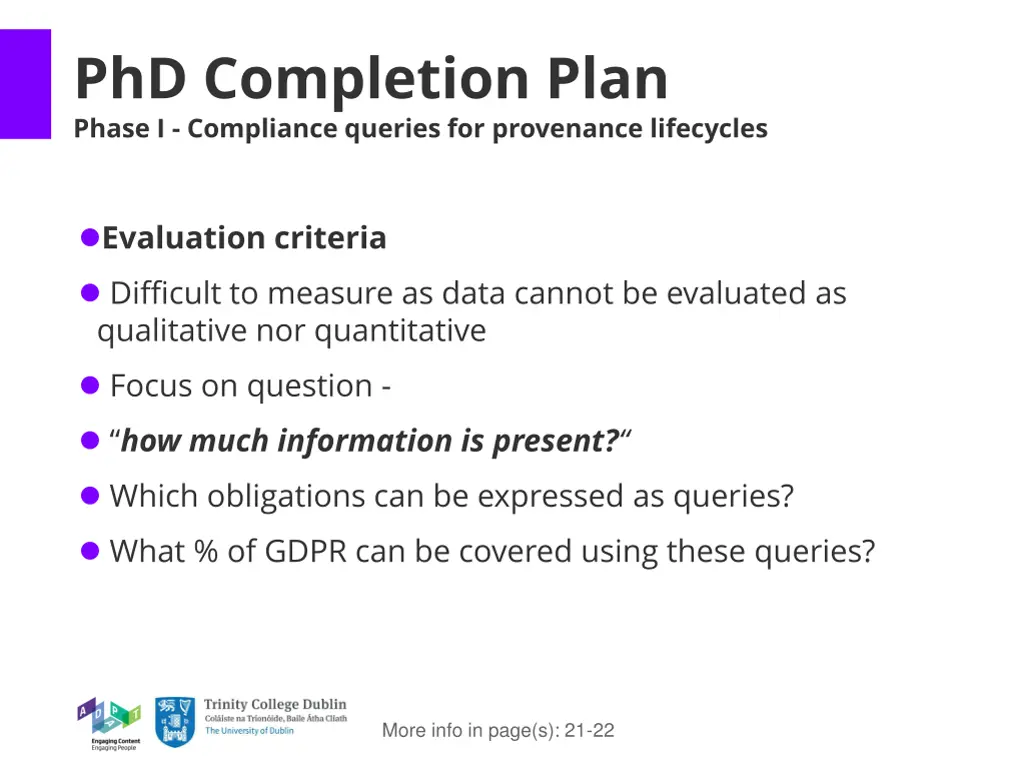
PhD Completion Plan Phase I - Compliance queries for provenance lifecycles Evaluation criteria Difficult to measure as data cannot be evaluated as qualitative nor quantitative Focus on question - how much information is present? Which obligations can be expressed as queries? What % of GDPR can be covered using these queries? More info in page(s): 21-22
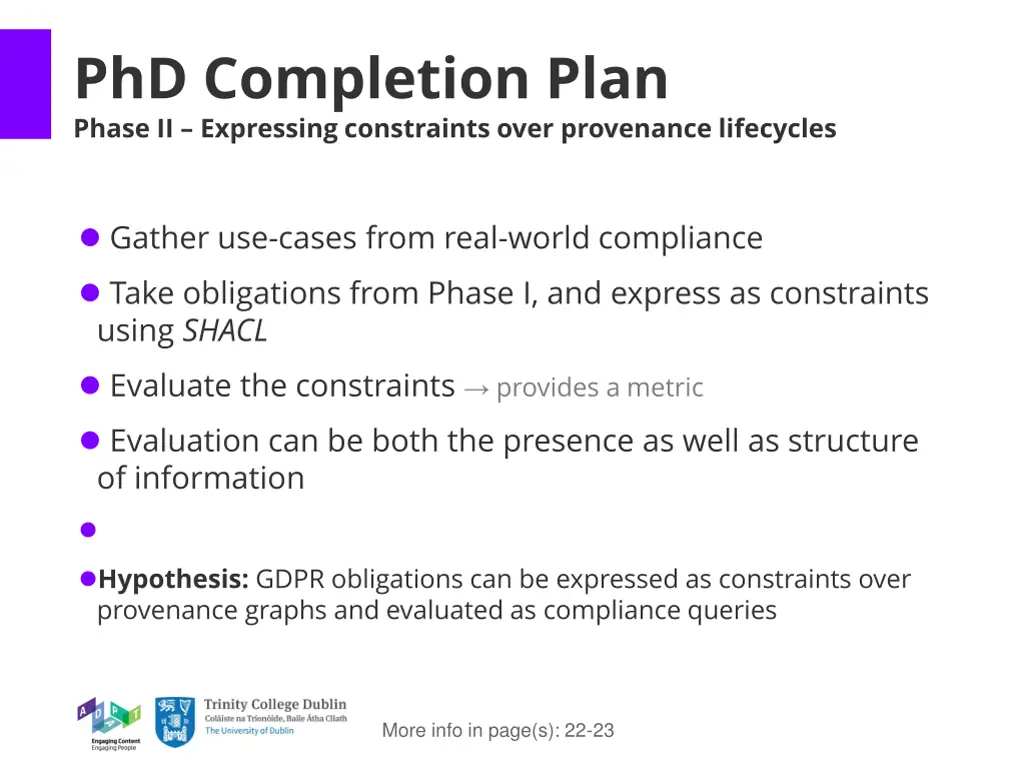
PhD Completion Plan Phase II Expressing constraints over provenance lifecycles Gather use-cases from real-world compliance Take obligations from Phase I, and express as constraints using SHACL Evaluate the constraints provides a metric Evaluation can be both the presence as well as structure of information Hypothesis: GDPR obligations can be expressed as constraints over provenance graphs and evaluated as compliance queries More info in page(s): 22-23
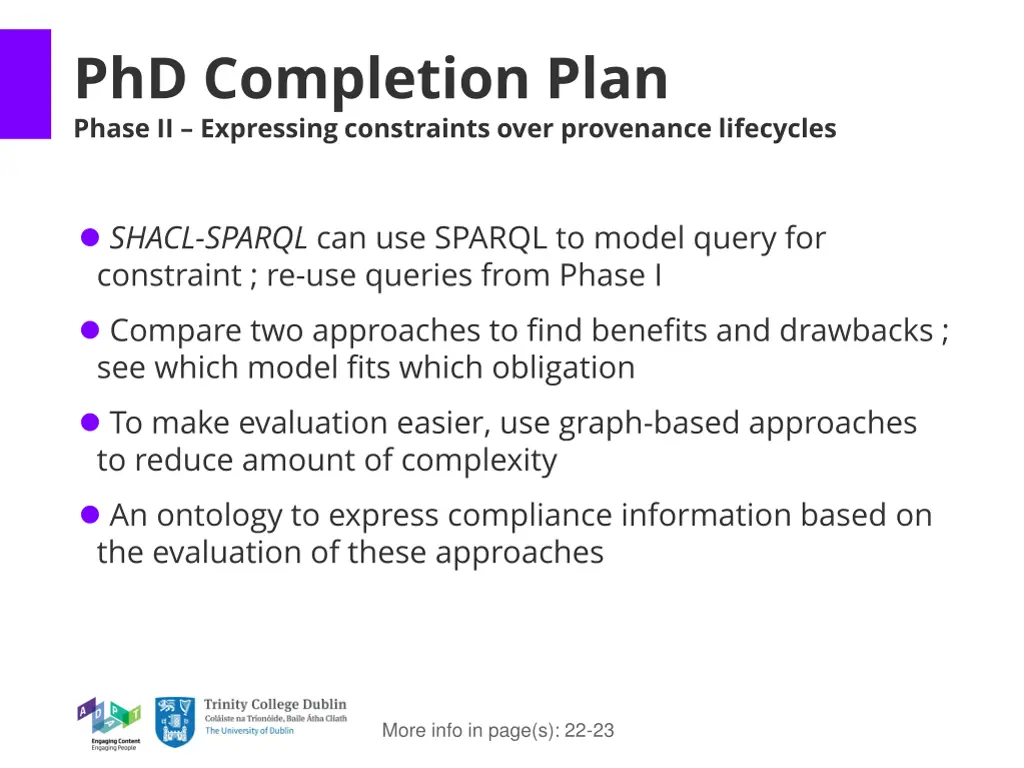
PhD Completion Plan Phase II Expressing constraints over provenance lifecycles SHACL-SPARQL can use SPARQL to model query for constraint ; re-use queries from Phase I Compare two approaches to find benefits and drawbacks ; see which model fits which obligation To make evaluation easier, use graph-based approaches to reduce amount of complexity An ontology to express compliance information based on the evaluation of these approaches More info in page(s): 22-23
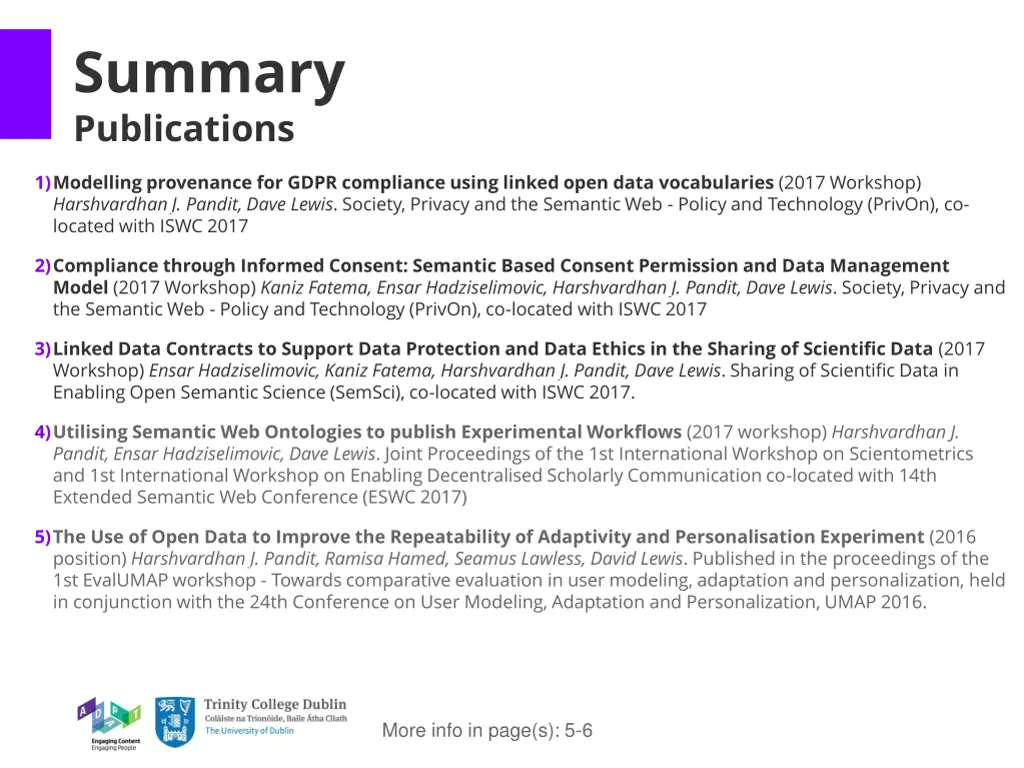
Summary Publications 1)Modelling provenance for GDPR compliance using linked open data vocabularies (2017 Workshop) Harshvardhan J. Pandit, Dave Lewis. Society, Privacy and the Semantic Web - Policy and Technology (PrivOn), co- located with ISWC 2017 2)Compliance through Informed Consent: Semantic Based Consent Permission and Data Management Model (2017 Workshop) Kaniz Fatema, Ensar Hadziselimovic, Harshvardhan J. Pandit, Dave Lewis. Society, Privacy and the Semantic Web - Policy and Technology (PrivOn), co-located with ISWC 2017 3)Linked Data Contracts to Support Data Protection and Data Ethics in the Sharing of Scientific Data (2017 Workshop) Ensar Hadziselimovic, Kaniz Fatema, Harshvardhan J. Pandit, Dave Lewis. Sharing of Scientific Data in Enabling Open Semantic Science (SemSci), co-located with ISWC 2017. 4)Utilising Semantic Web Ontologies to publish Experimental Workflows (2017 workshop) Harshvardhan J. Pandit, Ensar Hadziselimovic, Dave Lewis. Joint Proceedings of the 1st International Workshop on Scientometrics and 1st International Workshop on Enabling Decentralised Scholarly Communication co-located with 14th Extended Semantic Web Conference (ESWC 2017) 5)The Use of Open Data to Improve the Repeatability of Adaptivity and Personalisation Experiment (2016 position) Harshvardhan J. Pandit, Ramisa Hamed, Seamus Lawless, David Lewis. Published in the proceedings of the 1st EvalUMAP workshop - Towards comparative evaluation in user modeling, adaptation and personalization, held in conjunction with the 24th Conference on User Modeling, Adaptation and Personalization, UMAP 2016. More info in page(s): 5-6
Summary Short term and Long term Plan Next 6 months Next 18 months Create use-cases SPARQL queries GDPR obligations GDPRtEXT resource Publication: ESWC 2018 Evaluate SPARQL queries Express SHACL constraints Explore graph techniques GDPR impact Publication: ISWC2018, ESWC2019
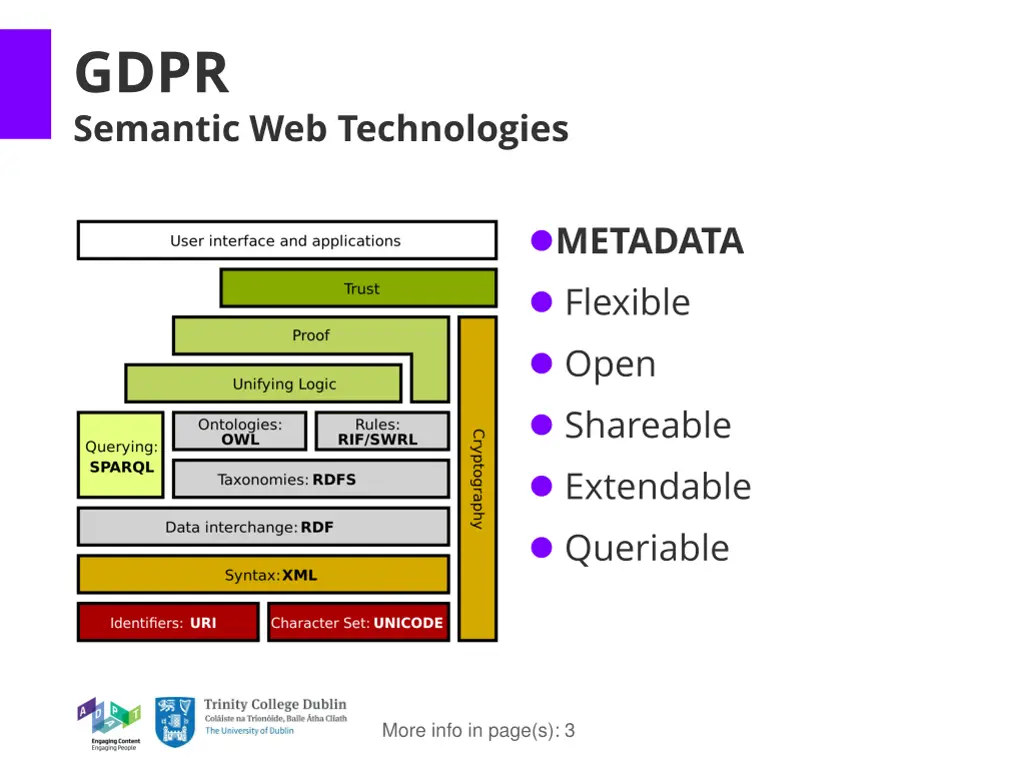
GDPR Semantic Web Technologies METADATA Flexible Open Shareable Extendable Queriable More info in page(s): 3
Recital 82 In order to demonstrate compliance with this Regulation, the controller or processor should maintain records of processing activities under its responsibility. Each controller and processor should be obliged to cooperate with the supervisory authority and make those records, on request, available to it, so that it might serve for monitoring those processing operations.
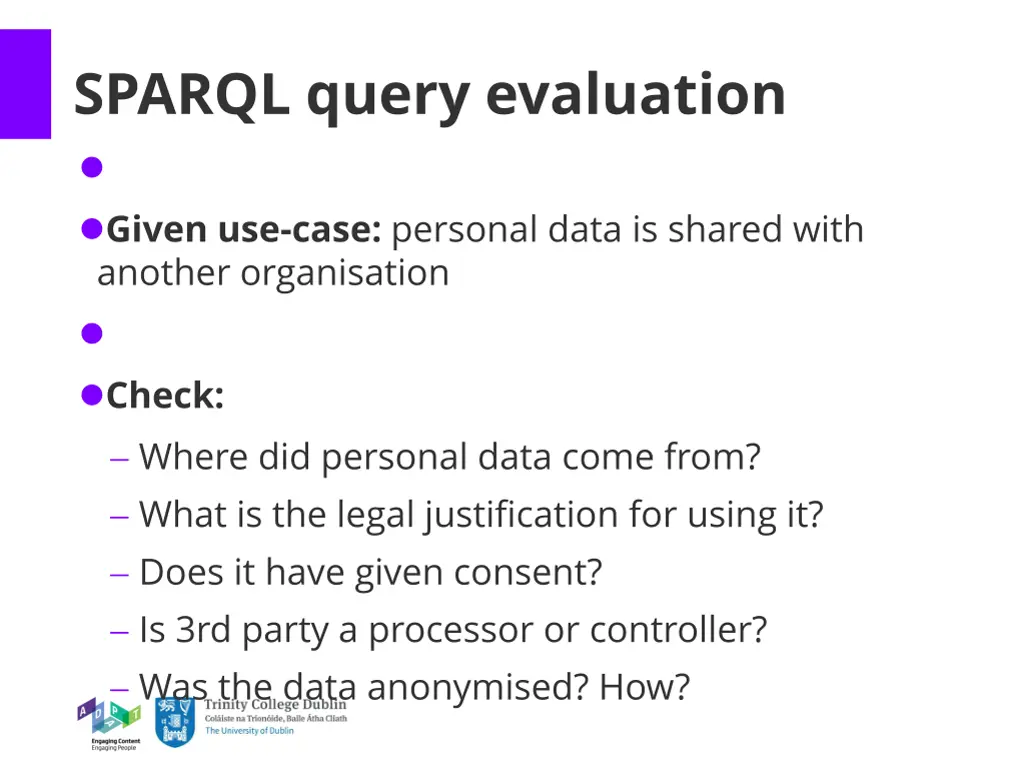
SPARQL query evaluation Given use-case: personal data is shared with another organisation Check: Where did personal data come from? What is the legal justification for using it? Does it have given consent? Is 3rd party a processor or controller? Was the data anonymised? How?
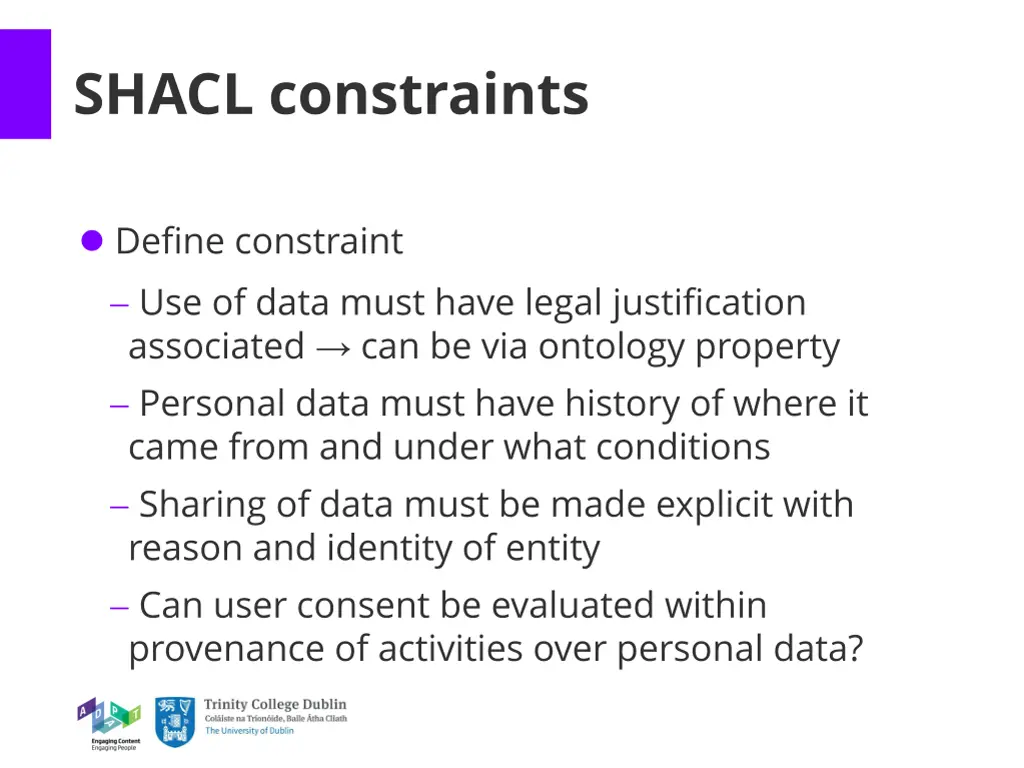
SHACL constraints Define constraint Use of data must have legal justification associated can be via ontology property Personal data must have history of where it came from and under what conditions Sharing of data must be made explicit with reason and identity of entity Can user consent be evaluated within provenance of activities over personal data?
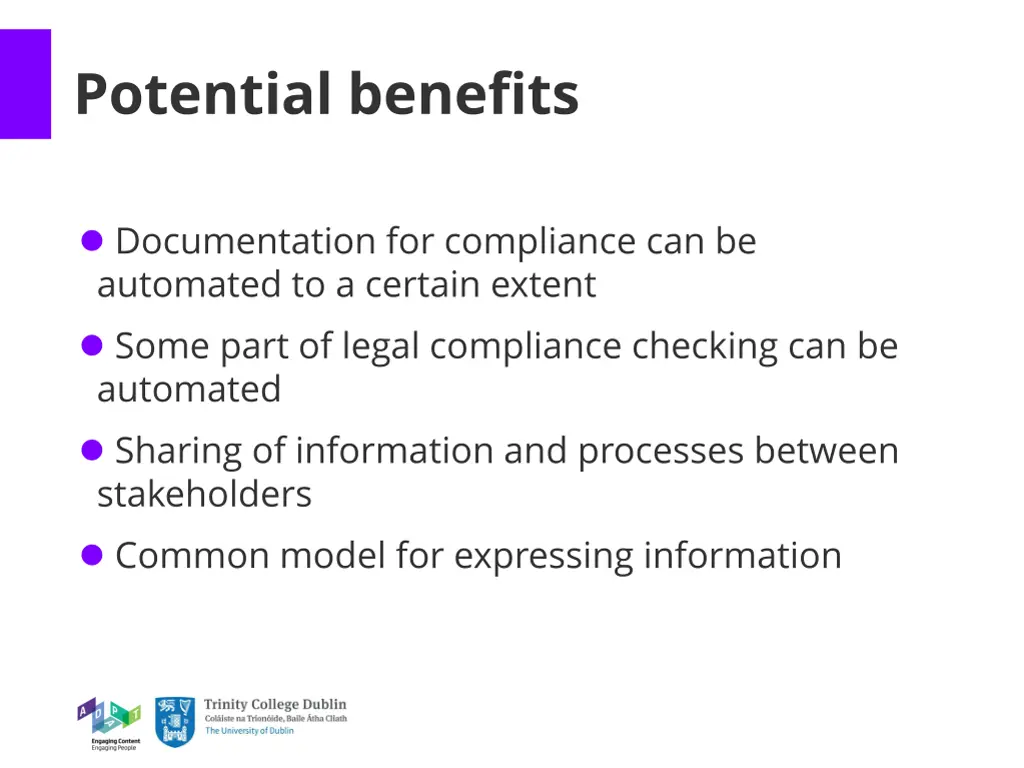
Potential benefits Documentation for compliance can be automated to a certain extent Some part of legal compliance checking can be automated Sharing of information and processes between stakeholders Common model for expressing information
PhD Completion Plan Phase I Phase II Build use-cases and compliance queries Express obligations as provenance constraints Pre GDPR enforcement Post GDPR enforcement SPARQL queries to retrieve information about consent and data usage required for compliance Constraints using SHACL Takes into factor how organisations have reacted to GDPR w.r.t. privacy policies Based on real-world use-cases Outcome: ontology to express compliance based on evaluation of constraints Outcome: compliance queries identified from GDPR More info in page(s): 19-23
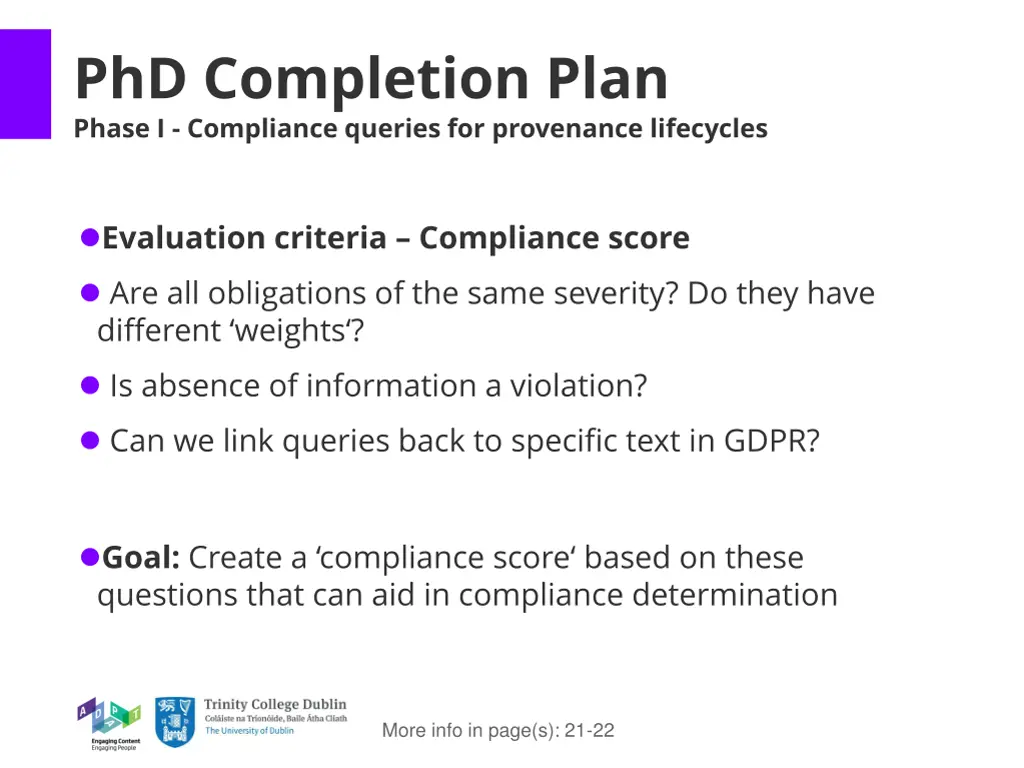
PhD Completion Plan Phase I - Compliance queries for provenance lifecycles Evaluation criteria Compliance score Are all obligations of the same severity? Do they have different weights ? Is absence of information a violation? Can we link queries back to specific text in GDPR? Goal: Create a compliance score based on these questions that can aid in compliance determination More info in page(s): 21-22
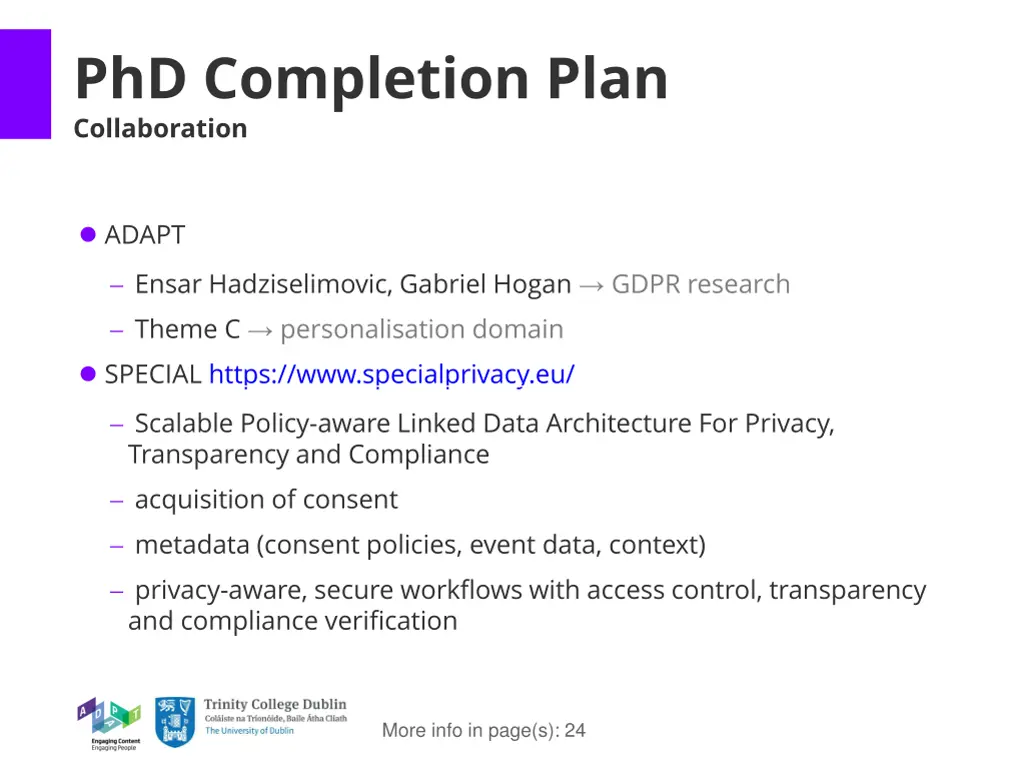
PhD Completion Plan Collaboration ADAPT Ensar Hadziselimovic, Gabriel Hogan GDPR research Theme C personalisation domain SPECIAL https://www.specialprivacy.eu/ Scalable Policy-aware Linked Data Architecture For Privacy, Transparency and Compliance acquisition of consent metadata (consent policies, event data, context) privacy-aware, secure workflows with access control, transparency and compliance verification More info in page(s): 24