Sentence Fragments and Corrections
Identification of sentence fragments and ways to correct them, including examples and types of fragments caused by subordinating conjunctions and relative pronouns.

Download Presentation

Please find below an Image/Link to download the presentation.
The content on the website is provided AS IS for your information and personal use only. It may not be sold, licensed, or shared on other websites without obtaining consent from the author.If you encounter any issues during the download, it is possible that the publisher has removed the file from their server.
You are allowed to download the files provided on this website for personal or commercial use, subject to the condition that they are used lawfully. All files are the property of their respective owners.
The content on the website is provided AS IS for your information and personal use only. It may not be sold, licensed, or shared on other websites without obtaining consent from the author.
E N D
Presentation Transcript
Sentence Problems 2 Dr. Nour TOUMI
Objectives 1. Identify fragment and choppy sentences 2. Recognise the different ways to correct these sentence problems
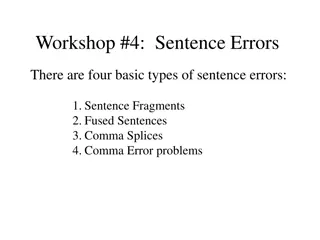
Fragment sentences A sentence fragment is an incomplete sentence. Most fragments are missing the subject, the verb, or both. Identifying some fragments can be confusing because they may actually contain a subject and a verb. However, these nouns and verbs do not form an independent clause when they follow subordinating conjunctions, adverbs, or relative pronouns.
Example of a sentence fragment: After the party starts. party=subject starts=verb This phrase has a noun and a verb; however, the subordinating conjunction after makes it a dependent clause. Therefore, this dependent clause needs to be linked to an independent clause.
Correct sentence: After the party starts, I will be able to relax. (complex sentence) I will be able to relax is an independent clause that can stand alone. It expresses a complete thought. Remember to separate a dependent clause and an independent clause with a comma (when the dependent clause appears before the independent clause).
1. Subordinating Conjunction and Relative Pronoun Fragments Example: While I was waiting for my car to be repaired. How to find this type of fragment: When proofreading a paper, pay attention to subordinating conjunctions and relative pronouns. These words (see box below) turn sentences into dependent clauses. Identifying proper usage of dependent clauses can help in recognizing fragments.
Examples of Subordinating Conjunctions and Relative Pronouns after if until what whether who whoever as though since because so that than whereas wherever how unless whichever although while as in order that/to as if once whatever as soon as rather than when whenever whom whomever before where whose even if why even though though that which
Strategies for correcting subordinating conjunction and relative pronoun fragments 1. Connect the fragment to the sentence that comes before or after it. Correct Sentences: While I was waiting for my car to be repaired, I read a magazine. Notice the use of the comma after the dependent clause (because the dependent clause falls at the beginning of the sentence). I had to ride the bus while I was waiting for my car to be repaired.
2. Remove the subordinating conjunction/relative pronoun. Correct sentence: I was waiting for my car to be repaired.
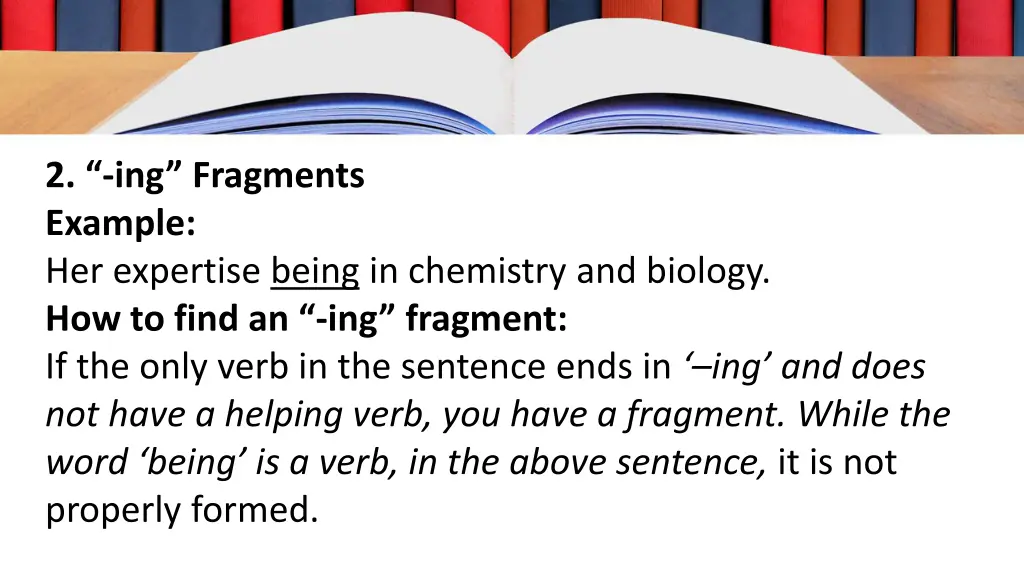
2. -ing Fragments Example: Her expertise being in chemistry and biology. How to find an -ing fragment: If the only verb in the sentence ends in ing and does not have a helping verb, you have a fragment. While the word being is a verb, in the above sentence, it is not properly formed.
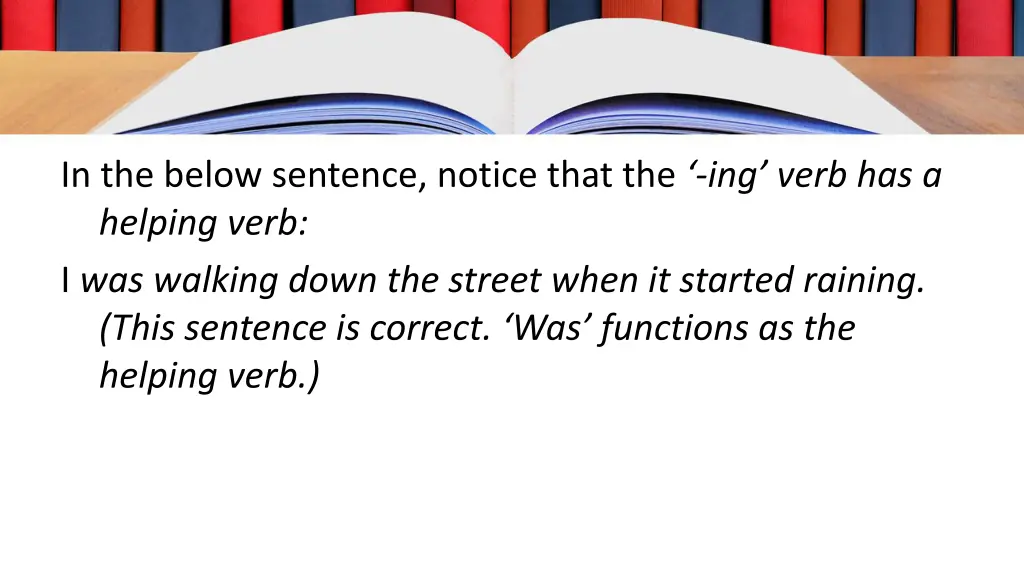
In the below sentence, notice that the -ing verb has a helping verb: I was walking down the street when it started raining. (This sentence is correct. Was functions as the helping verb.)
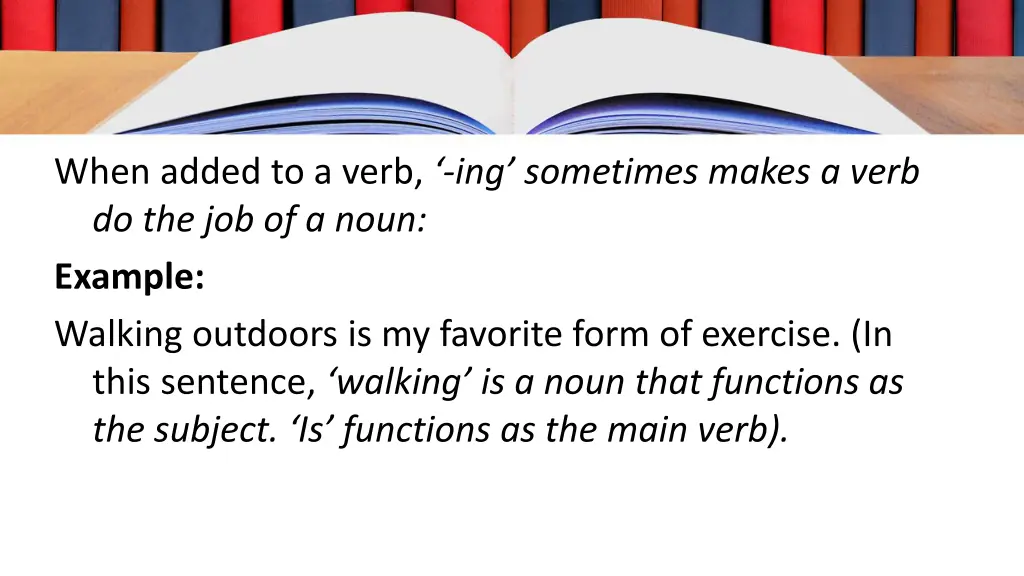
When added to a verb, -ing sometimes makes a verb do the job of a noun: Example: Walking outdoors is my favorite form of exercise. (In this sentence, walking is a noun that functions as the subject. Is functions as the main verb).
Strategies for correcting ing fragments 1. Connect the fragment to the sentence that comes before or after it. Correct sentences: Her expertise being in chemistry and biology, she was not hired as an English instructor. (dependent ing phrase , S + V ) She designed the new science exhibit, her expertise being in chemistry and biology. S + V , dependent ing phrase
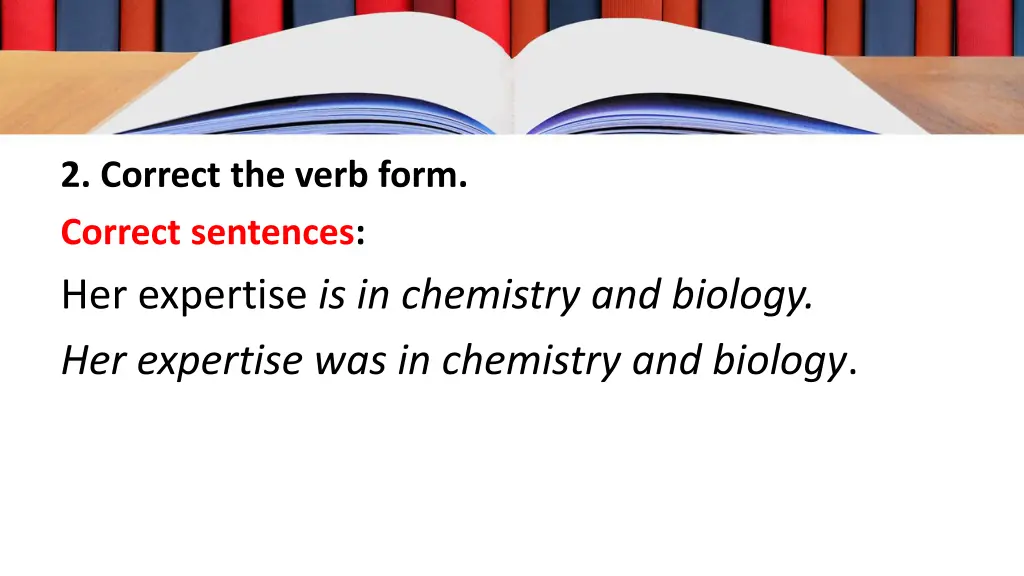
2. Correct the verb form. Correct sentences: Her expertise is in chemistry and biology. Her expertise was in chemistry and biology.
3. Missing Subject Fragments Example: Security set off the alarm and evacuated the building. Next, closed all the entrances. How to find this type of fragment: The second phrase above (noted in bold) is a fragment because there is no subject. Entrances is a noun, but it is the object of the verb closed. Who or what is closing the entrances is unknown. That is, the subject of the sentence is missing.
Strategies for correcting missing subject fragments: 1. Connect the fragment to the sentence that comes before or after it. Correct Sentences: Security set off the alarm, evacuated the building, and closed all the entrances. In the above sentence, it is clear that the subject, the doer of the actions, is security.
2. Add the missing subject. Correct Sentence: Security set off the alarm and evacuated the building. Next, they closed all the entrances.
4. Extra Information Fragments Example: For instance, clean water and electricity. How to find and fix this type of fragment: In these kinds of fragments, usually the verb is missing. Watch out for transitional phrases that signal an example, a list, added details or information.
Strategies for correcting extra information fragments: 1. Connect the fragment to the sentence that comes before or after it. Correct sentence: Many Americans take basic amenities for granted, for example, clean water and electricity. S + V , dependent phrase.
2. Add the missing subject and verb. Correct sentence: For example, basic amenities include clean water and electricity. transitional phrase, S + V
Choppy sentences PROBLEM: Sentences are too short and have many repeated words. Choppy sentences are sentences that are too short and often repeat the same words. They should be combined to make longer sentences. For example: I like dogs. Dogs make good pets. Dogs are friendly and loyal.
They sentences do not have good style. Reading these kinds of sentences can be boring for the reader. Fortunately, they are easy to fix by moving words around. I like dogs because they are friendly and loyal. These two characteristics make dogs good pets.
Practice Edit these choppy sentences into one or two sentences so they are more interesting to read. 1. Vegetables are good for you. Vegetables taste good. Vegetables are easy to prepare. 2. I like movies. I go to movies every weekend. I like action movies best. 3. Elephants are big. They live in Africa and Asia. They eat a lot of food. 4. Phil is a thrill seeker. He enjoys skydiving. He goes every chance he gets. 5. I hate housework. Housework is very boring. It takes too much time. I especially dislike mopping the floor and ironing.
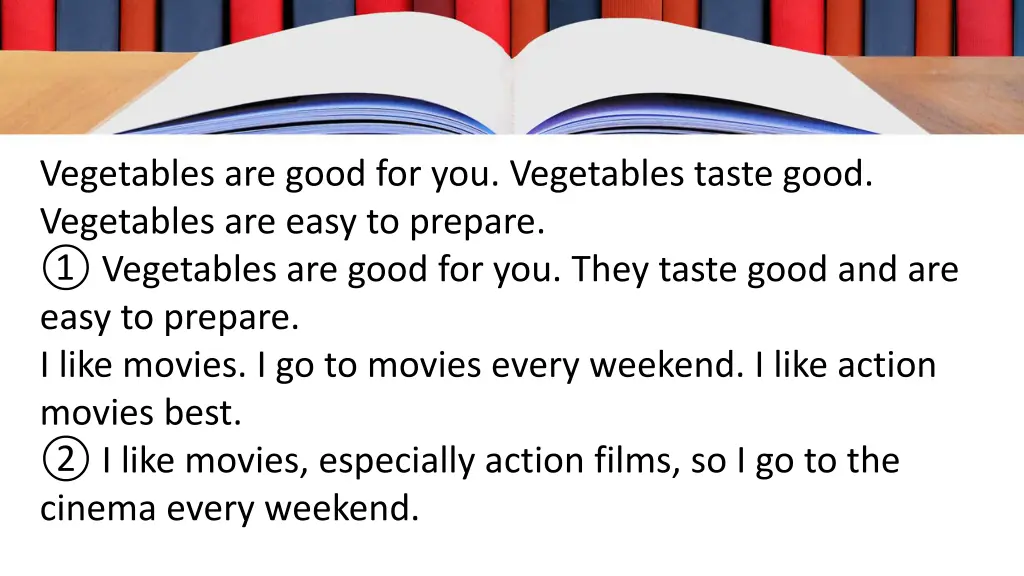
Vegetables are good for you. Vegetables taste good. Vegetables are easy to prepare. Vegetables are good for you. They taste good and are easy to prepare. I like movies. I go to movies every weekend. I like action movies best. I like movies, especially action films, so I go to the cinema every weekend.
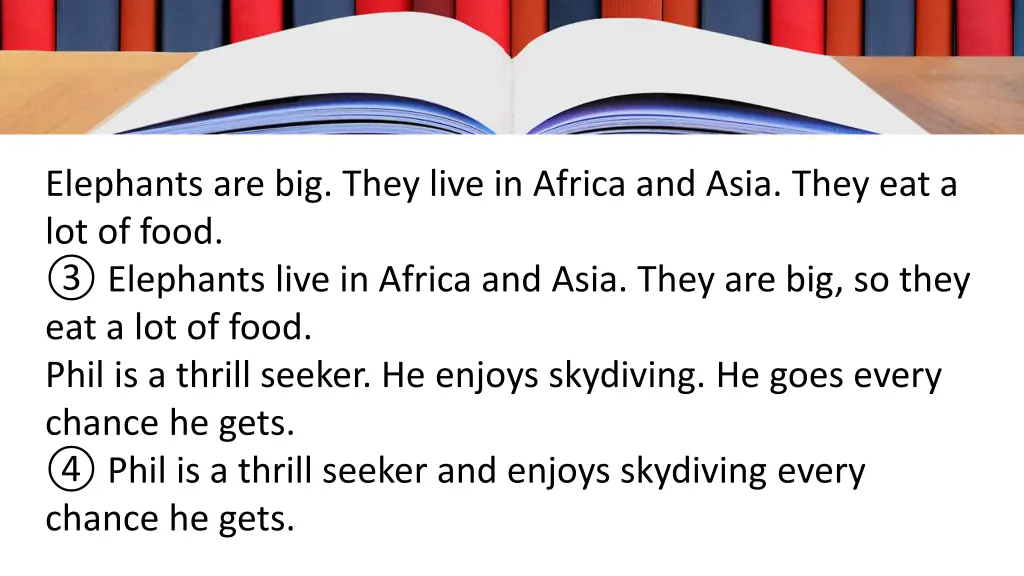
Elephants are big. They live in Africa and Asia. They eat a lot of food. Elephants live in Africa and Asia. They are big, so they eat a lot of food. Phil is a thrill seeker. He enjoys skydiving. He goes every chance he gets. Phil is a thrill seeker and enjoys skydiving every chance he gets.
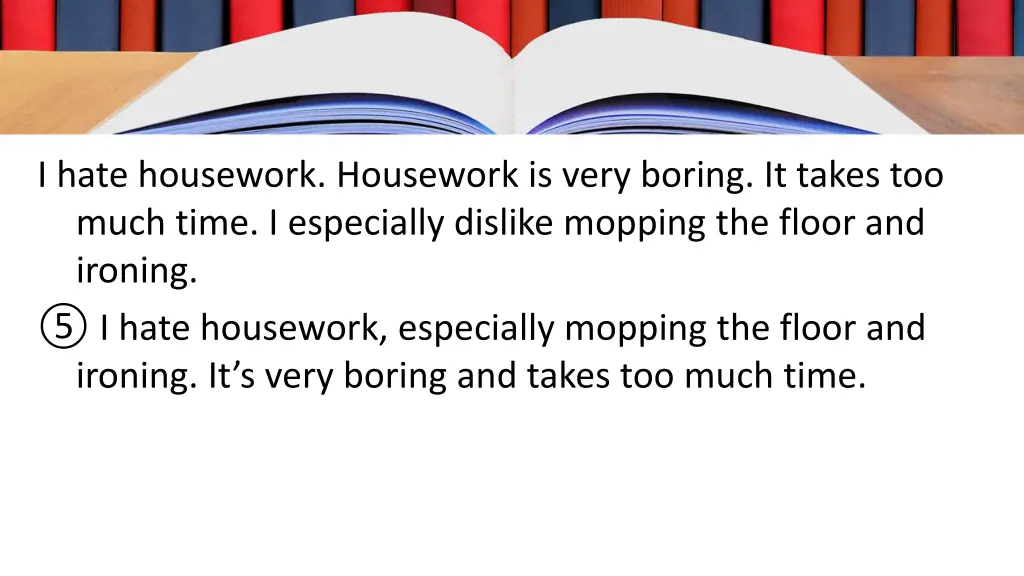
I hate housework. Housework is very boring. It takes too much time. I especially dislike mopping the floor and ironing. I hate housework, especially mopping the floor and ironing. It s very boring and takes too much time.