Service Statistics and Estimated Modern Use Tool
Explore the purpose, components, and data sources used in the Service Statistics to Estimated Modern Use Tool to analyze family planning service data and compare it with modern contraceptive prevalence rates. This presentation sheds light on the importance of data quality and its impact on decision-making processes.

Download Presentation

Please find below an Image/Link to download the presentation.
The content on the website is provided AS IS for your information and personal use only. It may not be sold, licensed, or shared on other websites without obtaining consent from the author. If you encounter any issues during the download, it is possible that the publisher has removed the file from their server.
You are allowed to download the files provided on this website for personal or commercial use, subject to the condition that they are used lawfully. All files are the property of their respective owners.
The content on the website is provided AS IS for your information and personal use only. It may not be sold, licensed, or shared on other websites without obtaining consent from the author.
E N D
Presentation Transcript
Introduction to Service Statistics to Estimated Modern Use Tool Name, Data for Impact Meeting or event Date
Objectives Understand the reason to use the SS to EMU tool. Describe the components of the SS to EMU tool. Define and identify the type of data to be used in the SS to EMU tool.
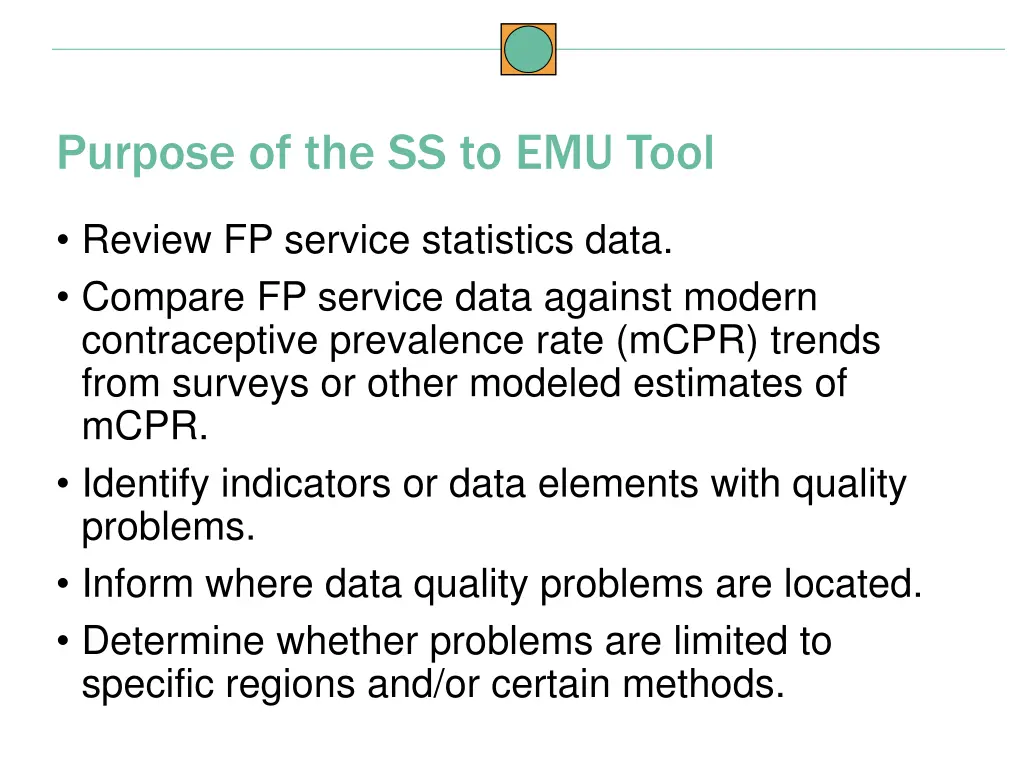
Purpose of the SS to EMU Tool Review FP service statistics data. Compare FP service data against modern contraceptive prevalence rate (mCPR) trends from surveys or other modeled estimates of mCPR. Identify indicators or data elements with quality problems. Inform where data quality problems are located. Determine whether problems are limited to specific regions and/or certain methods.
Components of the SS to EMU Tool Data entry Output review
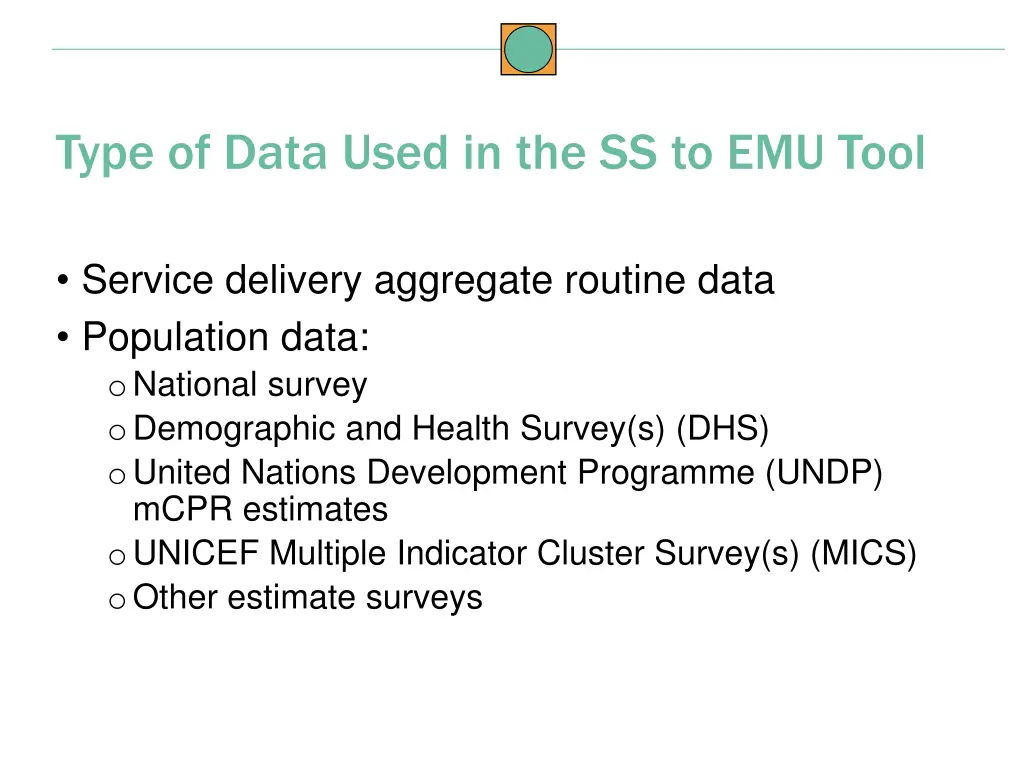
Type of Data Used in the SS to EMU Tool Service delivery aggregate routine data Population data: oNational survey oDemographic and Health Survey(s) (DHS) oUnited Nations Development Programme (UNDP) mCPR estimates oUNICEF Multiple Indicator Cluster Survey(s) (MICS) oOther estimate surveys
This presentation was produced with the support of the United States Agency for International Development (USAID) under the terms of the Data for Impact (D4I) associate award 7200AA18LA00008, which is implemented by the Carolina Population Center at the University of North Carolina at Chapel Hill, in partnership with Palladium International, LLC; ICF Macro, Inc.; John Snow, Inc.; and Tulane University. The views expressed in this publication do not necessarily reflect the views of USAID or the United States government. www.data4impactproject.org