"Explore Shenandoah Garbage Collector in Red Hat's OpenJDK, its algorithm, phases, features, and comparisons with G1GC. Learn about building blocks, modes, and tuning to optimize your Java applications efficiently."
Please find below an Image/Link to download the presentation.
The content on the website is provided AS IS for your information and personal use only. It may not be sold, licensed, or shared on other websites without obtaining consent from the author. If you encounter any issues during the download, it is possible that the publisher has removed the file from their server.
You are allowed to download the files provided on this website for personal or commercial use, subject to the condition that they are used lawfully. All files are the property of their respective owners.
The content on the website is provided AS IS for your information and personal use only. It may not be sold, licensed, or shared on other websites without obtaining consent from the author.
E N D
Presentation Transcript
shenandoah1.mp3 Shenandoah Intro to Red Hat s Shenandoah Garbage Collector
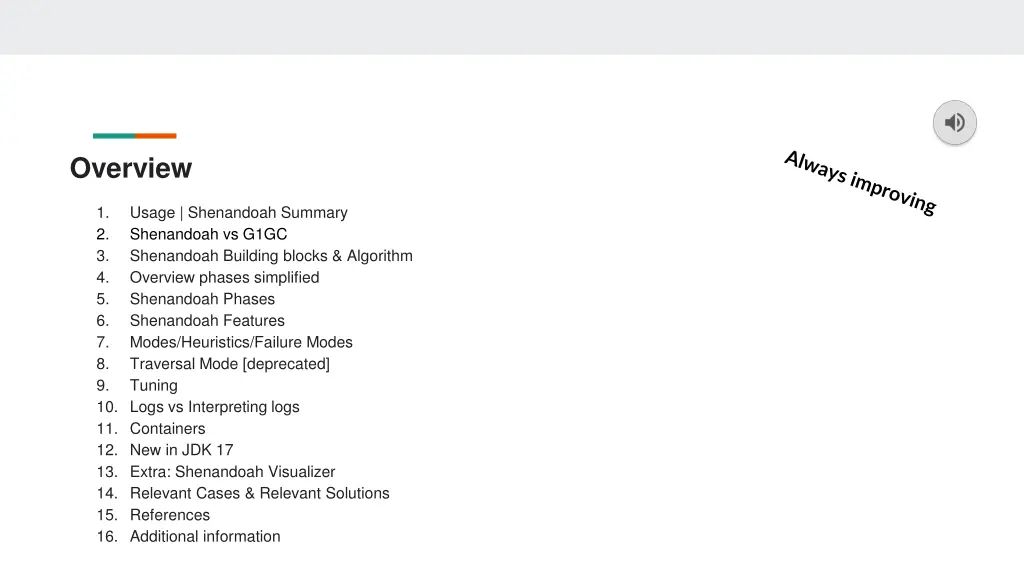
shenandoah2.mp3 Overview 1. 2. 3. 4. 5. 6. 7. 8. 9. 10. Logs vs Interpreting logs 11. Containers 12. New in JDK 17 13. Extra: Shenandoah Visualizer 14. Relevant Cases & Relevant Solutions 15. References 16. Additional information Usage | Shenandoah Summary Shenandoah vs G1GC Shenandoah Building blocks & Algorithm Overview phases simplified Shenandoah Phases Shenandoah Features Modes/Heuristics/Failure Modes Traversal Mode [deprecated] Tuning
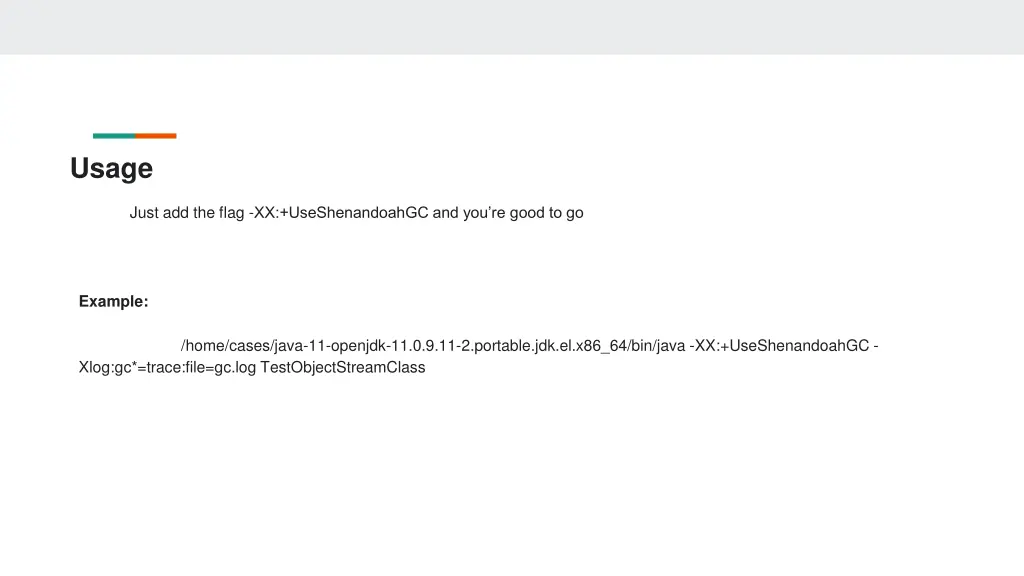
Usage Just add the flag -XX:+UseShenandoahGC and you re good to go Example: /home/cases/java-11-openjdk-11.0.9.11-2.portable.jdk.el.x86_64/bin/java -XX:+UseShenandoahGC - Xlog:gc*=trace:file=gc.log TestObjectStreamClass
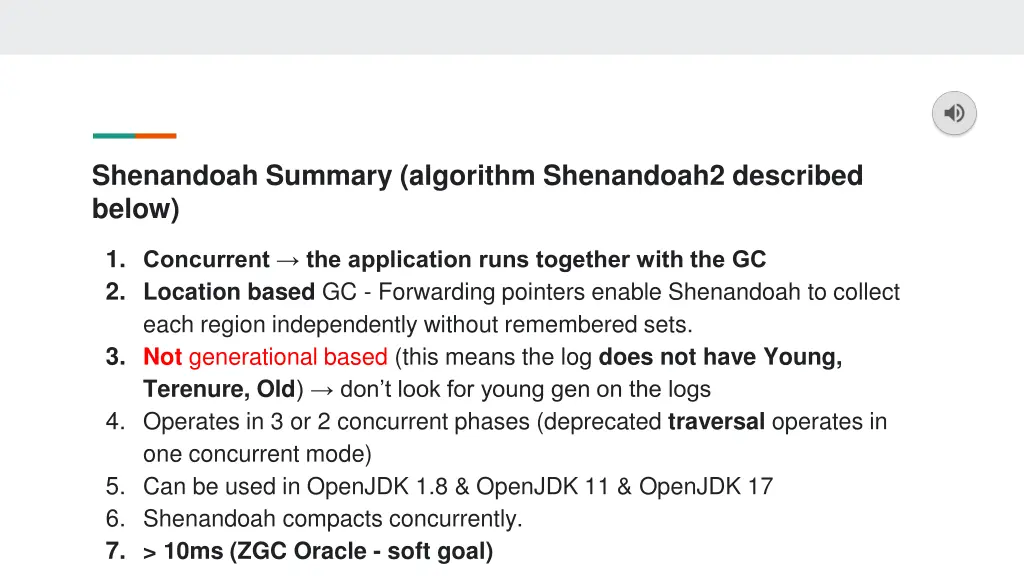
shenandoah3.mp3 Shenandoah Summary (algorithm Shenandoah2 described below) 1. Concurrent the application runs together with the GC 2. Location based GC - Forwarding pointers enable Shenandoah to collect each region independently without remembered sets. 3. Not generational based (this means the log does not have Young, Terenure, Old) don t look for young gen on the logs 4. Operates in 3 or 2 concurrent phases (deprecated traversal operates in one concurrent mode) 5. Can be used in OpenJDK 1.8 & OpenJDK 11 & OpenJDK 17 6. Shenandoah compacts concurrently. 7. > 10ms (ZGC Oracle - soft goal)
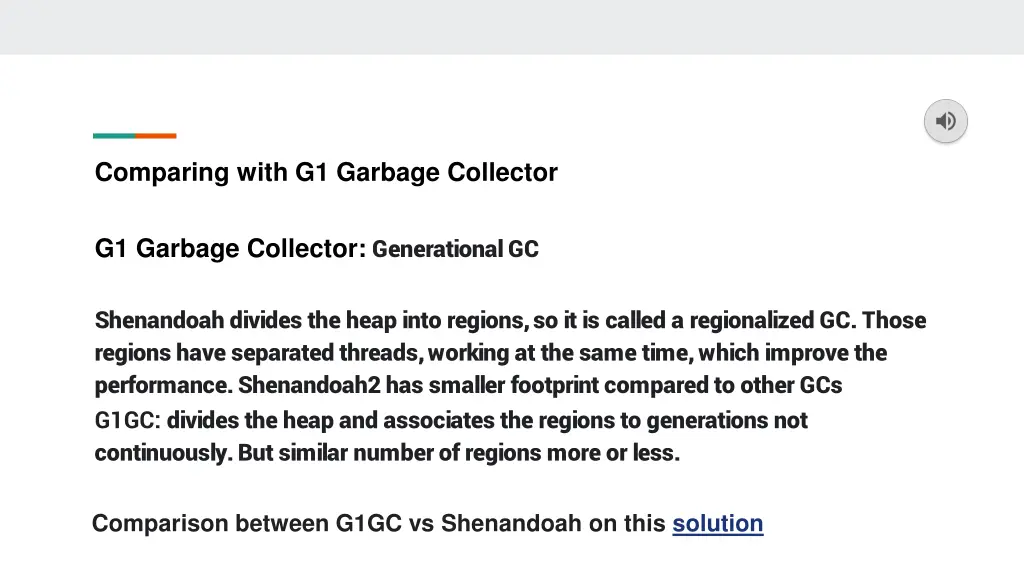
shenandoah4.mp3 Comparing with G1 Garbage Collector G1 Garbage Collector: Generational GC Shenandoah divides the heap into regions, so it is called a regionalized GC. Those regions have separated threads, working at the same time, which improve the performance. Shenandoah2 has smaller footprint compared to other GCs G1GC: divides the heap and associates the regions to generations not continuously. But similar number of regions more or less. Comparison between G1GC vs Shenandoah on this solution
shenandoah5.mp3 Shenandoah Building Blocks 1. Level of indirectness Brook s pointer used to be an additional word (plus the other two) now it uses the forwarding pointer in the header word 1. Snap shot at the Beginning -SATB (normal/stab mode) (also used by G1 GC): which takes a snapshot of the set of live objects in the heap at the start of a marking cycle.
shenandoah6.mp3 Shenandoah Algorithm 1. Heap divided into equal regions (similarly to G1GC) 2. Concurrent marking keeps track of live data in each region 3. GC threads pick the regions with the most garbage to join the collection set 4. GC threads evacuate live objects in those regions (evacuates, not evaluates) 5. Subsequent concurrent marking updates all references to evacuated regions 6. Evacuated regions reclaimed 7. Update references
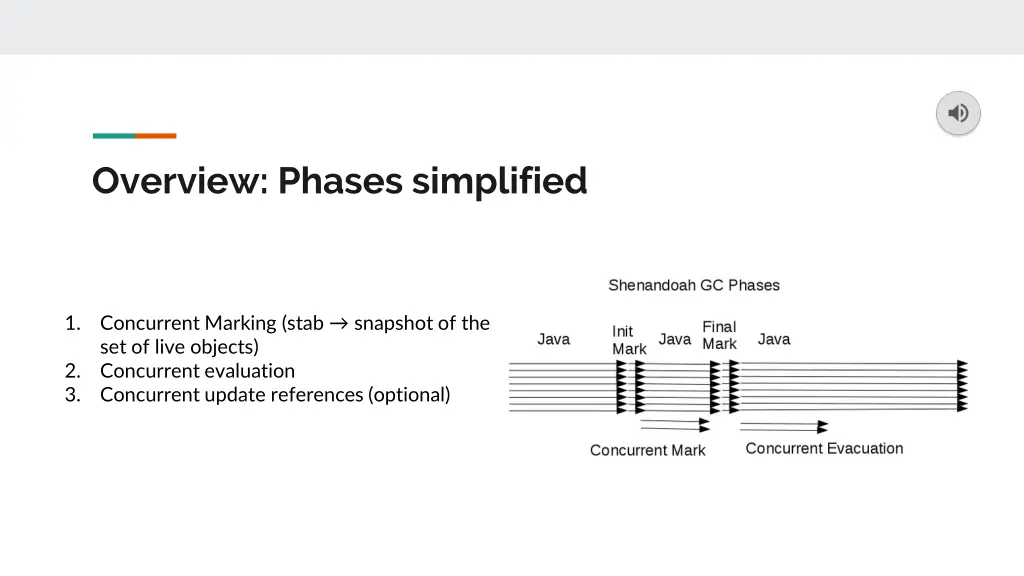
shenandoah7.mp3 Overview: Phases simplified 1. Concurrent Marking (stab snapshot of the set of live objects) Concurrent evaluation Concurrent update references (optional) 2. 3.
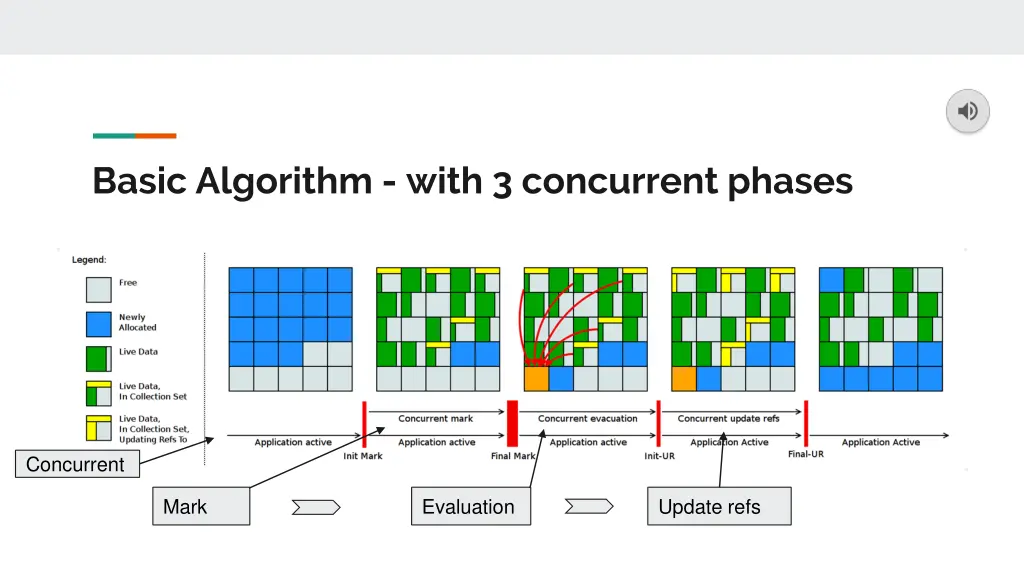
shenandoah8.mp3 Basic Algorithm - with 3 concurrent phases Concurrent Mark Evaluation Update refs
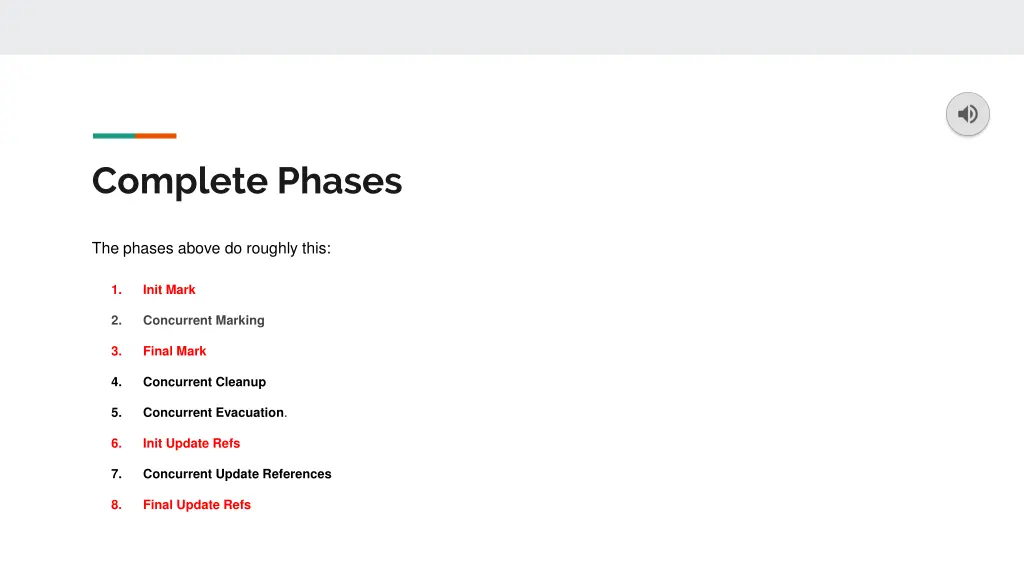
shenandoah9.mp3 Complete Phases The phases above do roughly this: 1. Init Mark 2. Concurrent Marking 3. Final Mark 4. Concurrent Cleanup Concurrent Evacuation. 5. 6. Init Update Refs 7. Concurrent Update References 8. Final Update Refs
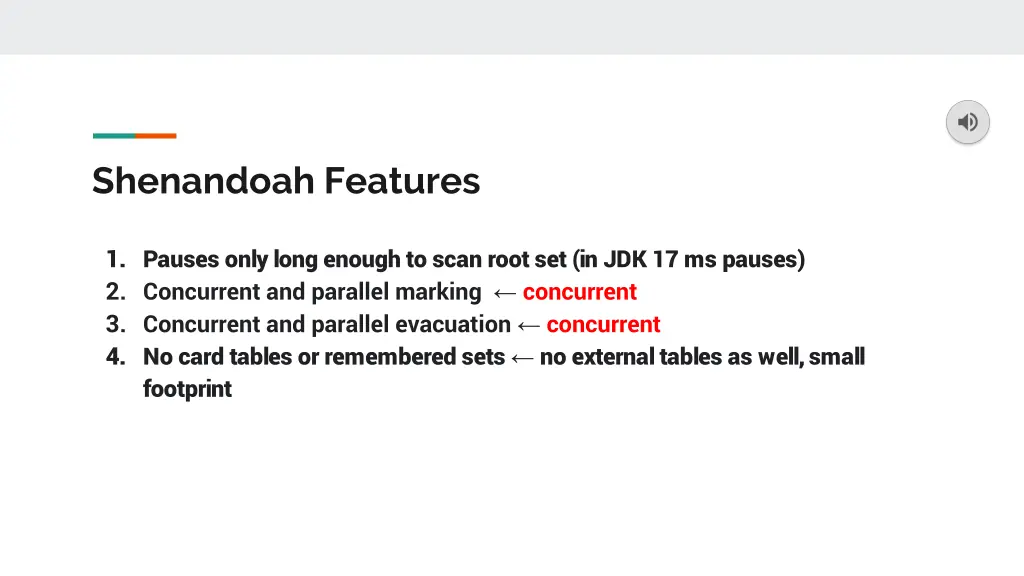
shenandoah10.mp3 Shenandoah Features 1. Pauses only long enough to scan root set (in JDK 17 ms pauses) 2. Concurrent and parallel marking concurrent 3. Concurrent and parallel evacuation concurrent 4. No card tables or remembered sets no external tables as well, small footprint
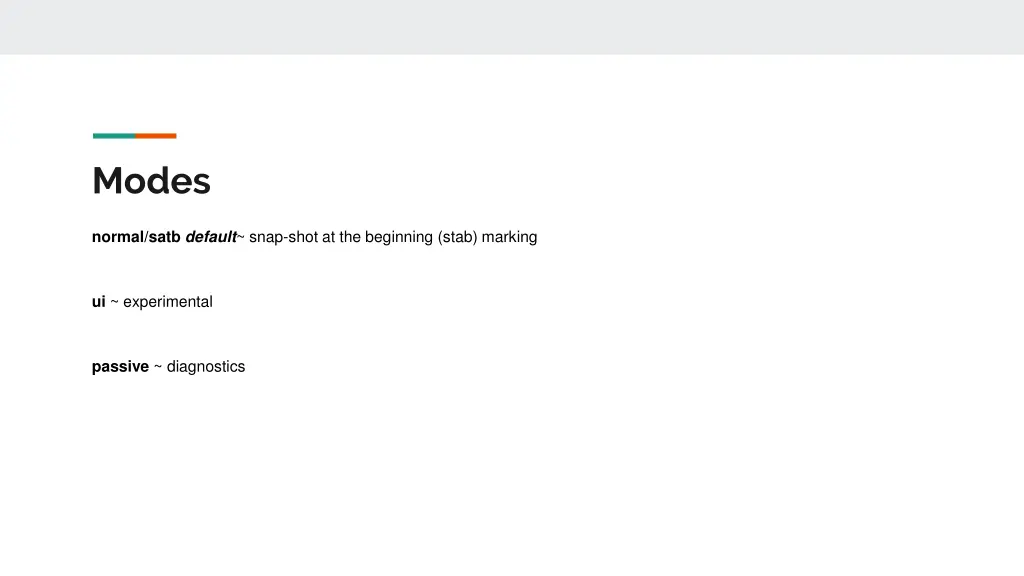
Modes normal/satb default~ snap-shot at the beginning (stab) marking ui ~ experimental passive ~ diagnostics
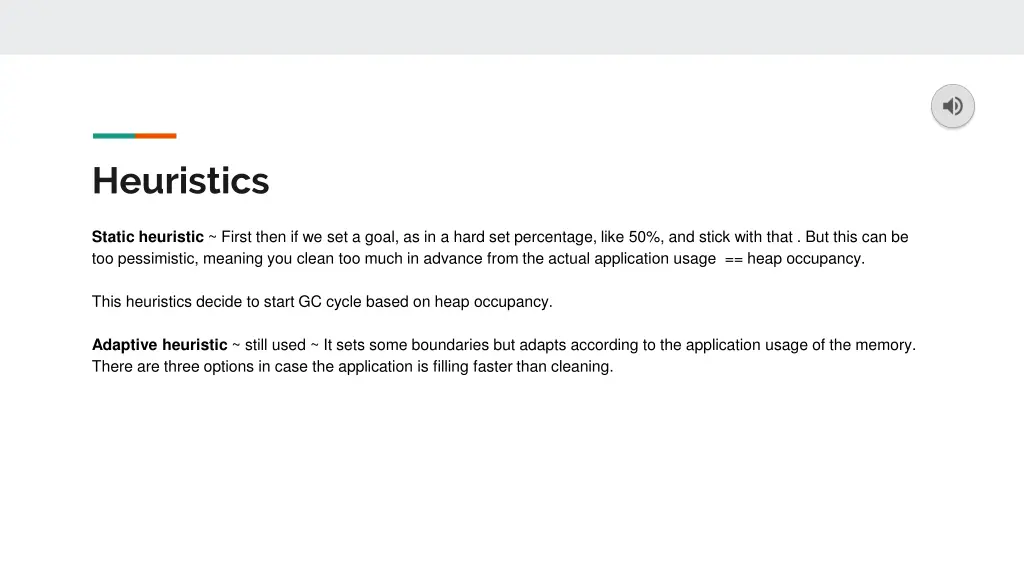
shenandoah11.mp3 Heuristics Static heuristic ~ First then if we set a goal, as in a hard set percentage, like 50%, and stick with that . But this can be too pessimistic, meaning you clean too much in advance from the actual application usage == heap occupancy. This heuristics decide to start GC cycle based on heap occupancy. Adaptive heuristic ~ still used ~ It sets some boundaries but adapts according to the application usage of the memory. There are three options in case the application is filling faster than cleaning.
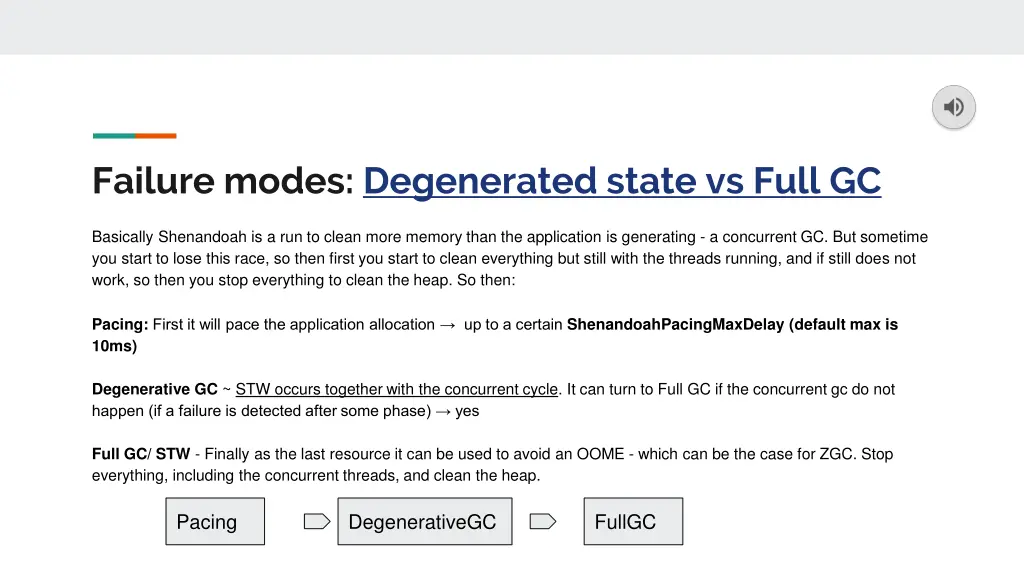
shenandoah12.mp3 Failure modes: Degenerated state vs Full GC Basically Shenandoah is a run to clean more memory than the application is generating - a concurrent GC. But sometime you start to lose this race, so then first you start to clean everything but still with the threads running, and if still does not work, so then you stop everything to clean the heap. So then: Pacing: First it will pace the application allocation up to a certain ShenandoahPacingMaxDelay (default max is 10ms) Degenerative GC ~ STW occurs together with the concurrent cycle. It can turn to Full GC if the concurrent gc do not happen (if a failure is detected after some phase) yes Full GC/ STW - Finally as the last resource it can be used to avoid an OOME - which can be the case for ZGC. Stop everything, including the concurrent threads, and clean the heap. Pacing DegenerativeGC FullGC
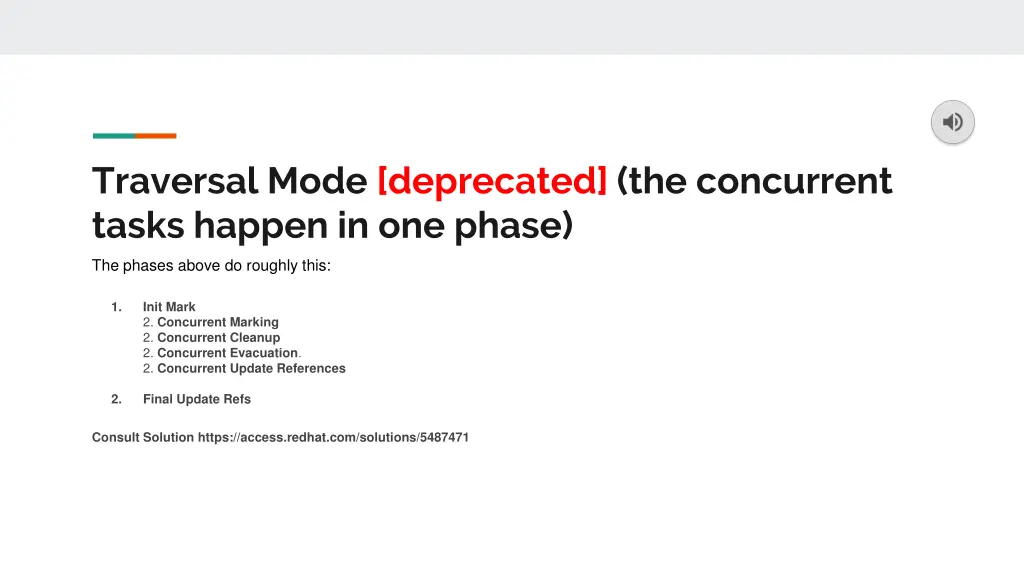
shenandoah13.mp3 Traversal Mode [deprecated] (the concurrent tasks happen in one phase) The phases above do roughly this: 1. Init Mark 2. Concurrent Marking 2. Concurrent Cleanup 2. Concurrent Evacuation. 2. Concurrent Update References 2. Final Update Refs Consult Solution https://access.redhat.com/solutions/5487471
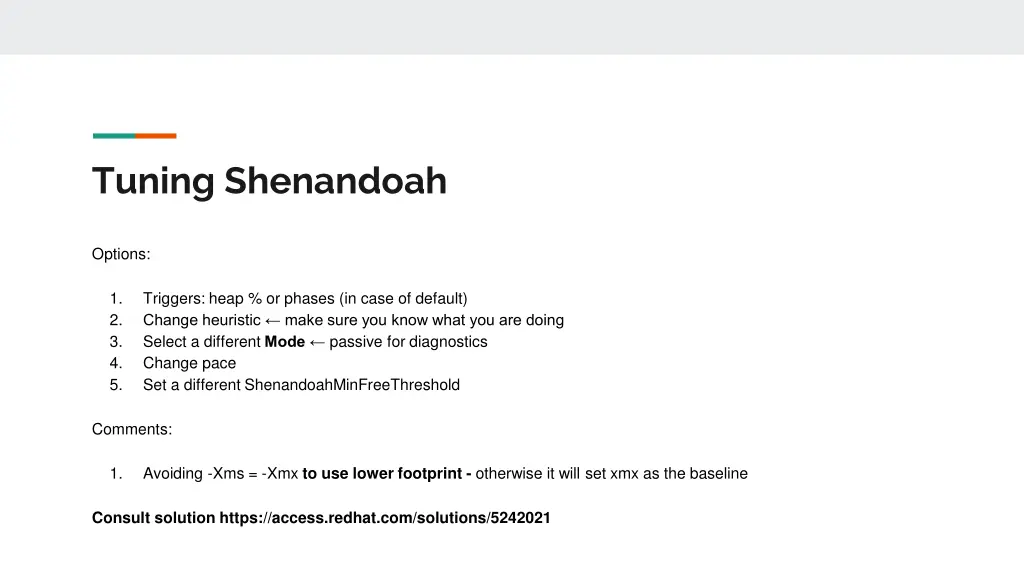
Tuning Shenandoah Options: 1. 2. 3. 4. 5. Triggers: heap % or phases (in case of default) Change heuristic make sure you know what you are doing Select a different Mode passive for diagnostics Change pace Set a different ShenandoahMinFreeThreshold Comments: 1. Avoiding -Xms = -Xmx to use lower footprint - otherwise it will set xmx as the baseline Consult solution https://access.redhat.com/solutions/5242021
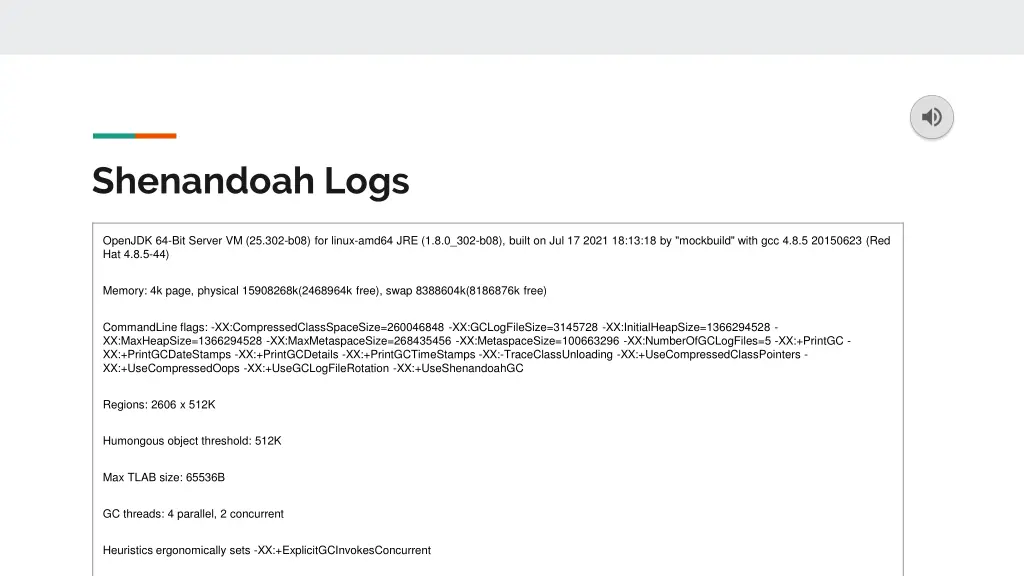
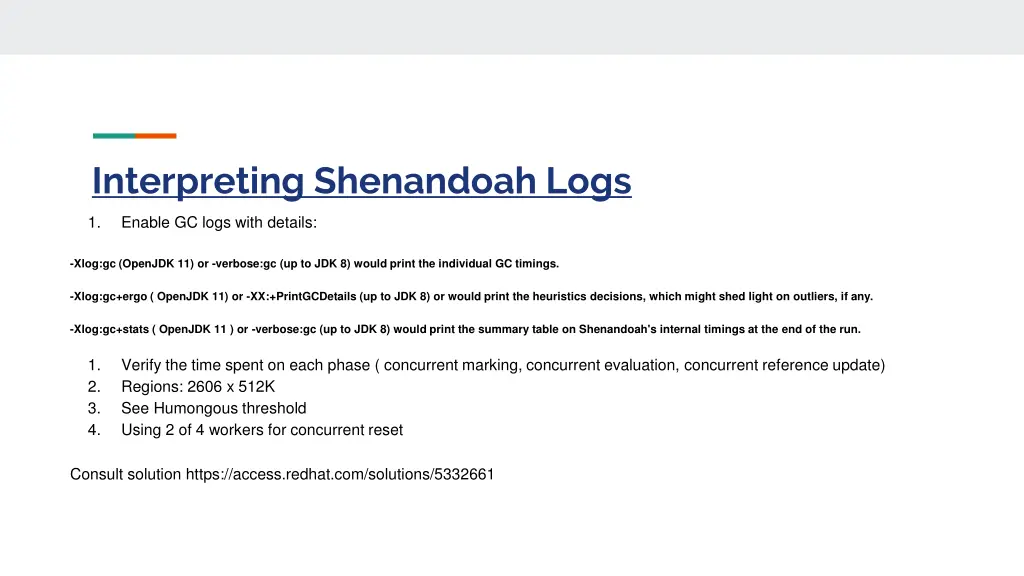
shenandoah15.mp3 Shenandoah Logs OpenJDK 64-Bit Server VM (25.302-b08) for linux-amd64 JRE (1.8.0_302-b08), built on Jul 17 2021 18:13:18 by "mockbuild" with gcc 4.8.5 20150623 (Red Hat 4.8.5-44) Memory: 4k page, physical 15908268k(2468964k free), swap 8388604k(8186876k free) CommandLine flags: -XX:CompressedClassSpaceSize=260046848 -XX:GCLogFileSize=3145728 -XX:InitialHeapSize=1366294528 - XX:MaxHeapSize=1366294528 -XX:MaxMetaspaceSize=268435456 -XX:MetaspaceSize=100663296 -XX:NumberOfGCLogFiles=5 -XX:+PrintGC - XX:+PrintGCDateStamps -XX:+PrintGCDetails -XX:+PrintGCTimeStamps -XX:-TraceClassUnloading -XX:+UseCompressedClassPointers - XX:+UseCompressedOops -XX:+UseGCLogFileRotation -XX:+UseShenandoahGC Regions: 2606 x 512K Humongous object threshold: 512K Max TLAB size: 65536B GC threads: 4 parallel, 2 concurrent Heuristics ergonomically sets -XX:+ExplicitGCInvokesConcurrent
Interpreting Shenandoah Logs 1. Enable GC logs with details: -Xlog:gc (OpenJDK 11) or -verbose:gc (up to JDK 8) would print the individual GC timings. -Xlog:gc+ergo ( OpenJDK 11) or -XX:+PrintGCDetails (up to JDK 8) or would print the heuristics decisions, which might shed light on outliers, if any. -Xlog:gc+stats ( OpenJDK 11 ) or -verbose:gc (up to JDK 8) would print the summary table on Shenandoah's internal timings at the end of the run. 1. 2. 3. 4. Verify the time spent on each phase ( concurrent marking, concurrent evaluation, concurrent reference update) Regions: 2606 x 512K See Humongous threshold Using 2 of 4 workers for concurrent reset Consult solution https://access.redhat.com/solutions/5332661
shenandoah17.mp3 Containers Shenandoah is not generational yet*, - - - Therefore this can have a high throughput losses; Consider it wisely for Containers (in comparison with others) but better than G1GC! The flag `ShenandoahGCHeuristics=compact` can be considered as well *Amazon and Microsoft are working to make it generational on JDK 17.
shenandoah18.mp3 New features in JDK 17 Shenandoah on JDK 17 is going very fast even faster than before. How they managed to do that? They gave up and implemented a colored pointer implementation to speed up the things, similarly to ZGC, which is based on that.
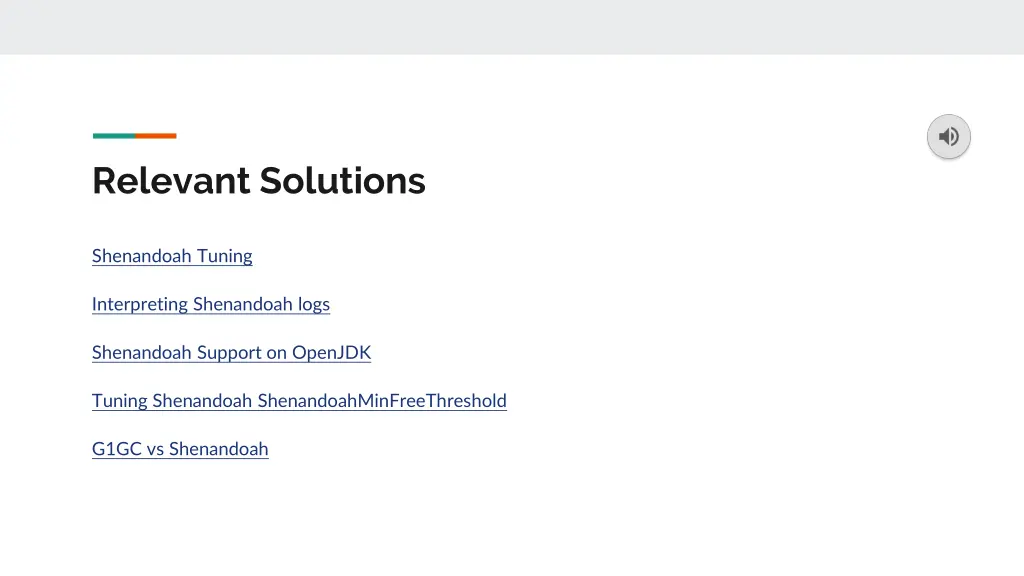
shenandoah20.mp3 Relevant Solutions Shenandoah Tuning Interpreting Shenandoah logs Shenandoah Support on OpenJDK Tuning Shenandoah ShenandoahMinFreeThreshold G1GC vs Shenandoah
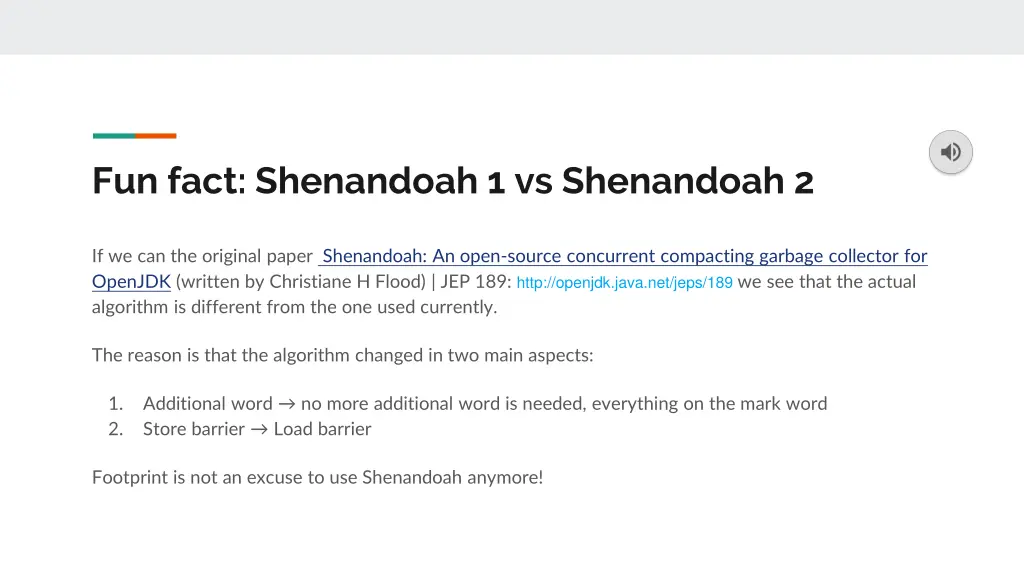
shenandoah22.mp3 Fun fact: Shenandoah 1 vs Shenandoah 2 If we can the original paper Shenandoah: An open-source concurrent compacting garbage collector for OpenJDK (written by Christiane H Flood) | JEP 189: http://openjdk.java.net/jeps/189 we see that the actual algorithm is different from the one used currently. The reason is that the algorithm changed in two main aspects: 1. 2. Additional word no more additional word is needed, everything on the mark word Store barrier Load barrier Footprint is not an excuse to use Shenandoah anymore!
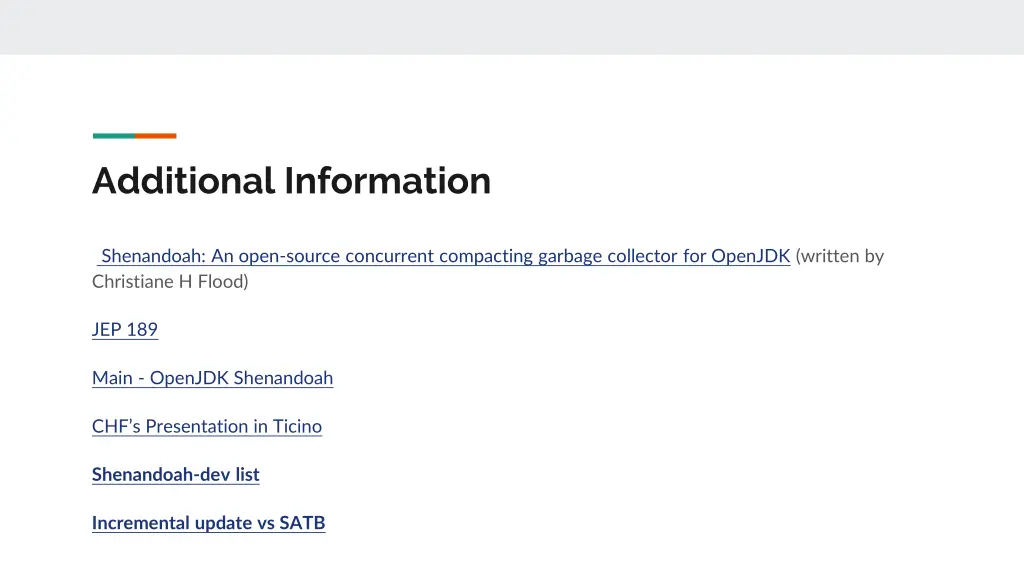
Additional Information Shenandoah: An open-source concurrent compacting garbage collector for OpenJDK (written by Christiane H Flood) JEP 189 Main - OpenJDK Shenandoah CHF s Presentation in Ticino Shenandoah-dev list Incremental update vs SATB
shenandoah25.mp3 Collection Fun-with-* ZGC G1GC CMS ParallelGC not sure why the overview shows SerialGC SerialGC C4 GC very basic state, much to learn









![(❤Read⚡) [✔PDF✔] Noodles for Baby](/thumb/68039/read-pdf-noodles-for-baby-powerpoint-ppt-presentation.jpg)