Signal Processing for Hearing Aids: Challenges and Solutions
This workshop presentation covers speech and hearing topics such as excitation sources, phonemic features, and hearing mechanisms. Explore challenges and solutions in signal processing for hearing aids.

Download Presentation

Please find below an Image/Link to download the presentation.
The content on the website is provided AS IS for your information and personal use only. It may not be sold, licensed, or shared on other websites without obtaining consent from the author.If you encounter any issues during the download, it is possible that the publisher has removed the file from their server.
You are allowed to download the files provided on this website for personal or commercial use, subject to the condition that they are used lawfully. All files are the property of their respective owners.
The content on the website is provided AS IS for your information and personal use only. It may not be sold, licensed, or shared on other websites without obtaining consent from the author.
E N D
Presentation Transcript
Workshop Radar and Sonar Signal Processing, NSTL Visakhapatnam, 17-21 Aug 2015 Coordinator: Ms. M. Vijaya < vijaya.m @ nstl.drdo.in > Session: 21 Aug 2015, 1100 to 1230 ============================================================================ Signal Processing for Hearing Aids: Challenges and Some Solutions P. C. Pandey IIT Bombay
Outline A. Speech & Hearing B. Sliding-band Dynamic Range Compression (Ref: N. Tiwari & P. C. Pandey, NCC 2014, Paper No.1569847357) C. Automated Modification of Consonant-Vowel Ratio of Stops (Ref: A. R. Jayan & P. C. Pandey, Int. J. Speech Technology, vol. 18, pp. 113 130, 2015) 2/15
P. C. Pandey, "Signal processing for hearing aids: Challenges and some solutions, Invited talk, Workshop Radar and Sonar Signal Processing, NSTL Visakhapatnam, 17-21 Aug 2015 Workshop Coordinator: Ms. M. Vijaya < vijaya.m @ nstl.drdo.in > Session: 21 Aug 2015, 1100 to 1230 ======================================================================================== Part A Speech & Hearing 3/15
Speech Production Excitation source & filter model Excitation: voiced/unvoiced glottal, frication Filtering: vocal tract filter 4/15
Speech segments Words Syllables Phonemes Sub-phonemic segments Phonemes: basic speech units Vowels: Pure vowels, Diphthongs Consonants: Semivowels, Stops, Fricatives, Affricates, Nasals /ada/ /aba/ /aga/ /apa/ 5/15
Phonemic features Modes of excitation Glottal: Unvoiced (constriction at the glottis), Voiced (glottal vibration) Frication: Unvoiced (constriction in vocal tract), Voiced (constriction in v.t. & glottal vibration) Movement of articulators Continuant (steady-state v.t. configuration): vowels, nasal stops, fricatives Non-continuant (changing v.t.): diphthongs, semivowels, oral stops (plosives) Place of articulation (place of maximum constriction in v.t.) Bilabial, Labio-dental, Linguo-dental, Alveolar, Palatal, Velar, Gluttoral Changes in voicing frequency (Fo) Supra-segmental features: Intonation, Rhythm 6/15
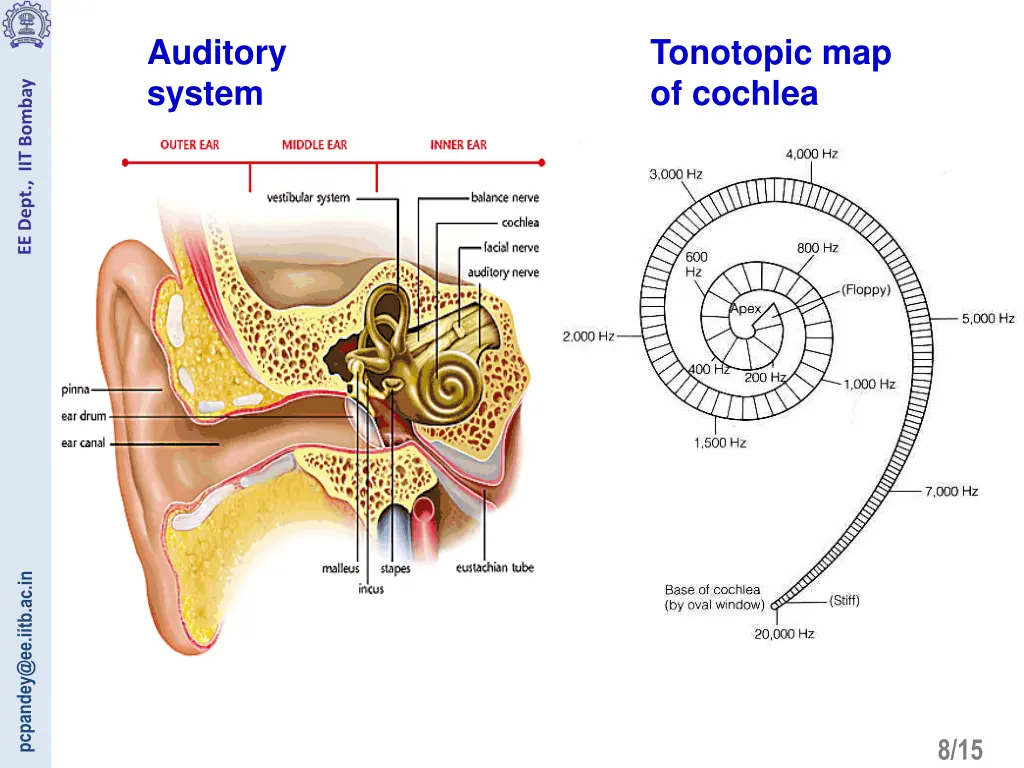
Hearing Mechanism Peripheral auditory system External ear: sound collection Pinna Auditory canal Middle ear: impedance matching Ear drum Middle ear bones Inner ear (cochlea): analysis & transduction Auditory nerve: transmission of neural impulses Central auditory system Information processing & interpretation 7/15
Auditory system Tonotopic map of cochlea 8/15
HearingImpairment Types of hearing losses Conductive Sensorineural Central Functional Sensorineural hearing loss Associated with abnormalities in the cochlear hair cells or the auditory nerve. Causes: aging, excessive noise exposure, infection, adverse effect of medicines, congenital. 9/15
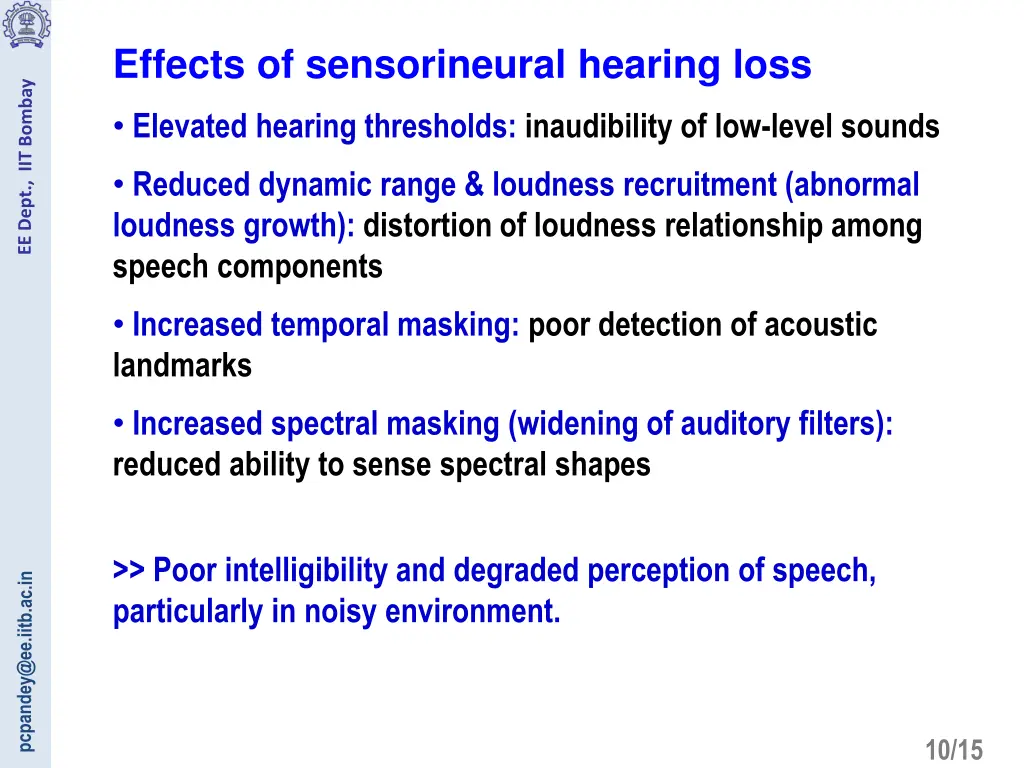
Effects of sensorineural hearing loss Elevated hearing thresholds: inaudibility of low-level sounds Reduced dynamic range & loudness recruitment (abnormal loudness growth): distortion of loudness relationship among speech components Increased temporal masking: poor detection of acoustic landmarks Increased spectral masking (widening of auditory filters): reduced ability to sense spectral shapes >> Poor intelligibility and degraded perception of speech, particularly in noisy environment. 10/15
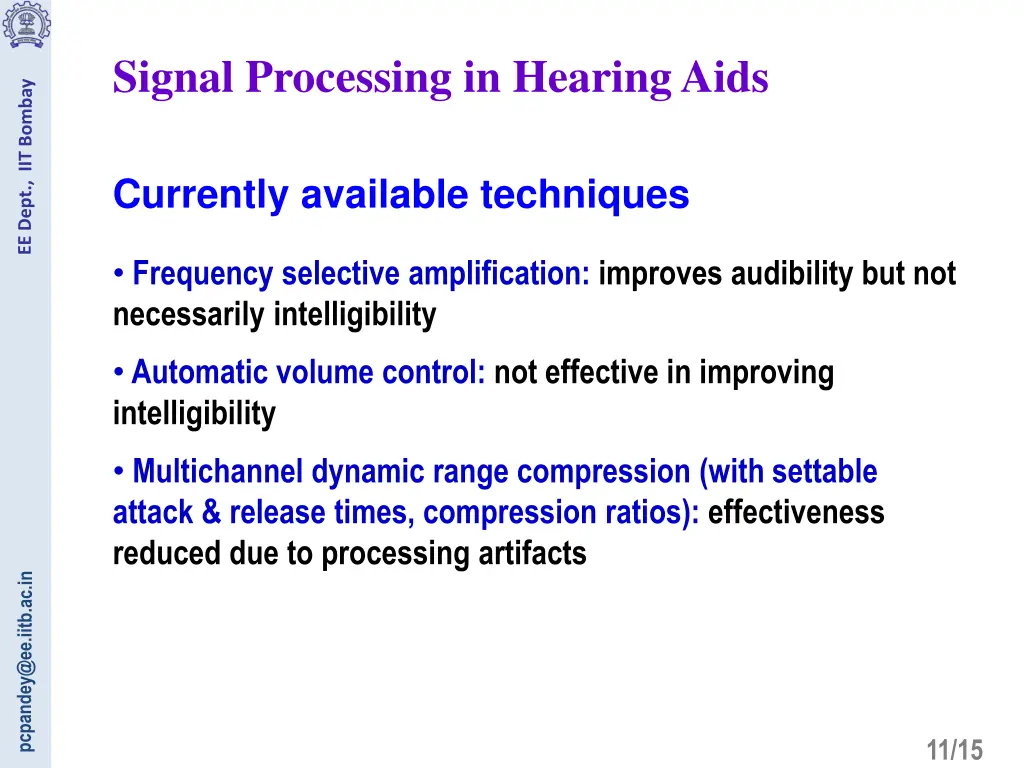
Signal Processing in Hearing Aids Currently available techniques Frequency selective amplification: improves audibility but not necessarily intelligibility Automatic volume control: not effective in improving intelligibility Multichannel dynamic range compression (with settable attack & release times, compression ratios): effectiveness reduced due to processing artifacts 11/15
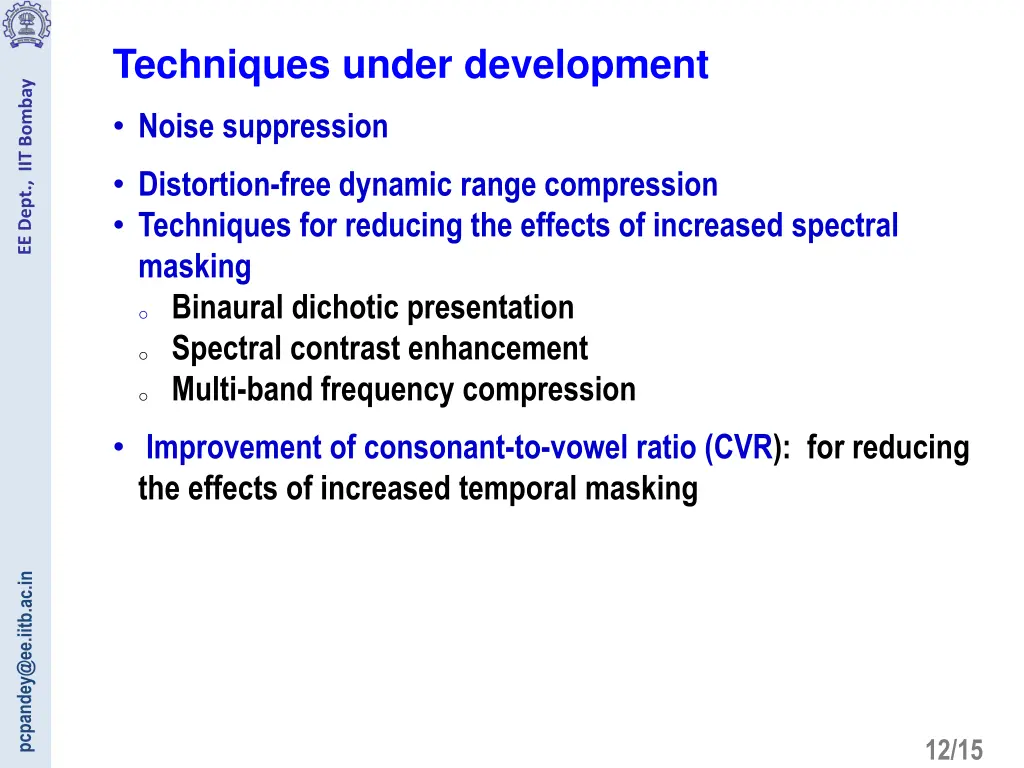
Techniques under development Noise suppression Distortion-free dynamic range compression Techniques for reducing the effects of increased spectral masking o Binaural dichotic presentation o Spectral contrast enhancement o Multi-band frequency compression Improvement of consonant-to-vowel ratio (CVR): for reducing the effects of increased temporal masking 12/15
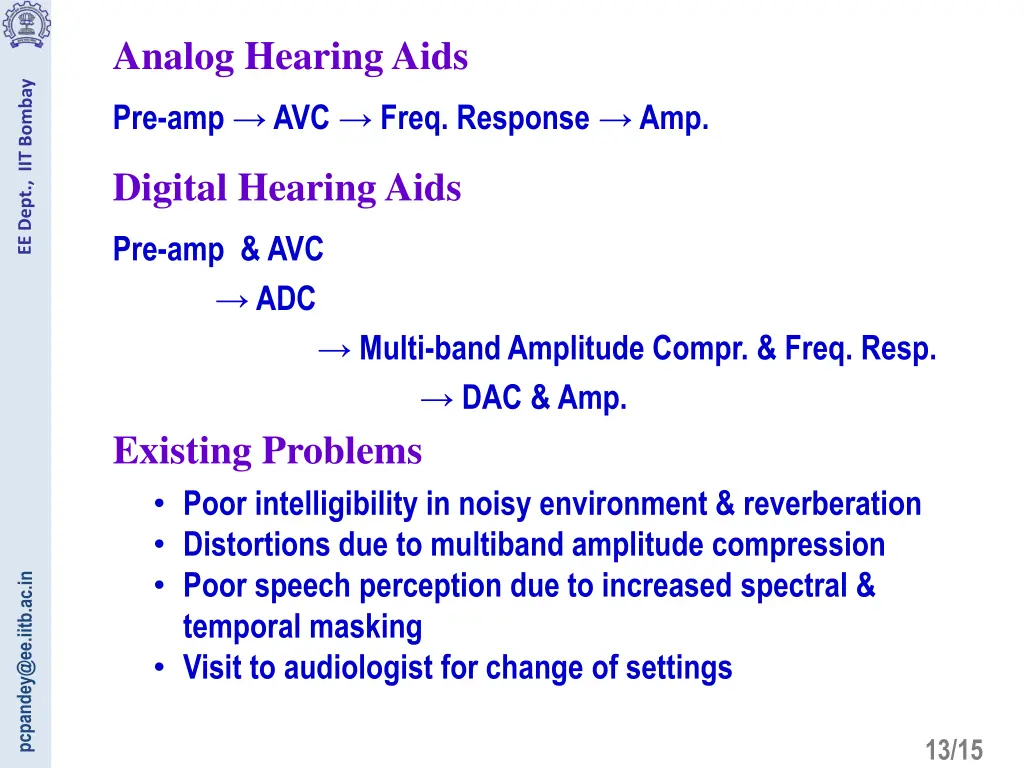
Analog Hearing Aids Pre-amp AVC Freq. Response Amp. Digital Hearing Aids Pre-amp & AVC ADC Existing Problems Poor intelligibility in noisy environment & reverberation Distortions due to multiband amplitude compression Poor speech perception due to increased spectral & temporal masking Visit to audiologist for change of settings Multi-band Amplitude Compr. & Freq. Resp. DAC & Amp. 13/15
Proposed Hearing Aids Distortion-free dynamic range compression & adjustable frequency response Noise suppression & de-reverberation Processing for reducing the effects of increased spectral masking Processing for reducing the effects of increased temporal masking Implementation of signal processing using a low-power DSP chip with acceptable signal delay (< 60 ms) User selectable settings 14/15
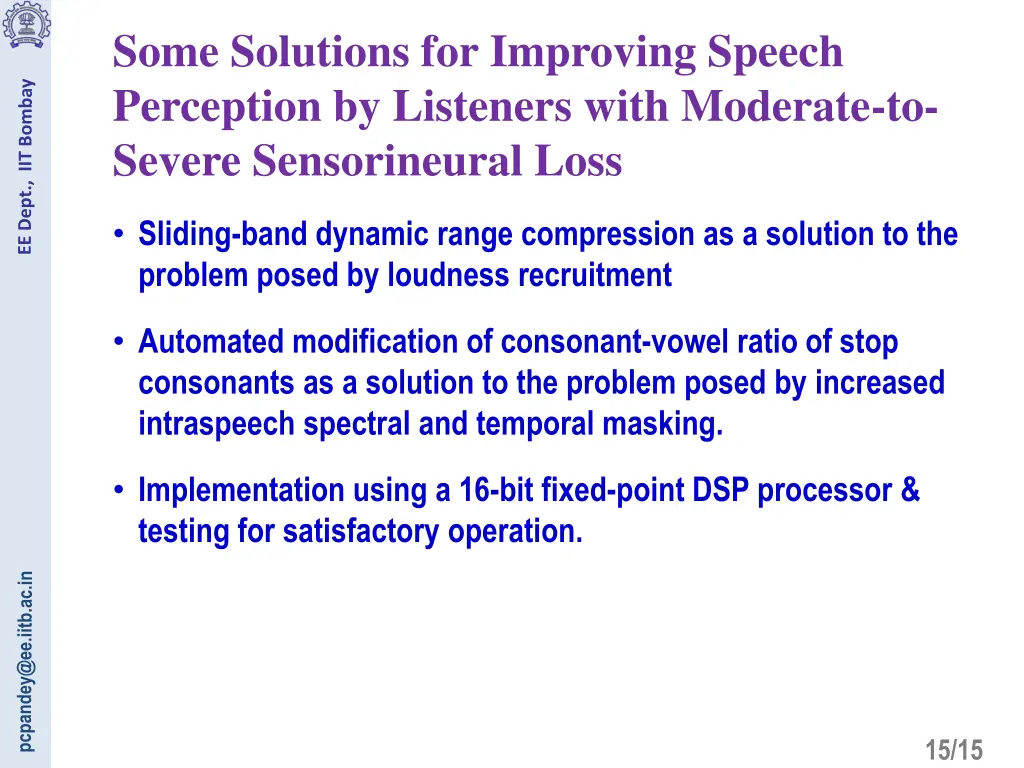
Some Solutions for Improving Speech Perception by Listeners with Moderate-to- Severe Sensorineural Loss Sliding-band dynamic range compression as a solution to the problem posed by loudness recruitment Automated modification of consonant-vowel ratio of stop consonants as a solution to the problem posed by increased intraspeech spectral and temporal masking. Implementation using a 16-bit fixed-point DSP processor & testing for satisfactory operation. 15/15