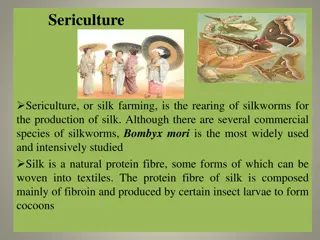
Explore the fascinating life cycle of silk worms at Mohanlal Sukhadiya University in Udaipur. From eggs to larvae to pupae, discover the stages of development and silk production. Learn about the Bombyx mori species and their cocoon-making process. Witness the transformation from larva to silk moth adult in this educational journey through the world of silk production.
Please find below an Image/Link to download the presentation.
The content on the website is provided AS IS for your information and personal use only. It may not be sold, licensed, or shared on other websites without obtaining consent from the author. If you encounter any issues during the download, it is possible that the publisher has removed the file from their server.
You are allowed to download the files provided on this website for personal or commercial use, subject to the condition that they are used lawfully. All files are the property of their respective owners.
The content on the website is provided AS IS for your information and personal use only. It may not be sold, licensed, or shared on other websites without obtaining consent from the author.
E N D
Presentation Transcript
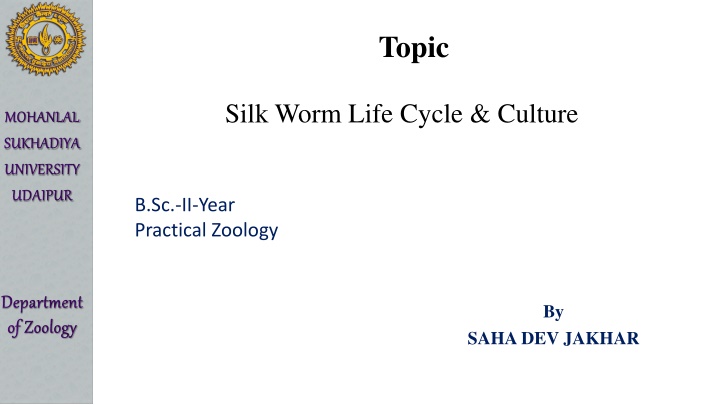
Topic Silk Worm Life Cycle & Culture MOHANLAL MOHANLAL SUKHADIYA SUKHADIYA UNIVERSITY UNIVERSITY UDAIPUR UDAIPUR B.Sc.-II-Year Practical Zoology Department Department of Zoology of Zoology By SAHA DEV JAKHAR
Classification Kingdom: Animalia Phylum: Arthropoda Class: Insecta Order: Lepidoptera Family: Bombycidae Genus: Bombyx Species: B. mori
Eggs take about 14 days to hatch into larvae, which eat continuously. They have a preference for white mulberry, having an attraction to the mulberry odorant cis-jasmone. They are not monophagous, since they can eat other species of Morus, as well as some other Moraceae, mostly Osage orange. They are covered with tiny black hairs. When the color of their heads turns darker, it indicates they are about to molt. After molting, the larval phase of the silkworms emerge white, naked, and with little horns on their backs. After they have molted four times, their bodies become slightly yellow, and the skin becomes tighter. The larvae then prepare to enter the pupal phase of their lifecycle, and enclose themselves in a cocoon made up of raw silk produced by the salivary glands. The final molt from larva to pupa takes place within the cocoon, which provides a vital layer of protection during the vulnerable, almost motionless pupal state. Many other Lepidoptera produce cocoons, but only a few the Bombycidae, in particular the genus Bombyx, and the Saturniidae, in particular the genus Antheraea have been exploited for fabric production. Pupa releases proteolytic enzymes to make a hole in the cocoon so it can emerge as an adult moth.