Simple Machines
Mechanical advantage in simple machines is a key concept that quantifies how much a device assists in overcoming resistance. The ratio of forces and distances traveled provides valuable insights for designers to optimize efficiency and function. Ideal and actual mechanical advantages offer theoretical and practical perspectives, considering factors like frictional losses. Explore real-world examples showcasing different mechanical advantage ratios, from greater than 1 to less than 1, highlighting the impact on force and distance exerted in various mechanisms.

Download Presentation

Please find below an Image/Link to download the presentation.
The content on the website is provided AS IS for your information and personal use only. It may not be sold, licensed, or shared on other websites without obtaining consent from the author.If you encounter any issues during the download, it is possible that the publisher has removed the file from their server.
You are allowed to download the files provided on this website for personal or commercial use, subject to the condition that they are used lawfully. All files are the property of their respective owners.
The content on the website is provided AS IS for your information and personal use only. It may not be sold, licensed, or shared on other websites without obtaining consent from the author.
E N D
Presentation Transcript
Simple Machines Mechanical Advantage
Mechanical Advantage Describes how much the device helps you, i.e. how much advantage do you get from using it? Can be expressed as the ratio of: 1) the resistance force (i.e. the load) to the effort force required to move it 2) the distance traveled by the effort force to the distance traveled by the resistance force These calculated ratios allow designers to manipulate a design to change speed, distance, force, and function.
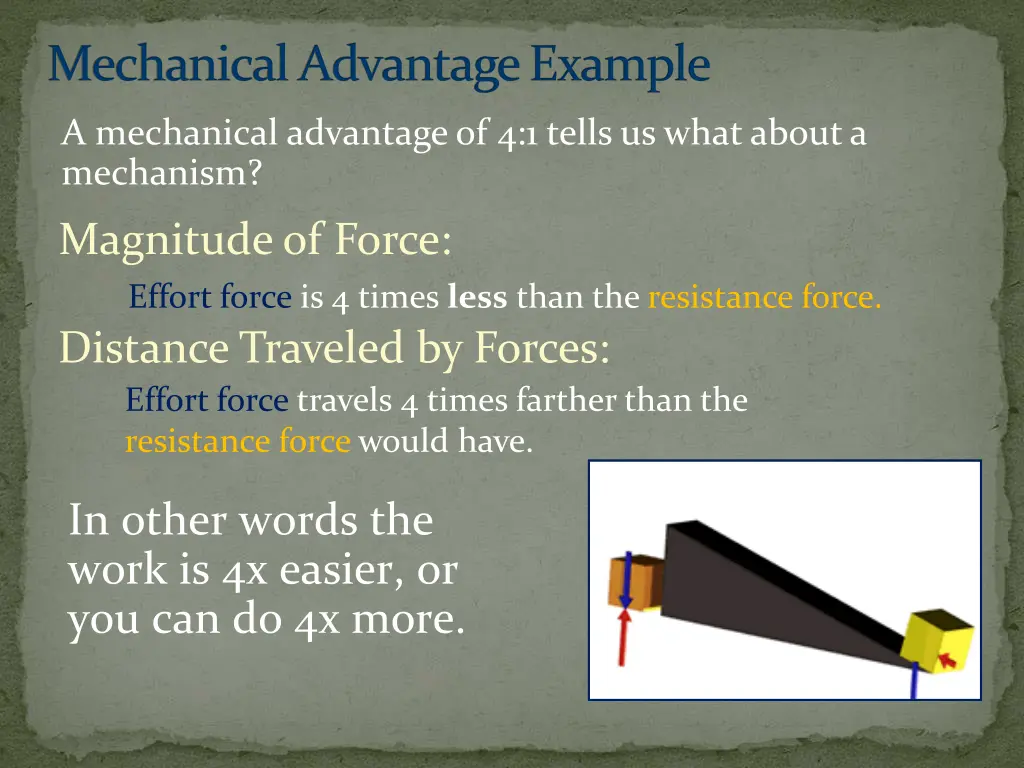
Mechanical Advantage Example A mechanical advantage of 4:1 tells us what about a mechanism? Magnitude of Force: Effort force is 4 times less than the resistance force. Distance Traveled by Forces: Effort force travels 4 times farther than the resistance force would have. In other words the work is 4x easier, or you can do 4x more.
Mechanical Advantage Ratios One is the magic number If MA is greater than 1: less effort force but greater effort distance are required to overcome a given resistance force If MA is less than 1: greater effort force but less effort distance are required to overcome a given resistance force MA is never less than zero.
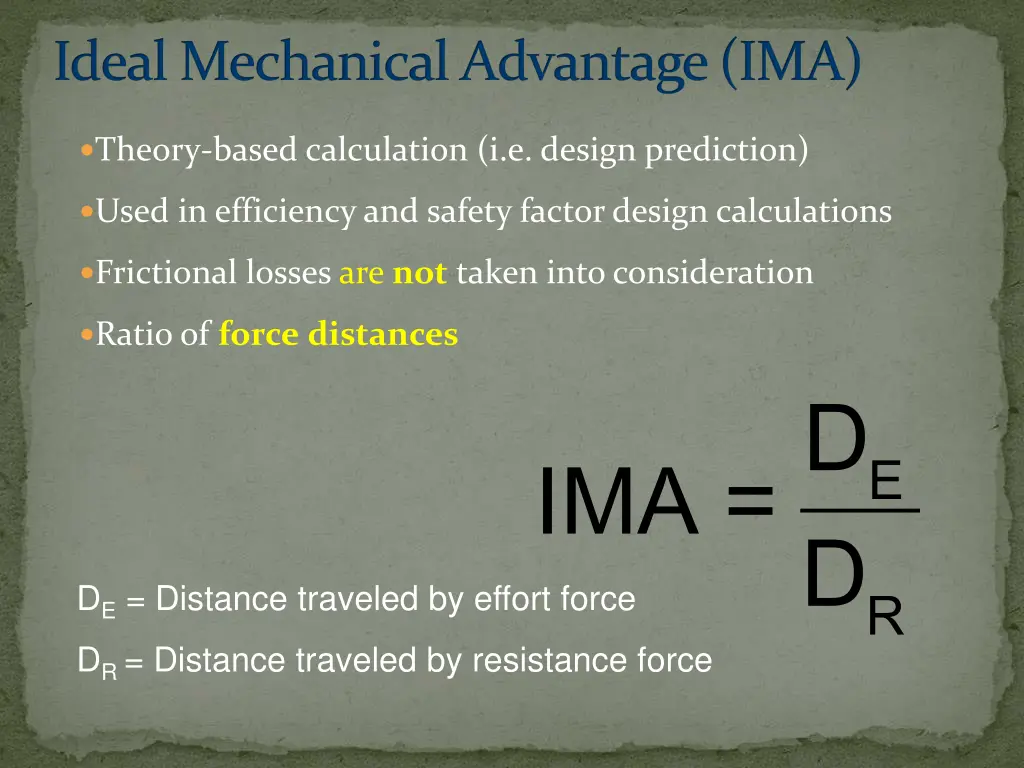
Ideal Mechanical Advantage (IMA) Theory-based calculation (i.e. design prediction) Used in efficiency and safety factor design calculations Frictional losses are not taken into consideration Ratio of forcedistances D IMA =D E R DE = Distance traveled by effort force DR = Distance traveled by resistance force
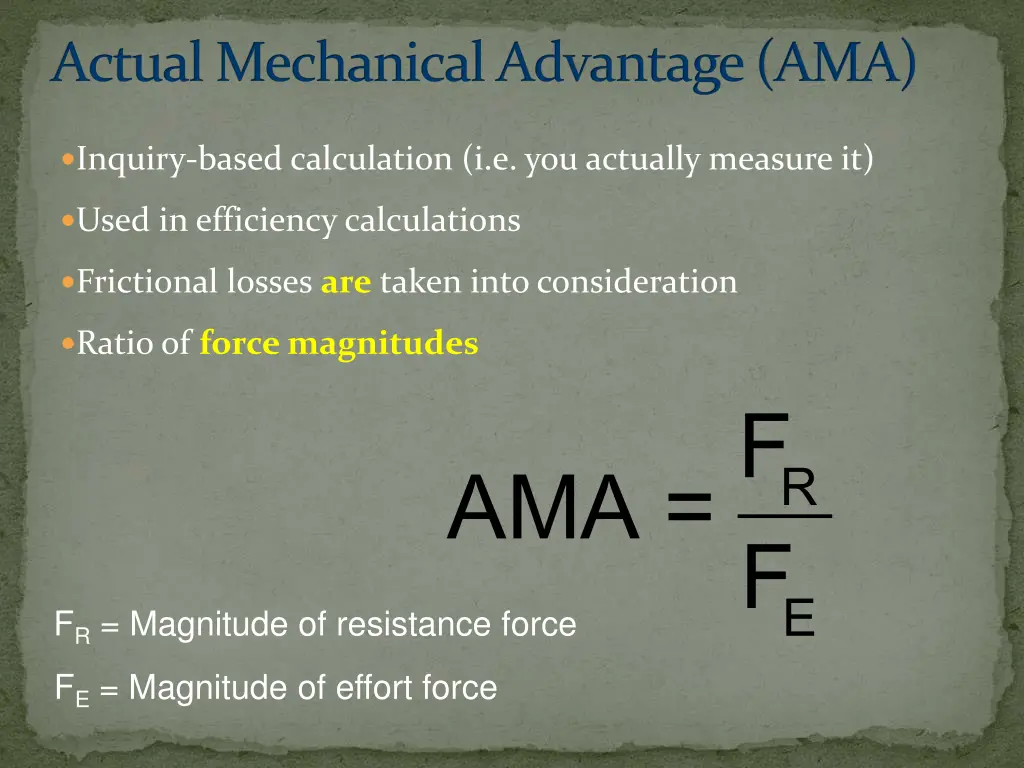
Actual Mechanical Advantage (AMA) Inquiry-based calculation (i.e. you actually measure it) Used in efficiency calculations Frictional losses are taken into consideration Ratio of force magnitudes F AMA =F R E FR = Magnitude of resistance force FE = Magnitude of effort force
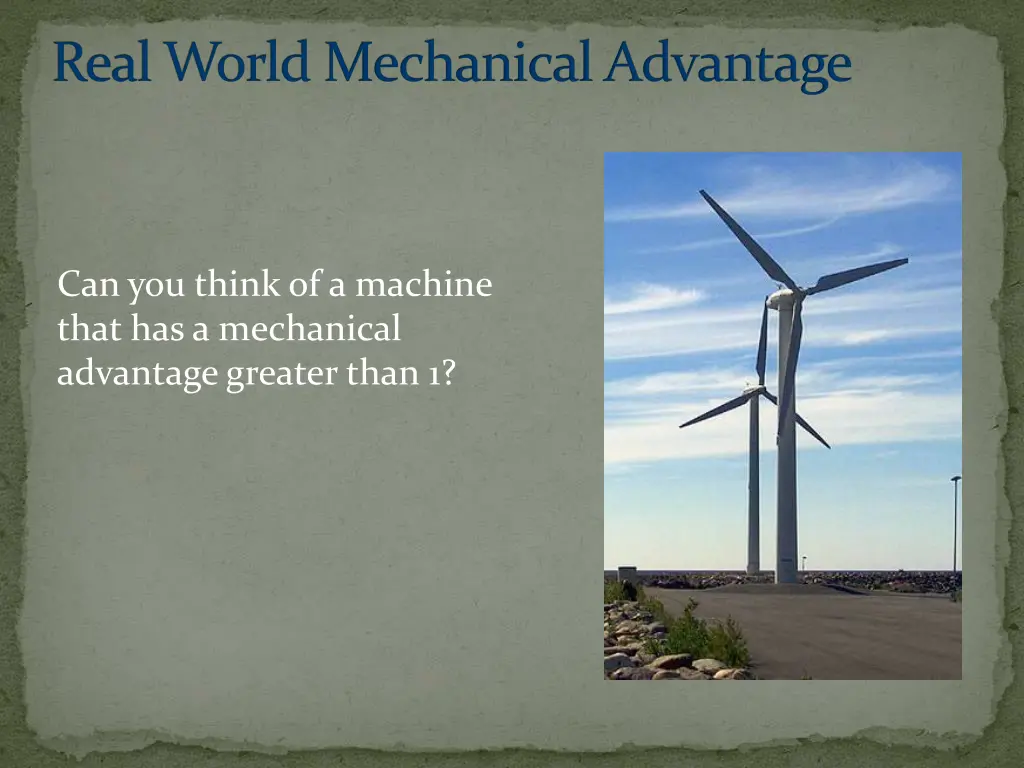
Real World Mechanical Advantage Can you think of a machine that has a mechanical advantage greater than 1?
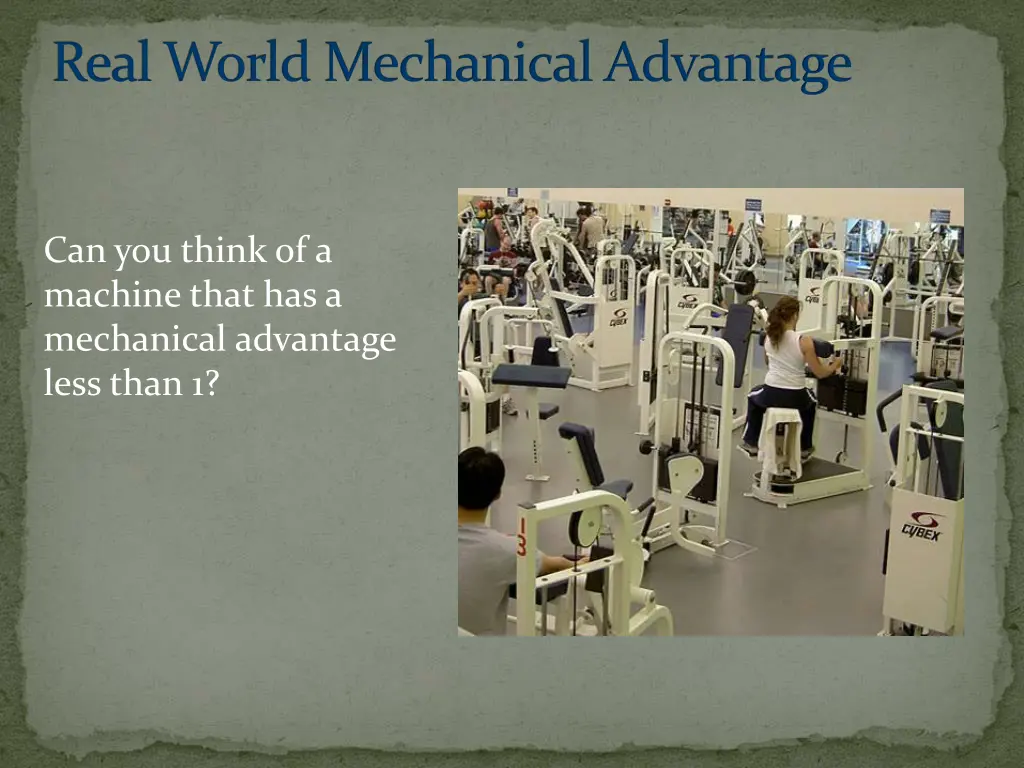
Real World Mechanical Advantage Can you think of a machine that has a mechanical advantage less than 1?
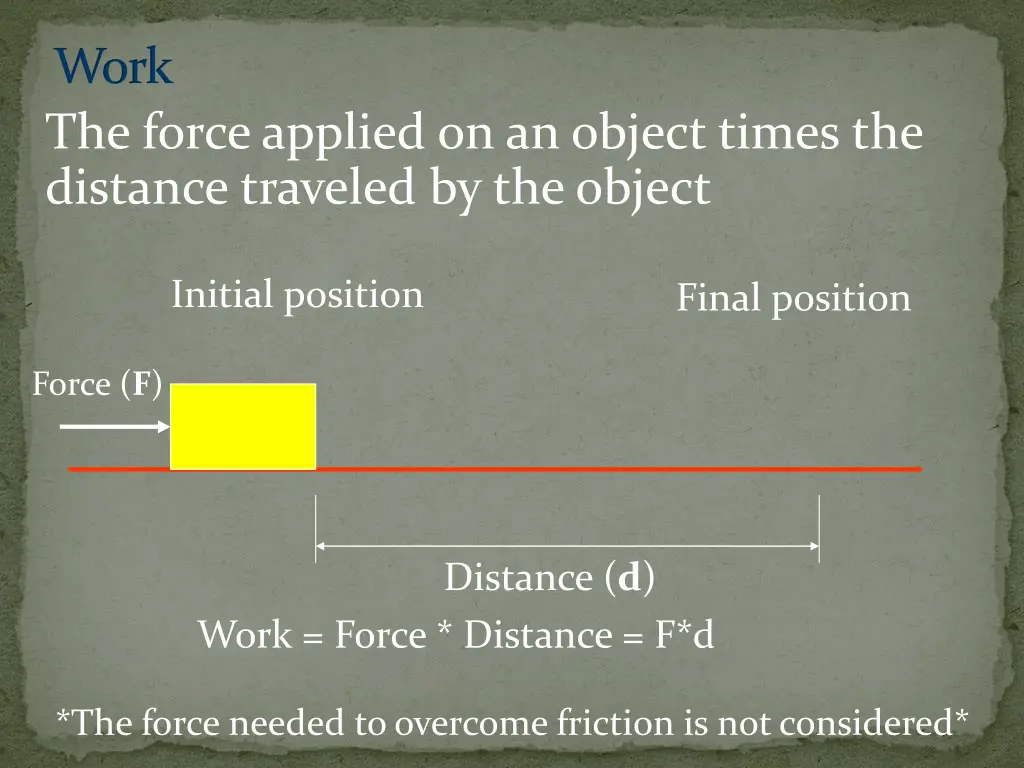
Work The force applied on an object times the distance traveled by the object Initial position Final position Force (F) Distance (d) Work = Force * Distance = F*d *The force needed to overcome friction is not considered*
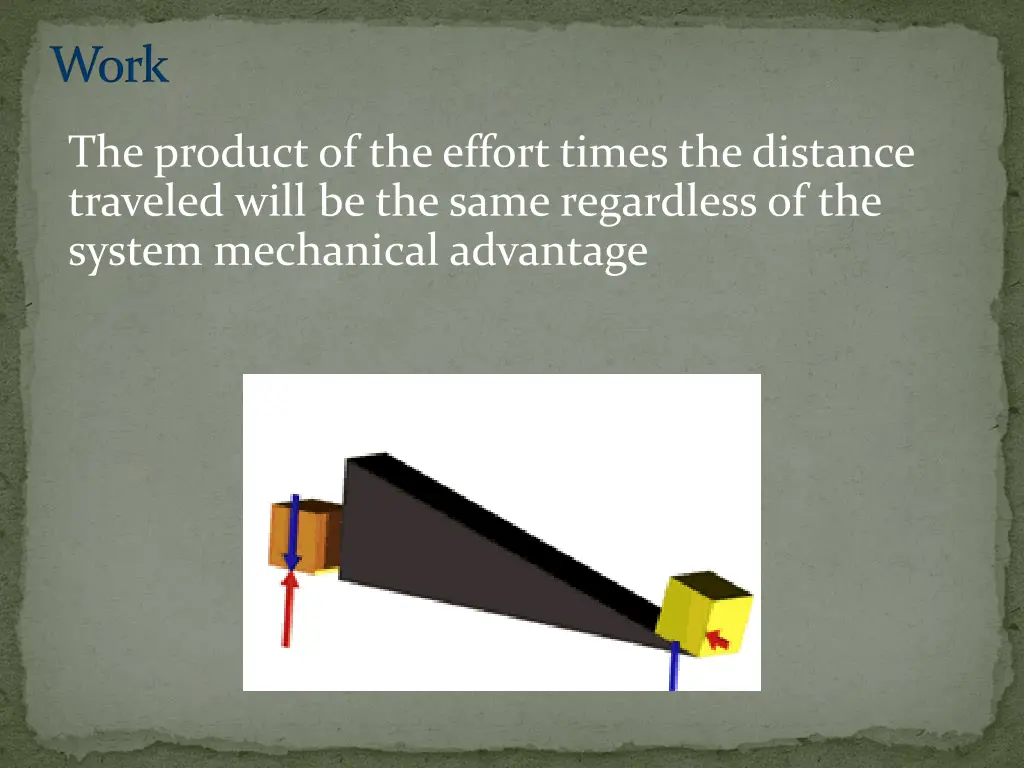
Work The product of the effort times the distance traveled will be the same regardless of the system mechanical advantage
Image Resources Microsoft, Inc. (2008). Clip Art. Retrieved January 10, 2008, from http://office.microsoft.com/en-us/clipart/default.aspx