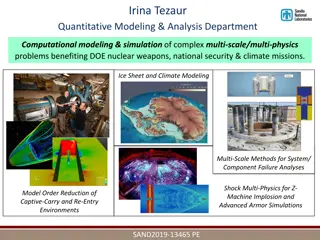
Simulation Modeling for Decision Support
This module focuses on developing skills in modeling and simulation of business dynamics to aid decision-making, utilizing simulation software for discrete-event simulation and System Dynamics. The course includes lectures, practical exercises, group coursework, and essays to enhance students' understanding and application of simulation models in management and business situations. Upon completion, students will be equipped to critically appraise and apply simulation methods to real business problems, using appropriate simulation software and following modeling procedures.

Download Presentation

Please find below an Image/Link to download the presentation.
The content on the website is provided AS IS for your information and personal use only. It may not be sold, licensed, or shared on other websites without obtaining consent from the author.If you encounter any issues during the download, it is possible that the publisher has removed the file from their server.
You are allowed to download the files provided on this website for personal or commercial use, subject to the condition that they are used lawfully. All files are the property of their respective owners.
The content on the website is provided AS IS for your information and personal use only. It may not be sold, licensed, or shared on other websites without obtaining consent from the author.
E N D
Presentation Transcript
Initial Advisory Committee Meeting Nov 1,2016 Columbus State Community College
Welcome/Introductions Dr. Randy Smith OSU (Co -chair) Dr. Mark Nutter -Washington State Community College (Co chair) Ms. Becky Barnes- Cuyahoga Community College Transfer & Articulation Dr. Rebecca Butler Columbus State Community College- Enrollment Management Dr. Tim Dorsey -Cuyahoga Community College Enrollment Management Mr. Charles Long -Wright State University-Transfer & Admission Advising Dr. Caroline Miller -University of Cincinnati - Enrollment Management Mr. Matthew Moore-Sinclair Community College-Financial Aid Mr. Kevin Neal -Cleveland State University Registrar Ms. Nichole Neal . -Shawnee State University-Financial Aid Ms. Fedearia Nicholson-Stark State College-Student Service Ms. Joan Ogg- Akron University Transfer Advising Dr. Mark Polatajko Kent State University - Chief Financial Officer Ms. Kathy Pruckno -Miami University Transfer Admissions Advising Dr. Regina Randall Columbus State Community College -Registrar Ms. Deborah Rathke -Owens Community College- Institutional Research Ms. Connie Strebe -Tollis -Career and Technical Center Transfer Advising Ms. Amy Sues Clark State Community College Student Service Mr. Craig This -Wright State University-Institutional Research
Committee Structure Co-Chairs ( Representatives from the Ohio Guaranteed Pathways Statewide Steering Committee) Student Service Deans/Enrollment Management Executives Transfer Advisors /Transfer Coordinators Admissions Transfer Advisors Registrars Institutional Research directors Financial Aid Directors Chief Financial Officer
Overview Introduction Over the past 25 years the State of Ohio has developed a highly sophisticated articulation and credit transfer system for Ohio s public colleges and universities. The system is supported by policies, agreed upon practices and guidelines and state legislative initiatives and funding. It has provided a framework that allows students to transfer among Ohio s 2 and 4 year colleges seamlessly without loss of time or additional expense for degree completion and guarantees both credit articulation and application to a degree. An analysis of the data compiled over the past 10 years by the Higher Education Information System indicates that there are both regional and institutional variances in the effectiveness of Ohio s articulation framework as it provides opportunities for transfer students degree completion goals. This is confirmed by a recent national study that indicates variations among institutions of higher education in Ohio in the mobility and success of students in transfer.
Charter Action Establish an advisory committee 0f knowledgeable volunteers from Ohio s 2 and 4 year Higher Ed institutions .The committee will assist in the process of identification and analysis the best and most promising practices in place Nationally and within the University System of Ohio for improvement in transfers degree completion rates. The committee, through a combination of national research, statewide discussion with stakeholders and surveys, will develop and provide an inventory of best and most promising practices that can be shared and implemented statewide to provide each college and university a comprehensive overview of processes for increasing transfer student degree completion.
Goals Identify and discuss emerging practices through a combination of national research, member discussions and survey. Develop an inventory of promising practices in Ohio Provide guidance in the implementation of promising practices for current and future statewide transfer initiatives Develop a process for the implementation of the best and promising practices based on the data collection and analysis Report findings to the Ohio Articulation and Transfer Network Oversight Board Recommend process for statewide dissemination of inventory
Background Information: Ohio Guaranteed Transfer Pathways Organizational Committee Structure Ohio Articulation and Transfer Network Oversight Board Ohio Guaranteed Transfer Pathway Statewide Steering Committee Co-Chairs (Representatives from the OATN Oversight Board) President of a Two-Year Public Institution (Dr. Marcia Ballinger of Lorain CCC) and President of a Four-Year Public Institution (Dr. Mary Ellen Mazey of Bowling Green State University) Representatives from Each of the Six Regions OACC Representative (Dr. Jack Hershey) IUC Representative (Mr. Bruce Johnson) Transfer Practices Advisory Committee* Academic Transfer Support Services Northwest Region 1. John Fischer (BGSU) 2. Steve Robinson (Owens) Central Region 1. Randy Smith (OSU) 2. Jack Cooley (Columbus State) Northeast Region 1. Kevin Ball (YSU) 2. Lada Gibson- Shreve (Stark State) Southwest Region 1. Gigi Escoe (UC) 2. Robbin Hoopes (Cincinnati St) West Region 1. Carl Brun (Wright State) 2. Dave Collins (Sinclair) Southeast Region 1. Howard Dewald (Ohio University) 2. Mark Nutter (WSCC) *Research indicates that a clear pathway for students is important, but not without sound advising and easy-to-navigate transfer process. This Advisory Committee s work can be strongly tied to the successful implementation of the statewide guaranteed transfer pathway work.
What we know in Ohio: Definition of transfers OATN definition: A student is defined as a transfer if she makes a clean break from her college in an academic year. A clean break occurs if one of three ways: 1. The student formally transfers credits from her college of attendance to another institution, or 2. The student does not transfer credit to another institution but attends a single institution of higher education that is different from the original college of attendance, or 3. The student does not transfer credit to another institution but attends multiple institutions and attempts the maximum number of credit hours in an institution different from the original college of attendance. There is no standardized definition of annual transfer movements for the nation as a whole. Different reports typically define transfer movements for a particular cohort of students. Such definitions are useful in calculating graduation rates. Ohio research data compiled by Dr. Shoumi Mustafa, Senior Research Analyst -Ohio Dept. of Higher Education
What we know in Ohio: Annualized enrollment numbers Ohio Public Institutions of Higher Education 589,549579,177 600,000 569,217 538,049522,350 522,198 467,039483,041491,787502,817498,632496,983494,106503,142 500,000 400,000 300,000 200,000 100,000 0 FY2001 FY2002 FY2003 FY2004 FY2005 FY2006 FY2007 FY2008 FY2009 FY2010 FY2011 FY2012 FY2013 FY2014
What we know in Ohio: Annual transfer numbers Ohio Public Institutions of Higher Education 45,000 43,471 42,998 41,936 39,777 39,650 40,000 37,388 36,295 34,660 33,795 35,000 33,449 33,319 32,199 30,930 29,993 30,000 25,000 20,000 15,000 10,000 5,000 0 FY2002 FY2003 FY2004 FY2005 FY2006 FY2007 FY2008 FY2009 FY2010 FY2011 FY2012 FY2013 FY2014 FY2015
What we know in Ohio: Transfer-to-enrollment ratios Ohio Public Institutions of Higher Education 8.0 7.8 7.6% 7.6% 7.6 7.4% 7.4% 7.4 7.2% 7.2% 7.2 7.2% 7.0% 7.0 6.8% 6.8 6.7% 6.7% 6.6 6.5% 6.4% 6.4 6.4% 6.2 6.0 2002 2003 2004 2005 2006 2007 2008 2009 2010 2011 2012 2013 2014 2015
What we know in Ohio: Transfers mostly regional: 2009 numbers (36,295) All Central Northeast Northwest Southeast Southwest Regions Central 8,442 74.9% 6.2% 4.5% 6.9% 7.6% Northeast 11,349 6.9% 83.3% 4.7% 2.8% 2.4% Northwest 4,523 13.6% 19.3% 56.2% 2.0% 8.9% Southeast 3492 21.1% 10.5% 3.3% 52.8% 12.2% Southwest 8,489 10.2% 4.0% 5.3% 3.2% 77.3%
What we know in Ohio: Transfers by source & destination Transfer Number in 2009: 36,295 From: From: From: 4-Yr Main 2-Yr Institution 4-Yr Regional Transfer-out: 13,777 Transfer-out: 13,910 Transfer-out: 8,608 Destinations: Destinations: Destinations: Other 4-Yr Main 4-Yr Reg. Other 2-Yrs 4-Yr Regional 4-Yr Main Other 4-Yr Reg. 4-Yr Main 2-Yrs 2-Yrs 8,163 (58.7%) 2,389 (17.2%) 3,358 (24.1%) 4,003 (29.1%) 1,490 (10.8%) 8,284 (60.1%) 2,248 (26.1%) 1,427 (16.6%) 4,933 (57.3%)
What we know in Ohio: The graduation question How many transfer students complete graduation? What are their rates of graduation? Two ways of answering the questions: Tracking graduation outcomes of transfer students from a given year, or Tracking graduation outcomes of transfer students from a specific cohort Cohort specific analyses are more common. Recent example: Jenkins and Fink (2016). Sample of first-time, fulltime, freshman 2-year college students from 2008. Defines them as transfers if they ever attend a 4-year institution. Tracks for six years. We select a sample of first-time, fulltime, freshman 2-year college students who transferred to 4-year main campuses in 2009. Our sample include students who started in 2006, 2007, and 2008. Track for six years.
What we know in Ohio: Data for the graduation question Transfer Number in 2009: 36,295 From: 2-Yr Institution Transfer-out: 13,777 Destinations: Other 2-Yrs 4-Yr Regional 4-Yr Main Year of entry: 2006, 2007, 2008 Full-time student at entry 4,003 1,490 8,284 Number: 3,876 Number: 2,701
What we know in Ohio: Sample for the graduation question Year of first entry All students FY2005-06 FY2006-07 FY2007-08 Number of students 2,701 794 1,047 860 Our sample comprises 2,701 students who transferred from Ohio public 2-year institutions to public 4-year institutions in FY2008-09. They had started as first-time, full-time students in the 2-year institution in FY2005-06, FY2006-07, and FY2007-08. First-time college students with accumulated college credit (earned as dual- enrollment high-school students) are included in the sample.
What we know in Ohio: Regional nature of transfers in sample All Central Northeast Northwest Southeast Southwest regions From 666 76.7% 4.5% 3.8% 8.6% 6.5% Central 1,020 6.7% 76.2% 9.4% 5.8% 2.0% Northeast 318 7.2% 3.1% 82.7% 0.9% 6.0% Northwest 154 9.7% 12.3% 3.2% 59.1% 15.6% Southeast 543 11.8% 2.0% 5.2% 6.1% 75.0% Southwest
What we know in Ohio: Larger 2-yr institutions dominate transfers Of the 2,701 students in the sample, eight large 2-year institutions account for 2,303 students 85.3% of the sample. Fifteen other institutions account for the remaining 398 students in the sample 14.7% of the sample. However, there are some variations in the transfer-out student size (by institution size). Eight larger institutions: Institution Cuyahoga Community Columbus State Sinclair Owens State Lorain Stark State Cincinnati State Lakeland Some of the 15 other institutions Institution Hocking College Clark State Central Ohio Number Number : 497 : 629 : 324 : 238 : 207 : 100 : 109 : 199 : 62 : 44 : 10 Southern State Edison State : 40 : 26 Eastern Gateway Rio Grande : 17 : 39
What we know in Ohio: Larger 4-yr institutions dominate; some exceptions Of the 2,701 students in the sample, six 4-year institutions account for 1,717 63.6% of the sample. Seven other institutions account for the remaining 984 students 36.4% of the sample. Institution Number Institution Number Ohio State : 681 Miami University : 29 University of Cincinnati : 177 Bowling Green State : 183 Kent State : 231 Wright State : 292 Ohio University : 184 Cleveland State : 383 University of Akron : 210 Youngstown State : 23 University of Toledo : 234 Shawnee State : 59 Central State : 15
What we know in Ohio: Transfer student graduation rates Year of first entry All students 2006 2007 2008 Number of students 2,701 794 1,047 860 Graduated in two years 0.3% - - 0.8% Graduated in four years 10.0% 1.8% 9.8% 17.9% Graduated in six years 49.9% 44.5% 55.1% 48.6% Graduated in six or more years 63.4% 69.6% 66.7% 53.6%
What we know in Ohio: Higher rates for within-region transfers All Within-region transfers Out-of-region transfers regions From N=666 N=511 Rate: 60.9% N=155 Rate: 36.1% Central N=1,020 N=777 Rate: 47.5% N=443 Rate: 37.4% Northeast N=318 N=263 Rate: 51.7% N=55 Rate: 23.6% Northwest N=154 N=91 Rate: 50.5% N=63 Rate: 23.8% Southeast N=543 N=407 Rate: 45.0% N=136 Rate: 22.1% Southwest
What we know in Ohio: Higher rates for larger 2-yr colleges, some variations Average graduation rate for eight large 2-year institutions Average graduation rate for other 15 2-year institutions : 51.3% : 41.7% Some of the 15 other institutions Institution Hocking College Clark State Central Ohio Eight larger institutions: Institution Cuyahoga Community Columbus State Sinclair Owens State Lorain Stark State Cincinnati State Lakeland Rate : 56.5% : 38.6% : - Rate : 44.9% : 57.1% : 49.4% : 50.4% : 62.8% : 35.0% : 44.0% : 53.8% Southern State Edison State : 30.0% : 53.8% Eastern Gateway Rio Grande : 23.5% : 46.2%
What we know in Ohio: Higher rates for larger 4-yr institutions; some exceptions Graduation rates: 4-Year Main Campuses ordered by enrollment Institution Number Institution Number Miami University : 62.1% Ohio State : 60.1% Bowling Green State : 61.7% University of Cincinnati : 42.4% Wright State : 45.2% Kent State : 49.4% Cleveland State : 53.5% Ohio University : 54.3% Youngstown State : 26.1% University of Akron : 30.5% Shawnee State : 22.0% University of Toledo : 42.3% Central State :
What is the national scene? Results from Jenkins-Fink (2016) Jenkins-Fink results for the nation: 32% of 2-year first-time, full-time college entrants in the nation from 2008 attended a 4-year institution in a subsequent year (transfer-out rate) 42% of the transfer-outs in the nation graduated in six years. Jenkins-Fink results for Ohio 28% of Ohio s 2-year first-time, full-time college entrants from 2008 attended a 4-year institution in a subsequent year (transfer-out rate). 31% of Ohio s transfer-outs graduated in six years. Our graduation results reproduced: 2-Yr to 4-Yr college transfers in 2009 have a 49.9% six-year graduation rate. These students had started as first-time, fulltime, freshman students at public 2-year institutions in 2006, 2007, and 2008.
Non-comparability of results: Differences in definition, methodology, and data Our results are not really comparable to those from Jenkins-Fink (J-F). Our definition excludes transients; J-F includes transients. We started with transfer students from a given year; J-F starts with a given cohort. We have data on students attending Ohio public 2-year and 4-year institutions; J-F has information on students attending public, private non-profit, and private for-profit institutions in any state. We tried to see how Ohio compares to J-F results when we relax our definition and sample selection rules. Similar to J-F, we started with 2008 2-year college entrants & retained only first- time, fulltime students: 14,166 Identified as transfer-outs if they ever attended any 4-year institution: 1,770 Transfer-out rate: 12.5% (J-F rates for nation & Ohio: 32% and 28%, respectively). Six-year graduation rate: 36.6% (J-F rates for nation & Ohio: 42% & 31%, respect.) If we consider transfers using our definition, graduation rate: 44.5%
Conclusion . Question Why is this and are there certain practices and environments that foster successful transfer , certificate and degree completion
Why Now This is critically important, not only the current transfer initiatives, but for the pending and future initiatives that provide new transfer opportunities for students. In order for new initiatives and transfer opportunities to achieve success the current system needs attention to ensure that the best practices are in operation across the public higher education system.
What does the National research data tell us are the most promising practices in state s with a high percentage transfer student degree completion rate 1.Transfer Student success and degree completion is a priority as indicated by: - A strong commitment to a transfer agenda - A focus on local/regional partnerships -Data sharing to prioritize transfer pathways and program success -Economic benefits of transfer and successful completion are well documented
What does the National research data tell us are best practices in high performing states 2.Create clear Program Pathways - Transfer pathways for broad major area using relevant career information ( with a focus on meeting regional needs. Arizona -Collaboratively develop course sequences and imbed certifications. -Begin Pathway advising early in the students academic career to help identify General Education courses that provide readiness for the intended field of study. - Plan less used Pathways as data indicates
What does the National research data tell us are best practices in high performing states 3.Tailored Transfer Student Advising -Continuously monitor student progress and intervene when students go off track ( pro-active advising) - Replicate elements of the first year experience for all transfer students. - Provide transfer focused financial aid advising. Examples of best and promising practices in use at colleges and universities can be found in The Transfer Playbook at http://ccrc.tc.columbia.edu/publications/transfer-playbook-essential- practices.html
Areas of Discussion Outreach WEB/Social Media Transfer Environment Advising Orientation Financial Aid Pathways/Partnerships Partner Collaboration
Timeline September /October Research and review current state and national date relating to transfer student Baccalaureate completion rates and existing best practice information Develop and staff a statewide advisory panel based on best practice /high impact areas of transfer student contact identified through initial research .
Timeline November -Convene advisory panel - Provide background information based on completed research - Develop with committee input mechanisms for solicitation and compiling most promising practices in uses throughout the University System of Ohio -Reach out to Colleges and Universities statewide for data on Ohio most promising practices in place at Ohio s colleges and Universities fostering transfer student degree completion December - Preliminary Analysis and review of data
Timeline January -June -Delineation and refinement of best practice processes in Ohio s colleges and universities - Draft report presented to Ohio dept of Higher Ed Staff , and Advisory Committee -Additional Issues discussed /addressed - Final Analysis of data completed and compiled - Final report completed/presented - Dissemination of report Statewide and regionally ( possible statewide and regional conference presentations)
Advisory Committee Input Next Steps 1.How do we identify Ohio Promising practices 2. How best to use committees expertise 3. Best process for statewide dissemination/ implementation of best practice information collected
Advisory Committee Input Discuss Data gathering options survey process target groups student input other options
Conclusion Review and identify action items and next steps