Smart Materials
Smart materials, including shape memory alloys like Nitinol, exhibit unique properties allowing them to retain and revert to their original shapes upon external stimuli. These alloys find applications in various sectors, from automotive and medicine to construction. Additionally, other smart materials like Piezoelectric and Fiber optic sensors have promising roles in concrete monitoring and corrosion prevention. The potential of these materials is highlighted in innovative structures like the Shimizu Mega-City Pyramid, showcasing the need for advanced lightweight and super-strong materials.

Download Presentation

Please find below an Image/Link to download the presentation.
The content on the website is provided AS IS for your information and personal use only. It may not be sold, licensed, or shared on other websites without obtaining consent from the author.If you encounter any issues during the download, it is possible that the publisher has removed the file from their server.
You are allowed to download the files provided on this website for personal or commercial use, subject to the condition that they are used lawfully. All files are the property of their respective owners.
The content on the website is provided AS IS for your information and personal use only. It may not be sold, licensed, or shared on other websites without obtaining consent from the author.
E N D
Presentation Transcript
Smart Materials Shape Memory Alloys
What is a shape memory alloy Typically mixture of metals Nickel and Titanium most common alloy Nitinol These metals have two atomic arrangements One at high temperature (cubic) One at low temperature (monoclinic) The cubic phase remembers its shape
How does it work? One way memory effect Original shape is formed at hot temperatures when material is cubic Upon cooling the material transforms to the monoclinic or slanted arrangement Material is deformed at room temperature into any shape and it will hold that shape However upon heating it will return to the cubic phase and the original shape it took when hot
History Nitinol was accidently discovered in 1962 when a sample bent many times was presented at a meeting and one of the participants decided to hold his pipe up to the material and it returned to its original shape
Applications Automotive Valve used to control the lumbar support for car seats Cell Phones Auto focus actuator on your smart phone Medicine Stents and braces Eyeglasses Eyeglass frames like Flexon and Titanflex Transition temp below RT so they can undergo large deformations and return to their original shae at Room Temp. Construction Reinforcing concrete
Other smart materials Piezoelectric PZT for concrete monitoring Peizoelectric PZT and concrete for tightening bolts remotely Fiber optic sensors for monitoring Thermal Conductivity monitoring for corrosion monitoring New concretes that are stronger Future applications in concrete?
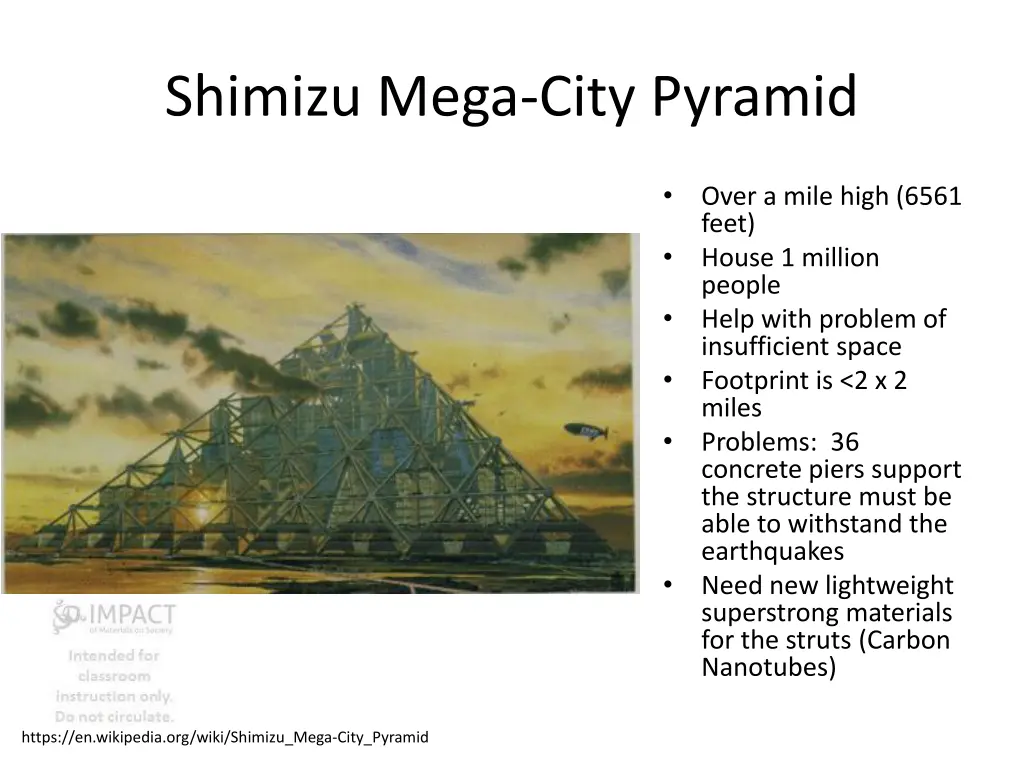
Shimizu Mega-City Pyramid Over a mile high (6561 feet) House 1 million people Help with problem of insufficient space Footprint is <2 x 2 miles Problems: 36 concrete piers support the structure must be able to withstand the earthquakes Need new lightweight superstrong materials for the struts (Carbon Nanotubes) https://en.wikipedia.org/wiki/Shimizu_Mega-City_Pyramid