Explore the basics of Social Security including who receives benefits, how much is paid out, and the number of people relying on it. Learn about retirement, disability, and survivor insurance, as well as comparisons to earnings to help you understand the importance of Social Security in financial planning.
Please find below an Image/Link to download the presentation.
The content on the website is provided AS IS for your information and personal use only. It may not be sold, licensed, or shared on other websites without obtaining consent from the author. If you encounter any issues during the download, it is possible that the publisher has removed the file from their server.
You are allowed to download the files provided on this website for personal or commercial use, subject to the condition that they are used lawfully. All files are the property of their respective owners.
The content on the website is provided AS IS for your information and personal use only. It may not be sold, licensed, or shared on other websites without obtaining consent from the author.
E N D
Presentation Transcript
Social Security Benefits, Social Security Benefits, Finances, and Policy Options Finances, and Policy Options A Primer A Primer Virginia P. Reno and Elisa A. Walker National Academy of Social Insurance www.nasi.org April 2012
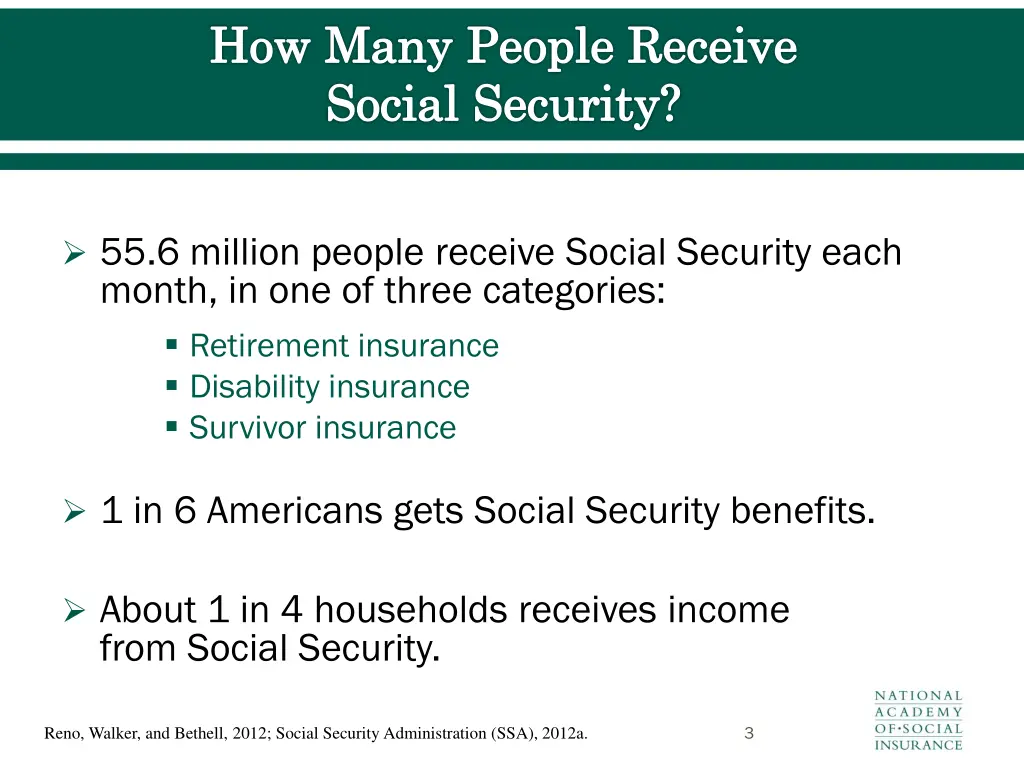
How Many People Receive Social Security? 55.6 million people receive Social Security each month, in one of three categories: Retirement insurance Disability insurance Survivor insurance 1 in 6 Americans gets Social Security benefits. About 1 in 4 households receives income from Social Security. Reno, Walker, and Bethell, 2012; Social Security Administration (SSA), 2012a. 3
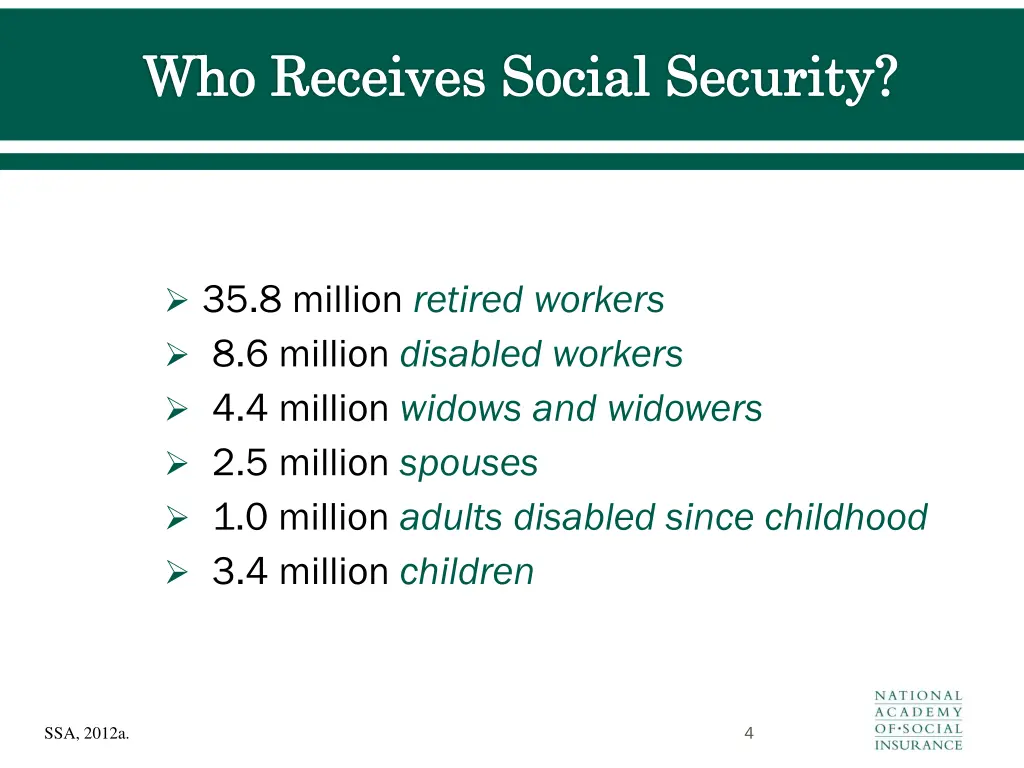
Who Receives Social Security? 35.8 million retired workers 8.6 million disabled workers 4.4 million widows and widowers 2.5 million spouses 1.0 million adults disabled since childhood 3.4 million children SSA, 2012a. 4
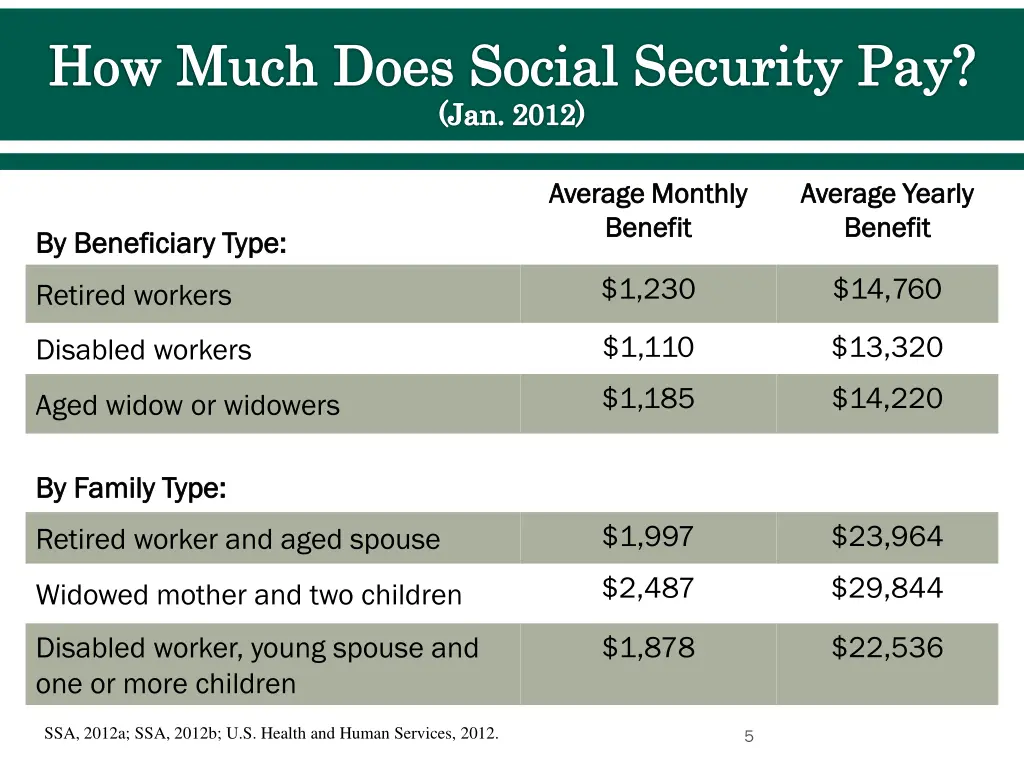
How Much Does Social Security Pay? (Jan. 2012) Average Monthly Average Monthly Benefit Benefit Average Yearly Average Yearly Benefit Benefit By Beneficiary Type: By Beneficiary Type: $1,230 $14,760 Retired workers $1,110 $13,320 Disabled workers $1,185 $14,220 Aged widow or widowers By Family Type: By Family Type: $1,997 $23,964 Retired worker and aged spouse $2,487 $29,844 Widowed mother and two children $1,878 $22,536 Disabled worker, young spouse and one or more children SSA, 2012a; SSA, 2012b; U.S. Health and Human Services, 2012. 5
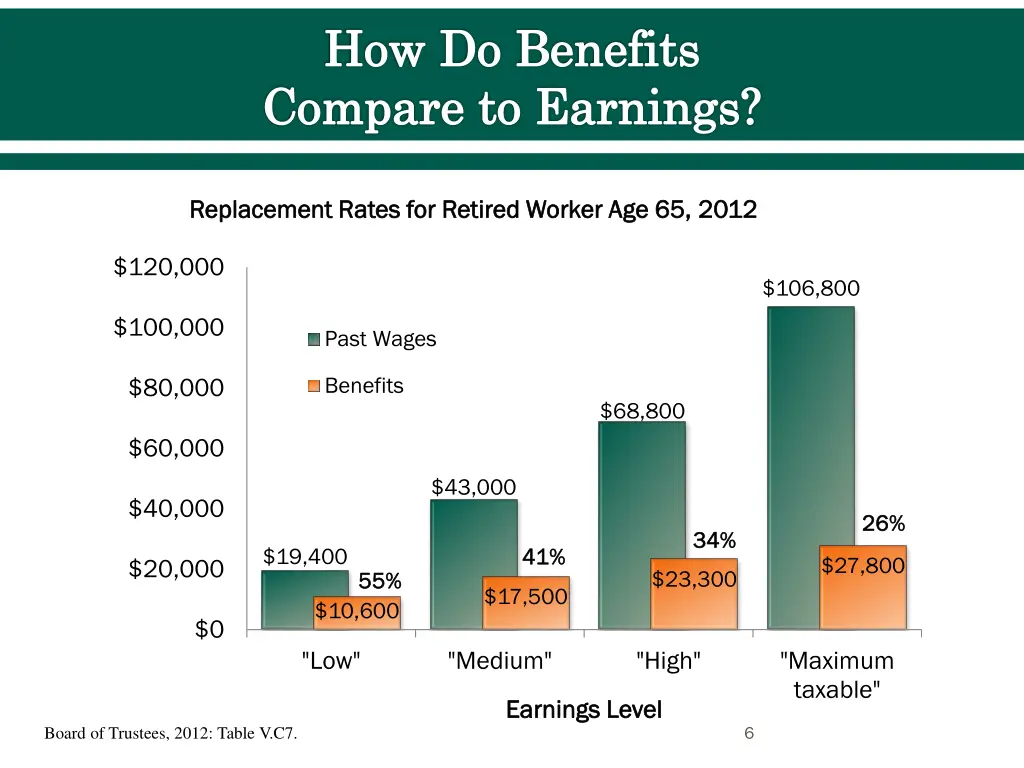
How Do Benefits Compare to Earnings? Replacement Rates for Retired Worker Age 65, Replacement Rates for Retired Worker Age 65, 2012 2012 $120,000 $106,800 $100,000 Past Wages Benefits $80,000 $68,800 $60,000 $43,000 $40,000 26% 26% 34% 34% $19,400 41% 41% $27,800 $20,000 $23,300 55% 55% $17,500 $10,600 $0 "Low" "Medium" "High" "Maximum taxable" Earnings Level Earnings Level Board of Trustees, 2012: Table V.C7. 6
How Many People Rely on Social Security for Most of Their Income? Nearly 90% of people 65 and older get Social Security. Nearly 2 in 3 (65%) get half or more of their income from Social Security. About 1 in 3 (36%) get almost all (90% or more) of their income from Social Security. SSA, 2012c: Tables 2.A1 and 9.A1. 7
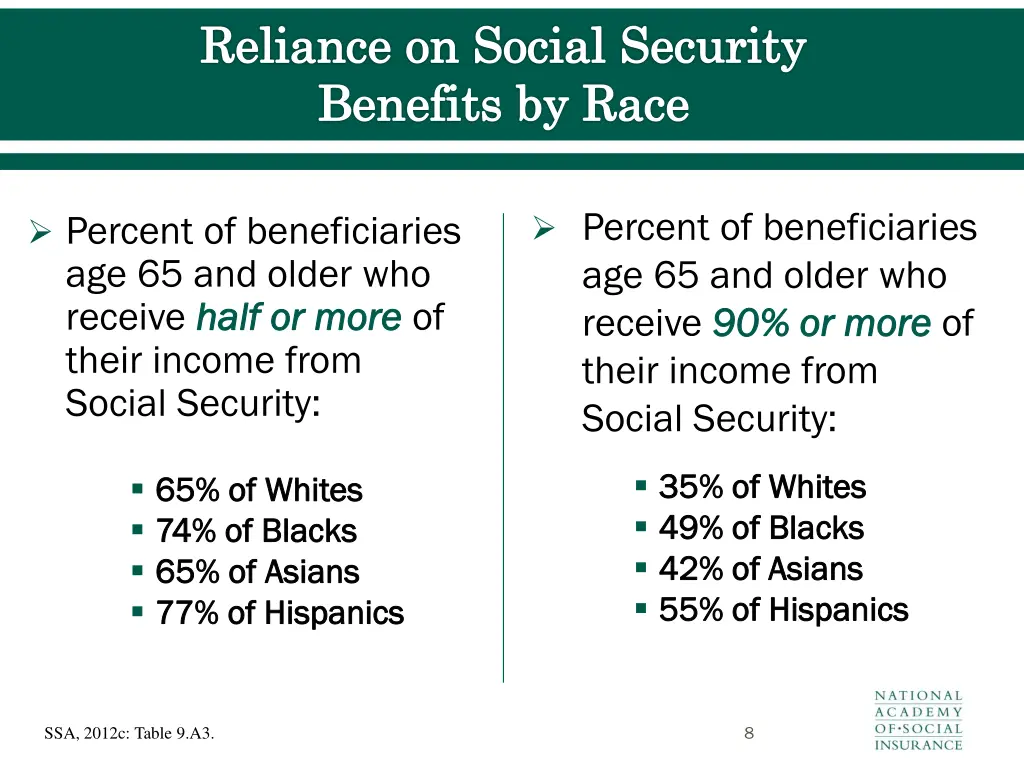
Reliance on Social Security Benefits by Race Percent of beneficiaries age 65 and older who receive 90% or more 90% or more of their income from Social Security: Percent of beneficiaries age 65 and older who receive half or more half or more of their income from Social Security: 35% of Whites 35% of Whites 49% of Blacks 49% of Blacks 42% of Asians 42% of Asians 55% of Hispanics 55% of Hispanics 65% of Whites 65% of Whites 74% of Blacks 74% of Blacks 65% of Asians 65% of Asians 77% of Hispanics 77% of Hispanics SSA, 2012c: Table 9.A3. 8
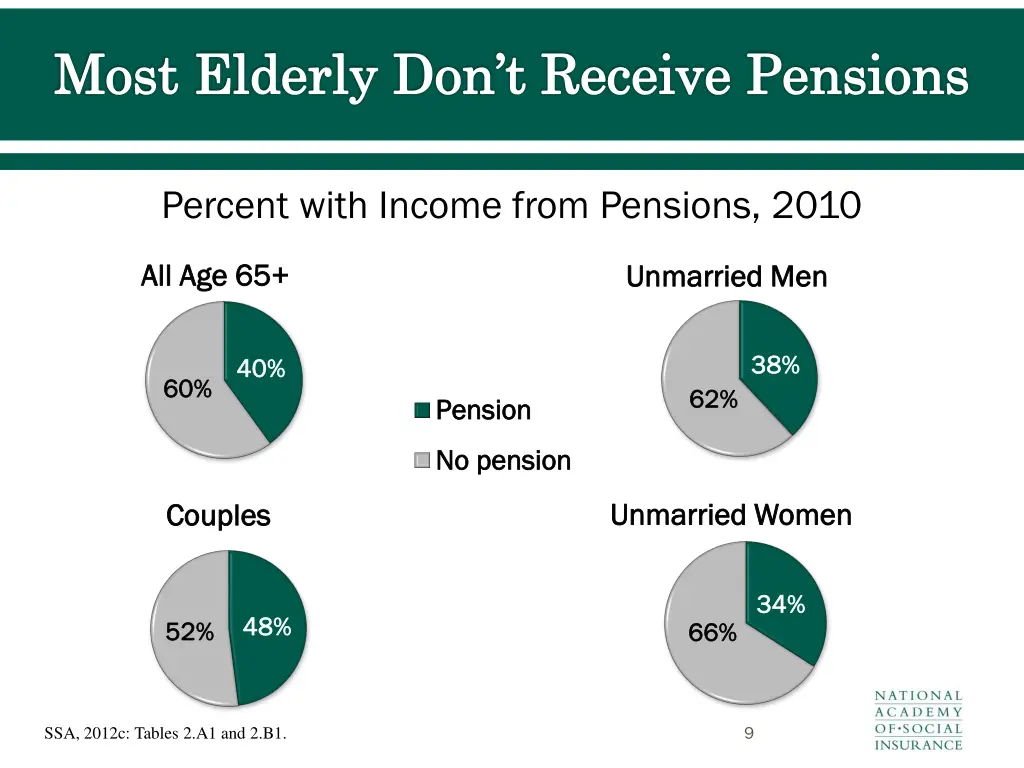
Most Elderly Dont Receive Pensions Percent with Income from Pensions, 2010 All Age 65+ All Age 65+ Unmarried Men Unmarried Men 38% 38% 40% 40% 60% 60% 62% 62% Pension Pension No pension No pension Unmarried Women Unmarried Women Couples Couples 34% 34% 48% 48% 52% 52% 66% 66% SSA, 2012c: Tables 2.A1 and 2.B1. 9
How Are Benefits Projected to Change in the Future? Benefits will grow faster than prices, but slower than wages. The increase in the full-benefit retirement age from 65 to 67 between 2002 and 2027 means that benefits will replace a smaller share of retirees past earnings. Reno, Bethell, and Walker, 2011. 10
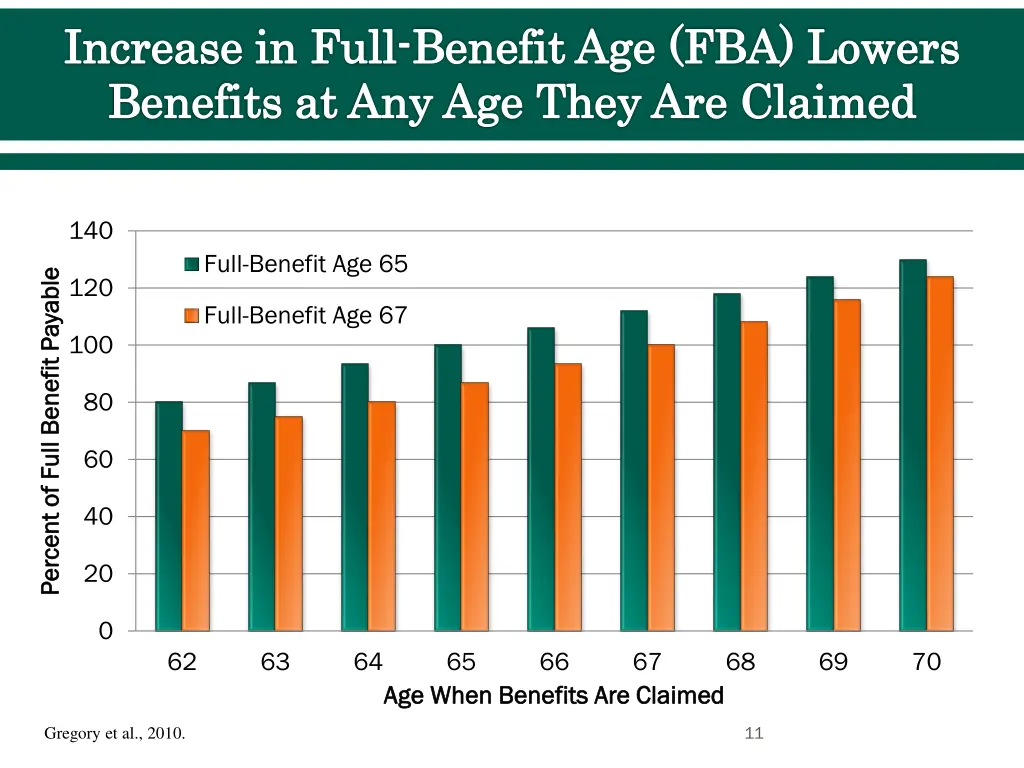
Increase in Full-Benefit Age (FBA) Lowers Benefits at Any Age They Are Claimed 140 Full-Benefit Age 65 Percent of Full Benefit Payable Percent of Full Benefit Payable 120 Full-Benefit Age 67 100 80 60 40 20 0 62 63 64 65 66 67 68 69 70 Age When Benefits Are Claimed Age When Benefits Are Claimed Gregory et al., 2010. 11
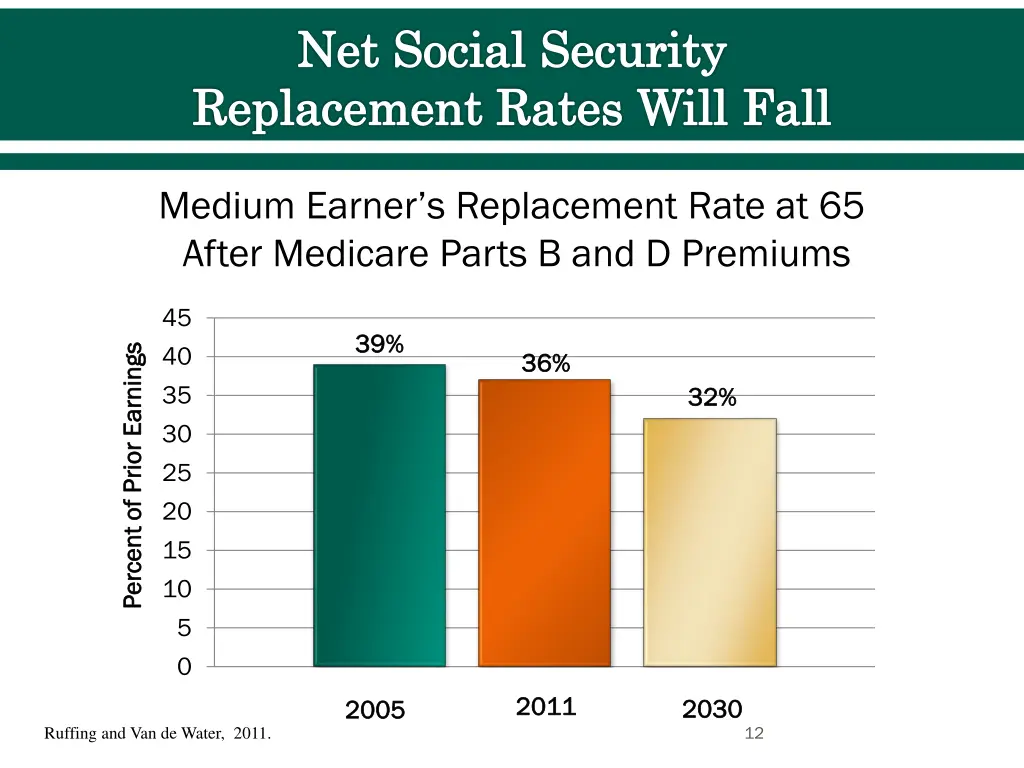
Net Social Security Replacement Rates Will Fall Medium Earner s Replacement Rate at 65 After Medicare Parts B and D Premiums 45 39% 39% 40 Percent of Prior Earnings Percent of Prior Earnings 36% 36% 35 32% 32% 30 25 20 15 10 5 0 2011 2011 2030 2030 2005 2005 Ruffing and Van de Water, 2011. 12
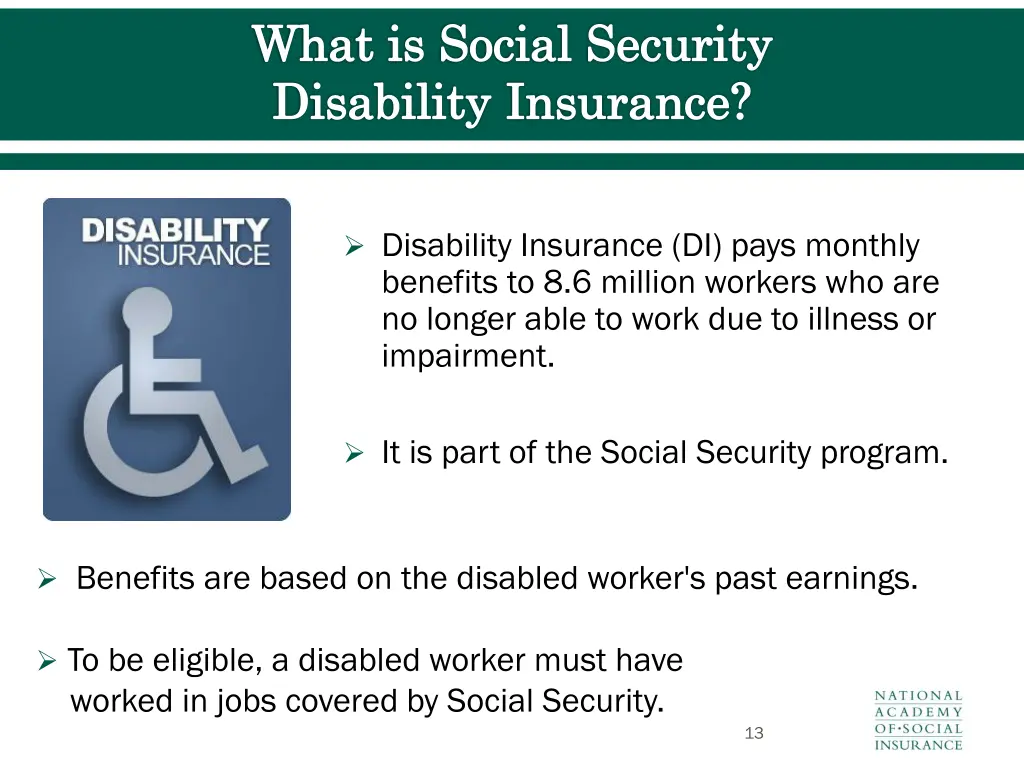
What is Social Security Disability Insurance? Disability Insurance (DI) pays monthly benefits to 8.6 million workers who are no longer able to work due to illness or impairment. It is part of the Social Security program. Benefits are based on the disabled worker's past earnings. To be eligible, a disabled worker must have worked in jobs covered by Social Security. 13
What are the Most Common Disabilities for DI Recipients? Mental Impairments Musculoskeletal Conditions 21% 21% 33% 33% Heart Disease/ Circulatory 9% 9% Nervous System/ Sense Organ Impairments 9% 9% 28% 28% Injuries/ Cancers/ Other Conditions SSA, 2011a. 14
Attributes of Disabled- Worker Beneficiaries About 34% of disabled workers have incomes below 125 percent of the poverty threshold. DI beneficiaries are more likely than other adults to be: Older (the average age of disabled worker beneficiaries is 53, and nearly 7 in 10 are over 50). Black or Hispanic. Lower educational attainment (67% have a high school diploma or less, and 1 in 3 did not finish high school). National Academy of Social Insurance, 2011; Ekman, 2012. 15
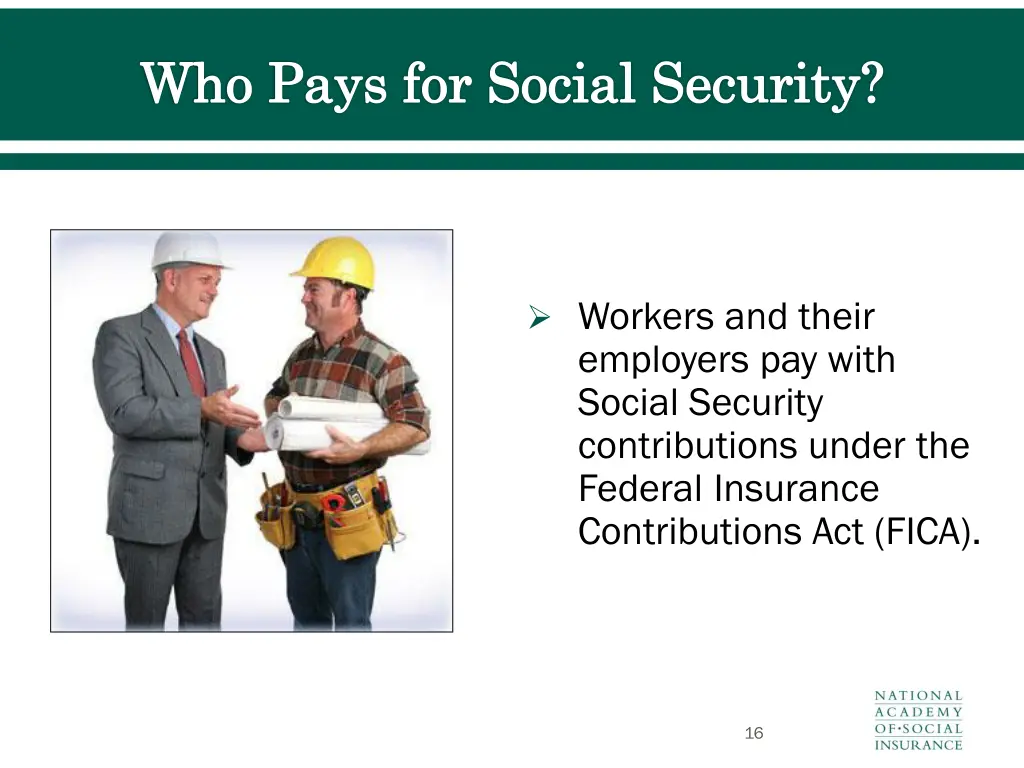
Who Pays for Social Security? Workers and their employers pay with Social Security contributions under the Federal Insurance Contributions Act (FICA). 16
How Much Do Workers Pay? Workers pay: 6.2% of their earnings for Social Security (or 4.2% for 2011-2012 under the temporary payroll tax holiday), and 1.45% of their earnings for Hospital Insurance (HI) under Medicare (Part A). Employers pay an equal amount (6.2% and 1.45%). The total is 12.4% for Social Security 12.4% for Social Security and 2.9% for HI. 2.9% for HI. The Social Security contribution base is $110,100 $110,100 in 2012. Reno, Walker, and Bethell, 2012; Walker, Bethell, and Reno, 2012. 17
Where Does the Money Go? It is credited to the Social Security trust funds. Projections of income and outgo of the trust funds are made by the Office of the Chief Actuary of the Social Security Administration. Board of Trustees, 2012. 18
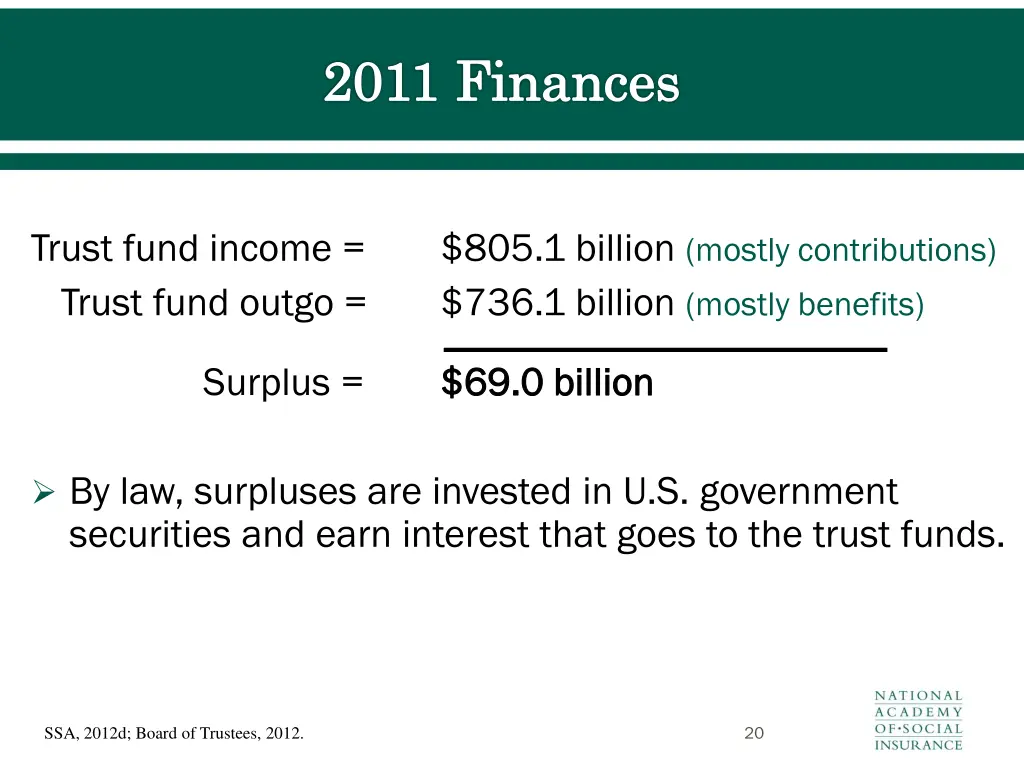
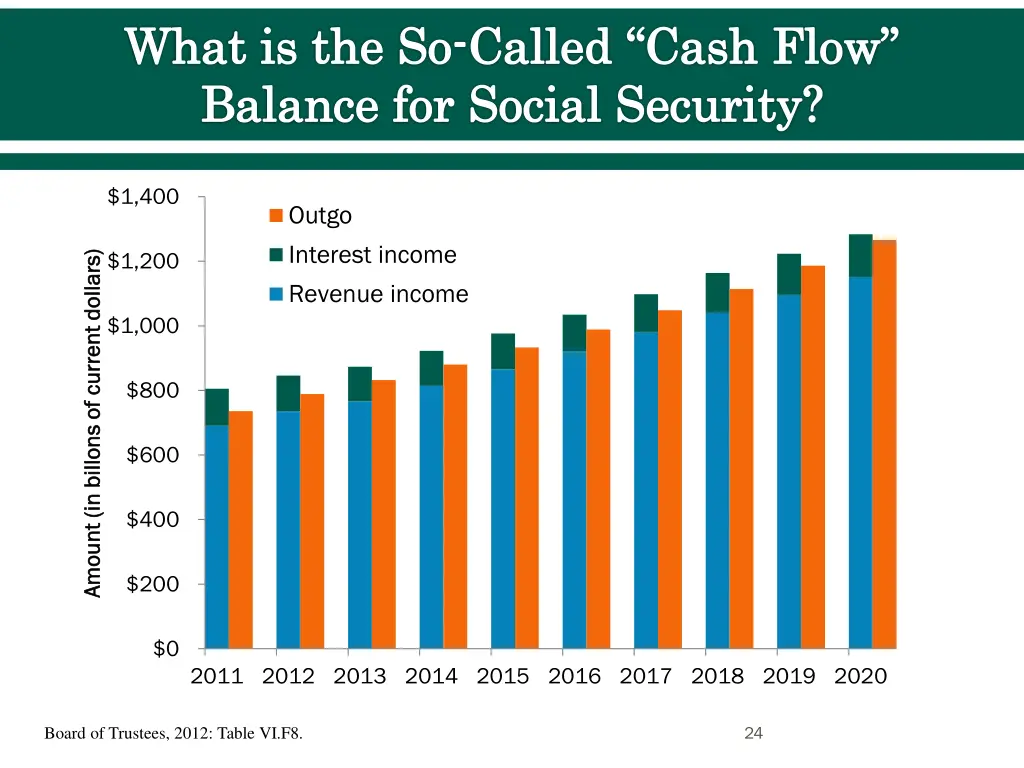
2011 Finances Trust fund income = Trust fund outgo = Surplus = $805.1 billion (mostly contributions) $736.1 billion (mostly benefits) $69.0 billion $69.0 billion By law, surpluses are invested in U.S. government securities and earn interest that goes to the trust funds. SSA, 2012d; Board of Trustees, 2012. 20
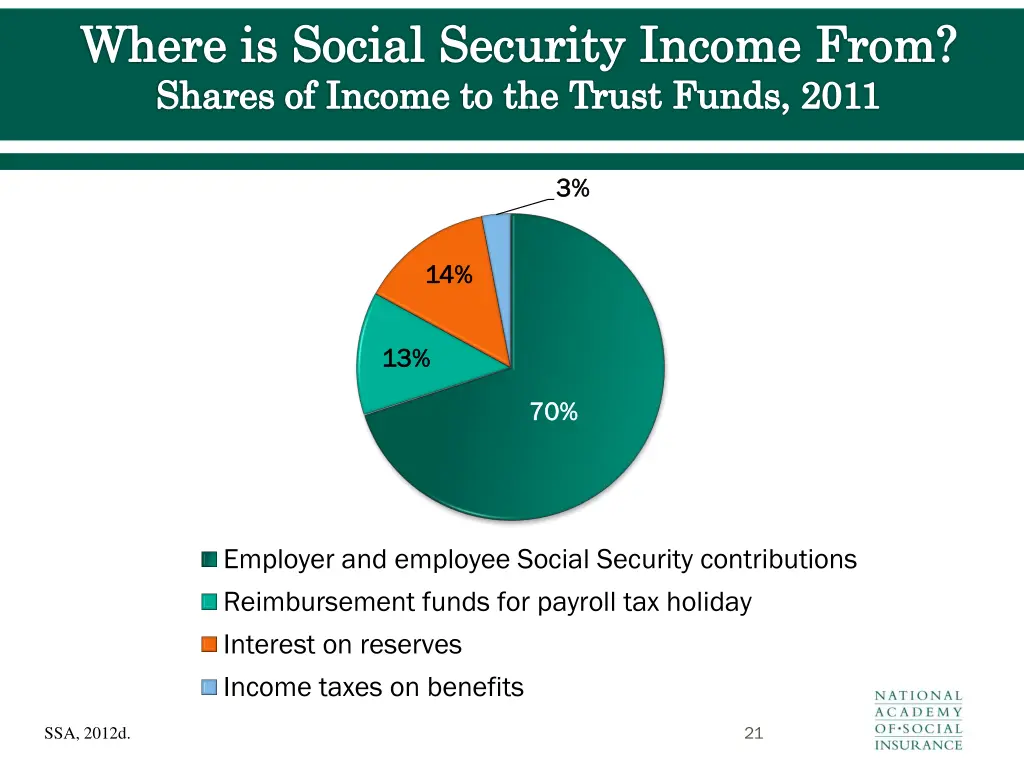
Where is Social Security Income From? Shares of Income to the Trust Funds, 2011 3% 3% 14% 14% 13% 13% 70% 70% Employer and employee Social Security contributions Reimbursement funds for payroll tax holiday Interest on reserves Income taxes on benefits SSA, 2012d. 21
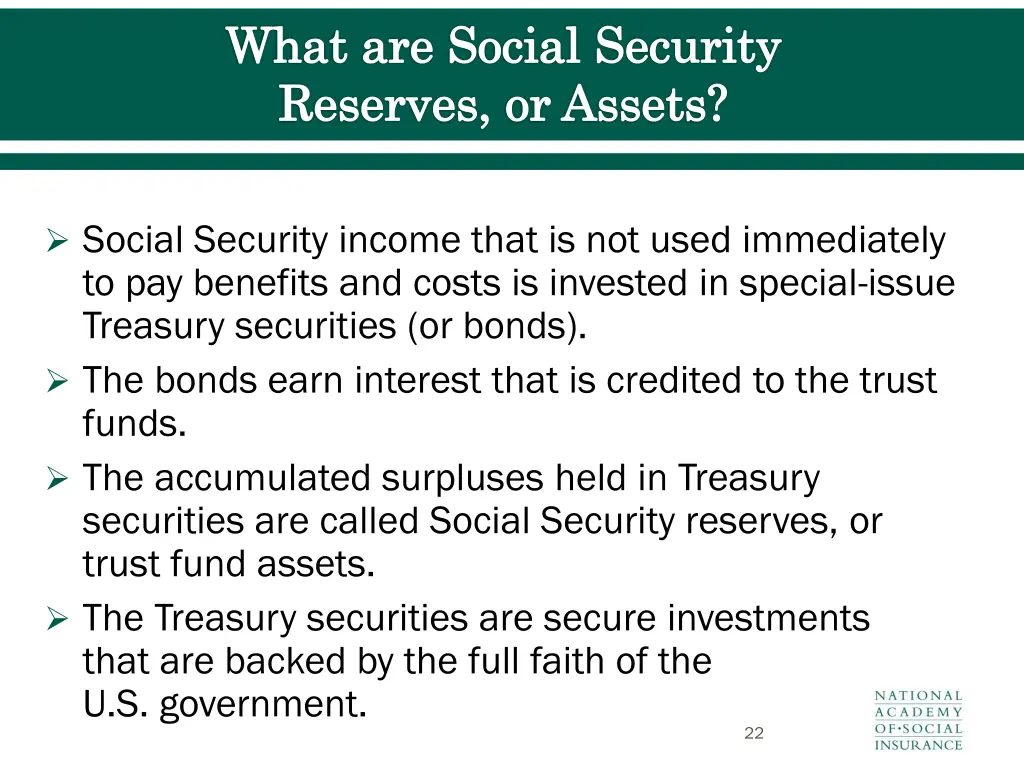
What are Social Security Reserves, or Assets? Social Security income that is not used immediately to pay benefits and costs is invested in special-issue Treasury securities (or bonds). The bonds earn interest that is credited to the trust funds. The accumulated surpluses held in Treasury securities are called Social Security reserves, or trust fund assets. The Treasury securities are secure investments that are backed by the full faith of the U.S. government. 22
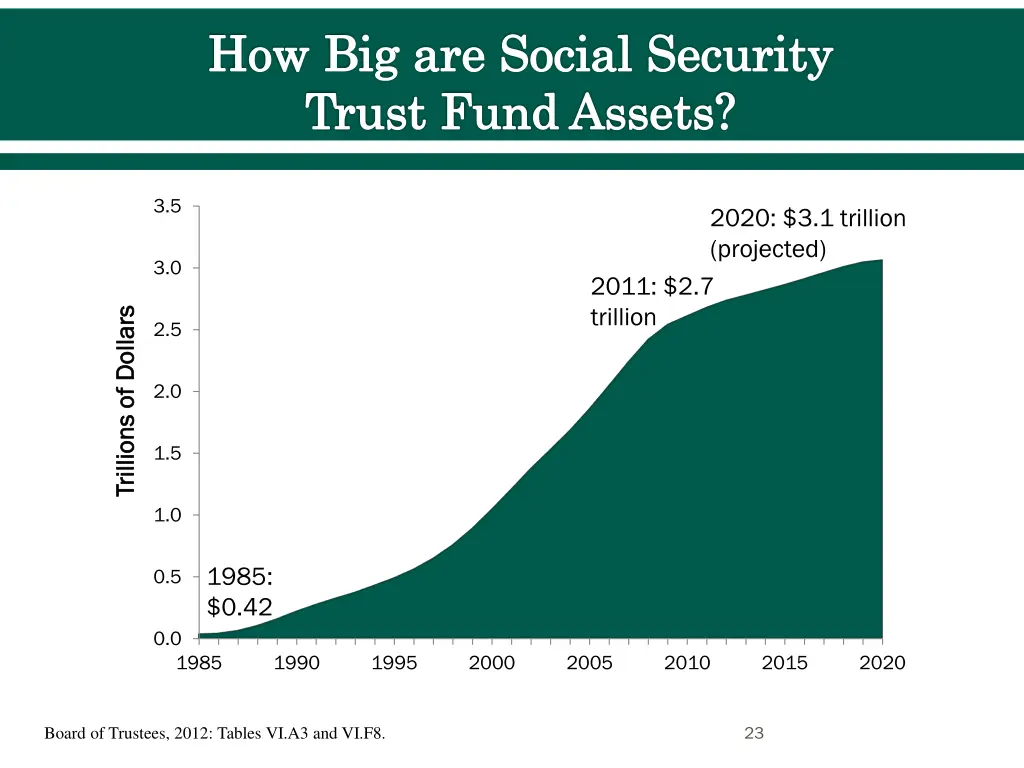
How Big are Social Security Trust Fund Assets? 3.5 2020: $3.1 trillion (projected) 3.0 2011: $2.7 trillion Trillions of Dollars Trillions of Dollars 2.5 2.0 1.5 1.0 1985: $0.42 0.5 0.0 1985 1990 1995 2000 2005 2010 2015 2020 Board of Trustees, 2012: Tables VI.A3 and VI.F8. 23
What is the So-Called Cash Flow Balance for Social Security? $1,400 Outgo Interest income Revenue income $1,200 Amount (in billons of current dollars) Amount (in billons of current dollars) $1,000 $800 $600 $400 $200 $0 2011 2012 2013 2014 2015 2016 2017 2018 2019 2020 Board of Trustees, 2012: Table VI.F8. 24
How Do Actuaries Estimate the Future? Review the past: birth rates, death rates, immigration, employment, wages, inflation, productivity, interest rates. Make assumptions for the next 75 years (longer than the rest of the government). Three scenarios: Low cost; High cost; Intermediate (best estimate). 1) 2) 3) Board of Trustees, 2012. 25
The Long-Range Projection (Best Estimate) In 2021, revenues plus interest income to the trust funds will be less than total expenditures for that year. Reserves will start to be drawn down to pay benefits. In 2033, trust fund reserves are projected to be depleted. Income is projected to cover 75% of benefits due then. By 2086, assuming no change in taxes, benefits or assumptions, revenue would cover about 73% of benefits due then. Board of Trustees, 2012. 26
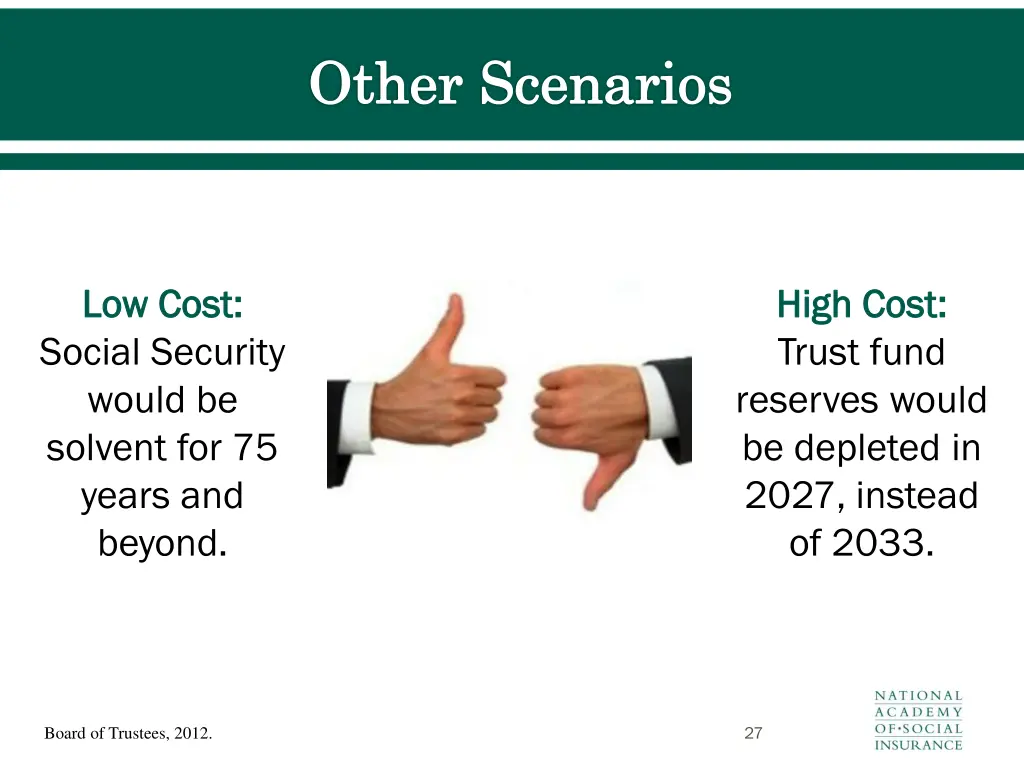
Other Scenarios Low Cost Low Cost: : Social Security would be solvent for 75 years and beyond. High Cost High Cost: : Trust fund reserves would be depleted in 2027, instead of 2033. Board of Trustees, 2012. 27
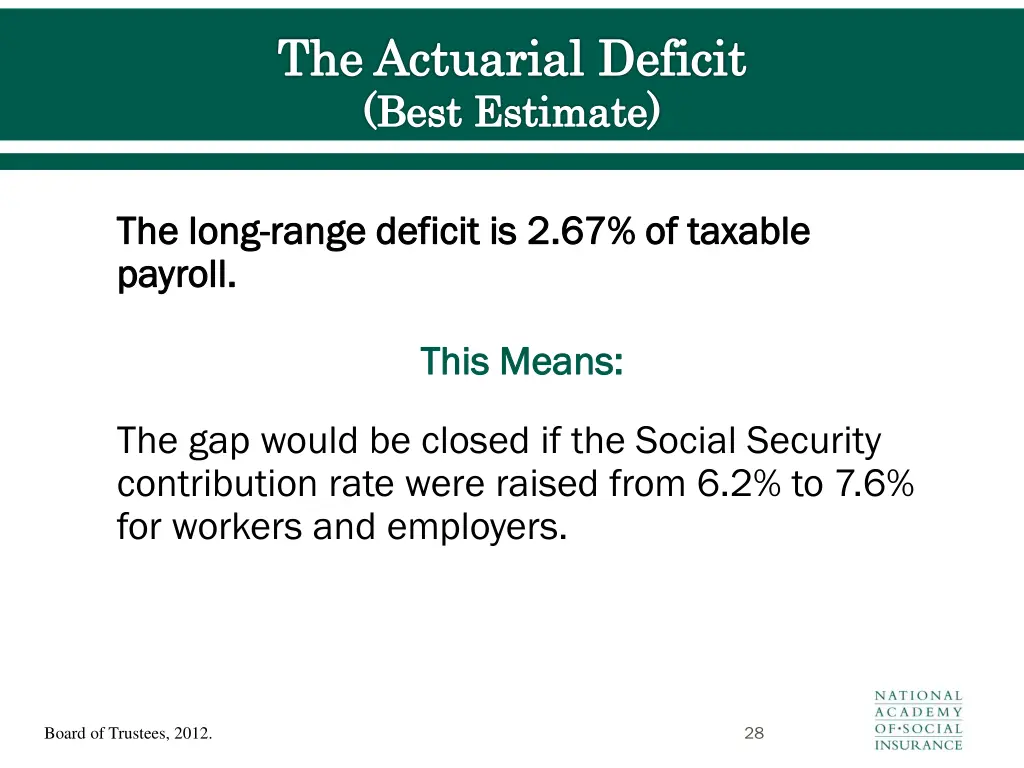
The Actuarial Deficit (Best Estimate) The long The long- -range deficit is 2.67% of taxable range deficit is 2.67% of taxable payroll. payroll. This Means: This Means: The gap would be closed if the Social Security contribution rate were raised from 6.2% to 7.6% for workers and employers. Board of Trustees, 2012. 28
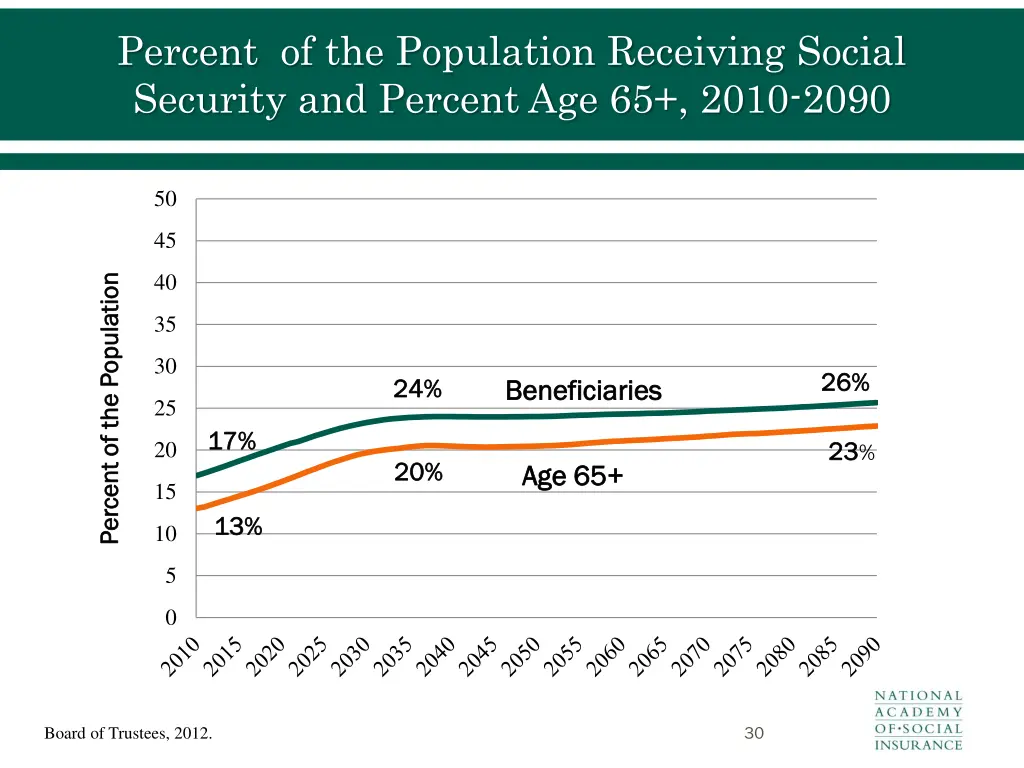
Why Will Social Security Cost More in the Future? The number of Americans over age 65 will grow because: Boomers are reaching age 65 Boomers are reaching age 65 People are living longer after age 65 People are living longer after age 65 Birth rates are projected to remain at replacement levels. People 65 and older will increase from 13% to 20% of all Americans. 29
Percent of the Population Receiving Social Security and Percent Age 65+, 2010-2090 50 45 40 Percent of the Population Percent of the Population 35 30 26% 26% 24% 24% Beneficiaries Beneficiaries 25 17% 17% 23 23% 20 20% 20% Age 65+ Age 65+ 15 13% 13% 10 5 0 Board of Trustees, 2012. 30
Can We Afford Can We Afford Social Security Social Security in the Future? in the Future?
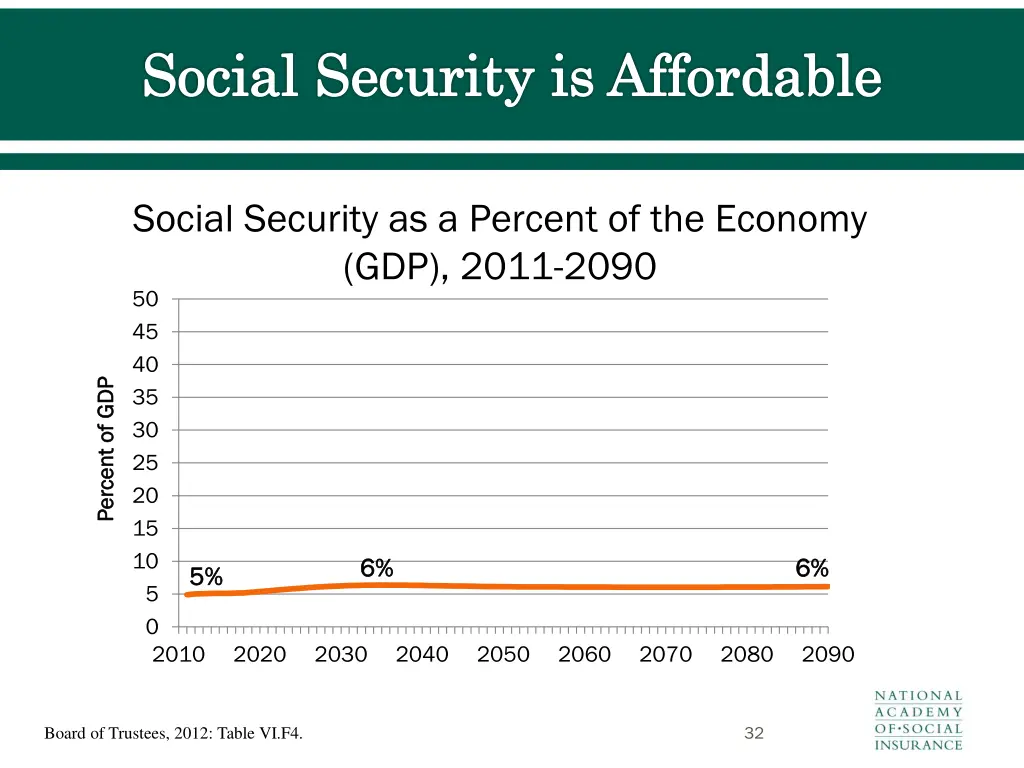
Social Security is Affordable Social Security as a Percent of the Economy (GDP), 2011-2090 50 45 40 Percent of GDP Percent of GDP 35 30 25 20 15 10 6% 6% 6% 6% 5% 5% 5 0 2010 2020 2030 2040 2050 2060 2070 2080 2090 Board of Trustees, 2012: Table VI.F4. 32
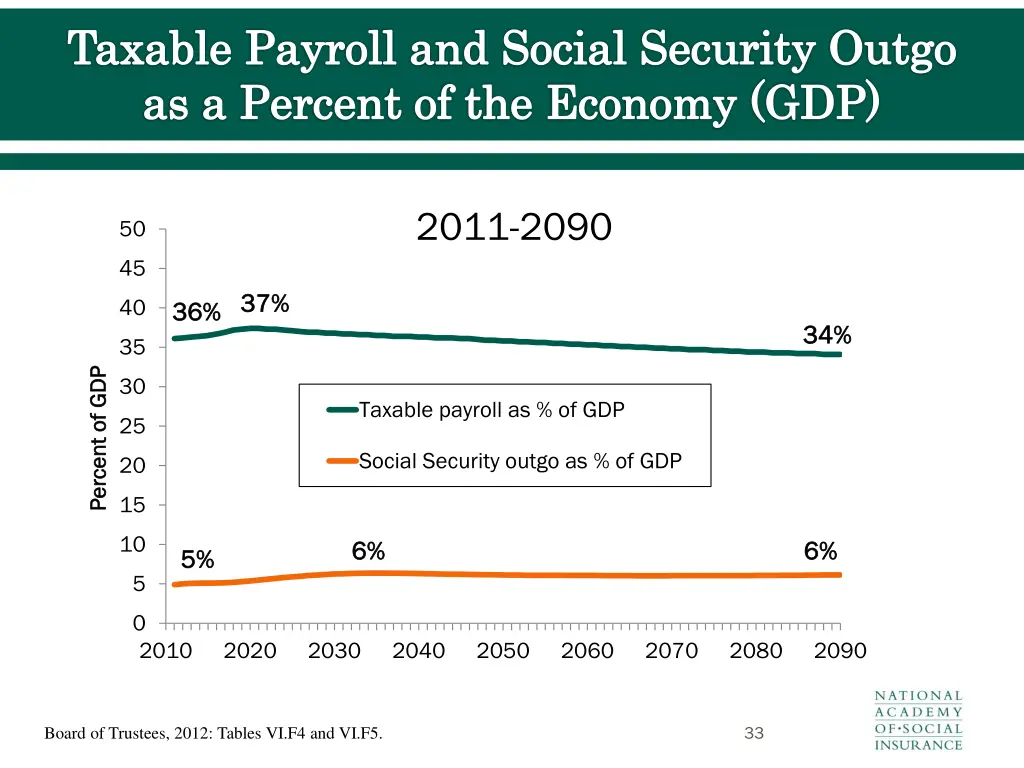
Taxable Payroll and Social Security Outgo as a Percent of the Economy (GDP) 2011-2090 50 45 37% 37% 40 36% 36% 34% 34% 35 Percent of GDP Percent of GDP 30 Taxable payroll as % of GDP 25 Social Security outgo as % of GDP 20 15 10 6% 6% 6% 6% 5% 5% 5 0 2010 2020 2030 2040 2050 2060 2070 2080 2090 Board of Trustees, 2012: Tables VI.F4 and VI.F5. 33
Strengthening Strengthening Social Security Social Security
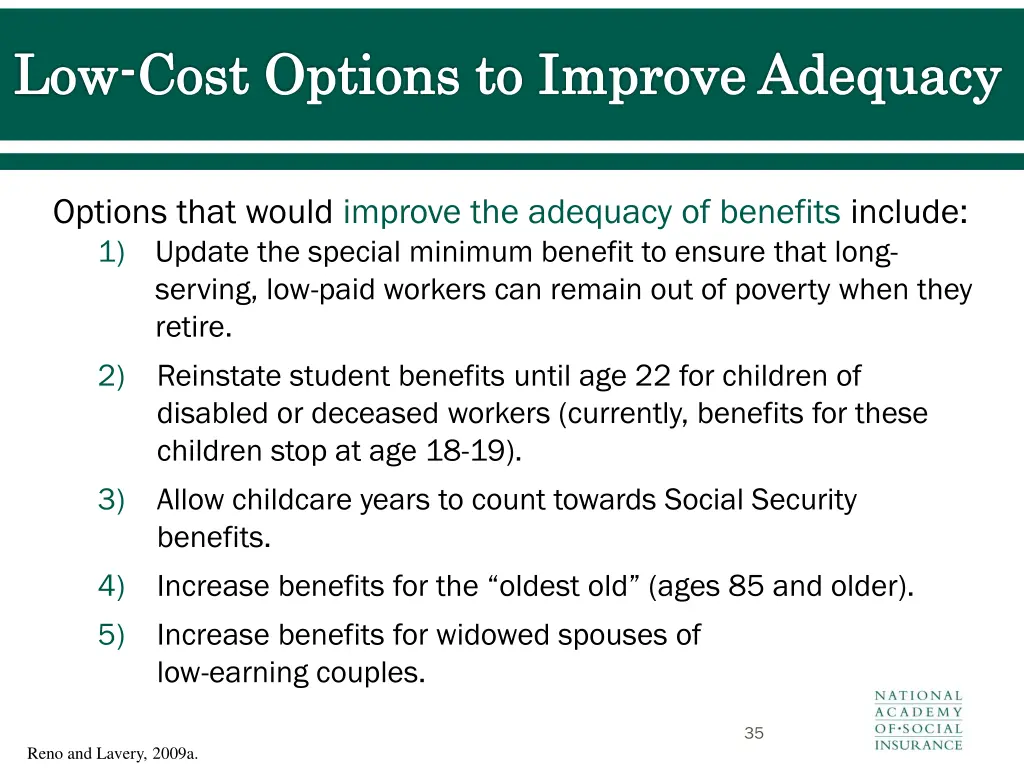
Low-Cost Options to Improve Adequacy Options that would improve the adequacy of benefits include: 1) Update the special minimum benefit to ensure that long- serving, low-paid workers can remain out of poverty when they retire. 2) Reinstate student benefits until age 22 for children of disabled or deceased workers (currently, benefits for these children stop at age 18-19). 3) Allow childcare years to count towards Social Security benefits. 4) Increase benefits for the oldest old (ages 85 and older). 5) Increase benefits for widowed spouses of low-earning couples. 35 Reno and Lavery, 2009a.
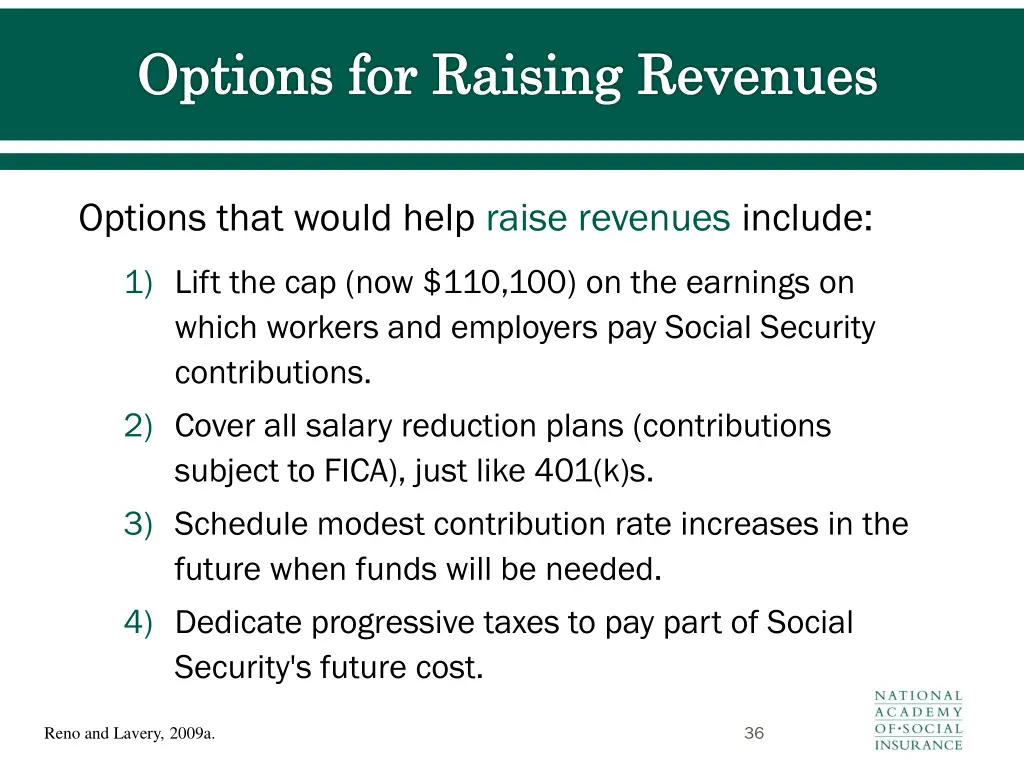
Options for Raising Revenues Options that would help raise revenues include: 1) Lift the cap (now $110,100) on the earnings on which workers and employers pay Social Security contributions. 2) Cover all salary reduction plans (contributions subject to FICA), just like 401(k)s. 3) Schedule modest contribution rate increases in the future when funds will be needed. 4) Dedicate progressive taxes to pay part of Social Security's future cost. Reno and Lavery, 2009a. 36
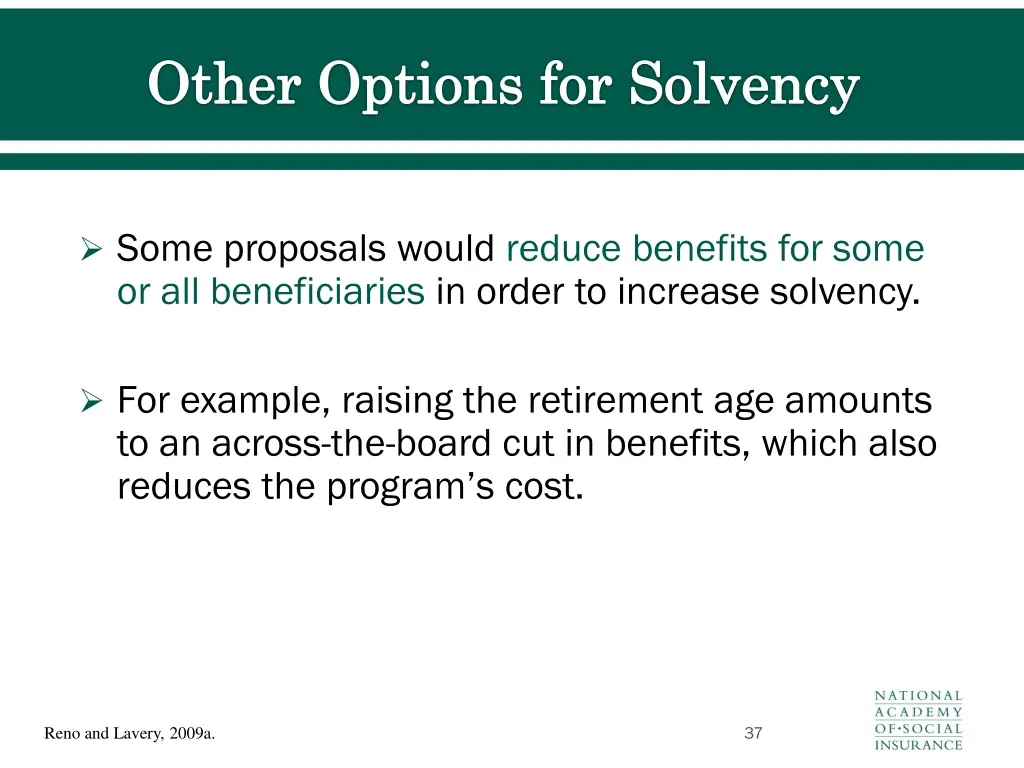
Other Options for Solvency Some proposals would reduce benefits for some or all beneficiaries in order to increase solvency. For example, raising the retirement age amounts to an across-the-board cut in benefits, which also reduces the program s cost. Reno and Lavery, 2009a. 37
Why Consider Revenue Why Consider Revenue Enhancements to Enhancements to Balance Balance Future Social Future Social Security Security Finances? Finances?
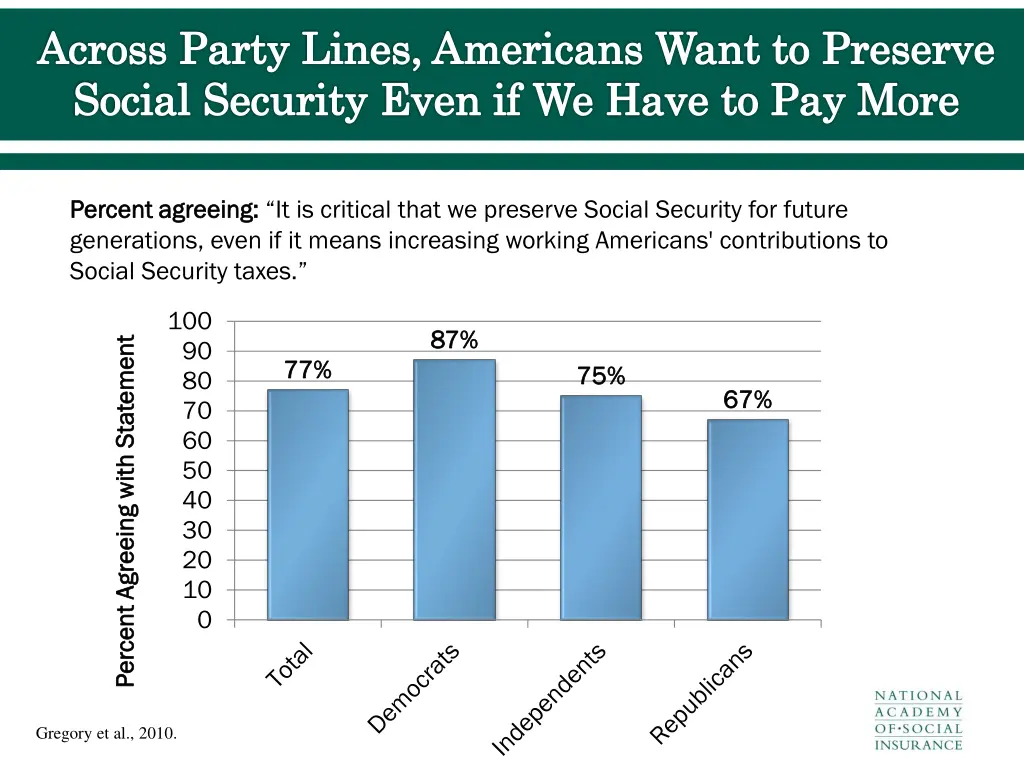
Across Party Lines, Americans Want to Preserve Social Security Even if We Have to Pay More Percent agreeing: Percent agreeing: It is critical that we preserve Social Security for future generations, even if it means increasing working Americans' contributions to Social Security taxes. 100 87% 87% Percent Agreeing with Statement Percent Agreeing with Statement 90 77% 77% 75% 75% 80 67% 67% 70 60 50 40 30 20 10 0 Gregory et al., 2010.
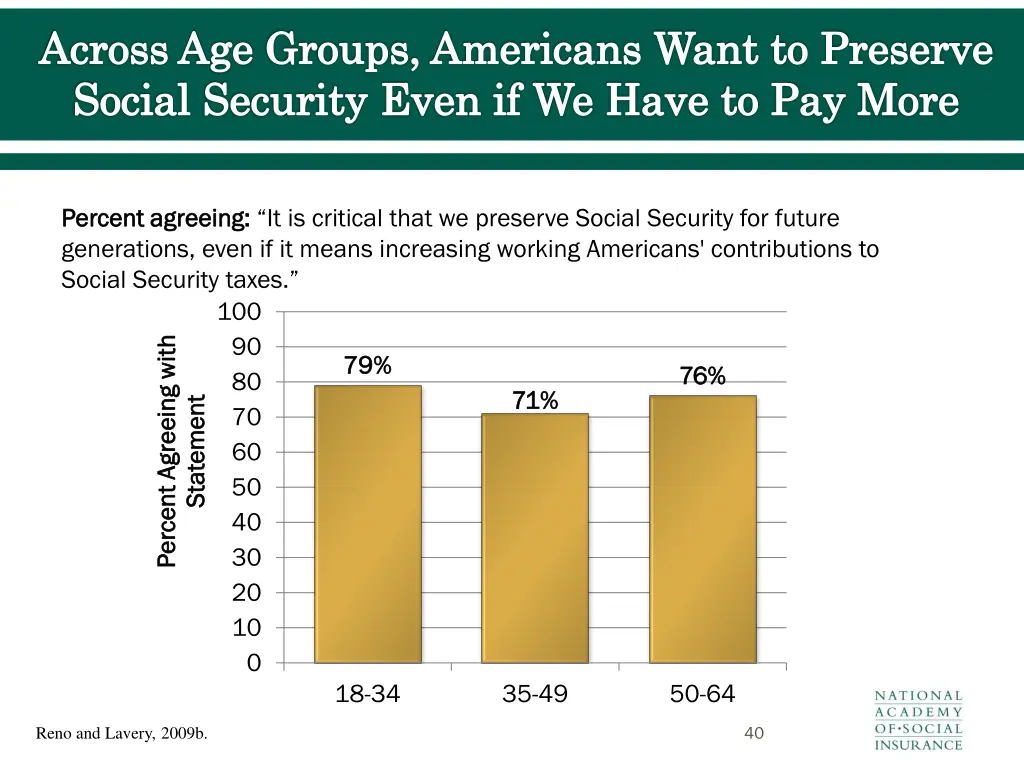
Across Age Groups, Americans Want to Preserve Social Security Even if We Have to Pay More Percent agreeing: Percent agreeing: It is critical that we preserve Social Security for future generations, even if it means increasing working Americans' contributions to Social Security taxes. 100 Percent Agreeing with Percent Agreeing with 90 79% 79% 76% 76% 80 71% 71% Statement Statement 70 60 50 40 30 20 10 0 18-34 35-49 50-64 Reno and Lavery, 2009b. 40
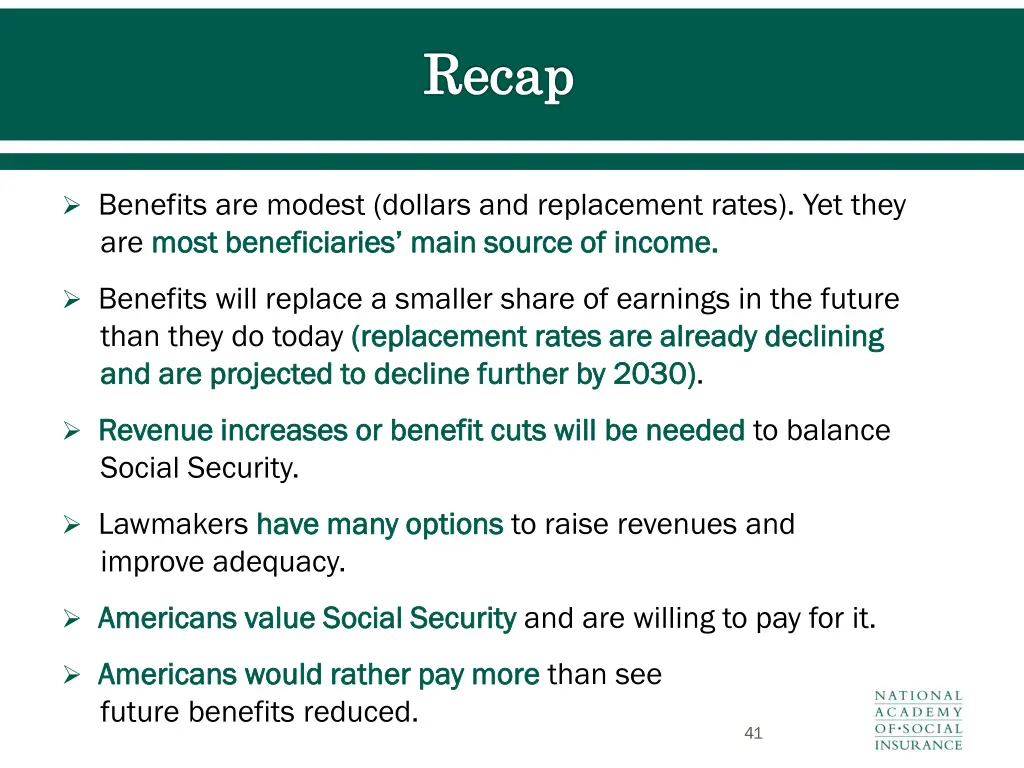
Recap Benefits are modest (dollars and replacement rates). Yet they are most beneficiaries main source of income. most beneficiaries main source of income. Benefits will replace a smaller share of earnings in the future than they do today (replacement rates are already declining (replacement rates are already declining and are projected to decline further by 2030) and are projected to decline further by 2030). Revenue Revenue increases Social Security. increases or benefit cuts will or benefit cuts will be needed be needed to balance Lawmakers have many options have many options to raise revenues and improve adequacy. Americans Americans value Social Security value Social Security and are willing to pay for it. Americans would rather pay more Americans would rather pay more than see future benefits reduced. 41
References Board of Trustees. 2012. Annual Report of the Board of Trustees of the Federal Old-Age and Survivors Insurance and Federal Disability Insurance Trust Funds. Washington, DC: Social Security Administration. Ekman, Lisa. 2012. Growth in the SSDI Roles: Why has it happened, what does it mean, and what should we do about it? Presentation at the National Academy of Social Insurance forum, Why Are More People Claiming Disability Insurance and What Should Be Done About It?, April 3. Washington, DC. Gregory, Janice M., Thomas N. Bethell, Virginia P. Reno, and Benjamin W. Veghte. 2010. Strengthening Social Security for the Long Run. Social Security Brief No. 35. Washington, DC: National Academy of Social Insurance. National Academy of Social Insurance. 2011. What is Social Security Disability Insurance? Washington, DC: National Academy of Social Insurance. http://www.nasi.org/learn/socialsecurity/disability-insurance Reno, Virginia P., Thomas N. Bethell, and Elisa A. Walker. 2011. Social Security Beneficiaries Face 19% Cut; New Revenue Can Restore Balance. Social Security Brief No. 37. Washington, DC: National Academy of Social Insurance. Reno, Virginia P. and Joni Lavery. 2010. When to Take Social Security Benefits: Questions to Consider. Social Security Brief No. 31. Washington, DC: National Academy of Social Insurance. Reno, Virginia P. and Joni Lavery. 2009a. Fixing Social Security: Adequate Benefits, Adequate Financing. Washington, DC: National Academy of Social Insurance. Reno, Virginia P. and Joni Lavery. 2009b. Economic Crisis Fuels Support for Social Security: Americans Views on Social Security. Washington, DC: National Academy of Social Insurance.
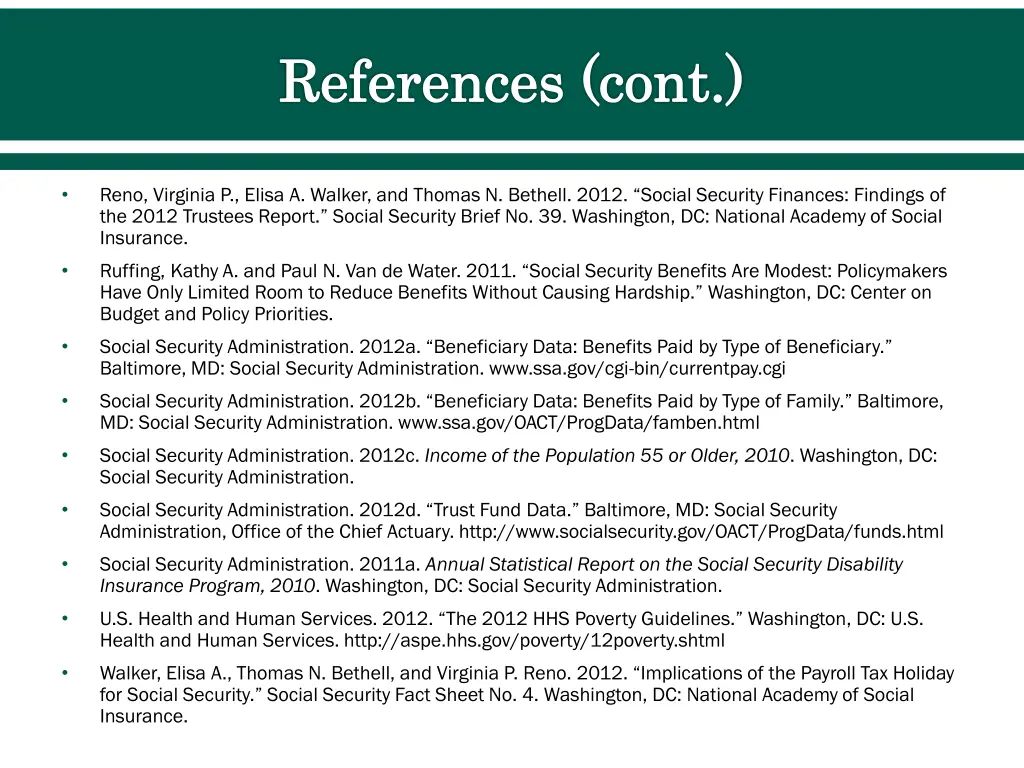
References (cont.) Reno, Virginia P., Elisa A. Walker, and Thomas N. Bethell. 2012. Social Security Finances: Findings of the 2012 Trustees Report. Social Security Brief No. 39. Washington, DC: National Academy of Social Insurance. Ruffing, Kathy A. and Paul N. Van de Water. 2011. Social Security Benefits Are Modest: Policymakers Have Only Limited Room to Reduce Benefits Without Causing Hardship. Washington, DC: Center on Budget and Policy Priorities. Social Security Administration. 2012a. Beneficiary Data: Benefits Paid by Type of Beneficiary. Baltimore, MD: Social Security Administration. www.ssa.gov/cgi-bin/currentpay.cgi Social Security Administration. 2012b. Beneficiary Data: Benefits Paid by Type of Family. Baltimore, MD: Social Security Administration. www.ssa.gov/OACT/ProgData/famben.html Social Security Administration. 2012c. Income of the Population 55 or Older, 2010. Washington, DC: Social Security Administration. Social Security Administration. 2012d. Trust Fund Data. Baltimore, MD: Social Security Administration, Office of the Chief Actuary. http://www.socialsecurity.gov/OACT/ProgData/funds.html Social Security Administration. 2011a. Annual Statistical Report on the Social Security Disability Insurance Program, 2010. Washington, DC: Social Security Administration. U.S. Health and Human Services. 2012. The 2012 HHS Poverty Guidelines. Washington, DC: U.S. Health and Human Services. http://aspe.hhs.gov/poverty/12poverty.shtml Walker, Elisa A., Thomas N. Bethell, and Virginia P. Reno. 2012. Implications of the Payroll Tax Holiday for Social Security. Social Security Fact Sheet No. 4. Washington, DC: National Academy of Social Insurance.