Software Testing: Process, Objectives, and Characteristics
Software testing is a crucial process involving executing programs to find errors and ensure they meet requirements. This includes discussing testing objectives, test characteristics, and the qualities of testable software such as operability, observability, and simplicity.

Download Presentation

Please find below an Image/Link to download the presentation.
The content on the website is provided AS IS for your information and personal use only. It may not be sold, licensed, or shared on other websites without obtaining consent from the author. If you encounter any issues during the download, it is possible that the publisher has removed the file from their server.
You are allowed to download the files provided on this website for personal or commercial use, subject to the condition that they are used lawfully. All files are the property of their respective owners.
The content on the website is provided AS IS for your information and personal use only. It may not be sold, licensed, or shared on other websites without obtaining consent from the author.
E N D
Presentation Transcript
INTRODUCTION Software Testing is the process of executing a program or system with the intent of finding errors. It involves any activity aimed at evaluating an attribute or capability of a program or system and determining that it meets its required results
TESTING OBJECTIVES 1. Testing is a process of executing a program with the intent of finding an error. 2. A good test case is one that has high probability of finding an undiscovered error. 3. A successful test is one that uncovers an as-yet undiscovered error. The major testing objectiveis to design tests that systematically uncover types of errors with minimum time and effort.
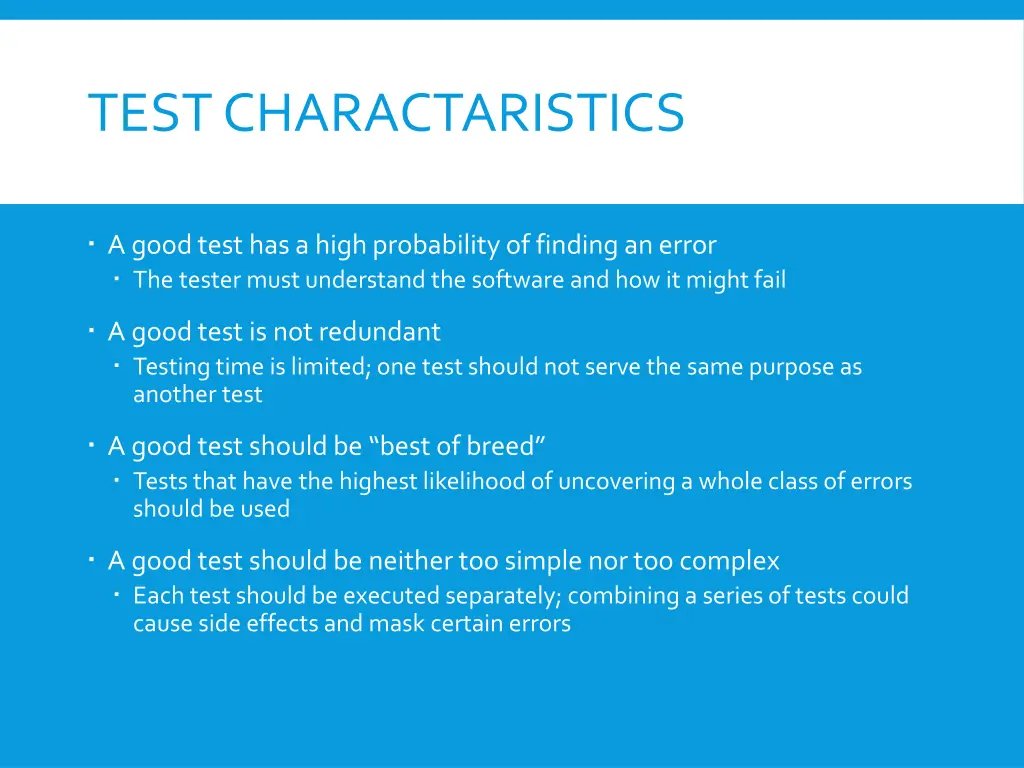
TEST CHARACTARISTICS A good test has a high probability of finding an error The tester must understand the software and how it might fail A good test is not redundant Testing time is limited; one test should not serve the same purpose as another test A good test should be best of breed Tests that have the highest likelihood of uncovering a whole class of errors should be used A good test should be neither too simple nor too complex Each test should be executed separately; combining a series of tests could cause side effects and mask certain errors
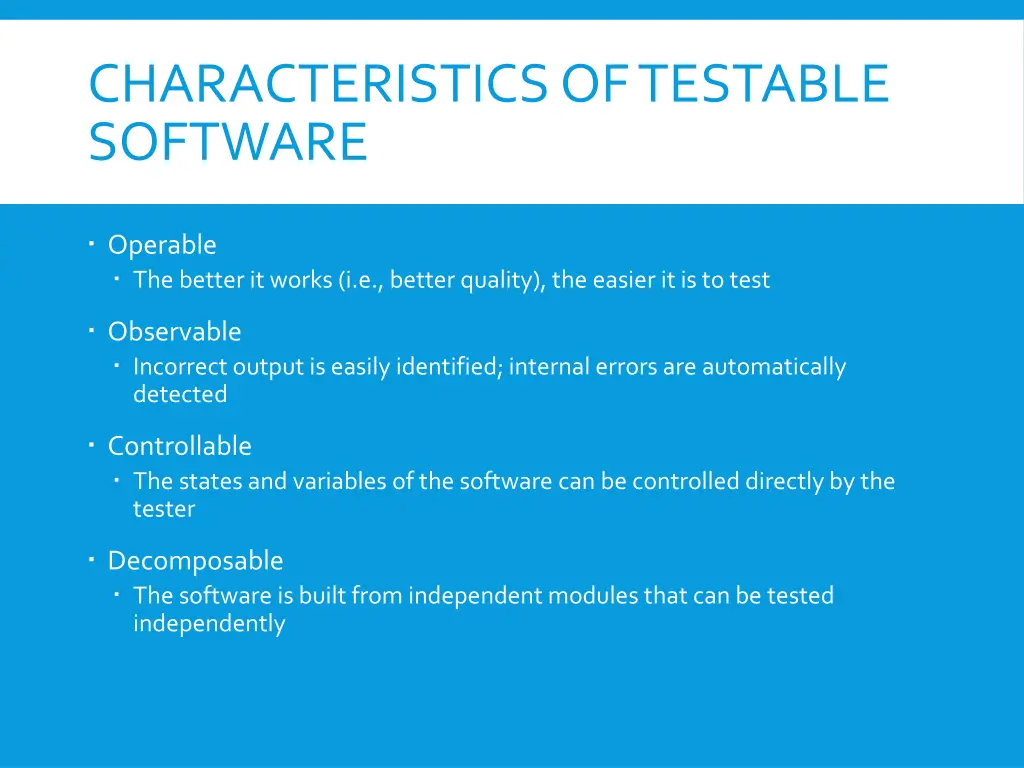
CHARACTERISTICS OF TESTABLE SOFTWARE Operable The better it works (i.e., better quality), the easier it is to test Observable Incorrect output is easily identified; internal errors are automatically detected Controllable The states and variables of the software can be controlled directly by the tester Decomposable The software is built from independent modules that can be tested independently
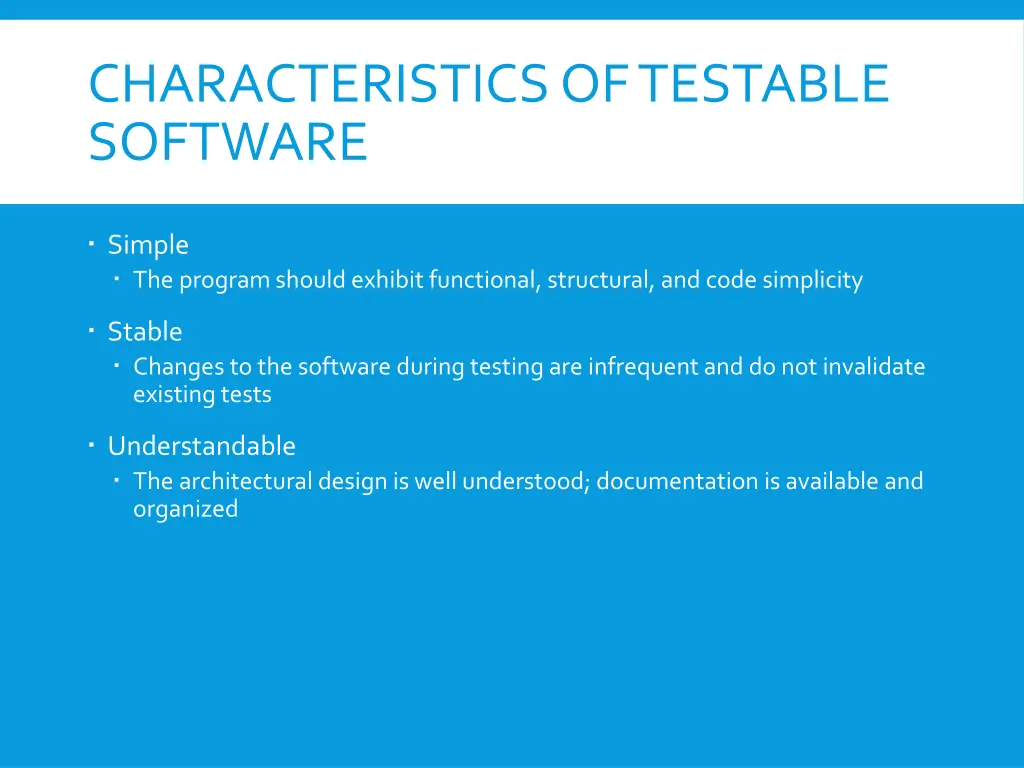
CHARACTERISTICS OF TESTABLE SOFTWARE Simple The program should exhibit functional, structural, and code simplicity Stable Changes to the software during testing are infrequent and do not invalidate existing tests Understandable The architectural design is well understood; documentation is available and organized
LEVELS OF TESTING Unit Testing Integration Testing Validation Testing Acceptance Testing
UNIT TESTING Algorithms and logic Data structures (global and local) Interfaces Independent paths Boundary conditions Error handling
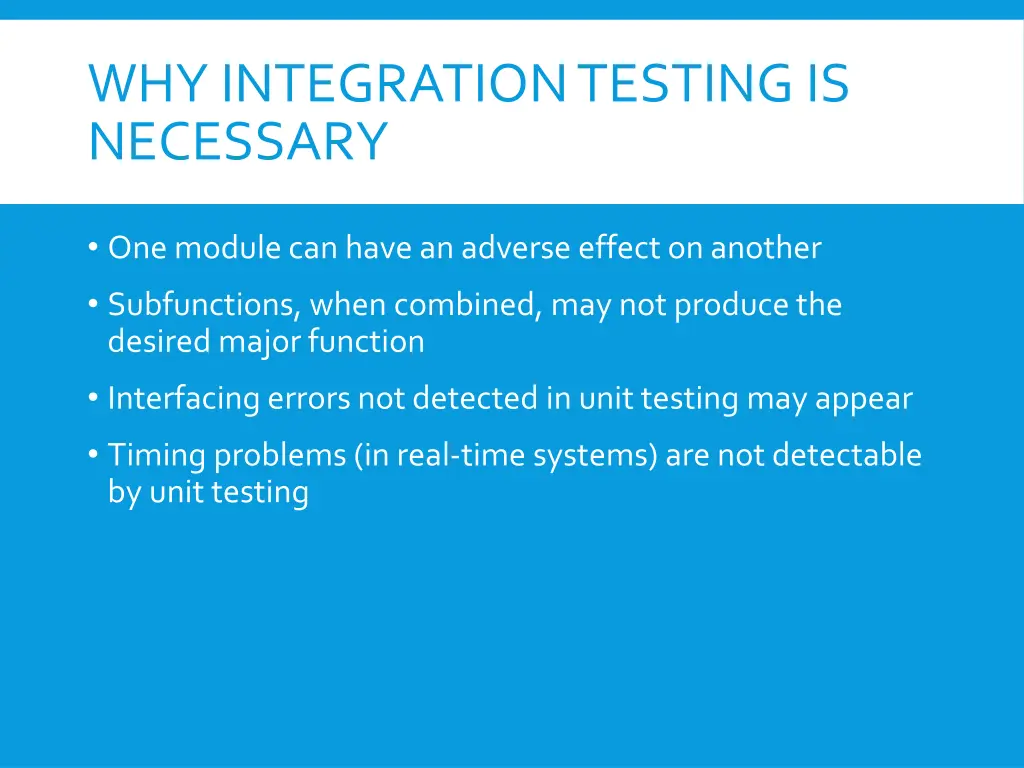
WHY INTEGRATION TESTING IS NECESSARY One module can have an adverse effect on another Subfunctions, when combined, may not produce the desired major function Interfacing errors not detected in unit testing may appear Timing problems (in real-time systems) are not detectable by unit testing
VALIDATION TESTING Determine if the software meets all of the requirements defined in the SR Having written requirements is essential Regression testing involves selectively repeating existing validation tests, not developing new tests
ACCEPTANCE TESTING Similar to validation testing except that customers are present or directly involved. Usually the tests are developed by the customer
TEST TECHNIQUE White box or glass box testing Black box testing
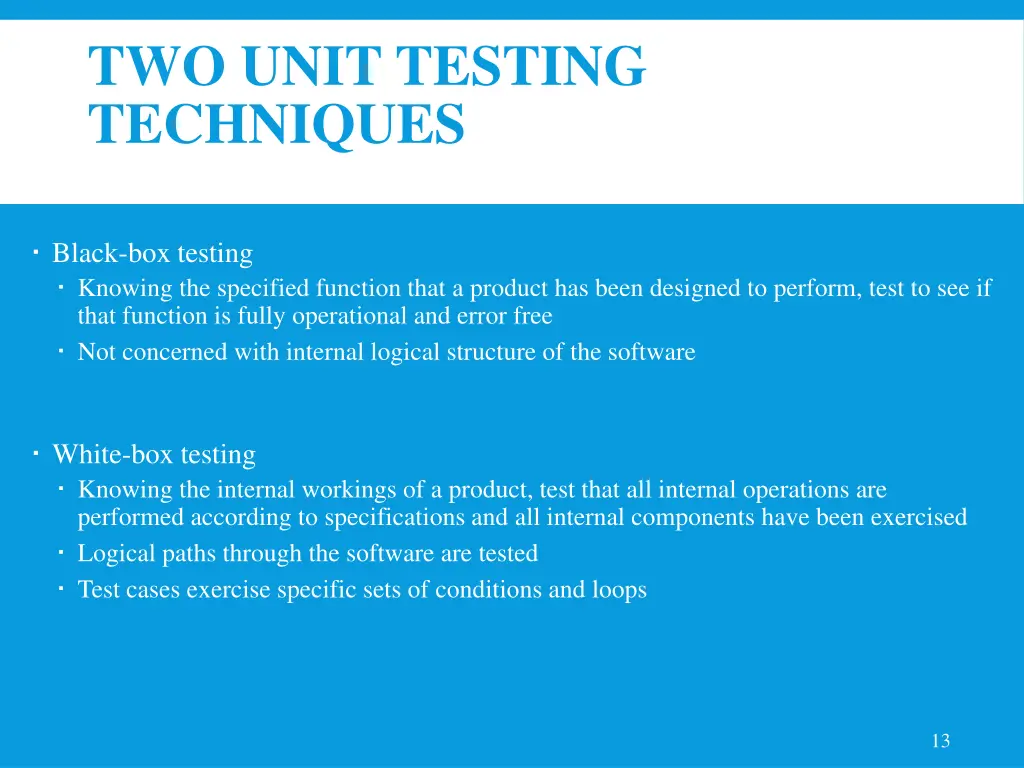
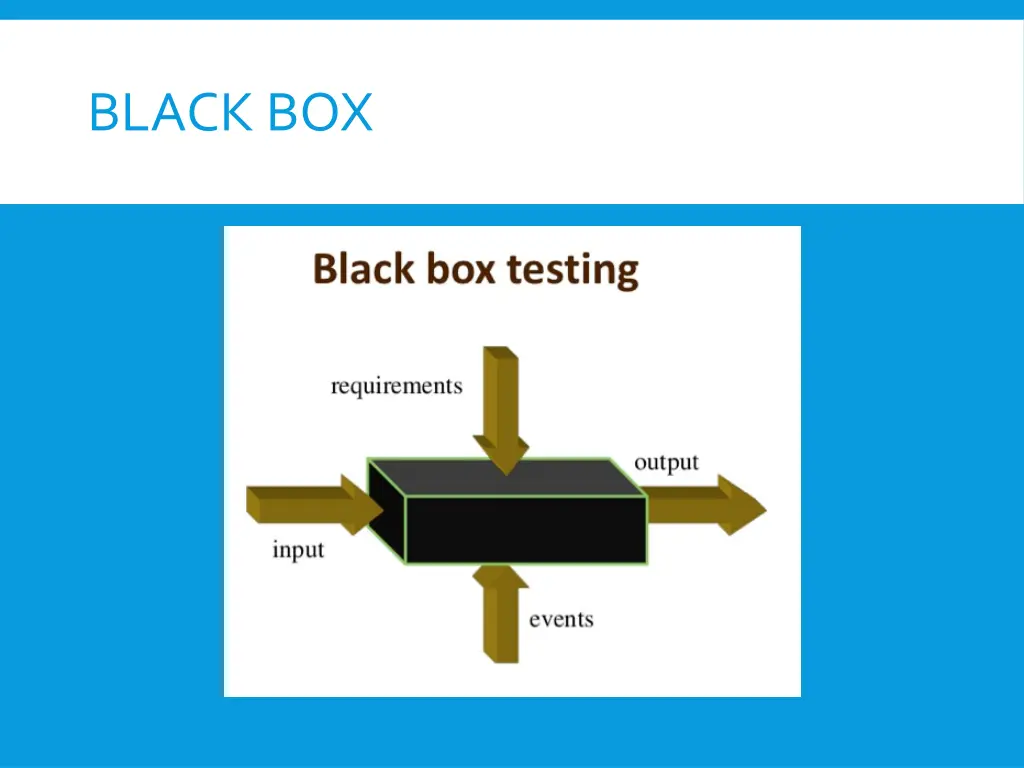
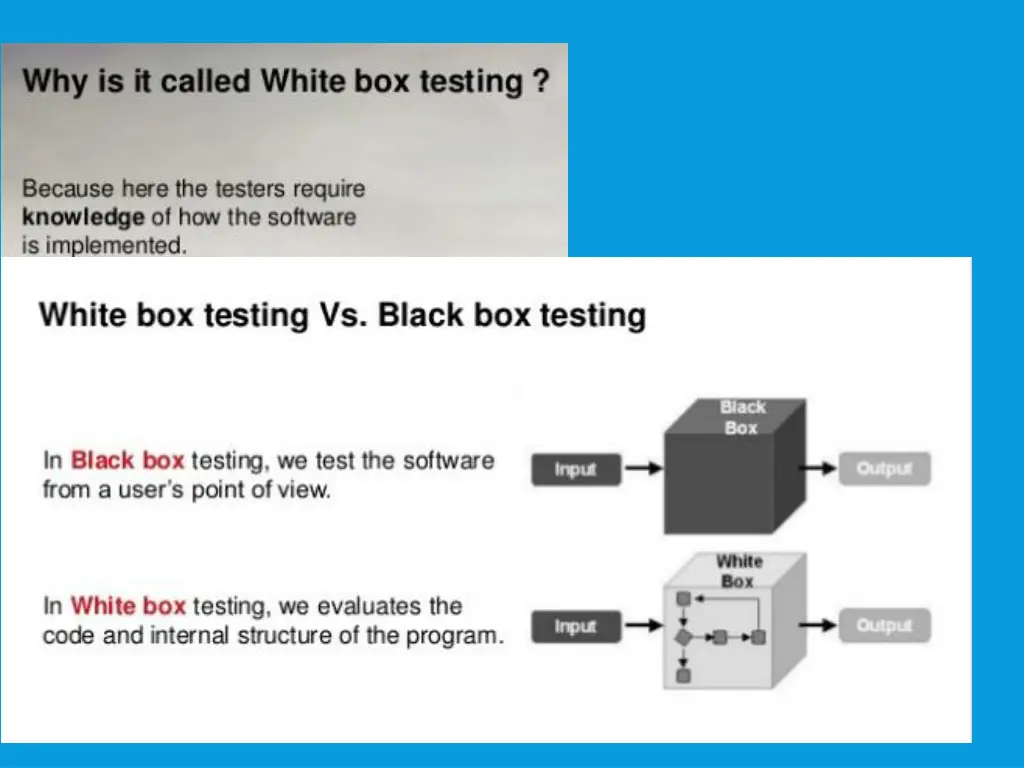
TWO UNIT TESTING TECHNIQUES Black-box testing Knowing the specified function that a product has been designed to perform, test to see if that function is fully operational and error free Not concerned with internal logical structure of the software White-box testing Knowing the internal workings of a product, test that all internal operations are performed according to specifications and all internal components have been exercised Logical paths through the software are tested Test cases exercise specific sets of conditions and loops 13
BLACK BOX TESTING Test cases are derived from formal specification of the system. Test case selection can be done without any reference to the program design or code. Only tests the functionality and features of the program. Not the internal operation. Advantages Test case selection is done before the implementation of a program. Help in getting the design and coding correct with respect to the specification.
BLACK-BOX TESTING CATEGORIES Incorrect or missing functions Interface errors Errors in data structures or external data base access Behavior or performance errors Initialization and termination errors 17
QUESTIONS ANSWERED BY BLACK-BOX TESTING How is functional validity tested? How are system behavior and performance tested? What classes of input will make good test cases? Is the system particularly sensitive to certain input values? How are the boundary values of a data class isolated? What data rates and data volume can the system tolerate? What effect will specific combinations of data have on system operation?
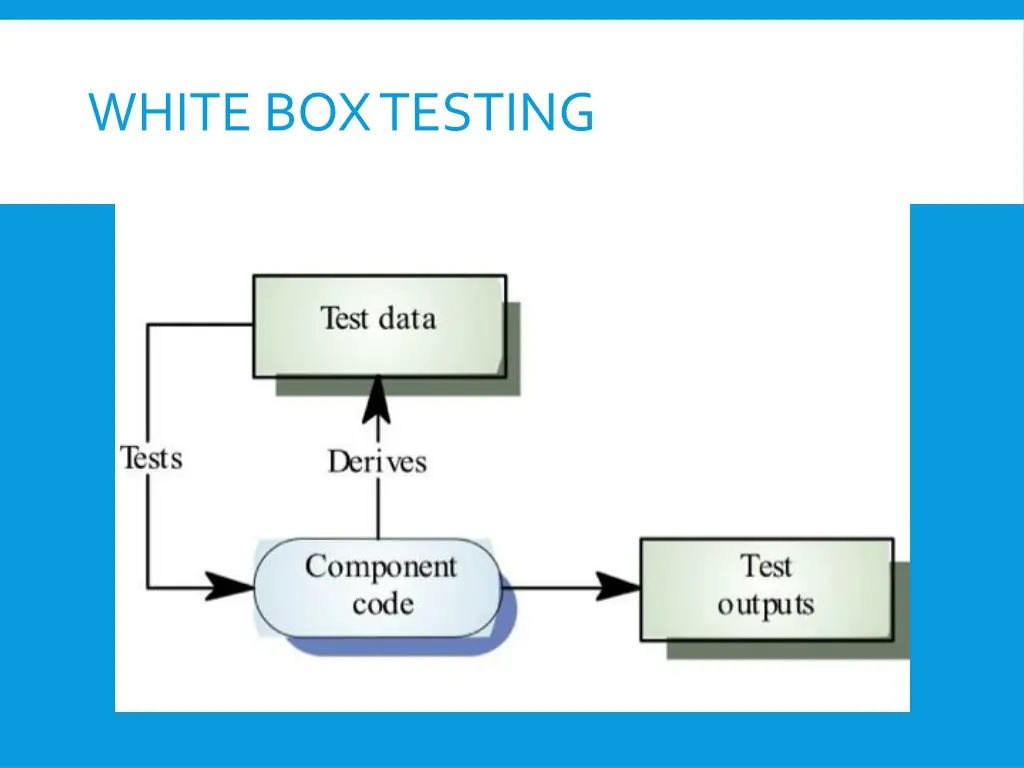
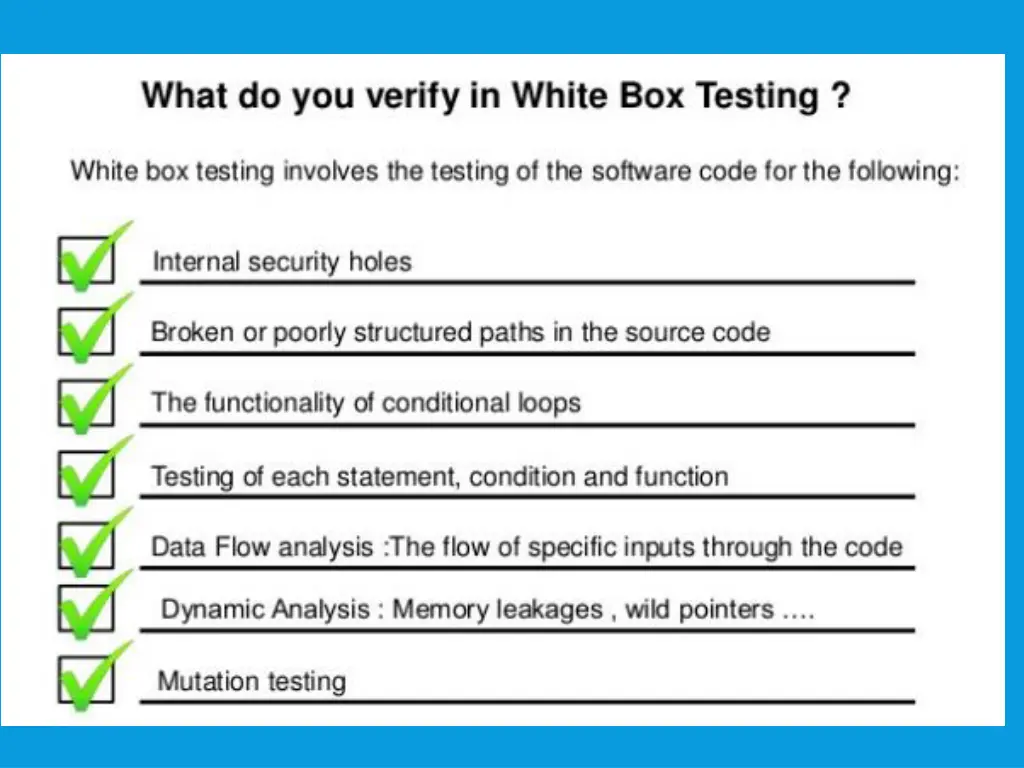
WHITE BOX TESTING Test cases are derived from the internal design specification or actual code for the program. Advantages Tests the internal details of the code; Checks all paths that a program can execute. Limitations Wait until after designing and coding the program under test in order to define test cases.
WHITE BOX TESTING White-box test design techniques include: Control flowtesting Data flow testing Branch testing Path testing
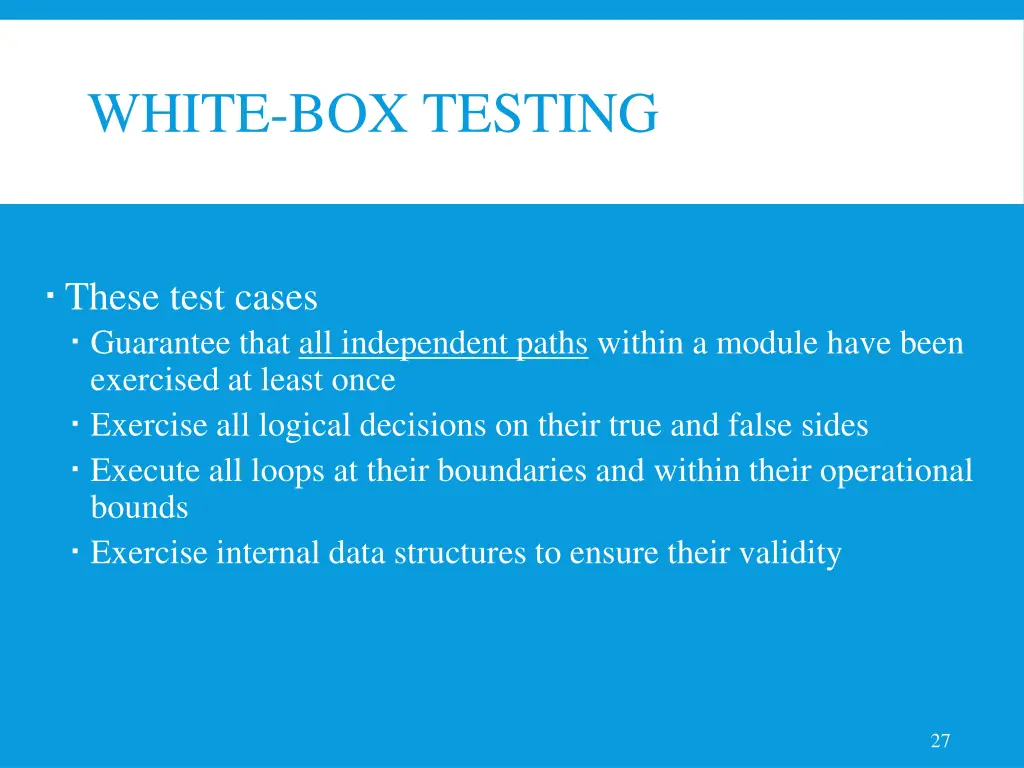
WHITE-BOX TESTING These test cases Guarantee that all independent paths within a module have been exercised at least once Exercise all logical decisions on their true and false sides Execute all loops at their boundaries and within their operational bounds Exercise internal data structures to ensure their validity 27
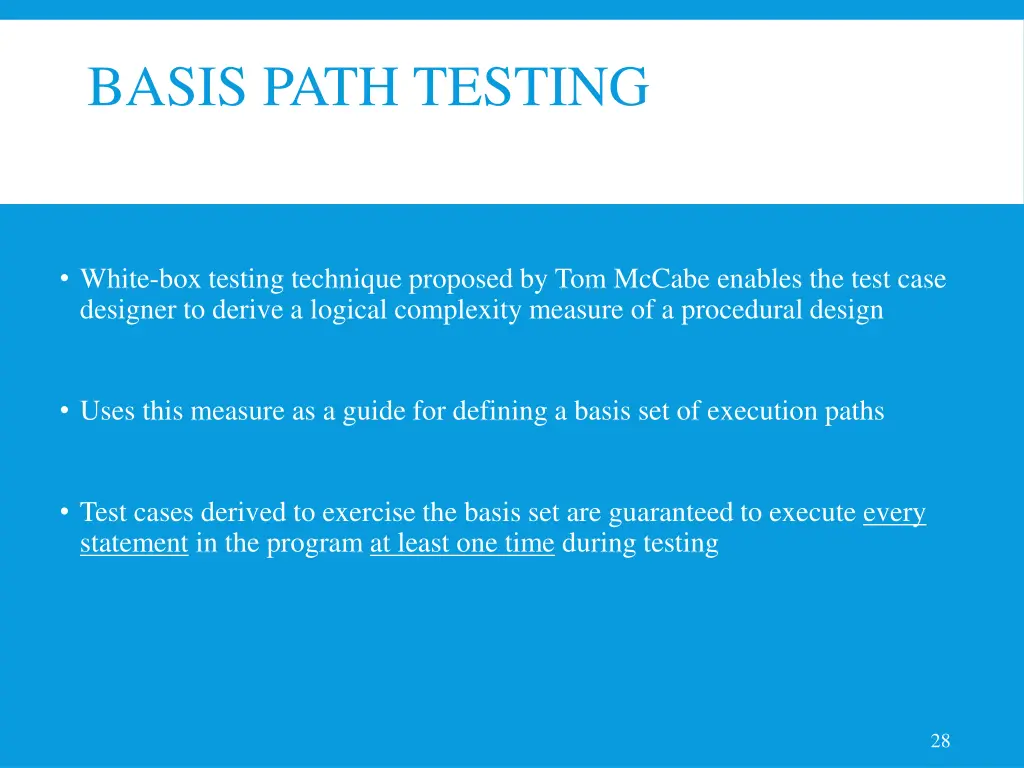
BASIS PATH TESTING White-box testing technique proposed by Tom McCabe enables the test case designer to derive a logical complexity measure of a procedural design Uses this measure as a guide for defining a basis set of execution paths Test cases derived to exercise the basis set are guaranteed to execute every statement in the program at least one time during testing 28
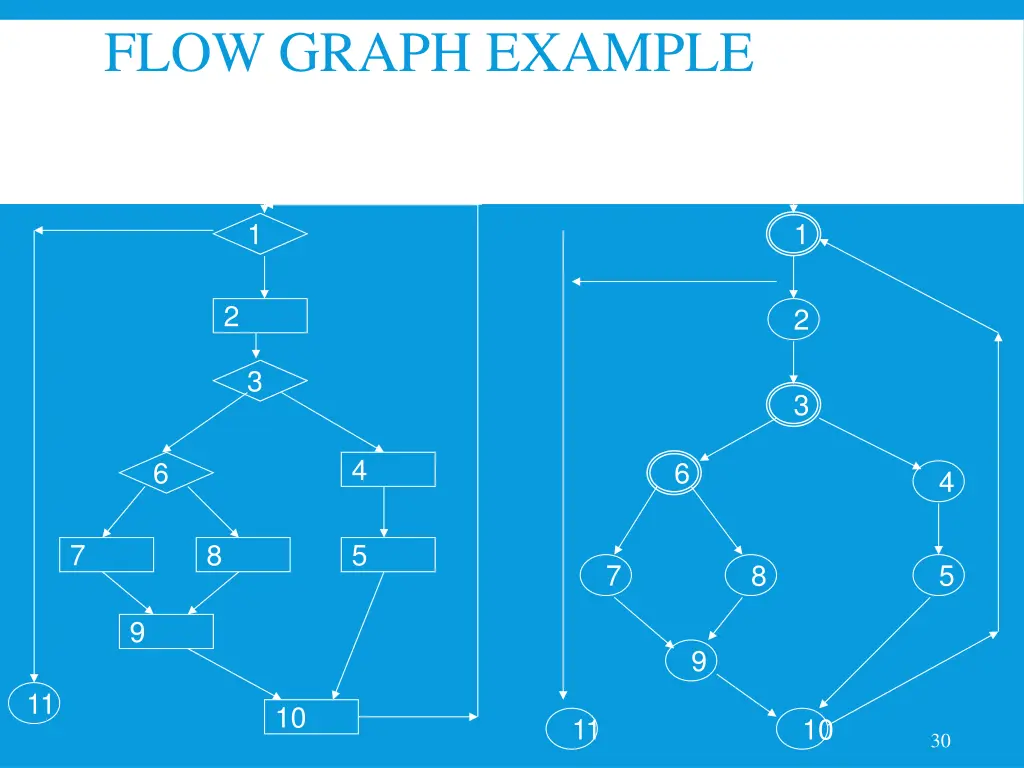
FLOW GRAPH NOTATION A circle in a graph represents a node, which stands for a sequence of one or more procedural statements A node containing a simple conditional expression is referred to as a predicate node Each compound condition in a conditional expression containing one or more Boolean operators (e.g., and, or) is represented by a separate predicate node A predicate node has two edges leading out from it (True and False) An edge, or a link, is a an arrow representing flow of control in a specific direction An edge must start and terminate at a node An edge does not intersect or cross over another edge 29
FLOW GRAPH EXAMPLE FLOW CHART FLOW GRAPH 0 0 1 1 2 2 3 3 4 6 6 4 7 8 5 7 8 5 9 9 11 10 11 10 30
INDEPENDENT PROGRAM PATHS Defined as a path through the program from the start node until the end node that introduces at least one new set of processing statements or a new condition (i.e., new nodes) Must move along at least one edge that has not been traversed before by a previous path Basis set for flow graph on previous slide Path 1: 0-1-11 Path 2: 0-1-2-3-4-5-10-1-11 Path 3: 0-1-2-3-6-8-9-10-1-11 Path 4: 0-1-2-3-6-7-9-10-1-11 The number of paths in the basis set is determined by the cyclomatic complexity 31
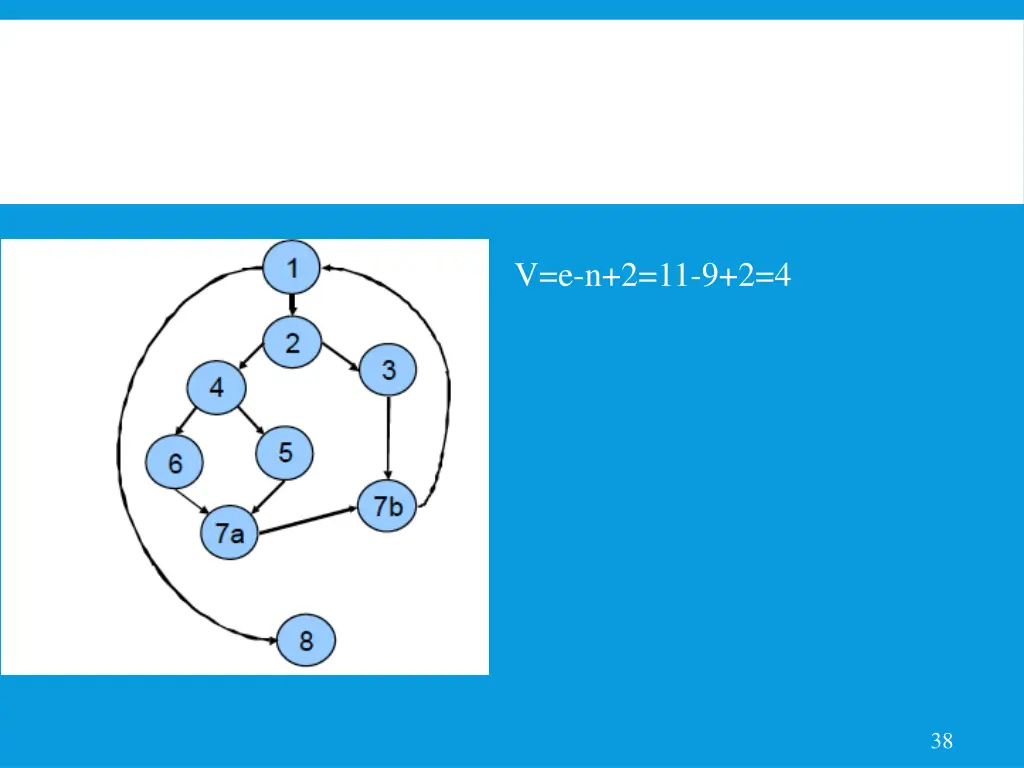
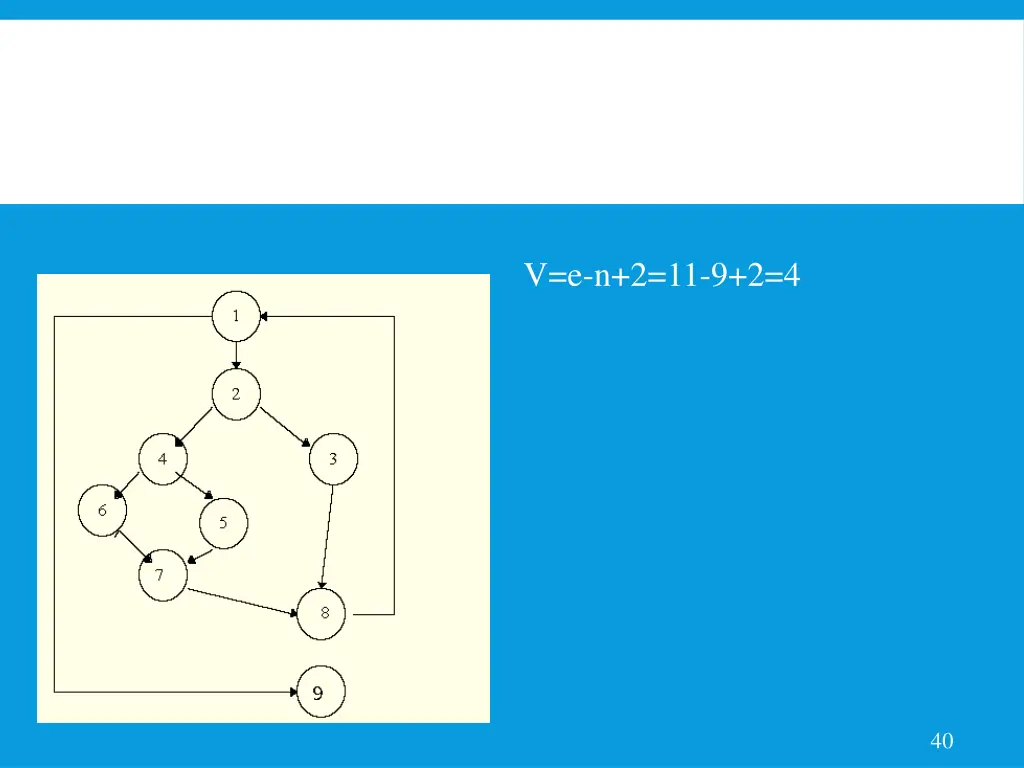
CYCLOMATIC COMPLEXITY Provides a quantitative measure of the logical complexity of a program Defines the number of independent paths in the basis set Provides an upper bound for the number of tests that must be conducted to ensure all statements have been executed at least once Can be computed two ways V(G) = E N + 2, where E is the number of edges and N is the number of nodes in graph G Results in the following equations for the example flow graph V(G) = 14 edges 12 nodes + 2 = 4 32
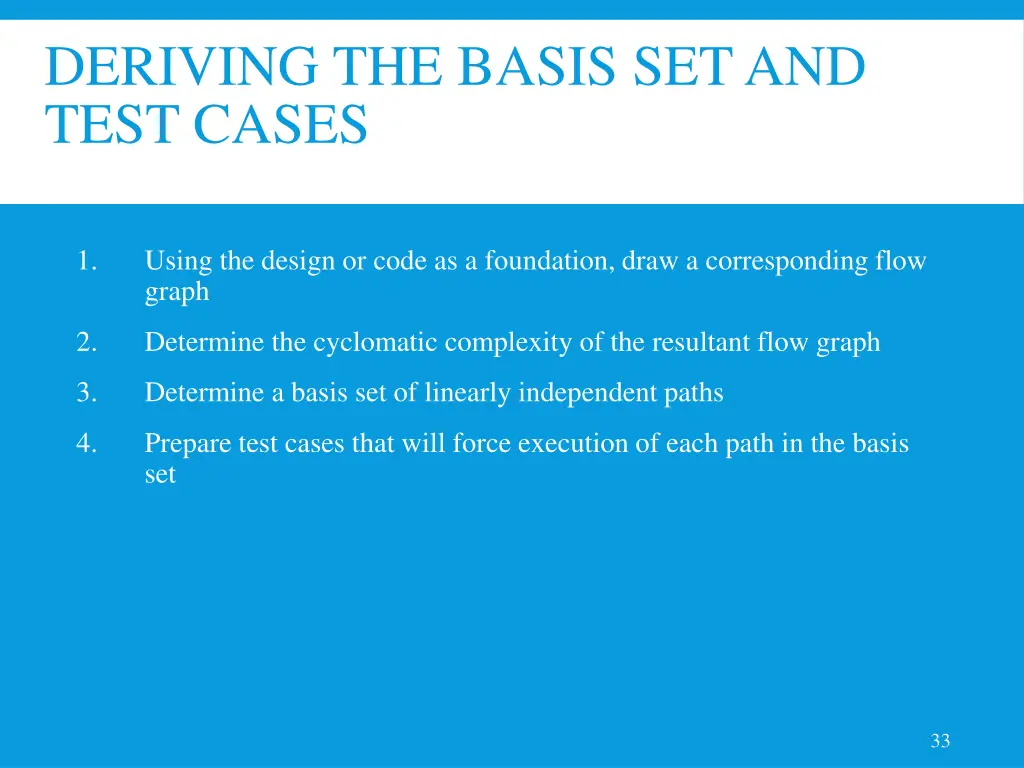
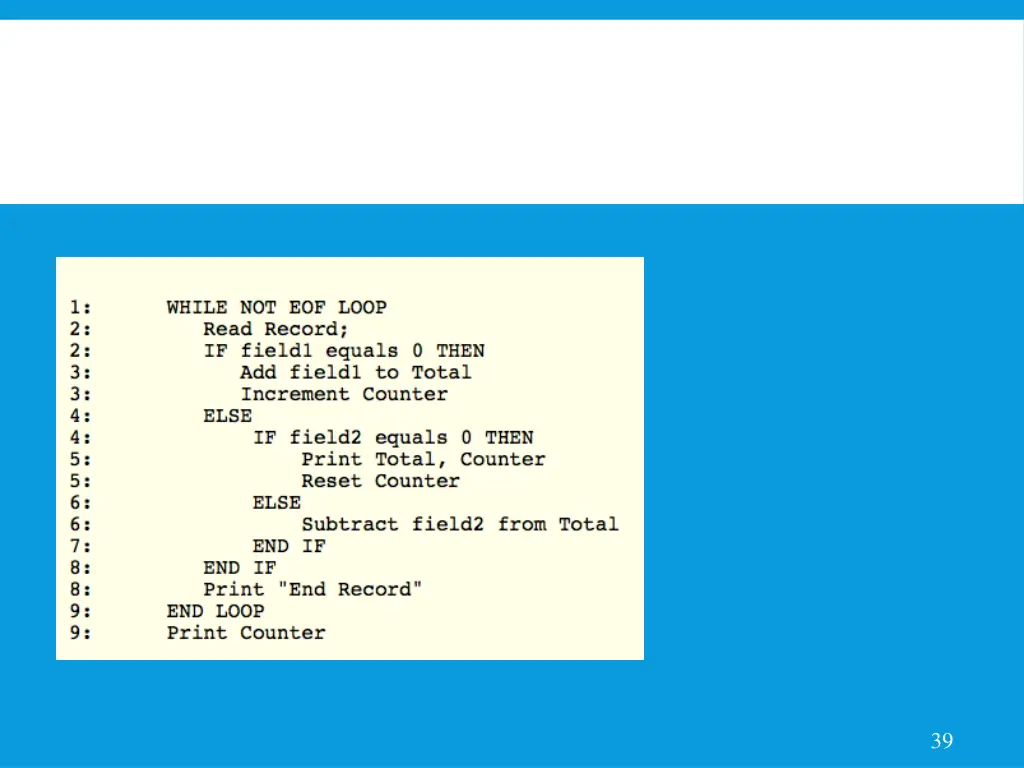
DERIVING THE BASIS SET AND TEST CASES 1. Using the design or code as a foundation, draw a corresponding flow graph 2. Determine the cyclomatic complexity of the resultant flow graph 3. Determine a basis set of linearly independent paths 4. Prepare test cases that will force execution of each path in the basis set 33
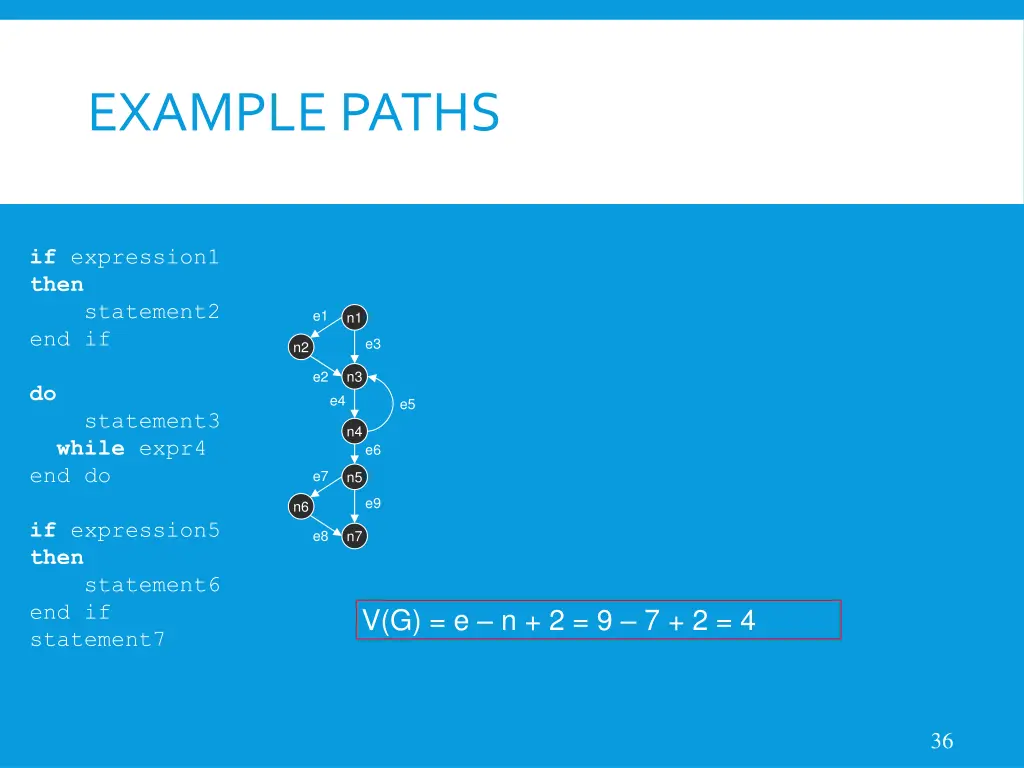
CYCLOMATIC COMPLEXITY Invented by Thomas McCabe (1974) to measure the complexity of a program s conditional logic Cyclomatic complexity of graph G equals #edges - #nodes + 2 V(G) = e n + 2 Also corresponds to the number of linearly independent paths in a program 34
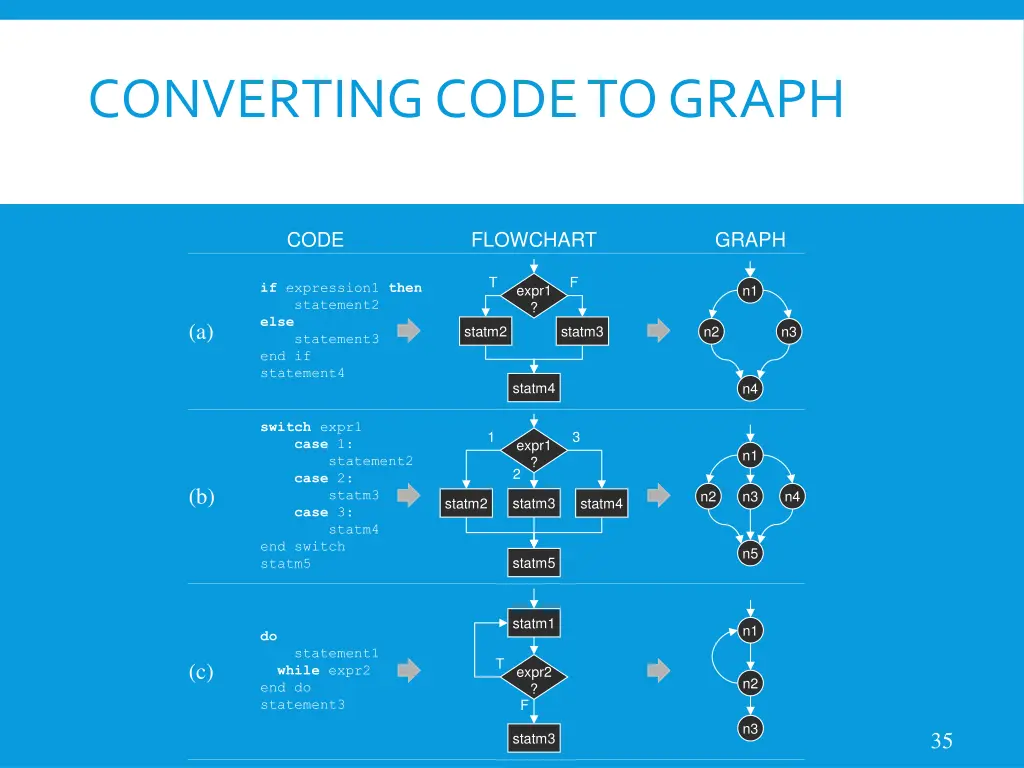
CONVERTING CODE TO GRAPH CODE FLOWCHART GRAPH T F if expression1 then statement2 else statement3 end if statement4 expr1 ? n1 (a) statm2 statm3 n2 n3 statm4 n4 switch expr1 case 1: statement2 case 2: statm3 case 3: statm4 end switch statm5 1 3 expr1 ? n1 2 (b) n2 n3 n4 statm3 statm2 statm4 n5 statm5 statm1 n1 do statement1 while expr2 end do statement3 T (c) expr2 ? n2 F n3 35 statm3
EXAMPLE PATHS if expression1 then statement2 end if e1 n1 e3 n2 e2 n3 do statement3 while expr4 end do e4 e5 n4 e6 e7 n5 e9 n6 if expression5 then statement6 end if statement7 e8 n7 V(G) = e n + 2 = 9 7 + 2 = 4 36
EXAMPLE 1 37