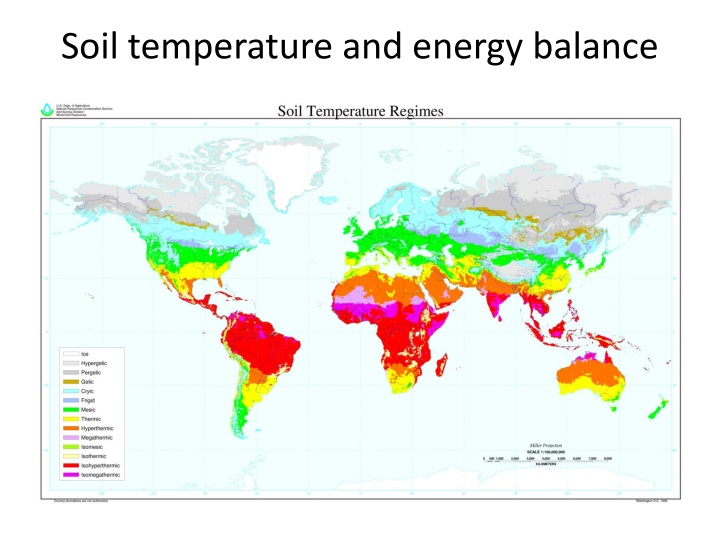
Soil Temperature, Energy Balance, and Radiation Laws
Explore the concepts of soil temperature, energy balance, and radiation laws in relation to heat flow and energy transfer. Learn about global carbon dioxide flux, modes of energy transfer, Stefan-Boltzmann law, Wien's law, short-wave and long-wave radiation, and net radiation at the soil surface.

Download Presentation

Please find below an Image/Link to download the presentation.
The content on the website is provided AS IS for your information and personal use only. It may not be sold, licensed, or shared on other websites without obtaining consent from the author. If you encounter any issues during the download, it is possible that the publisher has removed the file from their server.
You are allowed to download the files provided on this website for personal or commercial use, subject to the condition that they are used lawfully. All files are the property of their respective owners.
The content on the website is provided AS IS for your information and personal use only. It may not be sold, licensed, or shared on other websites without obtaining consent from the author.
E N D
Presentation Transcript
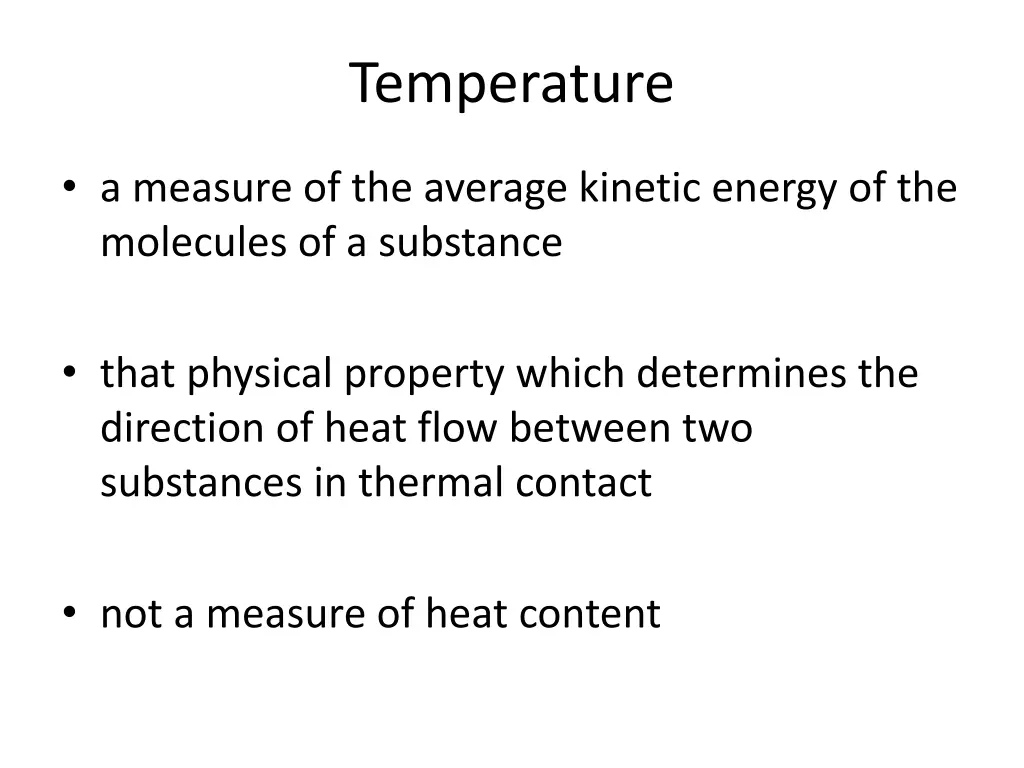
Temperature a measure of the average kinetic energy of the molecules of a substance that physical property which determines the direction of heat flow between two substances in thermal contact not a measure of heat content
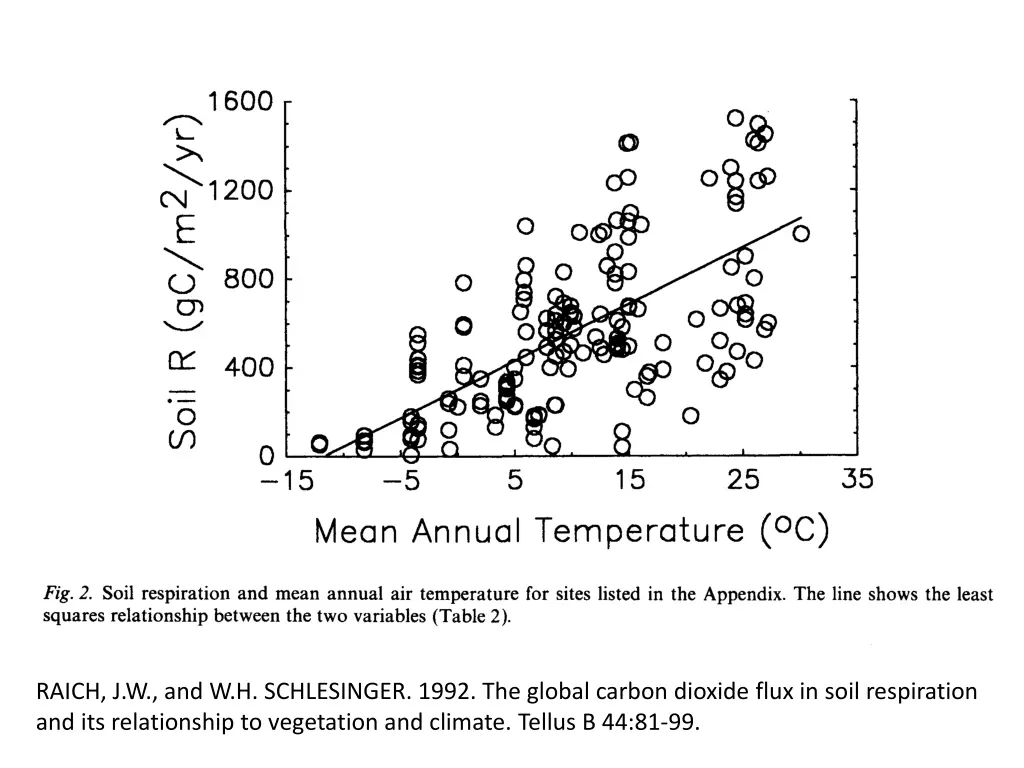
RAICH, J.W., and W.H. SCHLESINGER. 1992. The global carbon dioxide flux in soil respiration and its relationship to vegetation and climate. Tellus B 44:81-99.
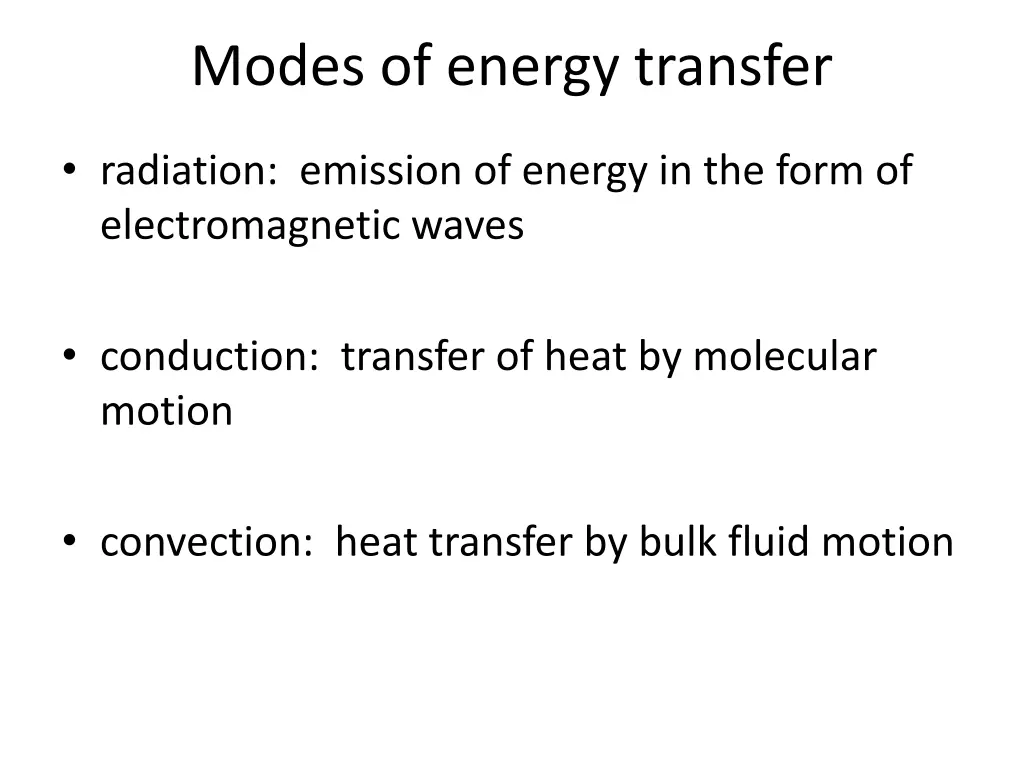
Modes of energy transfer radiation: emission of energy in the form of electromagnetic waves conduction: transfer of heat by molecular motion convection: heat transfer by bulk fluid motion
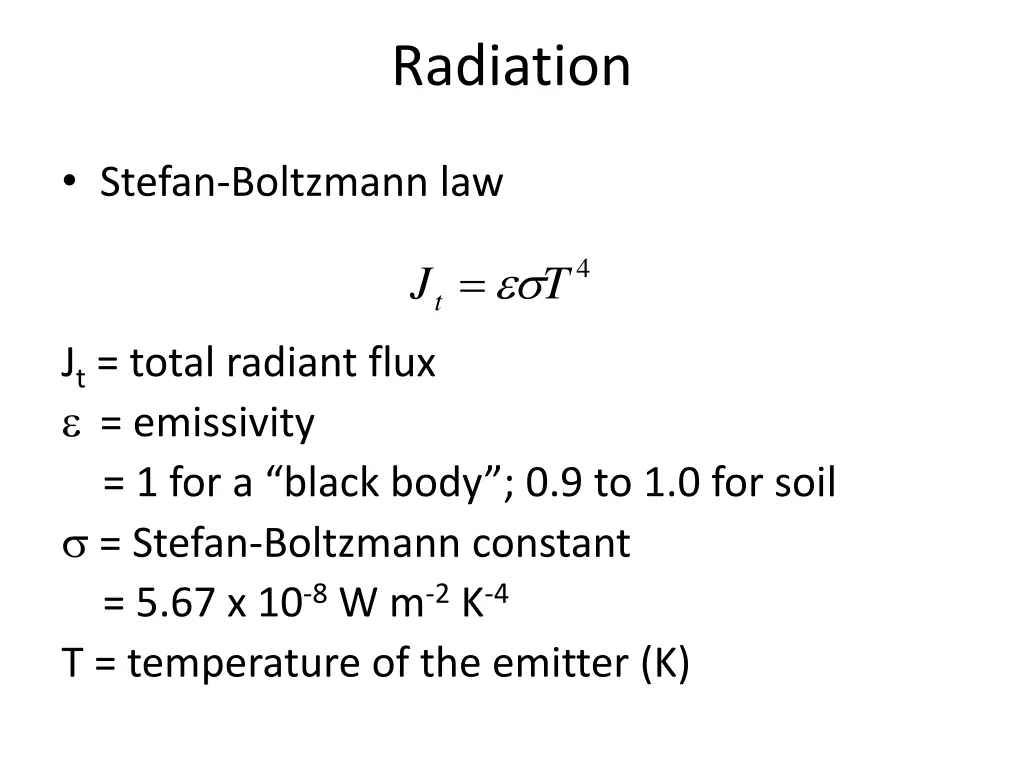
Radiation Stefan-Boltzmann law = 4 Jt T Jt = total radiant flux = emissivity = 1 for a black body ; 0.9 to 1.0 for soil = Stefan-Boltzmann constant = 5.67 x 10⁻⁸ W m-2 K-4 T = temperature of the emitter (K)
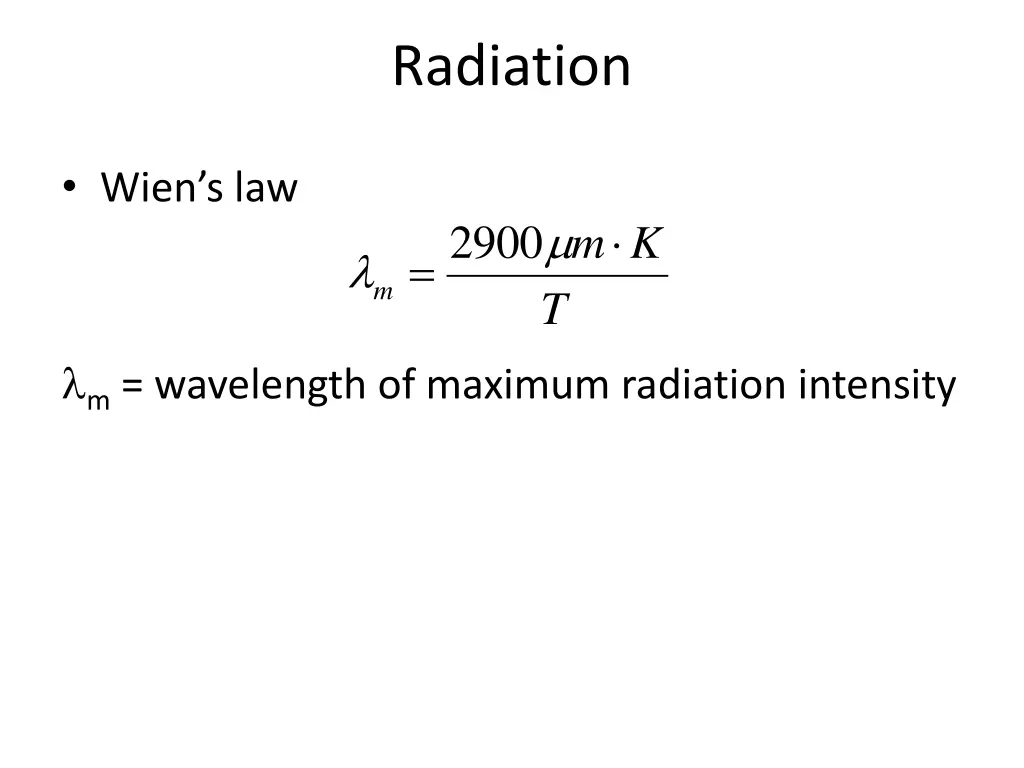
Radiation Wien s law 2900 m K = m T m = wavelength of maximum radiation intensity
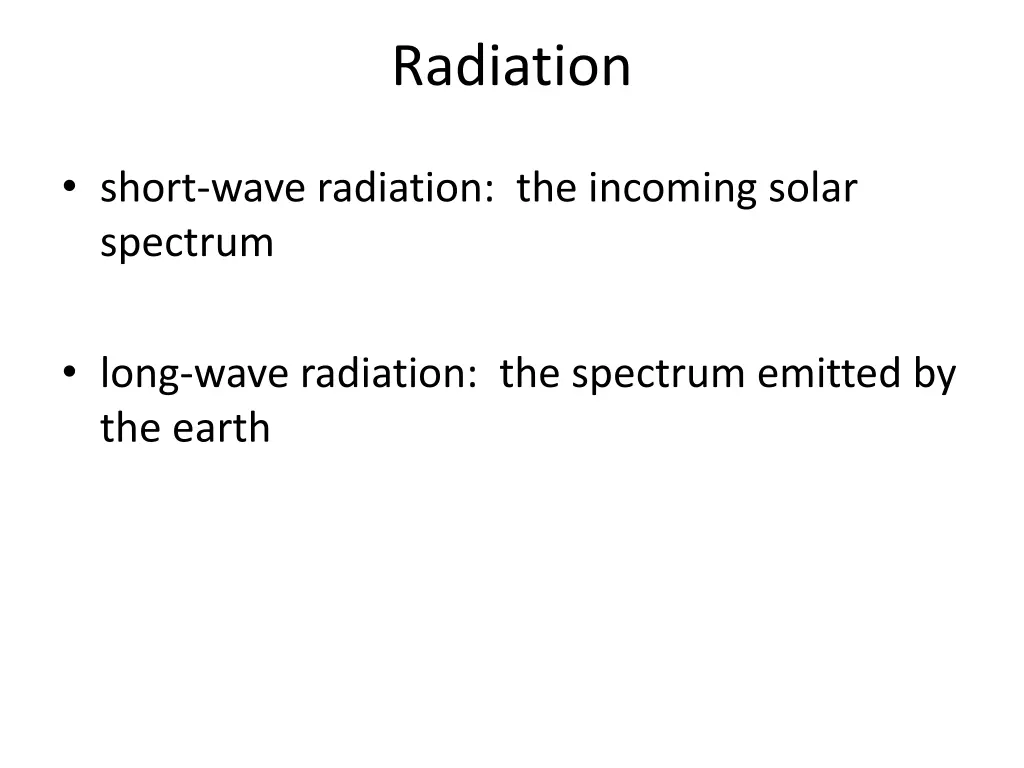
Radiation short-wave radiation: the incoming solar spectrum long-wave radiation: the spectrum emitted by the earth
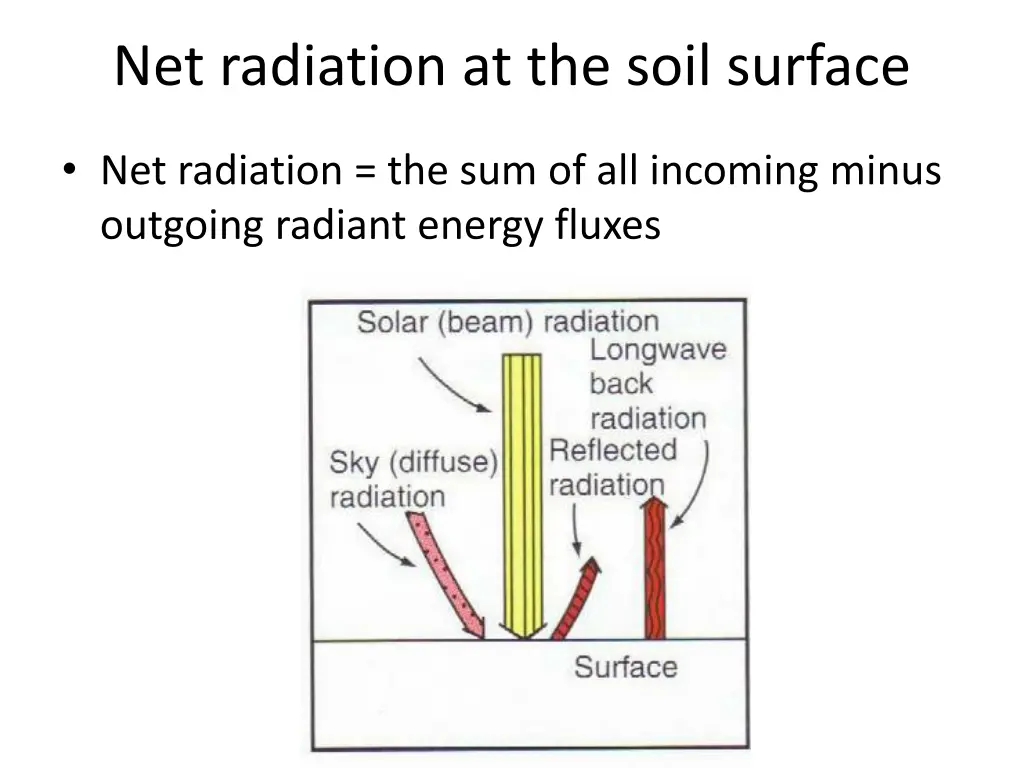
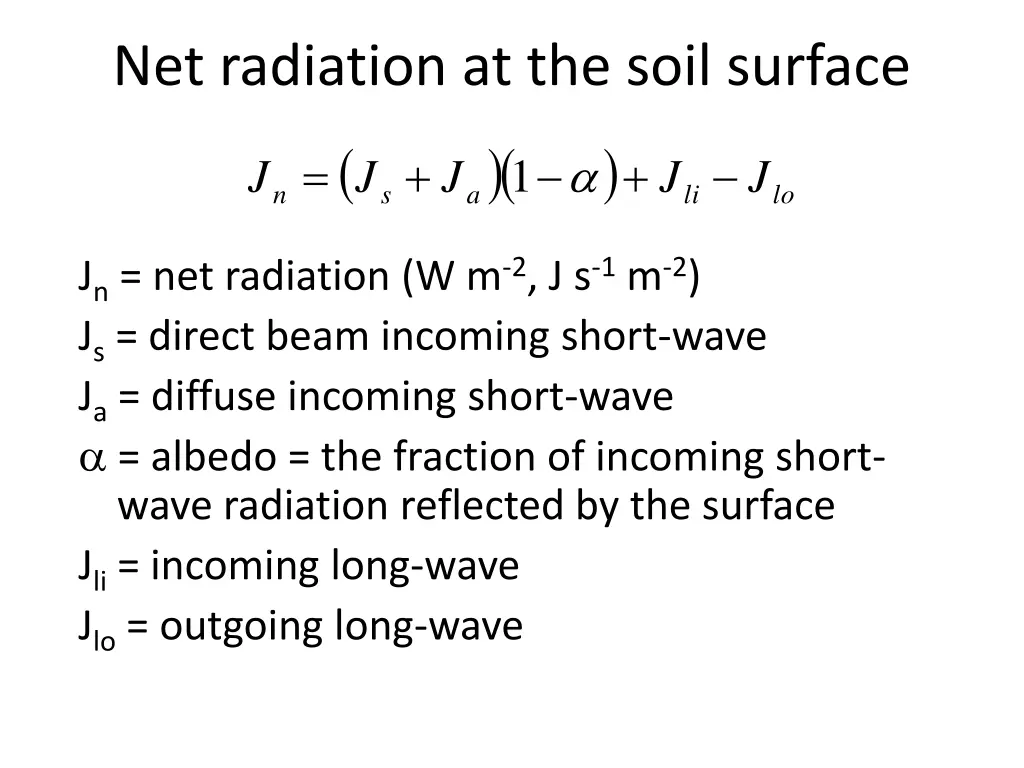
Net radiation at the soil surface Net radiation = the sum of all incoming minus outgoing radiant energy fluxes
Net radiation at the soil surface ( )( ) = + + 1 J J J J J n s a li lo Jn = net radiation (W m-2, J s-1 m-2) Js = direct beam incoming short-wave Ja = diffuse incoming short-wave = albedo = the fraction of incoming short- wave radiation reflected by the surface Jli = incoming long-wave Jlo = outgoing long-wave
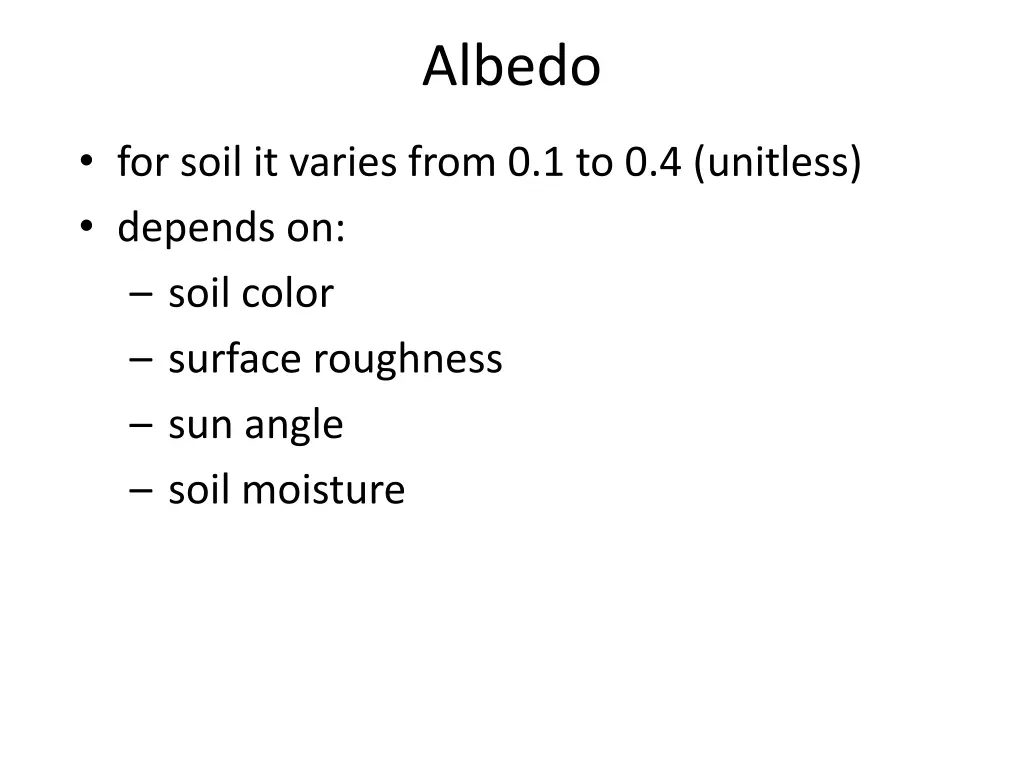
Albedo for soil it varies from 0.1 to 0.4 (unitless) depends on: soil color surface roughness sun angle soil moisture
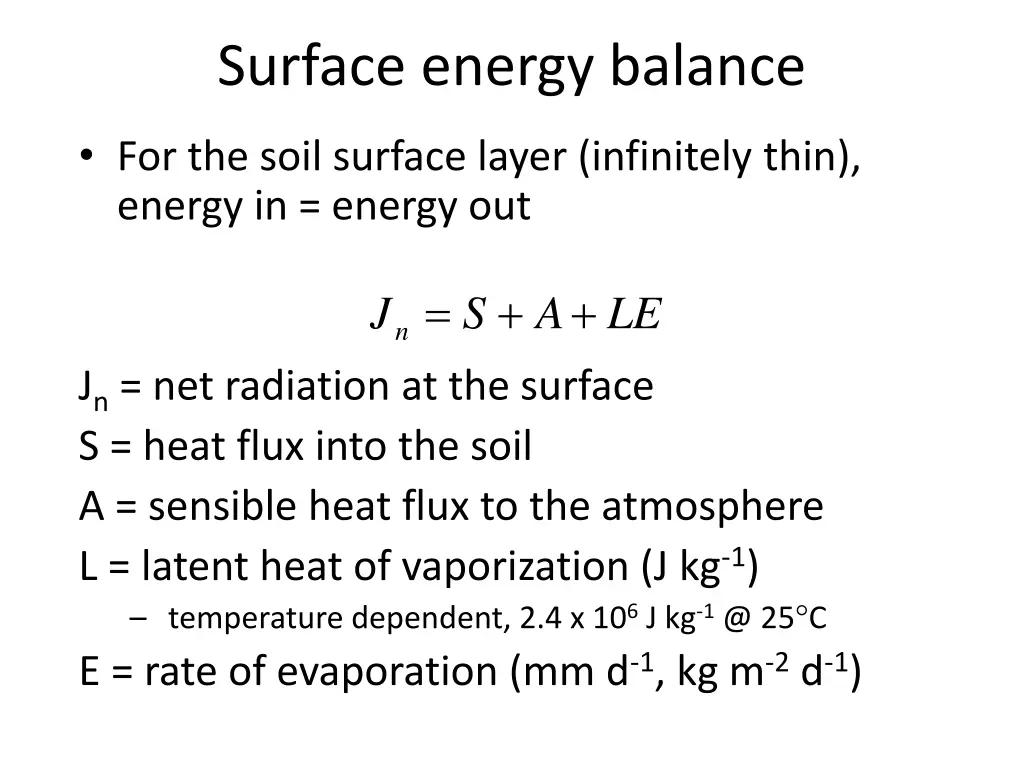
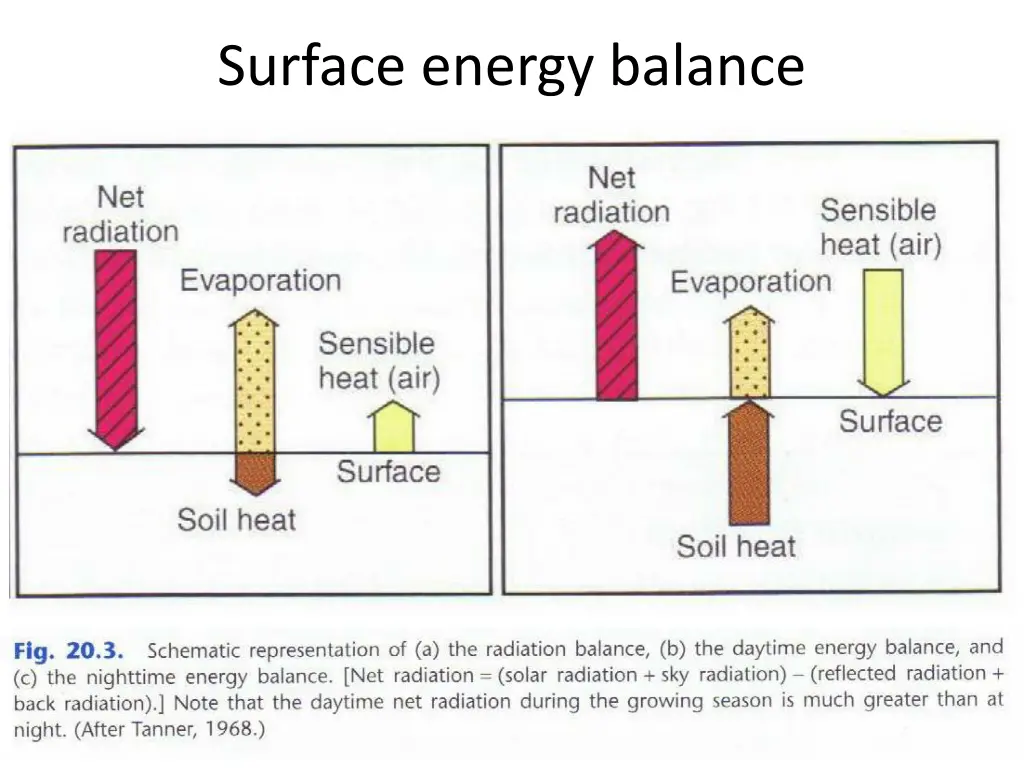
Surface energy balance For the soil surface layer (infinitely thin), energy in = energy out = + + Jn S A LE Jn = net radiation at the surface S = heat flux into the soil A = sensible heat flux to the atmosphere L = latent heat of vaporization (J kg-1) temperature dependent, 2.4 x 10⁶ J kg-1 @ 25 C E = rate of evaporation (mm d-1, kg m-2 d-1)
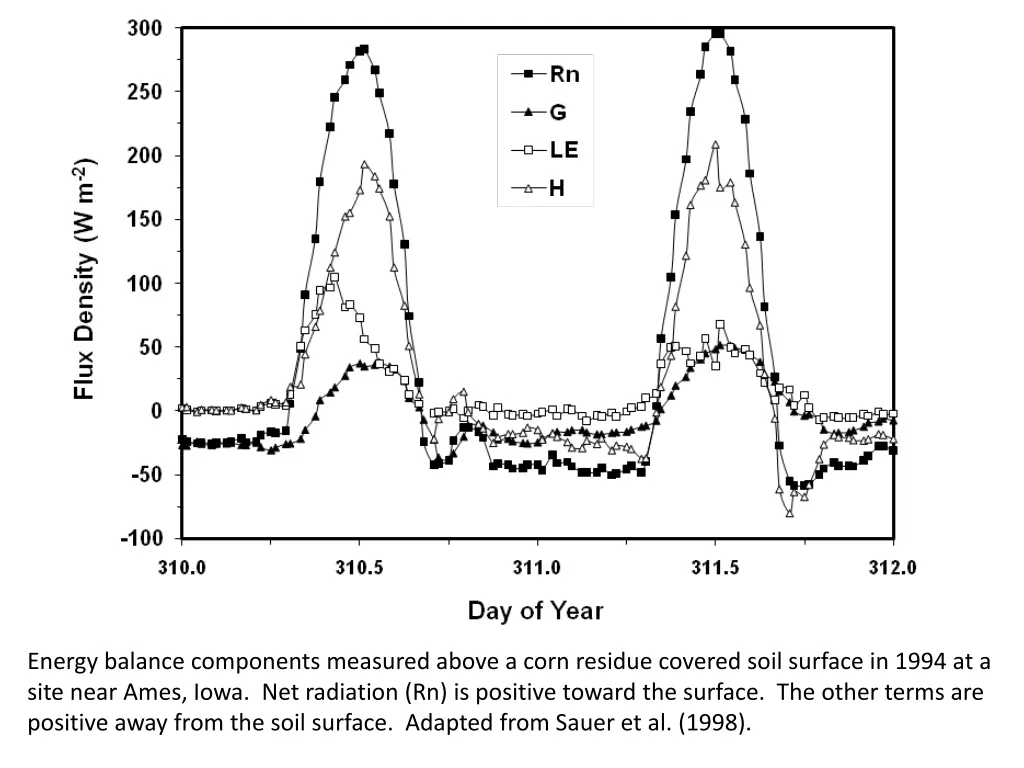
Energy balance components measured above a corn residue covered soil surface in 1994 at a site near Ames, Iowa. Net radiation (Rn) is positive toward the surface. The other terms are positive away from the soil surface. Adapted from Sauer et al. (1998).
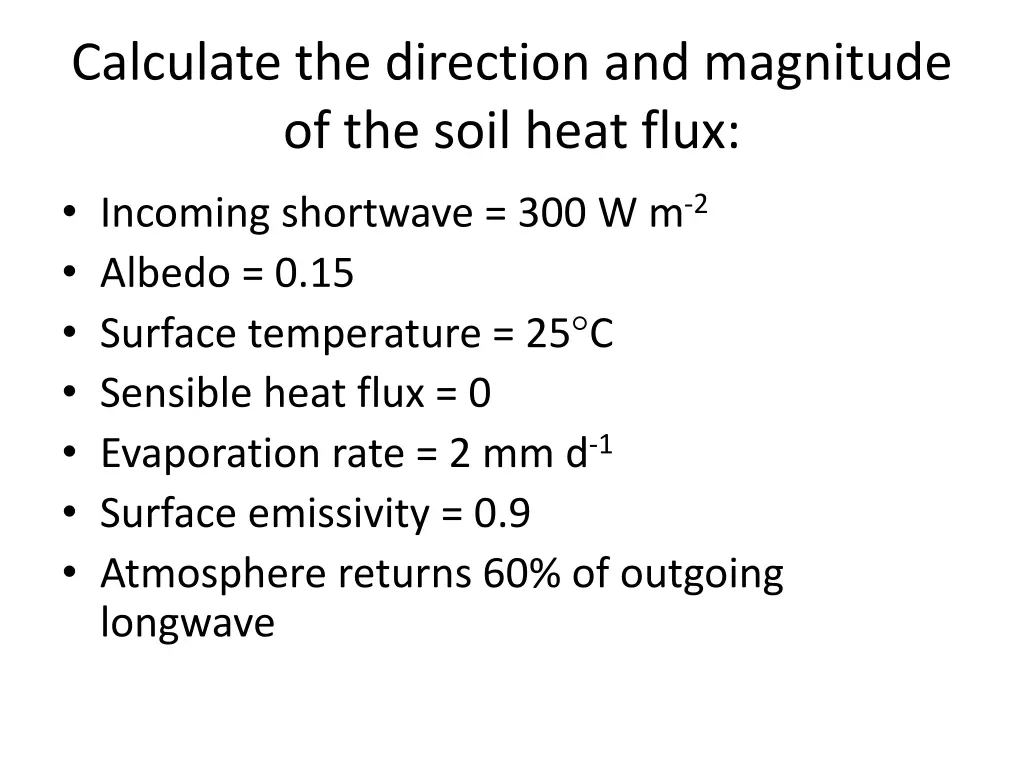
Calculate the direction and magnitude of the soil heat flux: Incoming shortwave = 300 W m-2 Albedo = 0.15 Surface temperature = 25 C Sensible heat flux = 0 Evaporation rate = 2 mm d-1 Surface emissivity = 0.9 Atmosphere returns 60% of outgoing longwave
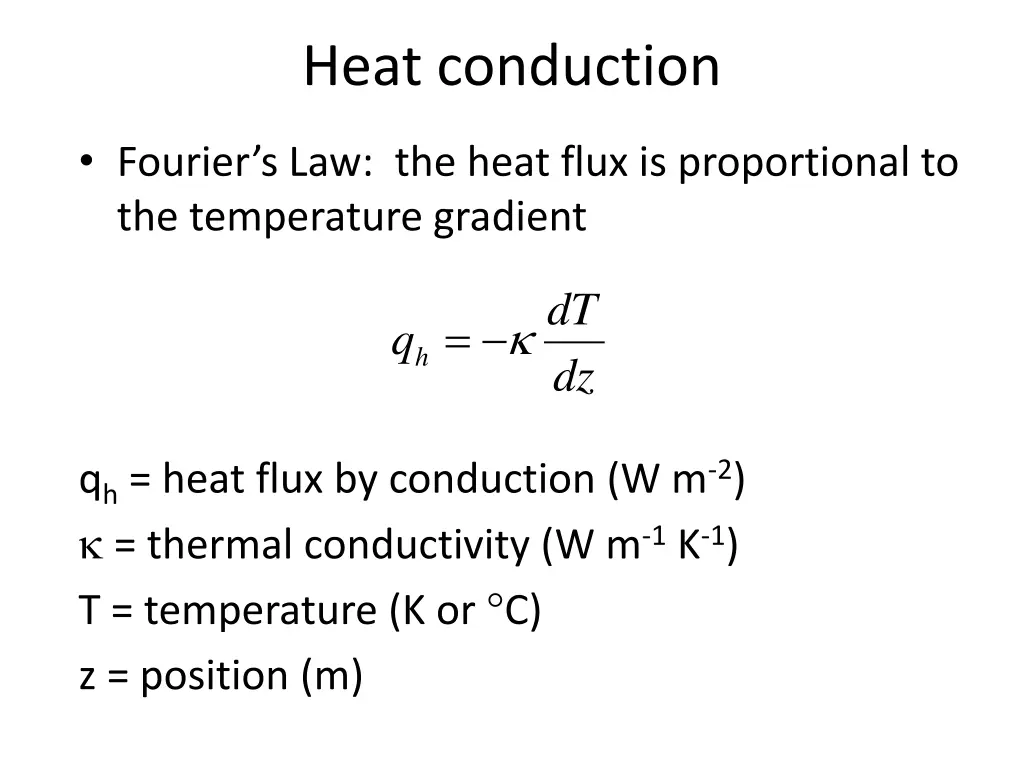
Heat conduction Fourier s Law: the heat flux is proportional to the temperature gradient dT = qh dz qh = heat flux by conduction (W m-2) = thermal conductivity (W m-1 K-1) T = temperature (K or C) z = position (m)
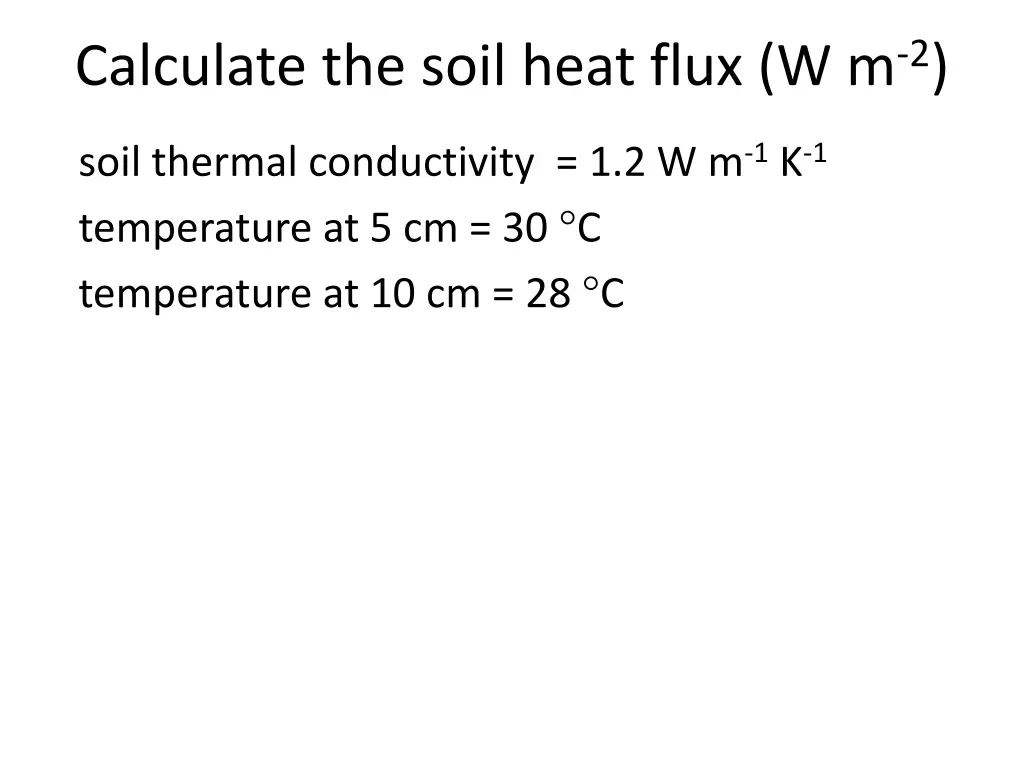
Calculate the soil heat flux (W m-2) soil thermal conductivity = 1.2 W m-1 K-1 temperature at 5 cm = 30 C temperature at 10 cm = 28 C
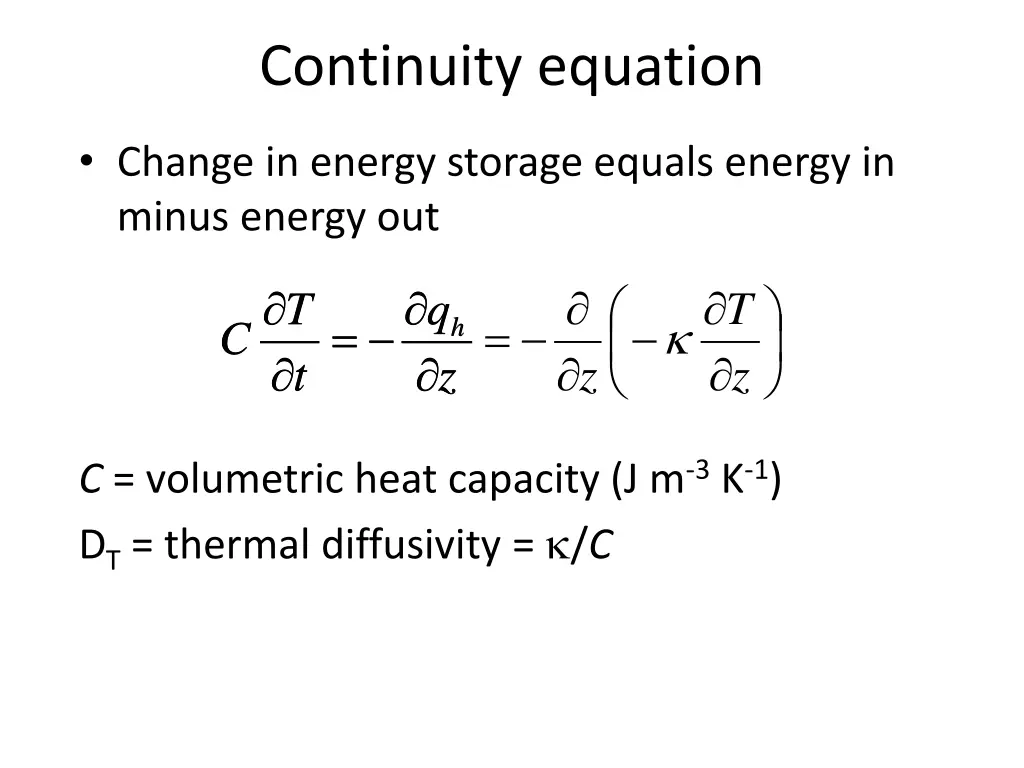
Continuity equation Change in energy storage equals energy in minus energy out q T T T q = = = h h C C t t z z z z C = volumetric heat capacity (J m-3 K-1) DT = thermal diffusivity = /C
Reading assignment Soil thermal properties, p. 218-225
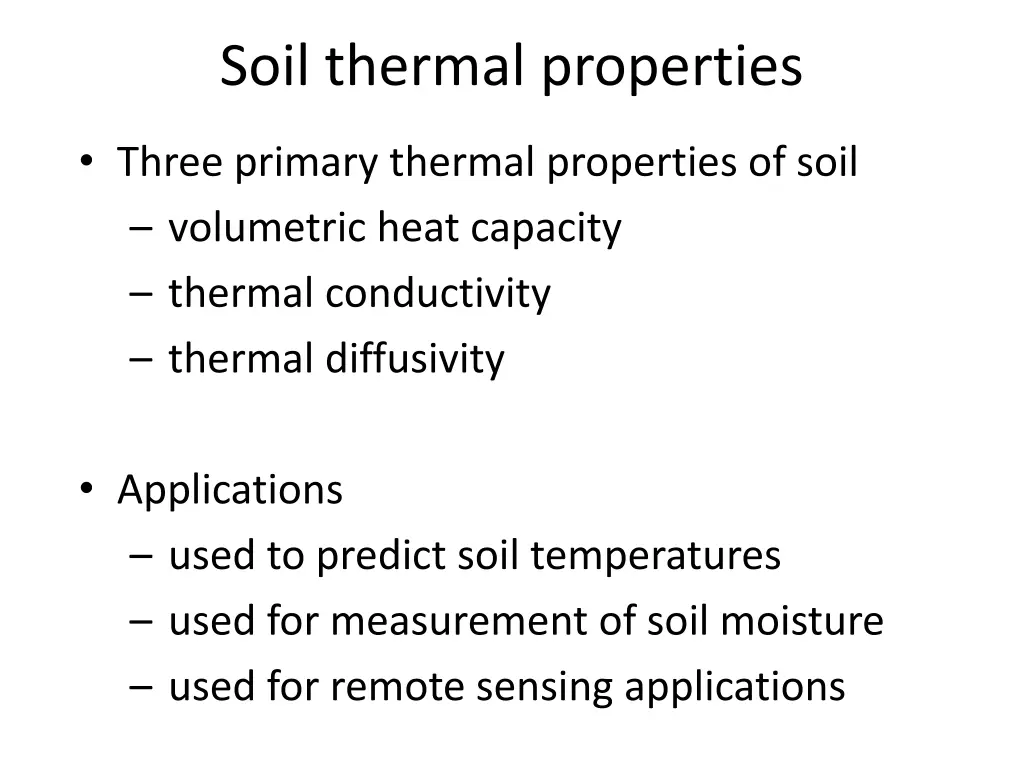
Soil thermal properties Three primary thermal properties of soil volumetric heat capacity thermal conductivity thermal diffusivity Applications used to predict soil temperatures used for measurement of soil moisture used for remote sensing applications
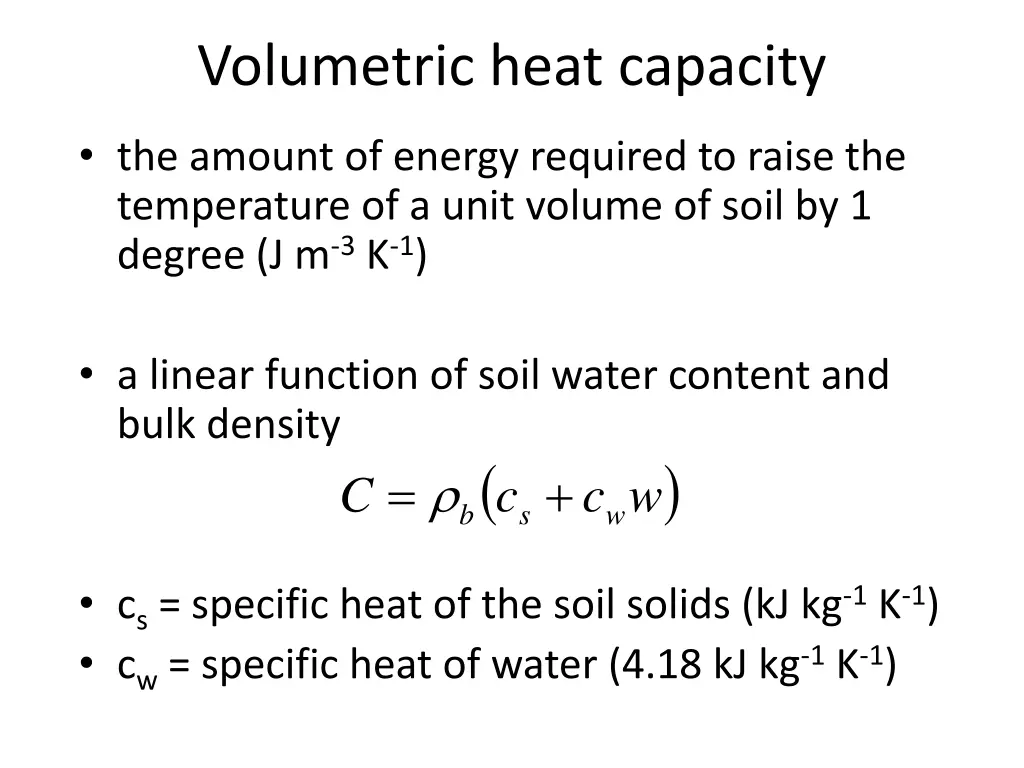
Volumetric heat capacity the amount of energy required to raise the temperature of a unit volume of soil by 1 degree (J m-3 K-1) a linear function of soil water content and bulk density ( C b = ) + c c w s w cs = specific heat of the soil solids (kJ kg-1 K-1) cw = specific heat of water (4.18 kJ kg-1 K-1)
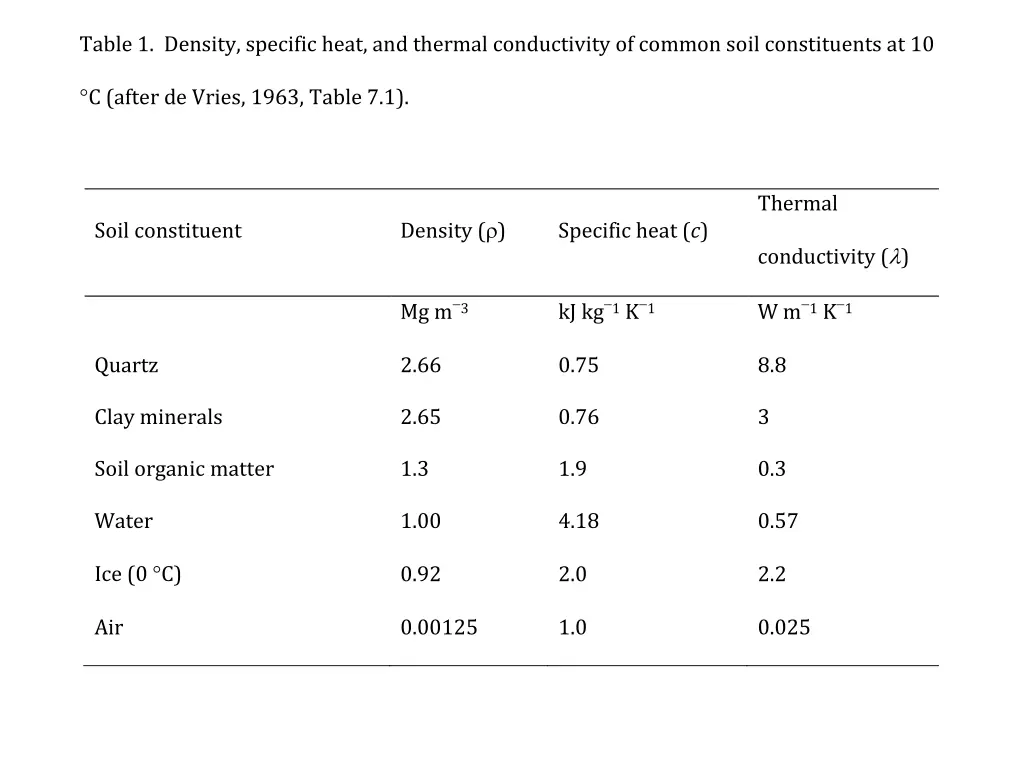
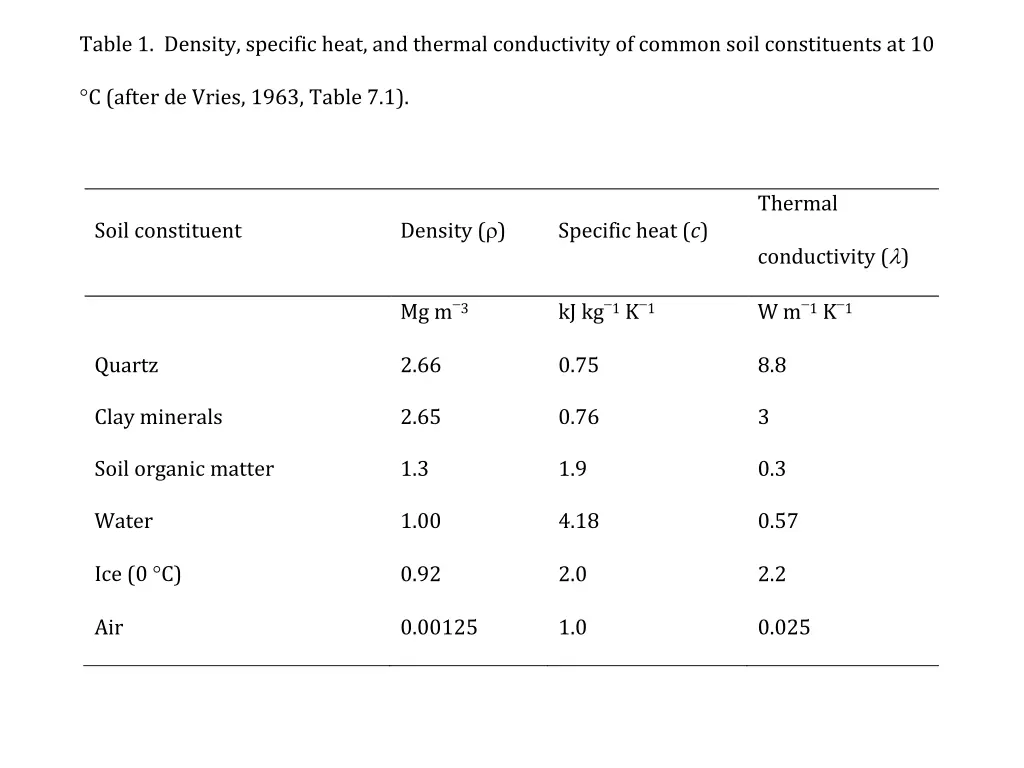
Table 1. Density, specific heat, and thermal conductivity of common soil constituents at 10 C (after de Vries, 1963, Table 7.1). Thermal Density ( ) Soil constituent Specific heat (c) conductivity ( ) Mg m 3 kJ kg 1 K 1 W m 1 K 1 Quartz 2.66 0.75 8.8 Clay minerals 2.65 0.76 3 Soil organic matter 1.3 1.9 0.3 Water 1.00 4.18 0.57 Ice (0 C) 0.92 2.0 2.2 Air 0.00125 1.0 0.025
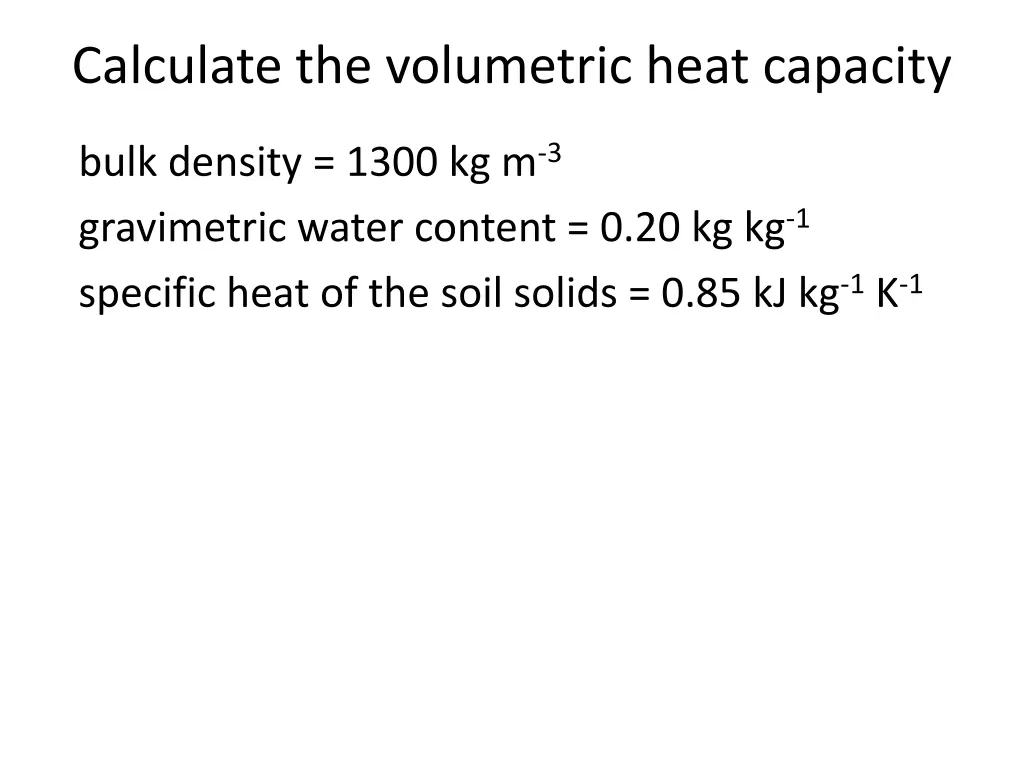
Calculate the volumetric heat capacity bulk density = 1300 kg m-3 gravimetric water content = 0.20 kg kg-1 specific heat of the soil solids = 0.85 kJ kg-1 K-1
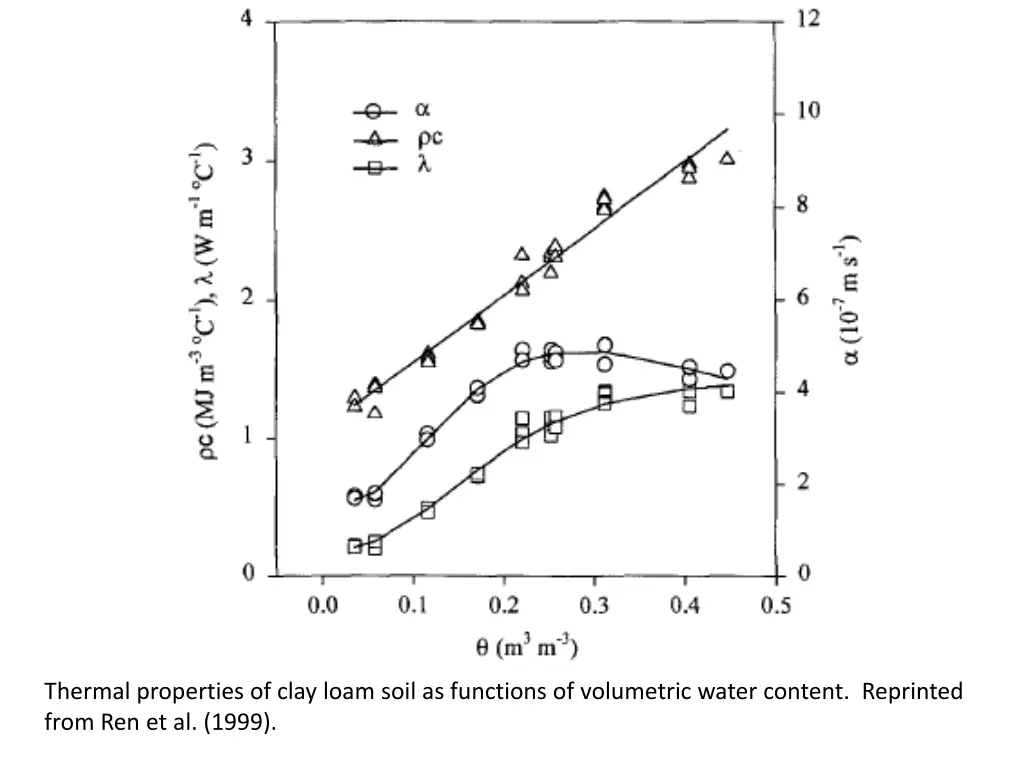
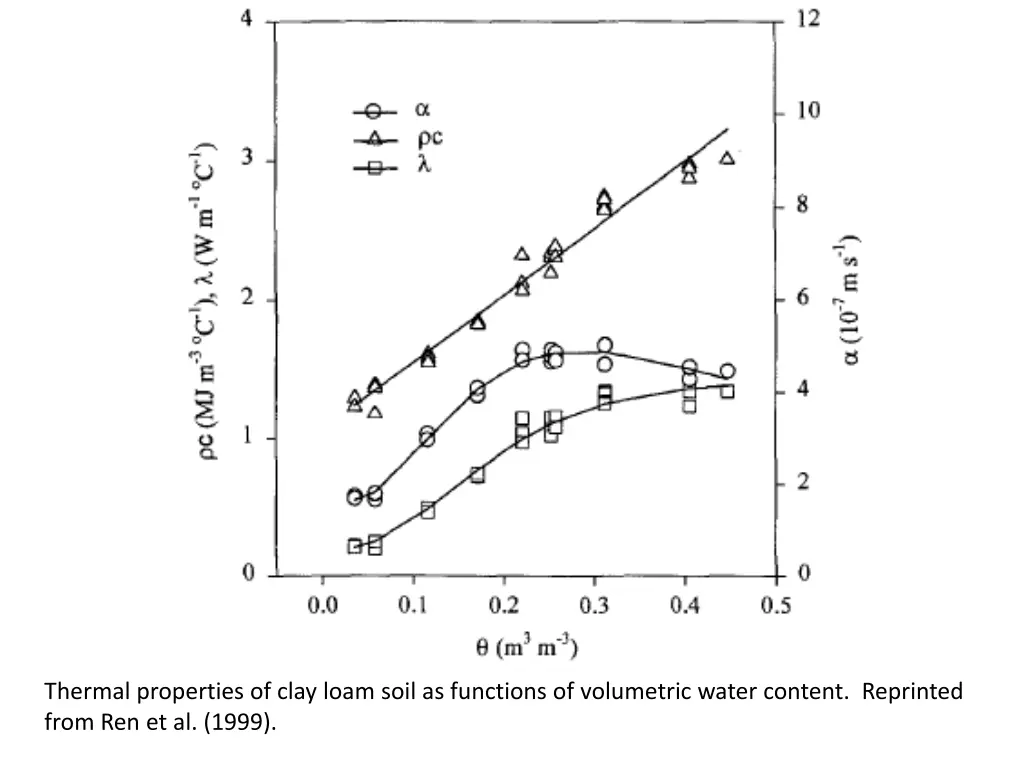
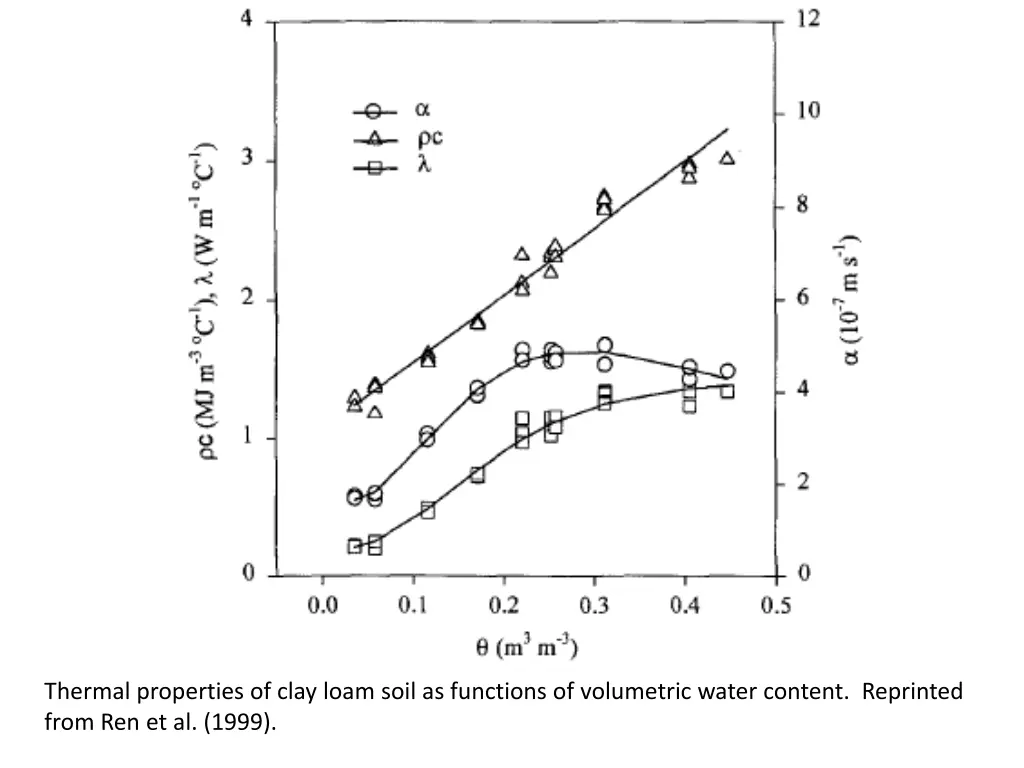
Thermal properties of clay loam soil as functions of volumetric water content. Reprinted from Ren et al. (1999).
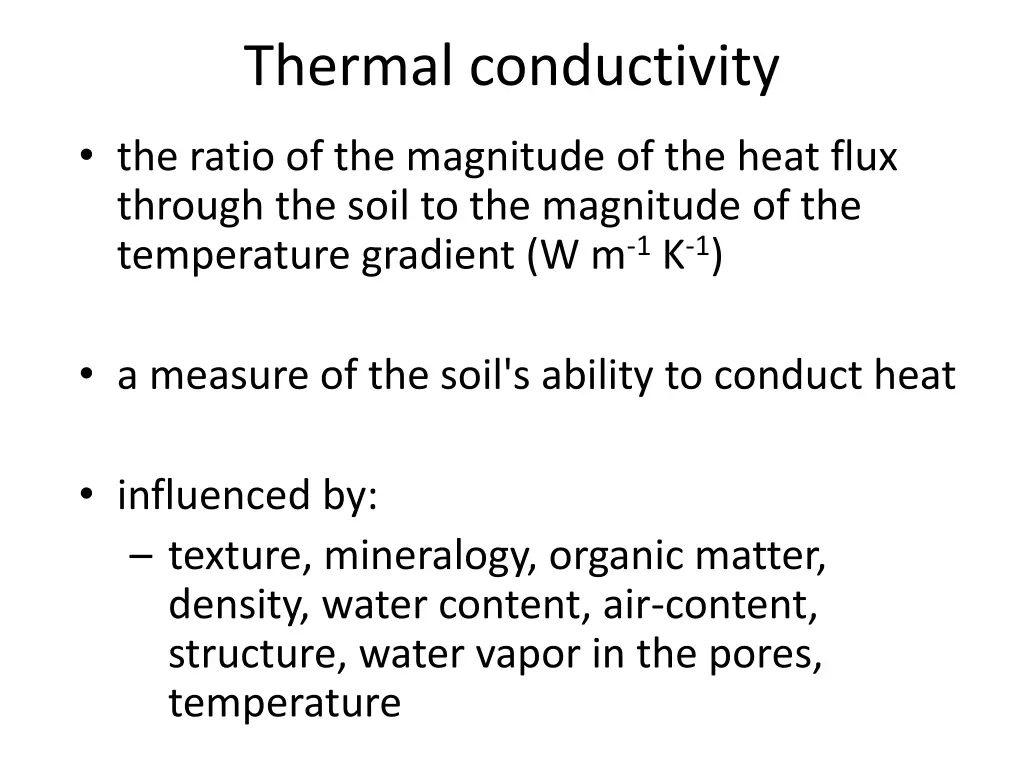
Thermal conductivity the ratio of the magnitude of the heat flux through the soil to the magnitude of the temperature gradient (W m-1 K-1) a measure of the soil's ability to conduct heat influenced by: texture, mineralogy, organic matter, density, water content, air-content, structure, water vapor in the pores, temperature
Table 1. Density, specific heat, and thermal conductivity of common soil constituents at 10 C (after de Vries, 1963, Table 7.1). Thermal Density ( ) Soil constituent Specific heat (c) conductivity ( ) Mg m 3 kJ kg 1 K 1 W m 1 K 1 Quartz 2.66 0.75 8.8 Clay minerals 2.65 0.76 3 Soil organic matter 1.3 1.9 0.3 Water 1.00 4.18 0.57 Ice (0 C) 0.92 2.0 2.2 Air 0.00125 1.0 0.025
Thermal properties of clay loam soil as functions of volumetric water content. Reprinted from Ren et al. (1999).
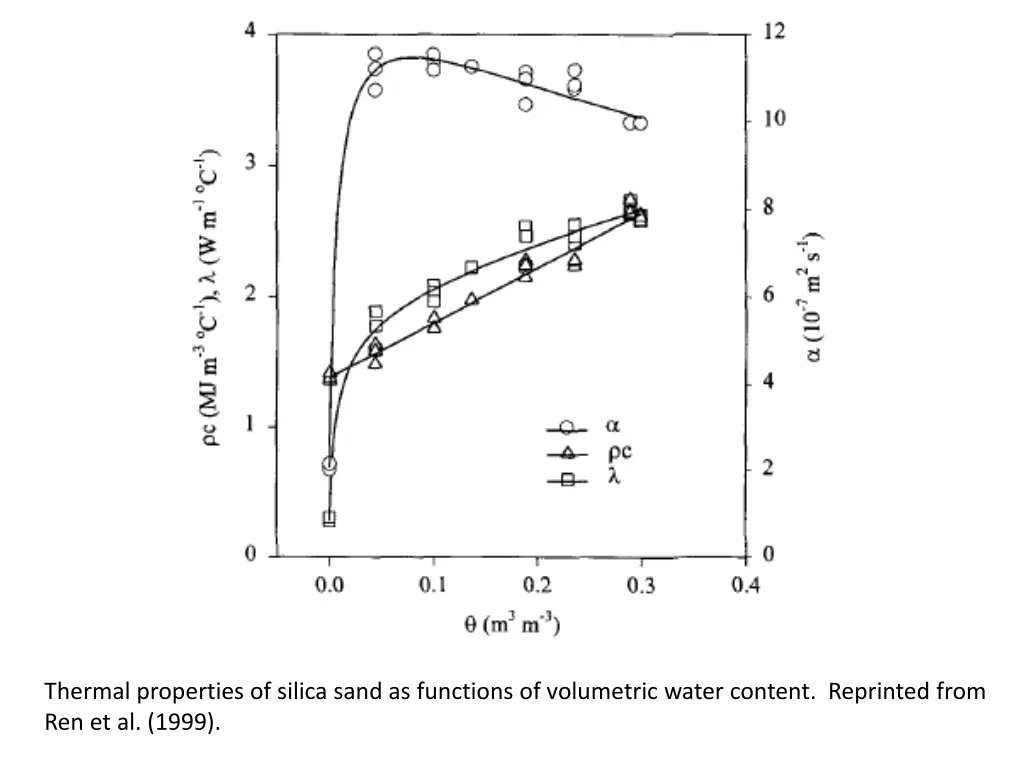
Thermal properties of silica sand as functions of volumetric water content. Reprinted from Ren et al. (1999).
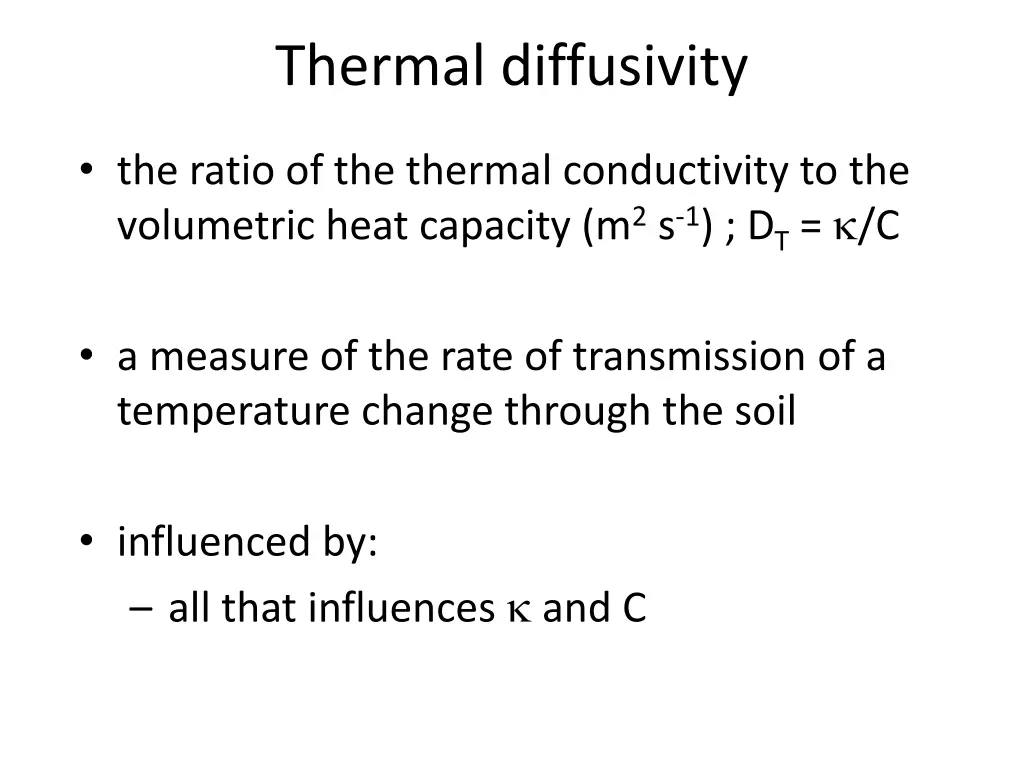
Thermal diffusivity the ratio of the thermal conductivity to the volumetric heat capacity (m2 s-1) ; DT = /C a measure of the rate of transmission of a temperature change through the soil influenced by: all that influences and C
Thermal properties of clay loam soil as functions of volumetric water content. Reprinted from Ren et al. (1999).
Reading assignment Soil thermal regime, p. 227-233
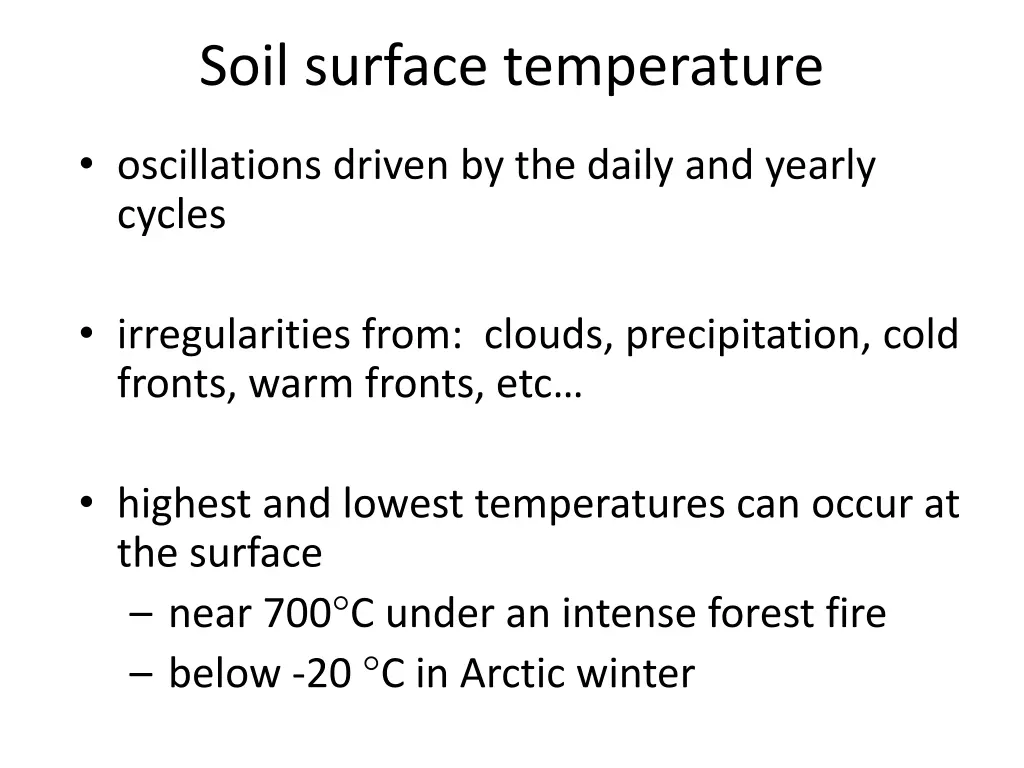
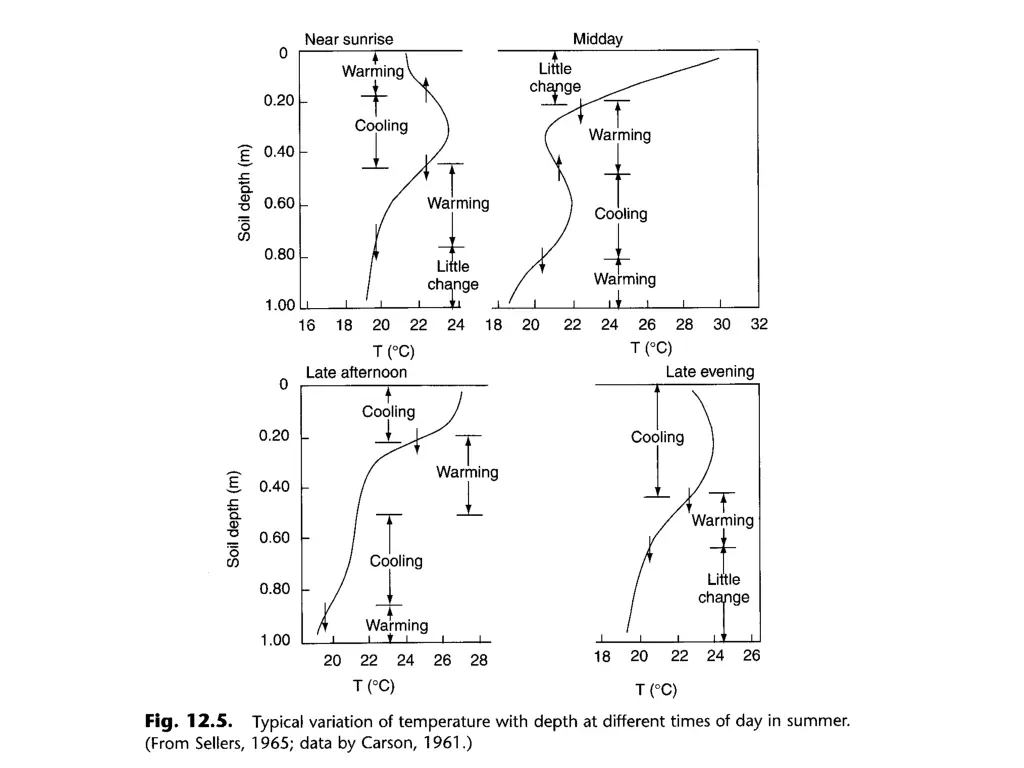
Soil surface temperature oscillations driven by the daily and yearly cycles irregularities from: clouds, precipitation, cold fronts, warm fronts, etc highest and lowest temperatures can occur at the surface near 700 C under an intense forest fire below -20 C in Arctic winter
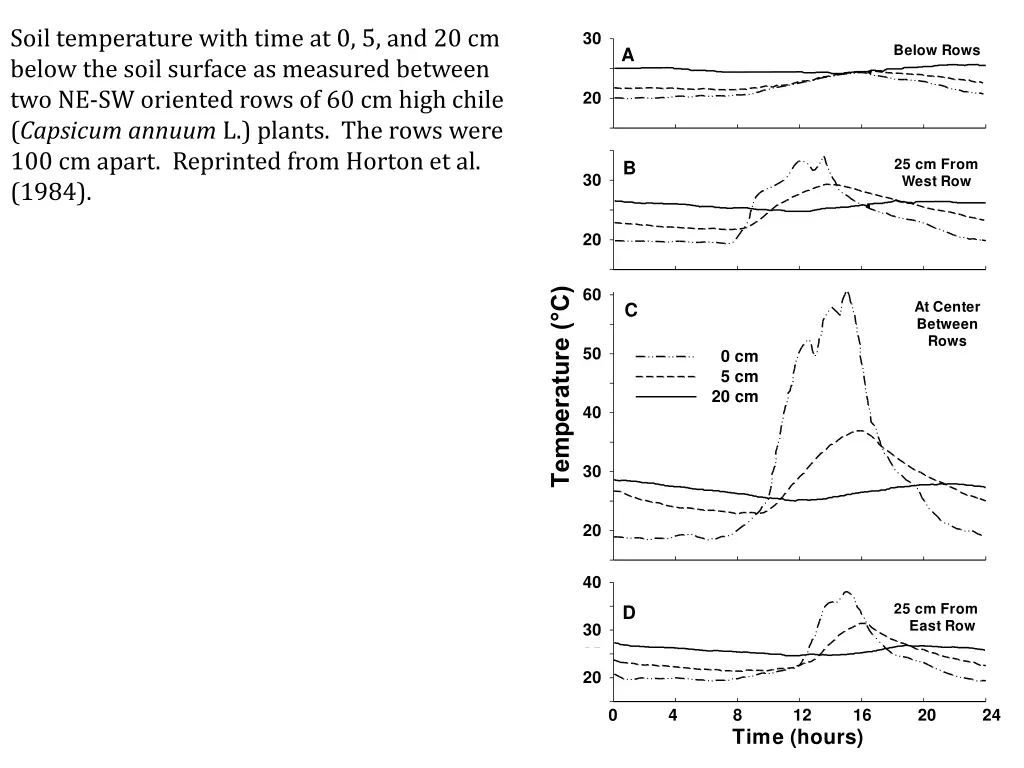
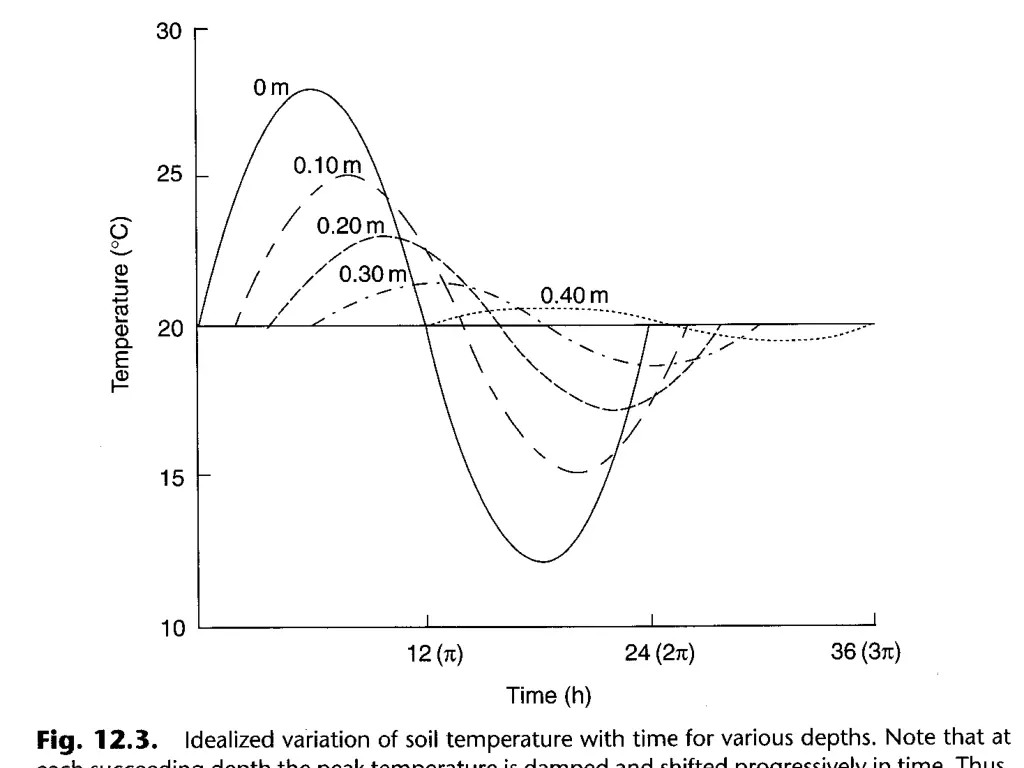
Soil temperature with time at 0, 5, and 20 cm below the soil surface as measured between two NE-SW oriented rows of 60 cm high chile (Capsicum annuum L.) plants. The rows were 100 cm apart. Reprinted from Horton et al. (1984). 30 Below Rows A 25 20 15 35 25 cm From West Row B 30 25 20 15 60 Temperature ( C) At Center Between Rows C 55 50 0 cm 5 cm 20 cm 45 40 35 30 25 20 15 40 35 25 cm From East Row D 30 25 20 15 0 4 8 12 16 20 24 Time (hours)
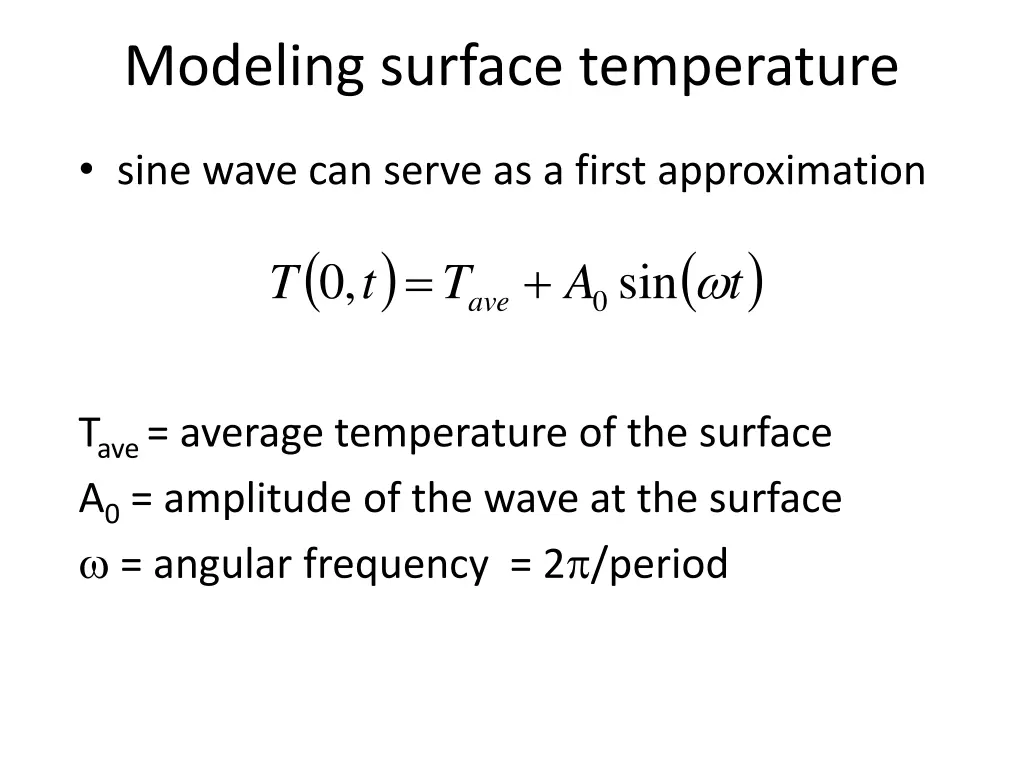
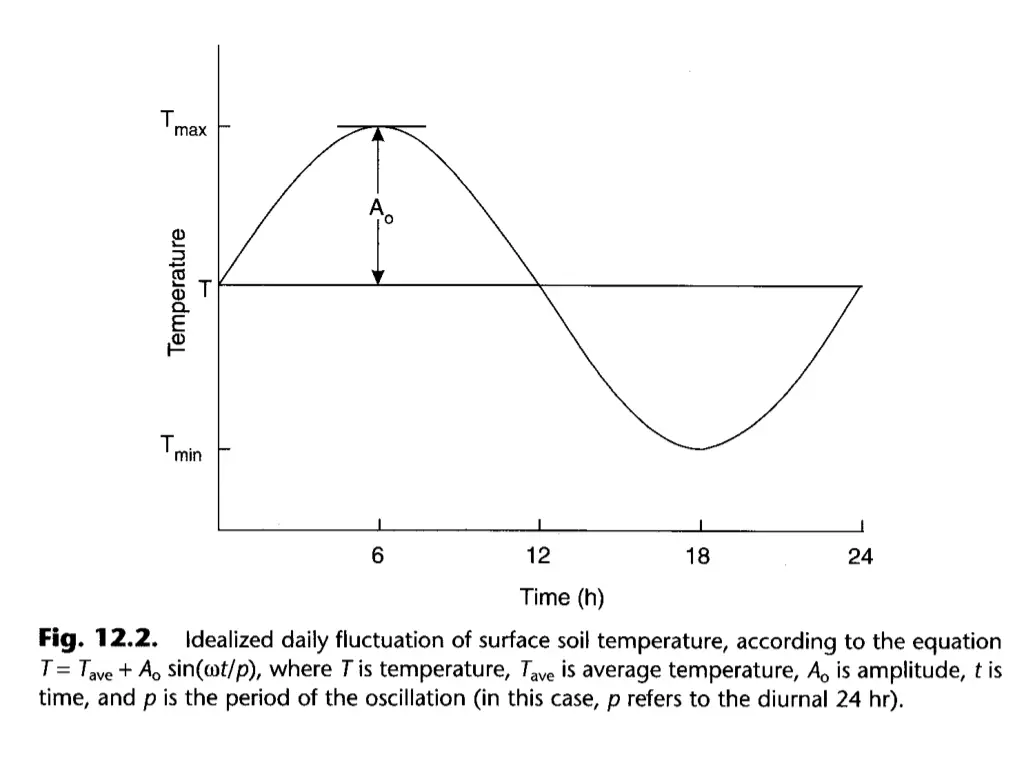
Modeling surface temperature sine wave can serve as a first approximation ( , 0 ) ( ) t = + sin T t T A 0 ave Tave = average temperature of the surface A0 = amplitude of the wave at the surface = angular frequency = 2 /period
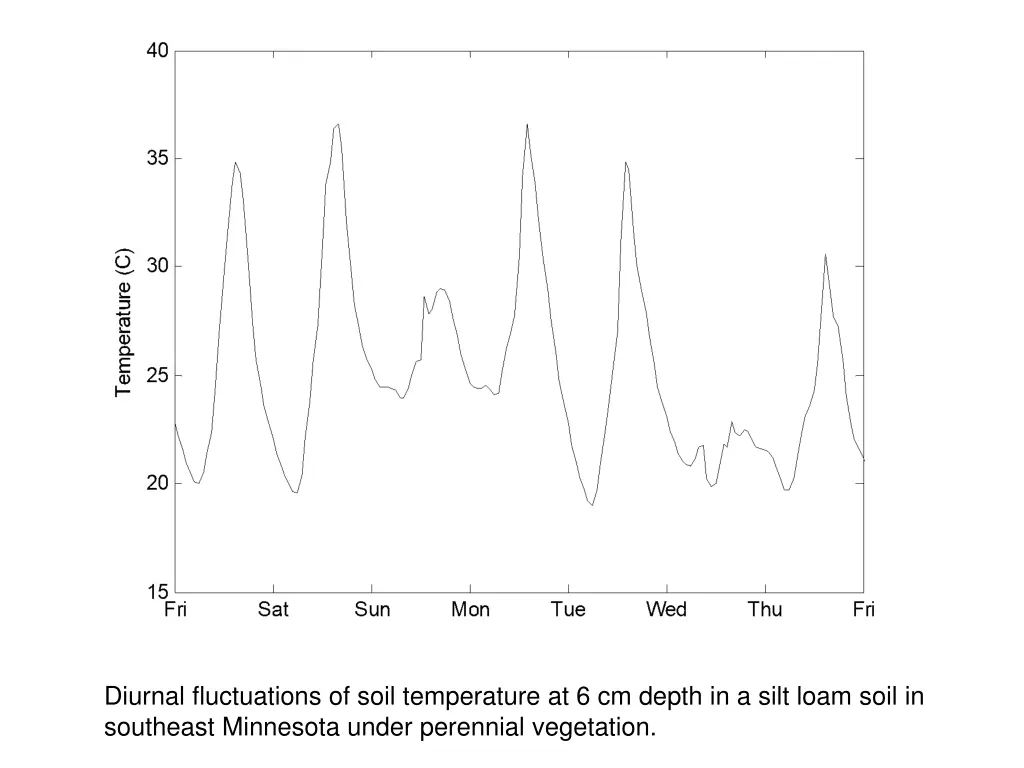
Diurnal fluctuations of soil temperature at 6 cm depth in a silt loam soil in southeast Minnesota under perennial vegetation.
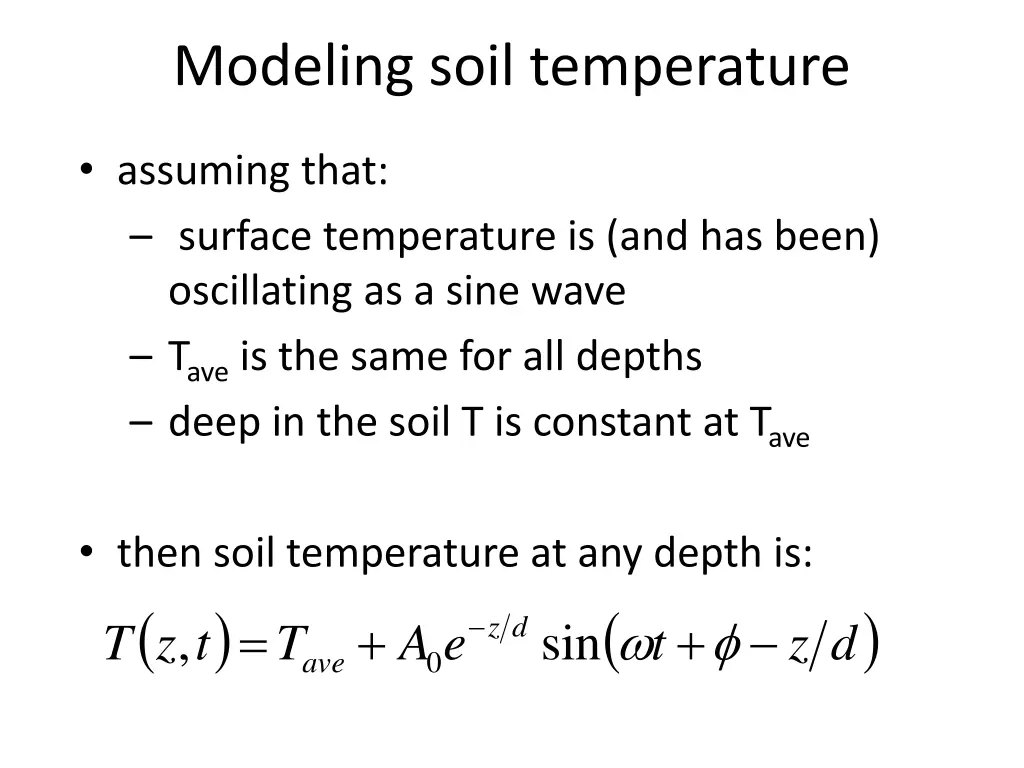
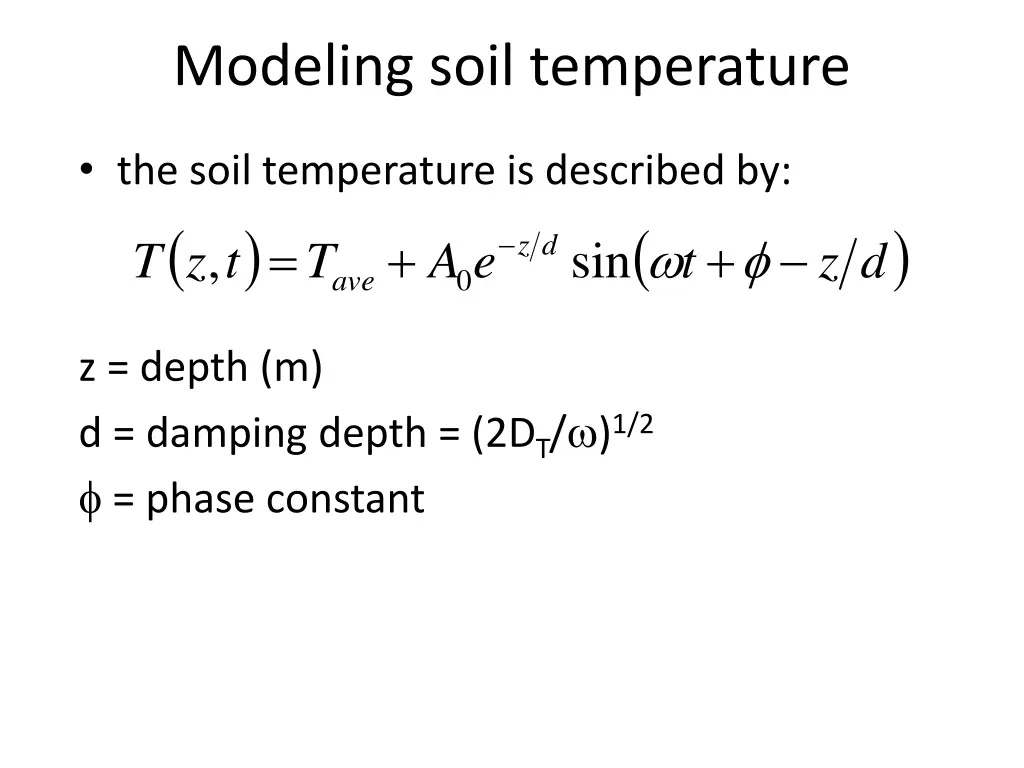
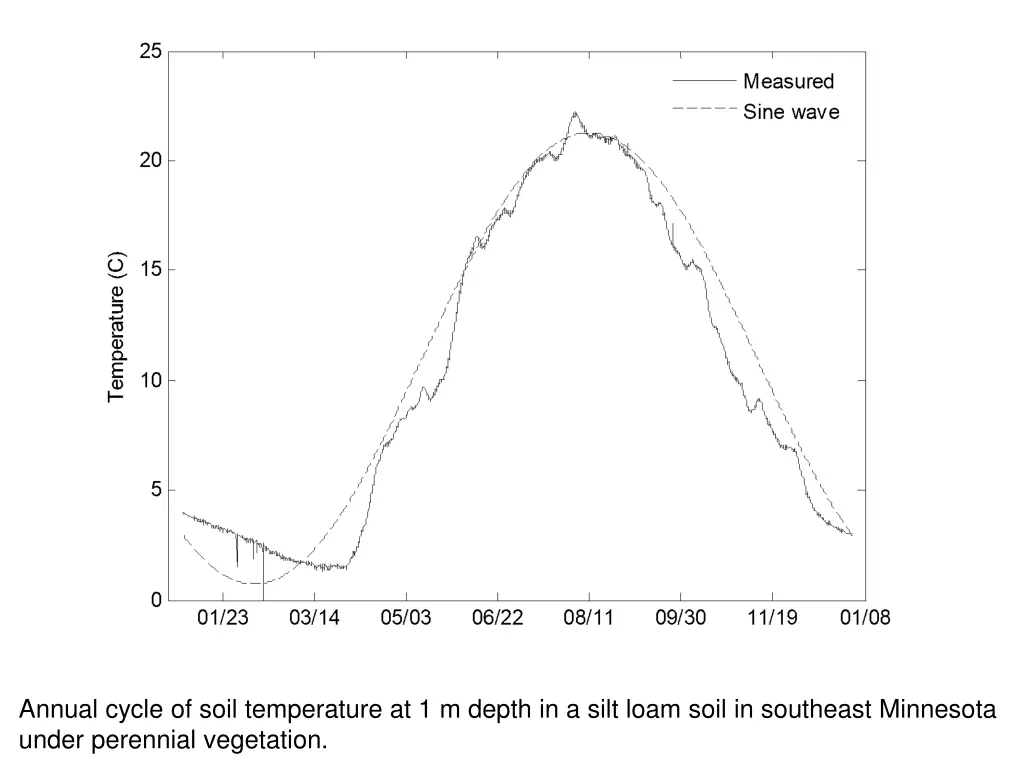
Modeling soil temperature assuming that: surface temperature is (and has been) oscillating as a sine wave Tave is the same for all depths deep in the soil T is constant at Tave then soil temperature at any depth is: ( ) e A T t z T ave + = , 0 ( ) + z d sin t z d
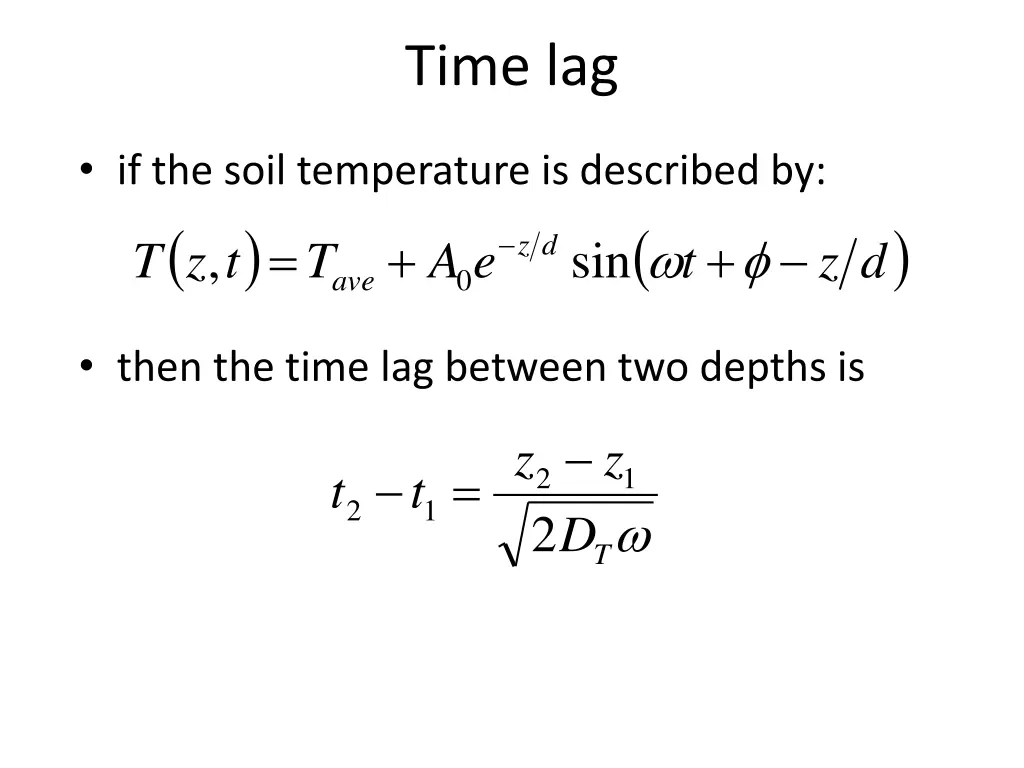
Modeling soil temperature the soil temperature is described by: ( ) A T t z T ave + = , ( ) + z d sin e t z d 0 z = depth (m) d = damping depth = (2DT/ )1/2 = phase constant
Annual cycle of soil temperature at 1 m depth in a silt loam soil in southeast Minnesota under perennial vegetation.
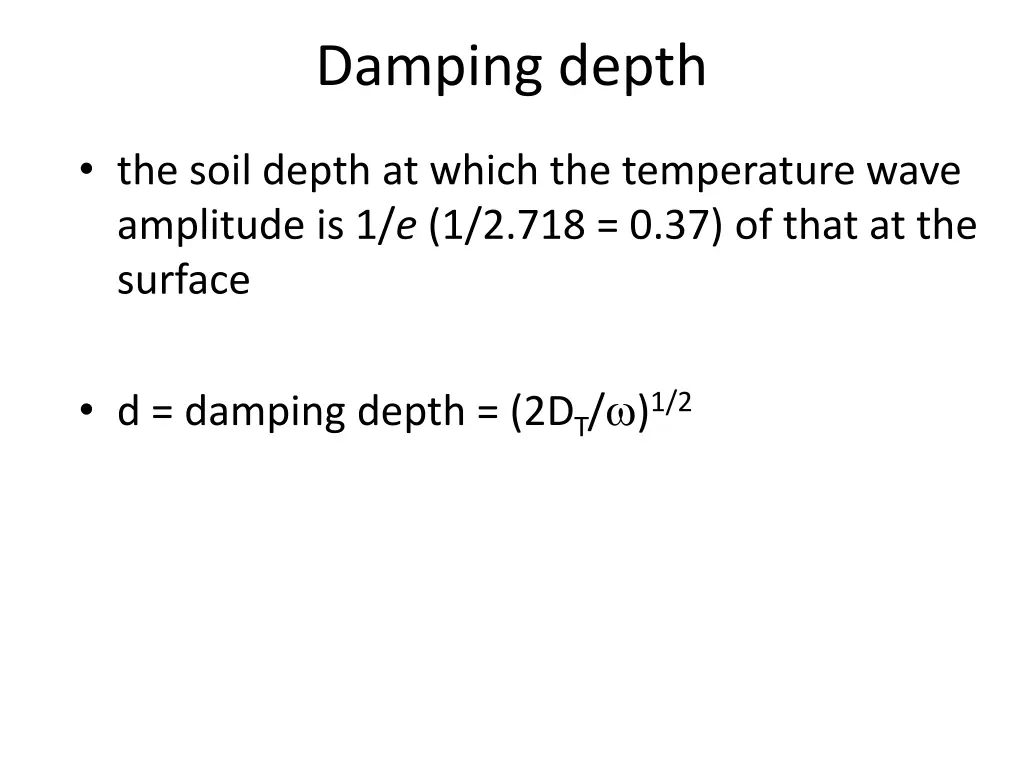
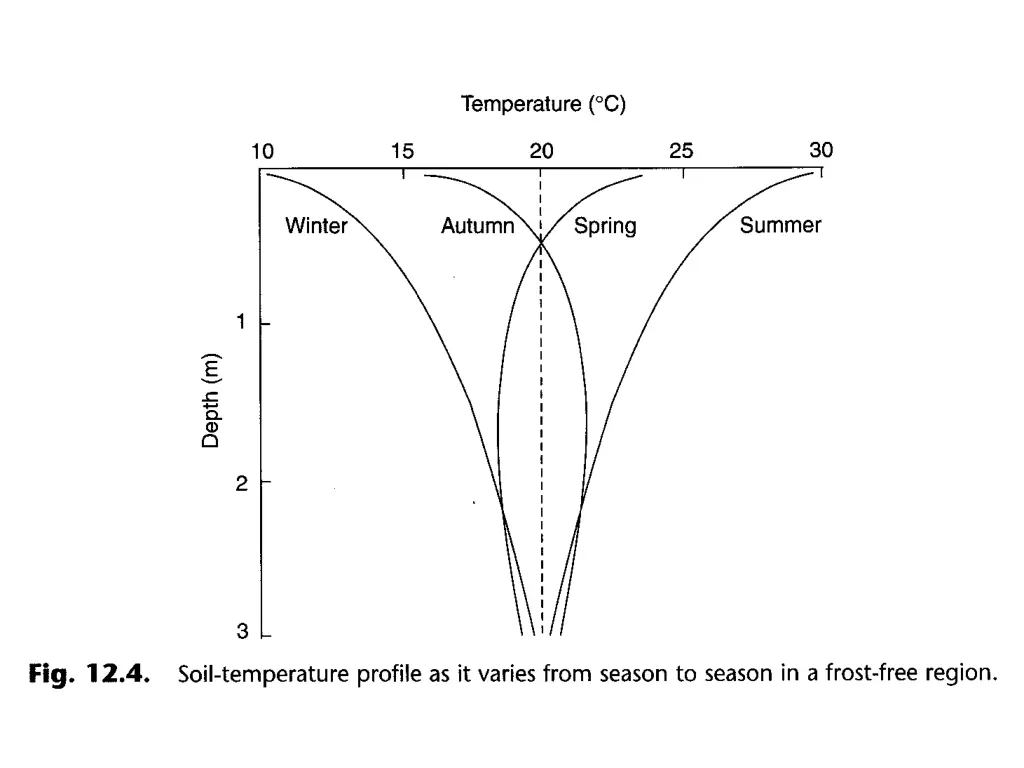
Damping depth the soil depth at which the temperature wave amplitude is 1/e (1/2.718 = 0.37) of that at the surface d = damping depth = (2DT/ )1/2
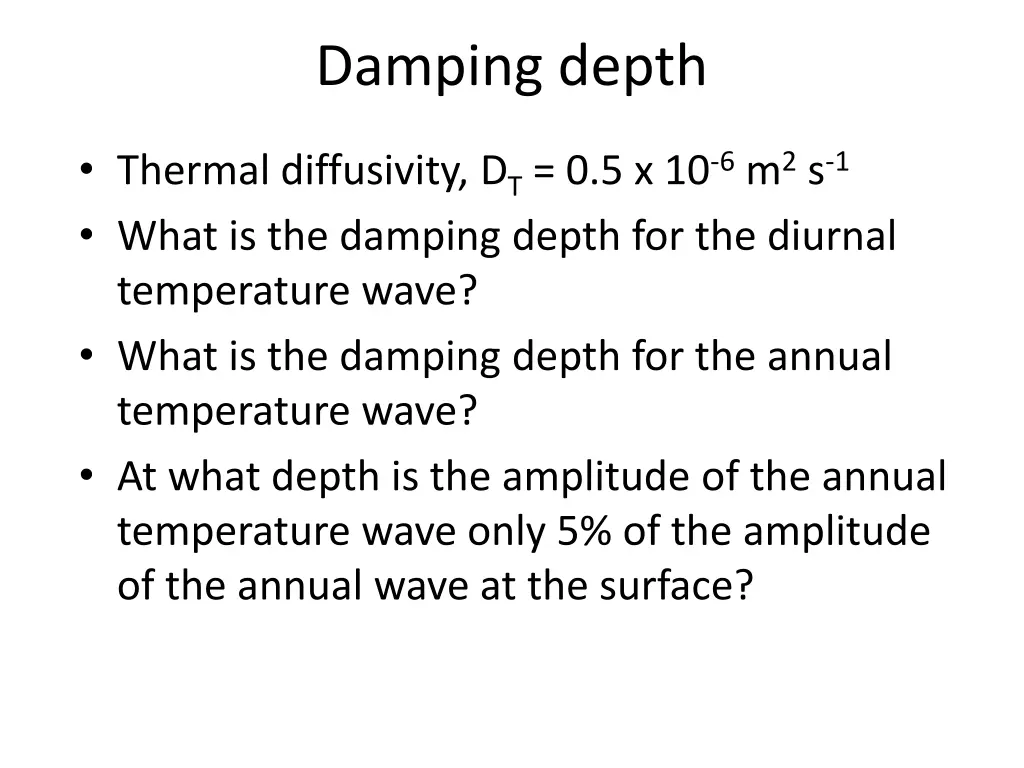
Damping depth Thermal diffusivity, DT = 0.5 x 10⁻⁶ m2 s-1 What is the damping depth for the diurnal temperature wave? What is the damping depth for the annual temperature wave? At what depth is the amplitude of the annual temperature wave only 5% of the amplitude of the annual wave at the surface?
Time lag if the soil temperature is described by: ( ) A T t z T ave + = , ( ) + z d sin e t z d 0 then the time lag between two depths is z z = 2 1 t t 2 1 T D 2
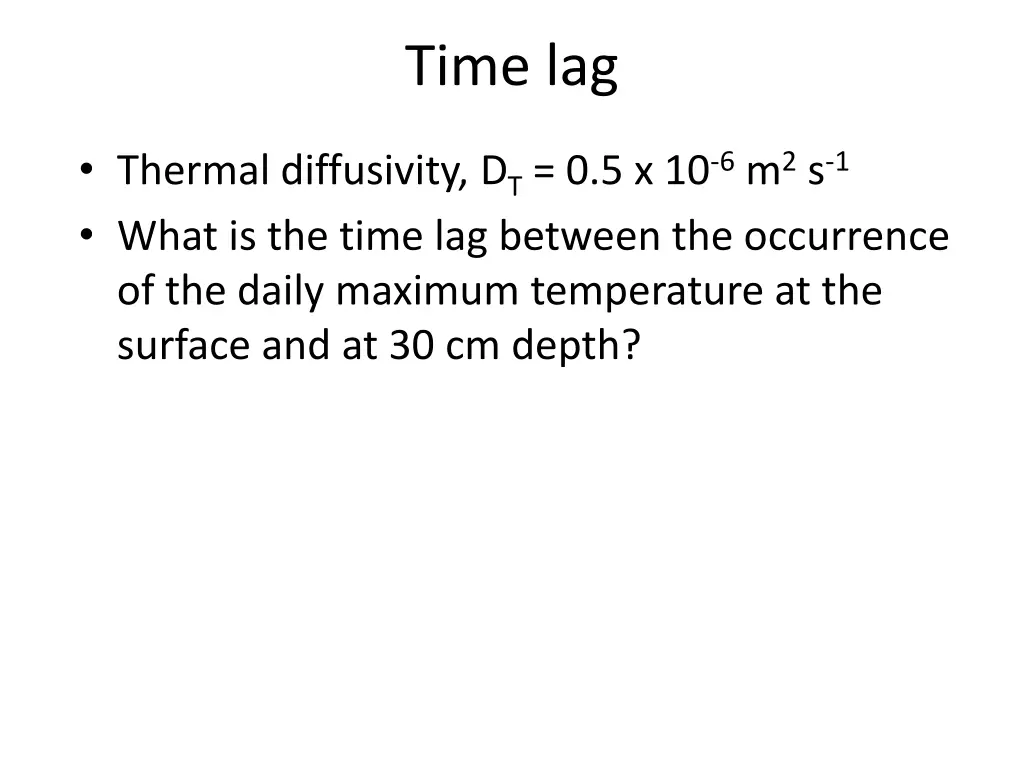
Time lag Thermal diffusivity, DT = 0.5 x 10⁻⁶ m2 s-1 What is the time lag between the occurrence of the daily maximum temperature at the surface and at 30 cm depth?
On-line software http://soilphysics.okstate.edu/