Explore the solutions of Maxwell's equations in the Lorentz gauge, focusing on Liénard-Wiechert potentials and fields for moving point particles. Delve into the determination of scalar and vector potentials, considering the electromagnetic fields generated by a point charge moving along a trajectory. Review the integration steps and the concept of retarded time for analyzing electromagnetic interactions.
Please find below an Image/Link to download the presentation.
The content on the website is provided AS IS for your information and personal use only. It may not be sold, licensed, or shared on other websites without obtaining consent from the author. If you encounter any issues during the download, it is possible that the publisher has removed the file from their server.
You are allowed to download the files provided on this website for personal or commercial use, subject to the condition that they are used lawfully. All files are the property of their respective owners.
The content on the website is provided AS IS for your information and personal use only. It may not be sold, licensed, or shared on other websites without obtaining consent from the author.
E N D
Presentation Transcript
PHY 712 Electrodynamics 10-10:50 AM MWF Olin 103 Notes for Lecture 28: Finish Chap. 11 and begin Chap. 14 (Sec. 14.1-14.3) A. Electromagnetic field transformations & corresponding analysis of Li nard-Wiechert potentials for constant velocity sources B. Radiation by moving charged particles 4/2/2025 PHY 712 Spring 2025 -- Lecture 28 1
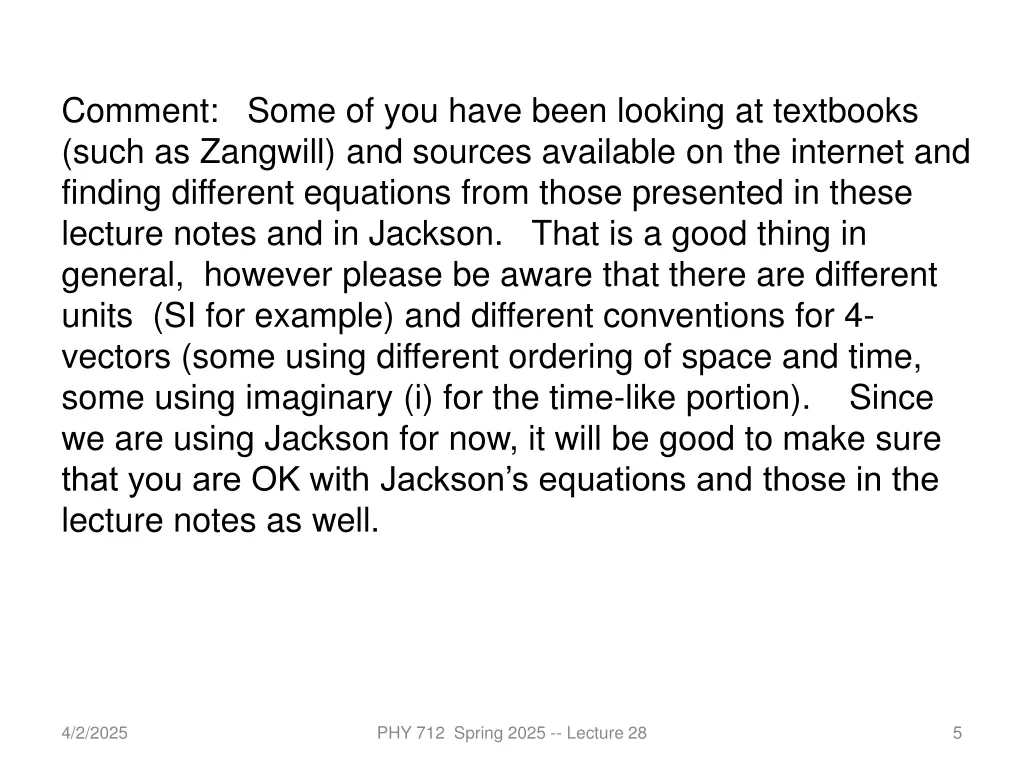
Comment: Some of you have been looking at textbooks (such as Zangwill) and sources available on the internet and finding different equations from those presented in these lecture notes and in Jackson. That is a good thing in general, however please be aware that there are different units (SI for example) and different conventions for 4- vectors (some using different ordering of space and time, some using imaginary (i) for the time-like portion). Since we are using Jackson for now, it will be good to make sure that you are OK with Jackson s equations and those in the lecture notes as well. 4/2/2025 PHY 712 Spring 2025 -- Lecture 28 5
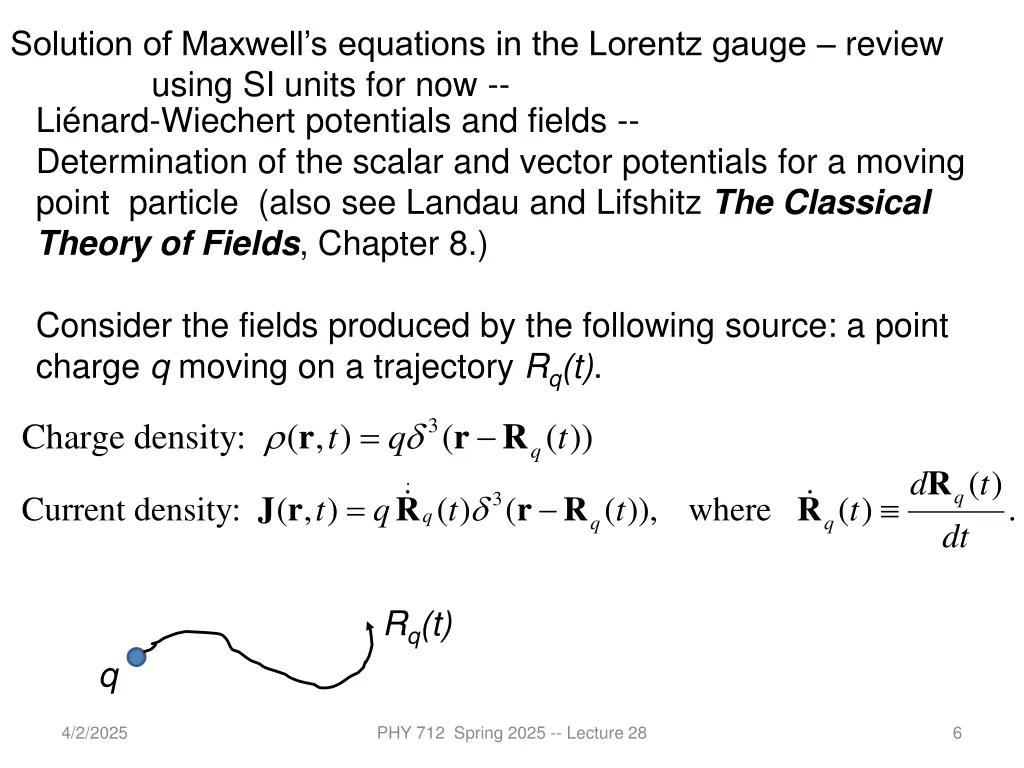
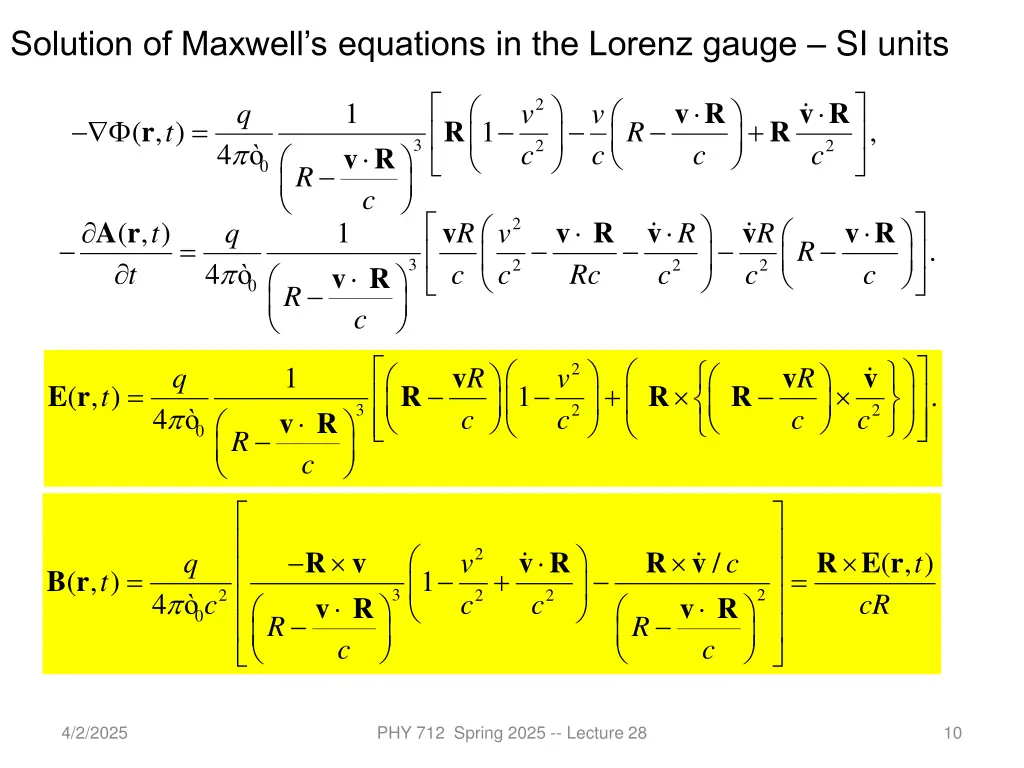
Solution of Maxwells equations in the Lorentz gauge review using SI units for now -- Li nard-Wiechert potentials and fields -- Determination of the scalar and vector potentials for a moving point particle (also see Landau and Lifshitz The Classical Theory of Fields, Chapter 8.) Consider the fields produced by the following source: a point charge q moving on a trajectory Rq(t). = 3 r r R Charge density: ( , ) t ( ( )) t q q R ( ) t d . q = 3 J r R r R R Current density: ( , ) ( ) t ( ( )), where t ( ) t . t q q q q dt Rq(t) q 4/2/2025 PHY 712 Spring 2025 -- Lecture 28 6
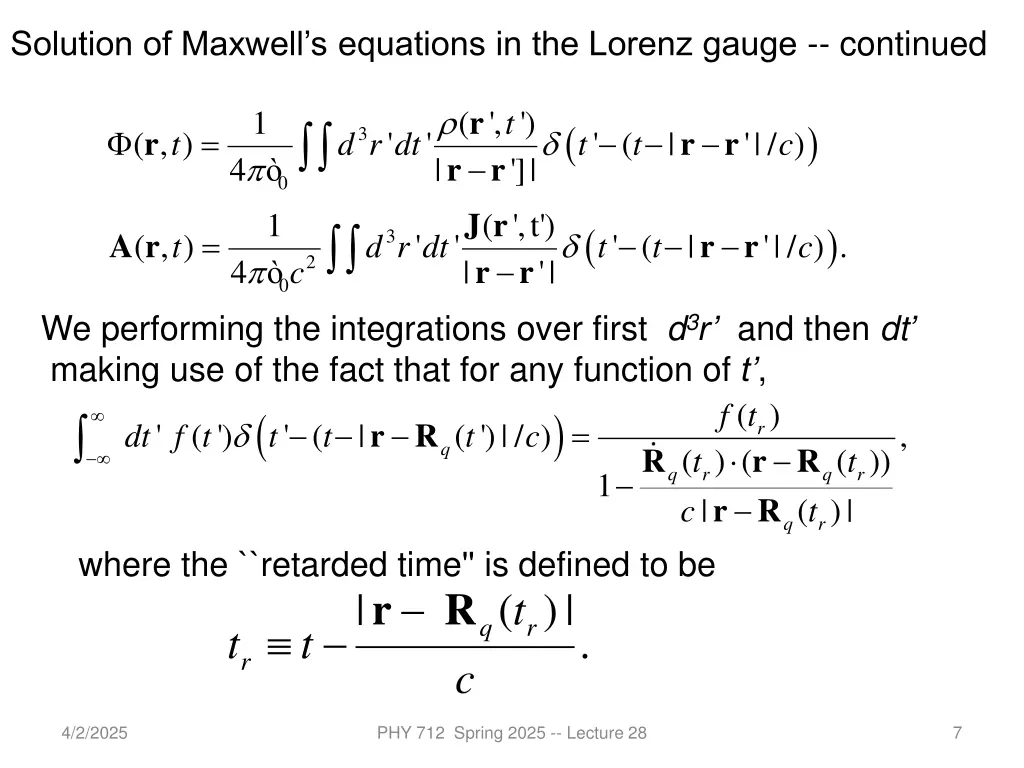
Solution of Maxwells equations in the Lorenz gauge -- continued ( , ' ') r r r 1 t ( ) = 3 ( , ) r r r d r dt ' ' ' ( | ' | / ) c t t t 4 | '] | 0 J r 1 ( ',t') r r ( ) = ' ( 3 ( , ) A r r r d r dt ' ' | '| / ) . c t t t 2 4 | '| c 0 We performing the integrations over first d3r and then dt making use of the fact that for any function of t , ( ( ) ( | ( )| / ) ' ' ' q d f t t t t t ( ) r f t r ) = r R ' , c R r R R ( ) ( | c ( )) )| t t q r q r 1 ( t q r where the ``retarded time'' is defined to be | r t t r R ( )|. t q r c 4/2/2025 PHY 712 Spring 2025 -- Lecture 28 7
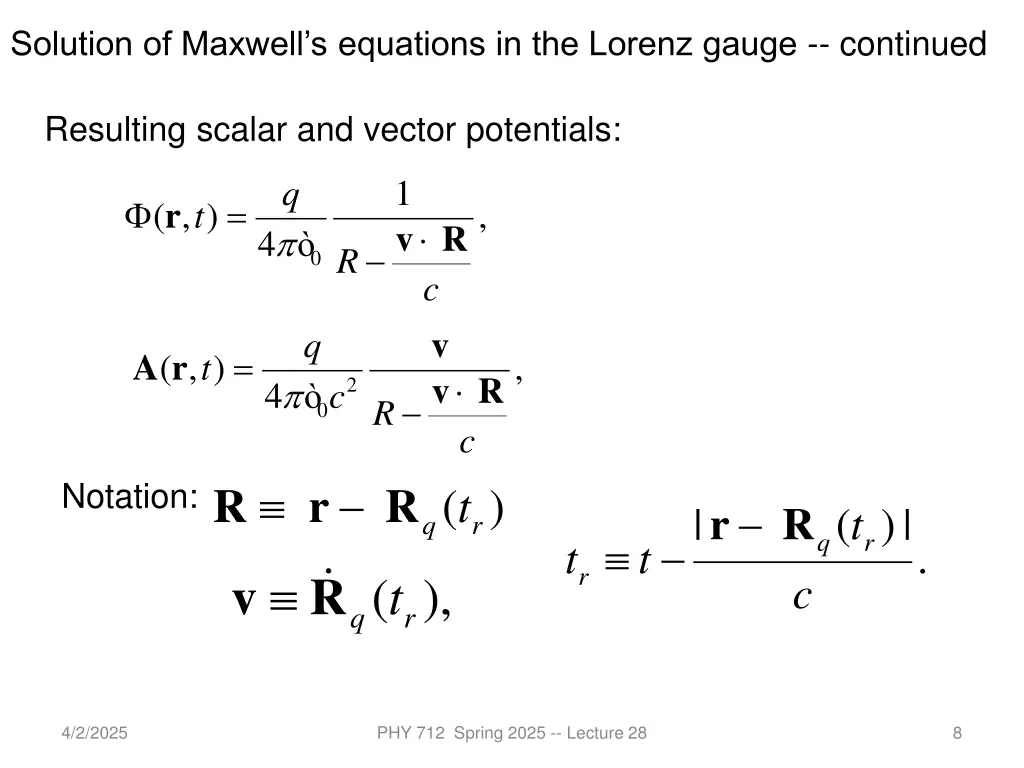
Solution of Maxwells equations in the Lorenz gauge -- continued Resulting scalar and vector potentials: 1 q = ( , ) r , t v R 4 R 0 c v v R q = A ( , r ) , t 2 4 c R 0 c Notation: R r R ( ) rt r R | ( )|. t q q r t t r v R ( ), c rt q 4/2/2025 PHY 712 Spring 2025 -- Lecture 28 8
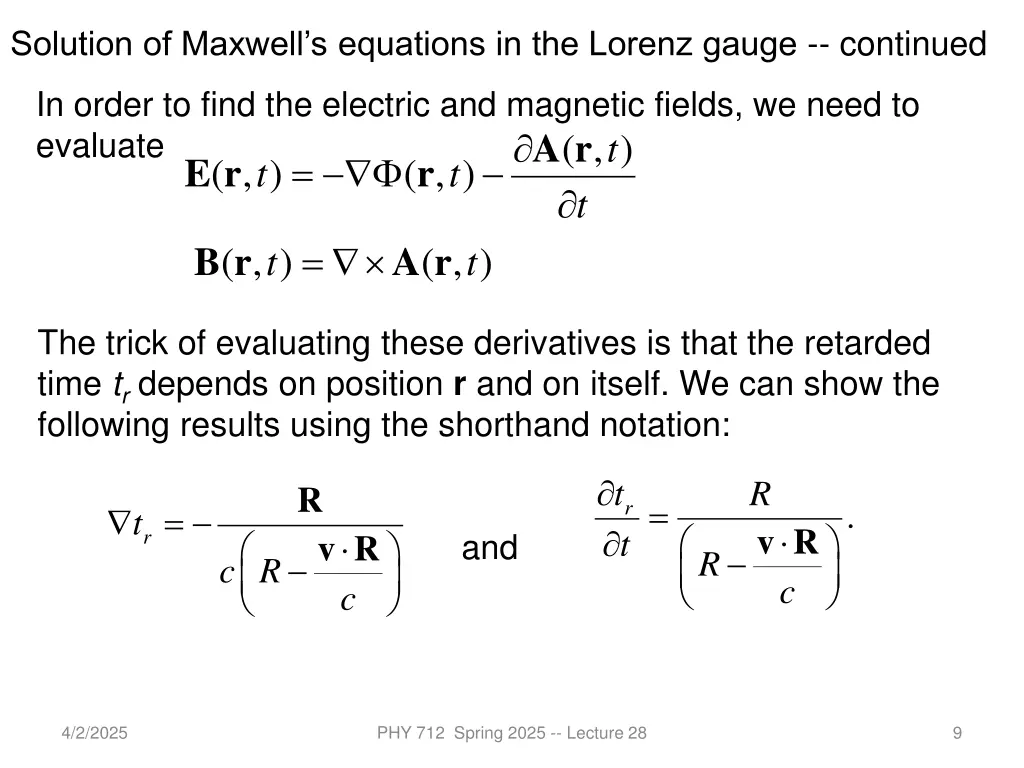
Solution of Maxwells equations in the Lorenz gauge -- continued In order to find the electric and magnetic fields, we need to evaluate ( , ) ( , ) t t = r r E A r ( , ) t t = A r ( , ) B r ( , ) t t The trick of evaluating these derivatives is that the retarded time trdepends on position r and on itself. We can show the following results using the shorthand notation: rt t R v R R = . = rt and c R v R R c c 4/2/2025 PHY 712 Spring 2025 -- Lecture 28 9
Solution of Maxwells equations in the Lorenz gauge SI units 2 v R v R 1 v q v c v c = + ( , ) r R R 1 , t R 3 2 2 4 c c R 0 R c 2 A r v v R v v v R ( , ) t 1 v R t q R v c R R = . R 3 2 2 2 4 c Rc c c c 0 R c 2 v v v 1 v q R c v c R c = + E ( , ) r R R R 1 . t 3 2 2 4 c R 0 R c R v v 2 v R R v R E r / ( , ) cR q v c c t = + = B r ( , ) t 1 3 2 2 2 2 4 c c R v R 0 R R c c 4/2/2025 PHY 712 Spring 2025 -- Lecture 28 10
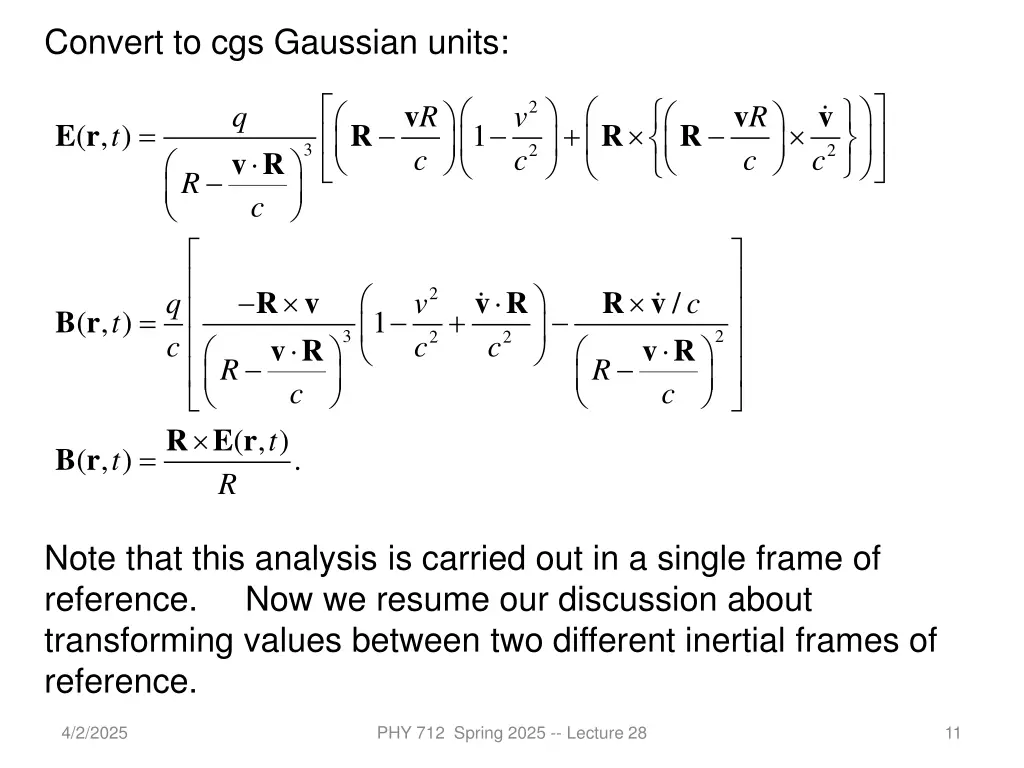
Convert to cgs Gaussian units: 2 v v v q v R R c v c R c = + E ( , ) r R R R 1 t 3 2 2 c R c R v v R 2 v R R v / q c v c c = + B ( , ) r 1 t 3 2 2 2 c v R R R c c R E r ( , ) R t = B ( , ) r . t Note that this analysis is carried out in a single frame of reference. Now we resume our discussion about transforming values between two different inertial frames of reference. 4/2/2025 PHY 712 Spring 2025 -- Lecture 28 11
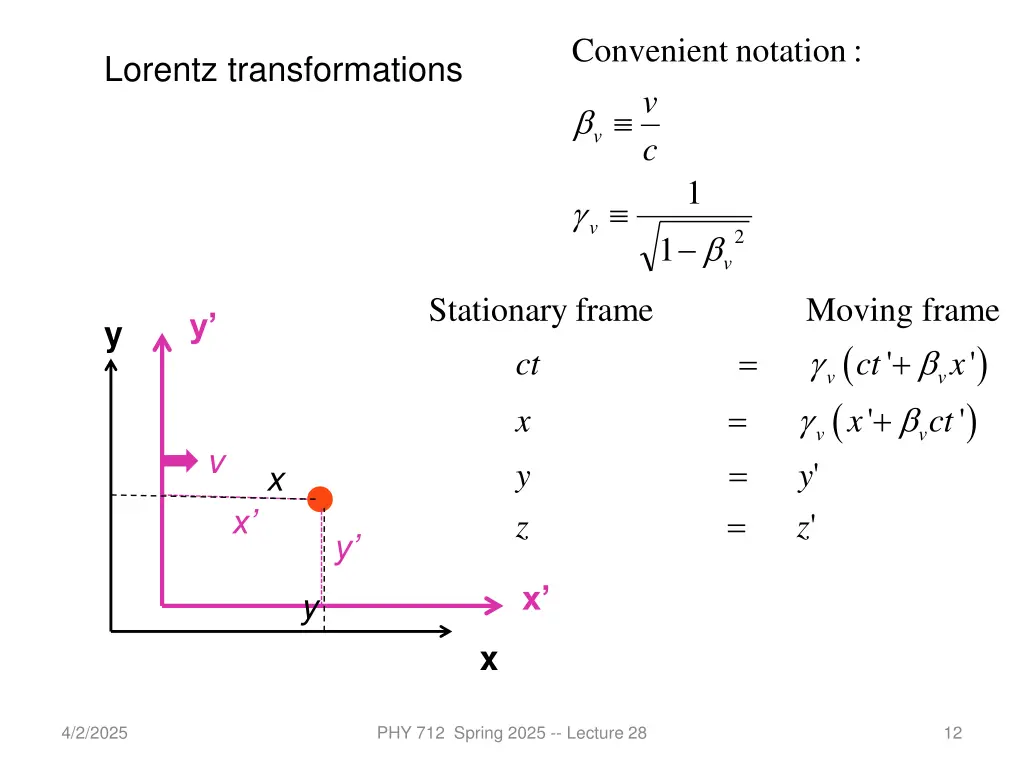
Convenient v notation : Lorentz transformations v c 1 v 2 1 v Stationary frame Moving frame ct y y ( x ) = + ' ' ct x v v ( ) = = = + z ' ' z ' ' x y ct v v v y x x y x y x 4/2/2025 PHY 712 Spring 2025 -- Lecture 28 12
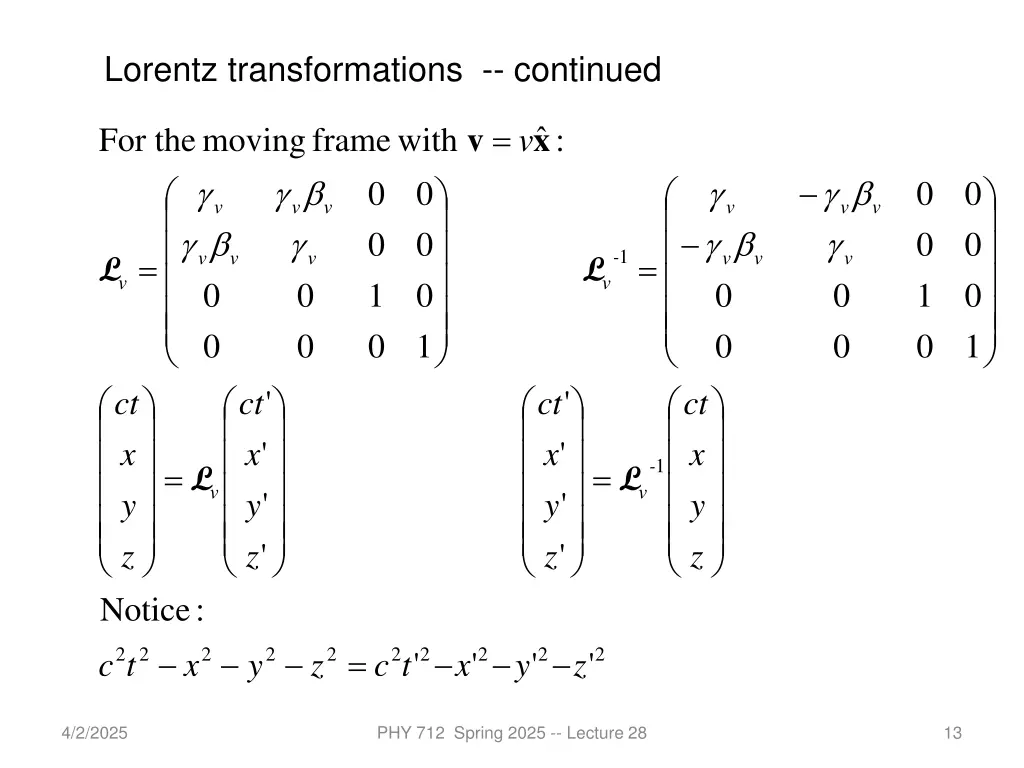
Lorentz transformations -- continued = v : v x For the moving frame with 0 0 0 0 v v v v v v 0 0 0 0 1 - v v v v v v = = L L v v 0 0 1 0 0 0 1 0 0 0 0 1 0 0 0 1 ' ' ct ct ct ct ' ' x x x x 1 - = = L L v v ' ' y y y y ' ' z z z z Notice : = 2 2 2 2 2 2 2 2 2 2 ' ' ' ' c t x y z c t x y z 4/2/2025 PHY 712 Spring 2025 -- Lecture 28 13
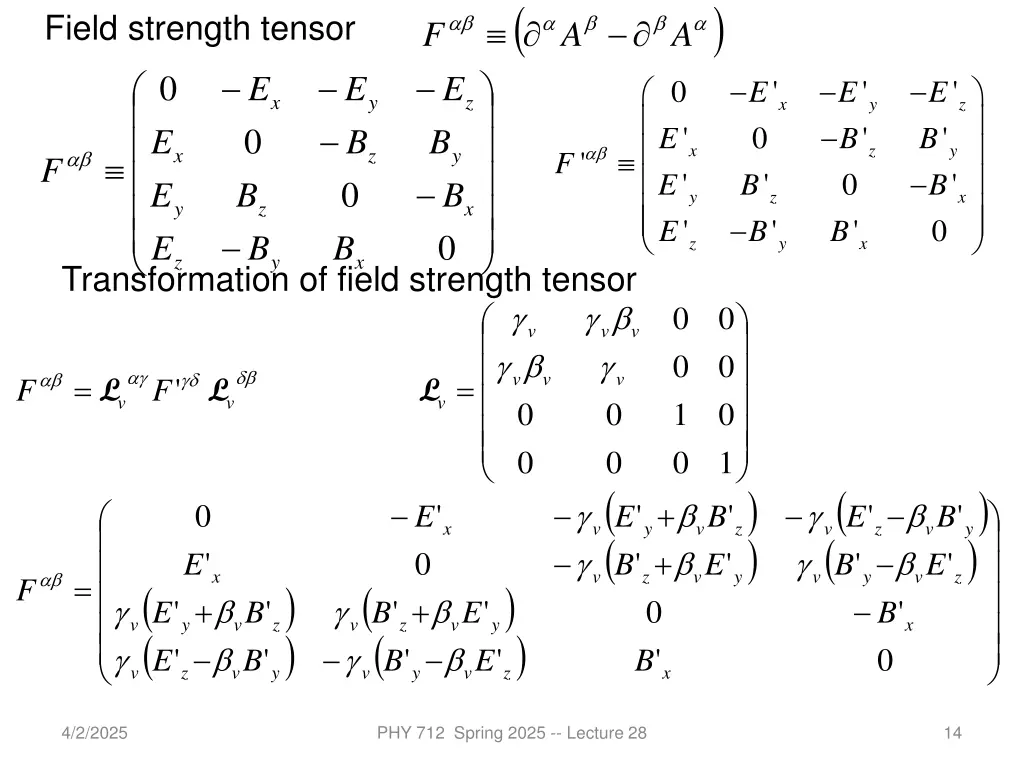
( ) Field strength tensor F B A A 0 E E E E 0 ' ' ' ' E E B E B B x y z x y z ' ' ' 0 ' E E E 0 B B x z y x z y ' F F ' 0 ' B B 0 B E B y z x y z x ' ' 0 B 0 E B z y x z y x Transformation of field strength tensor 0 0 v v v 0 0 v v v = = L L L ' F F v v v 0 0 1 0 0 0 0 1 ( ( ) ) ( B ) + 0 ' ' ' ' ' E E B E B x v y v z v z v E y ( ) + B ' 0 + ' ' ' ' E B E x v z v y v y v z = F ( ( ) ) ( ) + ' ' ' ' 0 ' E B B E v y v z v z v y x ( ) ' ' ' ' ' 0 E B B E B v z v y v y v z x 4/2/2025 PHY 712 Spring 2025 -- Lecture 28 14
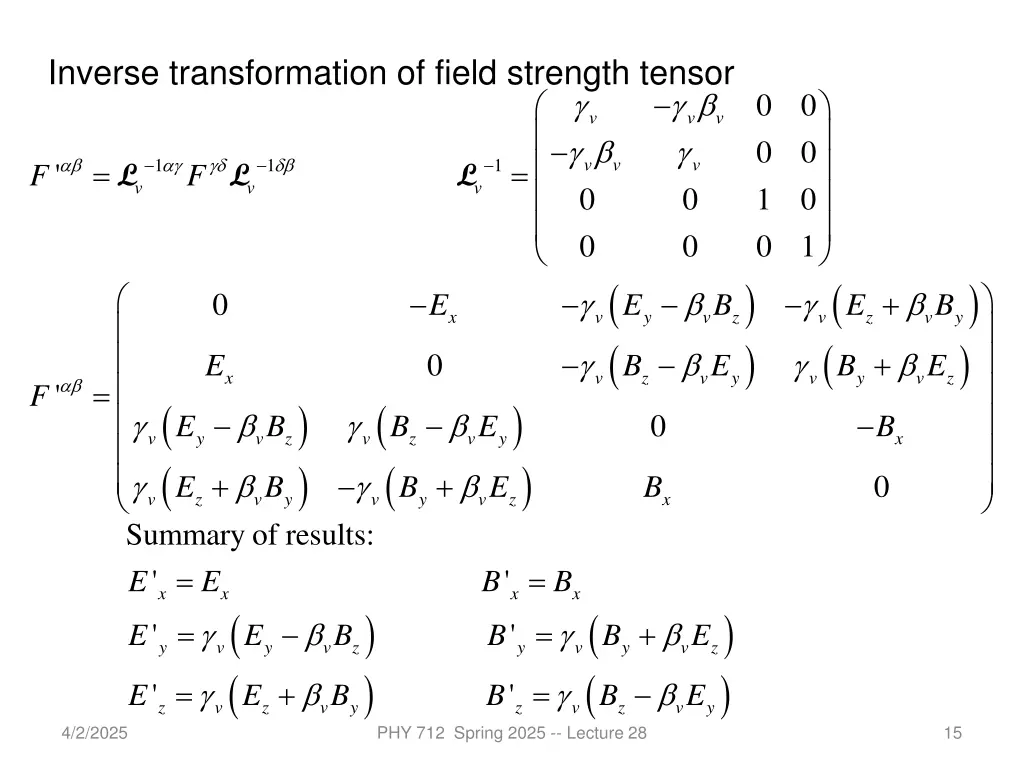
Inverse transformation of field strength tensor 0 0 1 0 0 0 0 1 v v v = = v v v 1 1 1 L L L ' F F v v v 0 0 0 0 ( ( ) ) ( ) + 0 E E B E B x v y v z v z v y ( ) + 0 E B E B E x v z v y v y v z = ' F ( ( ) ) ( ) 0 E B B E B v y v z v z v y x ( ) Summary of results: ' ' x x E E E E = + + 0 E B B E B v z v y v y v z x = = B B x x ( ( ) ) ( ( ) ) = + ' ' B B B E y v y v z y v y v z = + = ' ' E E B B B E z v z v y z v z v y 4/2/2025 PHY 712 Spring 2025 -- Lecture 28 15
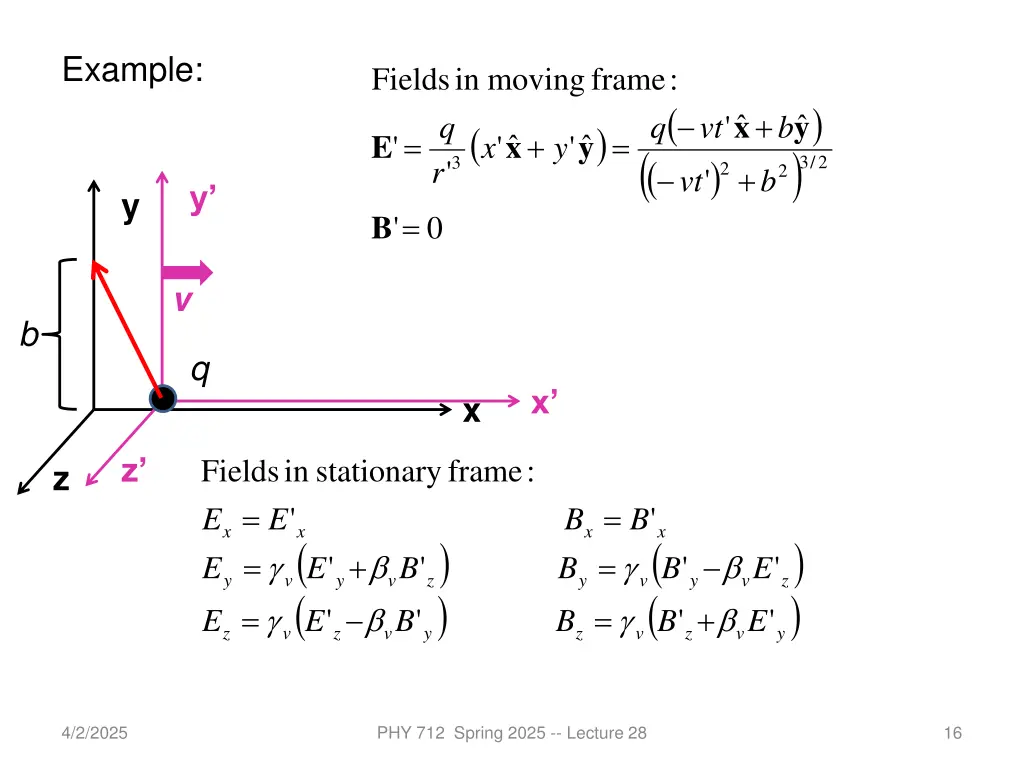
Example: Fields moving in q frame : ( ) + x y ' / 3 q vt b ( ) = + = E x y ' x ' y ' ( ) ( ) 2 3 ' r 2 + 2 ' vt b y y = B ' 0 v b q x x z stationary in Fields = frame : z = ' + ' E E B B x x x x B ( ( ) ) ( ( ) ) = = ' ' ' ' E E B B E y v y v z y v y v z = = + ' ' ' ' E E B B B E z v z v y z v z v y 4/2/2025 PHY 712 Spring 2025 -- Lecture 28 16
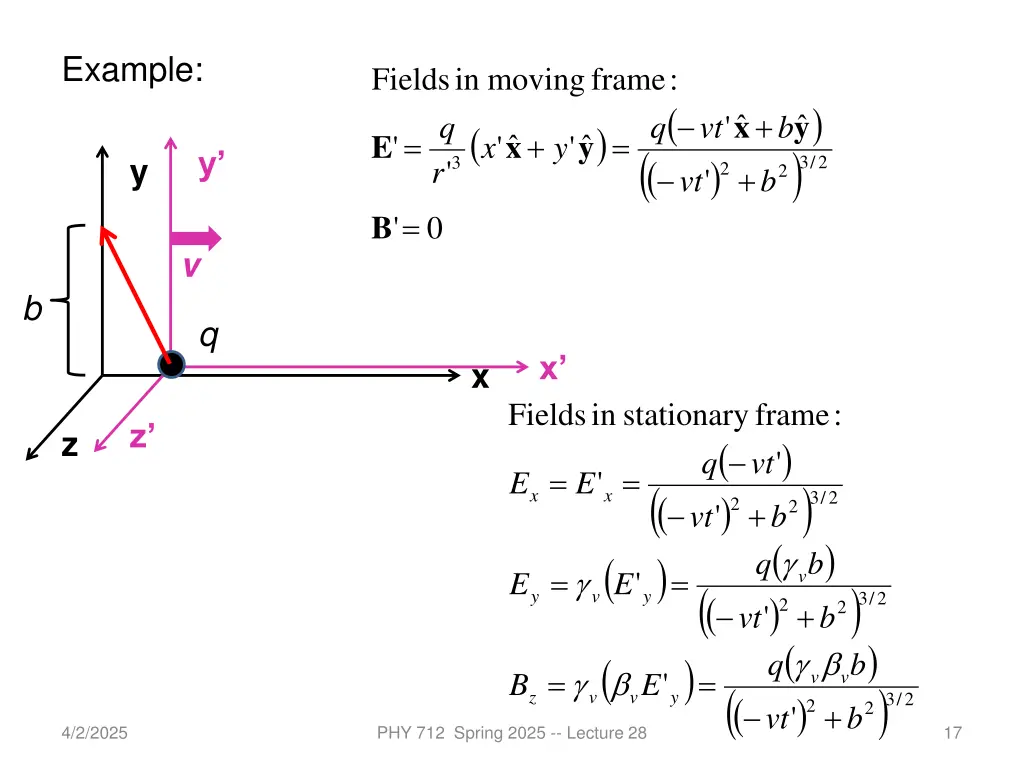
Example: Fields moving in q frame : ( ) + x y ' / 3 q vt b ( ) = + = E x y ' x ' y ' ( ) y ( ) y 2 3 ' r 2 + 2 ' vt b = B ' 0 v b q x x stationary in Fields frame vt + : z z ( ) ' ) ' q = = ' x E E ( ) b v + ( ) x / 3 2 2 2 vt b ( ) q ) ( q = = ' E E ( ) b ( y v y / 3 2 2 2 ' vt b ( ) ( ) = = ' v v B E ( ) ( ) z v v y / 3 2 2 + 2 ' vt b 4/2/2025 PHY 712 Spring 2025 -- Lecture 28 17
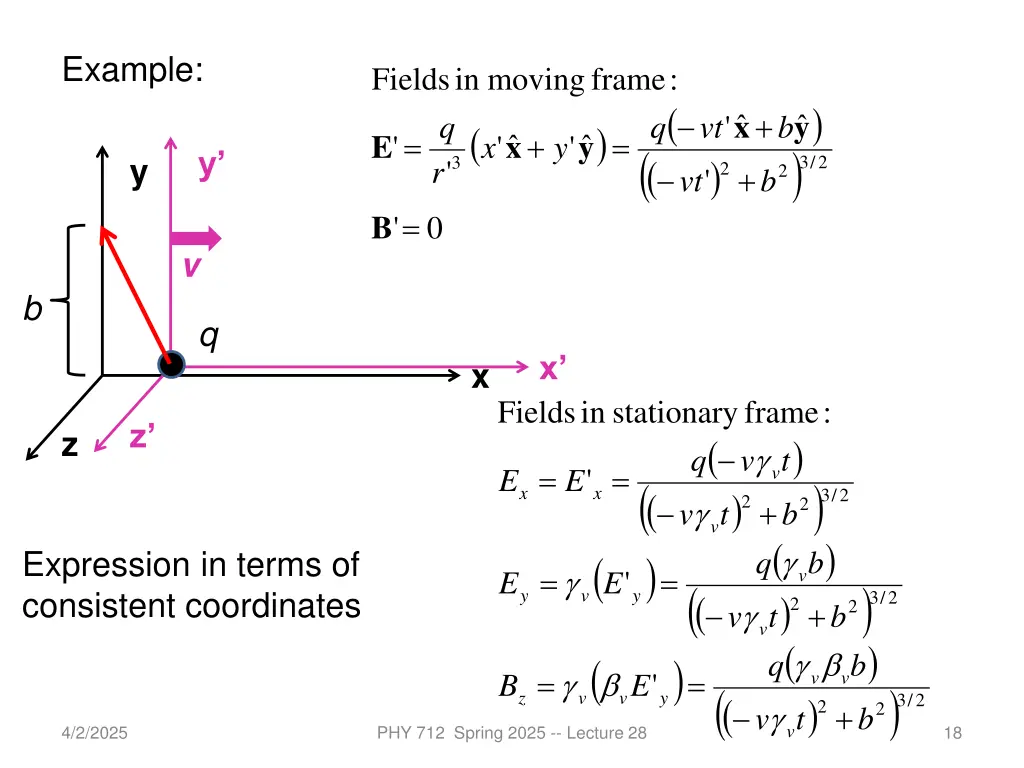
Example: Fields moving in q frame : ( ) + x y ' / 3 q vt b ( ) = + = E x y ' x ' y ' ( ) y ( ) y 2 3 ' r 2 + 2 ' vt b = B ' 0 v b q x x stationary in Fields frame v v + : z z ( ) q t = = ' x E E ( ) ( ) ) x / 3 2 2 2 v t b v ( t ) b ( Expression in terms of consistent coordinates q b + = = ' v E E ( ) ( ) ( y v y / 3 2 2 2 v v ) ( ) q b = = ' v v B E ( ) ( ) z v v y / 3 2 2 + 2 v t b v 4/2/2025 PHY 712 Spring 2025 -- Lecture 28 18
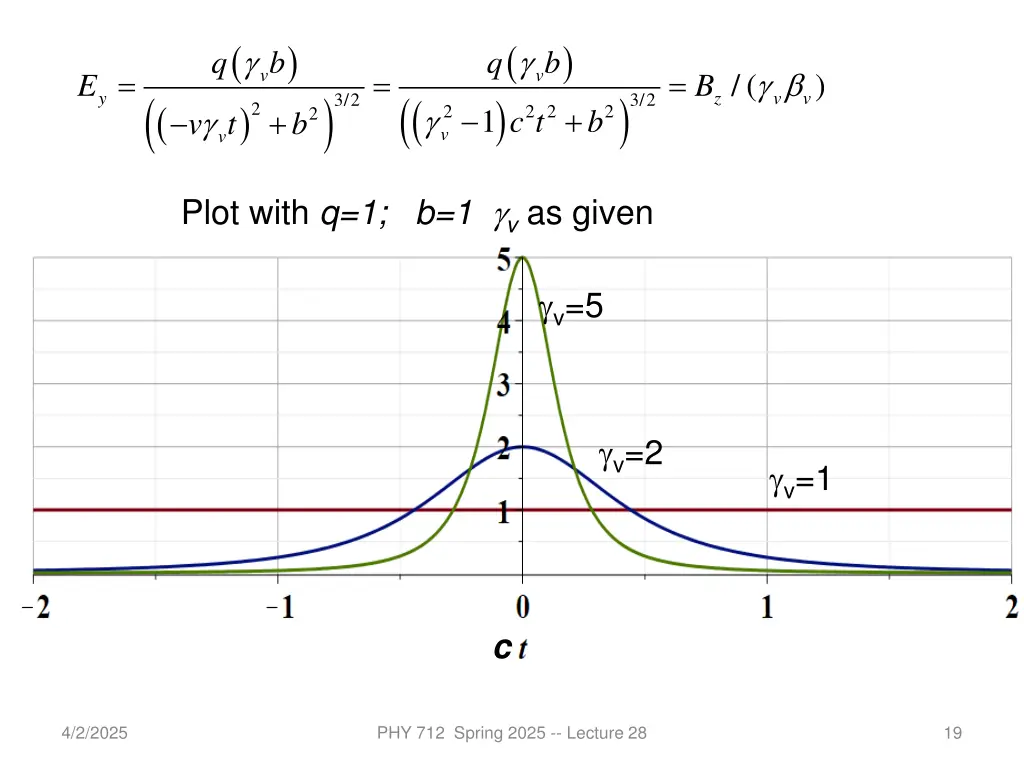
( ) ( ) + q b q b = = = v v /( ) E B ( ) ( ) ( ) y z v v 3/2 3/ 2 ( ) 2 2 v 2 2 2 v t + 1 2 c t b b v Plot with q=1; b=1 vas given v=5 v=2 v=1 c 4/2/2025 PHY 712 Spring 2025 -- Lecture 28 19
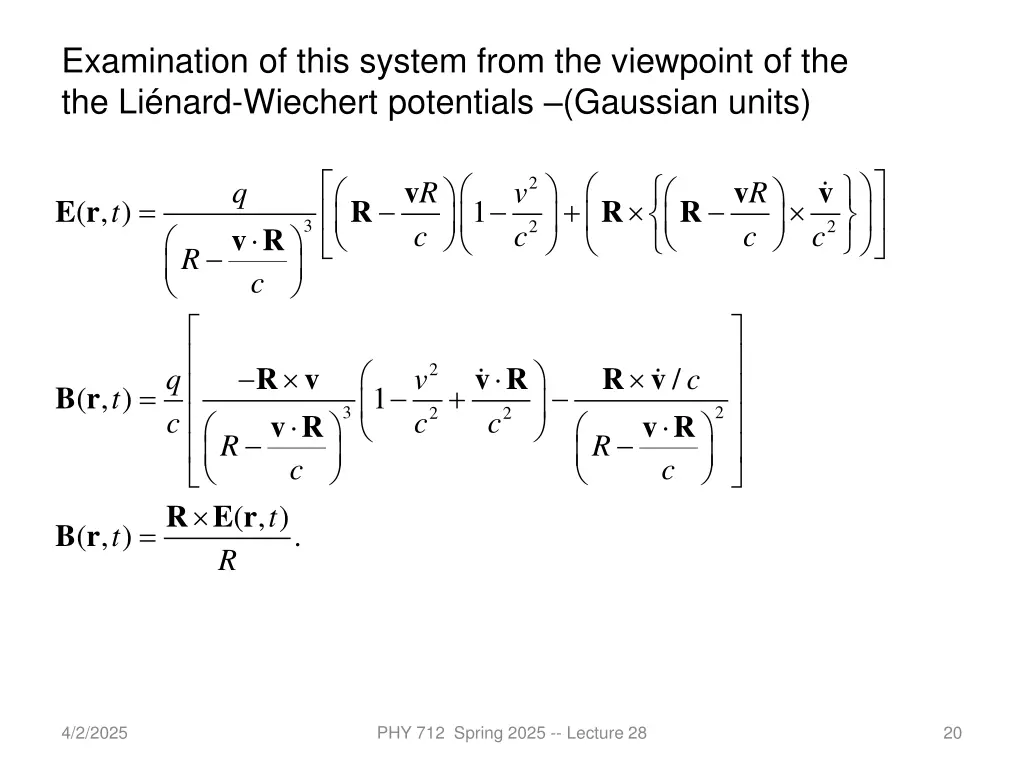
Examination of this system from the viewpoint of the the Li nard-Wiechert potentials (Gaussian units) 2 v v v q v R R c v c R c = + E ( , ) r R R R 1 t 3 2 2 c R c R v v R 2 v R R v / q c v c c = + B ( , ) r 1 t 3 2 2 2 c v R R R c c R E r ( , ) R t = B ( , ) r . t 4/2/2025 PHY 712 Spring 2025 -- Lecture 28 20
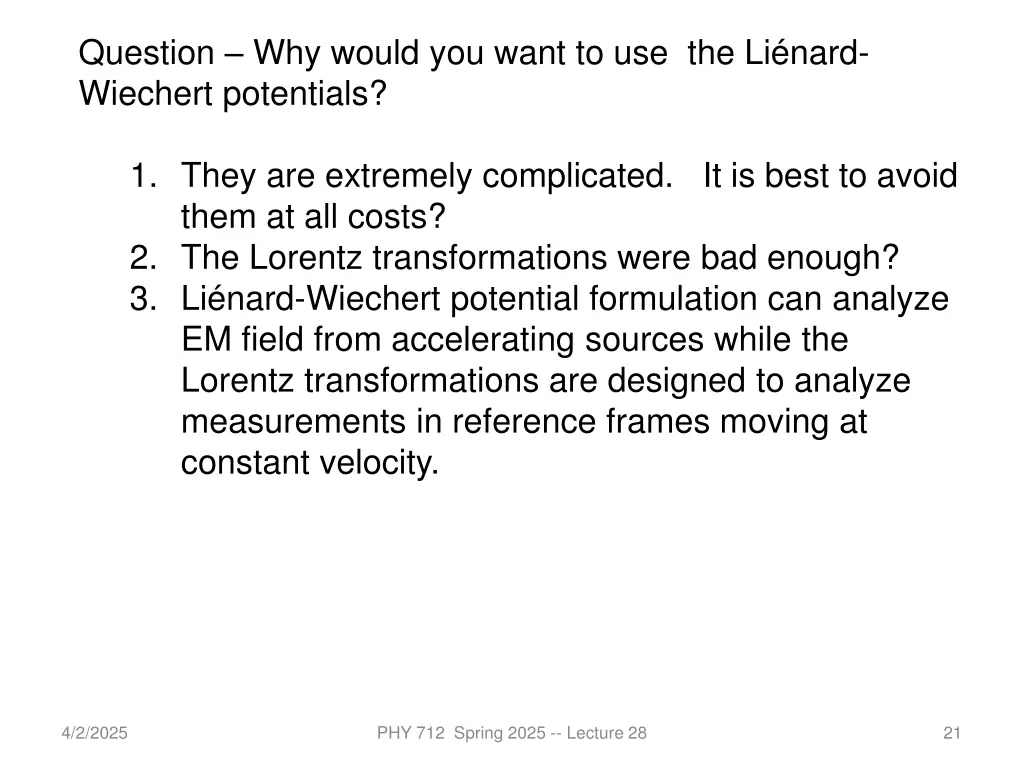
Question Why would you want to use the Linard- Wiechert potentials? 1. They are extremely complicated. It is best to avoid them at all costs? 2. The Lorentz transformations were bad enough? 3. Li nard-Wiechert potential formulation can analyze EM field from accelerating sources while the Lorentz transformations are designed to analyze measurements in reference frames moving at constant velocity. 4/2/2025 PHY 712 Spring 2025 -- Lecture 28 21
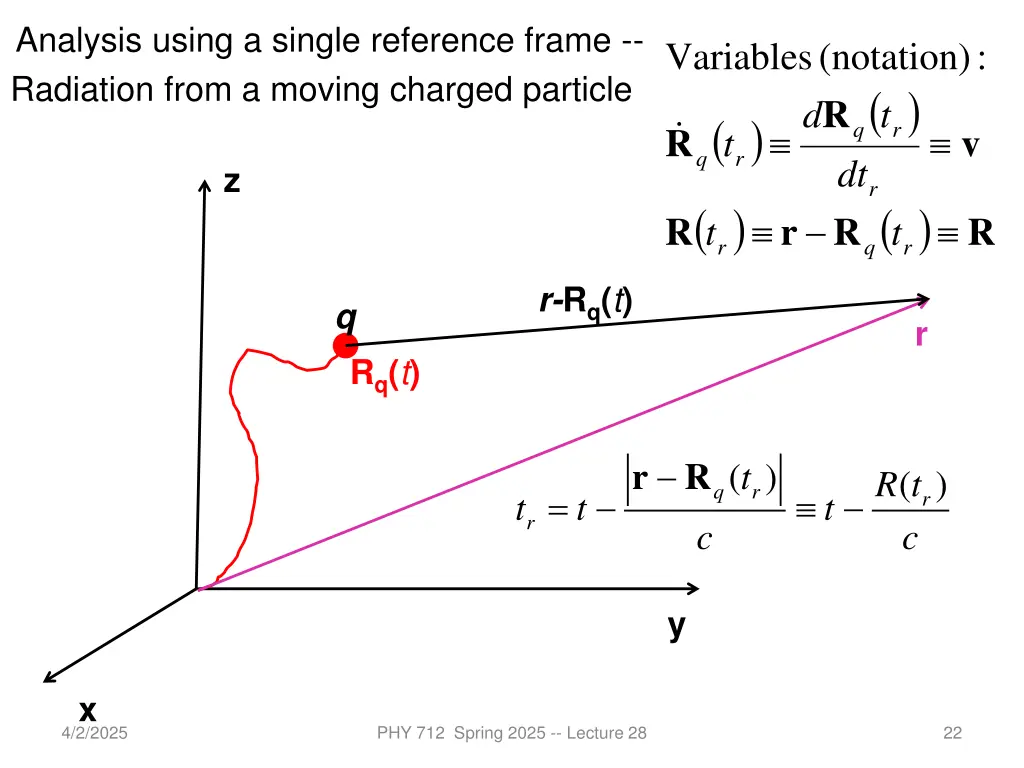
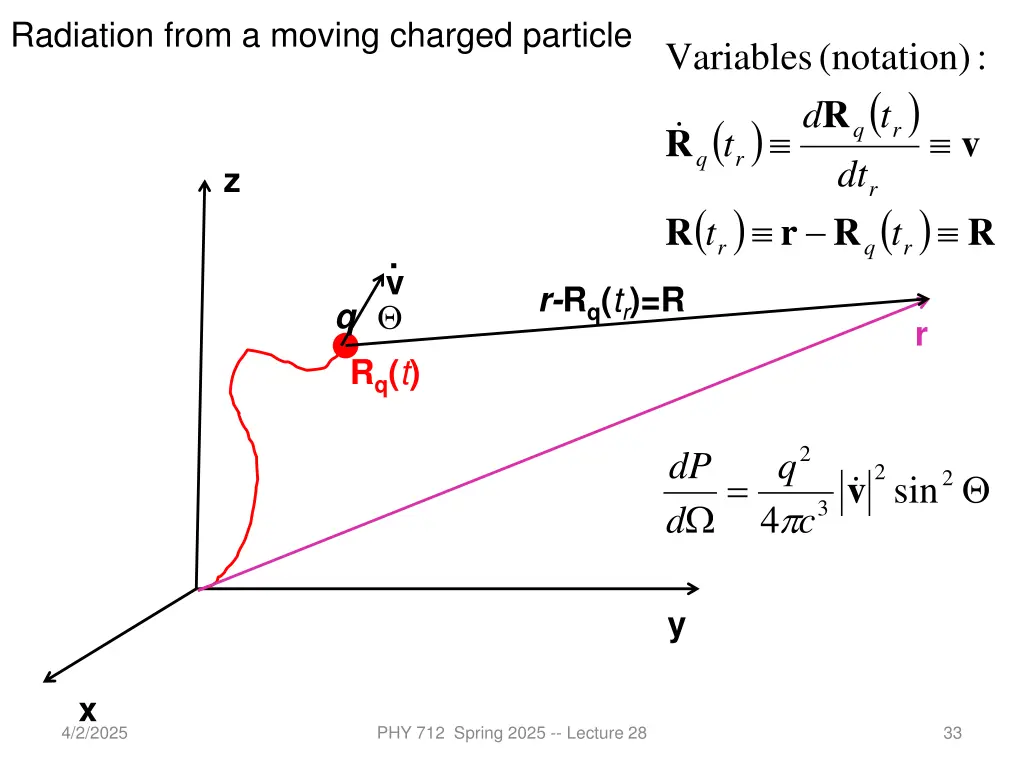
Analysis using a single reference frame -- Variables (notation) : Radiation from a moving charged particle ( ) r t R d ( ) r t R q v q dt z r ( ) r t ( ) r t R r R R q r-Rq(t) q r Rq(t) r R ( ) r t ( ) r R t c q = t t t r c y x 4/2/2025 PHY 712 Spring 2025 -- Lecture 28 22
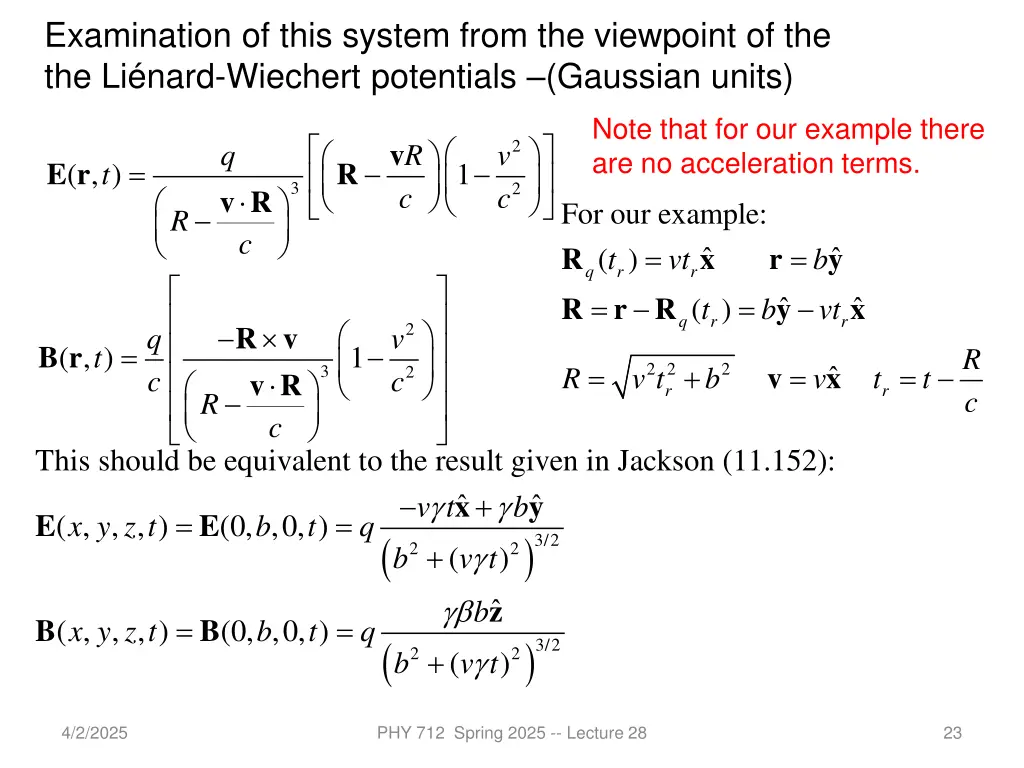
Examination of this system from the viewpoint of the the Li nard-Wiechert potentials (Gaussian units) Note that for our example there are no acceleration terms. 2 v q v R R c v c = E ( , ) r R 1 t 3 2 For our example: ( ) q r t vt = R r R R c = = R x r y = b r y x ( ) t b vt q r r R v v 2 q c v c = B ( , ) r 1 t R c = + = = 2 2 2 v x R v t b v t t 3 2 R r r R c This should be equivalent to the result given in Jack v t t q b + son (11.152): + x y b = = E E ( , x y z t , , ) (0, ,0 b , ) ( ) 3/2 v t 2 2 ( ) + z b = = B B ( , , , ) x y z t (0, ,0, ) b t q ( ) 3/2 2 2 ( ) b v t 4/2/2025 PHY 712 Spring 2025 -- Lecture 28 23
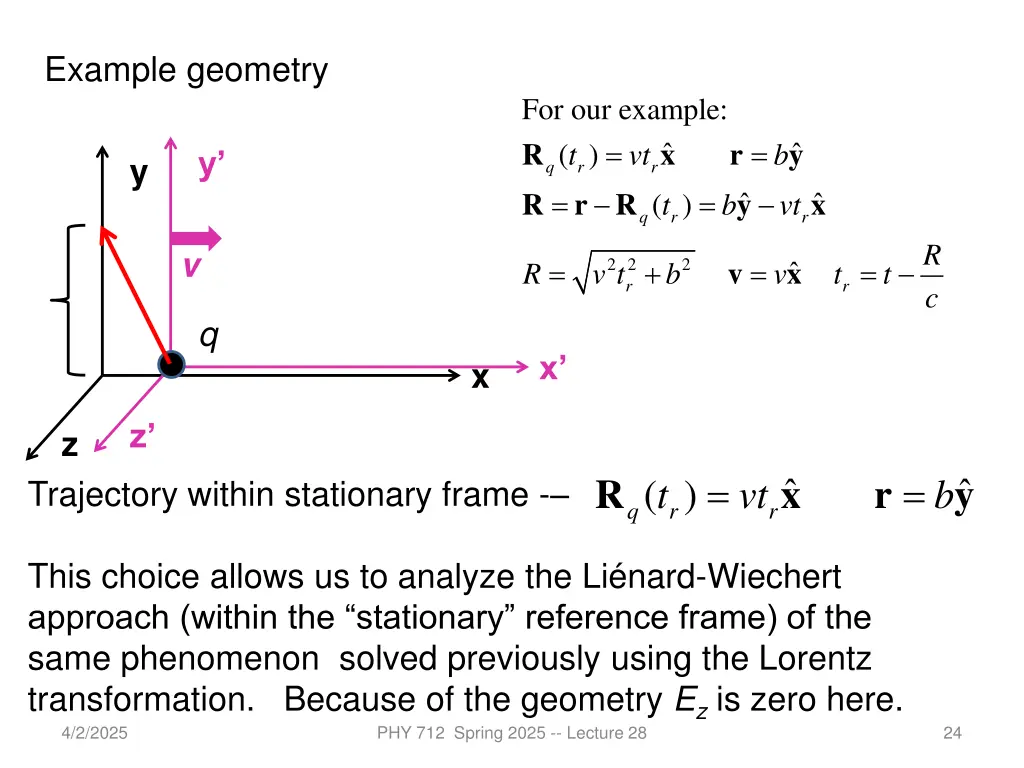
Example geometry For our example: ( ) q r t vt = R r R = = R x r y = b y y r y x ( ) t b vt q r r R c v = + = = 2 2 2 v x R v t b v t t r r q x x z z = = R x r y ( ) t vt b Trajectory within stationary frame - q r r This choice allows us to analyze the Li nard-Wiechert approach (within the stationary reference frame) of the same phenomenon solved previously using the Lorentz transformation. Because of the geometry Ez is zero here. 4/2/2025 PHY 712 Spring 2025 -- Lecture 28 24
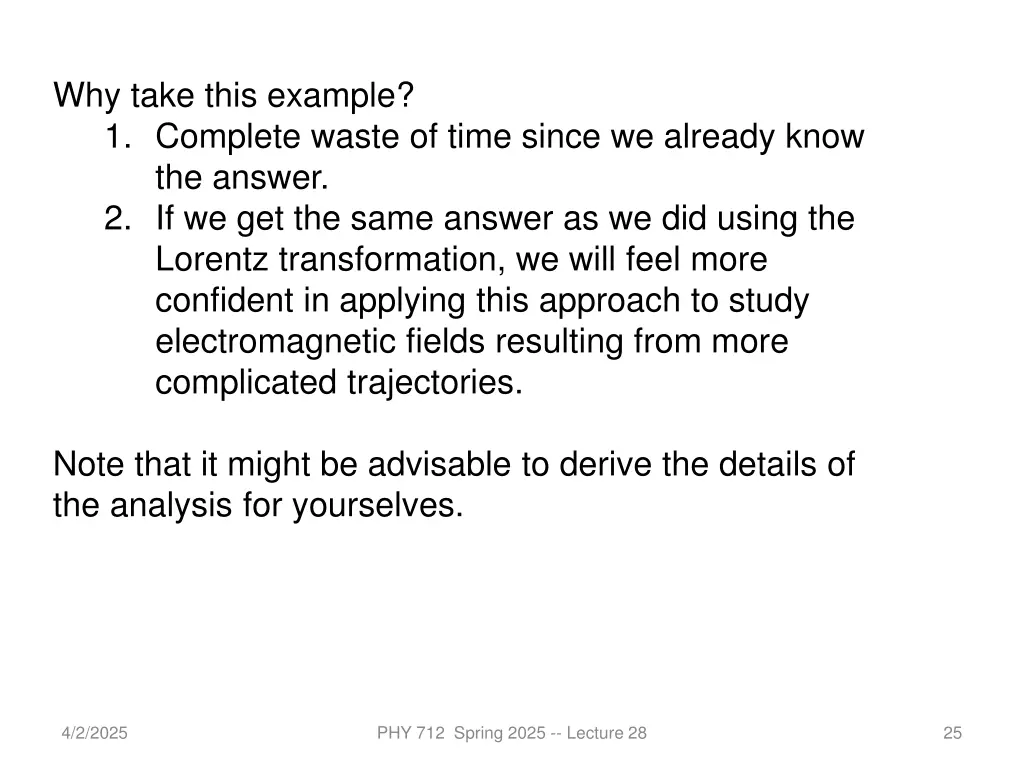
Why take this example? 1. Complete waste of time since we already know the answer. 2. If we get the same answer as we did using the Lorentz transformation, we will feel more confident in applying this approach to study electromagnetic fields resulting from more complicated trajectories. Note that it might be advisable to derive the details of the analysis for yourselves. 4/2/2025 PHY 712 Spring 2025 -- Lecture 28 25
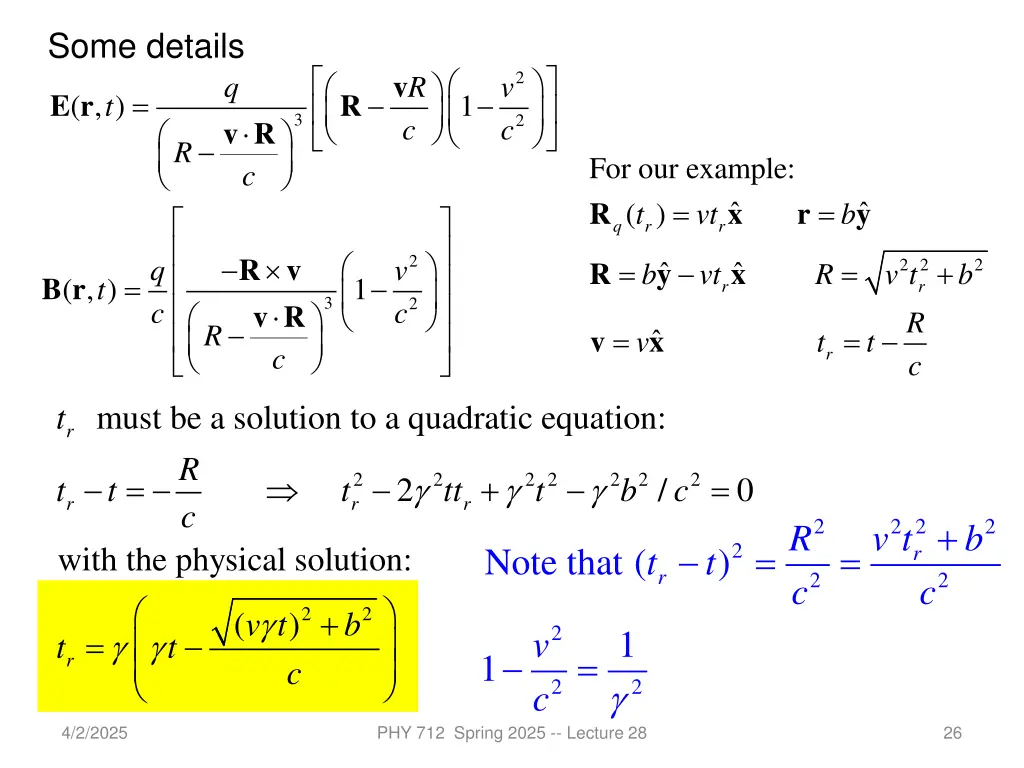
Some details 2 v q v R R c v c = E ( , ) r R 1 t 3 2 R For our example: ( ) q r t vt = R c = x r y b r R v v 2 q c v c = = + 2 2 2 R y x b v t R v t b = B ( , ) r 1 t r r 3 2 R R c R = = v x v t t c r must be a solution to a quadratic equation: R t t c t r = + = 2 r 2 2 2 t 2 2 2 2 / 0 t tt b c r r + 2 2 2 2 R c v t b = = 2 with the physical soluti = on: Note that ( ) r t t r 2 2 c v t + 2 2 ( ) c b 2 1 v c t t = 1 r 2 2 4/2/2025 PHY 712 Spring 2025 -- Lecture 28 26
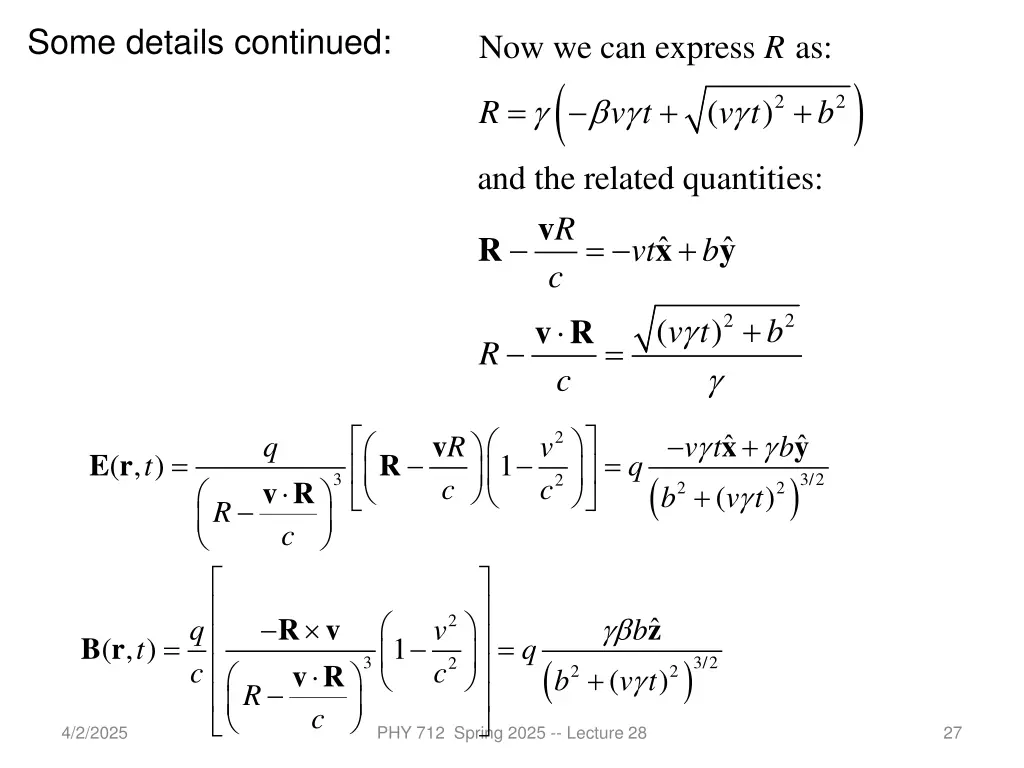
Some details continued: N ow we can exp ress a s: R ) ( = + v t + 2 2 ( ) R v t b and the el ted qua titi R vt c = r a n es: v = + R x y b v t + 2 2 v R ( ) b R c v t + + 2 v x y q v R R c v c b = = E ( , ) r R 1 t q ( ) 3 3/2 2 v t 2 2 ( ) b R c R v v R + 2 z q c v c b = = B r ( , ) t 1 q ( ) 3 3/2 2 2 2 ( ) b v t R c PHY 712 Spring 2025 -- Lecture 28 4/2/2025 27
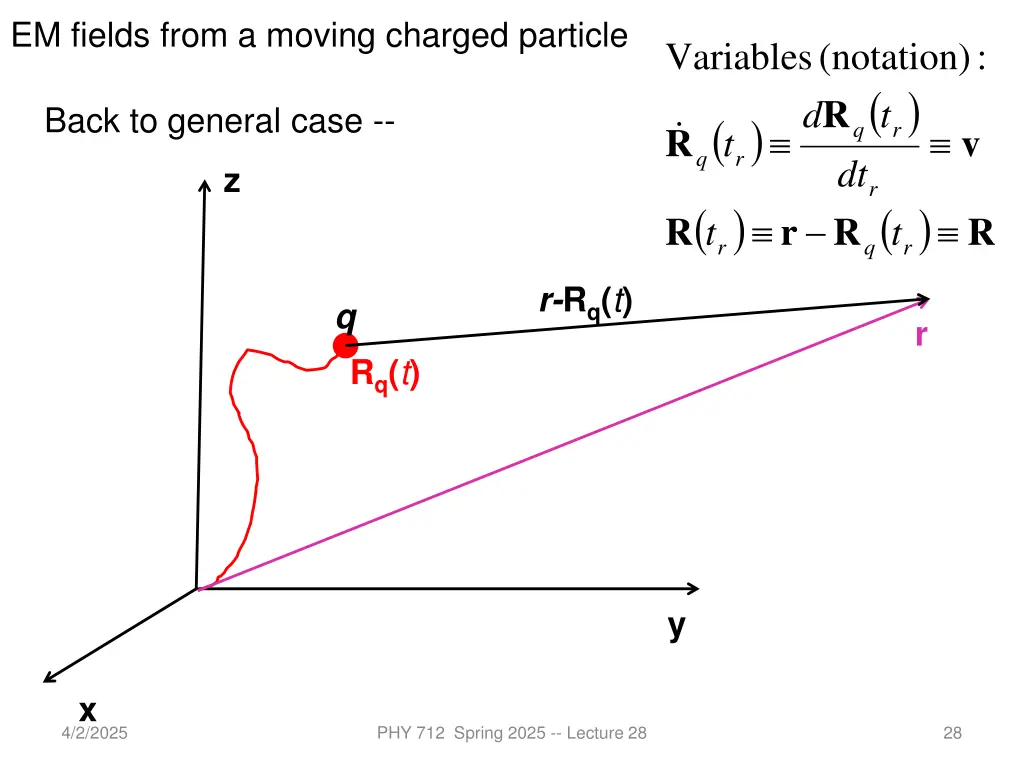
EM fields from a moving charged particle Variables (notation) : ( ) r t R d Back to general case -- ( ) r t R q v q dt z r ( ) r t ( ) r t R r R R q r-Rq(t) q r Rq(t) y x 4/2/2025 PHY 712 Spring 2025 -- Lecture 28 28
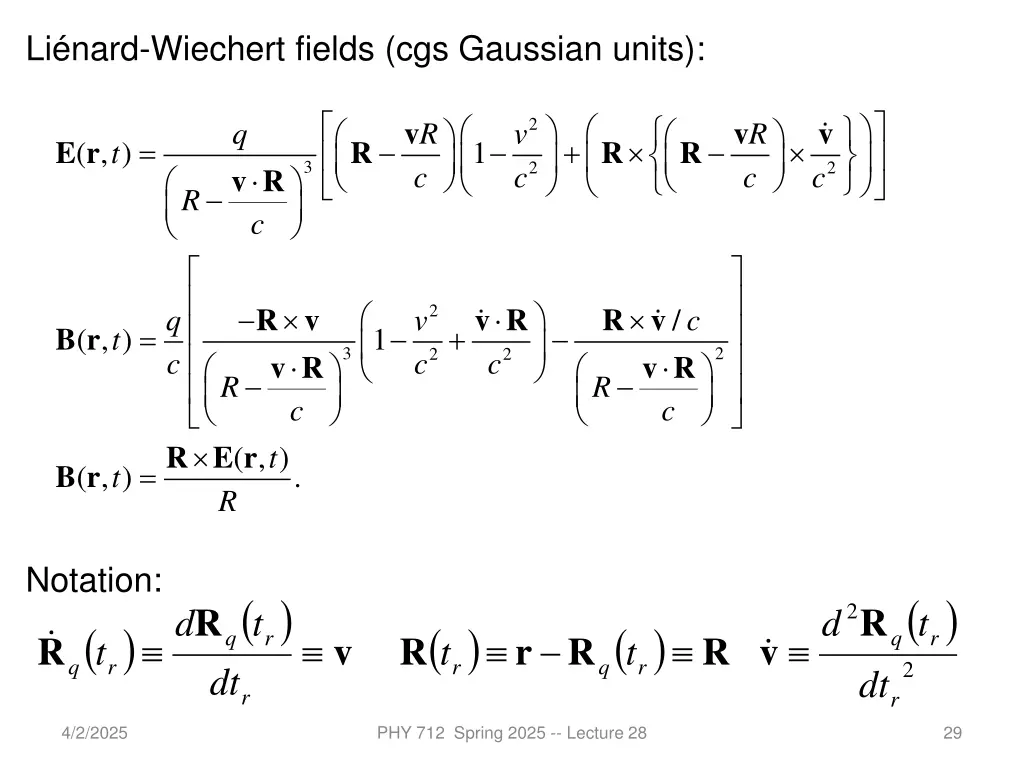
Linard-Wiechert fields (cgs Gaussian units): 2 v v v q v R R c v c R c = + E ( , ) r R R R 1 t 3 2 2 c R c R v v R 2 v R R v / q c v c c = + B ( , ) r 1 t 3 2 2 2 c v R R R c c R E r ( , ) R t = B ( , ) r . t Notation: ( ) r t ( ) 2 2 R R d d t ( ) r t ( ) r t ( ) r t R q q r v R r R R v q q dt dt r r 4/2/2025 PHY 712 Spring 2025 -- Lecture 28 29
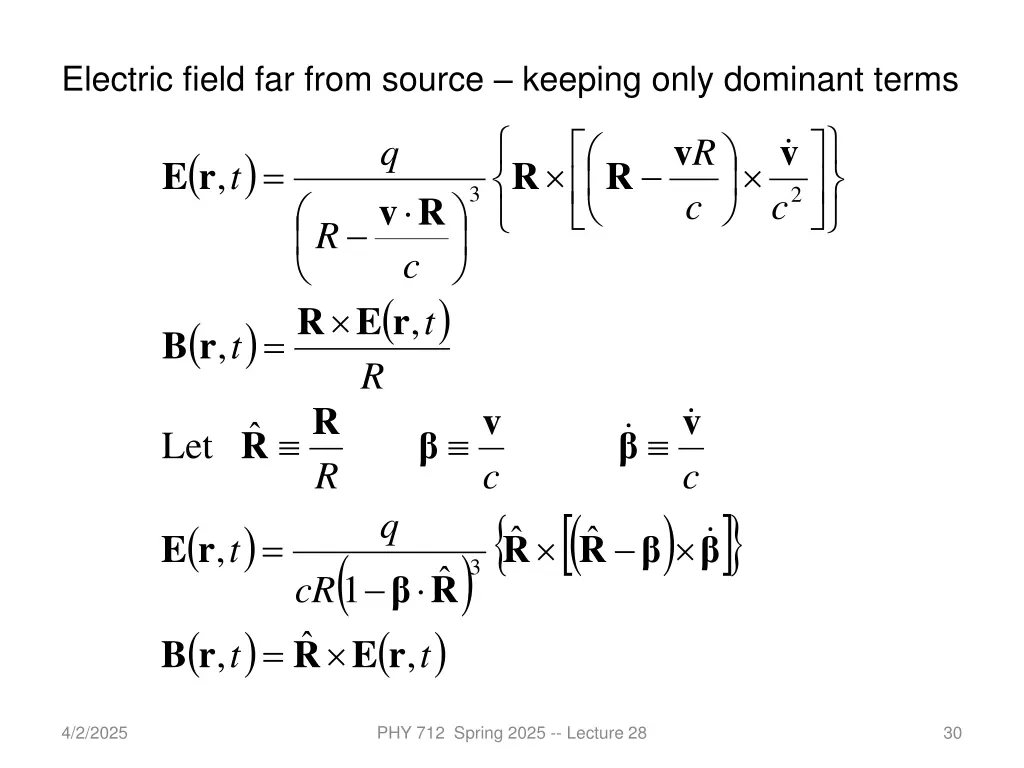
Electric field far from source keeping only dominant terms v v q v R ( ) = E r R R , t 3 2 c c R R c , ( ) R E r t ( ) = B r , t R R v v R Let R c c ( ) q ( ) = E r R R , t ( 1 ) 3 R cR R ( ) ( ) t , = B r E r , t 4/2/2025 PHY 712 Spring 2025 -- Lecture 28 30
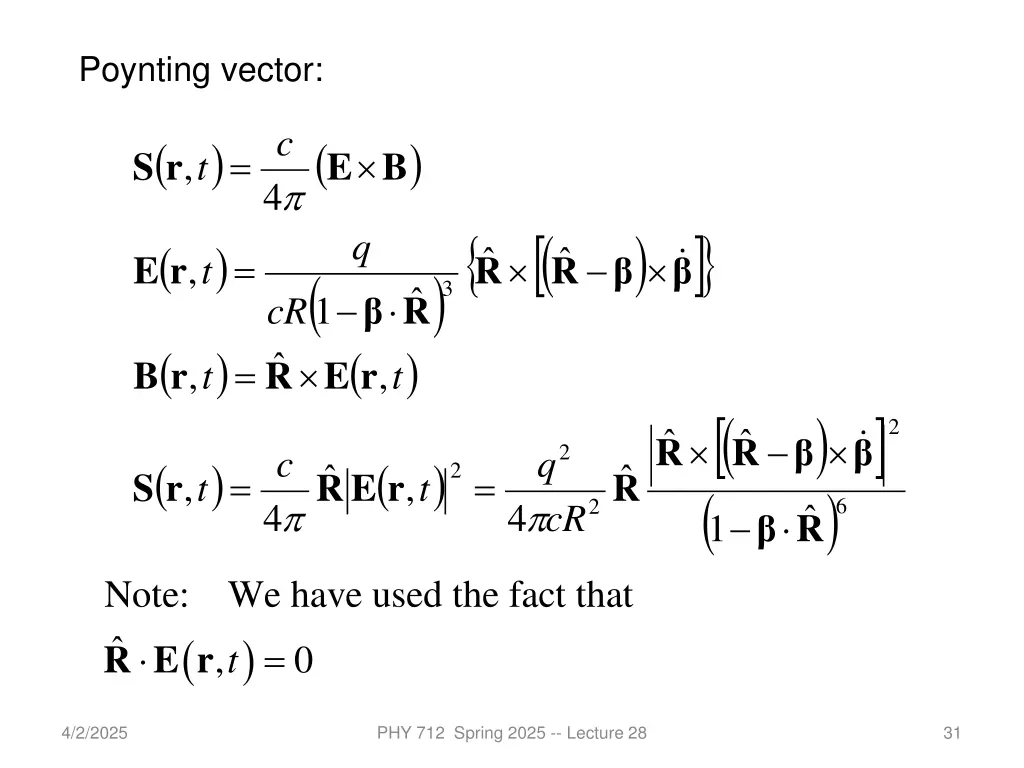
Poynting vector: c ( ) ( ) = S r E B , t 4 ( ) q ( ) = E r R R , t ( 1 ) 3 R cR ( ) ( ) = B r R E r , , t t ( ) 2 R R 2 c q ( ) ( ) 2 = = S r R E r R , , t t ( 1 ) 6 2 4 4 cR R Note: We have used the fact that , 0 t = R E r ( ) 4/2/2025 PHY 712 Spring 2025 -- Lecture 28 31
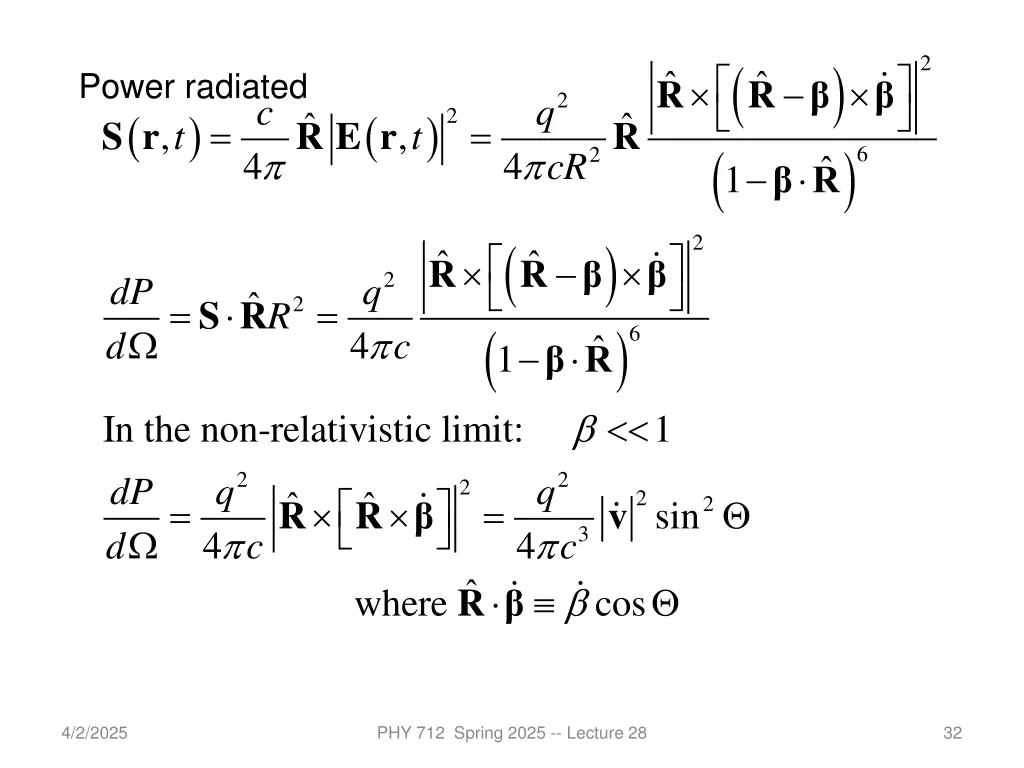
( ) 2 Power radiated ( ) , t S r R R 2 c q ( ) 2 = = R E r R , t ( ) 6 2 4 4 cR R 1 ( ) 2 R R 2 dP d q = S R = 2 R ( ) 6 4 c R 1 In the non-relativistic limit: 1 2 2 dP d q q 2 2 = = 2 R R sin v 3 4 4 c c R where cos 4/2/2025 PHY 712 Spring 2025 -- Lecture 28 32
Radiation from a moving charged particle Variables (notation) : ( ) r t R d ( ) r t R q v q dt z r ( ) r t ( ) r t R r R R q v. r-Rq(tr)=R q r Rq(t) 2 dP q 2 = 2 v sin 3 4 d c y x 4/2/2025 PHY 712 Spring 2025 -- Lecture 28 33
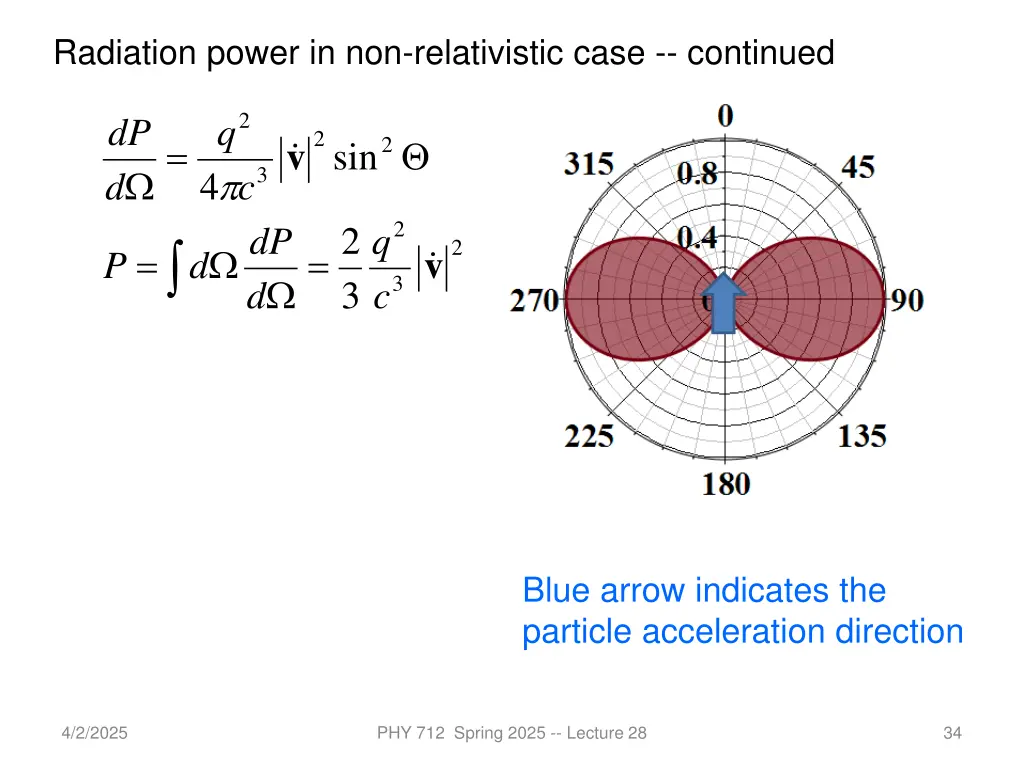
Radiation power in non-relativistic case -- continued 2 dP q 2 = 2 v sin 3 4 d c 2 2 dP q 2 = = v P d 3 3 d c Blue arrow indicates the particle acceleration direction 4/2/2025 PHY 712 Spring 2025 -- Lecture 28 34
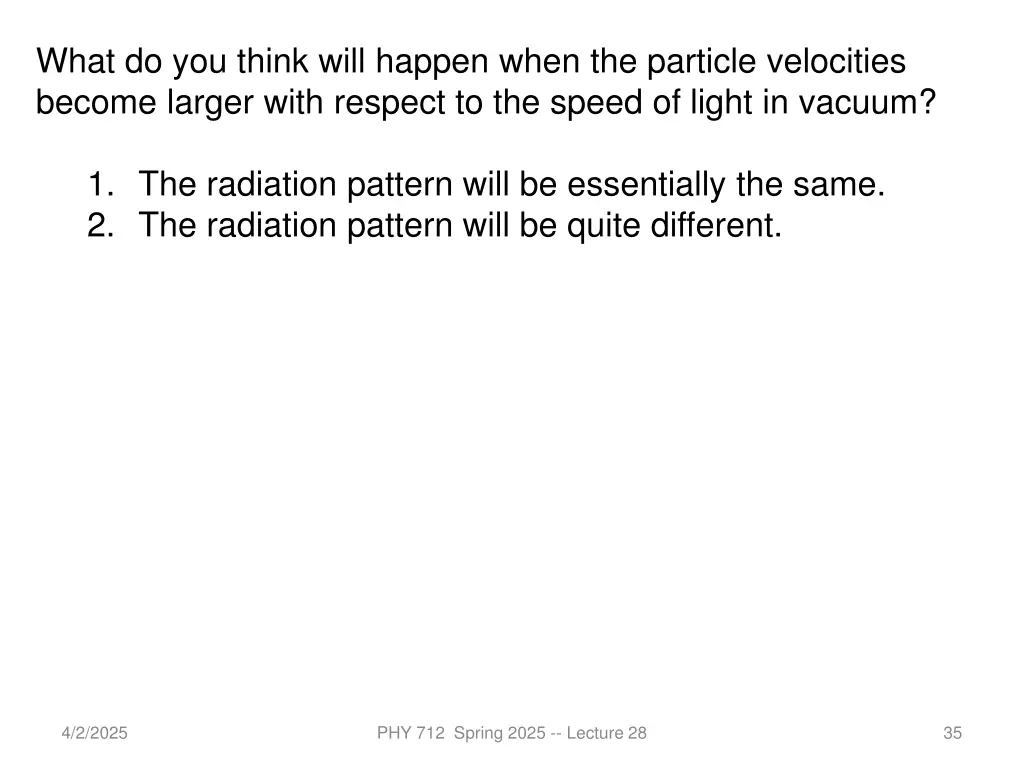
What do you think will happen when the particle velocities become larger with respect to the speed of light in vacuum? 1. The radiation pattern will be essentially the same. 2. The radiation pattern will be quite different. 4/2/2025 PHY 712 Spring 2025 -- Lecture 28 35