Standards-Based IEPs and Reform in Education
Learn about the evolution of standards-based reform in education, including the key changes brought about by the reauthorization of IDEA in 1997. Explore the concept of standards-based IEPs and how they align with state academic standards to support student achievement. Discover the challenges faced by state and local education agencies in implementing standards-based practices for special education students.

Uploaded on | 3 Views
Download Presentation

Please find below an Image/Link to download the presentation.
The content on the website is provided AS IS for your information and personal use only. It may not be sold, licensed, or shared on other websites without obtaining consent from the author. If you encounter any issues during the download, it is possible that the publisher has removed the file from their server.
You are allowed to download the files provided on this website for personal or commercial use, subject to the condition that they are used lawfully. All files are the property of their respective owners.
The content on the website is provided AS IS for your information and personal use only. It may not be sold, licensed, or shared on other websites without obtaining consent from the author.
E N D
Presentation Transcript
Standards-Based IEPs M. Pleshette Smith Office of Special Education Division of Technical Assistance
Standards-Based Reform Beginning with the reauthorization of IDEA in 1997, significant Federal legislation was passed that dramatically changed how states and local education agencies function. Accountability for student learning became foremost in Federal regulations. Office of Instructional Enhancement and Internal Operations/Office of Special Education February 2013 2
Standards-Based Reform IDEA reauthorization 1997 Access to, participation and progress in the general education curriculum No Child Left Behind Act of 2001 Aligned system of standards and assessments Accountability for all students IDEA 2004 and 2007 National Standards Movement Office of Instructional Enhancement and Internal Operations/Office of Special Education February 2013 3
Standards-Based Reform In the last decade, Federal legislation has focused on two major assumptions related to teaching and learning. Special Education students have the right to be taught with the same high standards expected for all students. All students must be provided opportunities to learn the general education curriculum. Office of Instructional Enhancement and Internal Operations/Office of Special Education February 2013 4
Standards-Based Reform Challenges to State and Local Education Agencies (LEAs) Change the way educators think about instruction for special education students. Raise expectations for students learning. Provide access to grade-level content standards. Plan, teach, and assess students so that they can participant and make progress in the general education curriculum. Office of Instructional Enhancement and Internal Operations/Office of Special Education February 2013 5
What is a Standards-Based IEP? A standards-based IEP is a process and document that is framed by the State standards and that contains goals aligned with, and chosen to facilitate, the student s achievement of State grade-level academic standards. NASDSE Project Forum Standards-based IEPs: Implementation in Selected States (Ahearn, 2006) Office of Instructional Enhancement and Internal Operations/Office of Special Education February 2013 6
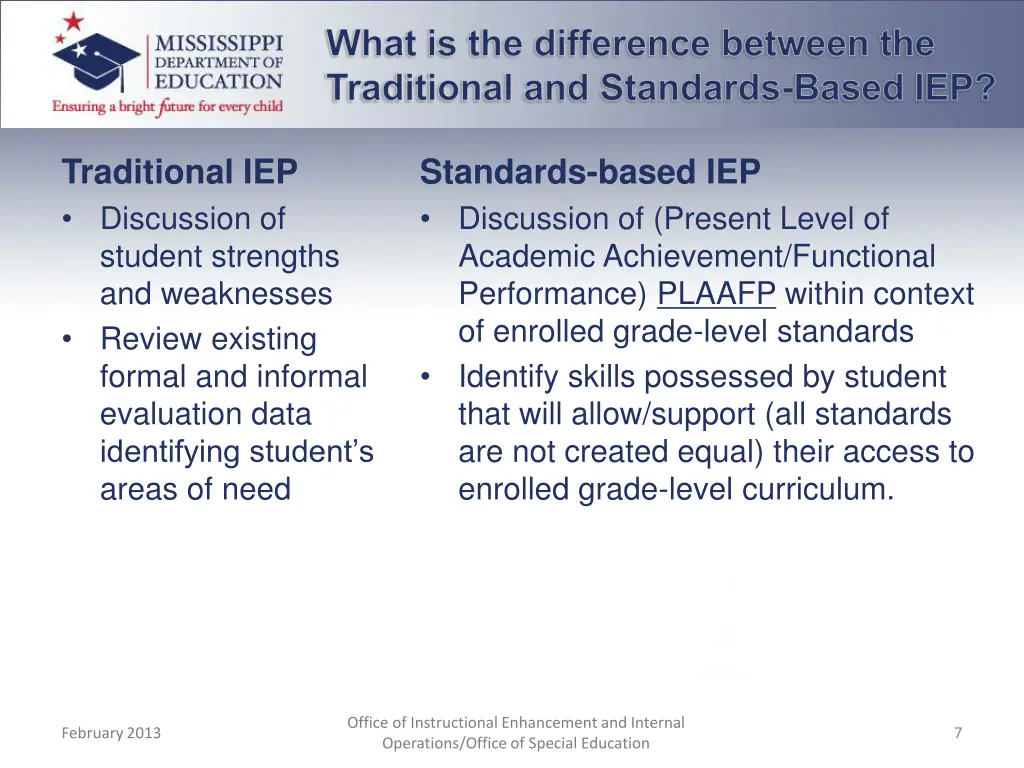
What is the difference between the Traditional and Standards-Based IEP? Traditional IEP Discussion of student strengths and weaknesses Review existing formal and informal evaluation data identifying student s areas of need Standards-based IEP Discussion of (Present Level of Academic Achievement/Functional Performance) PLAAFP within context of enrolled grade-level standards Identify skills possessed by student that will allow/support (all standards are not created equal) their access to enrolled grade-level curriculum. Office of Instructional Enhancement and Internal Operations/Office of Special Education February 2013 7
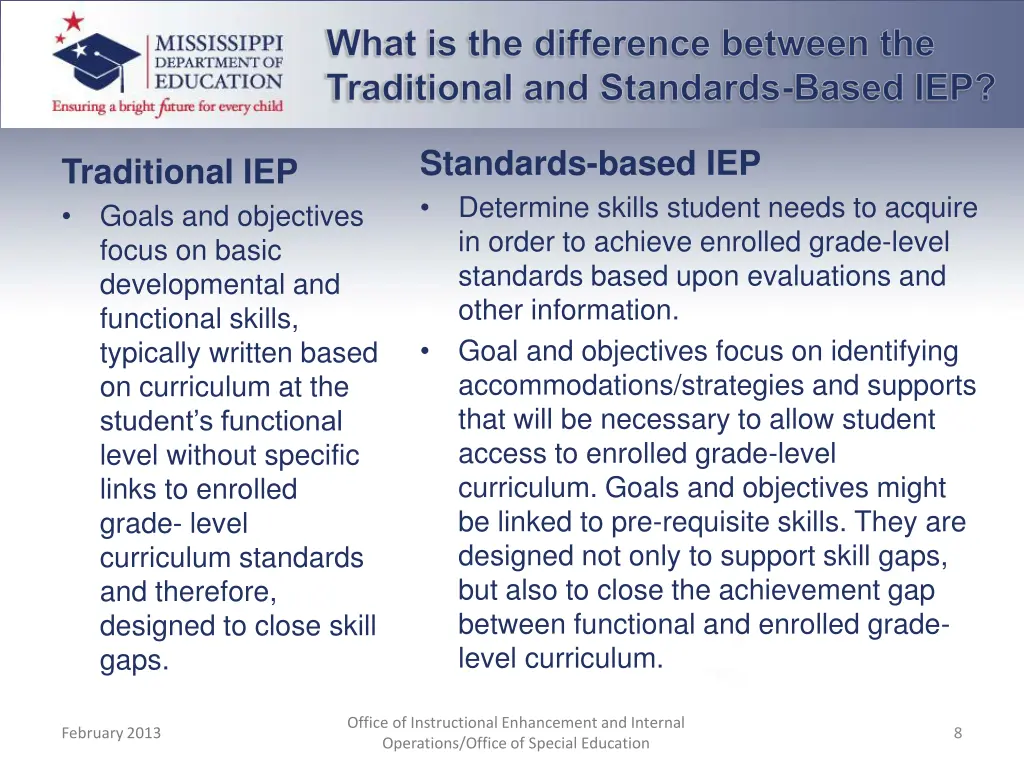
What is the difference between the Traditional and Standards-Based IEP? Standards-based IEP Determine skills student needs to acquire in order to achieve enrolled grade-level standards based upon evaluations and other information. Goal and objectives focus on identifying accommodations/strategies and supports that will be necessary to allow student access to enrolled grade-level curriculum. Goals and objectives might be linked to pre-requisite skills. They are designed not only to support skill gaps, but also to close the achievement gap between functional and enrolled grade- level curriculum. Traditional IEP Goals and objectives focus on basic developmental and functional skills, typically written based on curriculum at the student s functional level without specific links to enrolled grade- level curriculum standards and therefore, designed to close skill gaps. Office of Instructional Enhancement and Internal Operations/Office of Special Education February 2013 8
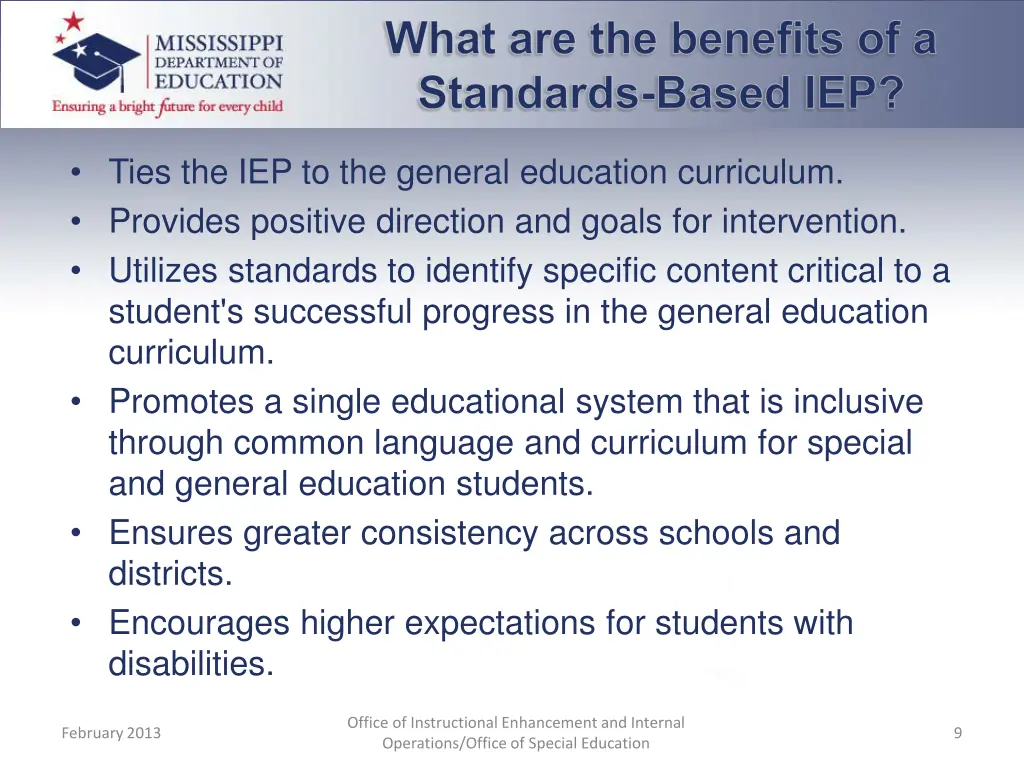
What are the benefits of a Standards-Based IEP? Ties the IEP to the general education curriculum. Provides positive direction and goals for intervention. Utilizes standards to identify specific content critical to a student's successful progress in the general education curriculum. Promotes a single educational system that is inclusive through common language and curriculum for special and general education students. Ensures greater consistency across schools and districts. Encourages higher expectations for students with disabilities. Office of Instructional Enhancement and Internal Operations/Office of Special Education February 2013 9
Standards-Based IEP Does a Standard-Based IEP imply that the student is on grade-level in that content area? Standards-Based IEP State-Directed Project- Virginia Department of Education Office of Instructional Enhancement and Internal Operations/Office of Special Education February 2013 10
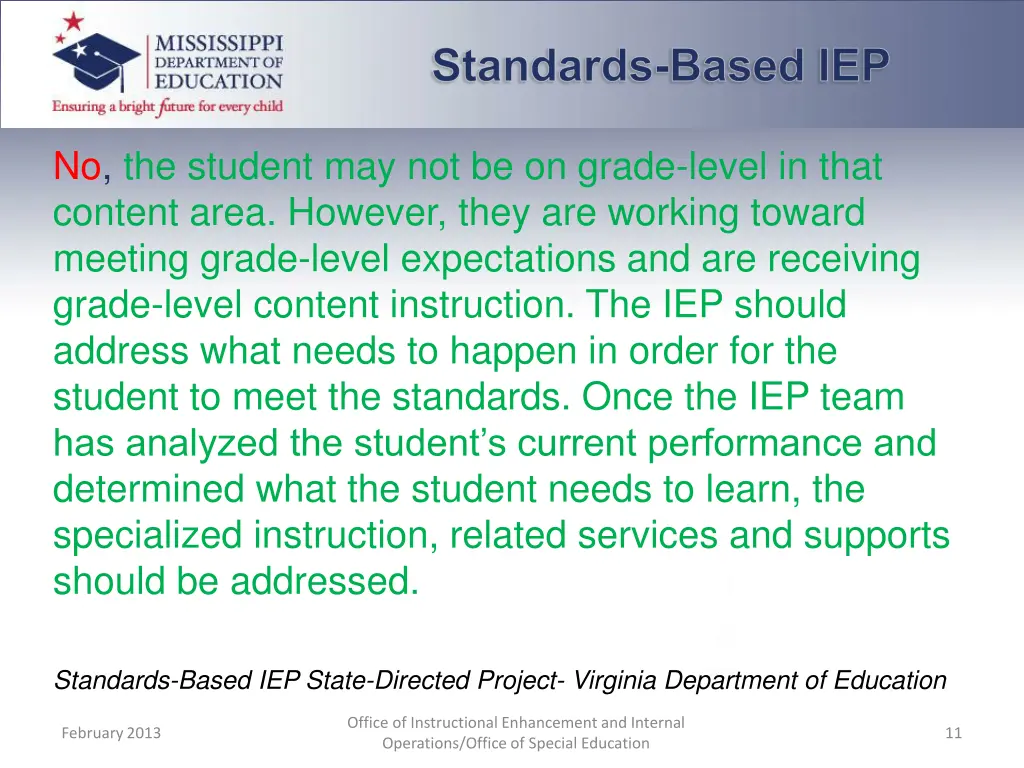
Standards-Based IEP No, the student may not be on grade-level in that content area. However, they are working toward meeting grade-level expectations and are receiving grade-level content instruction. The IEP should address what needs to happen in order for the student to meet the standards. Once the IEP team has analyzed the student s current performance and determined what the student needs to learn, the specialized instruction, related services and supports should be addressed. Standards-Based IEP State-Directed Project- Virginia Department of Education Office of Instructional Enhancement and Internal Operations/Office of Special Education February 2013 11
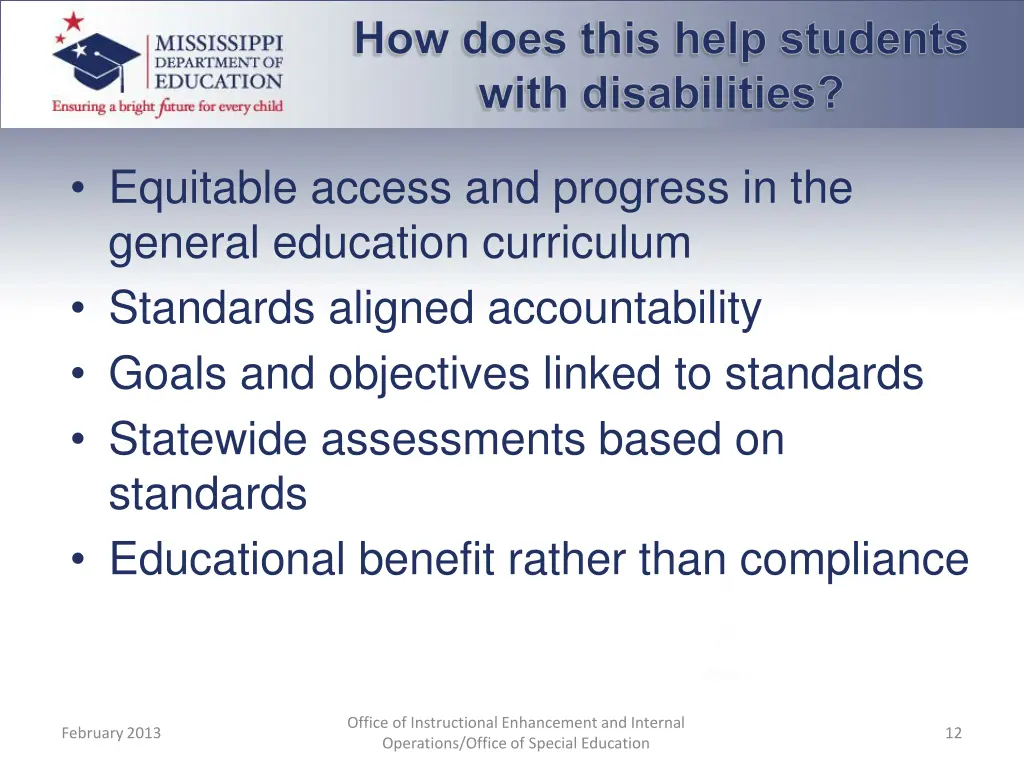
How does this help students with disabilities? Equitable access and progress in the general education curriculum Standards aligned accountability Goals and objectives linked to standards Statewide assessments based on standards Educational benefit rather than compliance Office of Instructional Enhancement and Internal Operations/Office of Special Education February 2013 12
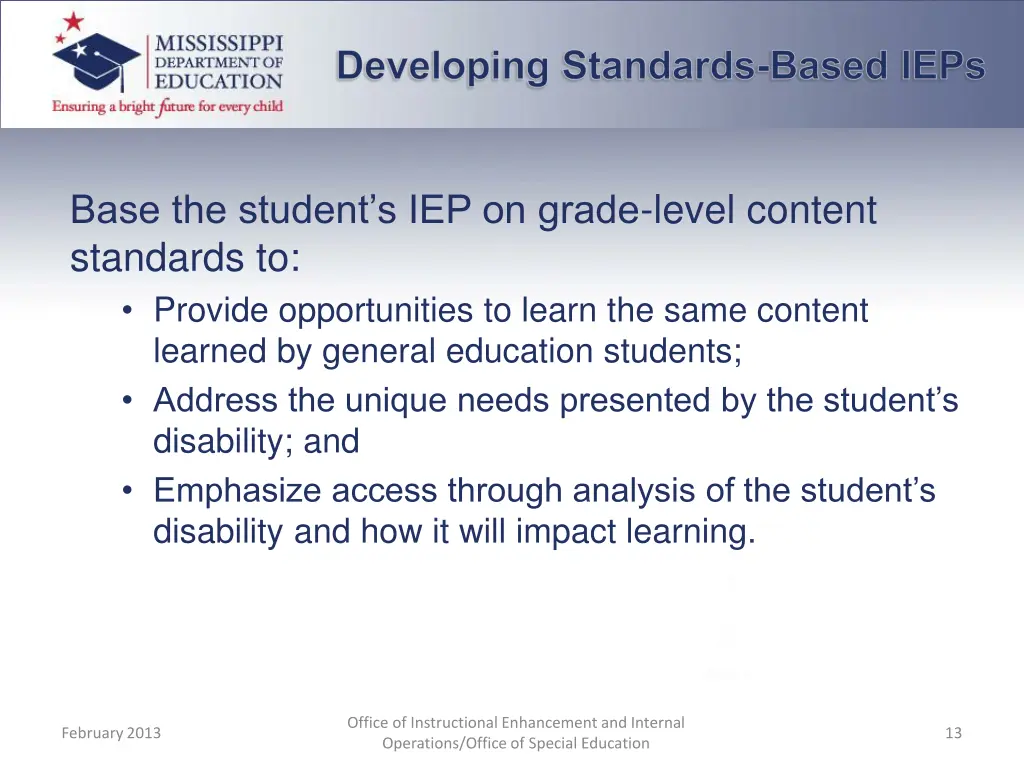
Developing Standards-Based IEPs Base the student s IEP on grade-level content standards to: Provide opportunities to learn the same content learned by general education students; Address the unique needs presented by the student s disability; and Emphasize access through analysis of the student s disability and how it will impact learning. Office of Instructional Enhancement and Internal Operations/Office of Special Education February 2013 13
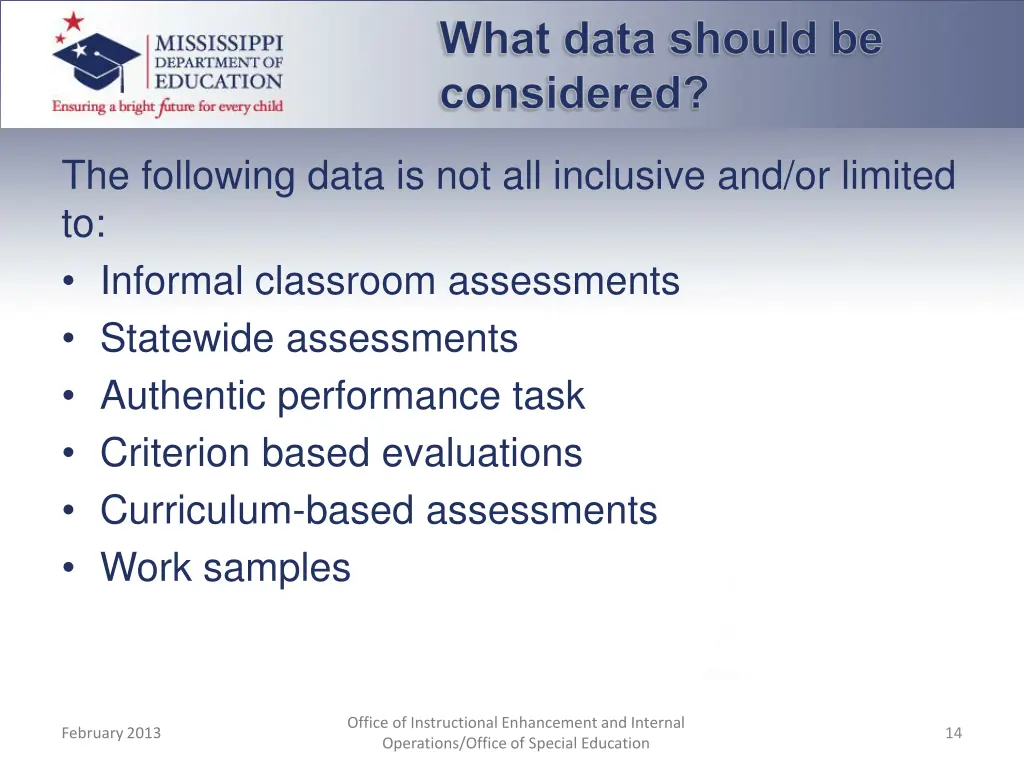
What data should be considered? The following data is not all inclusive and/or limited to: Informal classroom assessments Statewide assessments Authentic performance task Criterion based evaluations Curriculum-based assessments Work samples Office of Instructional Enhancement and Internal Operations/Office of Special Education February 2013 14
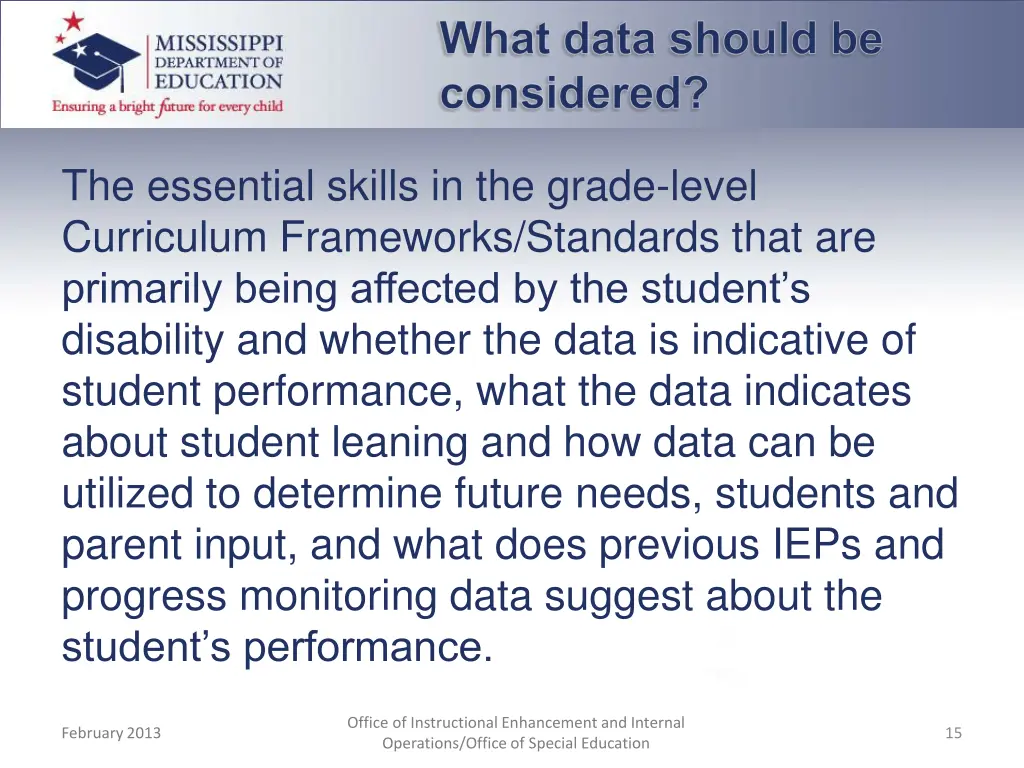
What data should be considered? The essential skills in the grade-level Curriculum Frameworks/Standards that are primarily being affected by the student s disability and whether the data is indicative of student performance, what the data indicates about student leaning and how data can be utilized to determine future needs, students and parent input, and what does previous IEPs and progress monitoring data suggest about the student s performance. Office of Instructional Enhancement and Internal Operations/Office of Special Education February 2013 15
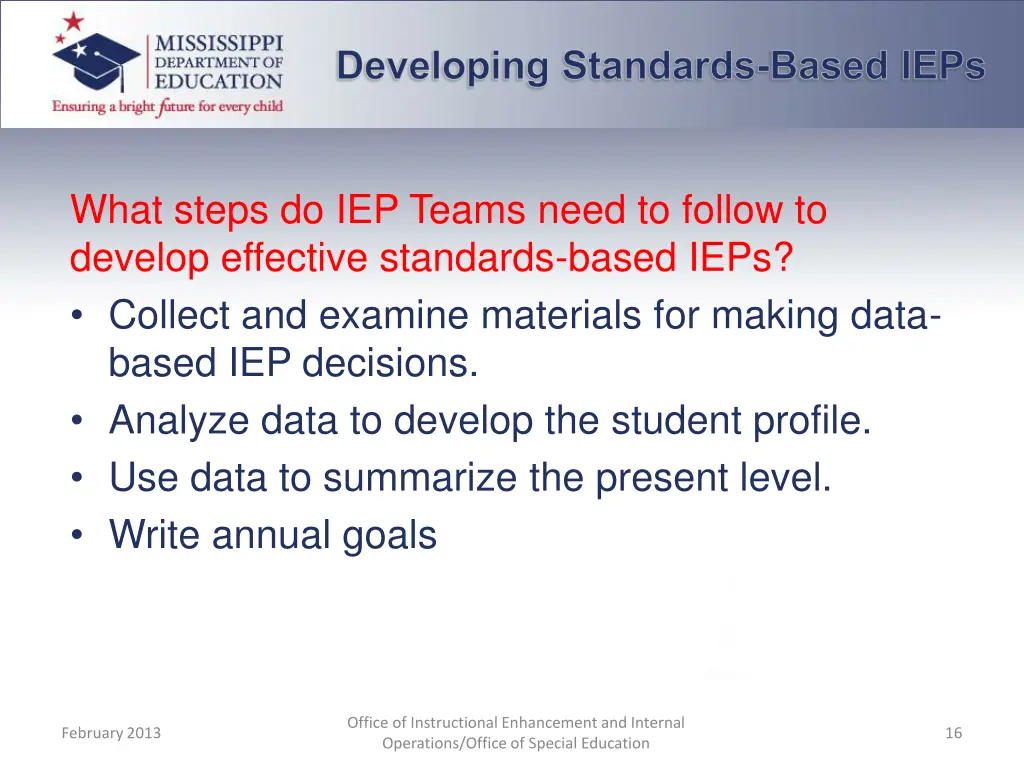
Developing Standards-Based IEPs What steps do IEP Teams need to follow to develop effective standards-based IEPs? Collect and examine materials for making data- based IEP decisions. Analyze data to develop the student profile. Use data to summarize the present level. Write annual goals Office of Instructional Enhancement and Internal Operations/Office of Special Education February 2013 16
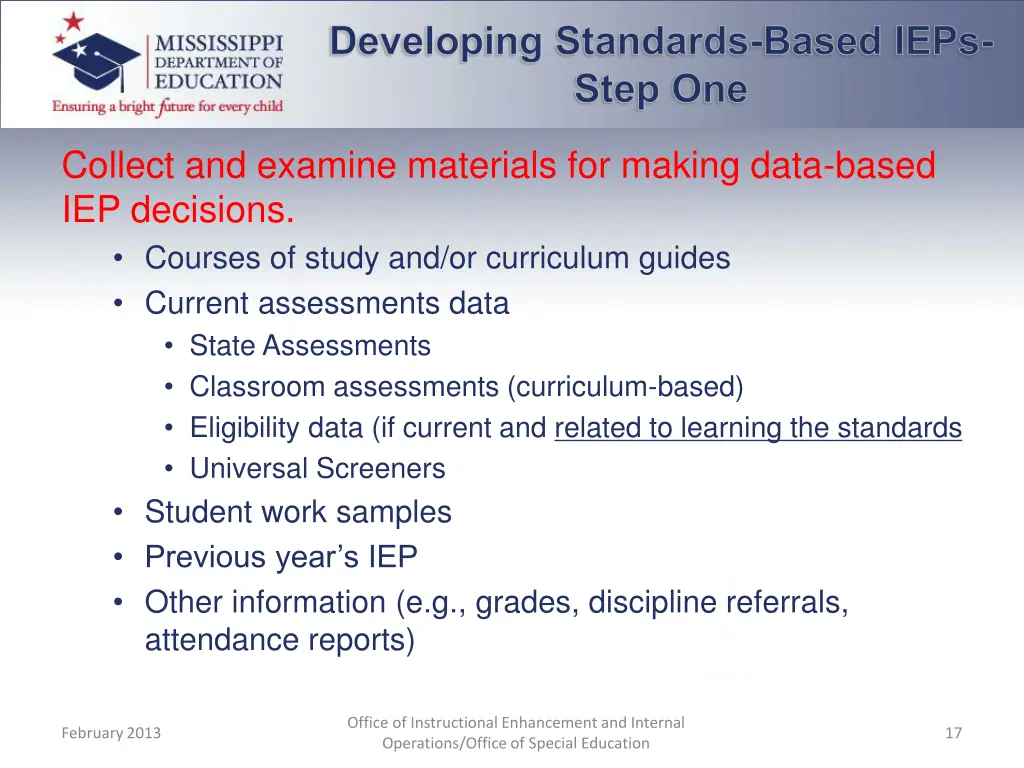
Developing Standards-Based IEPs- Step One Collect and examine materials for making data-based IEP decisions. Courses of study and/or curriculum guides Current assessments data State Assessments Classroom assessments (curriculum-based) Eligibility data (if current and related to learning the standards Universal Screeners Student work samples Previous year s IEP Other information (e.g., grades, discipline referrals, attendance reports) Office of Instructional Enhancement and Internal Operations/Office of Special Education February 2013 17
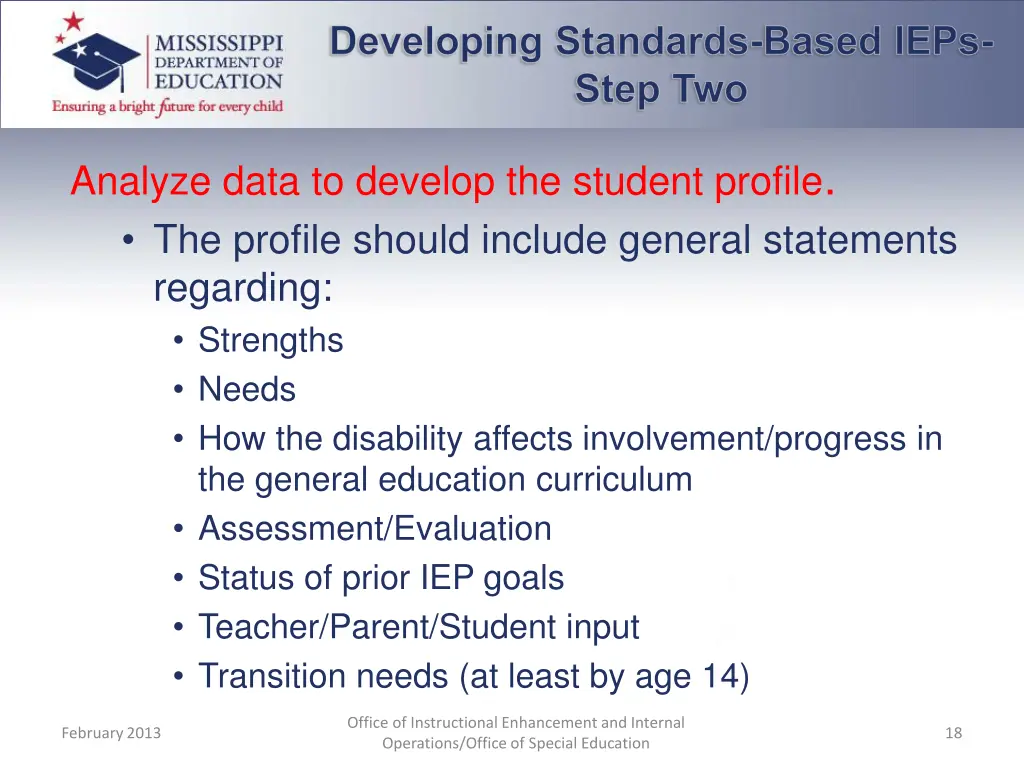
Developing Standards-Based IEPs- Step Two Analyze data to develop the student profile. The profile should include general statements regarding: Strengths Needs How the disability affects involvement/progress in the general education curriculum Assessment/Evaluation Status of prior IEP goals Teacher/Parent/Student input Transition needs (at least by age 14) Office of Instructional Enhancement and Internal Operations/Office of Special Education February 2013 18
Developing Standards-Based IEPs- Step Three Use data to summarize the present level. The present level answers the question: What is the student doing now? Office of Instructional Enhancement and Internal Operations/Office of Special Education February 2013 19
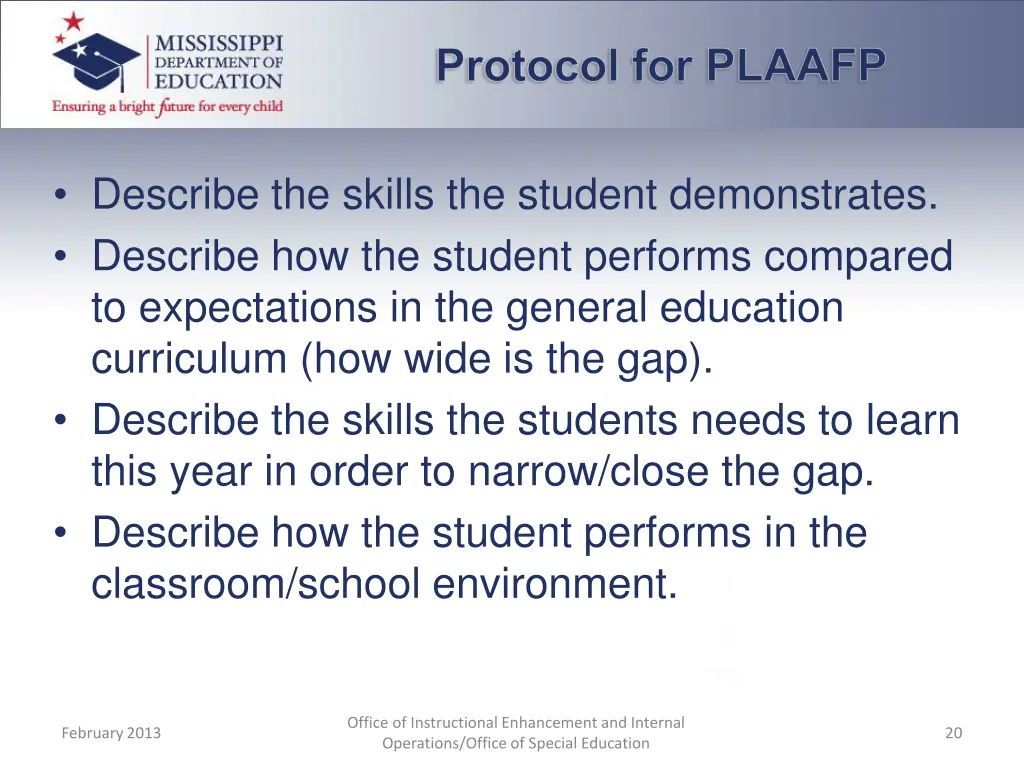
Protocol for PLAAFP Describe the skills the student demonstrates. Describe how the student performs compared to expectations in the general education curriculum (how wide is the gap). Describe the skills the students needs to learn this year in order to narrow/close the gap. Describe how the student performs in the classroom/school environment. Office of Instructional Enhancement and Internal Operations/Office of Special Education February 2013 20
Protocol for PLAAFP Describe effective accommodations that support this student. Describe the student s interest and preferences that are motivators. Identify what you will measure to assess progress and collect baseline data (measureable/observable data). Office of Instructional Enhancement and Internal Operations/Office of Special Education February 2013 21
PLAAFP Purposes To provide a summary of baseline information that indicates the student s academic achievement (focuses on student s learning/progressing in the general curriculum) To identify current functional performance (focuses on student accessing the general curriculum) To provide an explanation of how the disability affects the student s involvement/progress in participating in the general curriculum Office of Instructional Enhancement and Internal Operations/Office of Special Education February 2013 22
PLAAFP Characteristics Standards-centered Data-driven Understandable Measureable Office of Instructional Enhancement and Internal Operations/Office of Special Education February 2013 23
PLAAFP Components Strengths Needs How the student s disability affects performance in the general education curriculum (for preschool children, how the disability affects the child s participation in age-appropriate activities.) Office of Instructional Enhancement and Internal Operations/Office of Special Education February 2013 24
PLAAFP Strengths Student s response to: Learning Strategies Accommodations Interventions Standards Instruction Ask What have we learned about this student s strengths? Office of Instructional Enhancement and Internal Operations/Office of Special Education February 2013 25
PLAAFP Needs Focus on needs that affect progress in the general education curriculum Ask What prerequisite skills/knowledge does the student need to close the gap between his/her present level and the grade-level content standards? Office of Instructional Enhancement and Internal Operations/Office of Special Education February 2013 26
PLAAFP How the disability affects performance? Consider how the student s disability affects progress in learning the grade-level content standards Example: Tasha s difficulties retrieving information may negatively impact her progress in achieving reading standards that include synonyms, antonyms, and multiple-meaning words. Office of Instructional Enhancement and Internal Operations/Office of Special Education February 2013 27
PLAAFP DO NOT use the student s exceptionality to explain how the disability affects involvement/progress in the general curriculum! Example of what NOT to write Mark s learning disability affects his progress in the general curriculum. Example of what to write Mark s weakness in applying strategies, such as making inferences and making complex predictions, affect his progress in comprehending sixth grade literary materials. Office of Instructional Enhancement and Internal Operations/Office of Special Education February 2013 28
Content Standards Legend for IEPs Subject Grade-level Content standard Objective Standard R 4.3 Use a wide range of strategies including distinguishing fiction from nonfiction and making inferences, to comprehend fourth- grade recreational reading materials in a variety of genres. R 4.3.4 Draw conclusions Office of Instructional Enhancement and Internal Operations/Office of Special Education February 2013 29
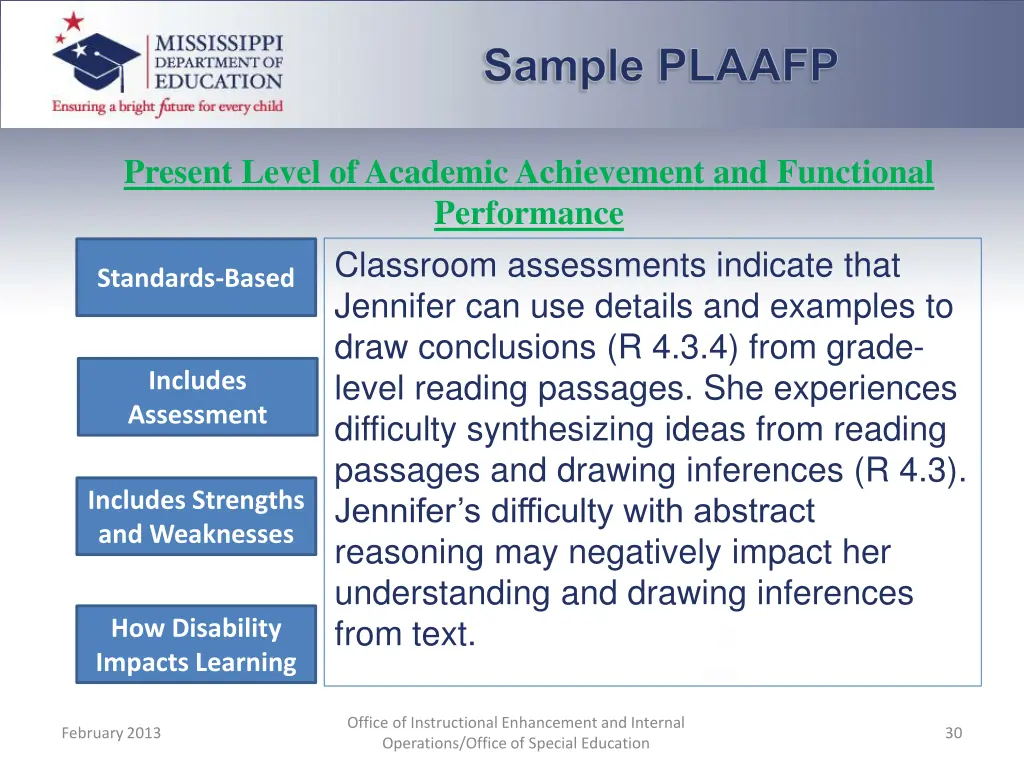
Sample PLAAFP Present Level of Academic Achievement and Functional Performance Classroom assessments indicate that Jennifer can use details and examples to draw conclusions (R 4.3.4) from grade- level reading passages. She experiences difficulty synthesizing ideas from reading passages and drawing inferences (R 4.3). Jennifer s difficulty with abstract reasoning may negatively impact her understanding and drawing inferences from text. Standards-Based Includes Assessment Includes Strengths and Weaknesses How Disability Impacts Learning Office of Instructional Enhancement and Internal Operations/Office of Special Education February 2013 30
PLAAFP Remember The present level of academic achievement and functional performance sets the stage for developing IEP goals! Office of Instructional Enhancement and Internal Operations/Office of Special Education February 2013 31
Developing Standards-Based IEPs- Step Four Write annual goals Purpose To describe what a student can reasonably expect to accomplish in one school year Annual Goals answer the question What should the student be doing? Office of Instructional Enhancement and Internal Operations/Office of Special Education February 2013 32
Annual Goals Annual goals are related to needs resulting from the student s disability that directly affect involvement and progress in the general education curriculum. Office of Instructional Enhancement and Internal Operations/Office of Special Education February 2013 33
Select Skills to Assess Not all standards are created equal! Select the most powerful standards to address, such as those that will: Target foundational skills; Target high leverage skills; and Move the student closer to long-term goals. Writing IEPs That Align to Common Core Standards by Carol Kosnitsky Office of Instructional Enhancement and Internal Operations/Office of Special Education February 2013 34
Annual Goals If a large number of needs are identified in the present level, the IEP Team must consider how each need impacts the students progress in the general education curriculum. Select the need that has the greatest impact on progress, and develop a goal to address that need. Aligning IEPs to Common Core State Standards for Students with Moderate and Severe Disabilities by authors Ginevra Countade and Diane Browder Office of Instructional Enhancement and Internal Operations/Office of Special Education February 2013 35
Selecting the Content Standards Consider content standards Look at all grade-level content standards Discuss intent of standard Determine which standards are most important for each student (based on progress in the general education curriculum) Compare standard(s) with student s areas of needs and the impact of the disability Use data to determine the areas that student will find difficult without additional supports Office of Instructional Enhancement and Internal Operations/Office of Special Education February 2013 36
Annual Goals Remember The IEP goal is NOT the content standard. Do not copy the content standard word for word to become an IEP goal. The IEP goal is part of a plan to make the content standard immediate and individualized for the student. Office of Instructional Enhancement and Internal Operations/Office of Special Education February 2013 37
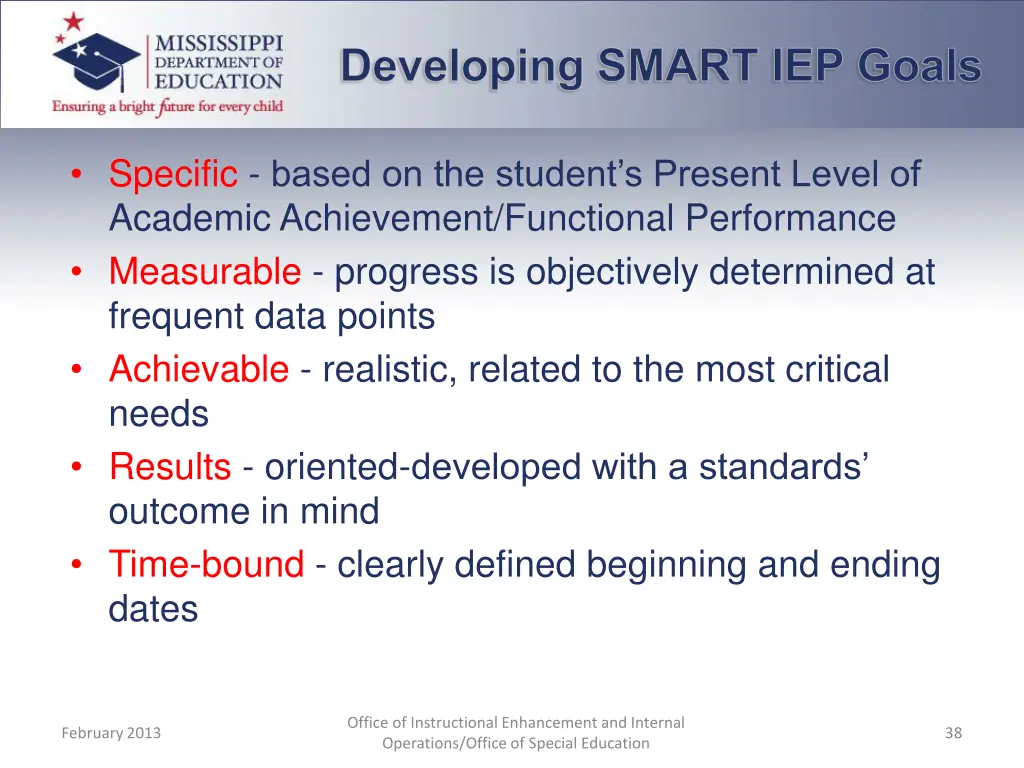
Developing SMART IEP Goals Specific - based on the student s Present Level of Academic Achievement/Functional Performance Measurable - progress is objectively determined at frequent data points Achievable - realistic, related to the most critical needs Results - oriented-developed with a standards outcome in mind Time-bound - clearly defined beginning and ending dates Office of Instructional Enhancement and Internal Operations/Office of Special Education February 2013 38
Standards-Based IEPs: Impact on Teaching and Learning Curriculum and Instruction IEPs Eligibility Teachers Professional Development Assessment Areas of Continued Work Office of Instructional Enhancement and Internal Operations/Office of Special Education February 2013 39
Challenge to Teachers Coming together is a beginning; Learning together is progress; Working together is success. Henry Ford Office of Instructional Enhancement and Internal Operations/Office of Special Education February 2013 40
Questions/Answers Office of Instructional Enhancement and Internal Operations/Office of Special Education February 2013 41
CONTACT INFORMATION M. Pleshette Smith mcsmith@mde.k12.ms.us Desma McElveen dmcelveen@mde.k12.ms.us Tanya Bradley tbradley@mde.k12.ms.us Office of Special Education Division of Technical Assistance (601) 359-3498 Office of Instructional Enhancement and Internal Operations/Office of Special Education February 2013 42