State Space Analysis and Controller Design for EEE Students
Dive into the world of state space analysis and controller design with a focus on ordinary differential equations, system properties, and dynamics. Enhance your mathematical skills and understanding of control theory in this comprehensive module led by Dr. Damian Giaouris at Newcastle University.

Download Presentation

Please find below an Image/Link to download the presentation.
The content on the website is provided AS IS for your information and personal use only. It may not be sold, licensed, or shared on other websites without obtaining consent from the author. If you encounter any issues during the download, it is possible that the publisher has removed the file from their server.
You are allowed to download the files provided on this website for personal or commercial use, subject to the condition that they are used lawfully. All files are the property of their respective owners.
The content on the website is provided AS IS for your information and personal use only. It may not be sold, licensed, or shared on other websites without obtaining consent from the author.
E N D
Presentation Transcript
EEE3001 EEE8013 State Space Analysis and Controller Design Module Leader: Dr Damian Giaouris Damian.Giaouris@ncl.ac.uk
Goals/Aims State Space Analysis and Controller Design 1. Analysis (Modelling) 2. Controller Design 3. State Space
EEE8013/3001 Requires good mathematical skills. Starts assuming that most students have a light background on control theory. Requires continuous study and work. Does not rely only on PowerPoint presentations. Most material will be uploaded at: https://www.staff.ncl.ac.uk/damian.giaouris/teaching.html
Do Not Forget There are NO stupid questions, there are ONLY stupid answers!!!!!!!!!!!
Syllabus Ordinary differential equations Introduction to state space (+ Observability/Controllability) Solution of state space models Controller Design State space transformations and Normal forms
Chapter 1 Ordinary Differential Equations First Order ODEs Second Order
Chapter 1 summary To understand the properties (dynamics) of a system, we can model (represent) it using differential equations (DEs). The response/behaviour of the system is found by solving the DEs.
Goals/Aims of Chapter 1 Introduction Revision of 1st order dynamics 2nd order dynamics
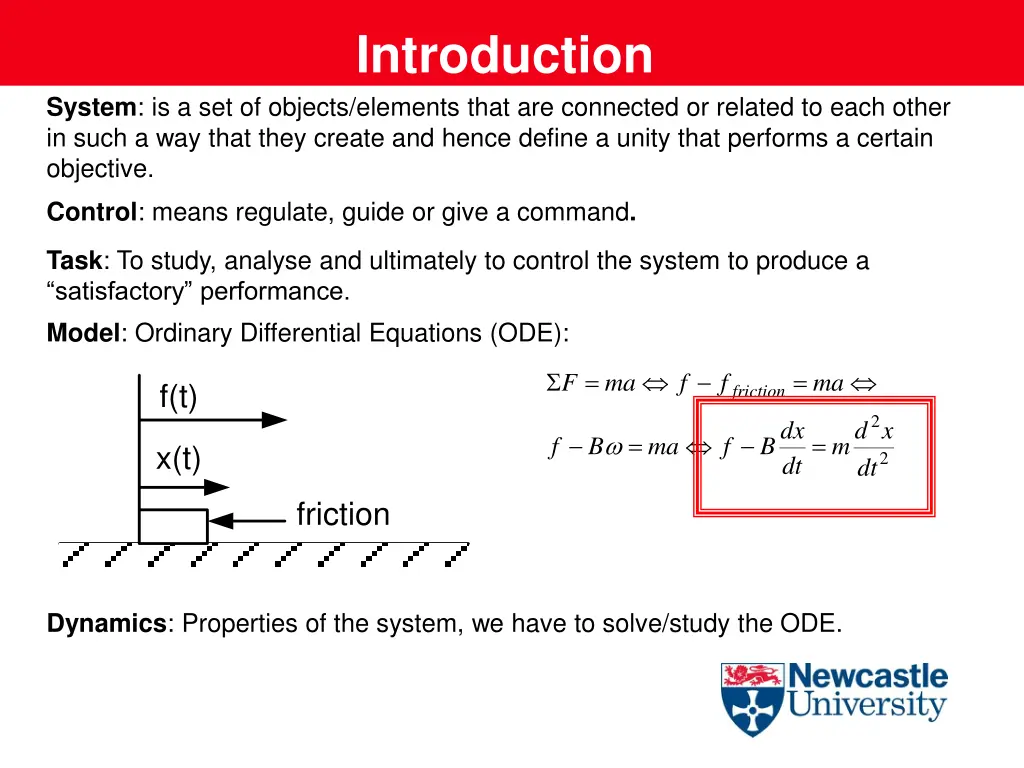
Introduction System: is a set of objects/elements that are connected or related to each other in such a way that they create and hence define a unity that performs a certain objective. Control: means regulate, guide or give a command. Task: To study, analyse and ultimately to control the system to produce a satisfactory performance. Model: Ordinary Differential Equations (ODE): = = F ma f f ma f(t) friction 2 dx d x = = f B ma f B m x(t) 2 dt dt friction Dynamics: Properties of the system, we have to solve/study the ODE.
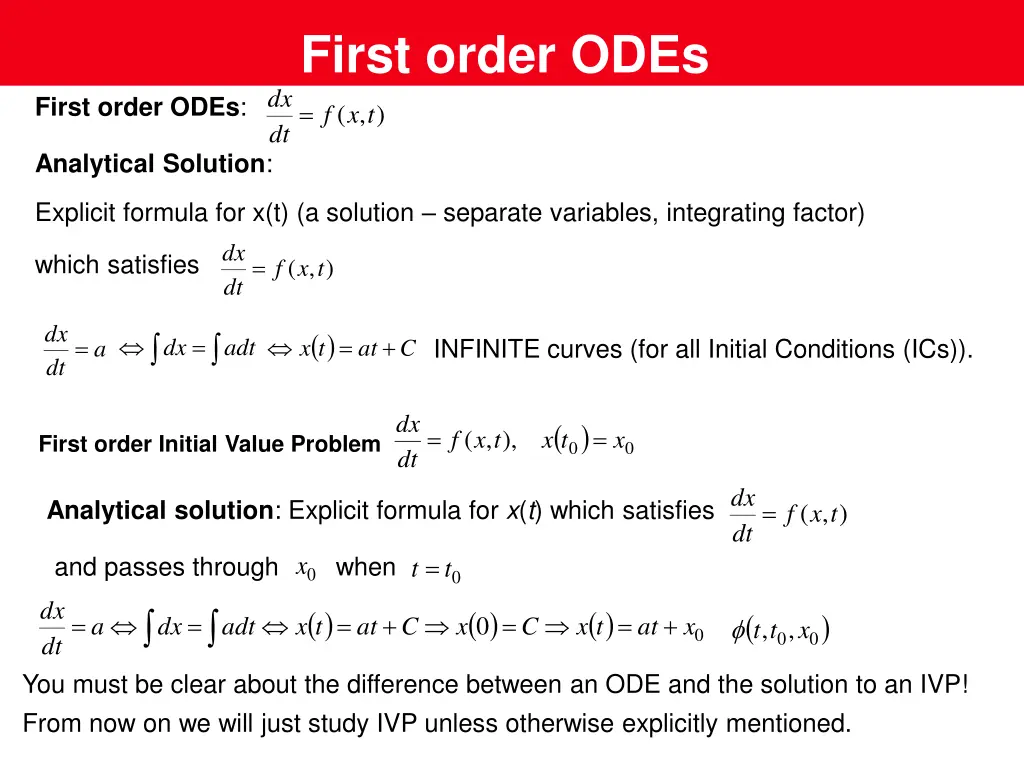
First order ODEs dx= First order ODEs: ( t x , ) f dt Analytical Solution: Explicit formula for x(t) (a solution separate variables, integrating factor) dx= which satisfies ( t x , ) f dt dx= ( ) t = = + INFINITE curves (for all Initial Conditions (ICs)). dx adt x at C a dt dx ( ) 0 t = = ( , ), f x t x x First order Initial Value Problem 0 dt dx= Analytical solution: Explicit formula for x(t) which satisfies ( t x , ) f dt 0x t = and passes through when 0t dx ( ) t ( ) 0 ( ) t ( ) = = = + = = + a dx adt x at C x C x at x , 0, t t x 0 0 dt You must be clear about the difference between an ODE and the solution to an IVP! From now on we will just study IVP unless otherwise explicitly mentioned.
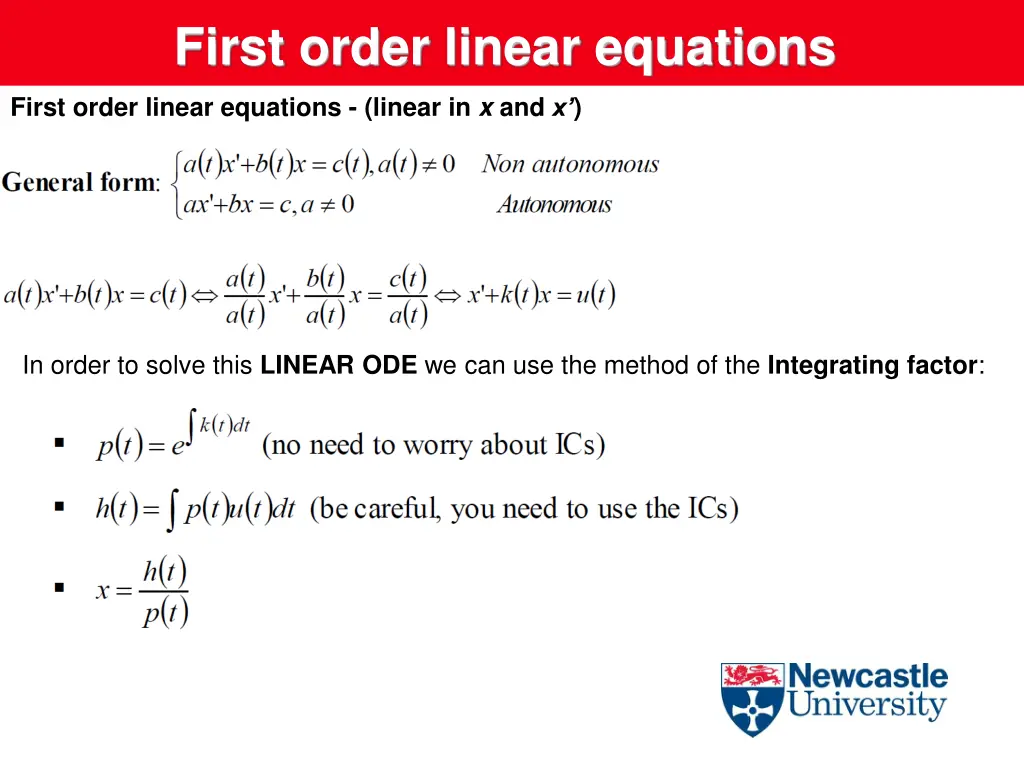
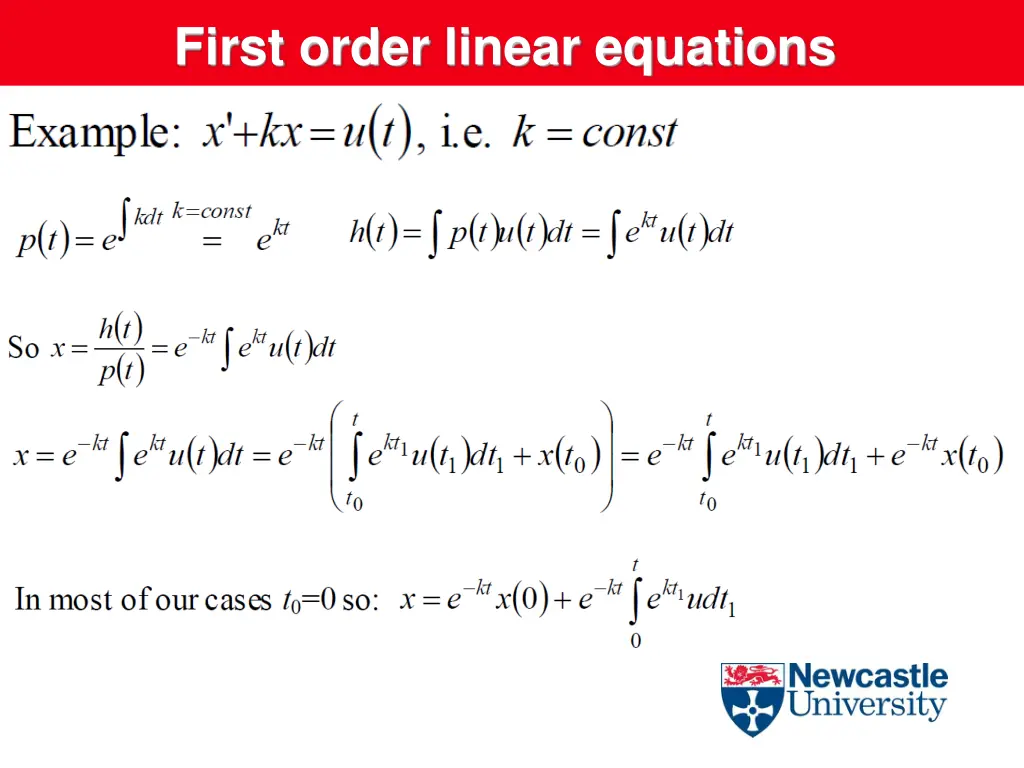
First order linear equations First order linear equations - (linear in x and x ) In order to solve this LINEAR ODE we can use the method of the Integrating factor:
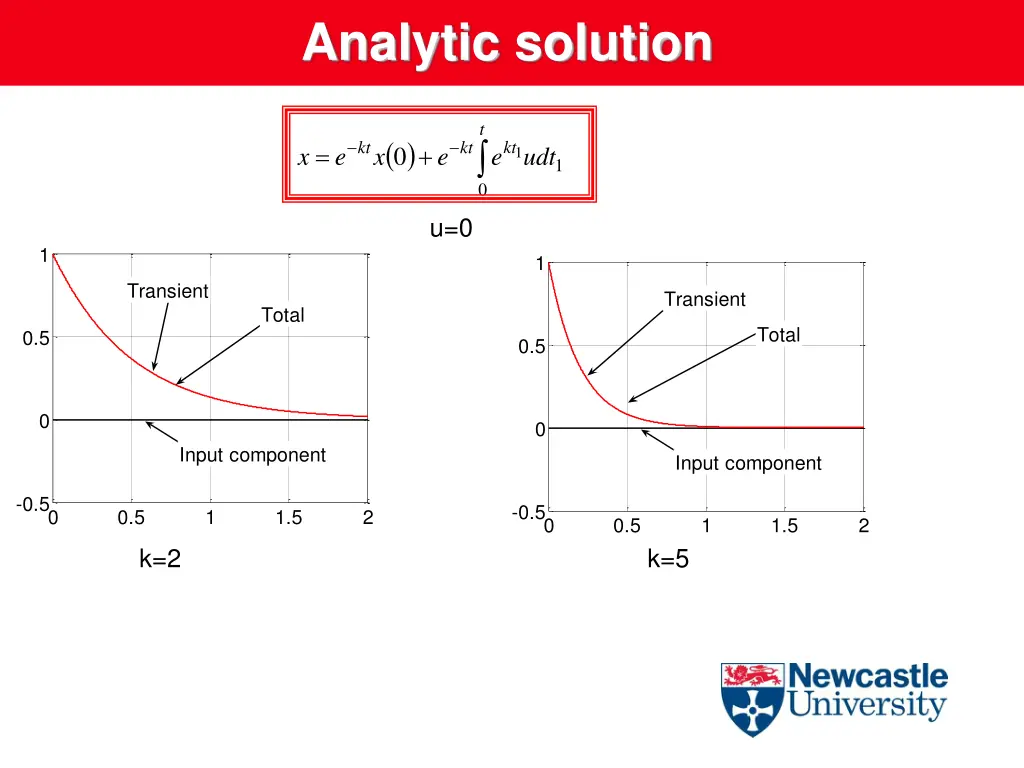
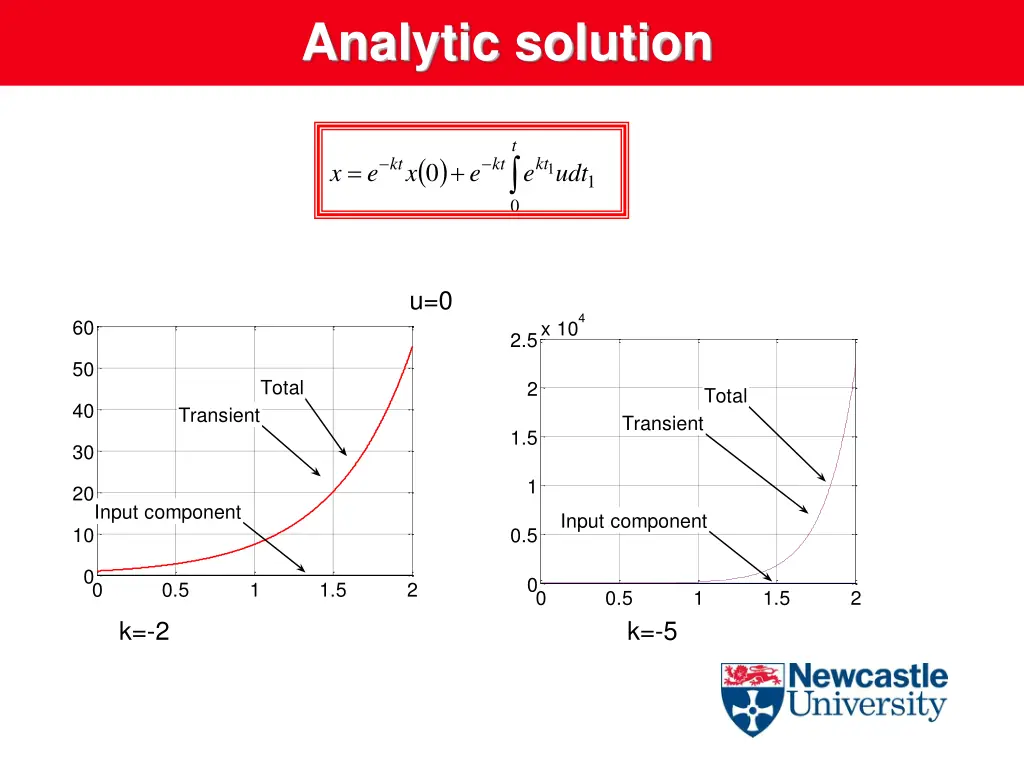
Analytic solution t ( ) 0 0 kt kt kt = + x e x e e udt 1 1 u=0 1 1 Transient Transient Total Total 0.5 0.5 0 0 Input component Input component -0.5 -0.5 0 0.5 1 1.5 2 0 0.5 1 1.5 2 k=2 k=5
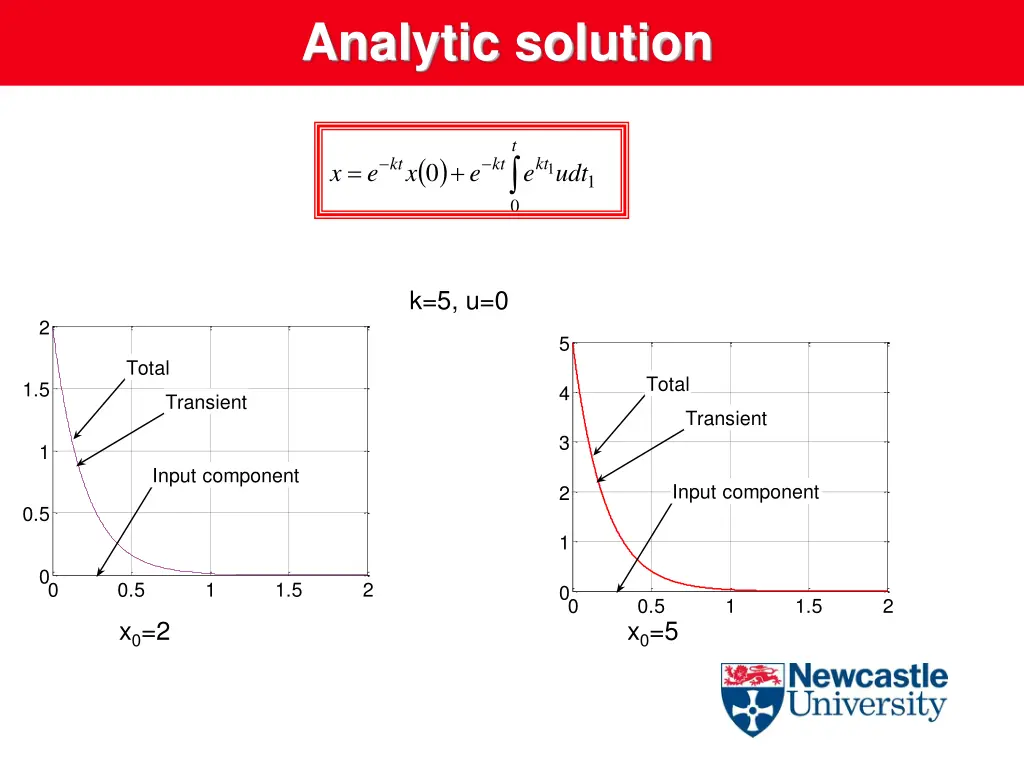
Analytic solution t ( ) 0 0 kt kt kt = + x e x e e udt 1 1 u=0 4 60 2.5x 10 50 Total 2 Total 40 Transient Transient 1.5 30 1 20 Input component Input component 10 0.5 0 0 0 0.5 1 1.5 2 0 0.5 1 1.5 2 k=-2 k=-5
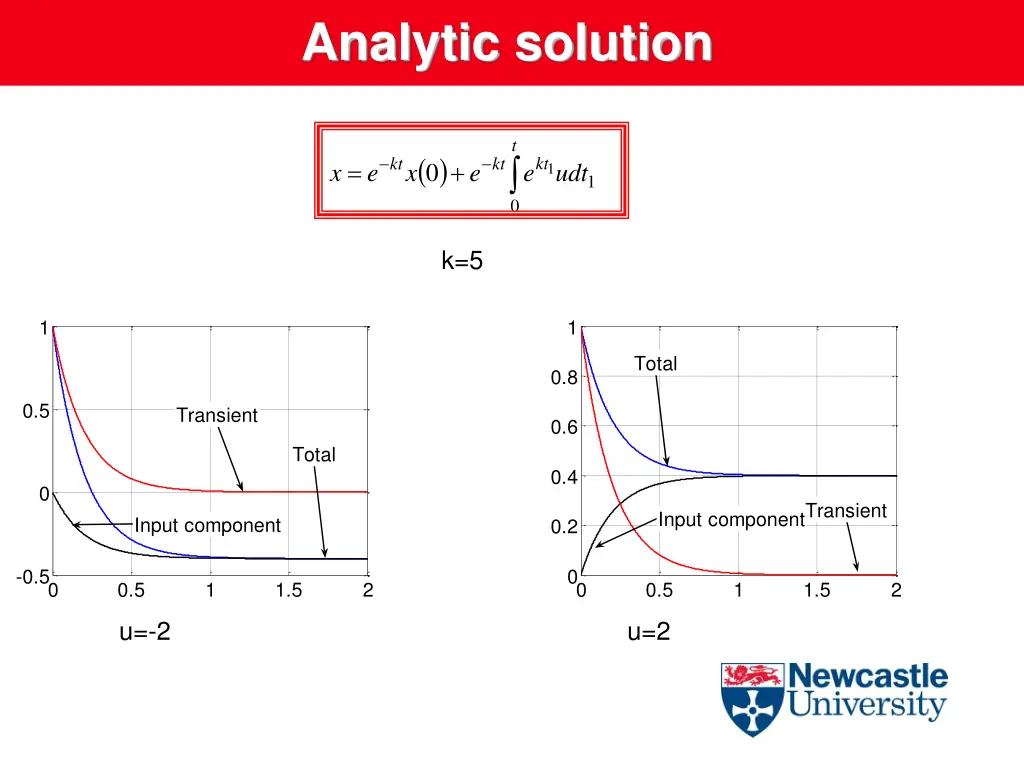
Analytic solution t ( ) 0 0 kt kt kt = + x e x e e udt 1 1 k=5, u=0 2 5 Total Total 1.5 4 Transient Transient 3 1 Input component Input component 2 0.5 1 0 0 0.5 1 1.5 2 0 0 0.5 1 1.5 2 x0=2 x0=5
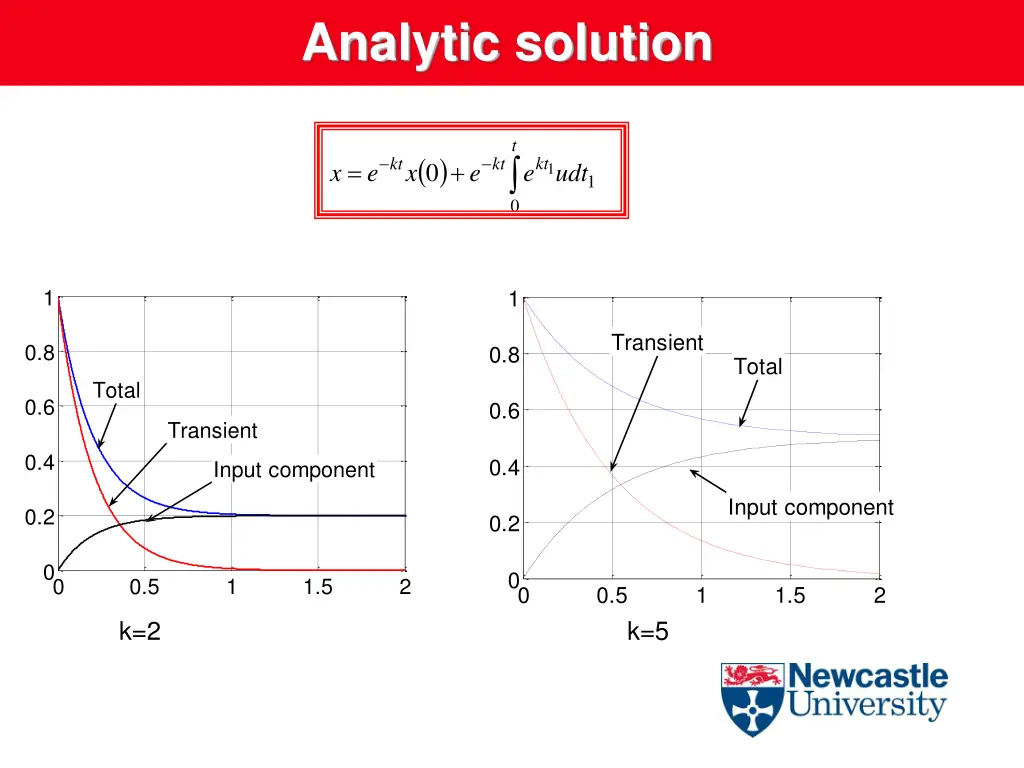
Analytic solution t ( ) 0 0 kt kt kt = + x e x e e udt 1 1 k=5 1 1 Total 0.8 0.5 Transient 0.6 Total 0.4 0 Transient Input component Input component 0.2 -0.5 0 0 0.5 1 1.5 2 0 0.5 1 1.5 2 u=-2 u=2
Analytic solution t ( ) 0 0 kt kt kt = + x e x e e udt 1 1 1 1 Transient 0.8 0.8 Total Total 0.6 0.6 Transient 0.4 0.4 Input component Input component 0.2 0.2 0 0 0 0.5 1 1.5 2 0 0.5 1 1.5 2 k=2 k=5
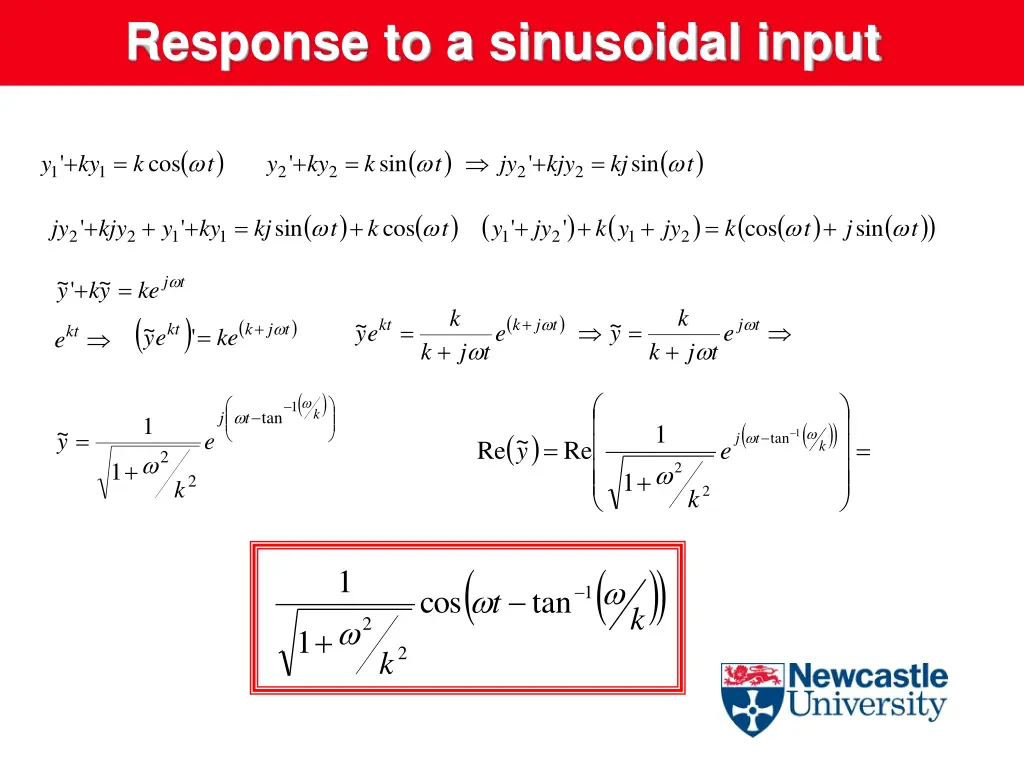
Response to a sinusoidal input ( ) t ( ) t ( ) t + = + = + = ' cos ' sin ' sin y ky k y ky k jy kjy kj 1 1 2 2 2 2 ( ) ( ) t ( ) ( ) ( ( ) ( ) ) + + + = + + + + = + ' ' sin cos ' ' cos sin jy kjy y ky kj t k y jy k y jy k t j t 2 2 1 1 1 2 1 2 y k +~ '~ j t = y ke ( y ) = ' k k ( ) t y ~ y ~ ( ) t + j t kt k j ~ = = + e e e kt k j kt e ke e + + k j t k j t ( ) 1 k tan j t 1 ( ( ) ) y ~ 1 ( ) y = ~ 1 e tan j t = = Re Re e k 2 + 1 2 + 1 2 k 2 k ( ( ) ) 1 1 cos tan t k 2 + 1 2 k
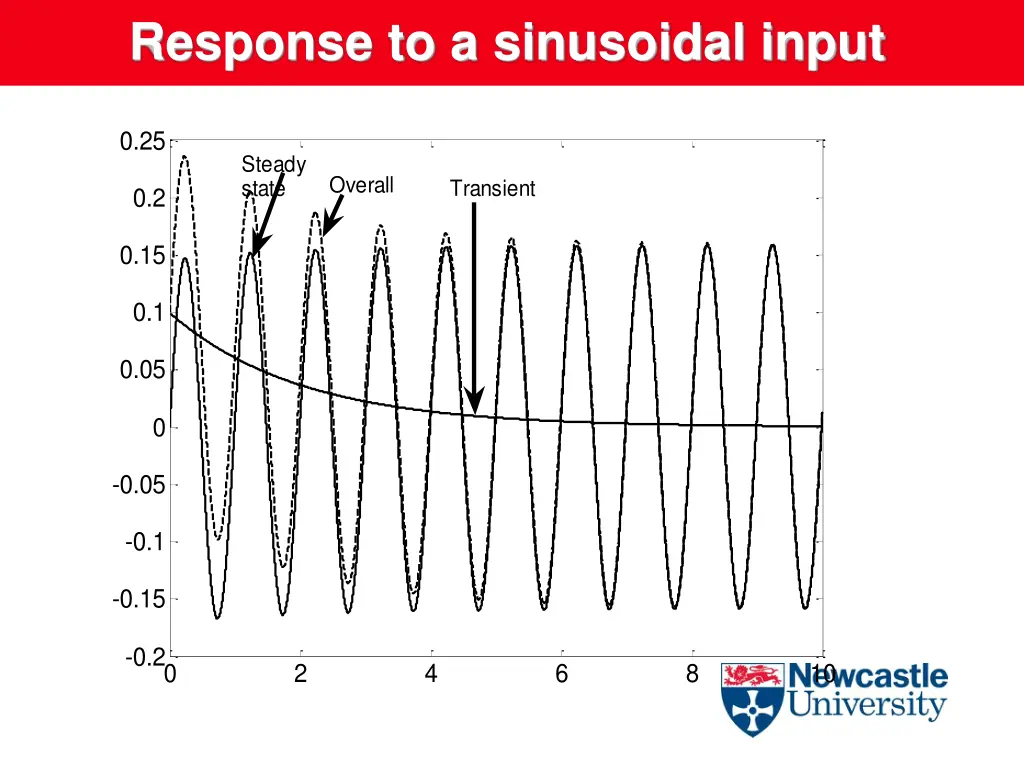
Response to a sinusoidal input 0.25 Steady state Overall Transient 0.2 0.15 0.1 0.05 0 -0.05 -0.1 -0.15 -0.2 0 2 4 6 8 10
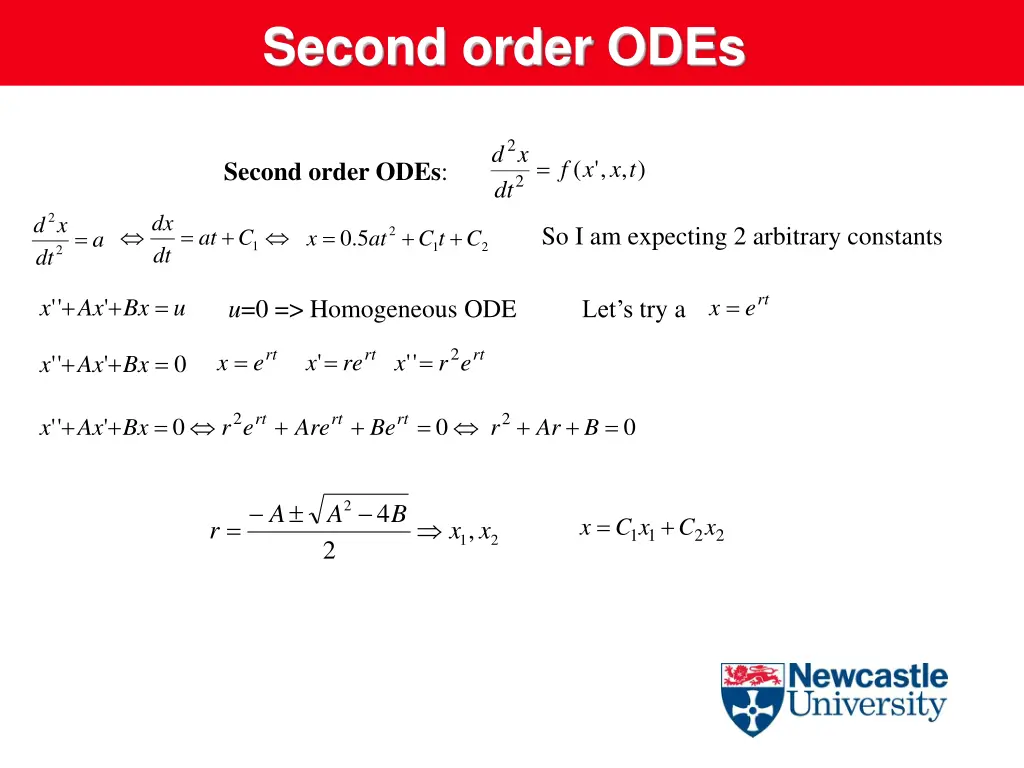
Second order ODEs 2 d x = ( , ' x , ) f x t Second order ODEs: 2 dt dx 2 d x 2 So I am expecting 2 arbitrary constants = + = + + 2 = at C 5 . 0 x at C t C a 1 1 2 dt dt rt + + ' = x = ' ' x Ax Bx u e u=0 => Homogeneous ODE Let s try a 2 rt rt rt x = x = ' ' ' = + + = e re x r e ' ' x ' 0 Ax Bx 2 2 rt rt rt + + ' = + + = + + = ' ' x 0 0 0 Ax Bx r e Are Be r Ar B 2 4 A A B = + = x C x C x , r x x 1 1 2 2 1 2 2
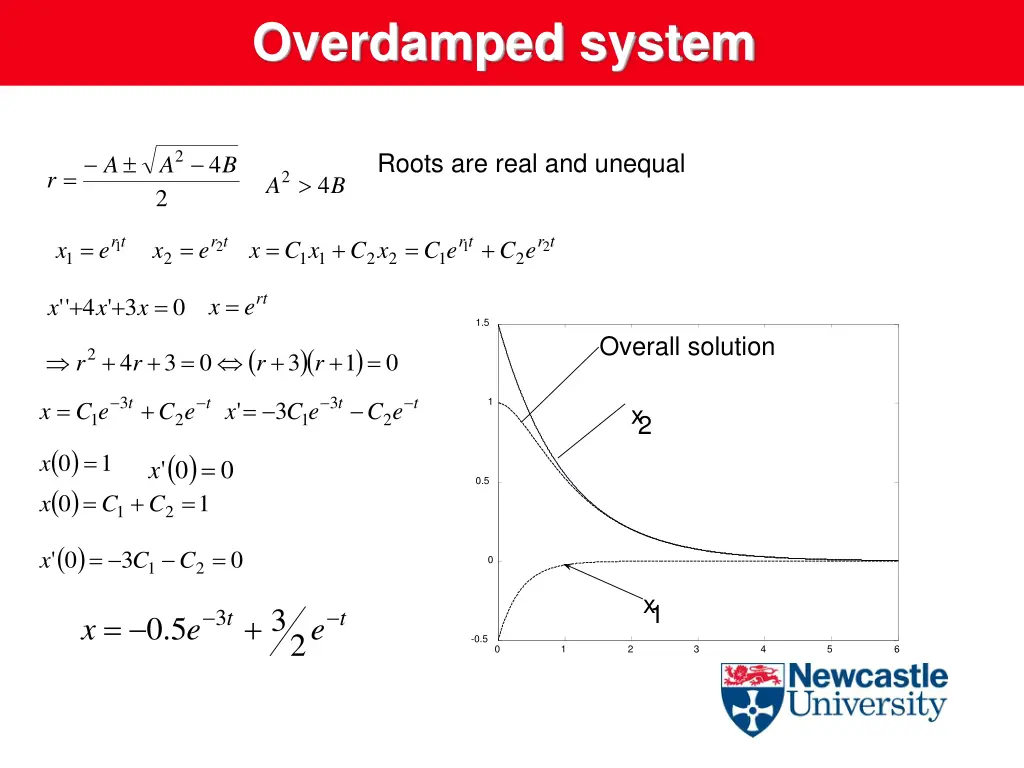
Overdamped system 2 Roots are real and unequal 4 A A B = r 2 4 A B 2 t re r t t r e 1 r t 1= 2= = + = + x x e x C x C x C C e 1 2 1 2 1 1 2 2 2 rt x = + + = e ' ' x 4 ' 3 0 x x 1.5 Overall solution ( )( ) 2 + + = + + = 4 3 0 3 1 0 r r r r 3 3 t t t t = + = 1 ' 3 x C e C e x C e C e x2 1 2 1 2 ( ) 1 0 = ( ) 0 ( ) 0 = x = 1 ' 0 x C 0.5 = + x C 1 2 ( ) 0 = = ' 3 0 x C C 0 1 2 x1 3 3 t t = + 5 . 0 x e e 2 -0.5 0 1 2 3 4 5 6
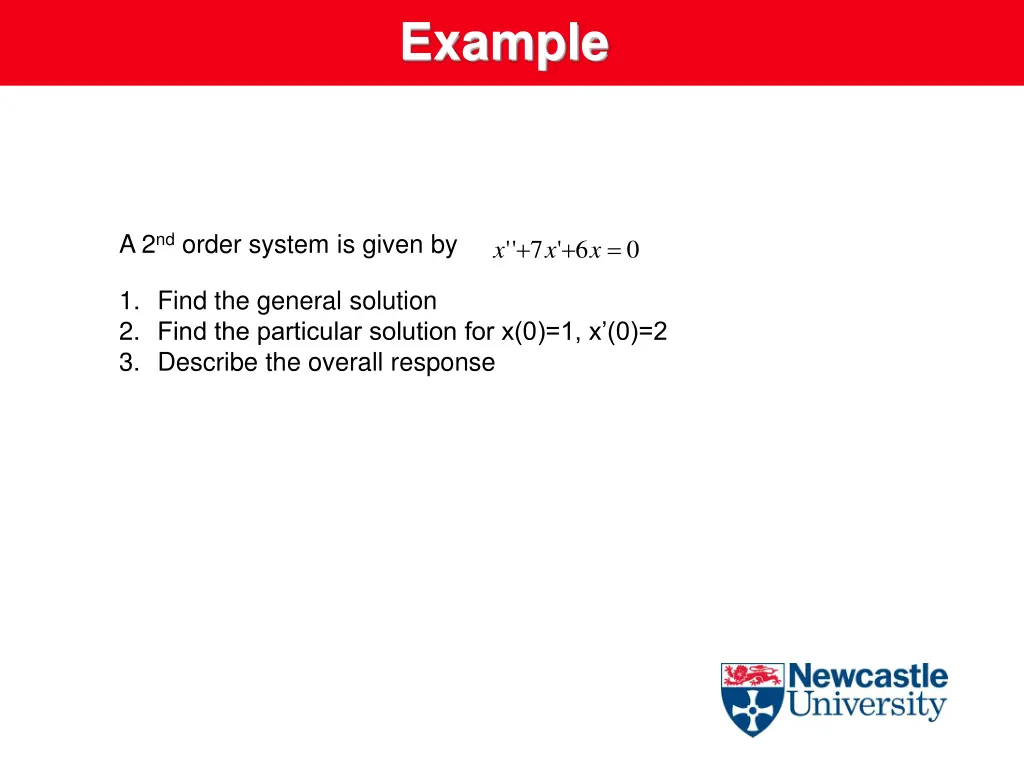
Example A 2nd order system is given by + + = ' ' x 7 ' 6 0 x x 1. Find the general solution 2. Find the particular solution for x(0)=1, x (0)=2 3. Describe the overall response
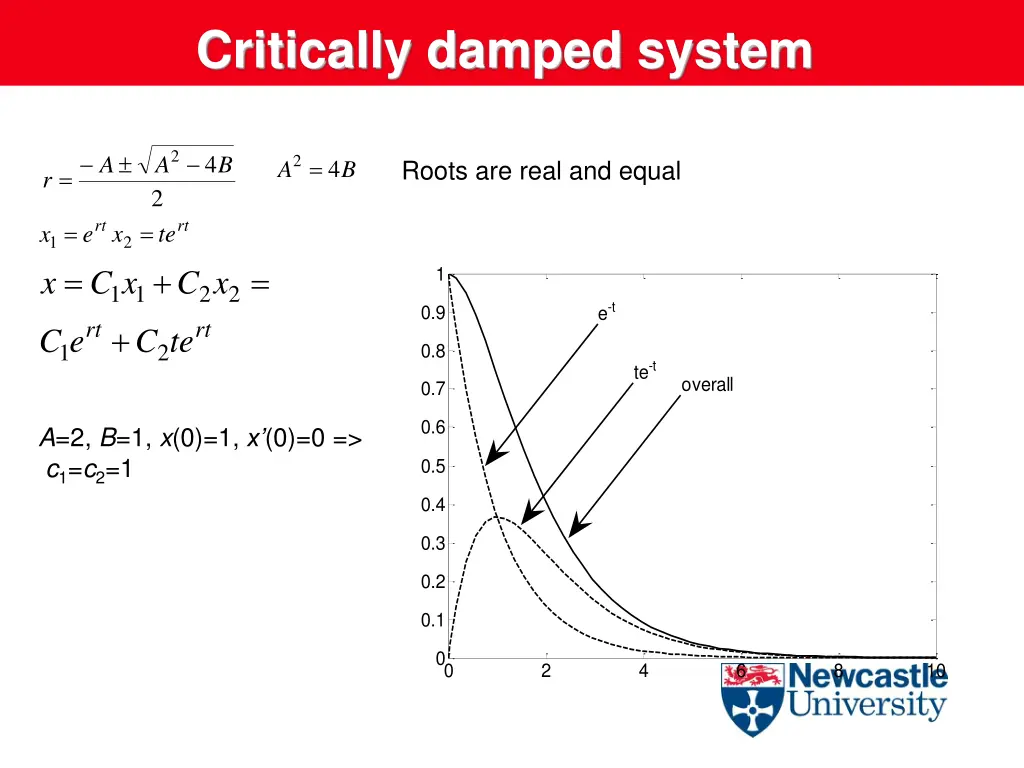
Critically damped system 2 4 A A B 2= Roots are real and equal 4 A B = r 2 rt rt x = 1 x x = 2 x 1 + e te + = = 1 C C x 1 2 2 e-t 0.9 rt rt C e C te 1 2 0.8 te-t overall 0.7 0.6 A=2, B=1, x(0)=1, x (0)=0 => c1=c2=1 0.5 0.4 0.3 0.2 0.1 0 0 2 4 6 8 10
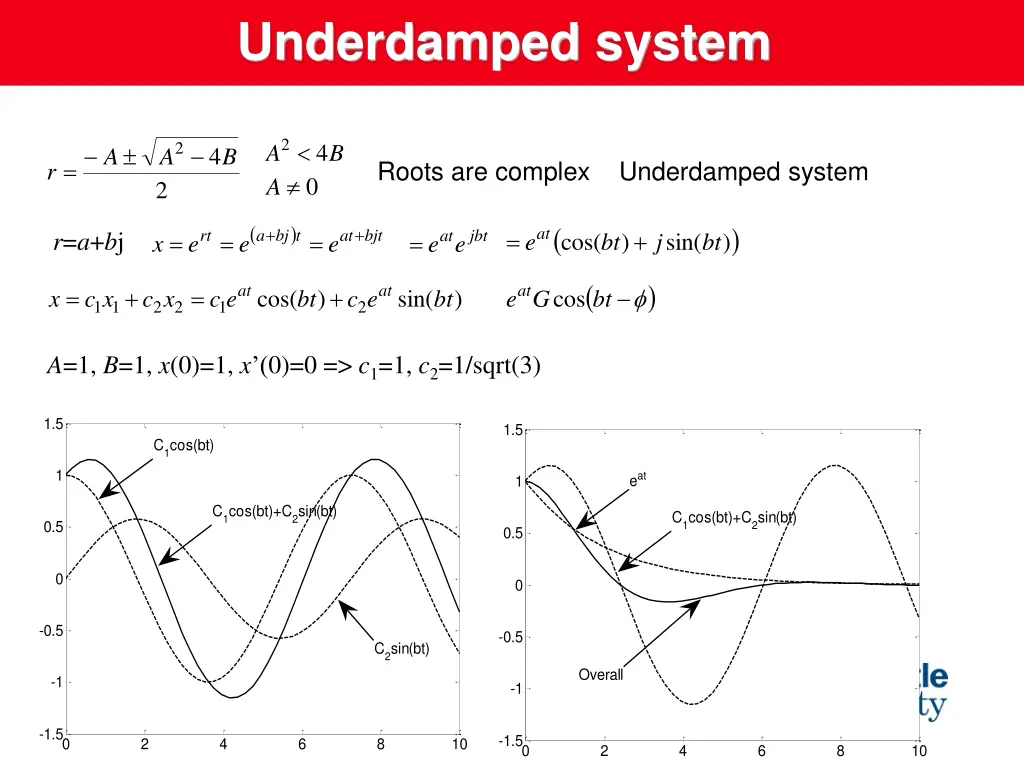
Underdamped system 2 2 4 A A B 4 A A B = Roots are complex Underdamped system r 0 2 ( ) ) ( ) eat + + = + rt a bj t at bjt ate jbt r=a+bj = = = cos( ) sin( = bt j bt x e e e e ( ) at at eat = + = + cos( ) sin( ) cos x c x c x c e bt c e bt G bt 1 1 2 2 1 2 A=1, B=1, x(0)=1, x (0)=0 => c1=1, c2=1/sqrt(3) 1.5 1.5 C1cos(bt) 1 eat 1 C1cos(bt)+C2sin(bt) C1cos(bt)+C2sin(bt) 0.5 0.5 0 0 -0.5 -0.5 C2sin(bt) Overall -1 -1 -1.5 -1.5 0 2 4 6 8 10 0 2 4 6 8 10
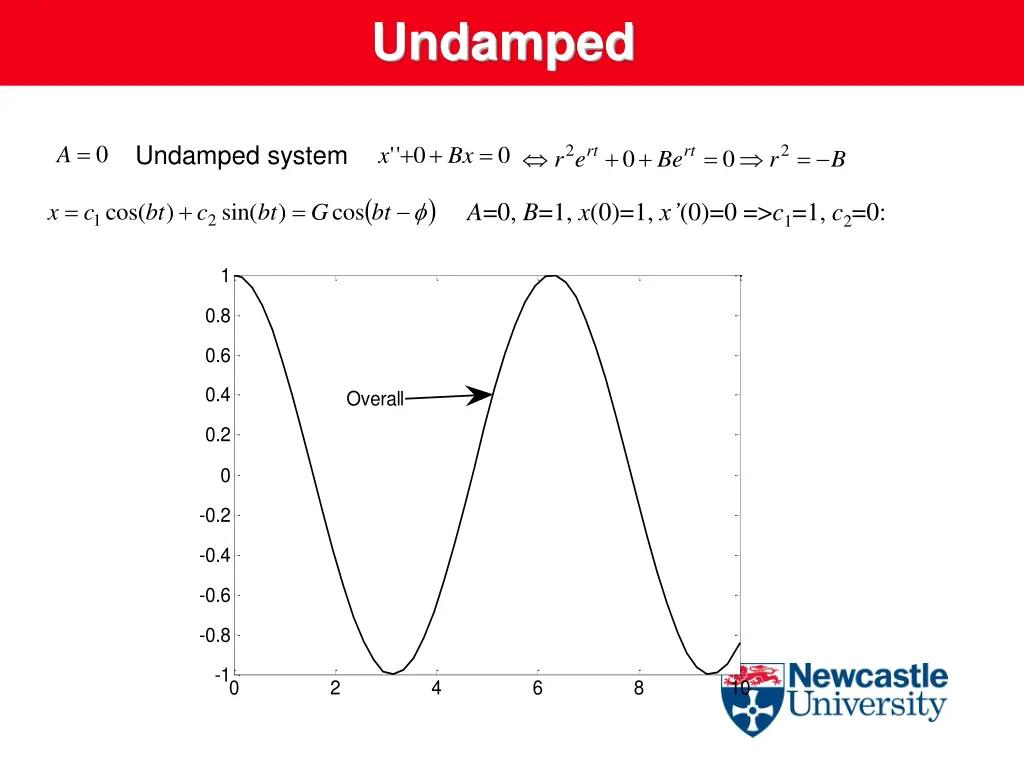
Undamped = + + = Undamped system 0 A 2 2 rt rt ' ' x 0 0 Bx + + = = 0 0 r e Be r B ( ) = + = A=0, B=1, x(0)=1, x (0)=0 =>c1=1, c2=0: cos( ) sin( ) cos x c bt c bt G bt 1 2 1 0.8 0.6 0.4 Overall 0.2 0 -0.2 -0.4 -0.6 -0.8 -1 0 2 4 6 8 10
Summary: 1.Analytical solution of 1st and 2nd order linear systems.