Statistics Classroom Activities and Summaries
Explore a comprehensive agenda covering homework assignments, warm-up activities, project presentations, chapter summaries, and IQ range classifications in a statistics class. Engage in activities like a gallery walk, analyzing data distributions, and discussing individual observations within the classroom. Get insights into percentiles, z-scores, density curves, normal distributions, and more to enhance statistical understanding.

Download Presentation

Please find below an Image/Link to download the presentation.
The content on the website is provided AS IS for your information and personal use only. It may not be sold, licensed, or shared on other websites without obtaining consent from the author. If you encounter any issues during the download, it is possible that the publisher has removed the file from their server.
You are allowed to download the files provided on this website for personal or commercial use, subject to the condition that they are used lawfully. All files are the property of their respective owners.
The content on the website is provided AS IS for your information and personal use only. It may not be sold, licensed, or shared on other websites without obtaining consent from the author.
E N D
Presentation Transcript
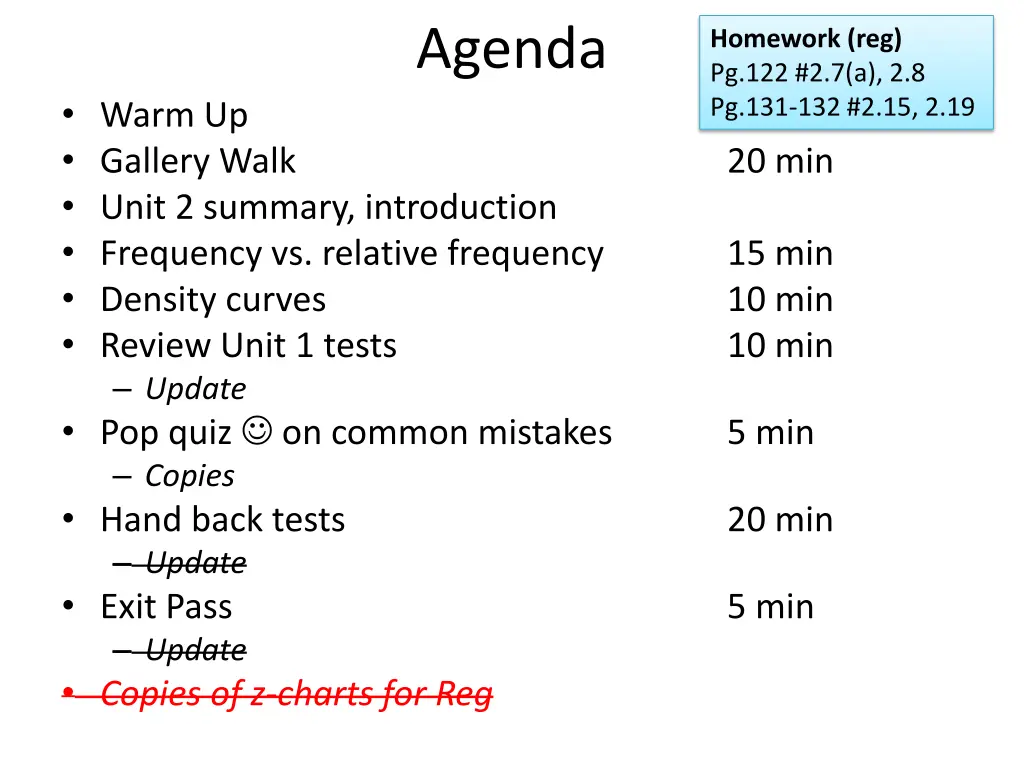
Agenda Homework (reg) Pg.122 #2.7(a), 2.8 Pg.131-132 #2.15, 2.19 Warm Up Gallery Walk Unit 2 summary, introduction Frequency vs. relative frequency Density curves Review Unit 1 tests Update Pop quiz on common mistakes Copies Hand back tests Update Exit Pass Update Copies of z-charts for Reg 10 min 20 min 15 min 10 min 10 min 5 min 20 min 5 min
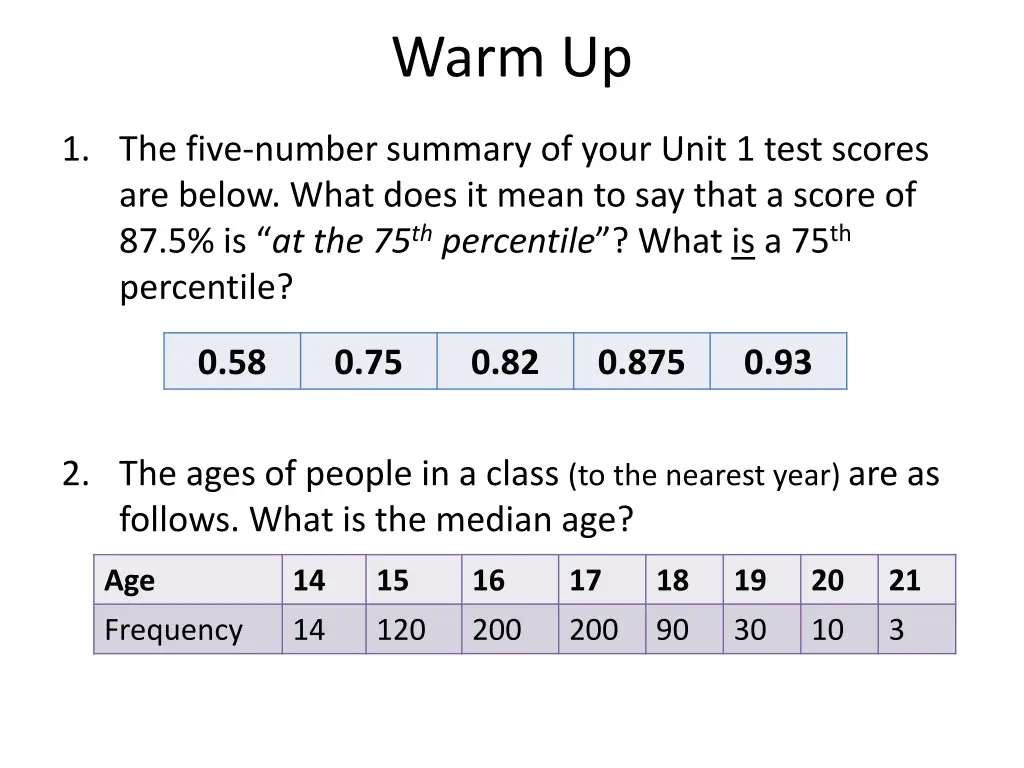
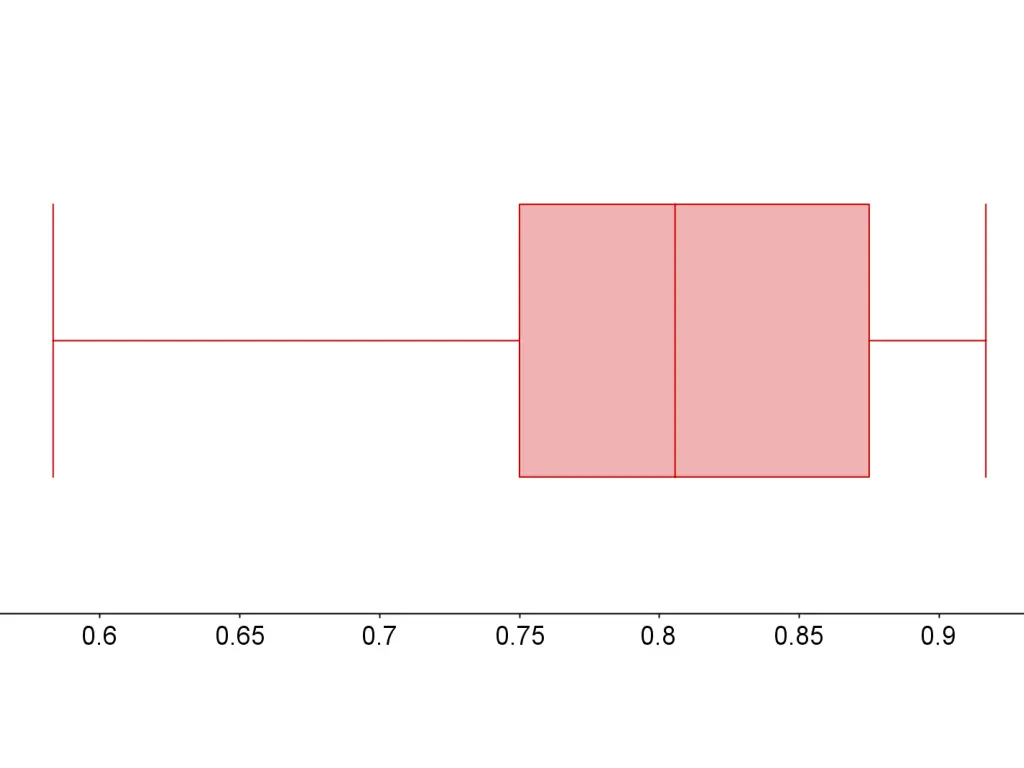
Warm Up 1. The five-number summary of your Unit 1 test scores are below. What does it mean to say that a score of 87.5% is at the 75th percentile ? What is a 75th percentile? 0.58 0.75 0.82 0.875 0.93 2. The ages of people in a class (to the nearest year) are as follows. What is the median age? Age 14 15 16 17 18 19 20 21 Frequency 14 120 200 200 90 30 10 3
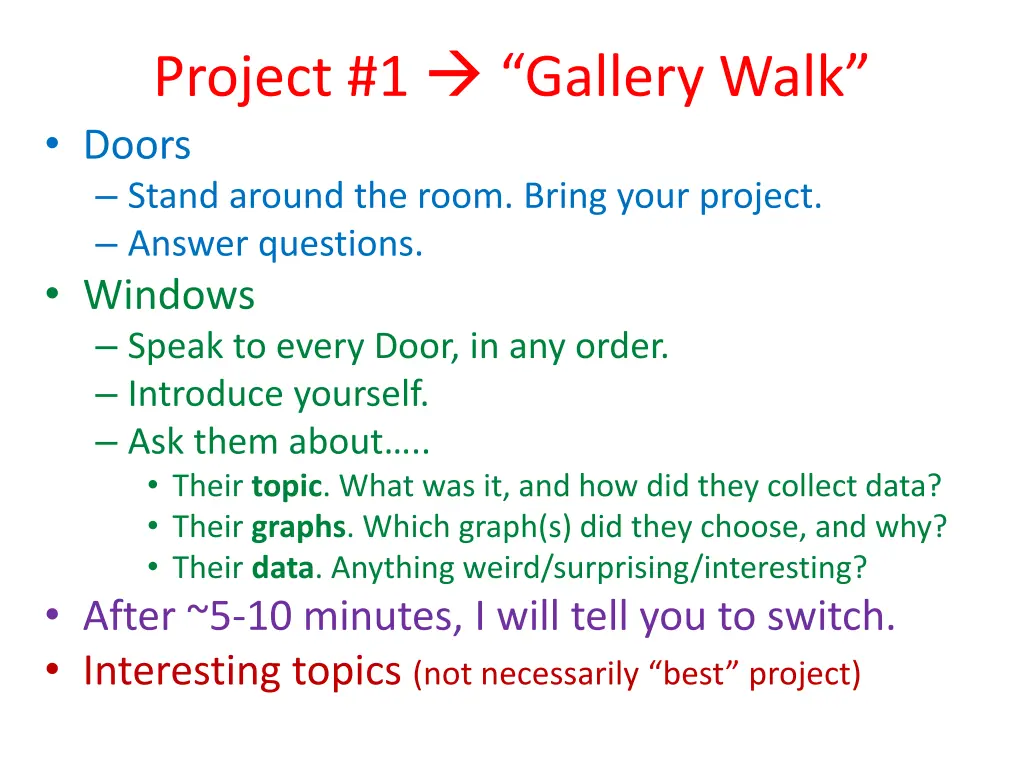
Project #1 Gallery Walk Doors Stand around the room. Bring your project. Answer questions. Windows Speak to every Door, in any order. Introduce yourself. Ask them about .. Their topic. What was it, and how did they collect data? Their graphs. Which graph(s) did they choose, and why? Their data. Anything weird/surprising/interesting? After ~5-10 minutes, I will tell you to switch. Interesting topics (not necessarily best project)
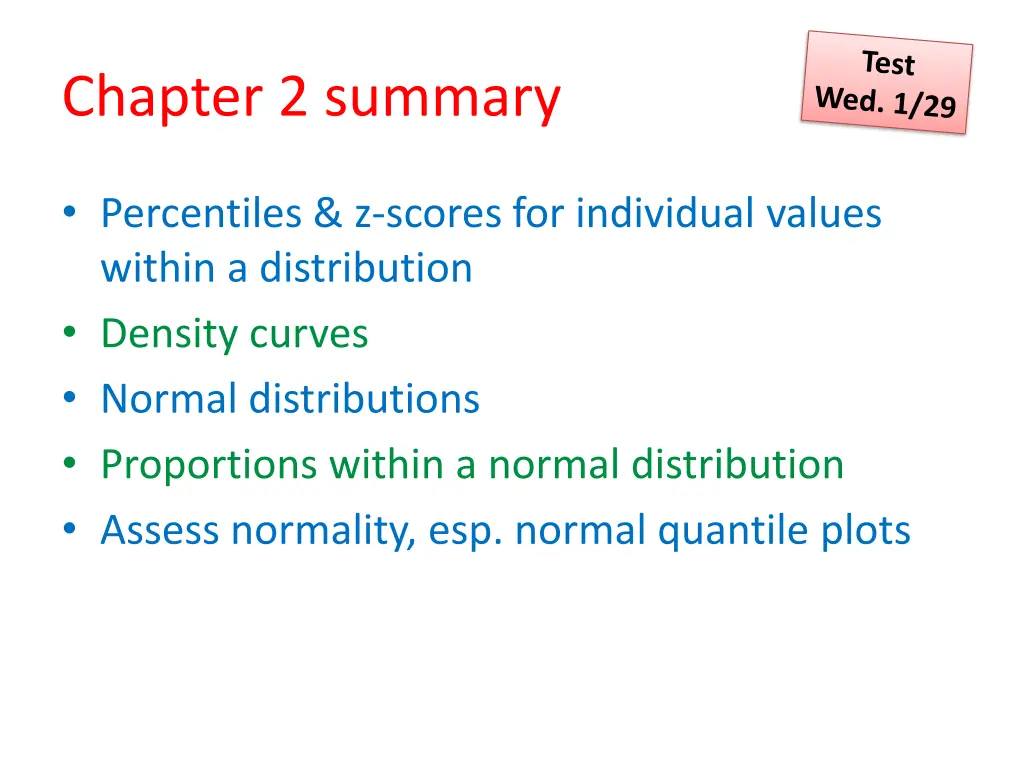
Chapter 2 summary Percentiles & z-scores for individual values within a distribution Density curves Normal distributions Proportions within a normal distribution Assess normality, esp. normal quantile plots
Chapter 2: Location in a Distribution
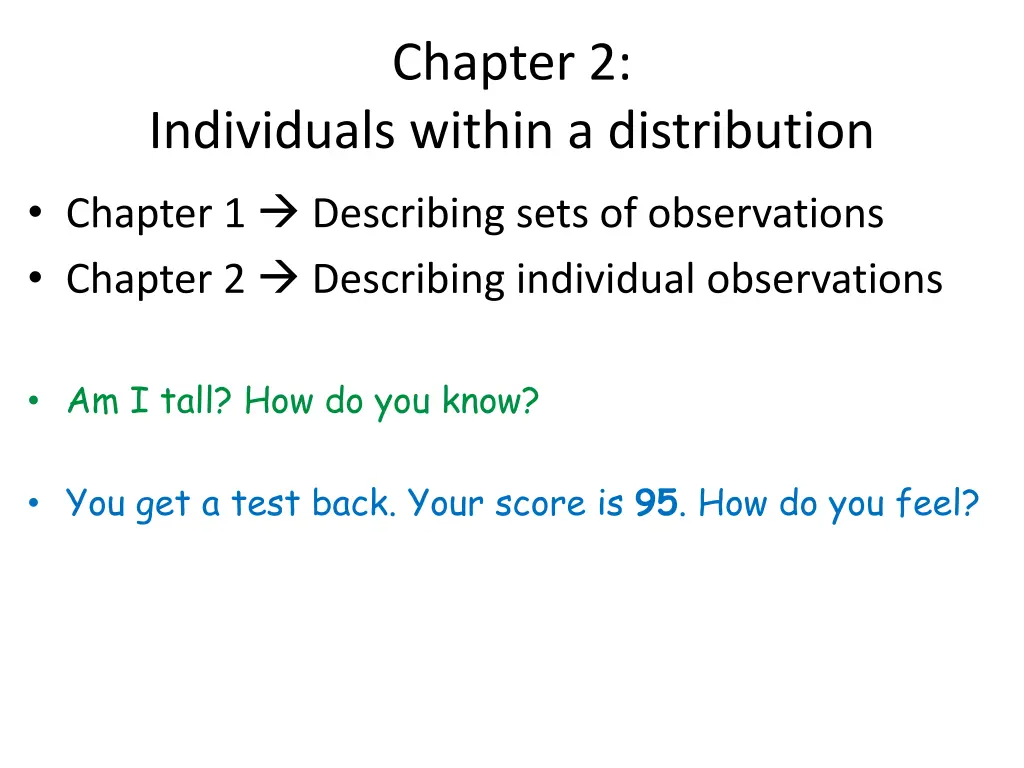
Chapter 2: Individuals within a distribution Chapter 1 Describing sets of observations Chapter 2 Describing individual observations Am I tall? How do you know? You get a test back. Your score is 95. How do you feel?
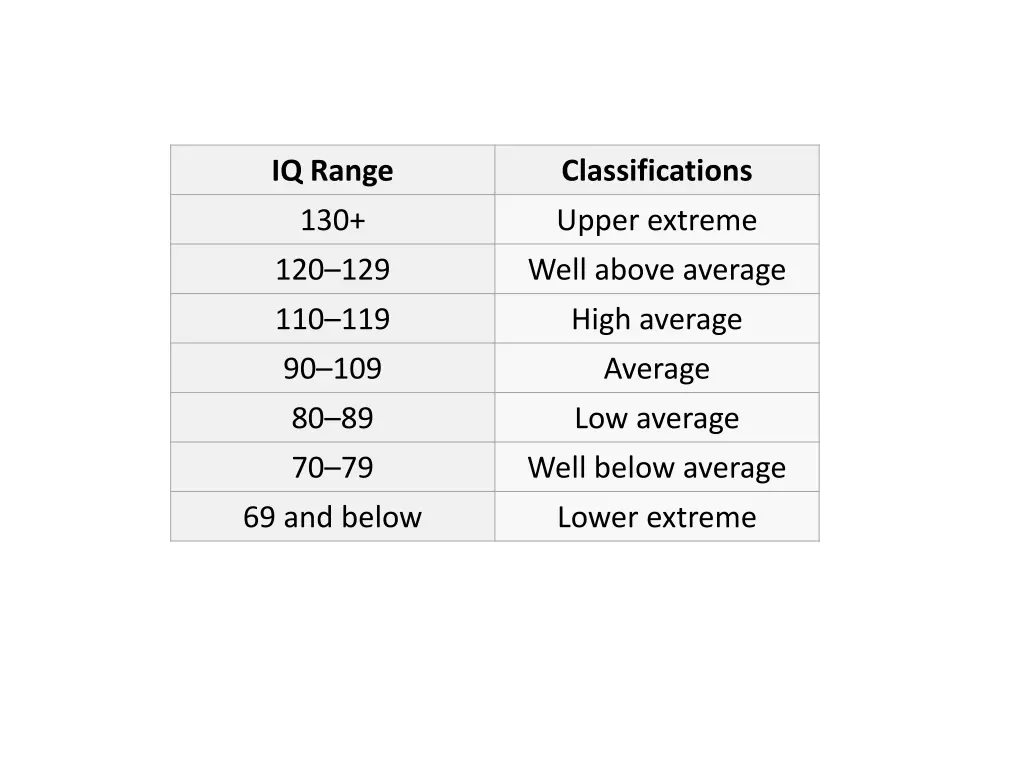
IQ Range Classifications 130+ Upper extreme 120 129 Well above average 110 119 High average 90 109 Average 80 89 Low average 70 79 Well below average 69 and below Lower extreme
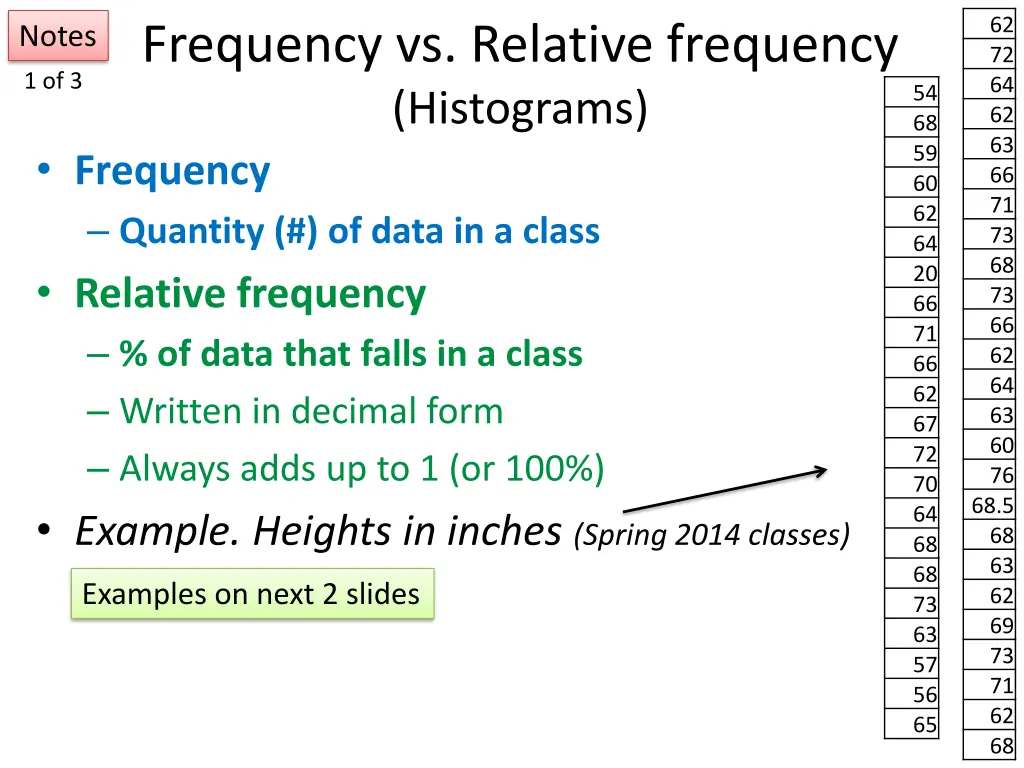
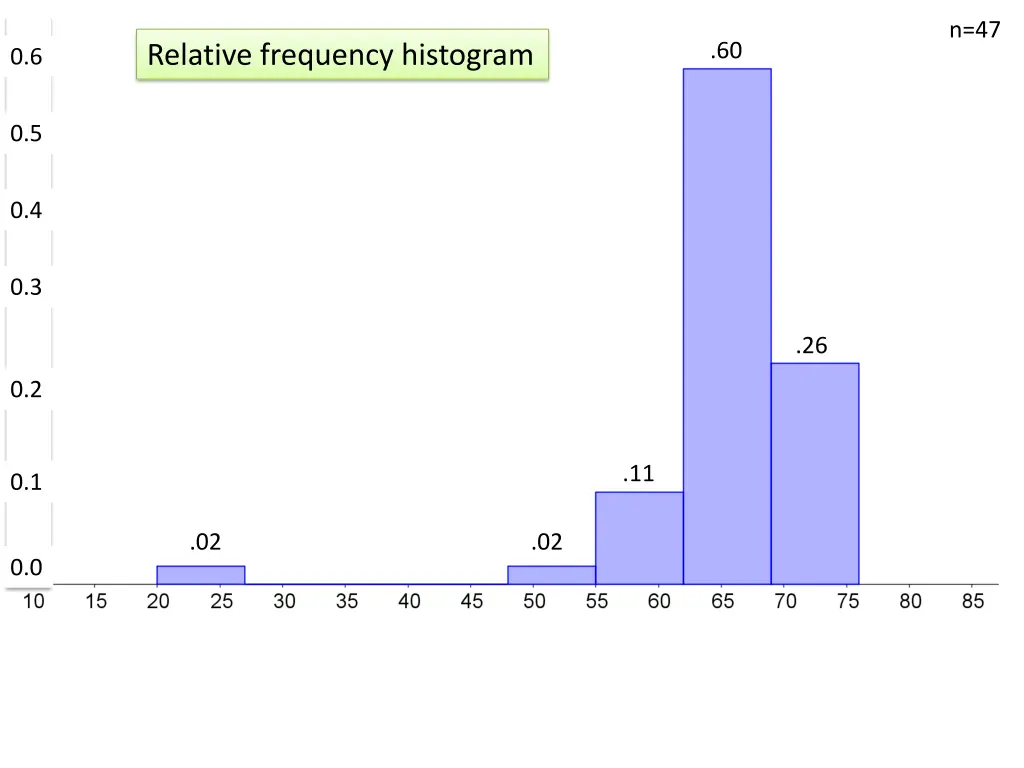
62 72 64 62 63 66 71 73 68 73 66 62 64 63 60 76 Frequency vs. Relative frequency (Histograms) Frequency Quantity (#) of data in a class Relative frequency % of data that falls in a class Written in decimal form Always adds up to 1 (or 100%) Example. Heights in inches (Spring 2014 classes) Notes 1 of 3 54 68 59 60 62 64 20 66 71 66 62 67 72 70 64 68 68 73 63 57 56 65 68.5 68 63 62 69 73 71 62 68 Examples on next 2 slides
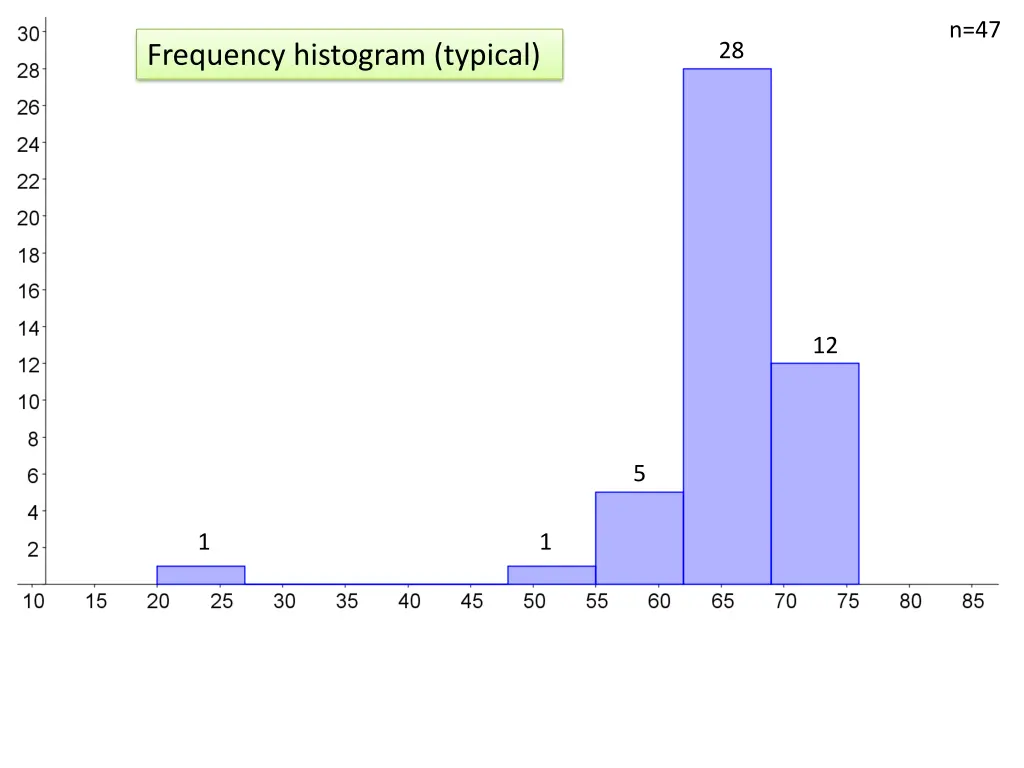
n=47 28 Frequency histogram (typical) 12 5 1 1
n=47 .60 Relative frequency histogram 0.6 0.5 0.4 0.3 .26 0.2 .11 0.1 .02 .02 0.0
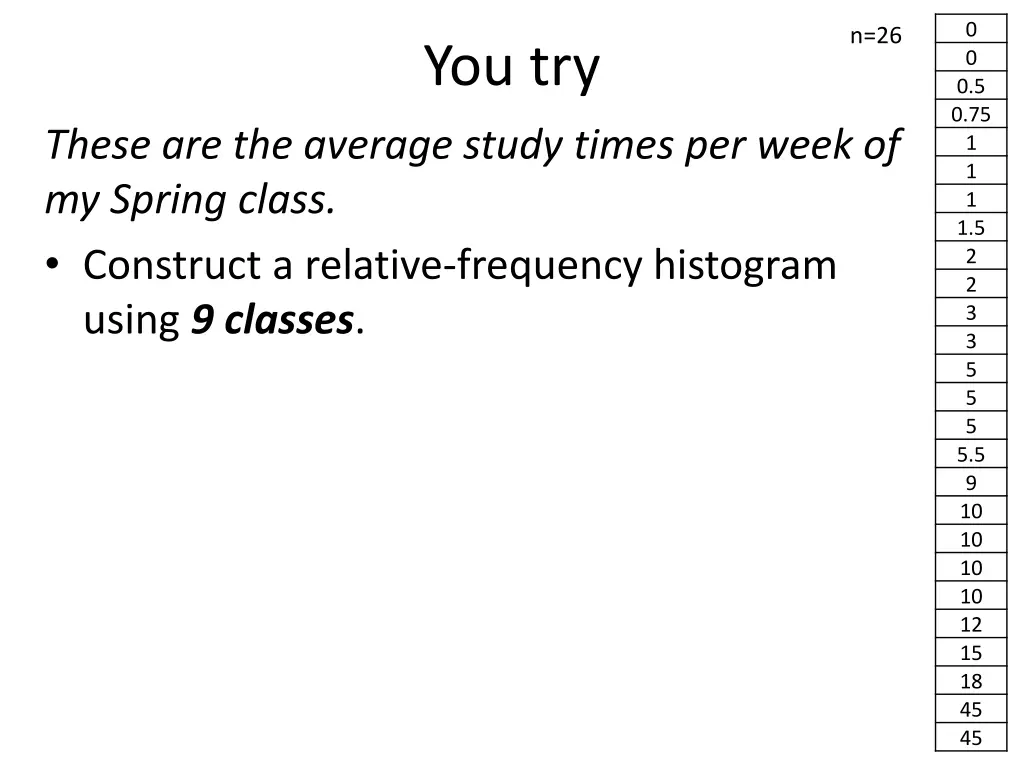
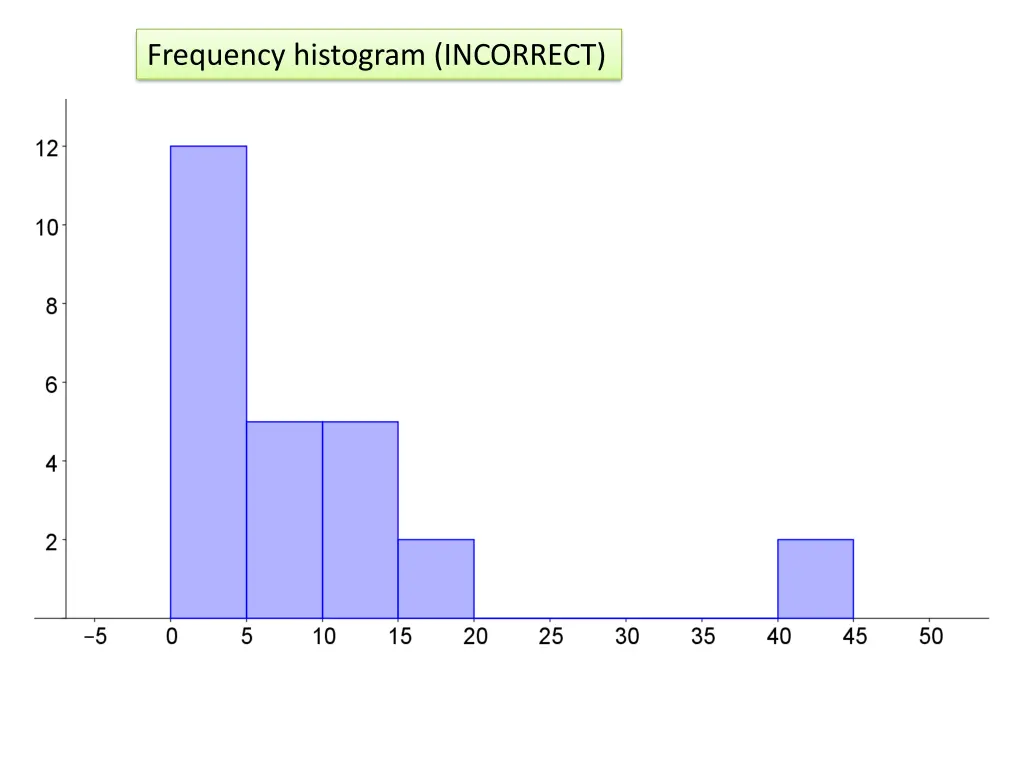
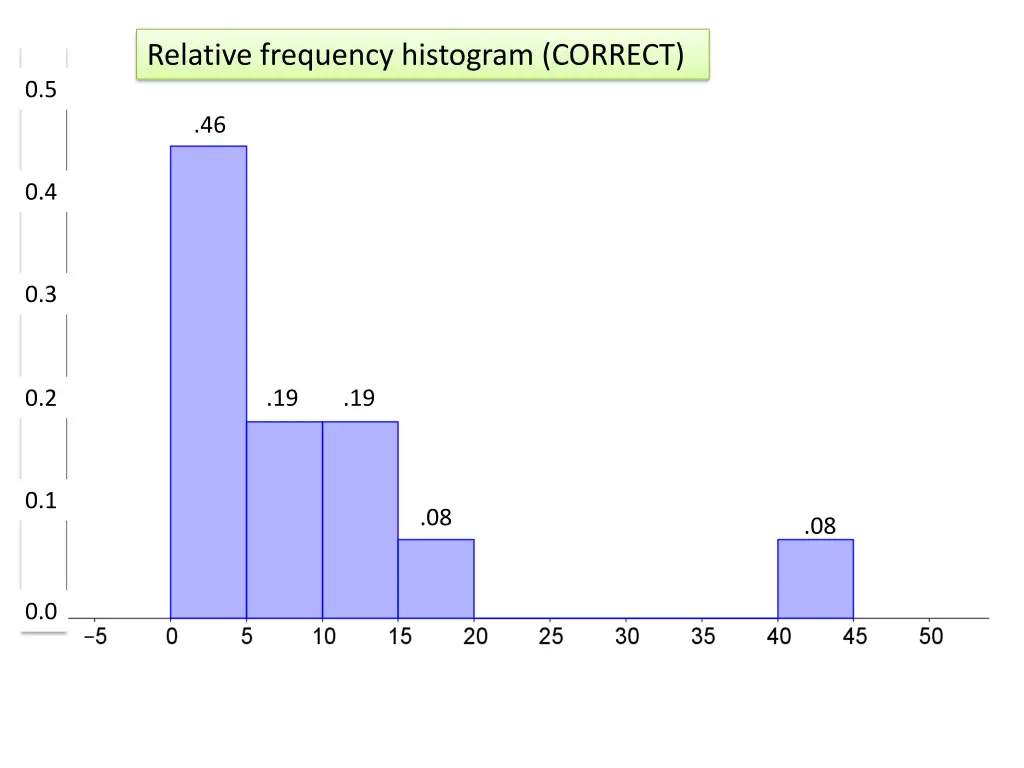
0 0 n=26 You try 0.5 0.75 1 1 1 1.5 2 2 3 3 5 5 5 5.5 9 10 10 10 10 12 15 18 45 45 These are the average study times per week of my Spring class. Construct a relative-frequency histogram using 9 classes.
Relative frequency histogram (CORRECT) 0.5 .46 0.4 0.3 0.2 .19 .19 0.1 .08 .08 0.0
Notes Density curve 2 of 3 A relative-frequency histogram with a curve going through the (invisible) midpoint of each (invisible) bar Area = 1 (or 100%) Useful for describing position of individuals within a distribution
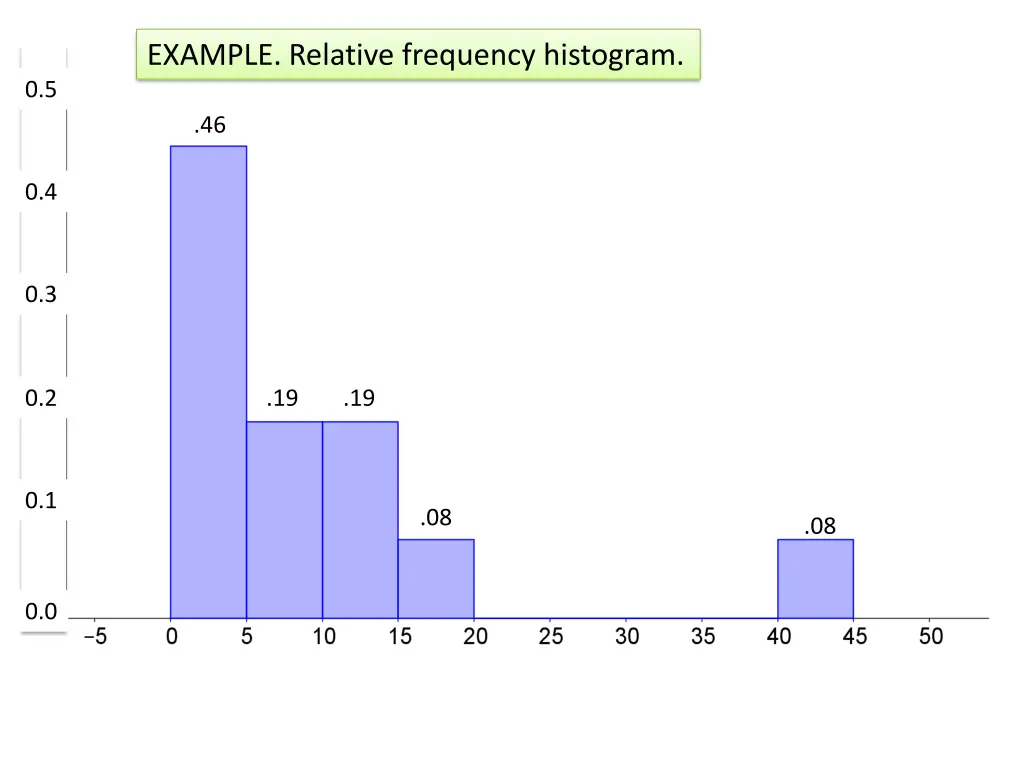
EXAMPLE. Relative frequency histogram. 0.5 .46 0.4 0.3 0.2 .19 .19 0.1 .08 .08 0.0
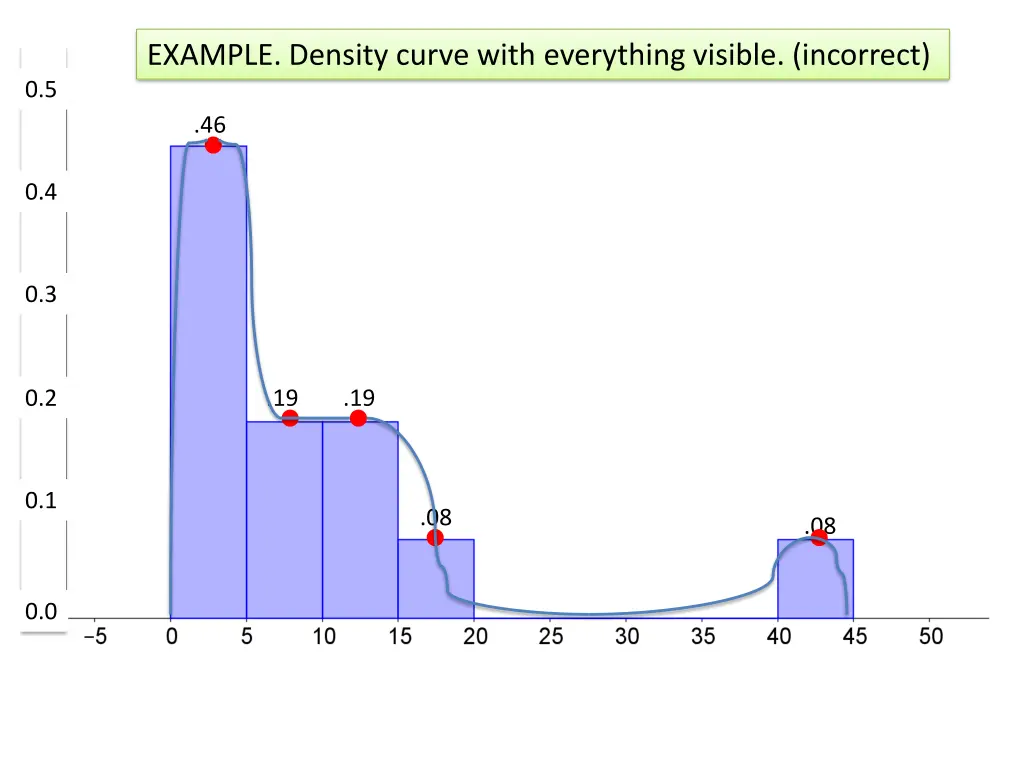
EXAMPLE. Density curve with everything visible. (incorrect) 0.5 .46 0.4 0.3 0.2 .19 .19 0.1 .08 .08 0.0
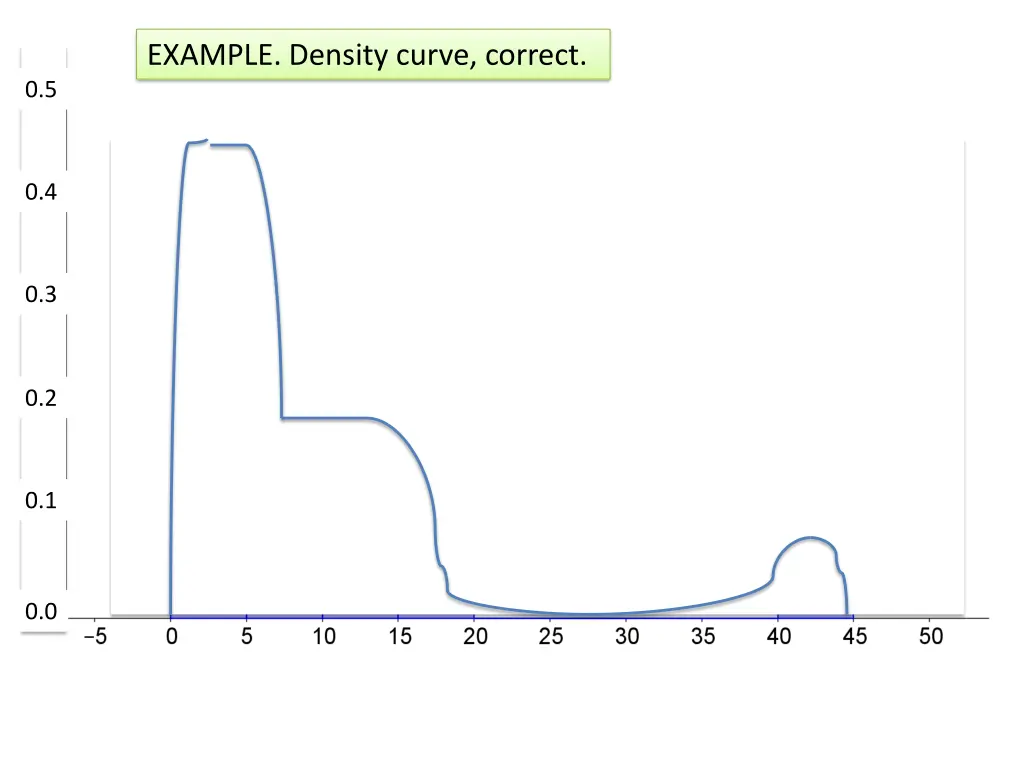
EXAMPLE. Density curve, correct. 0.5 0.4 0.3 0.2 .19 .19 0.1 .08 .08 0.0
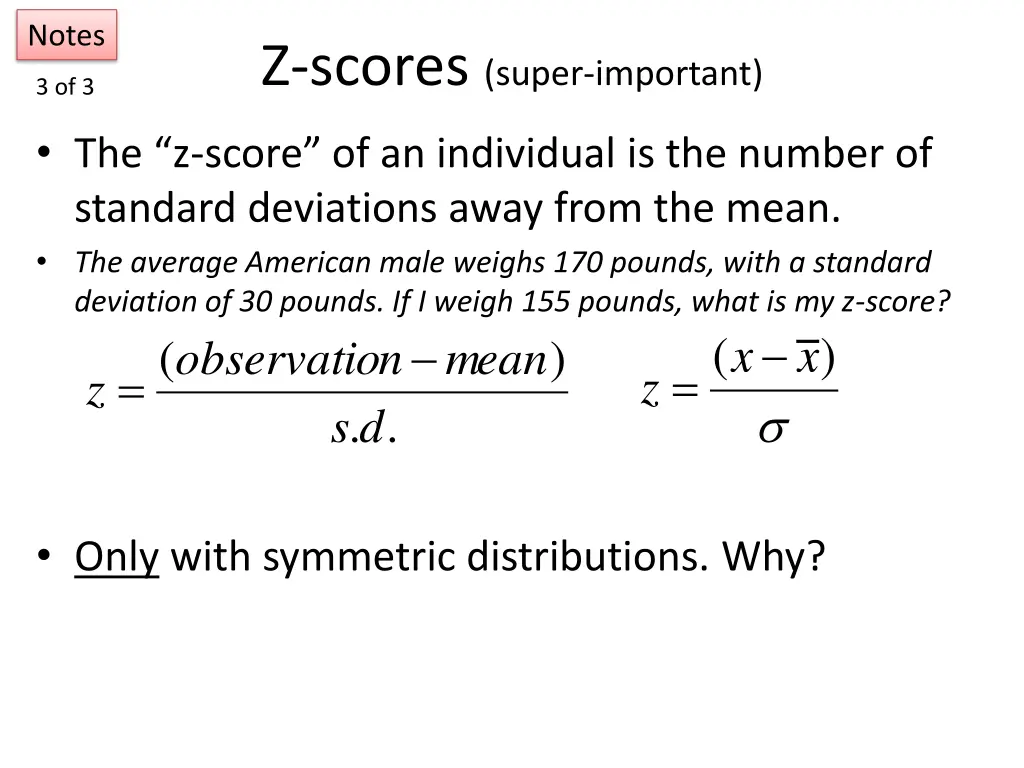
Notes Z-scores (super-important) 3 of 3 The z-score of an individual is the number of standard deviations away from the mean. The average American male weighs 170 pounds, with a standard deviation of 30 pounds. If I weigh 155 pounds, what is my z-score? ( d s ( ) x x ) observatio n mean = = z z . . Only with symmetric distributions. Why?
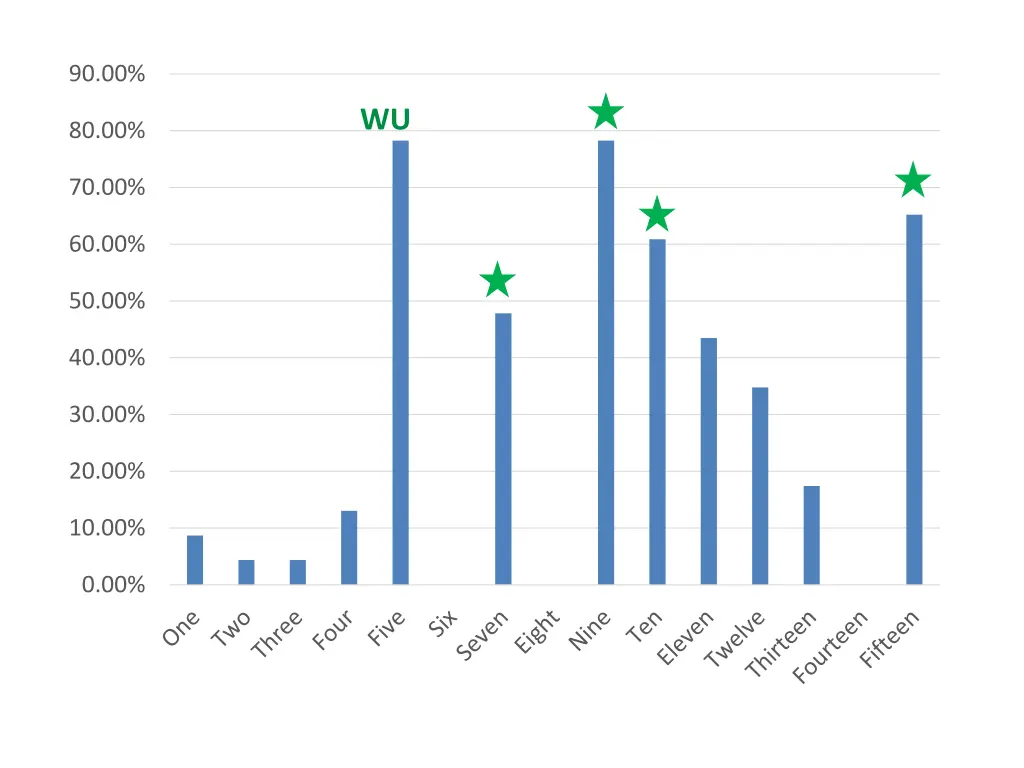
90.00% WU 80.00% 70.00% 60.00% 50.00% 40.00% 30.00% 20.00% 10.00% 0.00%
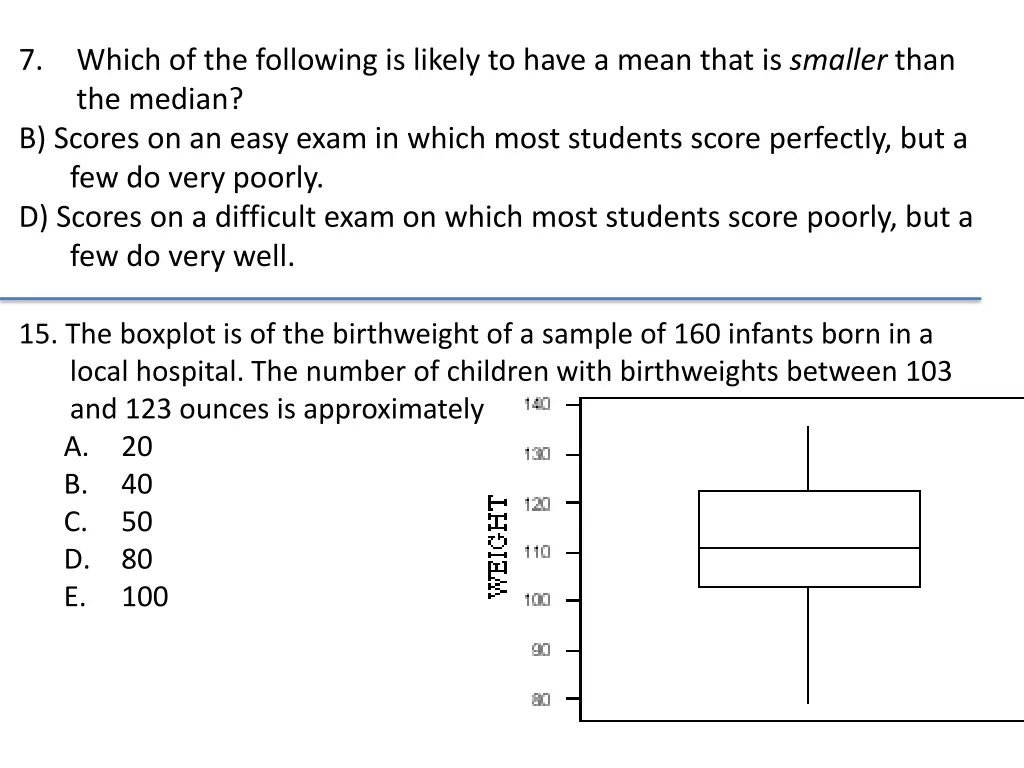
7. Which of the following is likely to have a mean that is smaller than the median? B) Scores on an easy exam in which most students score perfectly, but a few do very poorly. D) Scores on a difficult exam on which most students score poorly, but a few do very well. 15. The boxplot is of the birthweight of a sample of 160 infants born in a local hospital. The number of children with birthweights between 103 and 123 ounces is approximately A. 20 B. 40 C. 50 D. 80 E. 100
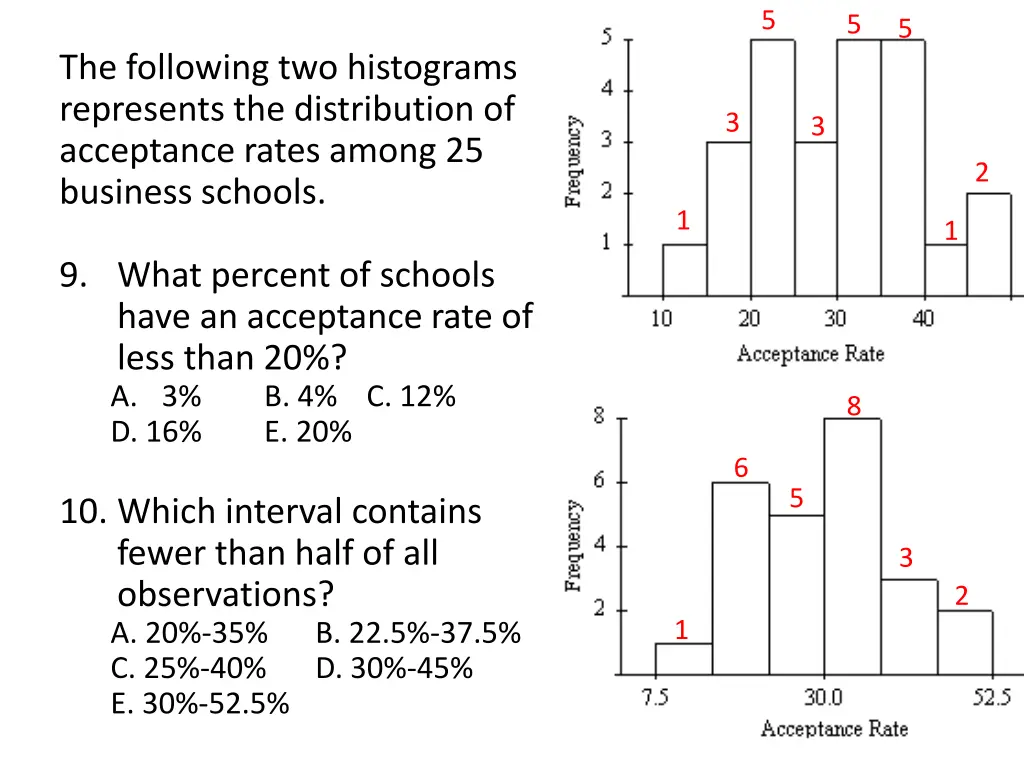
5 5 5 The following two histograms represents the distribution of acceptance rates among 25 business schools. 3 3 2 1 1 9. What percent of schools have an acceptance rate of less than 20%? A. 3% B. 4% C. 12% D. 16% E. 20% 8 6 5 10. Which interval contains fewer than half of all observations? A. 20%-35% C. 25%-40% E. 30%-52.5% 3 2 1 B. 22.5%-37.5% D. 30%-45%
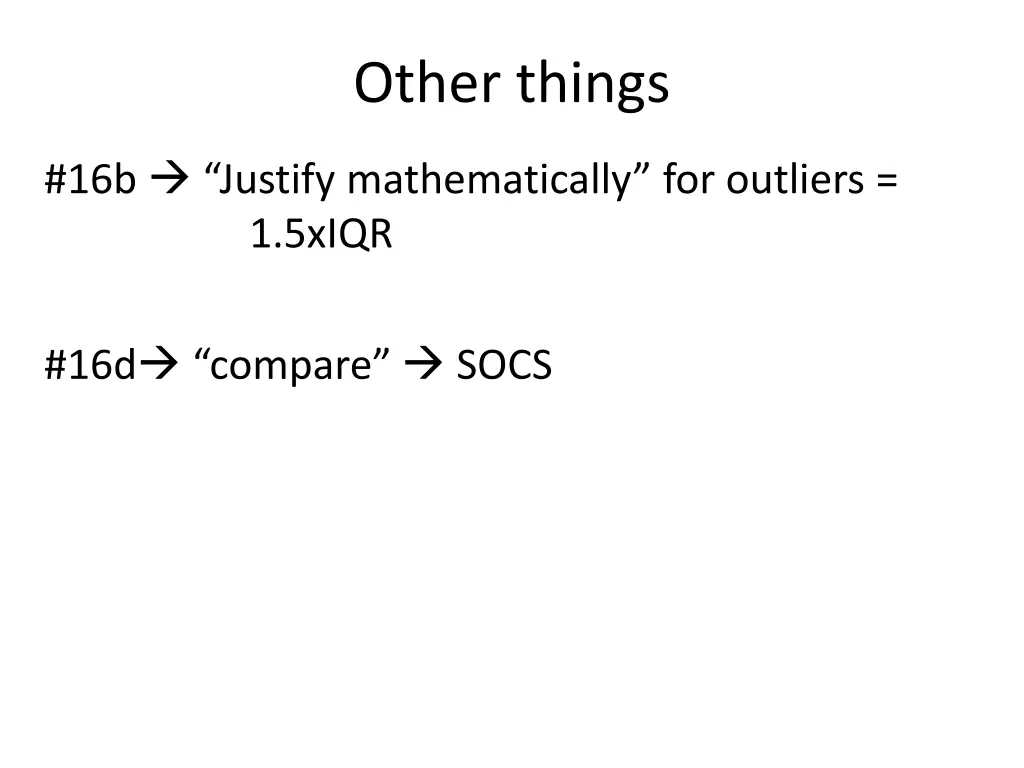
Other things #16b Justify mathematically for outliers = 1.5xIQR #16d compare SOCS
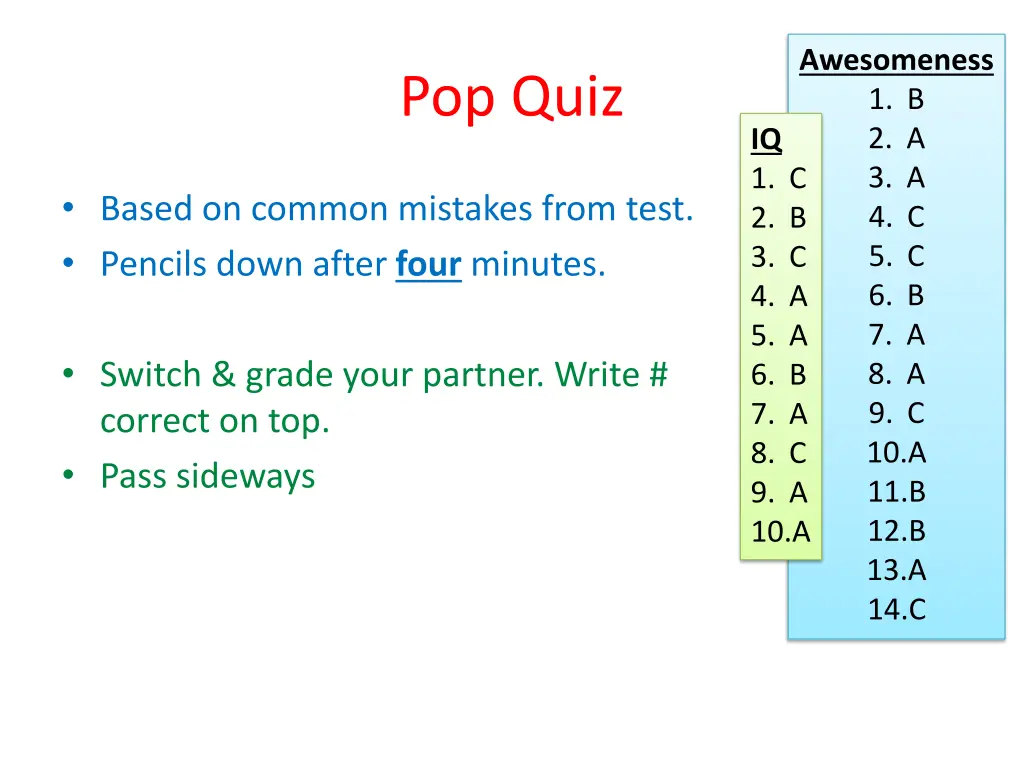
Awesomeness 1. B 2. A 3. A 4. C 5. C 6. B 7. A 8. A 9. C 10.A 11.B 12.B 13.A 14.C Pop Quiz IQ 1. C 2. B 3. C 4. A 5. A 6. B 7. A 8. C 9. A 10.A Based on common mistakes from test. Pencils down after four minutes. Switch & grade your partner. Write # correct on top. Pass sideways
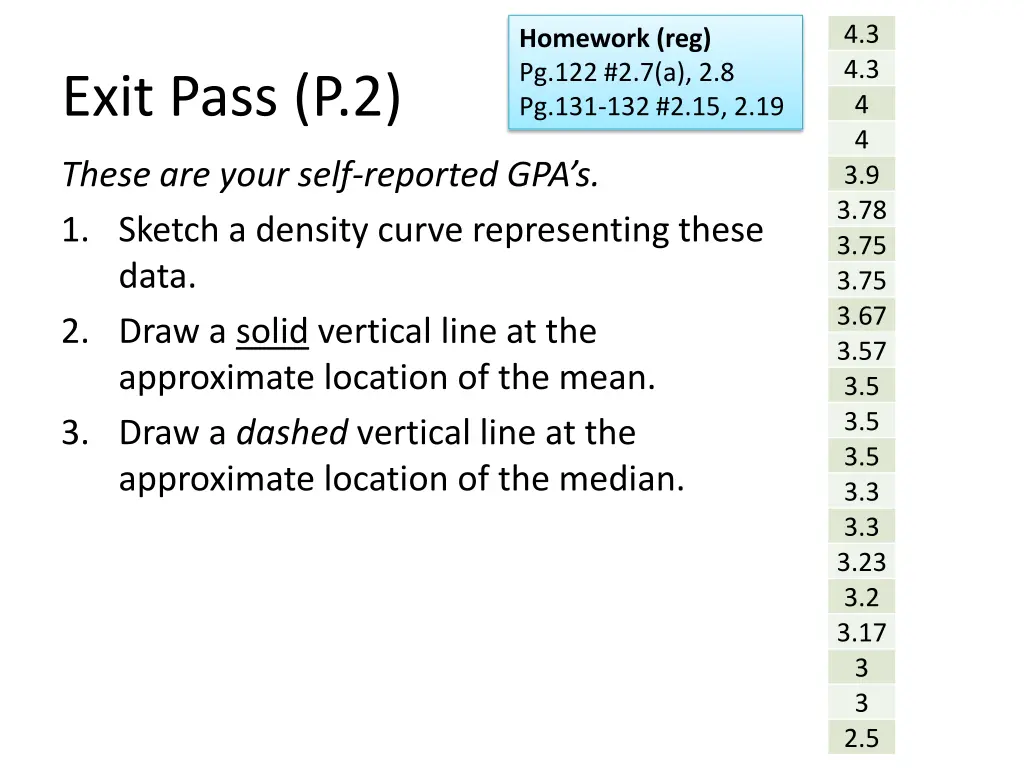
4.3 4.3 4 4 3.9 3.78 3.75 3.75 3.67 3.57 3.5 3.5 3.5 3.3 3.3 3.23 3.2 3.17 3 3 2.5 Homework (reg) Pg.122 #2.7(a), 2.8 Pg.131-132 #2.15, 2.19 Exit Pass (P.2) These are your self-reported GPA s. 1. Sketch a density curve representing these data. 2. Draw a solid vertical line at the approximate location of the mean. 3. Draw a dashed vertical line at the approximate location of the median.