Stats 207: New Moms Research Questions Analysis
Explore the research questions investigated by Stats 207 classes, such as the marital status of new moms, gender distribution of preemies, smoking proportions among married and unmarried moms, smoking prevalence in pregnant women compared to the general population, and the average baby weight in North Carolina. Includes confidence intervals, hypothesis tests, and comparisons with national averages.

Download Presentation

Please find below an Image/Link to download the presentation.
The content on the website is provided AS IS for your information and personal use only. It may not be sold, licensed, or shared on other websites without obtaining consent from the author. If you encounter any issues during the download, it is possible that the publisher has removed the file from their server.
You are allowed to download the files provided on this website for personal or commercial use, subject to the condition that they are used lawfully. All files are the property of their respective owners.
The content on the website is provided AS IS for your information and personal use only. It may not be sold, licensed, or shared on other websites without obtaining consent from the author.
E N D
Presentation Transcript
Day 20 1 sample hypothesis tests Stats 207
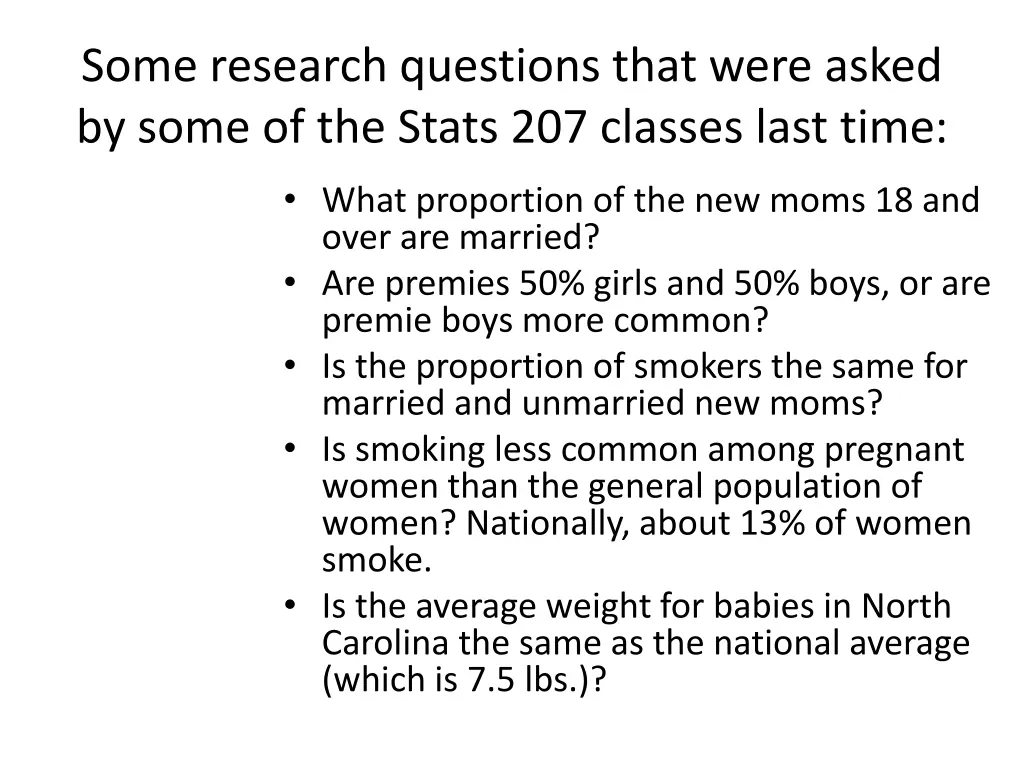
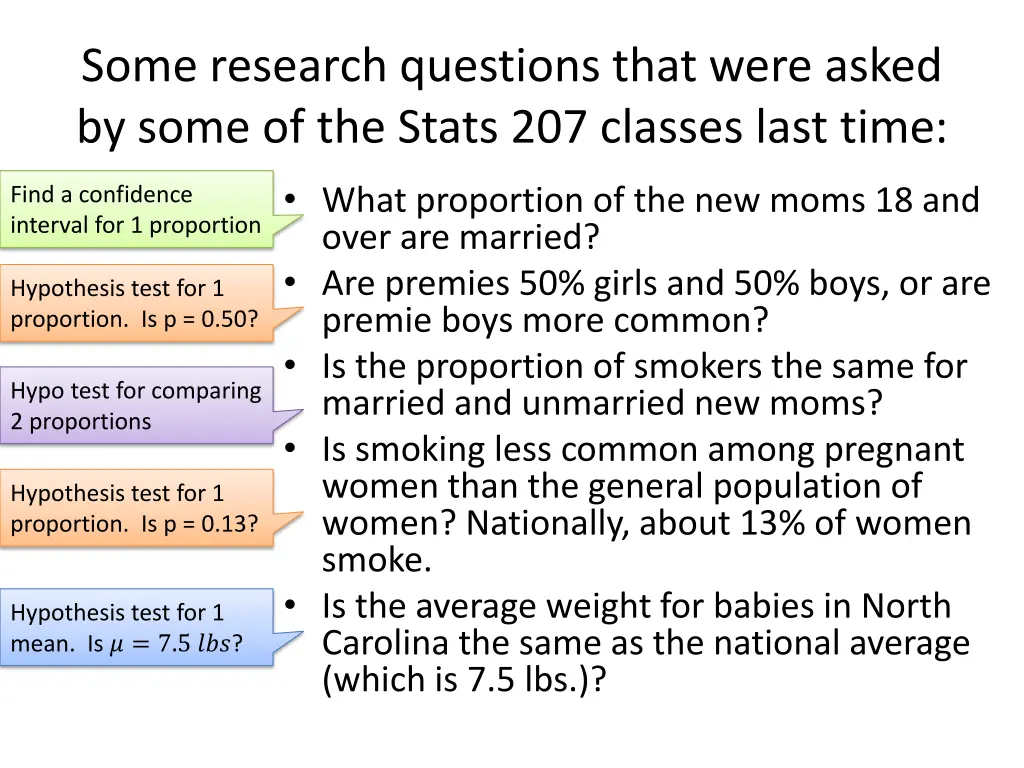
Some research questions that were asked by some of the Stats 207 classes last time: What proportion of the new moms 18 and over are married? Are premies 50% girls and 50% boys, or are premie boys more common? Is the proportion of smokers the same for married and unmarried new moms? Is smoking less common among pregnant women than the general population of women? Nationally, about 13% of women smoke. Is the average weight for babies in North Carolina the same as the national average (which is 7.5 lbs.)?
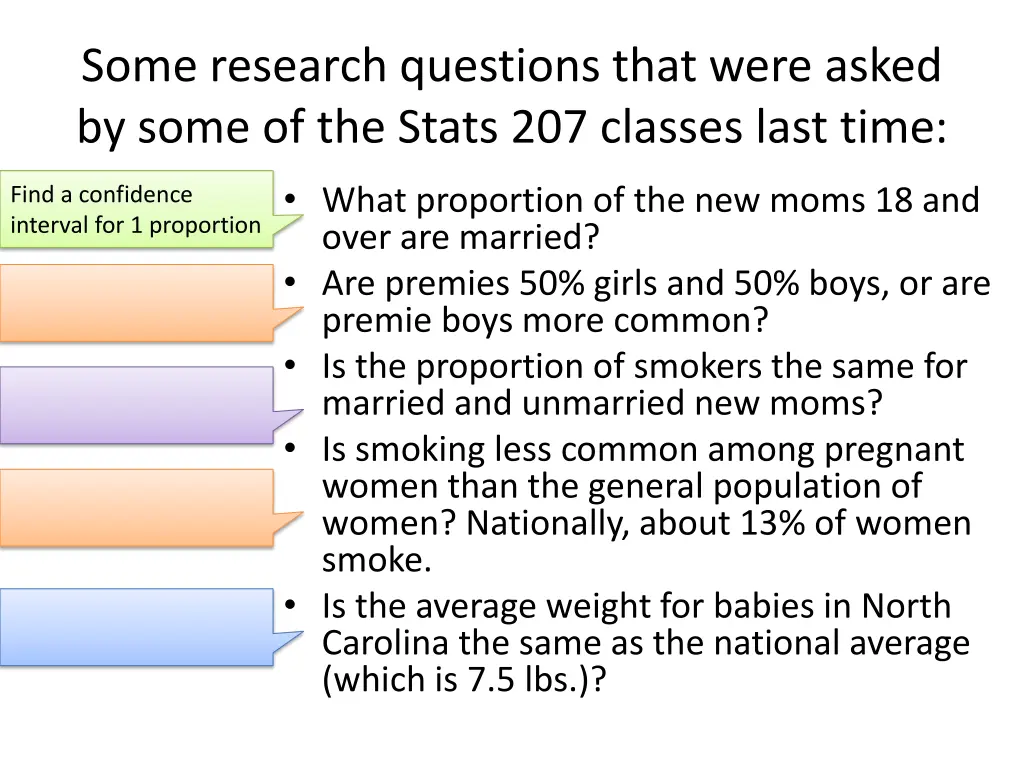
Some research questions that were asked by some of the Stats 207 classes last time: What proportion of the new moms 18 and over are married? Are premies 50% girls and 50% boys, or are premie boys more common? Is the proportion of smokers the same for married and unmarried new moms? Is smoking less common among pregnant women than the general population of women? Nationally, about 13% of women smoke. Is the average weight for babies in North Carolina the same as the national average (which is 7.5 lbs.)? Find a confidence interval for 1 proportion
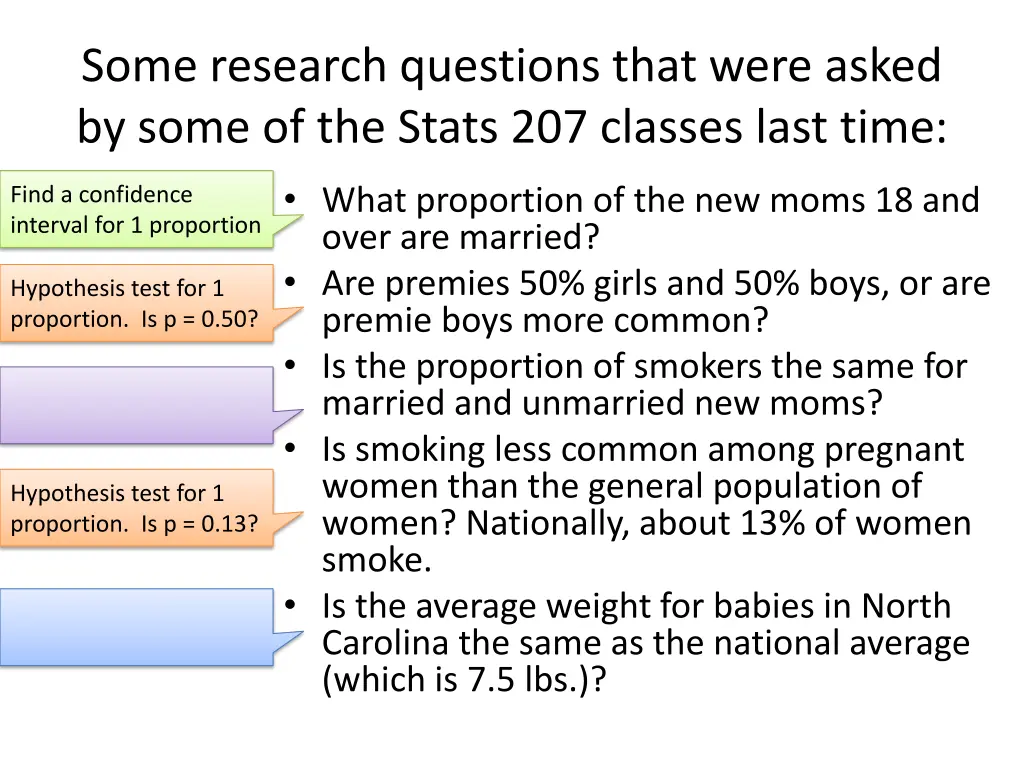
Some research questions that were asked by some of the Stats 207 classes last time: What proportion of the new moms 18 and over are married? Are premies 50% girls and 50% boys, or are premie boys more common? Is the proportion of smokers the same for married and unmarried new moms? Is smoking less common among pregnant women than the general population of women? Nationally, about 13% of women smoke. Is the average weight for babies in North Carolina the same as the national average (which is 7.5 lbs.)? Find a confidence interval for 1 proportion Hypothesis test for 1 proportion. Is p = 0.50? Hypothesis test for 1 proportion. Is p = 0.13?
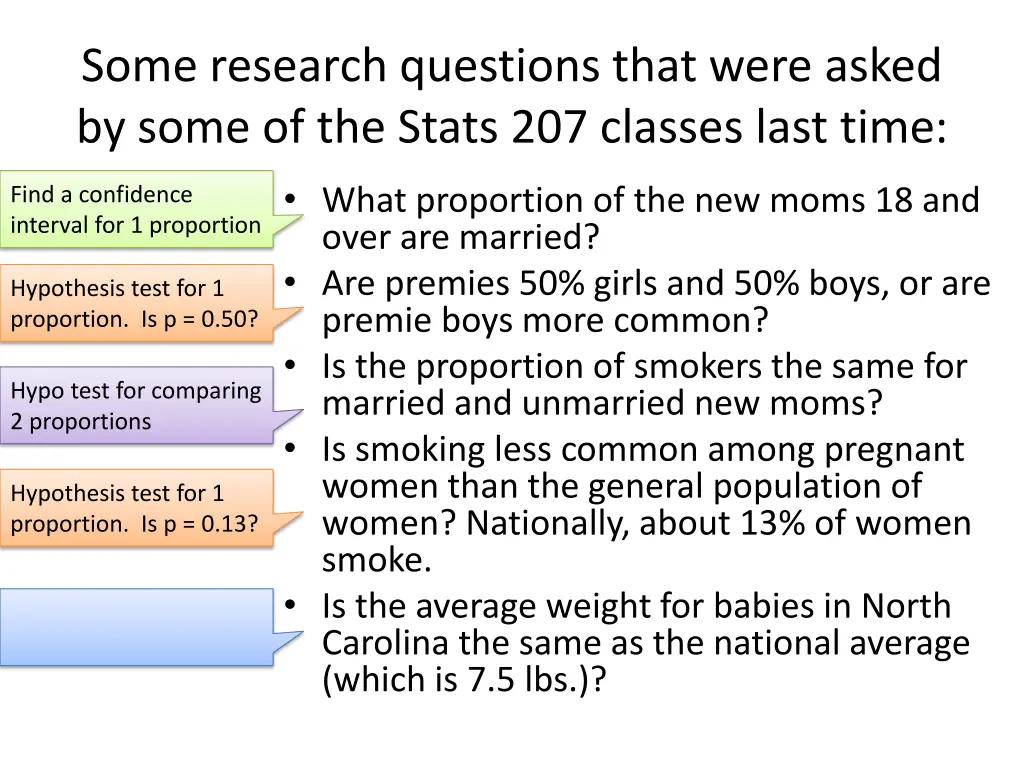
Some research questions that were asked by some of the Stats 207 classes last time: What proportion of the new moms 18 and over are married? Are premies 50% girls and 50% boys, or are premie boys more common? Is the proportion of smokers the same for married and unmarried new moms? Is smoking less common among pregnant women than the general population of women? Nationally, about 13% of women smoke. Is the average weight for babies in North Carolina the same as the national average (which is 7.5 lbs.)? Find a confidence interval for 1 proportion Hypothesis test for 1 proportion. Is p = 0.50? Hypo test for comparing 2 proportions Hypothesis test for 1 proportion. Is p = 0.13?
Some research questions that were asked by some of the Stats 207 classes last time: What proportion of the new moms 18 and over are married? Are premies 50% girls and 50% boys, or are premie boys more common? Is the proportion of smokers the same for married and unmarried new moms? Is smoking less common among pregnant women than the general population of women? Nationally, about 13% of women smoke. Is the average weight for babies in North Carolina the same as the national average (which is 7.5 lbs.)? Find a confidence interval for 1 proportion Hypothesis test for 1 proportion. Is p = 0.50? Hypo test for comparing 2 proportions Hypothesis test for 1 proportion. Is p = 0.13? Hypothesis test for 1 mean. Is ? = 7.5 ????
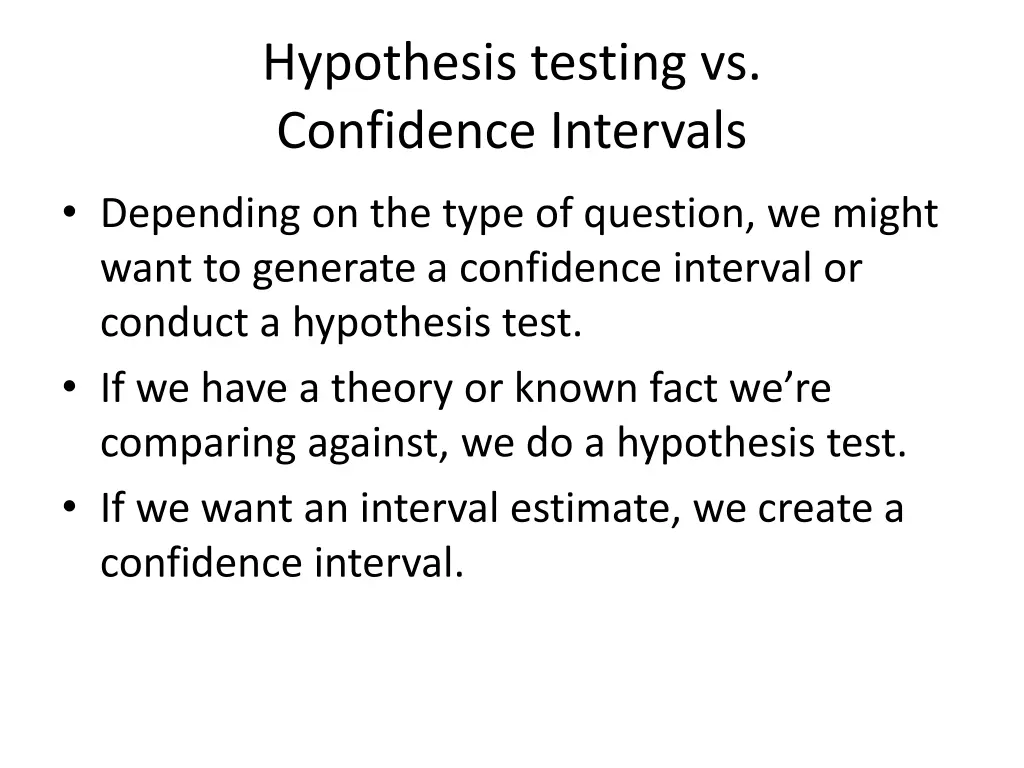
Hypothesis testing vs. Confidence Intervals Depending on the type of question, we might want to generate a confidence interval or conduct a hypothesis test. If we have a theory or known fact we re comparing against, we do a hypothesis test. If we want an interval estimate, we create a confidence interval.
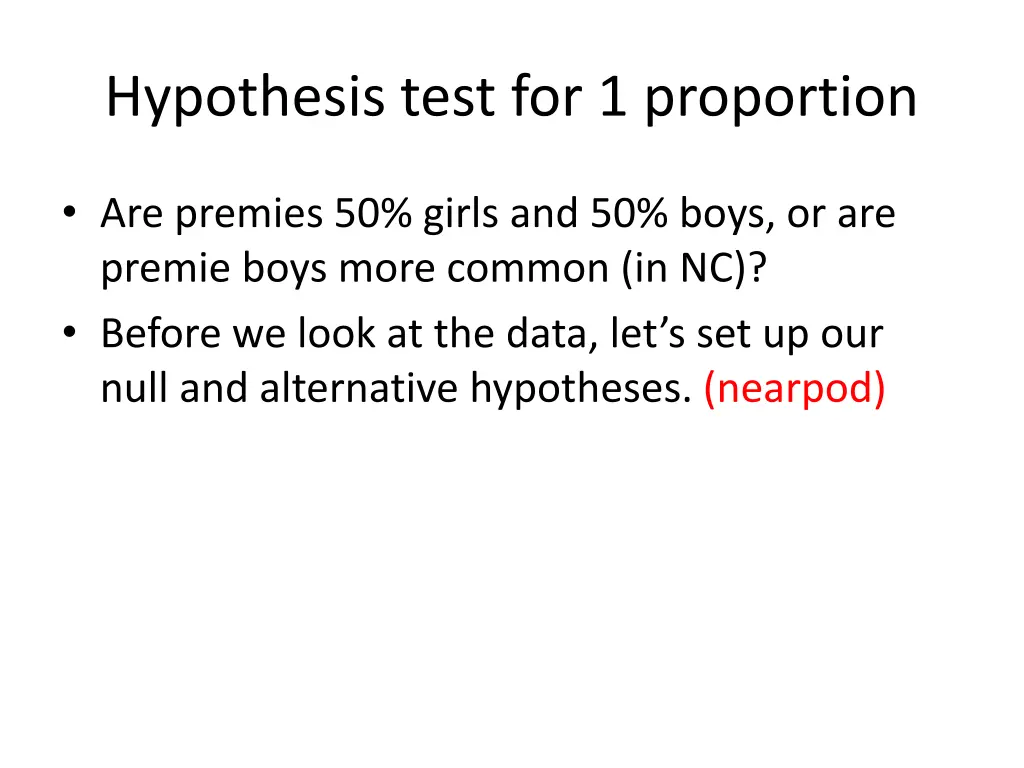
Hypothesis test for 1 proportion Are premies 50% girls and 50% boys, or are premie boys more common (in NC)? Before we look at the data, let s set up our null and alternative hypotheses. (nearpod)
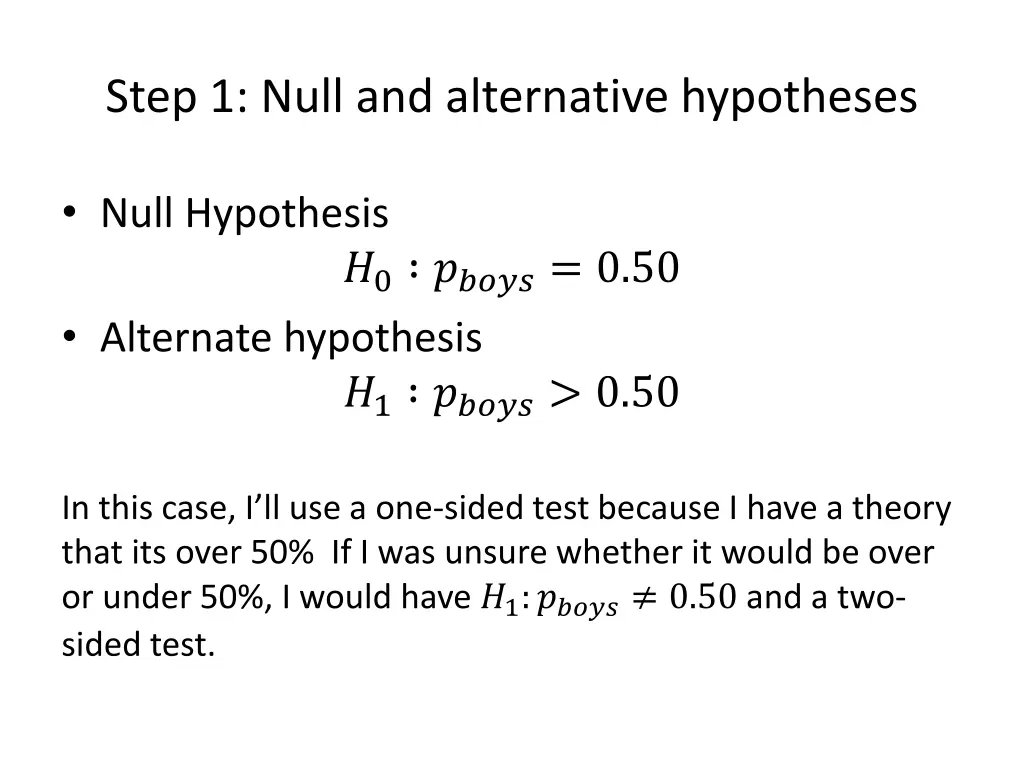
Step 1: Null and alternative hypotheses Null Hypothesis ?0 ?????= 0.50 Alternate hypothesis ?1 ?????> 0.50 In this case, I ll use a one-sided test because I have a theory that its over 50% If I was unsure whether it would be over or under 50%, I would have ?1:????? 0.50 and a two- sided test.
Hypothesis test for 1 proportion Are premies 50% girls and 50% boys, or are premie boys more common (in NC)? Before we look at the data, let s set up our null and alternative hypotheses. Now let s sketch the sampling distribution and mark the center ? and standard error ??
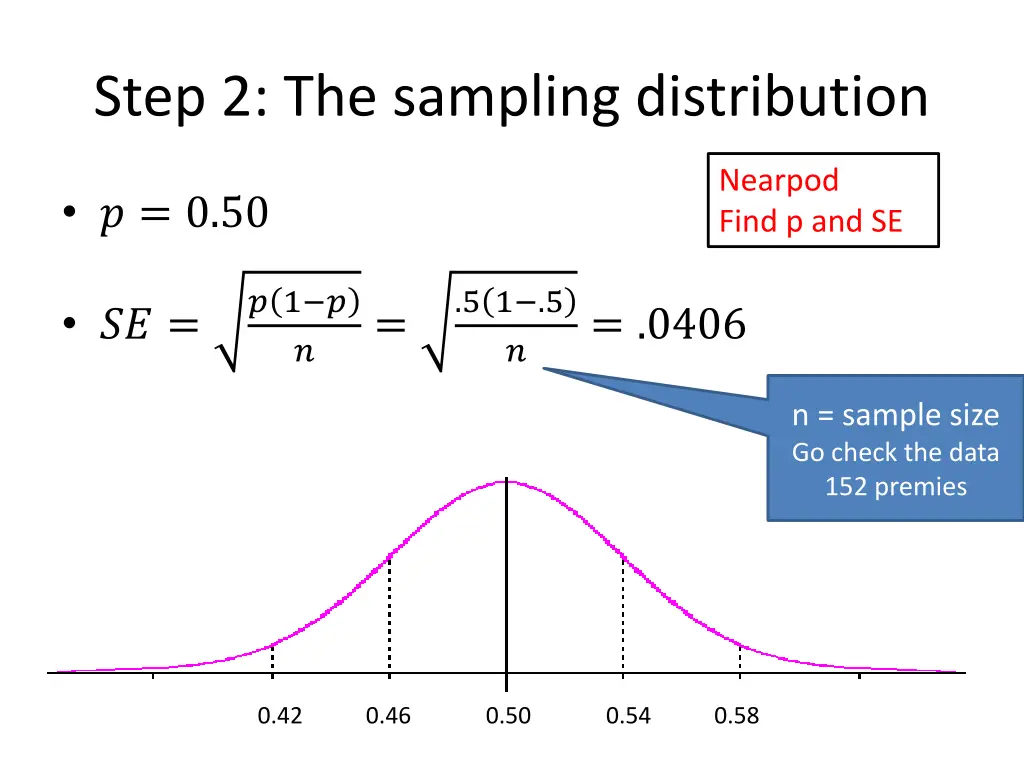
Step 2: The sampling distribution Nearpod Find p and SE ? = 0.50 ? 1 ? ? .5 1 .5 ? ?? = = = .0406 n = sample size Go check the data 152 premies 0.42 0.46 0.50 0.54 0.58
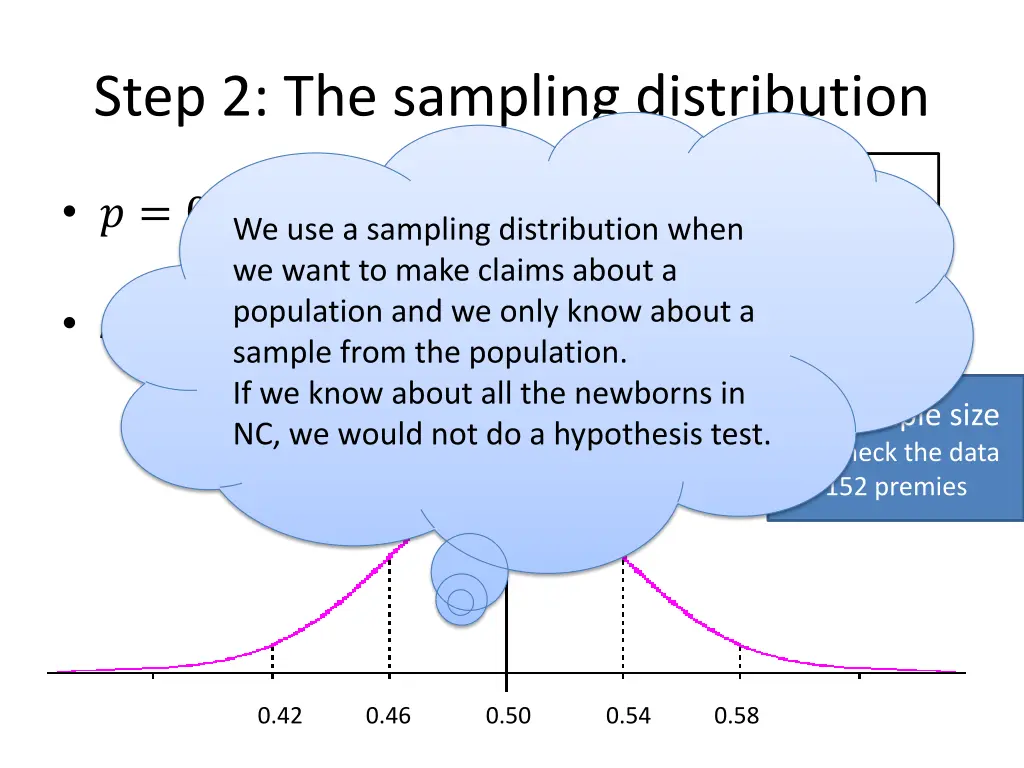
Step 2: The sampling distribution Nearpod Find p and SE ? = 0.50 We use a sampling distribution when we want to make claims about a population and we only know about a ? 1 ? ? sample from the population. If we know about all the newborns in NC, we would not do a hypothesis test. .5 1 .5 ? ?? = = = .0406 n = sample size Go check the data 152 premies 0.42 0.46 0.50 0.54 0.58
Hypothesis test for 1 proportion Are premies 50% girls and 50% boys, or are premie boys more common (in NC)? Before we look at the data, let s set up our null and alternative hypotheses. Now let s sketch the sampling distribution and mark the center ? and standard error ?? Does our sample data seem extreme?
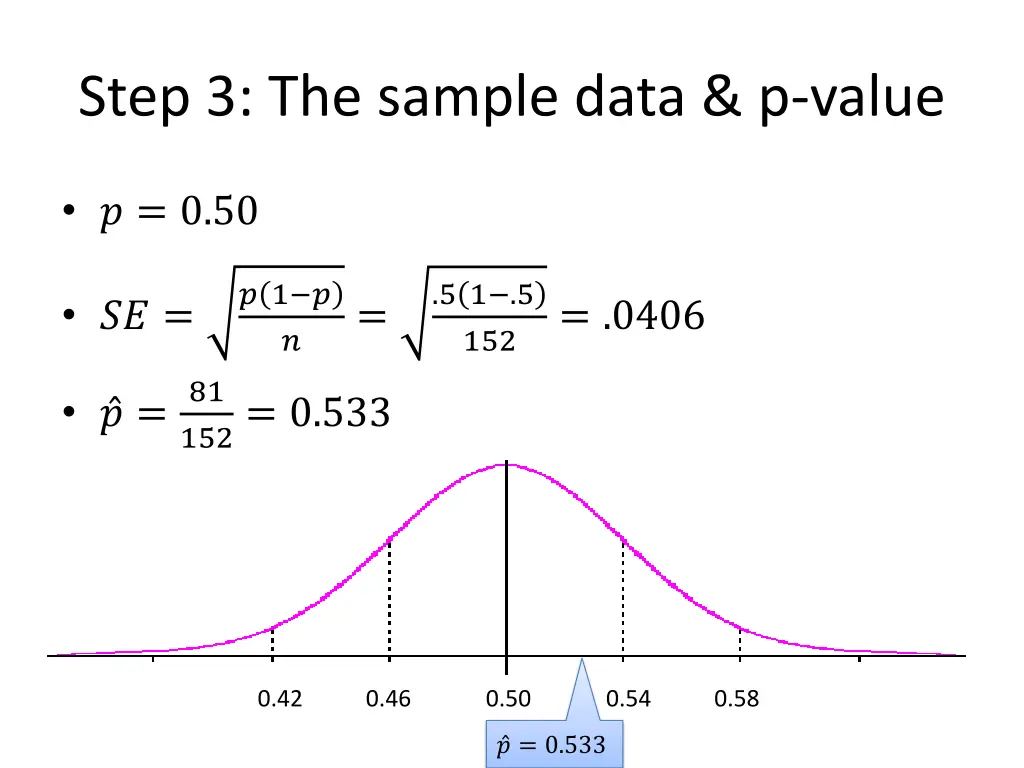
Step 3: The sample data & p-value ? = 0.50 ? 1 ? ? .5 1 .5 152 ?? = = = .0406 81 152= 0.533 ? = 0.42 0.46 0.50 0.54 0.58 ? = 0.533
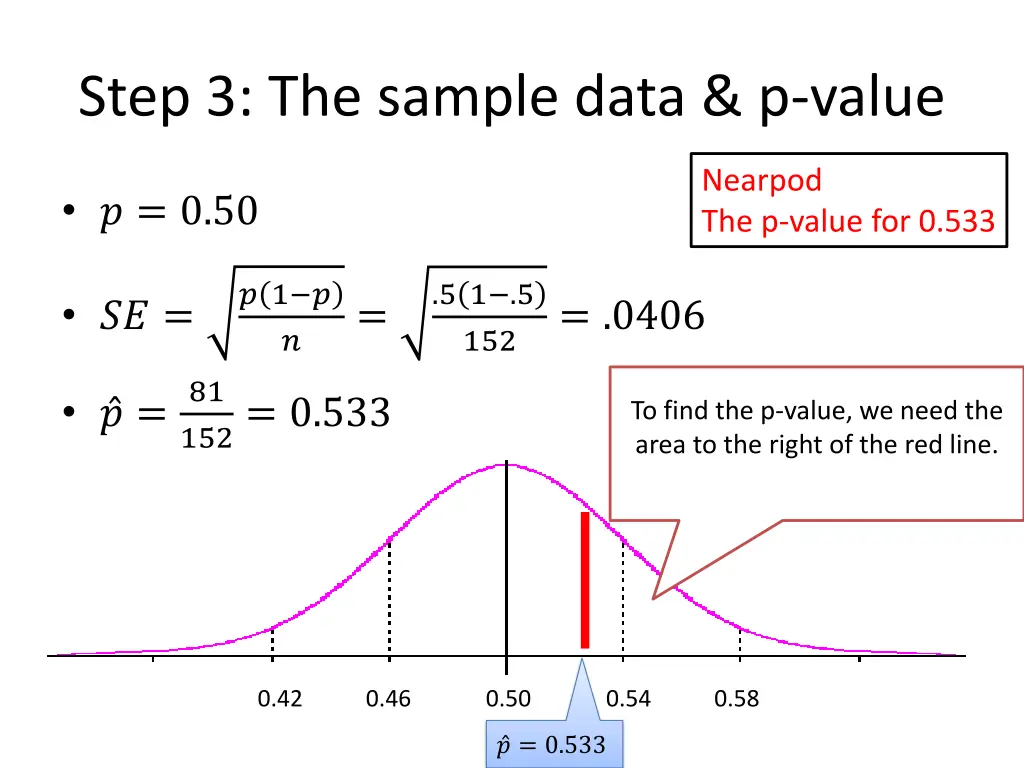
Step 3: The sample data & p-value Nearpod The p-value for 0.533 ? = 0.50 ? 1 ? ? .5 1 .5 152 ?? = = = .0406 81 152= 0.533 ? = To find the p-value, we need the area to the right of the red line. 0.42 0.46 0.50 0.54 0.58 ? = 0.533
Hypothesis test for 1 proportion Are premies 50% girls and 50% boys, or are premie boys more common (in NC)? Before we look at the data, let s set up our null and alternative hypotheses. Now let s sketch the sampling distribution and mark the center ? and standard error ?? Does our sample data seem extreme? What do we conclude?
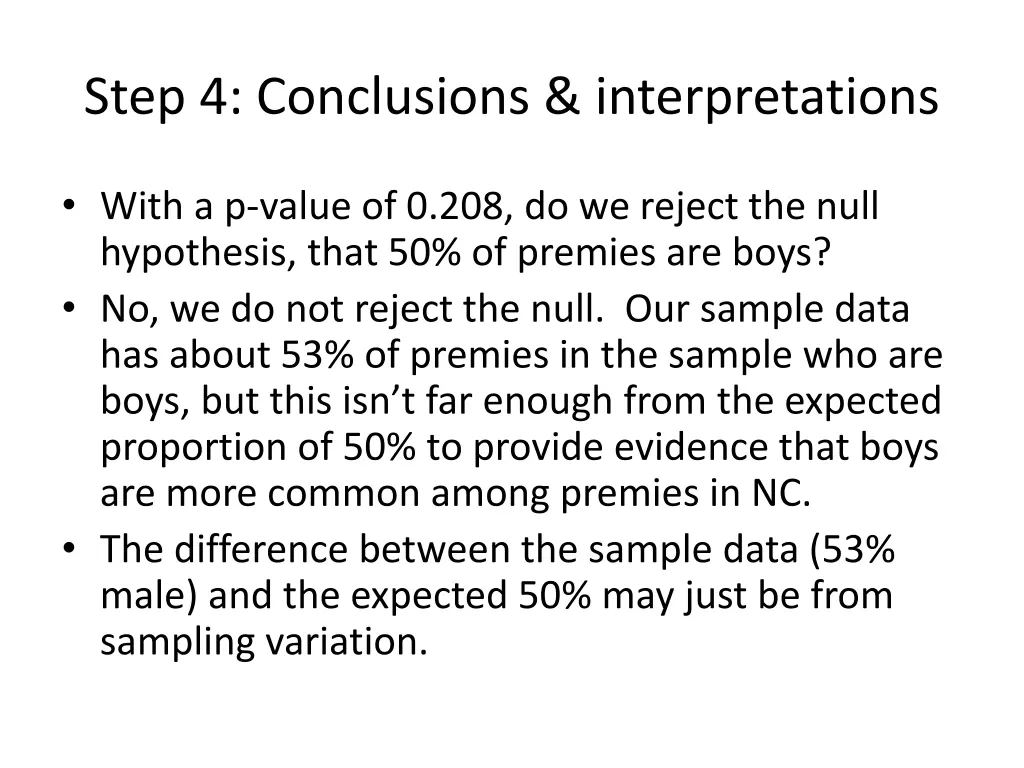
Step 4: Conclusions & interpretations With a p-value of 0.208, do we reject the null hypothesis, that 50% of premies are boys? No, we do not reject the null. Our sample data has about 53% of premies in the sample who are boys, but this isn t far enough from the expected proportion of 50% to provide evidence that boys are more common among premies in NC. The difference between the sample data (53% male) and the expected 50% may just be from sampling variation.
Step 4: Conclusions & interpretations With a p-value of 0.208, do we reject the null hypothesis, that 50% of premies are boys? No, we do not reject the null. Our sample data has about 53% of premies in the sample who are boys, but this isn t far enough from the expected proportion of 50% to provide evidence that boys are more common among premies in NC. The difference between the sample data (53% male) and the expected 50% may just be from sampling variation.
An example for you Is smoking less common among pregnant women than the general population of women? Nationally, about 13% of women smoke. Step 1: Set up hypotheses Step 2: Set up sampling distribution (Sketching the curve, finding p and n and SE) Step 3: Find the p-value of the sample proportion ? Step 4: Draw conclusions
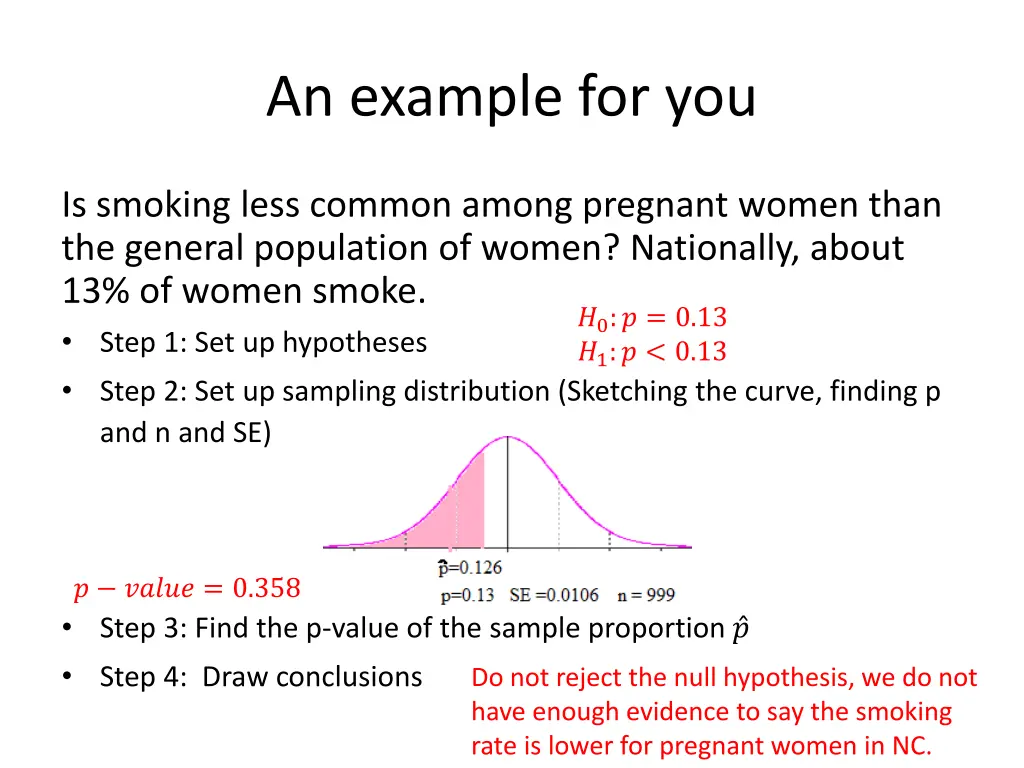
An example for you Is smoking less common among pregnant women than the general population of women? Nationally, about 13% of women smoke. Step 1: Set up hypotheses Step 2: Set up sampling distribution (Sketching the curve, finding p and n and SE) ?0:? = 0.13 ?1:? < 0.13 ? ????? = 0.358 Step 3: Find the p-value of the sample proportion ? Step 4: Draw conclusions Do not reject the null hypothesis, we do not have enough evidence to say the smoking rate is lower for pregnant women in NC.
Problem 3 Approximately 8%* of pregnant women in the US reported smoking in 2014. Is the rate of smoking higher than this in NC for women 35 and under? Clearly label your hypothesis testing steps and include an appropriate graph.
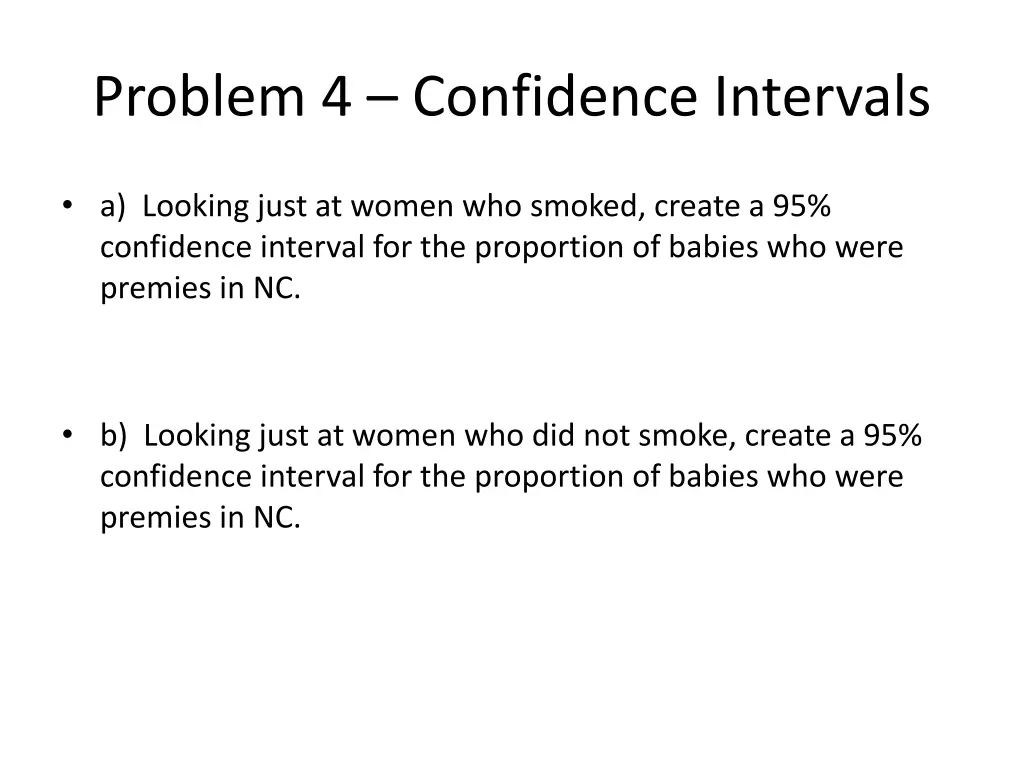
Problem 4 Confidence Intervals a) Looking just at women who smoked, create a 95% confidence interval for the proportion of babies who were premies in NC. b) Looking just at women who did not smoke, create a 95% confidence interval for the proportion of babies who were premies in NC.