Step Pattern in Mathematics: How Many Squares for Stage 4?
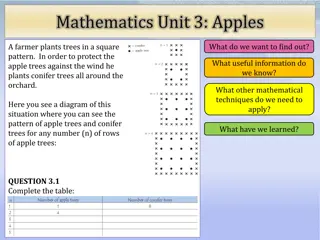
Robert is building a step pattern using squares, with different numbers of squares for each stage. Given the squares used in Stages 1, 2, and 3, we aim to determine how many squares he should use for Stage 4. Apply mathematical techniques to deduce the pattern and find the solution.

Download Presentation

Please find below an Image/Link to download the presentation.
The content on the website is provided AS IS for your information and personal use only. It may not be sold, licensed, or shared on other websites without obtaining consent from the author.If you encounter any issues during the download, it is possible that the publisher has removed the file from their server.
You are allowed to download the files provided on this website for personal or commercial use, subject to the condition that they are used lawfully. All files are the property of their respective owners.
The content on the website is provided AS IS for your information and personal use only. It may not be sold, licensed, or shared on other websites without obtaining consent from the author.
E N D
Presentation Transcript
History of the early Britain The Celts The Romans The Anglo-Saxon The Vikings
The Celts (700 BC- 55 BC) 700 BC Celtic tribes began to establish themselves in Britain. The Celts came from the region surrounding the Rhine and were divided into two main tribes: the Britons and the Gaels. Celtic society was based on hunting and farming. Druids, Celtic religious leaders, played an essential role in the preservation of culture and tradition.
The Romans (55 BC- 410 AD) The first attempt to conquer England was in 55 BC under Julius Caesar. But the Romans met with a strong resistance from the local Celtic tribes and failed theirattempt. It was in 43 AD, under Emperor Claudius, that the Roman conquest of Britain actually began. Romans met little resistance from the Celts, whose tribal system had gradually weakened.
The Roman advancewas halted just south of what is now the border between England and Scotland, where Adrian decided to build a wall to keep the northen invasions (Hadrian s wall). The area south of Hadrian s wall became the Roman province of Britannia and stayed under Roman rule for nearly 400 years.
The Anglo-Saxon (450 AD- 750 AD) The Roman Empire began to decline: German tribes progressively invaded the island. The term Anglo-Saxon refers to three Germanic tribes (the Angles, the Saxon an the Jutes) who began raiding the British coasts around 450. The Celtic tribes were pushed into present day Wales, Scotland and Ireland.
The Vikings (750 1050 AD) Vikings came from the northen European region known as Scandinavia. They managed to occupy large of Nortumbria, Mercia and East England under the leadership of King Alfred the Great (871-899). He was the frist King to unite England under one crown.