Addressing the intricate realm of storage management and caching, this presentation by Baskar Rethinasabapathi delves into efficient strategies and techniques for enhancing data storage performance. The discourse includes insightful perspectives and practical approaches that pave the way for optimizing storage systems and improving data accessibility, making it a valuable resource for professionals and enthusiasts seeking to bolster their knowledge in this critical area.
Please find below an Image/Link to download the presentation.
The content on the website is provided AS IS for your information and personal use only. It may not be sold, licensed, or shared on other websites without obtaining consent from the author. If you encounter any issues during the download, it is possible that the publisher has removed the file from their server.
You are allowed to download the files provided on this website for personal or commercial use, subject to the condition that they are used lawfully. All files are the property of their respective owners.
The content on the website is provided AS IS for your information and personal use only. It may not be sold, licensed, or shared on other websites without obtaining consent from the author.
Peer-to-peer systems Widely deployed Napster not pure p2p, used centralized database of servers Gnutella BitTorrent Primary motivation: File sharing Problems: Congestion, No good caching mechanism 2
Peer-to-peer systems OceanStore transactional storage, allows updates FarSite no content location and routing, traditional filesystem semantics FreeNet, FreeHaven, Eternity strong security paradigms CFS weak persistence, read-only file sharing, built on Chord PAST belongs to this class Primary motivation: p2p archival storage 3
How PAST differs? PAST large scale, persistent peer-to-peer storage utility Strong persistence High availability Scalability Security 4
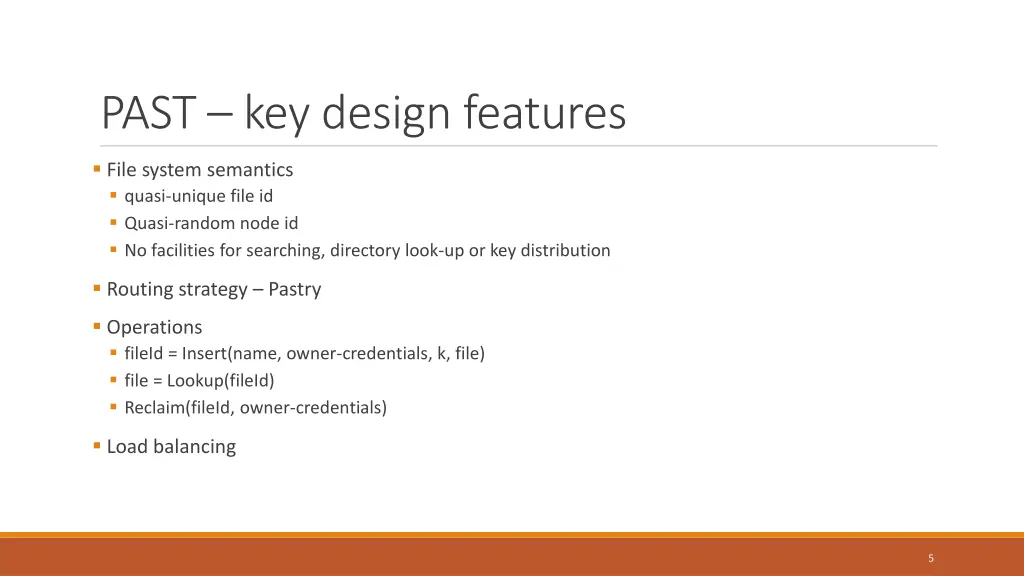
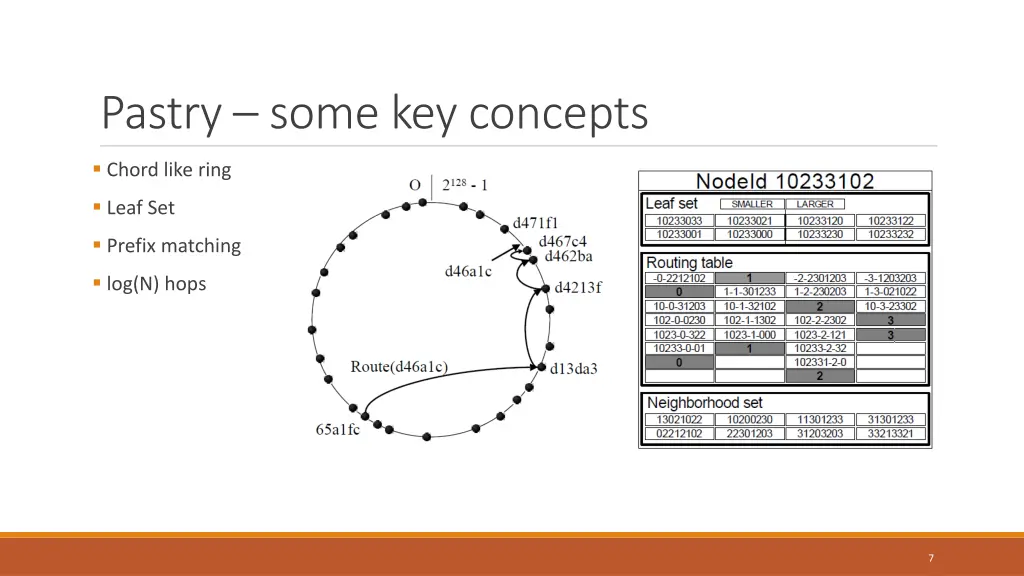
PAST key design features File system semantics quasi-unique file id Quasi-random node id No facilities for searching, directory look-up or key distribution Routing strategy Pastry Operations fileId = Insert(name, owner-credentials, k, file) file = Lookup(fileId) Reclaim(fileId, owner-credentials) Load balancing 5
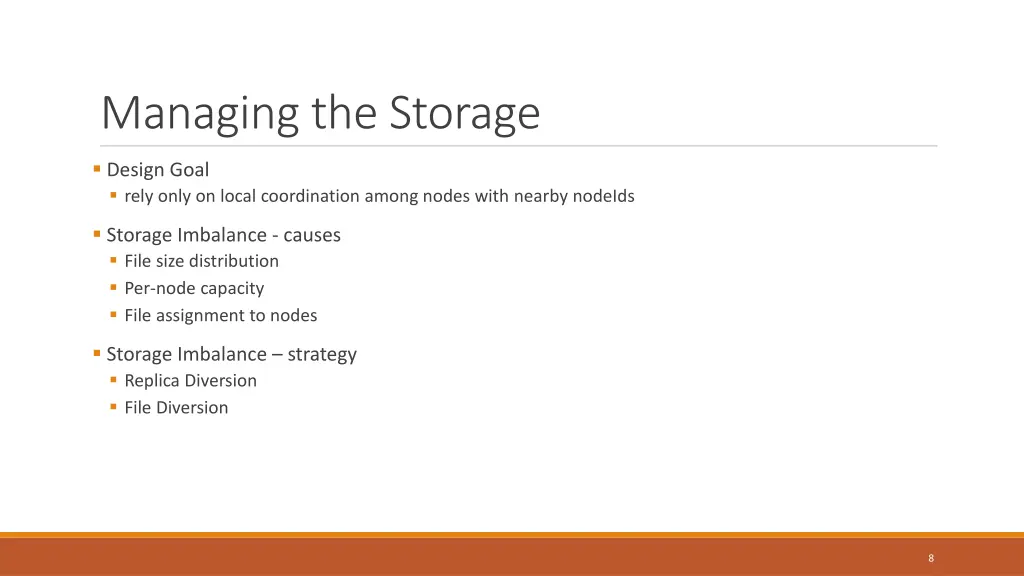
Managing the Storage Design Goal rely only on local coordination among nodes with nearby nodeIds Storage Imbalance - causes File size distribution Per-node capacity File assignment to nodes Storage Imbalance strategy Replica Diversion File Diversion 8
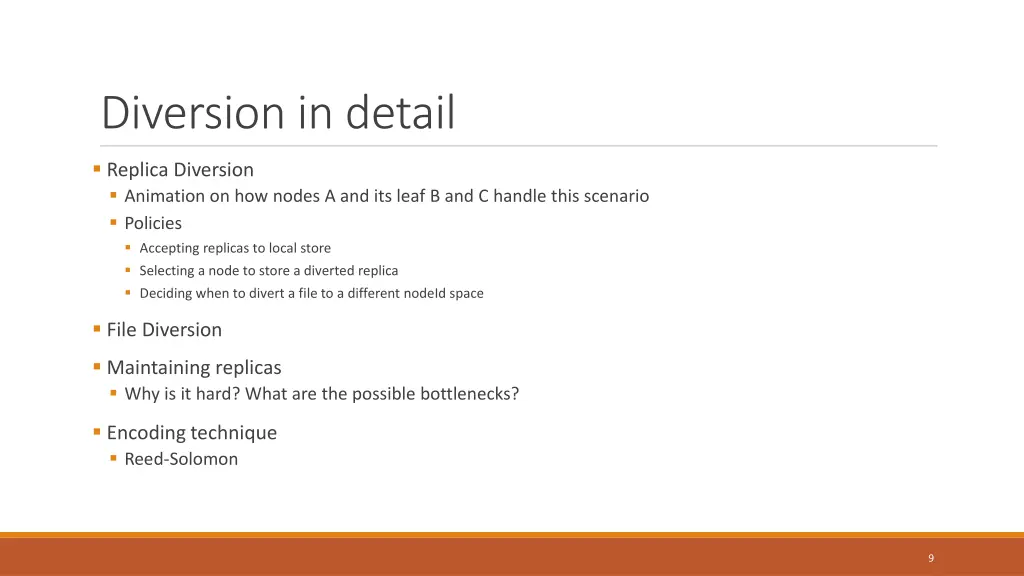
Diversion in detail Replica Diversion Animation on how nodes A and its leaf B and C handle this scenario Policies Accepting replicas to local store Selecting a node to store a diverted replica Deciding when to divert a file to a different nodeId space File Diversion Maintaining replicas Why is it hard? What are the possible bottlenecks? Encoding technique Reed-Solomon 9
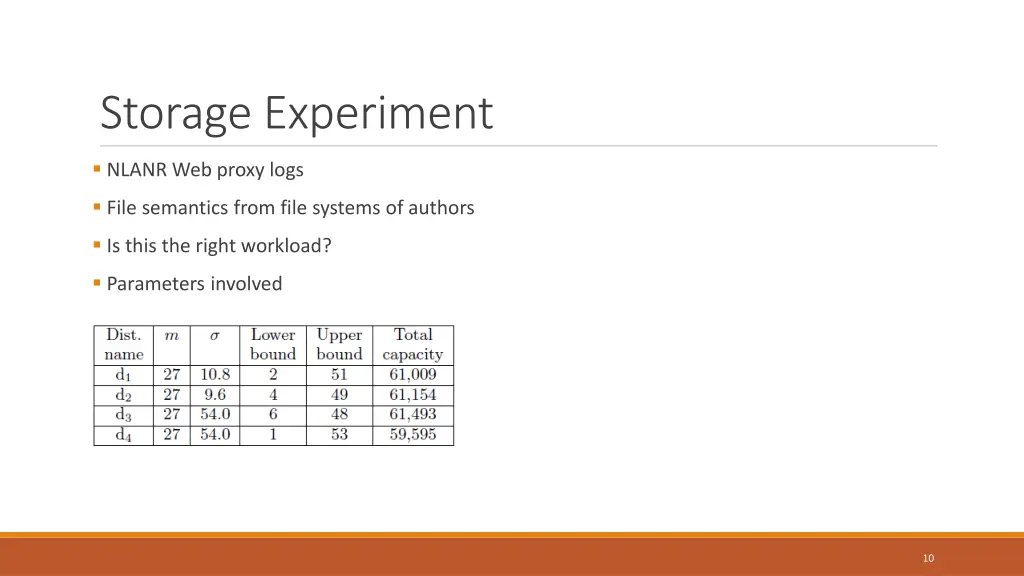
Storage Experiment NLANR Web proxy logs File semantics from file systems of authors Is this the right workload? Parameters involved 10
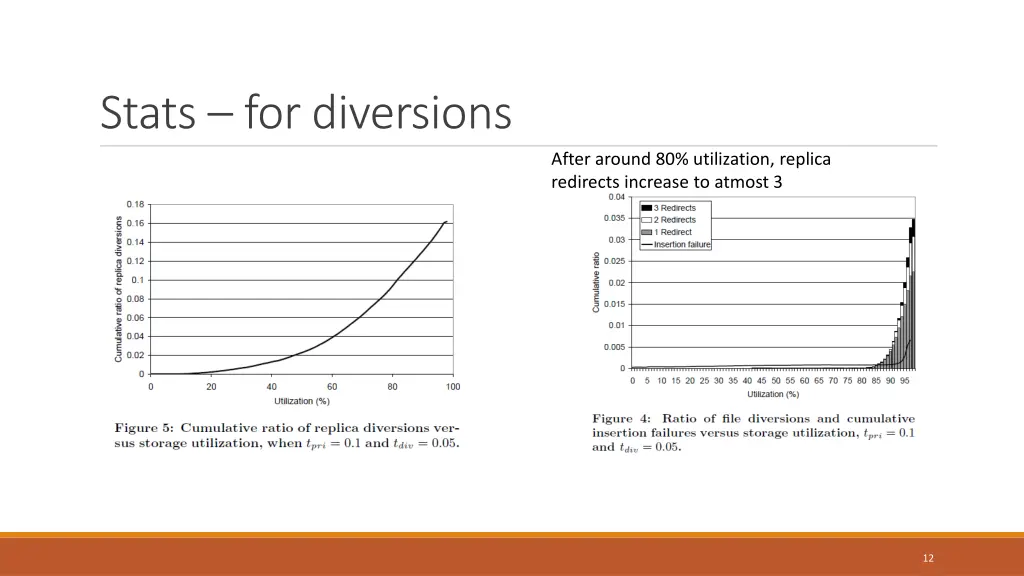
Stats for diversions After around 80% utilization, replica redirects increase to atmost 3 12
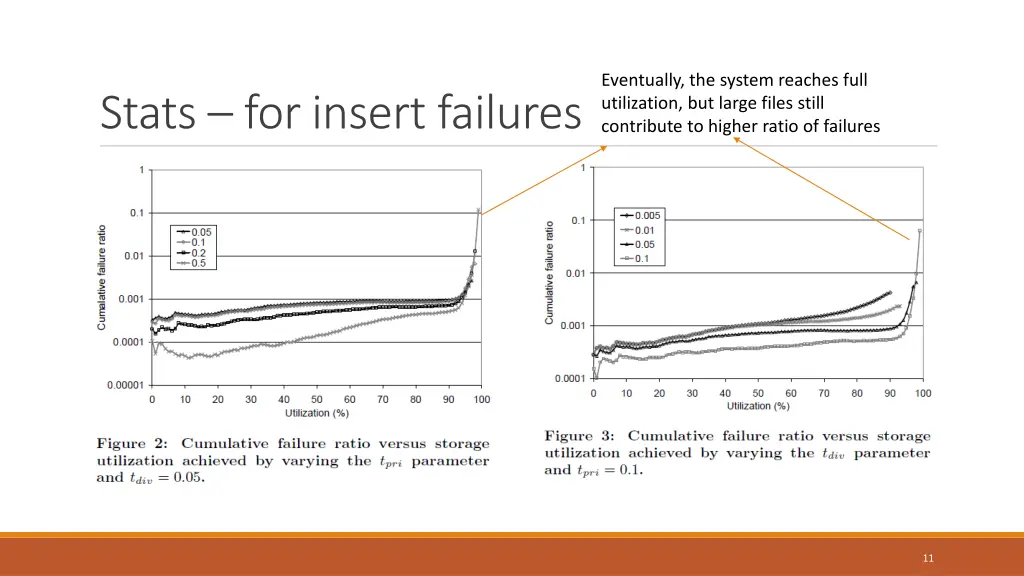
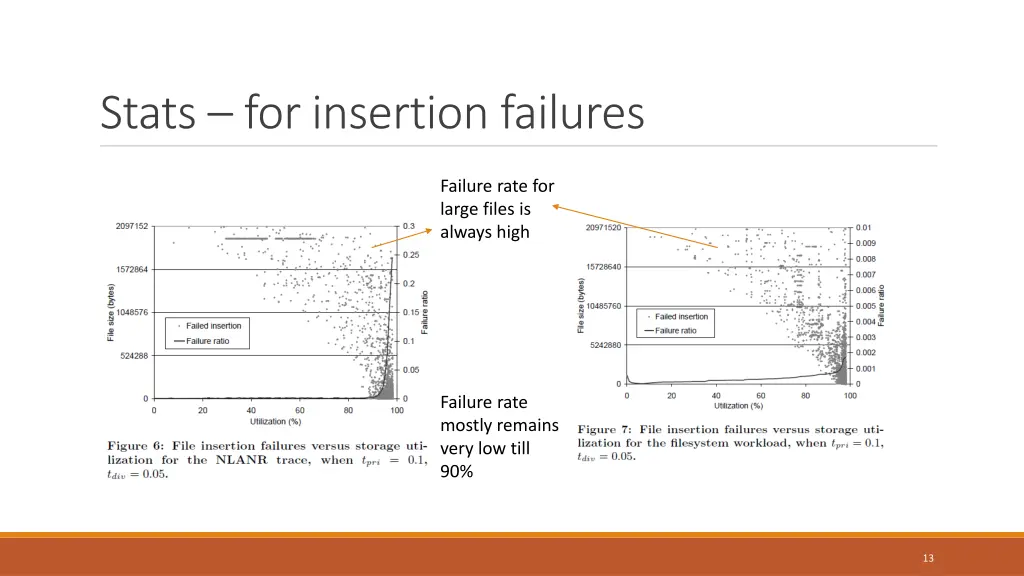
Stats for insertion failures Failure rate for large files is always high Failure rate mostly remains very low till 90% 13
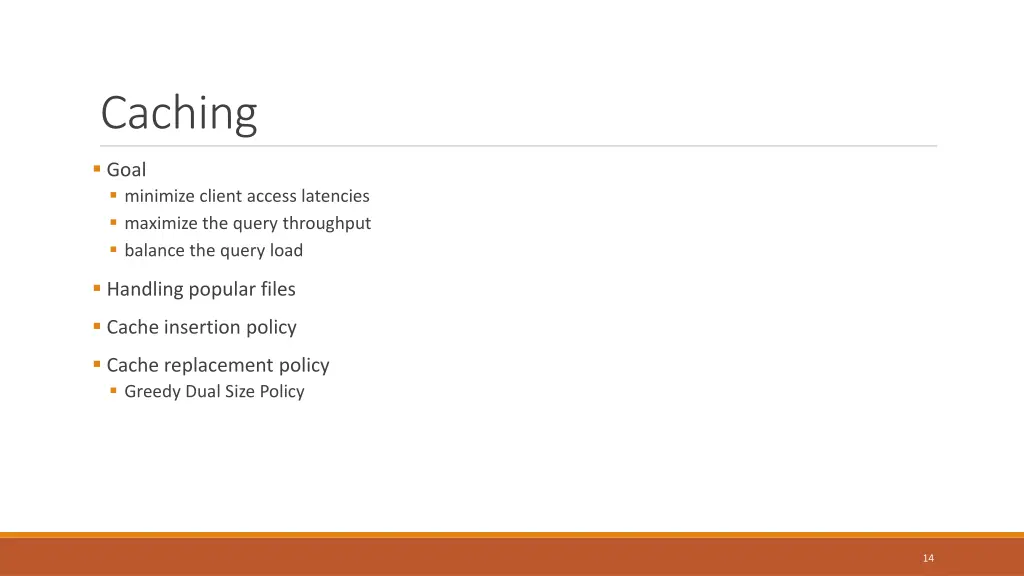
Caching Goal minimize client access latencies maximize the query throughput balance the query load Handling popular files Cache insertion policy Cache replacement policy Greedy Dual Size Policy 14
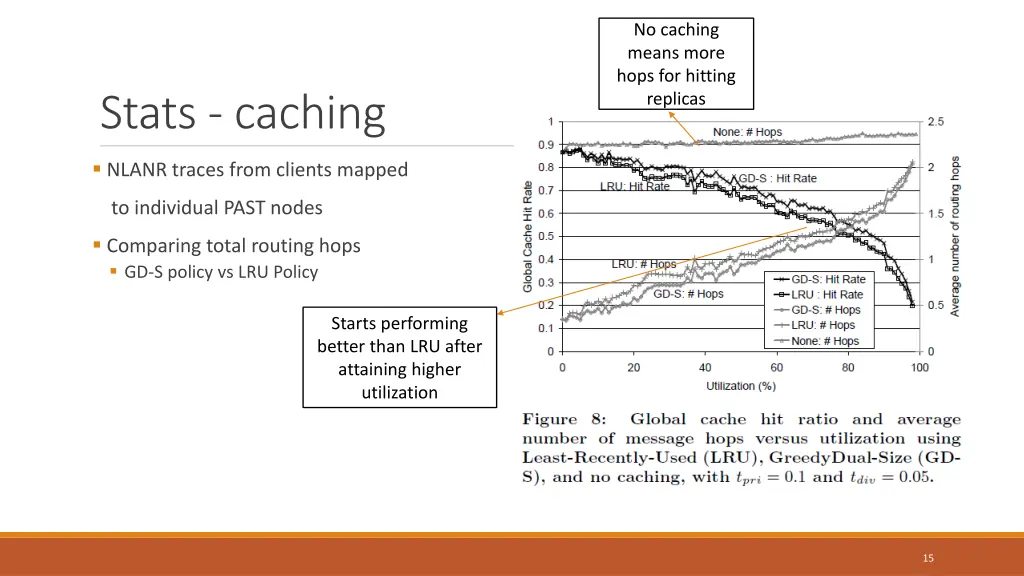
No caching means more hops for hitting replicas Stats - caching NLANR traces from clients mapped to individual PAST nodes Comparing total routing hops GD-S policy vs LRU Policy Starts performing better than LRU after attaining higher utilization 15
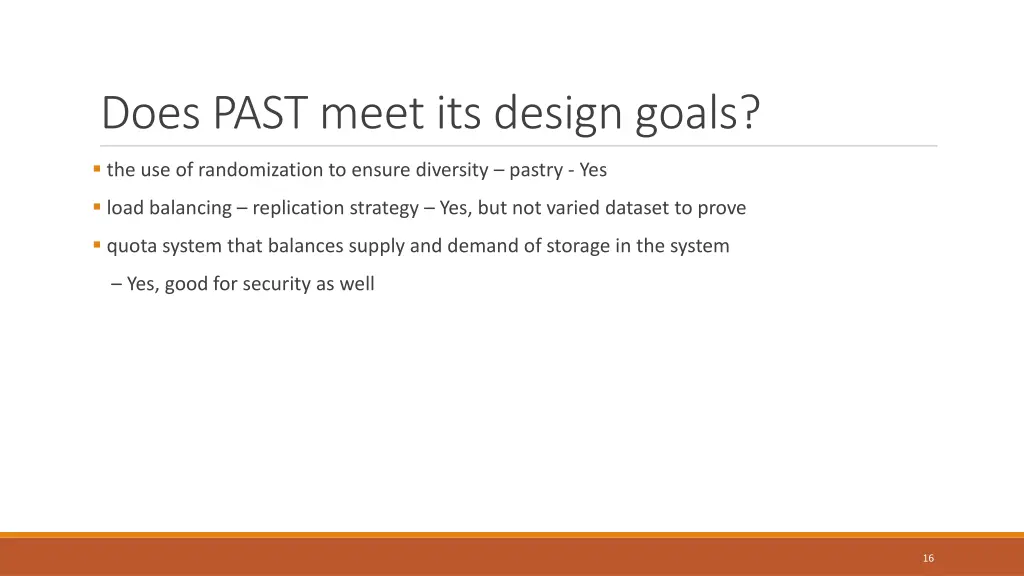
Does PAST meet its design goals? the use of randomization to ensure diversity pastry - Yes load balancing replication strategy Yes, but not varied dataset to prove quota system that balances supply and demand of storage in the system Yes, good for security as well 16
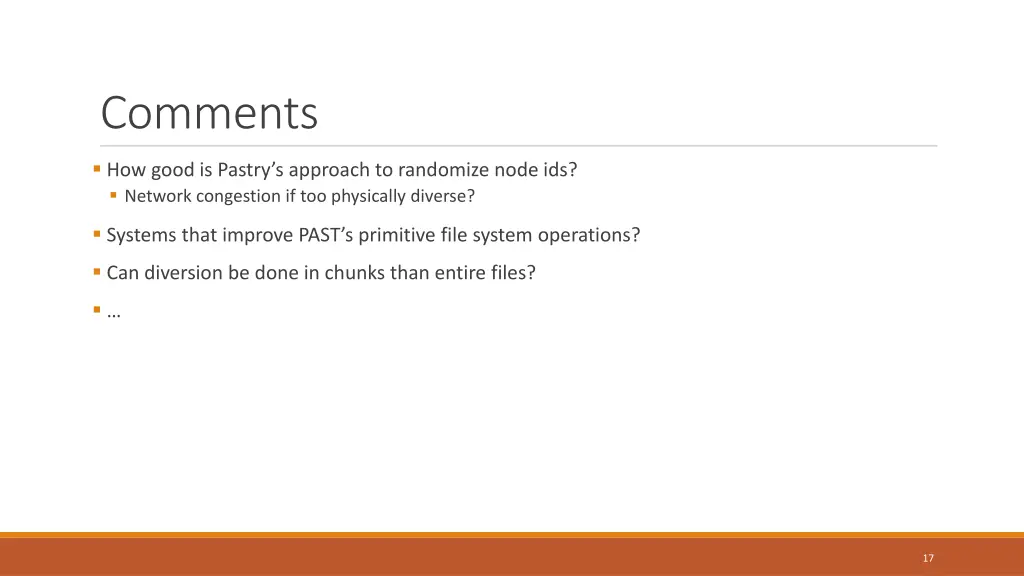
Comments How good is Pastry s approach to randomize node ids? Network congestion if too physically diverse? Systems that improve PAST s primitive file system operations? Can diversion be done in chunks than entire files? 17