Strategies for Successful Supervision, Team Collaboration, and Motivation in Leadership
Explore effective strategies for supervision, team collaboration, and leadership motivation discussed in this resource. Gain insights into defining leadership, understanding motivation, and appreciating good supervisors. Delve into crucial conversations and confrontations, accountability, and the essence of servant leadership. Reflect on your own motivations as a leader and the impact of different leadership styles on team dynamics.

Uploaded on | 1 Views
Download Presentation

Please find below an Image/Link to download the presentation.
The content on the website is provided AS IS for your information and personal use only. It may not be sold, licensed, or shared on other websites without obtaining consent from the author. If you encounter any issues during the download, it is possible that the publisher has removed the file from their server.
You are allowed to download the files provided on this website for personal or commercial use, subject to the condition that they are used lawfully. All files are the property of their respective owners.
The content on the website is provided AS IS for your information and personal use only. It may not be sold, licensed, or shared on other websites without obtaining consent from the author.
E N D
Presentation Transcript
Strategies for Successful Strategies for Successful Supervision and Team Supervision and Team Collaboration Collaboration ADAM MEYER UNIVERSITY OF CENTRAL FLORIDA ADAM.MEYER@UCF.EDU
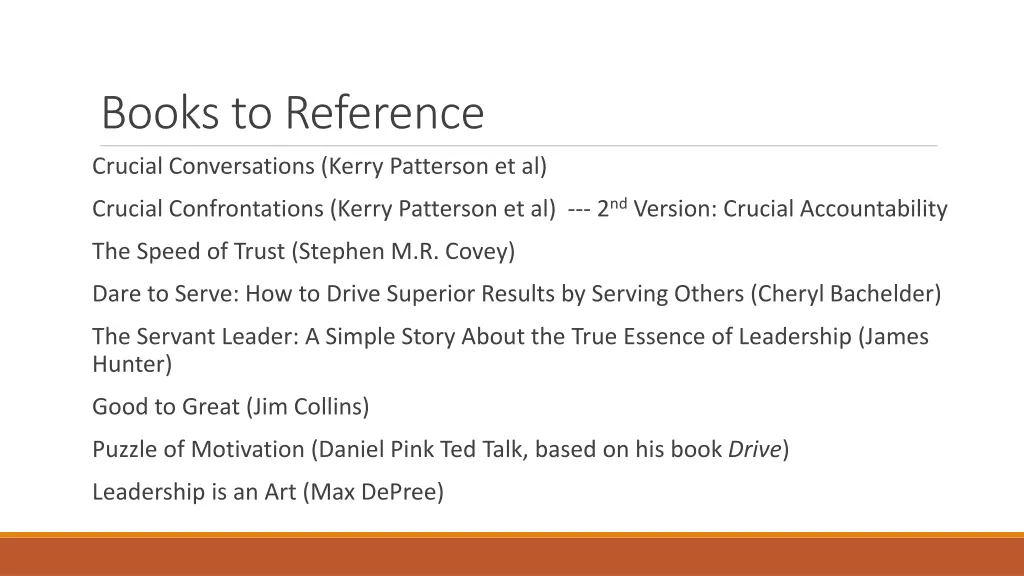
Books to Reference Crucial Conversations (Kerry Patterson et al) Crucial Confrontations (Kerry Patterson et al) --- 2ndVersion: Crucial Accountability The Speed of Trust (Stephen M.R. Covey) Dare to Serve: How to Drive Superior Results by Serving Others (Cheryl Bachelder) The Servant Leader: A Simple Story About the True Essence of Leadership (James Hunter) Good to Great (Jim Collins) Puzzle of Motivation (Daniel Pink Ted Talk, based on his book Drive) Leadership is an Art (Max DePree)
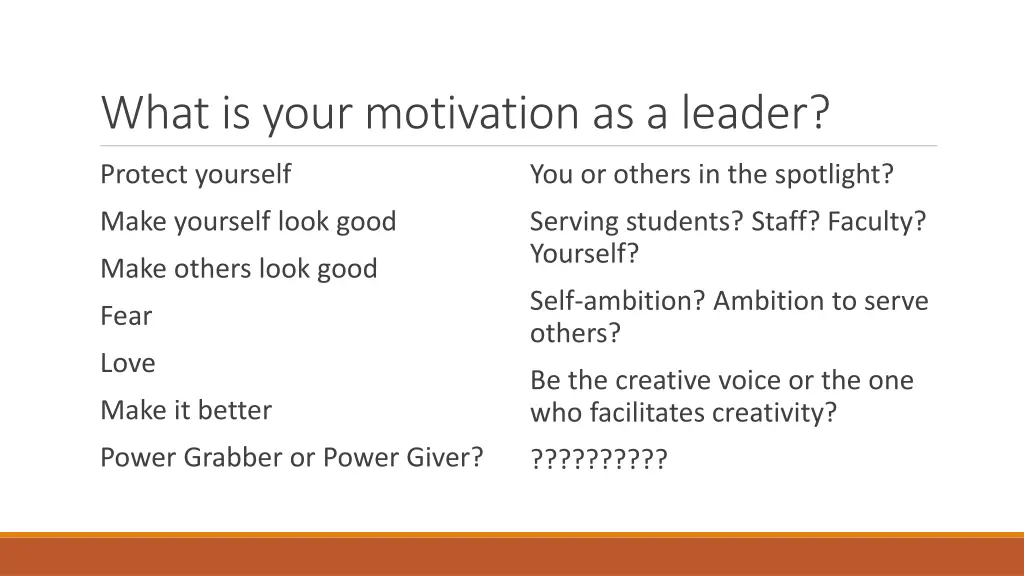
What is your motivation as a leader? Protect yourself You or others in the spotlight? Make yourself look good Serving students? Staff? Faculty? Yourself? Make others look good Self-ambition? Ambition to serve others? Fear Love Be the creative voice or the one who facilitates creativity? Make it better Power Grabber or Power Giver? ??????????
The reality Others know (or assume) your motivation even if you do not. Do you want to decide what is your motivation or leave it to others?
What are some of the things you appreciate (appreciated) about your favorite supervisor?
What are/were some of your greatest frustrations in working with your least favorite supervisor?
Leadership defined here The skill of influencing people to work enthusiastically toward goals identified as being for the common good. Leadership Revolves around character Can be learned and developed by anyone Effectively utilizes authority -- The Servant Leadership
The true measure of leadership is influence; nothing more, nothing less. -- John Maxwell
Power of Influence If you have 5 full-time people looking to you for leadership, in the year ahead you will have 10,000 hours of influence opportunity. -- Dare to Serve
You Need To Establish Trust The ability to establish, grow, extend, and restore trust with all stakeholders is the KEY leadership competency Every interaction with every person is a moment of trust. The way you behave in that moment will either build or diminish trust. --Stephen M.R. Covey
What people want to know Do you care for me? Can you help me? Can I trust you?
If you are a supervisor The answer to Do you trust your boss? is more predictive of team and office performance THAN ANYTHING ELSE!
Could It Be This Simple? When we believe that people are truly acting in our best interest, we tend to trust them. When we believe they are not acting in our best interest (or we may not be sure of the intent), we do not trust them. --Stephen M.R. Covey
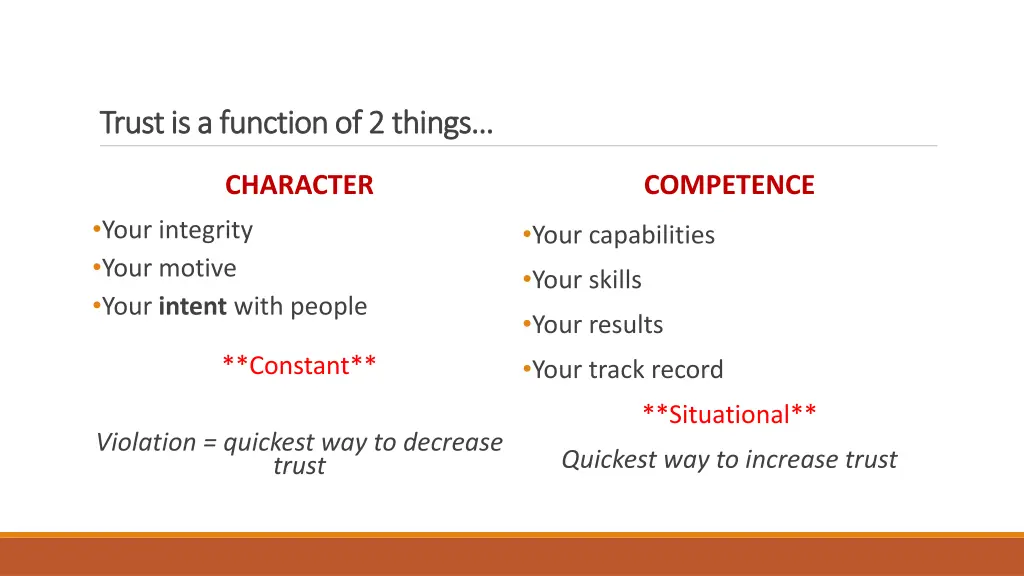
Trust is a function of 2 things Trust is a function of 2 things CHARACTER COMPETENCE Your integrity Your motive Your intent with people Your capabilities Your skills Your results Your track record **Constant** **Situational** Violation = quickest way to decrease trust Quickest way to increase trust
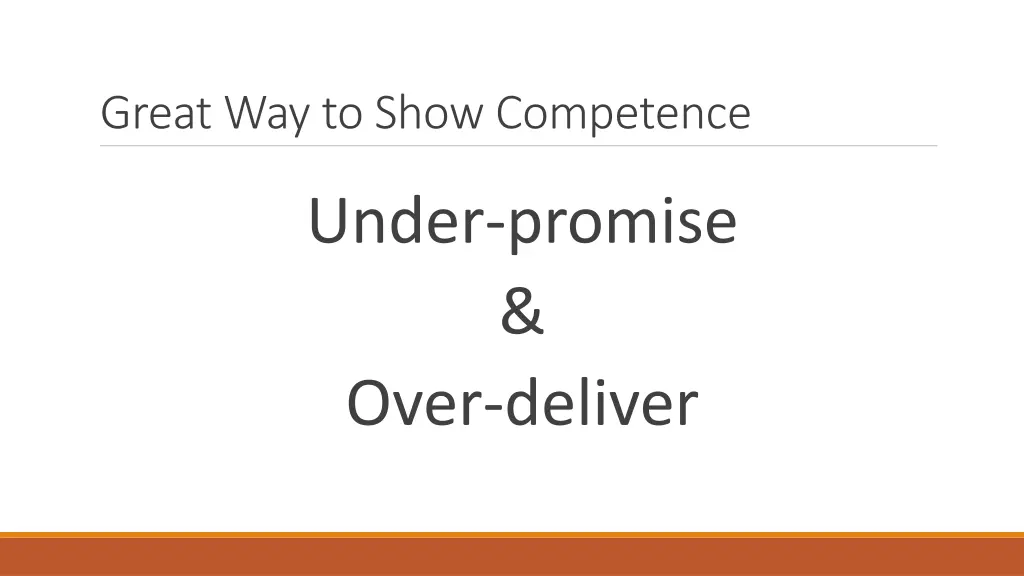
Great Way to Show Competence Under-promise & Over-deliver
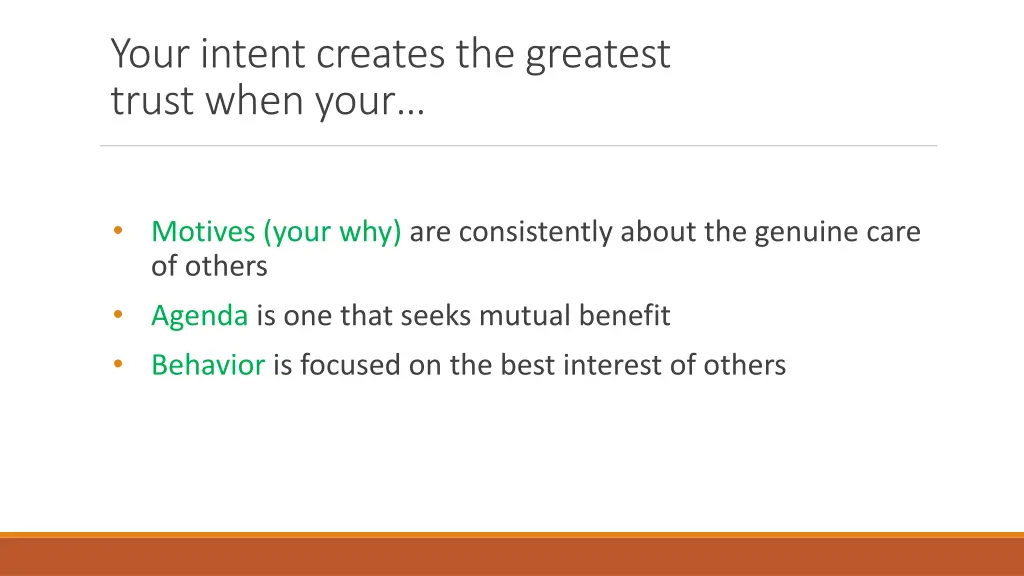
Your intent creates the greatest trust when your Motives (your why) are consistently about the genuine care of others Agenda is one that seeks mutual benefit Behavior is focused on the best interest of others
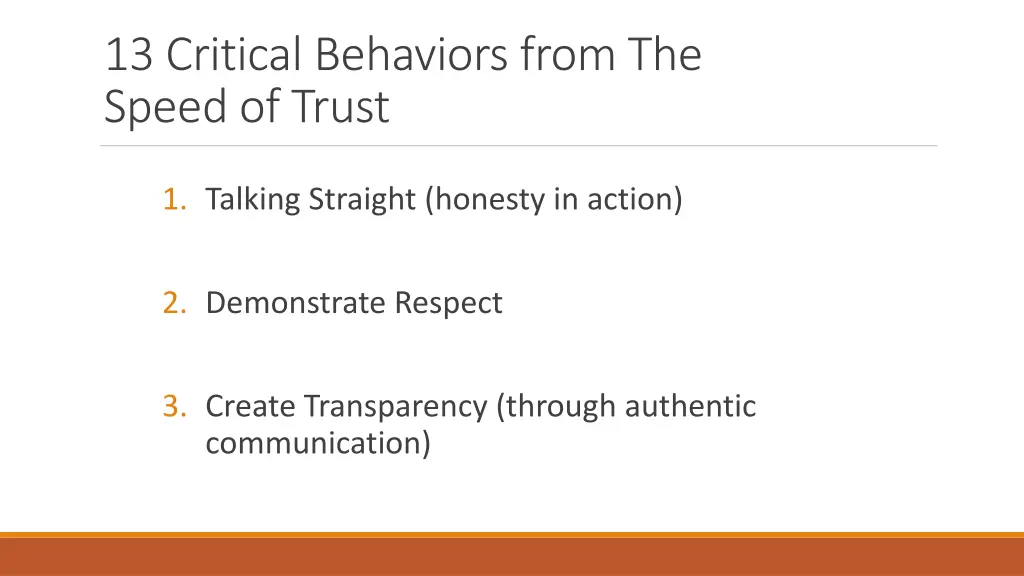
13 Critical Behaviors from The Speed of Trust 1. Talking Straight (honesty in action) 2. Demonstrate Respect 3. Create Transparency (through authentic communication)
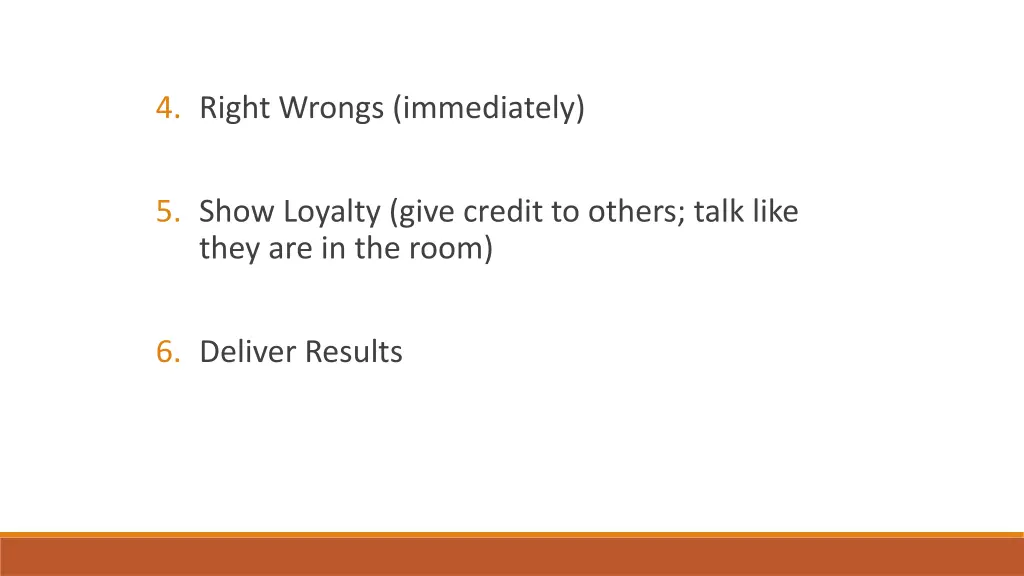
4. Right Wrongs (immediately) 5. Show Loyalty (give credit to others; talk like they are in the room) 6. Deliver Results
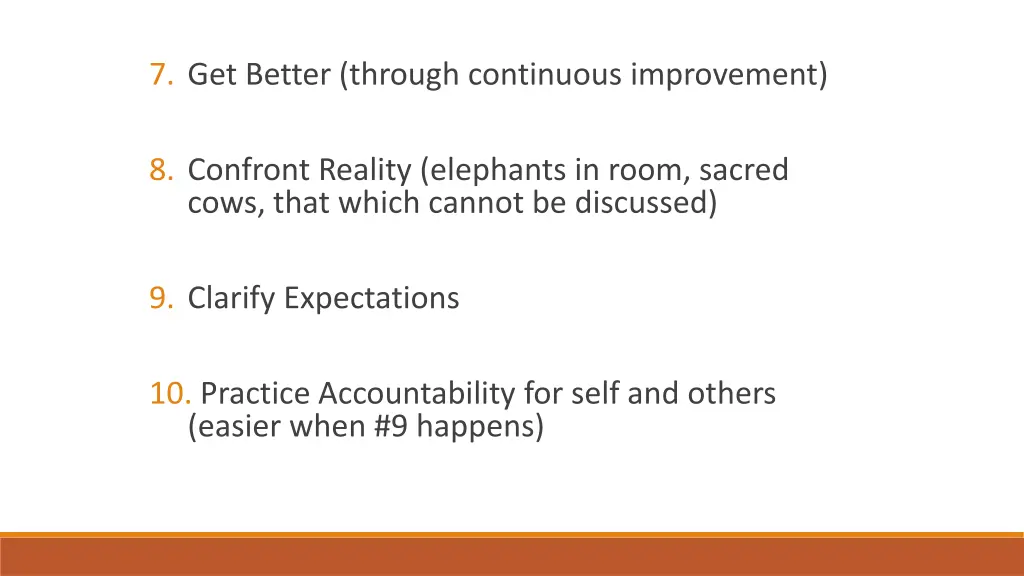
7. Get Better (through continuous improvement) 8. Confront Reality (elephants in room, sacred cows, that which cannot be discussed) 9. Clarify Expectations 10. Practice Accountability for self and others (easier when #9 happens)
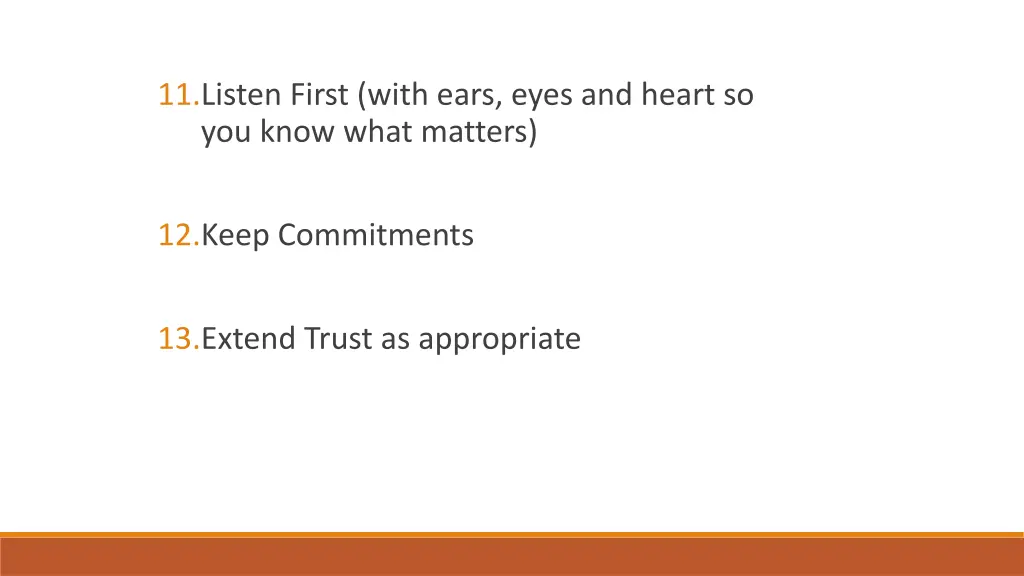
11.Listen First (with ears, eyes and heart so you know what matters) 12.Keep Commitments 13.Extend Trust as appropriate
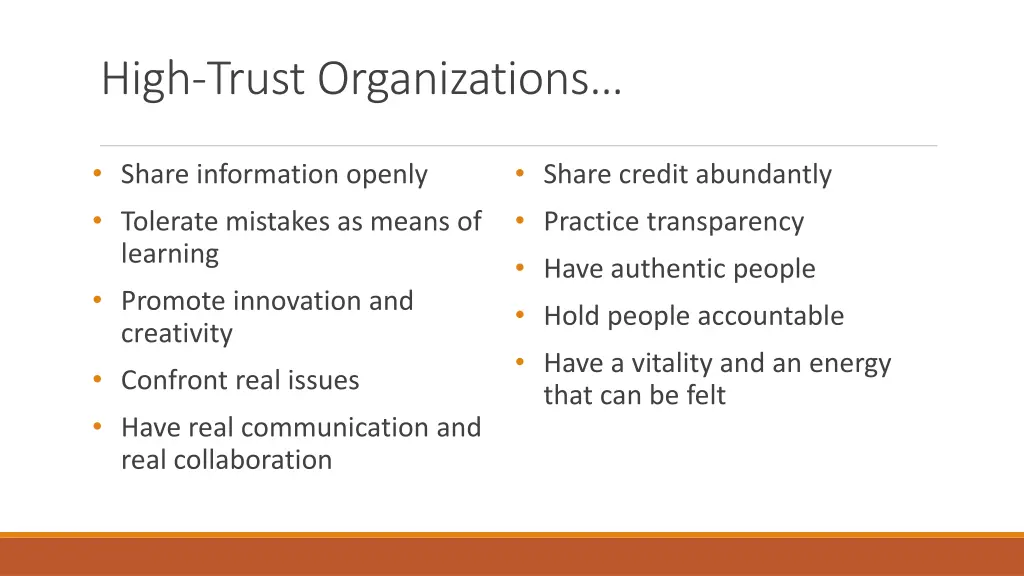
High-Trust Organizations Share information openly Tolerate mistakes as means of learning Promote innovation and creativity Confront real issues Have real communication and real collaboration Share credit abundantly Practice transparency Have authentic people Hold people accountable Have a vitality and an energy that can be felt
What is Flow? Mental state of operation in which the person is fully immersed in what he or she is doing Feeling of energized focus, full involvement, and success in the process of the activity Completely focused motivation The hallmark of flow is a feeling of spontaneous joy, even rapture, while performing a task Proposed by Mih ly Cs kszentmih lyi
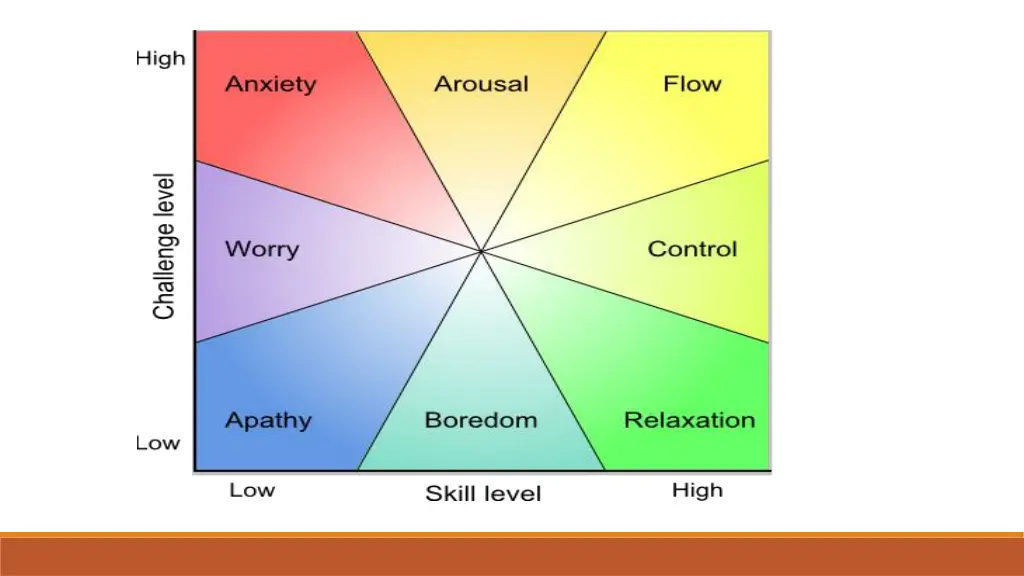
Flow Graph This graph depicts various levels of feelings and experiences based on the challenge level and skill level of a job. Low skill and challenge results in apathy. Low skill and mid challenge creates worry. Low skill and high challenge creates anxiety. Mid skill and low challenge creates boredom. High challenge and mid skill creates arousal. High skill and low challenge creates relaxation. High skill and mid challenge creates control. And the ideal is high skill level and a high challenge level, which is flow.
I do not have to necessarily like my players and associates, but as a leader I must love them. Love is loyalty, love is teamwork, love respects the dignity of the individual. This is the strength of any organization. -- Vince Lombardi
Reframing Love Common in English language: Love is a feeling Reframe: Love is a behavior, an action (Agape love) Patience Kindness Humility Respectfulness Selflessness Forgiveness Honesty Commitment
A team member or employee motivated by fear, force or any other form of manipulation is not that same as a team member motivated by love or the knowledge that someone cares about them. -- Zach Thomas
Intrinsic Motivation is Critical Autonomy The desire to direct our own lives Mastery The desire to get better and better at what we do that truly matters Purpose The yearning to do what we do in the spirit of something larger than ourselves Traditional management is great for compliance. Self-direction works better for employee engagement. -- Daniel Pink
Help Them Reach Goals, Even if it Means They Leave
Growth Mindset How can you make each person better? What are your colleague s Short-term goals? Long-term goals? Work Passions? Work Strengths? Obvious places where they can contribute in the office operations?
Individual Connection Must connect with each employee individually each have unique needs Think UDL -- Universal Design for Leading
Examples Develop presentation skills? Develop programs? Organize events? Enhance office processes and policies? Database management? Get involved in committees on campus? Assistant Director? Director? Leaving disability field for something else?
Leaders owe people space, space in the sense of freedom. Freedom in the sense of enabling our gifts to be exercised. -- Max Depree
Understanding and accepting diversity enables us to see that each of us is needed. It also enables us to begin to think about being abandoned to the strengths of others, of admitting we cannot do everything. -- Max DePree
Of all of the bad ideas circulating the grapevine, pretending that leaders must know everything is among the most ridiculous and harmful. Leaders earn their keep, not by knowing everything, but by knowing how to bring the right combination of people (most of whom know more about certain topics than the leader) and propel them toward common objectives. It is okay to say, I do not know. Ideas anyone? -- Crucial Confrontations
Ultimate Leadership Goal To have your boss come into your office and tell you that you mentored someone so well that they will now be better in your position than you so get out Leaders leave behind a positive influence when they leave and the office builds on the leader s work and flourishes
Supervising Challenging Employees or Challenging Situations
What are some challenges you experience in supervising employees?
4 Possible Roots of Challenging Employees 1. Me 2. Unmet Expectations 3. Lack of skill 4. Lack of motivation
Me Our attitude toward others plays a large role in other s performance results Everyone is a valuable member of the team do you think that? Where am I the person s barrier to great performance? Where have I failed to communicate or act in the manner needed for that person s success?
Most leaders can tell you the weaknesses of their team members. But can you cite the strengths and talents of your team? Are you accessing their very best capability? -- Dare to Serve
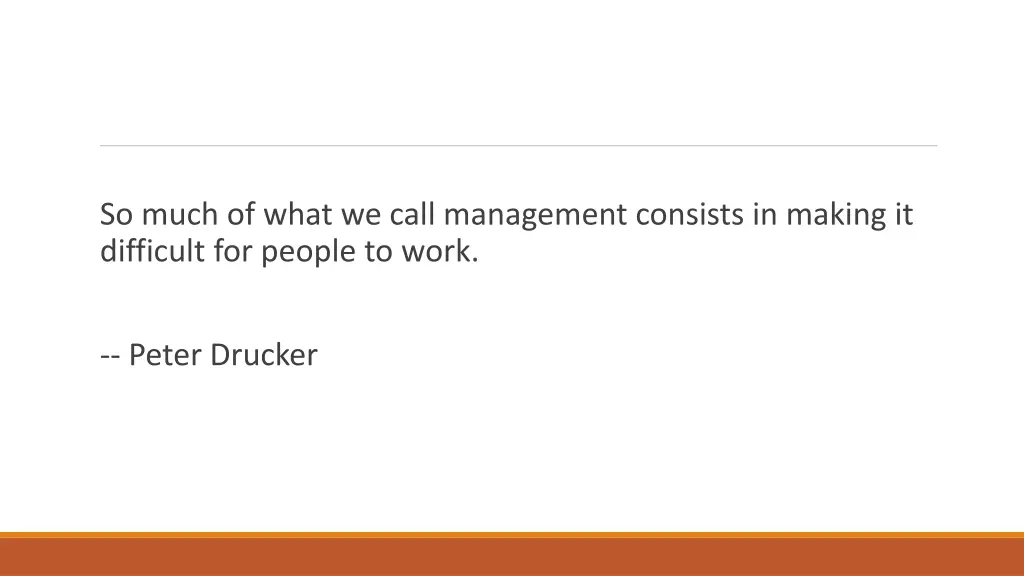
So much of what we call management consists in making it difficult for people to work. -- Peter Drucker