Straw Tube Detectors in Particle Physics
Learn about straw tube detectors, cylindrical drift cells used in particle physics experiments for tracking particles with high resolution and transparency. Discover how these detectors work, their advantages, and applications in particle tracking.

Download Presentation

Please find below an Image/Link to download the presentation.
The content on the website is provided AS IS for your information and personal use only. It may not be sold, licensed, or shared on other websites without obtaining consent from the author. If you encounter any issues during the download, it is possible that the publisher has removed the file from their server.
You are allowed to download the files provided on this website for personal or commercial use, subject to the condition that they are used lawfully. All files are the property of their respective owners.
The content on the website is provided AS IS for your information and personal use only. It may not be sold, licensed, or shared on other websites without obtaining consent from the author.
E N D
Presentation Transcript
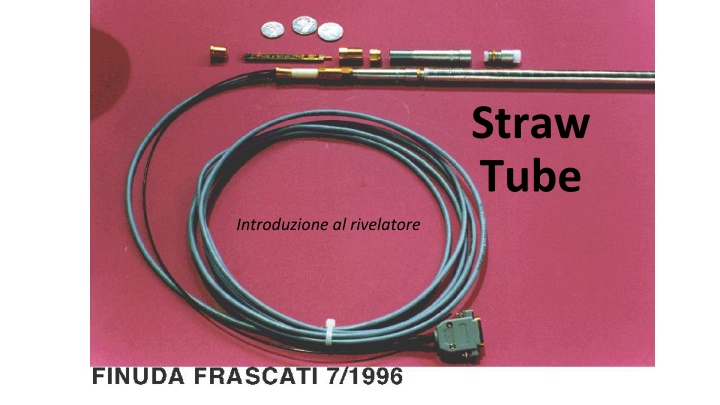
Straw Tube Introduzione al rivelatore
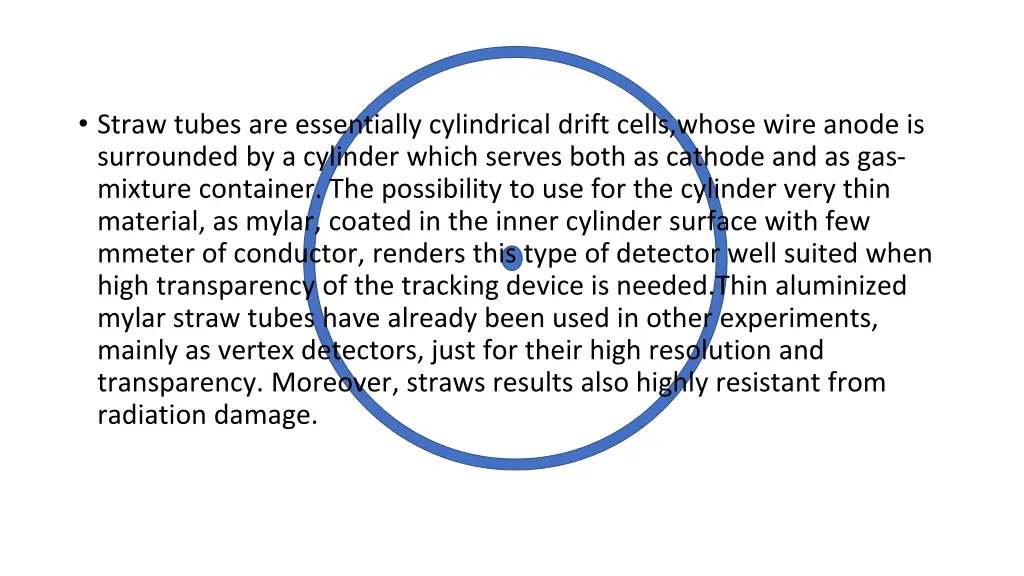
Straw tubes are essentially cylindrical drift cells,whose wire anode is surrounded by a cylinder which serves both as cathode and as gas- mixture container. The possibility to use for the cylinder very thin material, as mylar, coated in the inner cylinder surface with few mmeter of conductor, renders this type of detector well suited when high transparency of the tracking device is needed.Thin aluminized mylar straw tubes have already been used in other experiments, mainly as vertex detectors, just for their high resolution and transparency. Moreover, straws results also highly resistant from radiation damage.
Una camera a Straw un tipo di rivelatore a ionizzazione gassosa. un lungo tubo con un filo al centro e un gas che si ionizza quando passa una particella. Viene mantenuta una potenziale differenza tra il filo e le pareti del tubo, in modo che una volta che il gas viene ionizzato gli elettroni si muovono in una direzione e gli ioni nell'altra. Questo produce una corrente che indica che una particella passata attraverso la camera Un tracker un tipo di rivelatore di particelle che utilizza molte camere Straw per tracciare il percorso di una particella. Il percorso di una particella tracciato adattando gli Straws nello spazio. Poich il tempo in cui una particolare straw produce un segnale proporzionale alla distanza della particella al filo di quella camera, se una particella su un percorso prevedibile (ad esempio un'elica in un campo magnetico) attraversa molte cannucce, il percorso della particella pu essere determinata in modo pi preciso.
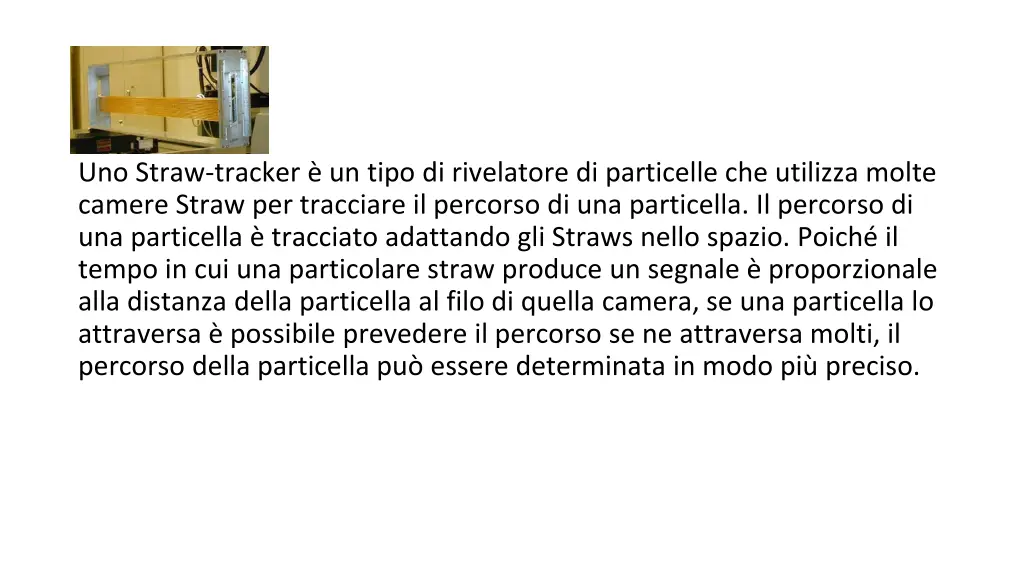
Uno Straw-tracker un tipo di rivelatore di particelle che utilizza molte camere Straw per tracciare il percorso di una particella. Il percorso di una particella tracciato adattando gli Straws nello spazio. Poich il tempo in cui una particolare straw produce un segnale proporzionale alla distanza della particella al filo di quella camera, se una particella lo attraversa possibile prevedere il percorso se ne attraversa molti, il percorso della particella pu essere determinata in modo pi preciso.
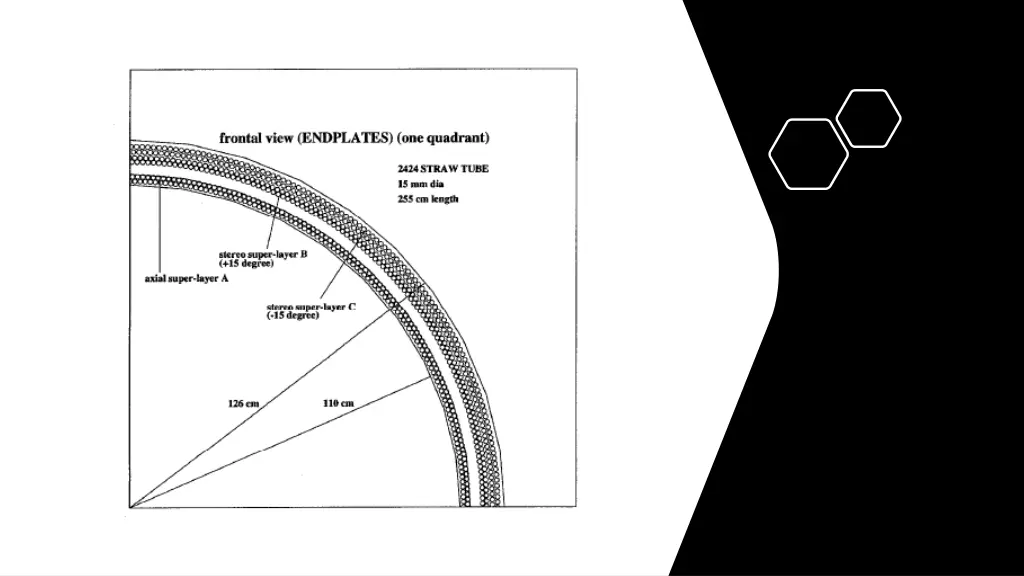
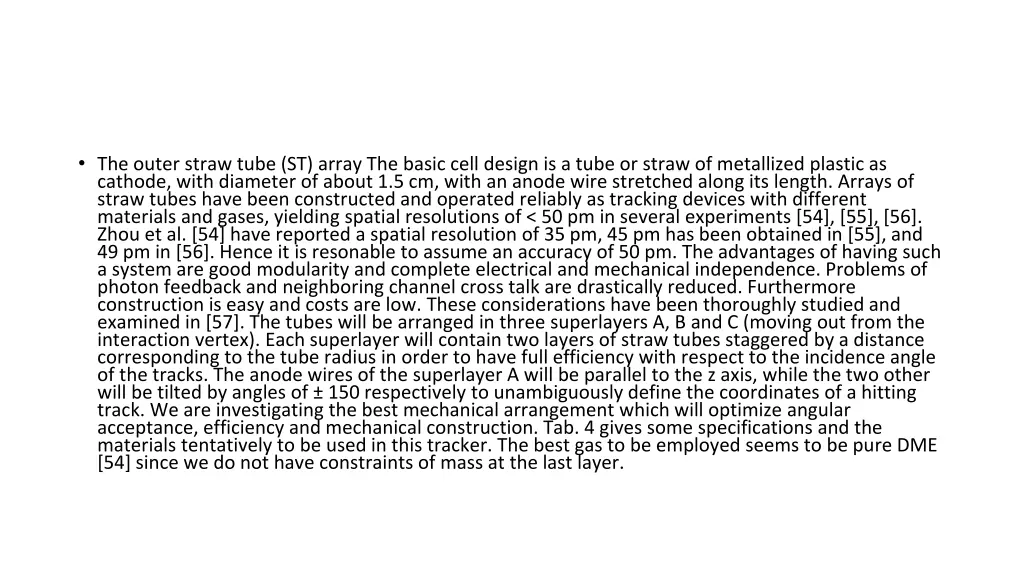
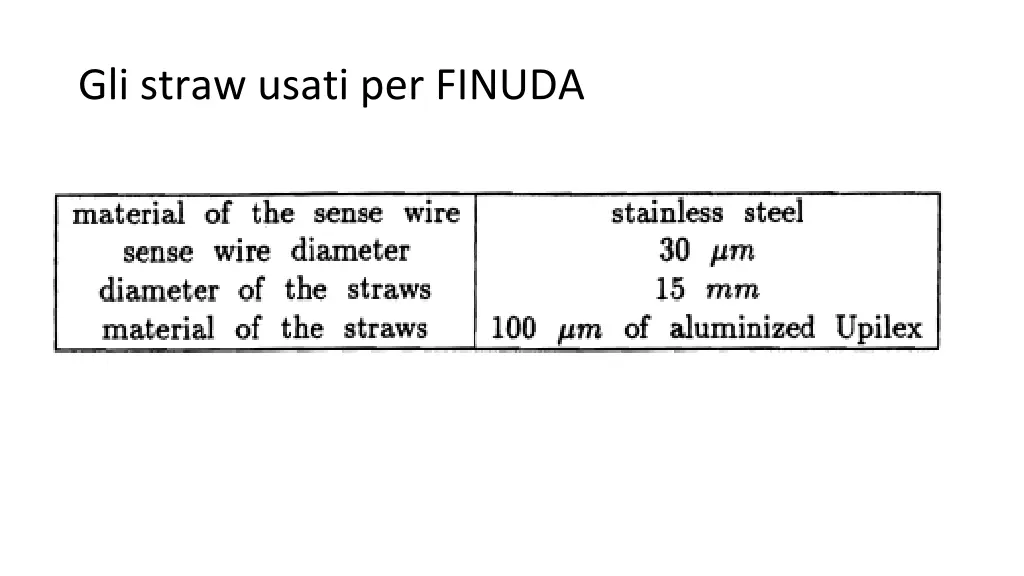
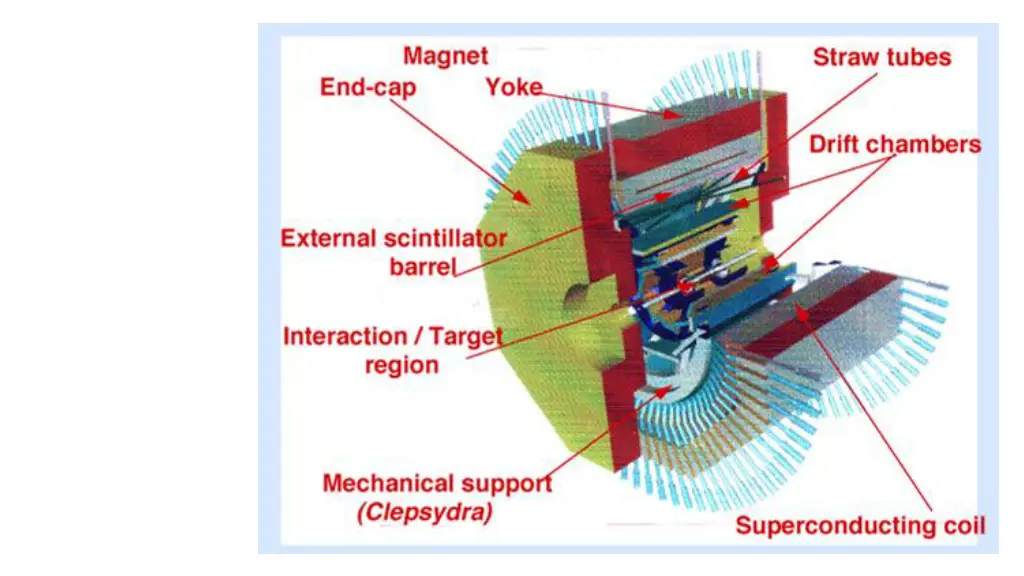
The outer straw tube (ST) array The basic cell design is a tube or straw of metallized plastic as cathode, with diameter of about 1.5 cm, with an anode wire stretched along its length. Arrays of straw tubes have been constructed and operated reliably as tracking devices with different materials and gases, yielding spatial resolutions of < 50 pm in several experiments [54], [55], [56]. Zhou et al. [54] have reported a spatial resolution of 35 pm, 45 pm has been obtained in [55], and 49 pm in [56]. Hence it is resonable to assume an accuracy of 50 pm. The advantages of having such a system are good modularity and complete electrical and mechanical independence. Problems of photon feedback and neighboring channel cross talk are drastically reduced. Furthermore construction is easy and costs are low. These considerations have been thoroughly studied and examined in [57]. The tubes will be arranged in three superlayers A, B and C (moving out from the interaction vertex). Each superlayer will contain two layers of straw tubes staggered by a distance corresponding to the tube radius in order to have full efficiency with respect to the incidence angle of the tracks. The anode wires of the superlayer A will be parallel to the z axis, while the two other will be tilted by angles of 150 respectively to unambiguously define the coordinates of a hitting track. We are investigating the best mechanical arrangement which will optimize angular acceptance, efficiency and mechanical construction. Tab. 4 gives some specifications and the materials tentatively to be used in this tracker. The best gas to be employed seems to be pure DME [54] since we do not have constraints of mass at the last layer.
https://indico.cern.ch/event/121649/attachments/68416/98147/straw.pdhttps://indico.cern.ch/event/121649/attachments/68416/98147/straw.pd f Straw Tubes Info made bu Daniele P. Straw Tubes Info made bu Daniele P.