Join the virtual workshop by Jagath Karunathilaka on Strengthening Human Resource Management of Civil Society Organizations. Explore topics like conflict resolution, grievance management, and more to enhance your organization's HR practices. Don't miss this opportunity to gain valuable insights in just 10 days!
Please find below an Image/Link to download the presentation.
The content on the website is provided AS IS for your information and personal use only. It may not be sold, licensed, or shared on other websites without obtaining consent from the author. If you encounter any issues during the download, it is possible that the publisher has removed the file from their server.
You are allowed to download the files provided on this website for personal or commercial use, subject to the condition that they are used lawfully. All files are the property of their respective owners.
The content on the website is provided AS IS for your information and personal use only. It may not be sold, licensed, or shared on other websites without obtaining consent from the author.
E N D
Presentation Transcript
Workshop on Workshop on Strengthening Human Resource Strengthening Human Resource Management of Civil Society Management of Civil Society Organizations Organizations By By Jagath Jagath Karunathilaka Karunathilaka (Through Virtual Meeting (Through Virtual Meeting Zoom Technology) October 4 October 4 22 22 (20 Lesson Hours in 10 Days) (20 Lesson Hours in 10 Days) Zoom Technology)
Lesson Plans of HR Management of CSO Lesson Plans of HR Management of CSO Chapter No Lesson Topics Scheduled Date Timing Monday, 4th October 1 Business Code Practice, Compliance and Data Security Employment Practices 10.00 12.00am 2 Tuesday, 5th October 3 Recruitment, Selection and Induction 10.00 11.30am Wednesday, 6th October 4 General Terms and Conditions of Employment 10.00 12.00am Thursday, 7th October 5 Rewards and Recognition 10.00 11.30am Monday, 11th October 6 Performance Review, Training & Learning Practices Superannuation and Severance 9.00 12.00am Tuesday, 12th October 7 10.00 11.30am Wednesday, 13th October Thursday, 14th October 8 Conflict and Grievance Management 10.00 11.30am 9 Disciplinary Management 9.00 12.00am Thursday, 21st October 10 Employment Law & Employee Rights 10.00 12.00am Friday, 22nd October 11 Current Issues & Trends in HRM 10.00 11.30am
Chapter 8: Conflict and Grievance Management Chapter 8: Conflict and Grievance Management About This Chapter About This Chapter The conflict and grievance management chapter of this workshop is designed you to learn about how conflict is transformed into, for instance, a grievance and then into a dispute, the degree of formalization of the issues increases. A grievance is more formal than a mere complaint or a grudge. Open and honest communication is essential for resolution of conflicts and grievances within the organization. The person/s with a concern is encouraged to raise concerns with those involved at the first sign of an issue developing. The guidance and the tools introduced through this chapter can help you to set up, revise or realign existing conflict and grievance management system in your organization.
Chapter 8: Conflict and Grievance Management Chapter 8: Conflict and Grievance Management The Scope The Scope Process of the conflict resolution in an organization Grievance redressel system: a formal process to settle employee grievances (addresses including violation of the terms of employment, the law, organization regulations, and worker rights or accepted past practices etc.) Key components of grievance mechanism: o Raised with the immediate supervisor - conciliation o Internal review hearing stages o Arbitration hearing o Dismissal of complaint o Withdrawal of grievances Responsibilities of the officer handling grievances etc. Records on grievances received, responded, resolved, withdrawal and dismissal, and appeal process etc.
Conflict and Grievance Management Conflict and Grievance Management Open Door Policy Open Door Policy Guideline Guideline The Open Door Policy relates to the provision provided by the management of CSO and the commitment towards open and honest discussion with the relevant person in authority pertaining to any employment, people, operational or workplace related concerns one may have in resolving any problem, conflict or misunderstanding promptly and effectively. The Open Door Policy is operative through the Employee Suggestion Box and the procedure of Grievance Policy . All matters discussed shall be held as confidential and shall not be held against the person who raised the concern.
What is an open door policy? In most companies, an open door policy indicates to employees that a supervisor or manager is open to an employee's questions, that a supervisor or manager is open to an employee's questions, complaints, suggestions, and challenges complaints, suggestions, and challenges. The objective is to encourage open communication, feedback, and discussion about any concerns employees may have to employees
How does the open door policy work? How does the open door policy work? An open door policy means every manager's door is open to every employee manager's door is open to every employee. The purpose is to encourage open communication, feedback, and discussion about any matter of importance to an employee. Employees can take their workplace concerns, questions, or suggestions outside their own chain of command without worrying every Image result for open door policy
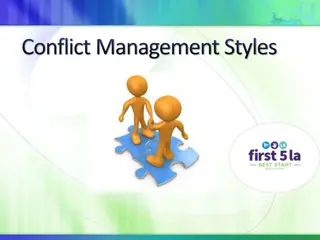
What is Conflict Management? Conflict management is the practice of being able to identify and handle conflicts sensibly, fairly, and efficiently. Since conflicts in a business are a natural part of the workplace, it is important that there are people who understand conflicts and know how to resolve them. This is important in today's market more than ever. Everyone is striving to show how valuable they are to the company they work for and at times, this can lead to disputes with other members of the team. Conflict management Conflict management is the process of limiting the negative aspects of conflict while increasing the positive aspects of conflict. The aim of conflict management is to enhance learning and group outcomes, including effectiveness or performance in an organizational setting.
What are Conflict Management Styles? Conflicts happen. How an employee responds and resolves conflict will limit or enable that employe's success. Here are five conflict styles that a manager will follow according to Kenneth W. Thomas and Ralph H. Kilmann:
Examples of conflict management skills Effective communication. One of the most important skills you can have for conflict management is the communication skills to resolve conflict effectively. ... Active listening. ... Practicing empathy. ... Problem-solving. ... Positive attitude. ... Level-headedness. ... Have patience. ... Understand body language.
What Are the Different Types of Grievance What Are the Different Types of Grievance in the Workplace? in the Workplace? Individual and collective grievances. Interpersonal issues: bullying, harassment and discrimination. Pay and benefits. Grievances related to the gender pay gap. Grievances about working time and working conditions. What are the three types of grievances? What are the three types of grievances? Individual grievance. One person grieves that a management action has violated their rights under the collective agreement. ... Group grievance. A group grievance complains that management action has hurt a group of individuals in the same way. ... Policy or Union grievance.