Structural Analysis of Economic Impact Risk Propagation in Infrastructures

Structural analysis meets economic impact risk propagation in this insightful presentation by Dr. Albert Owusu. Explore the connectivity and interdependencies of infrastructure networks, highlighting vulnerabilities and model impact transfers. Gain a new perspective on applying engineering principles in various disciplines to enhance infrastructure resilience.

Download Presentation

Please find below an Image/Link to download the presentation.
The content on the website is provided AS IS for your information and personal use only. It may not be sold, licensed, or shared on other websites without obtaining consent from the author.If you encounter any issues during the download, it is possible that the publisher has removed the file from their server.
You are allowed to download the files provided on this website for personal or commercial use, subject to the condition that they are used lawfully. All files are the property of their respective owners.
The content on the website is provided AS IS for your information and personal use only. It may not be sold, licensed, or shared on other websites without obtaining consent from the author.
E N D
Presentation Transcript
Rethinking the Application of Engineering: Structural Analysis of Economic Impact Risk Propagation in Infra_Structures. Dr. Albert Owusu PhD; M.Sc. (Proj Mgt); M. E (Civil Eng.); B.Sc.(Civil Eng.); PMI. MNZSEE. E-mail: ahowusu@gmail.com
Objectives of Presentation Exhibit a Model Impact Propagation Illustrate Structural concept application Show convergence between Structural & Economic concepts To encourage Engineers to take interest and explore Engineering applications in other disciplines. 2
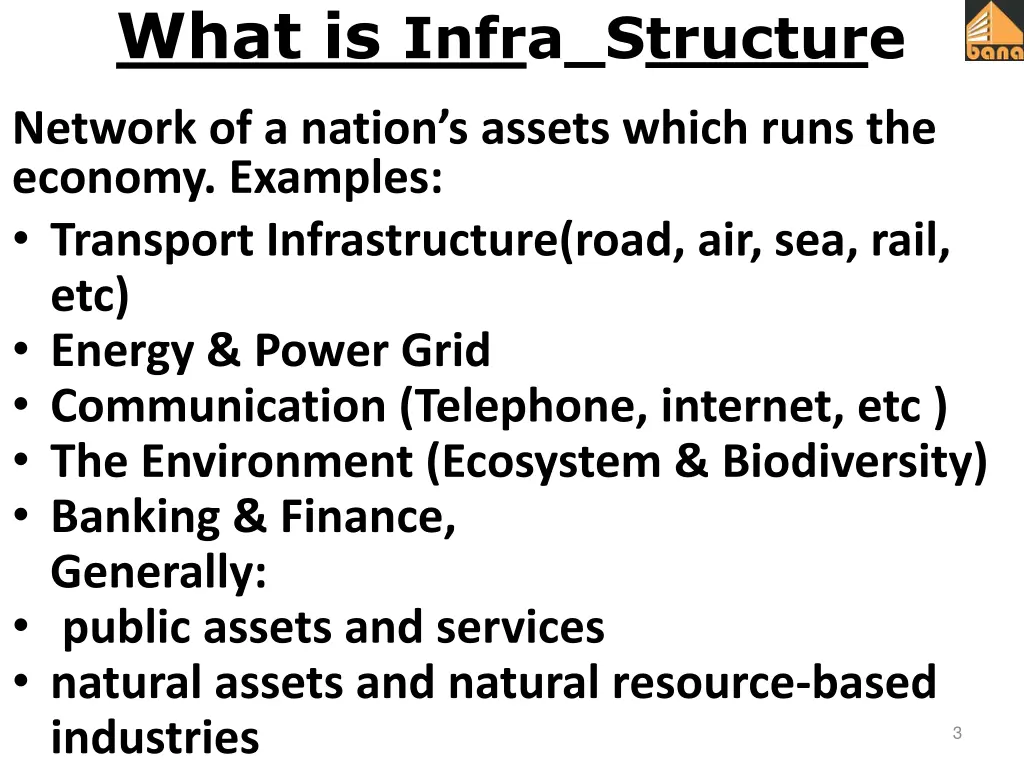
What is Infra_Structure Network of a nation s assets which runs the economy. Examples: Transport Infrastructure(road, air, sea, rail, etc) Energy & Power Grid Communication (Telephone, internet, etc ) The Environment (Ecosystem & Biodiversity) Banking & Finance, Generally: public assets and services natural assets and natural resource-based industries 3
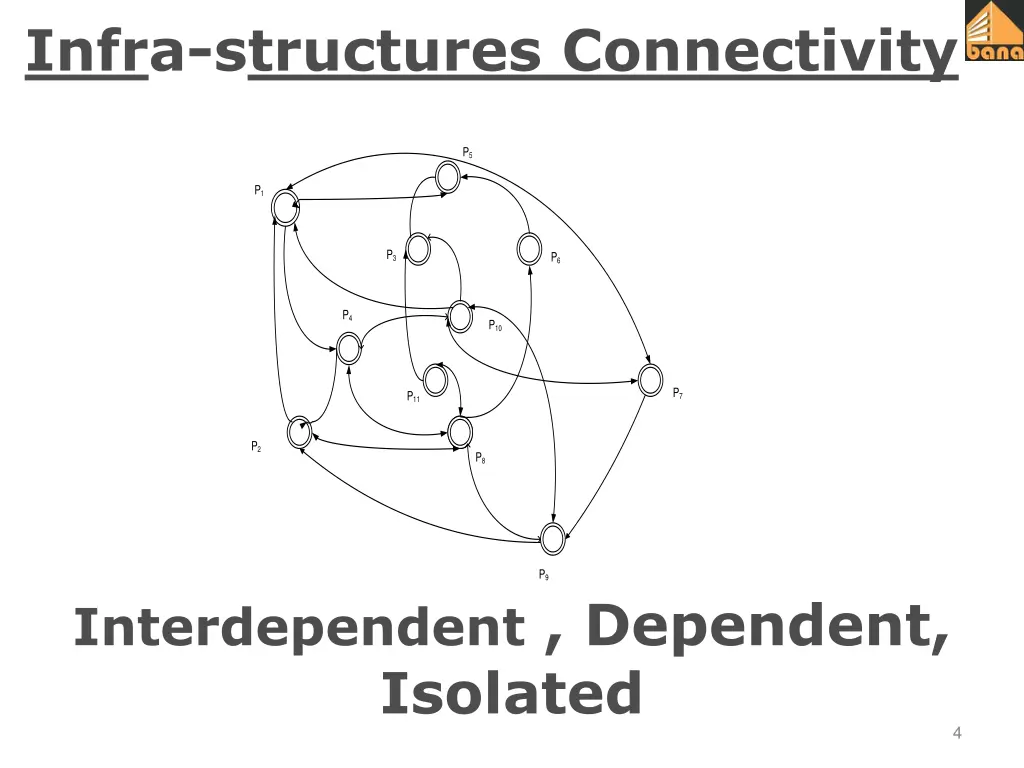
Infra-structures Connectivity P5 P1 P3 P6 P4 P10 P7 P11 P2 P8 P9 Interdependent , Dependent, Isolated 4
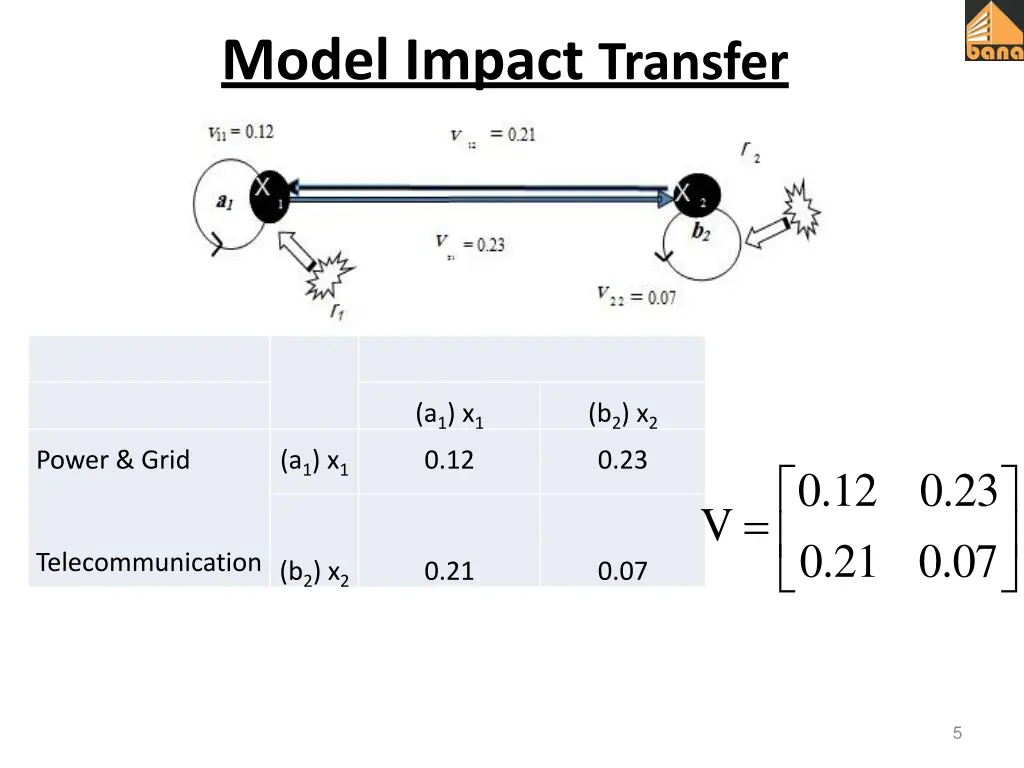
Model Impact Transfer (a1) x1 0.12 (b2) x2 0.23 Power & Grid (a1) x1 0.12 0.23 0.21 0.07 = V Telecommunication (b2) x2 0.21 0.07 5
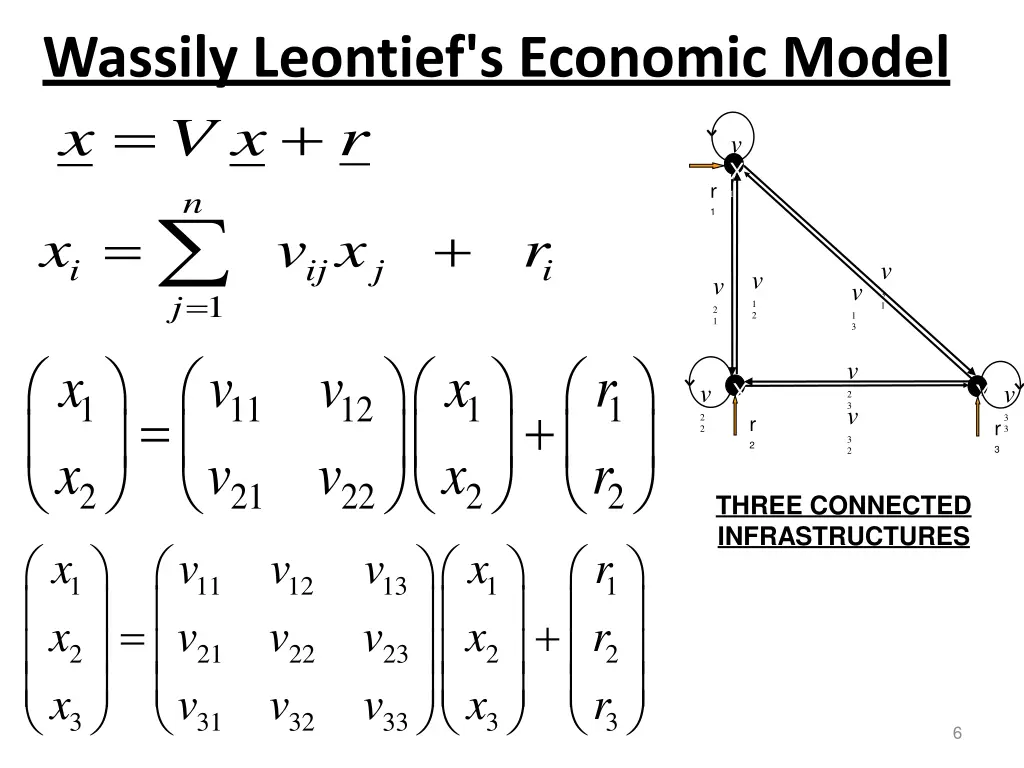
Wassily Leontief's Economic Model = + x V x r v 1 1 X 1 r 1 n j = + x v x r i ij j i v 3 1 v 1 2 v 2 1 v 1 3 = 1 v v v + + x x v v v v x x r r v 2 3 v 3 2 X 2 v 2 2 v 3 3 X 3 1 11 12 1 1 = r 2 r 3 2 21 22 2 2 THREE CONNECTED INFRASTRUCTURES x x x v v v v v v x x x r r r 1 11 12 13 1 1 = 2 21 22 23 2 2 3 31 32 33 3 3 6
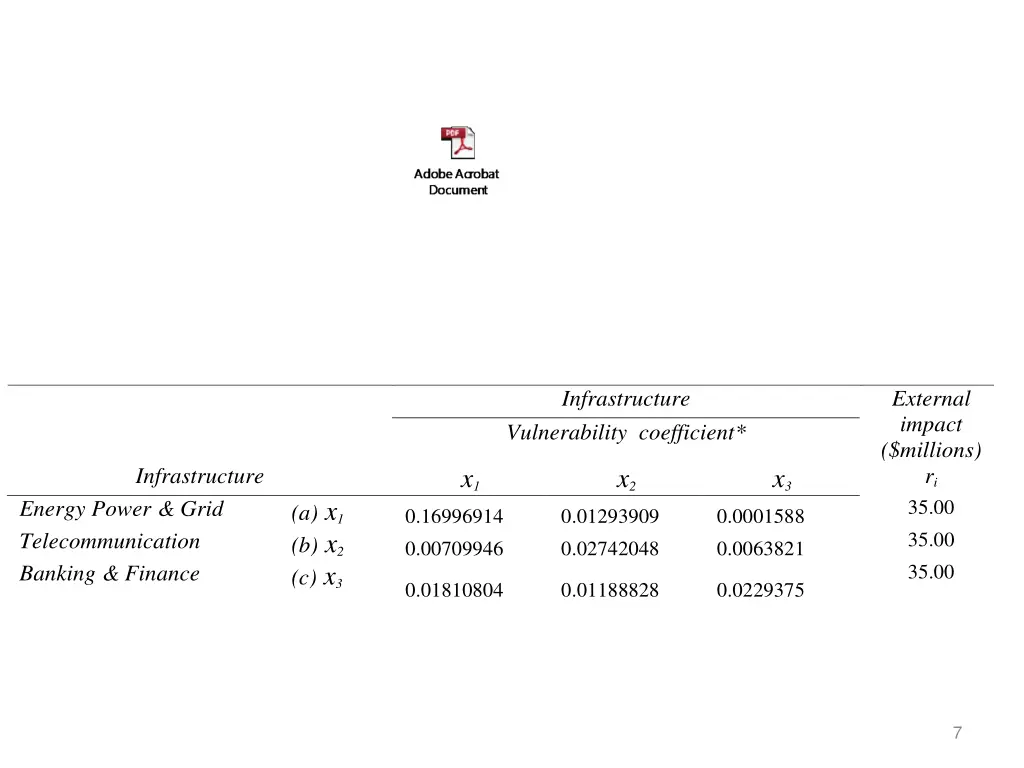
Table 2 Matrix representation of vulnerability coefficients Infrastructure Vulnerability coefficient* External impact ($millions) ri 35.00 35.00 35.00 Infrastructure x1 x2 x3 (a) x1 (b) x2 (c) x3 Energy Power & Grid Telecommunication Banking & Finance 0.16996914 0.00709946 0.01293909 0.02742048 0.0001588 0.0063821 0.01810804 0.01188828 0.0229375 *Extract data from input by industry and final use category; 109 industries ($million) 2004-5. Australia. 7
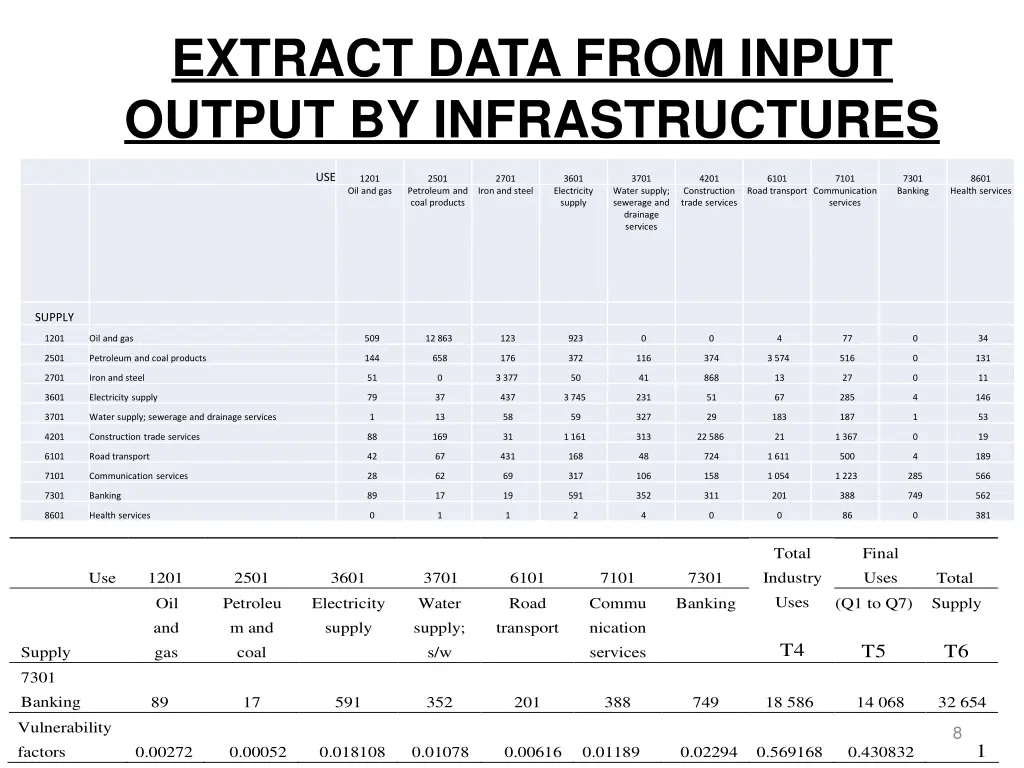
EXTRACT DATA FROM INPUT OUTPUT BY INFRASTRUCTURES USE 1201 2501 2701 3601 Electricity supply 3701 4201 6101 7101 7301 Banking 8601 Oil and gas Petroleum and coal products Iron and steel Water supply; sewerage and drainage services Construction trade services Road transport Communication Health services services SUPPLY 1201 Oil and gas 509 12 863 123 923 0 0 4 77 0 34 2501 Petroleum and coal products 144 658 176 372 116 374 3 574 516 0 131 2701 Iron and steel 51 0 3 377 50 41 868 13 27 0 11 3601 Electricity supply 79 37 437 3 745 231 51 67 285 4 146 3701 Water supply; sewerage and drainage services 1 13 58 59 327 29 183 187 1 53 4201 Construction trade services 88 169 31 1 161 313 22 586 21 1 367 0 19 6101 Road transport 42 67 431 168 48 724 1 611 500 4 189 7101 Communication services 28 62 69 317 106 158 1 054 1 223 285 566 7301 Banking 89 17 19 591 352 311 201 388 749 562 8601 Health services 0 1 1 2 4 0 0 86 0 381 Total Industry Uses T4 Final Uses Use 1201 Oil and gas 2501 Petroleu m and coal 3601 Electricity supply 3701 Water supply; s/w 6101 Road transport 7101 Commu nication services 7301 Banking Total Supply T6 (Q1 to Q7) T5 Supply 7301 Banking 89 17 591 352 201 388 749 18 586 14 068 32 654 Vulnerability factors 8 1 0.00272 0.00052 0.018108 0.01078 0.00616 0.01189 0.02294 0.569168 0.430832
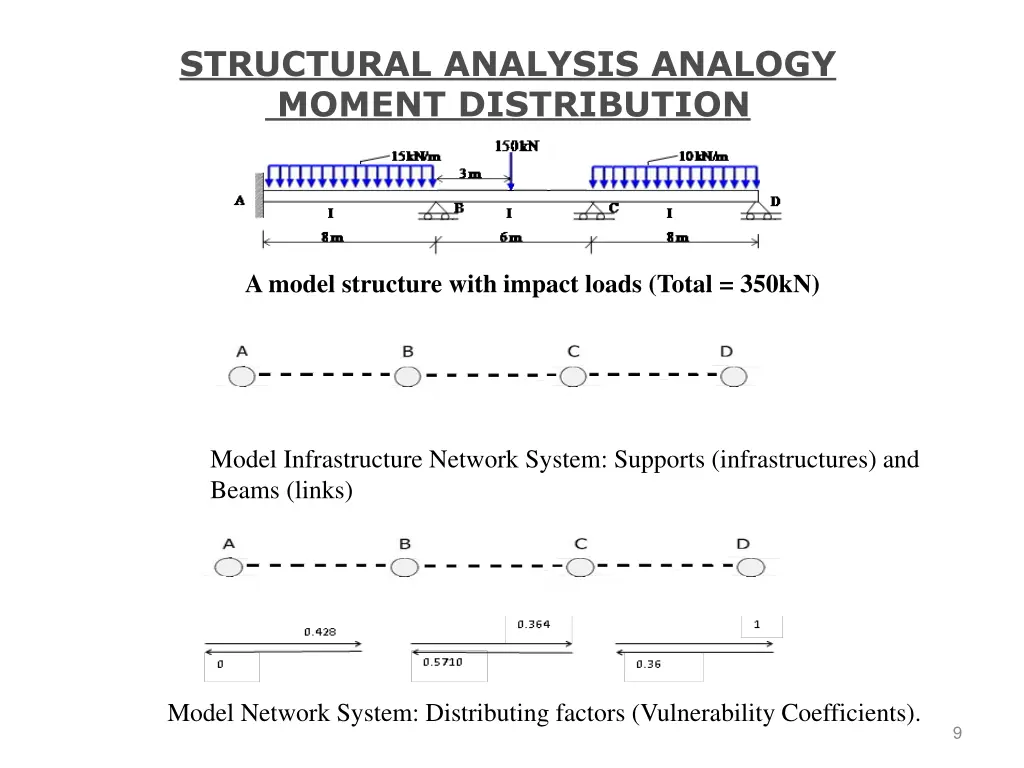
STRUCTURAL ANALYSIS ANALOGY MOMENT DISTRIBUTION A model structure with impact loads (Total = 350kN) Model Infrastructure Network System: Supports (infrastructures) and Beams (links) Model Network System: Distributing factors (Vulnerability Coefficients). 9
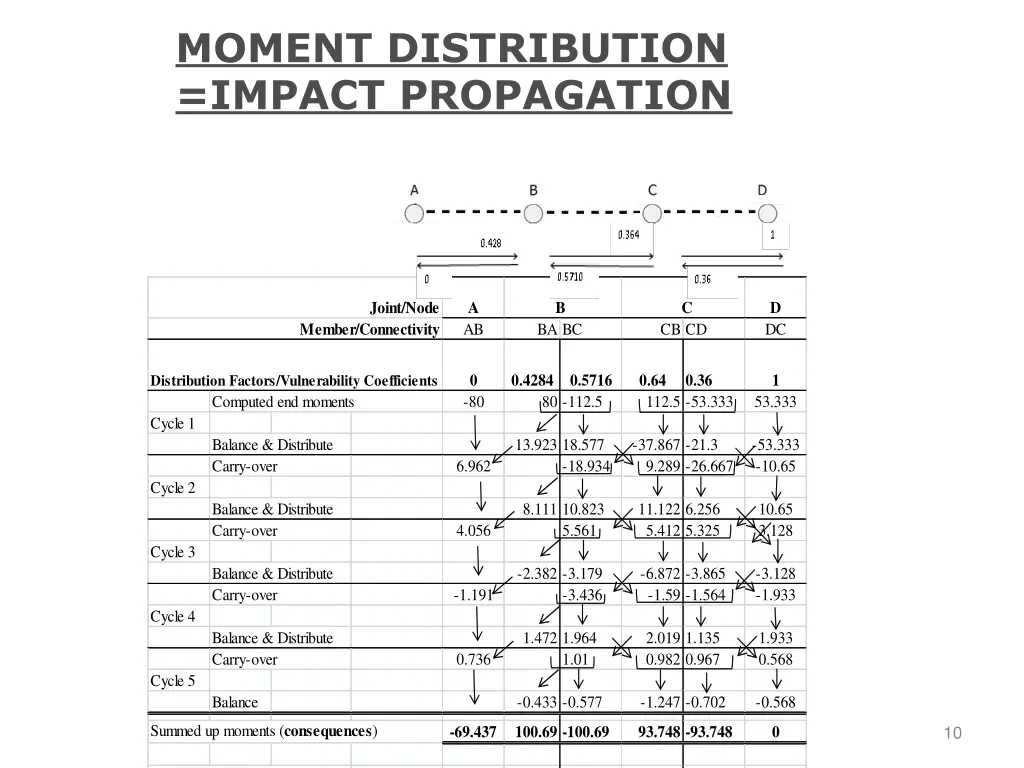
MOMENT DISTRIBUTION =IMPACT PROPAGATION Joint/Node A AB B C D DC Member/Connectivity BA BC CB CD 0 0.4284 0.5716 0.64 112.5 -53.333 0.36 1 Distribution Factors/Vulnerability Coefficients Computed end moments -80 80 -112.5 53.333 Cycle 1 Balance & Distribute Carry-over 13.923 18.577 -37.867 -21.3 9.289 -26.667 -53.333 -10.65 6.962 -18.934 Cycle 2 Balance & Distribute Carry-over 8.111 10.823 5.561 11.122 6.256 5.412 5.325 10.65 3.128 4.056 Cycle 3 Balance & Distribute Carry-over -2.382 -3.179 -6.872 -3.865 -1.59 -1.564 -3.128 -1.933 -1.191 -3.436 Cycle 4 Balance & Distribute Carry-over 1.472 1.964 2.019 1.135 0.982 0.967 1.933 0.568 0.736 1.01 Cycle 5 Balance -0.433 -0.577 -1.247 -0.702 -0.568 Summed up moments (consequences) -69.437 100.69 -100.69 93.748 -93.748 0 10 A 60 B C D 40 At Equilibrium: Simply-supported reactions End reaction due to left hand FEM 60 75 75 40 8.726 -8.726 16.665 -16.665 12.079 -12.077 End reaction due to right hand FEM -12.498 12.498 -16.102 16.102 0 0 Summed-up/Rippled Impacts/Reactions 56.228 63.772 75.563 74.437 52.079 27.923
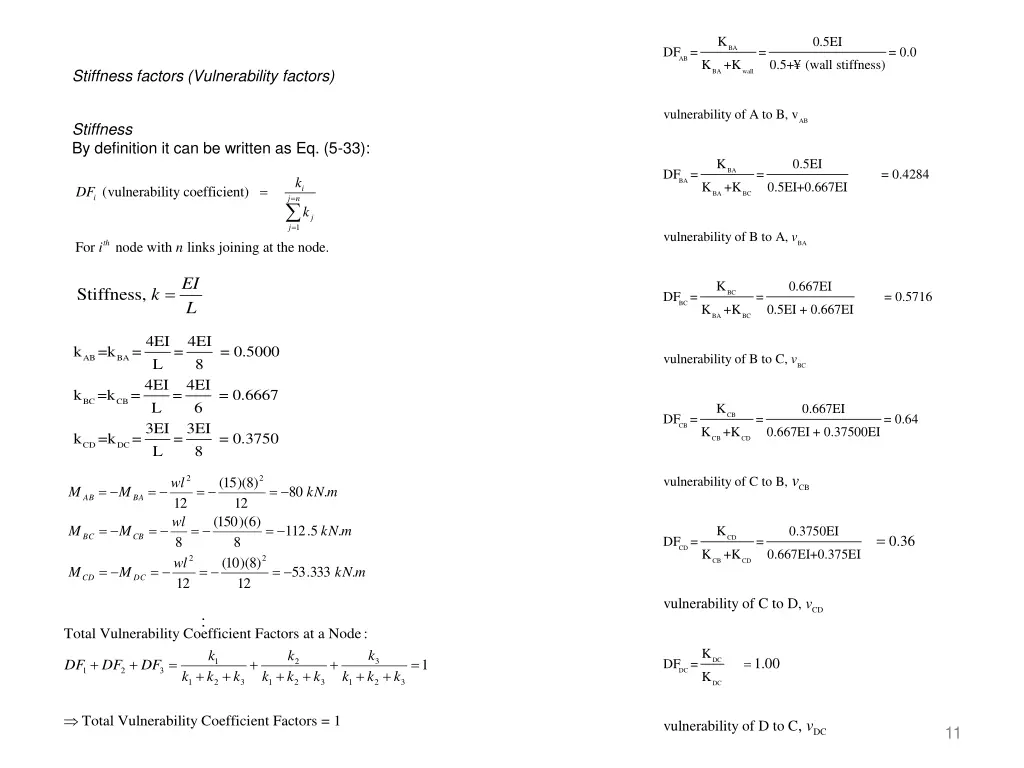
K 0.5EI DF = = = 0.0 BA +K AB K 0.5+ (wall stiffness) Stiffness factors (Vulnerability factors) BA wall vulnerability of A to B, v AB Stiffness By definition it can be written as Eq. (5-33): K 0.5EI DF = = = 0.4284 BA +K k BA K 0.5EI+0.667EI = (vulnerability coefficient) DF i BA BC = i j n j k j = 1 vulnerability of B to A, v th For node with links joining at the node. n i BA EI L K 0.667EI = Stiffness, k DF = = = 0.5716 BC +K BC K 0.5EI + 0.667EI BA BC 4EI L 4EI L 3EI L 4EI 8 4EI 6 3EI 8 k =k = = = 0.5000 vulnerability of B to C, v AB BA BC k =k = = = 0.6667 BC CB K 0.667EI DF = CB +K = = 0.64 CB K 0.667EI + 0.37500EI k =k = = = 0.3750 CB CD CD DC v 2 2 vulnerability of C to B, 15 ( ) 8 )( wl 12 = = = = CB 80 m . M M kN AB BA 12 150 ( ) 6 )( wl 8 = = = = 112 5 . m . M M kN K 0.3750EI = BC CB 0.36 DF = = CD +K 8 CD K 0.667EI+0.375EI 2 2 10 ( ) 8 )( wl 12 CB CD = = = = 53 . 333 m . M M kN CD DC 12 vulnerability of C to D, v CD : Total Vulnerability Coefficient Factors at a Node: k DF DF DF k k K k k k k 1.00 = + + = + + = DF = DC 1 3 1 2 1 2 3 + + + + + + DC k k k k k K 1 2 3 1 2 3 1 2 3 DC Total Vulnerability Coefficient Factors = 1 , v vulnerability of D to C 11 DC
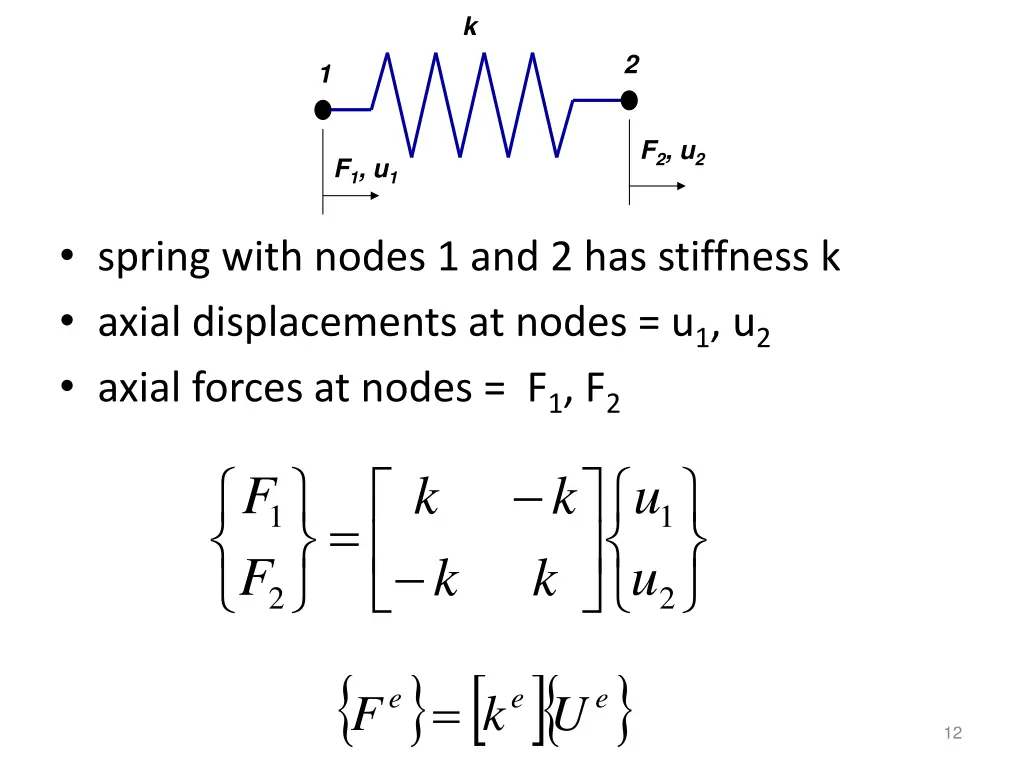
k 2 1 F2, u2 F1, u1 spring with nodes 1 and 2 has stiffness k axial displacements at nodes = u1, u2 axial forces at nodes = F1, F2 F u k k 1 1 = F u k k 2 2 k F = e e e U 12