Structured Analysis and Data Flow Diagrams
Learn about problem analysis approaches, Data Flow Diagrams (DFDs), and Leveled DFD Sets in structured analysis. Discover how DFDs help in system understanding and hierarchical organization for analyzing complex systems effectively.

Download Presentation

Please find below an Image/Link to download the presentation.
The content on the website is provided AS IS for your information and personal use only. It may not be sold, licensed, or shared on other websites without obtaining consent from the author. If you encounter any issues during the download, it is possible that the publisher has removed the file from their server.
You are allowed to download the files provided on this website for personal or commercial use, subject to the condition that they are used lawfully. All files are the property of their respective owners.
The content on the website is provided AS IS for your information and personal use only. It may not be sold, licensed, or shared on other websites without obtaining consent from the author.
E N D
Presentation Transcript
Software Requirements Analysis and Specification Structured Analysis -DFD Prototyping Characteristics of SRS Ms. Vinitha S Ganiga Assistant Professor Department of Computer Science
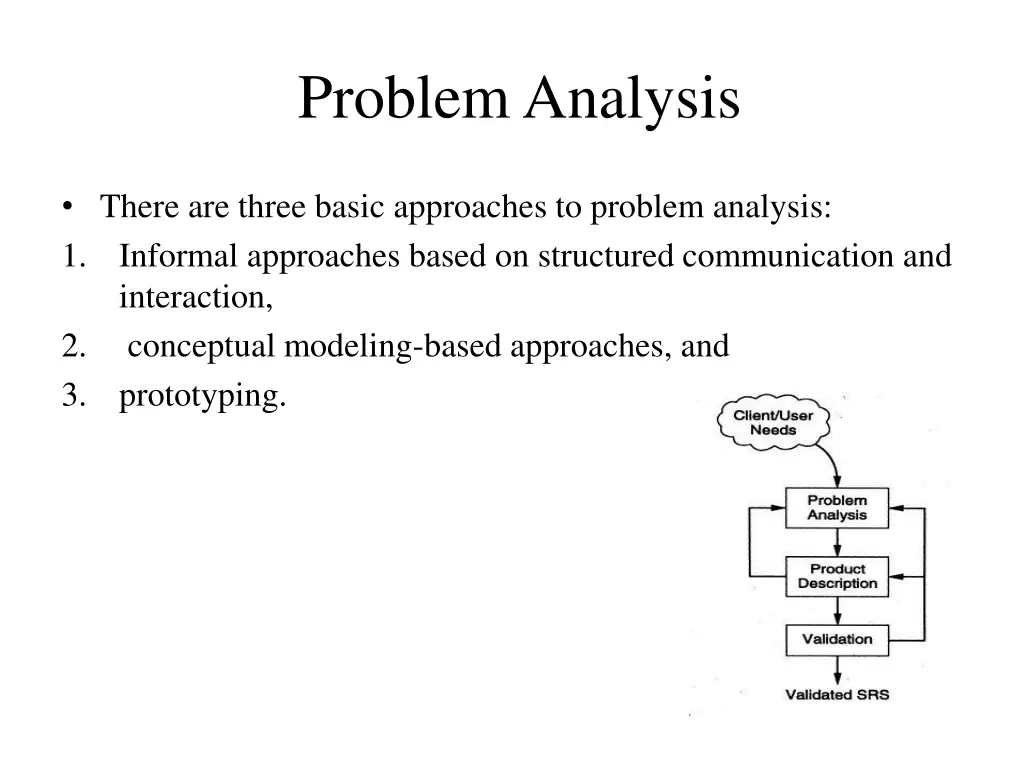
Problem Analysis There are three basic approaches to problem analysis: 1. Informal approaches based on structured communication and interaction, 2. conceptual modeling-based approaches, and 3. prototyping.
DFD Data flow diagrams (also called data flow graphs) are commonly used during problem analysis. DFDs are very useful in understanding a system and can be effectively used during analysis. A DFD shows the flow of data through a system.
Leveled DFD set Many systems are too large for a single DFD to describe the data processing clearly. It is necessary that some decomposition and abstraction mechanism be used for such systems. DFDs can be hierarchically organized, which helps in progressively partitioning and analyzing large systems. Such DFDs together are called a leveled DFD set.
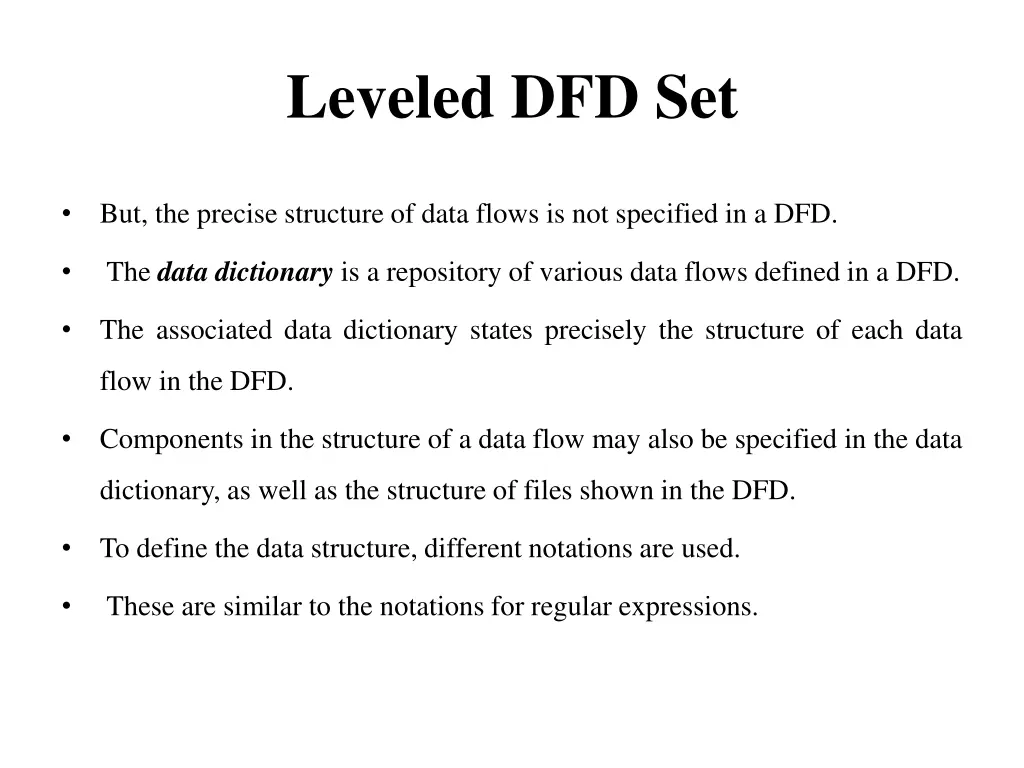
Leveled DFD Set A leveled DFD set has a starting DFD, which is a very abstract representation of the system, identifying the major inputs and outputs and the major processes in the system. Then each process is refined and a DFD is drawn for the process. In other words, a bubble in a DFD is expanded into a DFD during refinement. This refinement stops if each bubble is considered to be "atomic," in that each bubble can be easily specified or understood. In a DFD, data flows are identified by unique names. These names are chosen so that they convey some meaning about what the data is.
Leveled DFD Set But, the precise structure of data flows is not specified in a DFD. The data dictionary is a repository of various data flows defined in a DFD. The associated data dictionary states precisely the structure of each data flow in the DFD. Components in the structure of a data flow may also be specified in the data dictionary, as well as the structure of files shown in the DFD. To define the data structure, different notations are used. These are similar to the notations for regular expressions.
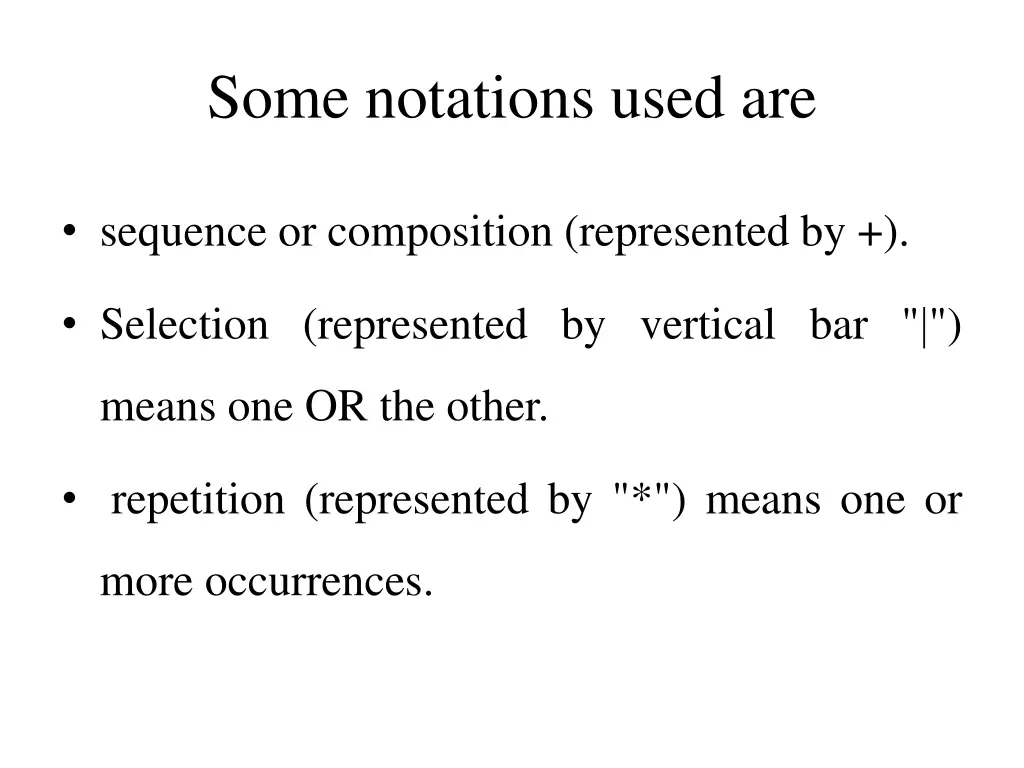
Some notations used are sequence or composition (represented by +). Selection (represented by vertical bar " ") means one OR the other. repetition (represented by "*") means one or more occurrences.
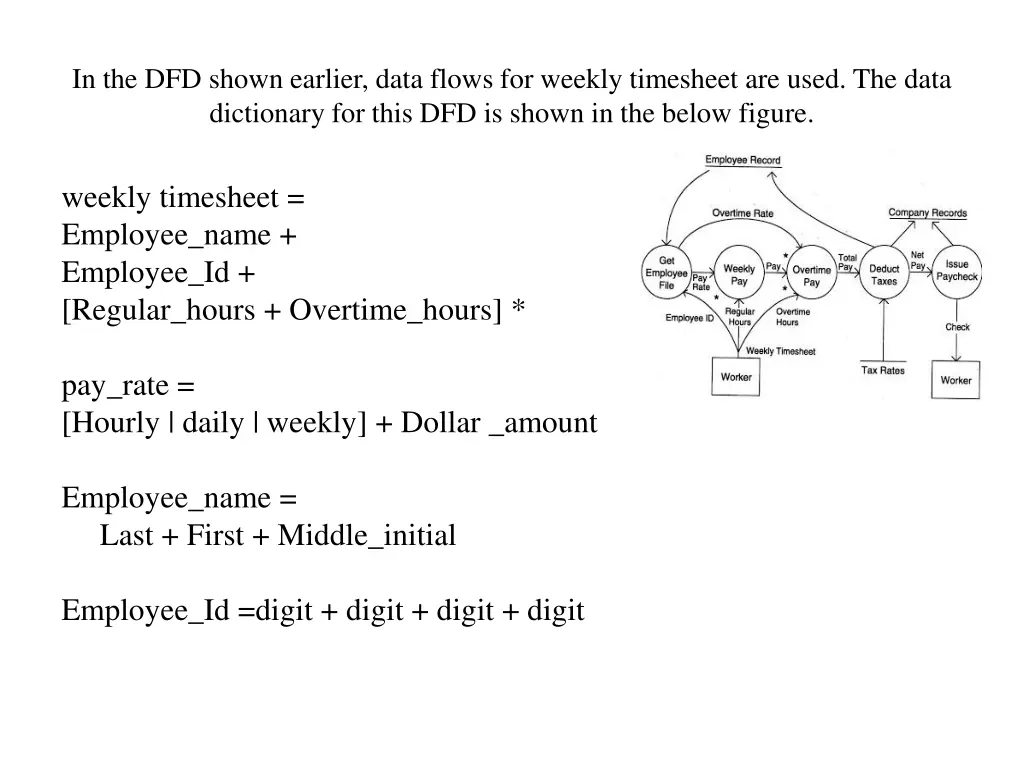
In the DFD shown earlier, data flows for weekly timesheet are used. The data dictionary for this DFD is shown in the below figure. weekly timesheet = Employee_name + Employee_Id + [Regular_hours + Overtime_hours] * pay_rate = [Hourly | daily | weekly] + Dollar _amount Employee_name = Last + First + Middle_initial Employee_Id =digit + digit + digit + digit
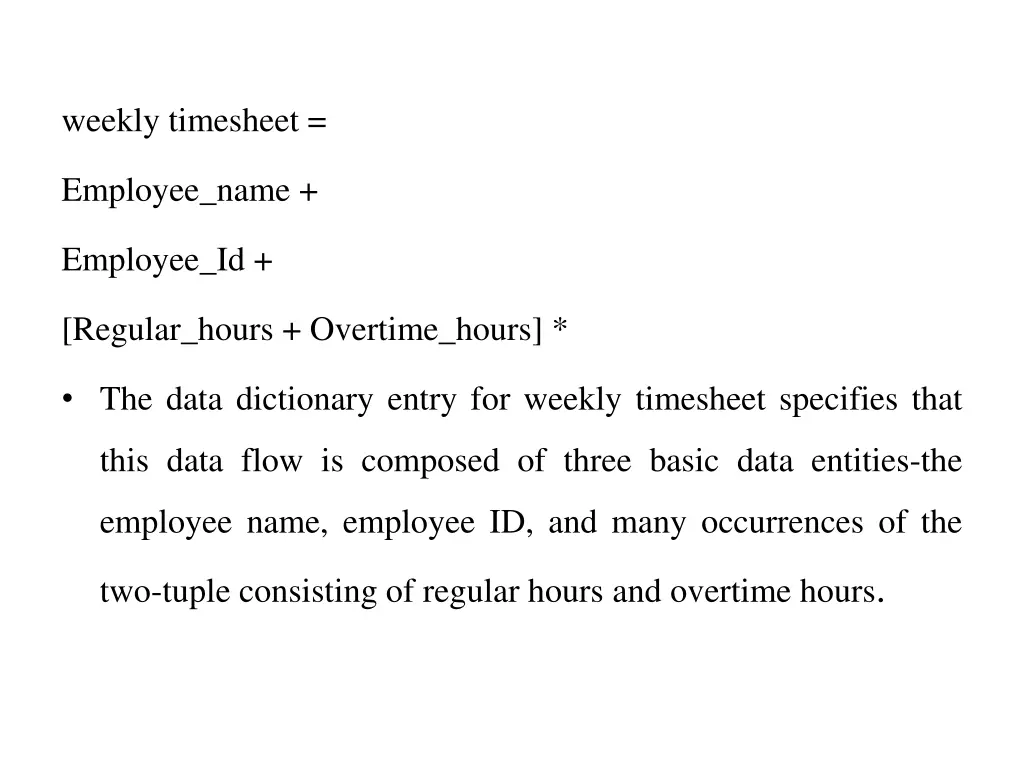
weekly timesheet = Employee_name + Employee_Id + [Regular_hours + Overtime_hours] * The data dictionary entry for weekly timesheet specifies that this data flow is composed of three basic data entities-the employee name, employee ID, and many occurrences of the two-tuple consisting of regular hours and overtime hours.
The analyst should look for common errors Some common errors are: 1. Unlabeled data flows 2. Missing data flows 3. Extraneous data flows 4. Consistency not maintained during refinement. 5. Missing processes 6. Contains some control information
Prototyping In Prototyping, a partial system is constructed, which is then used by the client, users, and developers to gain a better understanding of the problem and the needs. Hence, actual experience with a prototype that implements part of the eventual software system are used to analyze the problem and understand the requirements for the eventual software system.
Prototyping A software prototype can be defined as a partial implementation of a system whose purpose is to learn something about the problem being solved or the solution approach. The rationale behind using prototyping for problem understanding and analysis is that the client and the users often find it difficult to visualize how the eventual software system will work in their environment just by reading a specification document.
Prototyping Visualizing the operation of the software that is yet to be built and whether it will satisfy the ultimate objectives, merely by reading and discussing the paper requirements, is indeed difficult. This is particularly true if the system is a totally new system and many users and clients do not have a good idea of their needs. The idea behind prototyping is that clients and the users can assess their needs much better if they can see the working of a system, even if the system is only a partial system. Prototyping emphasizes that actual practical experience is the best aid for understanding needs.
There are two approaches to prototyping: 1. Throwaway prototyping 2. Evolutionary prototyping. In the throwawayapproach the prototype is constructed with the idea that it will be discarded after the analysis is complete, and the final system will be built from scratch. In the evolutionaryapproach, the prototype is built with the idea that it will eventually be converted into the final system.
Throwaway Prototyping In throwaway prototyping, as the prototype is to be discarded, there is no point in implementing those parts of the requirements that are already well understood. Hence, the focus of the development is to include those features that are not properly understood. And the development approach is "quick and dirty . Experience with this prototype is used to determine if the understanding of requirements when building the prototype is correct.
Evolutionary Prototyping In contrast, in the evolutionary prototype approach, because the prototype is to be retained, those parts of the system that are well understood are implemented. The development approach is more formal, as the prototype needs to be of the quality standards expected of the final system. The basic focus in this prototype is to elicit missing requirements. By working with a stable system having features that are definitely needed, the client and users can determine which other services and features are needed.
Problem Analysis Informal approach Structured Analysis DFD Prototyping Throwaway prototyping Evolutionary prototyping
Software Requirements Specification The final output of the requirement process is the software requirements specification document (SRS). For smaller problems or problems that can easily be comprehended, the specification activity might come after the entire analysis is complete. However, it is more likely that problem analysis and specification are done concurrently. An analyst typically will analyze some parts of the problem and then write the requirements for that part.
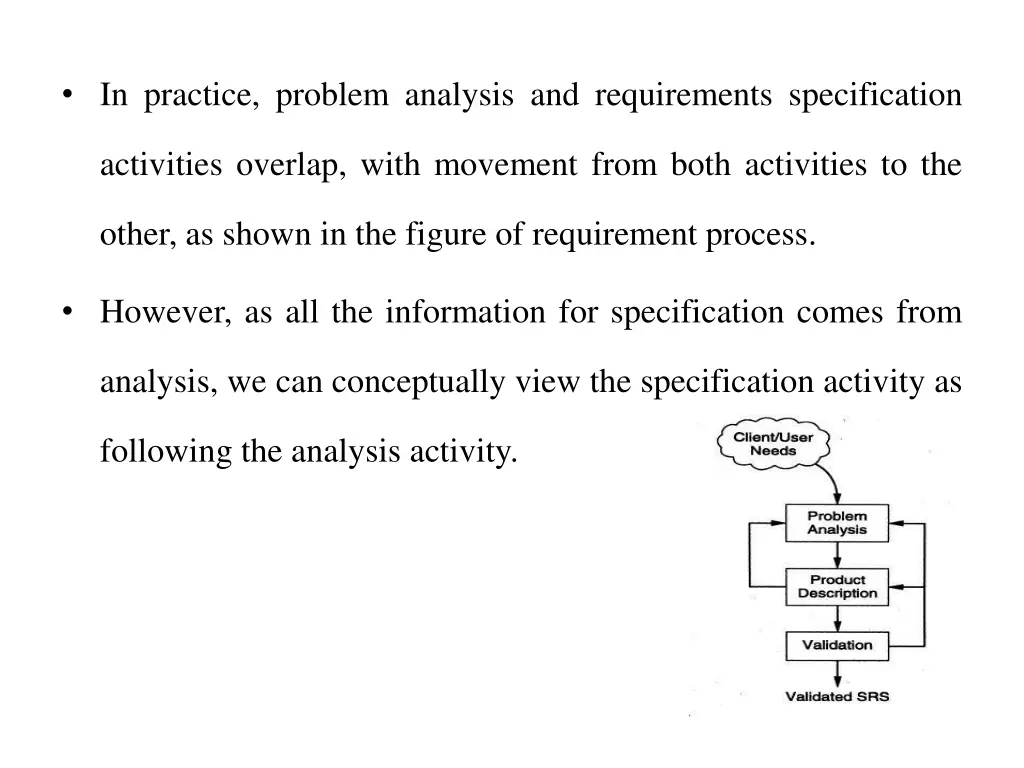
In practice, problem analysis and requirements specification activities overlap, with movement from both activities to the other, as shown in the figure of requirement process. However, as all the information for specification comes from analysis, we can conceptually view the specification activity as following the analysis activity.
Software Requirements Specification What passes from requirements analysis activity to the specification activity ? Is the knowledge acquired about the system. The SRS is written based on the knowledge acquired during analysis. Converting knowledge into a structured document is not straightforward, specification itself is a major task, which is relatively independent.
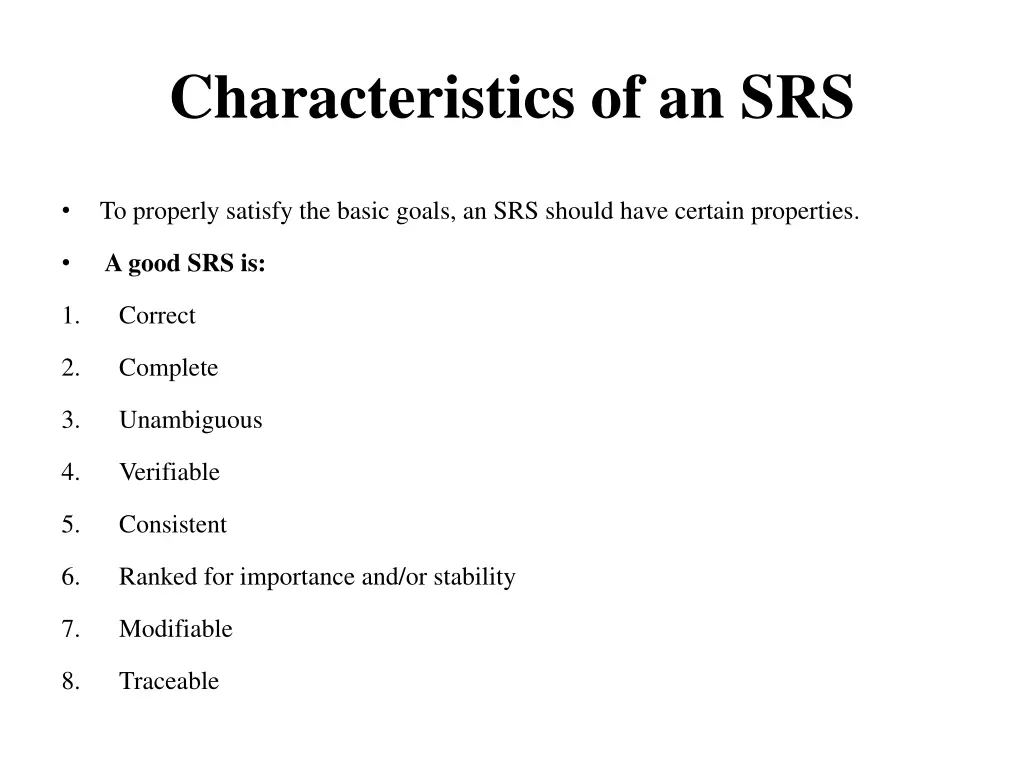
Characteristics of an SRS To properly satisfy the basic goals, an SRS should have certain properties. A good SRS is: 1. Correct 2. Complete 3. Unambiguous 4. Verifiable 5. Consistent 6. Ranked for importance and/or stability 7. Modifiable 8. Traceable
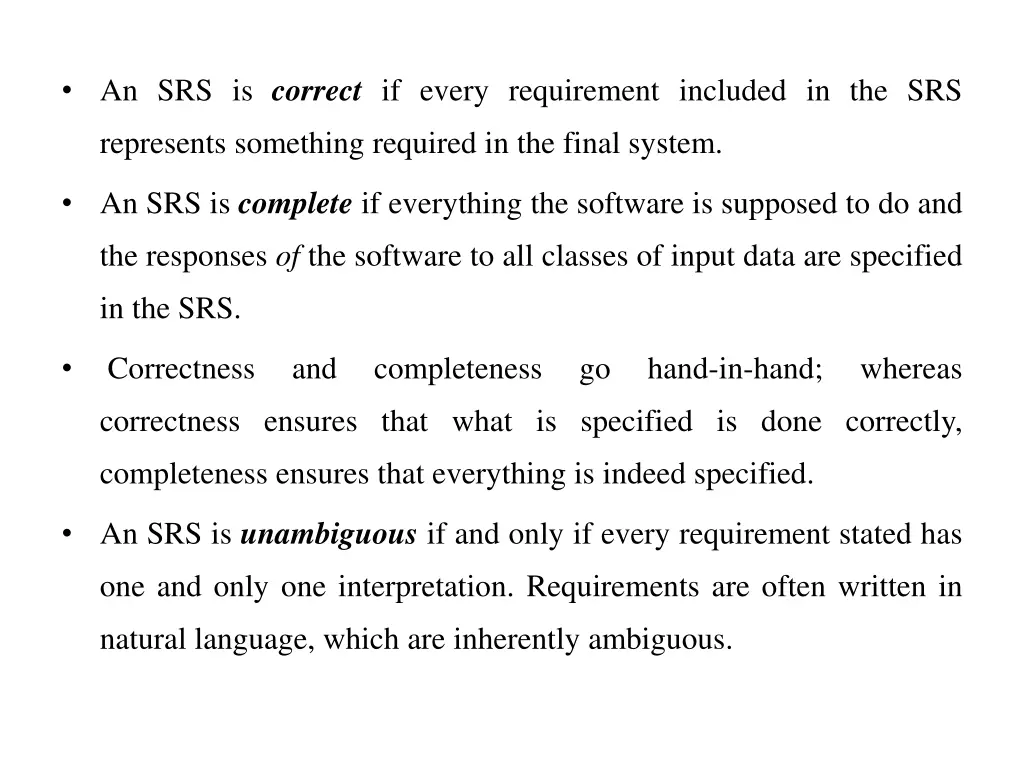
An SRS is correctif every requirement included in the SRS represents something required in the final system. An SRS is completeif everything the software is supposed to do and the responses of the software to all classes of input data are specified in the SRS. Correctness and completeness go hand-in-hand; whereas correctness ensures that what is specified is done correctly, completeness ensures that everything is indeed specified. An SRS is unambiguousif and only if every requirement stated has one and only one interpretation. Requirements are often written in natural language, which are inherently ambiguous.
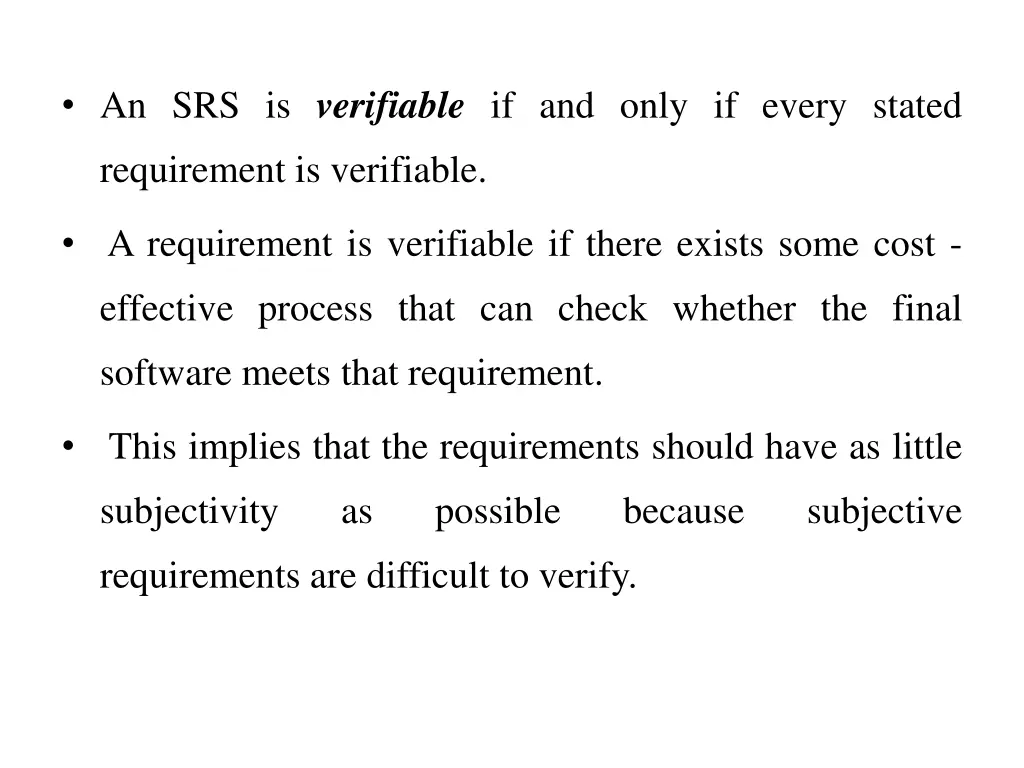
An SRS is verifiableif and only if every stated requirement is verifiable. A requirement is verifiable if there exists some cost - effective process that can check whether the final software meets that requirement. This implies that the requirements should have as little subjectivity as possible because subjective requirements are difficult to verify.
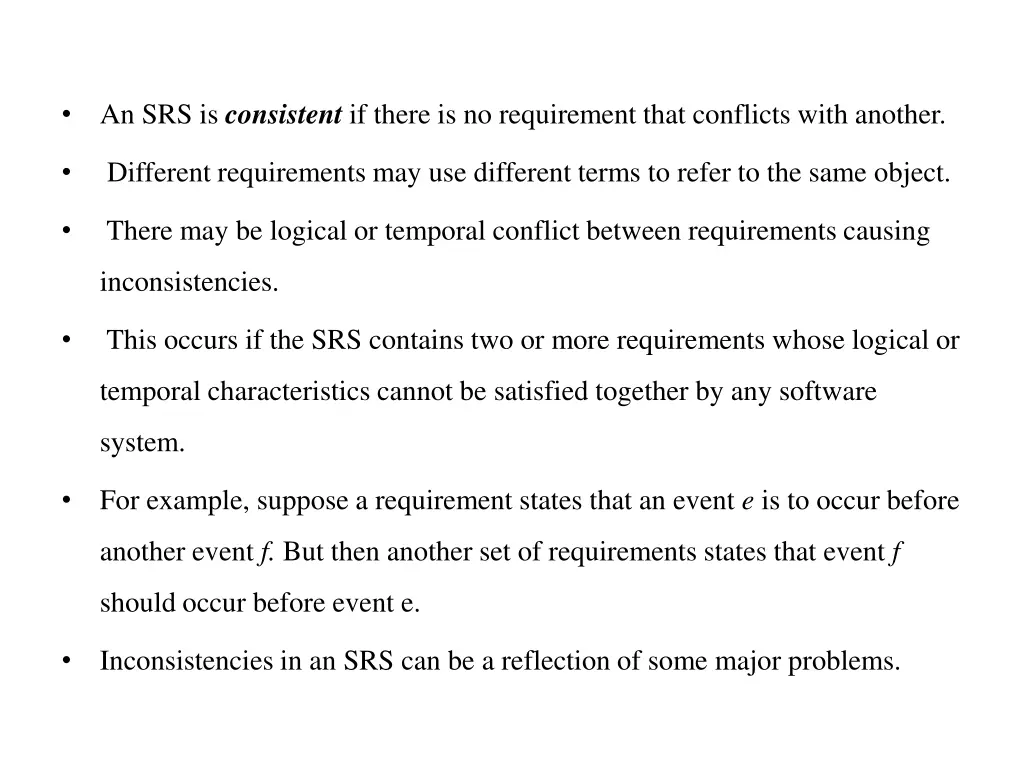
An SRS is consistentif there is no requirement that conflicts with another. Different requirements may use different terms to refer to the same object. There may be logical or temporal conflict between requirements causing inconsistencies. This occurs if the SRS contains two or more requirements whose logical or temporal characteristics cannot be satisfied together by any software system. For example, suppose a requirement states that an event e is to occur before another event f. But then another set of requirements states that event f should occur before event e. Inconsistencies in an SRS can be a reflection of some major problems.
Generally, all the requirements for software are not of equal importance. Some are critical, others are important but not critical, and there are some, which are desirable, but not very important. Similarly, some requirements are "core" requirements, which are not likely to change as time passes, while others are more dependent on time. An SRS is ranked for importance and/or stability if for each requirement the importance and the stability of the requirement are indicated. Stability of a requirement reflects the chances of it changing in future. It can be reflected in terms of the expected change volume.
Writing an SRS is an iterative process. Even when the requirements of a system are specified, they are later modified as the needs of the client change. Hence an SRS should be easy to modify. An SRS is modifiableif its structure and style are such that any necessary change can be made easily while preserving completeness and consistency. Presence of redundancy is a major hindrance to modifiability, as it can easily lead to errors.
An SRS is traceable if the origin of each of its requirements is clear and if it facilitates the referencing of each requirement in future development Forward traceability means that each requirement should be traceable to some design and code elements. Backward traceability requires that it be possible to trace design and code elements to the requirements they support. Traceability aids verification and validation.
Characteristics of an SRS Of all these characteristics, completeness is perhaps the most important (and hardest to ensure). One of the most common problem in requirements specification is when some of the requirements of the client are not specified. This necessitates additions and modifications to the requirements later in the development cycle, which are often expensive to incorporate. Incompleteness is also a major source of disagreement between the client and the supplier.