Structures and Procedures for Implementation of Codes of Conduct in National Parliaments
Learn about the structures and procedures governing deontology in the Belgian House of Representatives, including incompatibilities, financial ceilings, statements of offices held, declarations of assets, and the Code of Deontology of the House. Explore the regulations set to ensure transparency, equality, and ethical conduct among parliamentary members.

Uploaded on | 2 Views
Download Presentation

Please find below an Image/Link to download the presentation.
The content on the website is provided AS IS for your information and personal use only. It may not be sold, licensed, or shared on other websites without obtaining consent from the author. If you encounter any issues during the download, it is possible that the publisher has removed the file from their server.
You are allowed to download the files provided on this website for personal or commercial use, subject to the condition that they are used lawfully. All files are the property of their respective owners.
The content on the website is provided AS IS for your information and personal use only. It may not be sold, licensed, or shared on other websites without obtaining consent from the author.
E N D
Presentation Transcript
DEONTOLOGY IN THE BELGIAN HOUSE OF REPRESENTATIVES ECPRD Seminar Skopje May 8, 2014 Session 2 Structures and Procedures for Implementation of the Codes of Conduct in the National Parliaments
OVERVIEW 1. Incompatibilities Financial ceiling (1999) 2. Statements of offices held (2005) Declarations of assets (2005) 3. Code of Deontology of the House (2013)
1. INCOMPATIBILITIES AND FINANCIAL CEILING Act of 1931 modified by an Act of 1999 1.1 Absolute incompatibilities 1.2 Relative incompatibilities 1.3 Financial ceiling
1.1 Absolute incompatibilities - Limited enumeration in the Act of 1931: public offices (elected or not); judicial functions; private sector employment (attorney for the state). - Constitution: Minister, MP in other Parliament. - Acts regulating public institutions: railway, post, ...
1.2 Relative incompatibilities (1999) MP + one paid executive mandate : - Mayor, alderman, President social council; - Representative of a public authority in a private or public institution with more competences than an ordinary Board or General Council member [especially (V)P]; - More than 672,39 EUR/month.
1.3 Financial ceiling In case of plurality of public offices : max. 1,5x parliamentary alllowance.
2. Statements of offices held Declarations of assets Objective Transparency and equal treatment. Information to the public. Statements of offices conflicts of interests. Declaration of assets illegal enrichment.
2. Statements of offices held Declarations of assets Procedure MPs amongst other political representatives. Statement of offices : public and private functions, indicating remunerated or not no amounts. Declaration of assets : assets and liabilities, in a sealed envelope. To submit yearly to the Court of Audit.
2. Statements of offices held Declarations of assets Publicity Statements of offices published in Official Gazette. Rectifications possible (by subjects and third persons), contradictory procedure. Declarations of assets : only judicial authorities can consult in case of a criminal procedure for an offence in the performance of parliamentary duties.
2. Statements of offices held Declarations of assets Sanctions List of defaulting (MPs) in Official Gazette. Failure to submit = criminal offence : fine of 600 till 6000 EUR.
3. Code of Deontology 3.1 Federal Commission on Deontology 3.2 Code of Deontology of the House
3.1 Commission on Deontology Independent body. Advisory body (no punishing authority): - confidential individual opinions; - general opinions and recommendations. Will draft a Code for public officers, except for MPs.
3.2 Code of Deontology of the House Result of the 6th State Reform (2011). November 2013. New article in the Rules of Procedure that refers to the Code as annex of those Rules. 20 articles, 6 pages.
3.2 Code of Deontology of the House Triple objective: - improve relations MPs-citizens; - framing/ contextualising work of MPs; - reinforce role of Parliament. Orientated towards political services. Citizens can deduce also guidelines for their behaviour. MPs can be punished in next elections.
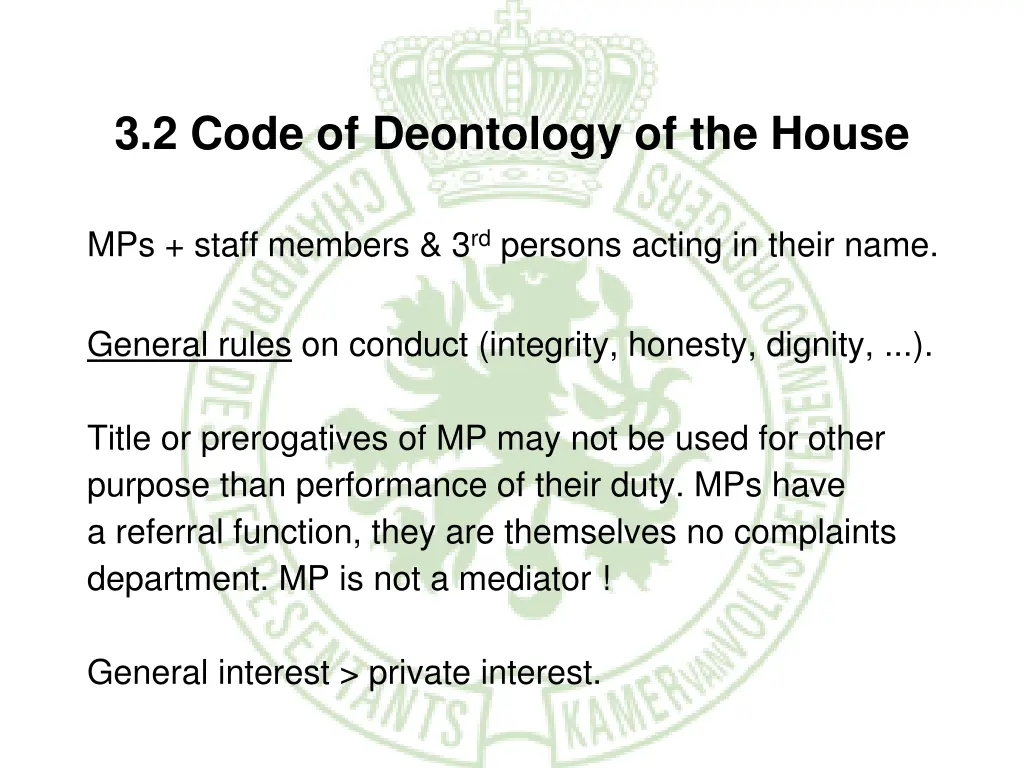
3.2 Code of Deontology of the House MPs + staff members & 3rd persons acting in their name. General rules on conduct (integrity, honesty, dignity, ...). Title or prerogatives of MP may not be used for other purpose than performance of their duty. MPs have a referral function, they are themselves no complaints department. MP is not a mediator ! General interest > private interest.
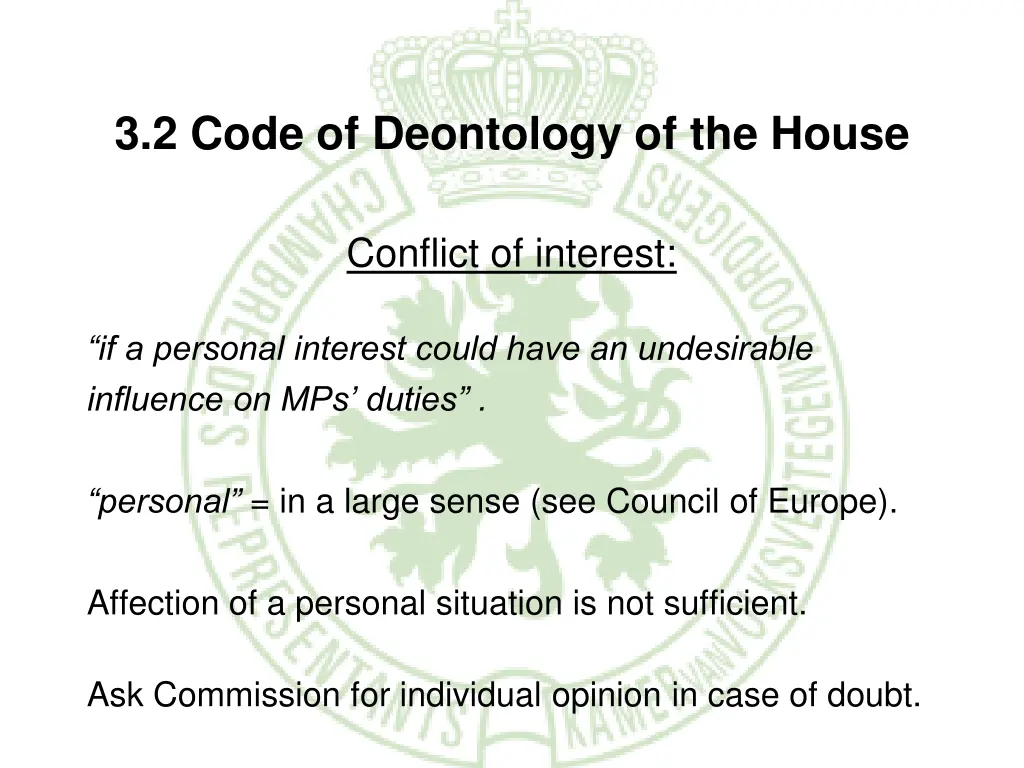
3.2 Code of Deontology of the House Conflict of interest: if a personal interest could have an undesirable influence on MPs duties . personal = in a large sense (see Council of Europe). Affection of a personal situation is not sufficient. Ask Commission for individual opinion in case of doubt.
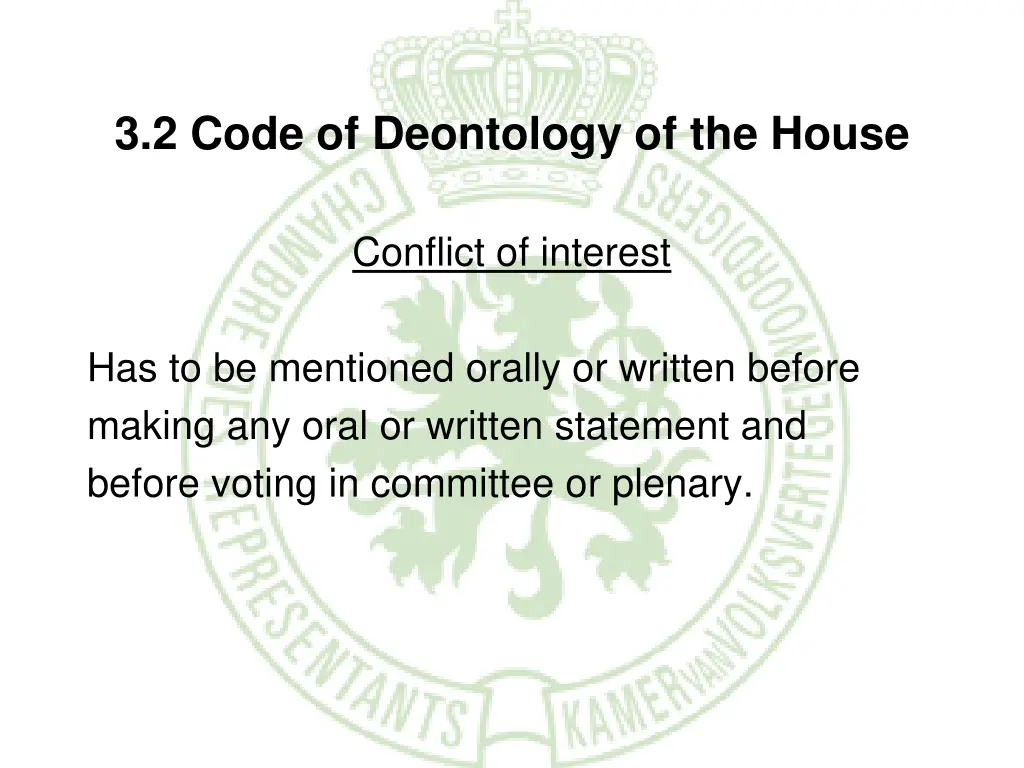
3.2 Code of Deontology of the House Conflict of interest Has to be mentioned orally or written before making any oral or written statement and before voting in committee or plenary.
3.2 Code of Deontology of the House No financial or material advantages in exchange for acts accomplished in the performance of MPs duties (except for symbolic gifts / reimbursment of costs). No discrimination between citizens (see Constitution). Informational and referral function (but no information to which citizens have no access).
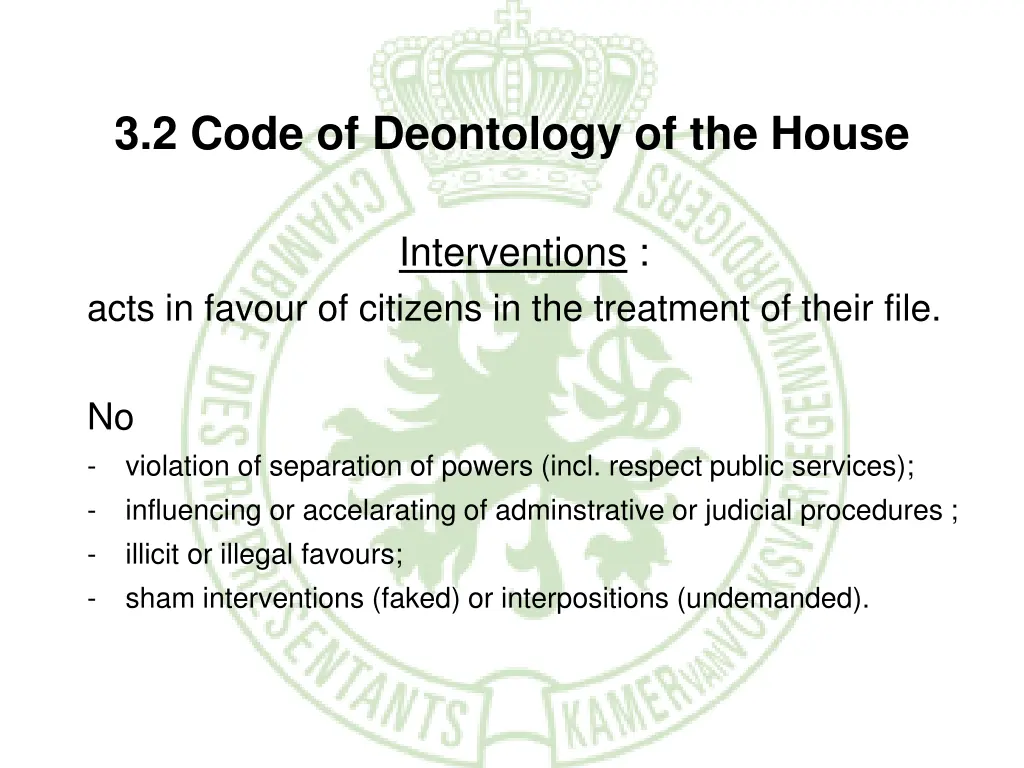
3.2 Code of Deontology of the House Interventions : acts in favour of citizens in the treatment of their file. No - - - - violation of separation of powers (incl. respect public services); influencing or accelarating of adminstrative or judicial procedures ; illicit or illegal favours; sham interventions (faked) or interpositions (undemanded).
3.2 Code of Deontology of the House specific intervention : entrance into office - informational / referral function; - no favouritism if MP in selection committee; - assistance to candidates after selection procedure is possible. Letters of recommendation are authorised.
3.2 Code of Deontology of the House Publicity Limited to minimal necessary contact information, except for political publications .
3.2 Code of Deontology of the House Compliance For the moment no sanctions. But some articles repeat criminal provisions (e.g. corruption). Commission can issue ex officio recommendations. Political groups make summaries of problems to help the Commission for issuiing its opinions.
DEONTOLOGY IN THE BELGIAN HOUSE OF REPRESENTATIVES