Student Learning and Growth Goals: Requirements, Components, and Recommendations
Explore the essential components of Student Learning and Growth (SLG) goals, understand scoring requirements, and discover the role of SLG goals in the evaluation cycle. Learn the distinctions between Achievement Goals and SLG Goals, required components of SLG Goals, and recommendations for setting Tiered Targets to cater to diverse student needs effectively.

Download Presentation

Please find below an Image/Link to download the presentation.
The content on the website is provided AS IS for your information and personal use only. It may not be sold, licensed, or shared on other websites without obtaining consent from the author. If you encounter any issues during the download, it is possible that the publisher has removed the file from their server.
You are allowed to download the files provided on this website for personal or commercial use, subject to the condition that they are used lawfully. All files are the property of their respective owners.
The content on the website is provided AS IS for your information and personal use only. It may not be sold, licensed, or shared on other websites without obtaining consent from the author.
E N D
Presentation Transcript
Student Learning and Growth Goals 101: Requirements and Recommendations
Outcomes Review 8 components of Student Learning and Growth (SLG) goals Understand requirements for scoring SLG goals Recognize the role of SLG goals in the evaluation cycle
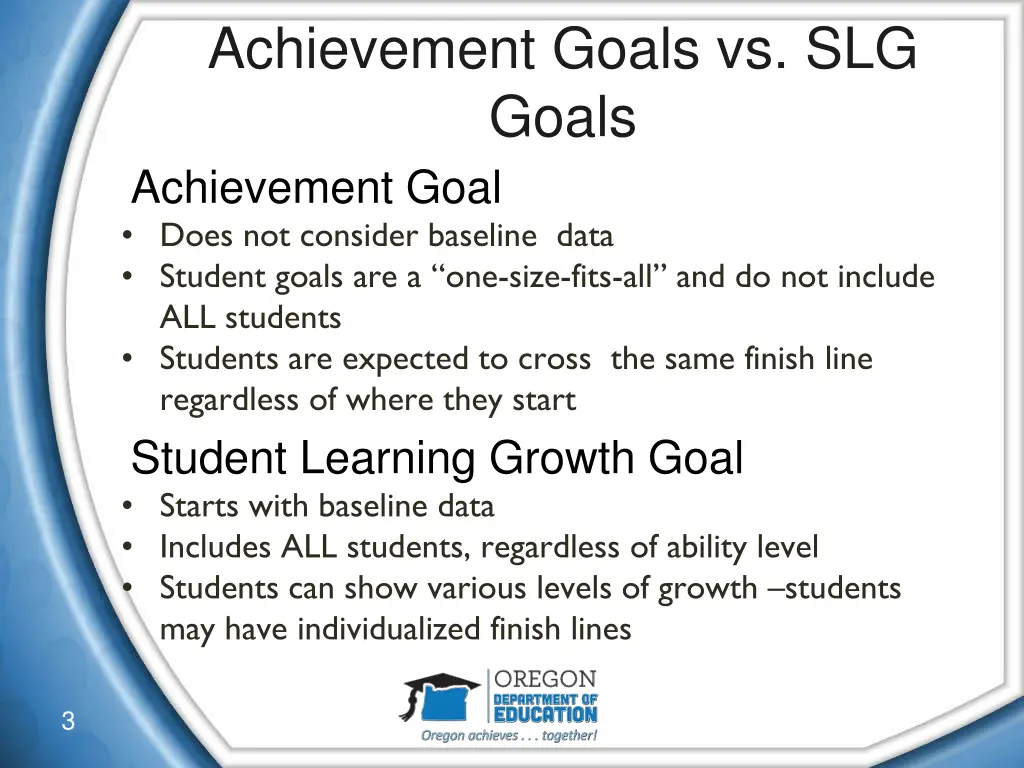
Achievement Goals vs. SLG Goals Achievement Goal Does not consider baseline data Student goals are a one-size-fits-all and do not include ALL students Students are expected to cross the same finish line regardless of where they start Student Learning Growth Goal Starts with baseline data Includes ALL students, regardless of ability level Students can show various levels of growth students may have individualized finish lines 3
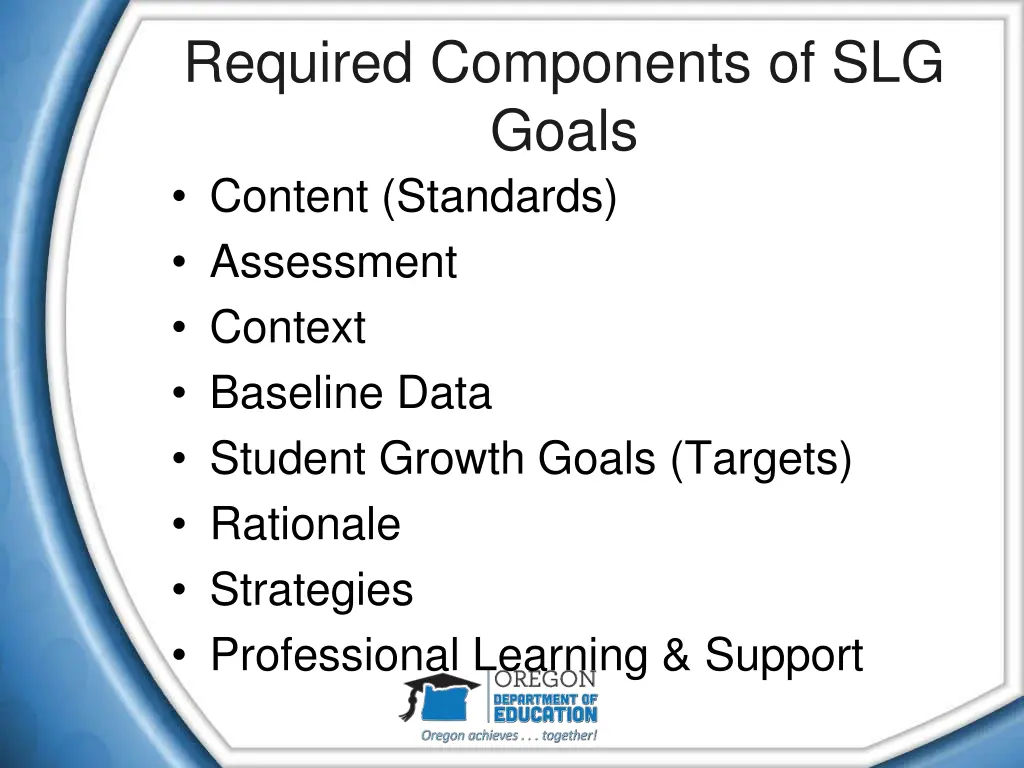
Required Components of SLG Goals Content (Standards) Assessment Context Baseline Data Student Growth Goals (Targets) Rationale Strategies Professional Learning & Support
Requirements for SLG Goals Minimum of 2 SLG goals each year Quality Review Checklist used for goal setting District-wide, school-wide or nationally recognized measures Use of statewide assessments optional
Quality Review Checklist Takes place during the goal setting phase of the professional growth cycle for teachers and administrators For an SLG goal to be approved, all criteria must be met Version with guiding questions available in SLG section of toolkit
Recommendations Content is focused, not everything you teach Context can help ascertain instructional needs Tier goals/targets where appropriate Include the support YOU need
Tiered Targets Students enter the classroom with a range of knowledge and skills Tiered targets help ensure that each student is appropriately challenged Tiers typically set for groups of students with similar performance Tiered targets allow for more realistic expectations for goal attainment
Role of SLG Goals in Evaluation Summative evaluations must be based on multiple measures Professional Practice, Professional Responsibility, and Student Learning and Growth Districts determine the degree of impact of each of the three types of measures on the summative evaluation Summative ratings reported to ODE must include PP and PR Inclusion of SLG in calculation is optional
Common Questions Where does goal setting originate? Who has to set SLG goals? Who are SLG goals set for? What kinds of assessments can be used?
Where does goal setting originate? Goal setting begins with the individual educator and is based on data a part of a collaborative process within their school and/or district and with the evaluator
Who has to set SLG goals? As defined by law: Teacher anyone holding TSPC license or registration, employed as an instructor at .5 FTE and at least 135 consecutive days Administrator - any teacher the majority of whose employed time is devoted to service as a supervisor, principal, vice principal or director of a department or the equivalent in a fair dismissal district Exceptions: superintendents, non-TSPC licensed personnel, teachers who do not instruct students directly (e.g., TOSAs, instructional coaches)
Who are SLG goals set for? Teachers Course or class Intact group Administrators Targeted goals rather than school wide All goals must be focused on academic growth
What assessments can be used? Statewide assessments Statewide assessments are no longer required, but can be used as an OPTIONAL measure School-wide or district-wide Purchased or developed Include pre and post measures Aligned to assessment criteria
Resources Toolkit Guidance documents FAQs, SLG Guidance, Assessment Guidance, Who is Evaluated under SB 290 Sample SLG Goals Resources from Districts Visit the Educator Effectiveness Toolkit web page for additional details.
Contacts Brian Putnam brian.putnam@state.or.us Sarah Martin sarah.martin@state.or.us